Weekly industry intelligence · No noiseSubscribe to the Luck My Sales newsletterFree briefing

Independent intelligence on AI in sales

Menu

Operator workflow diary · Social selling

Inside Our Lemlist Outreach Workflow: Why Every Reply Stopped Automation

See a real Lemlist email and LinkedIn workflow with lead tiers, reply stops, SDR dispositions, selective CRM admission and campaign corrections.
Editorial disclosure

AI may assist research organization and drafting. A human editor reviews every published page, checks material claims against the cited sources and owns the final decision. No company paid for placement in this article.

AI use policy

Agent-ready brief

AI takeaways

Keep the key points here, or take a source-aware text brief into Claude, ChatGPT or another AI workspace.
  1. 01Qualification, tiers and channel order must be approved before records enter Lemlist.
  2. 02LinkedIn led for tier one; email led for tiers two and three and could follow tier-one silence after five to eight days.
  3. 03Any reply in either channel stopped every remaining automated touch.
  4. 04An SDR validated replies and only positive or neutral commercial states entered CRM.
  5. 05Read contact-level and message-level metrics separately and correct the rule that caused each qualification miss.
Includes summary, takeaways, sources and a use note.
A useful Lemlist multichannel outreach workflow begins before Lemlist. The team defines the ICP, exclusions, offer, lead tiers, approved evidence, message thesis, sender health, channel order, and reply owner. Lemlist then executes the approved state machine.
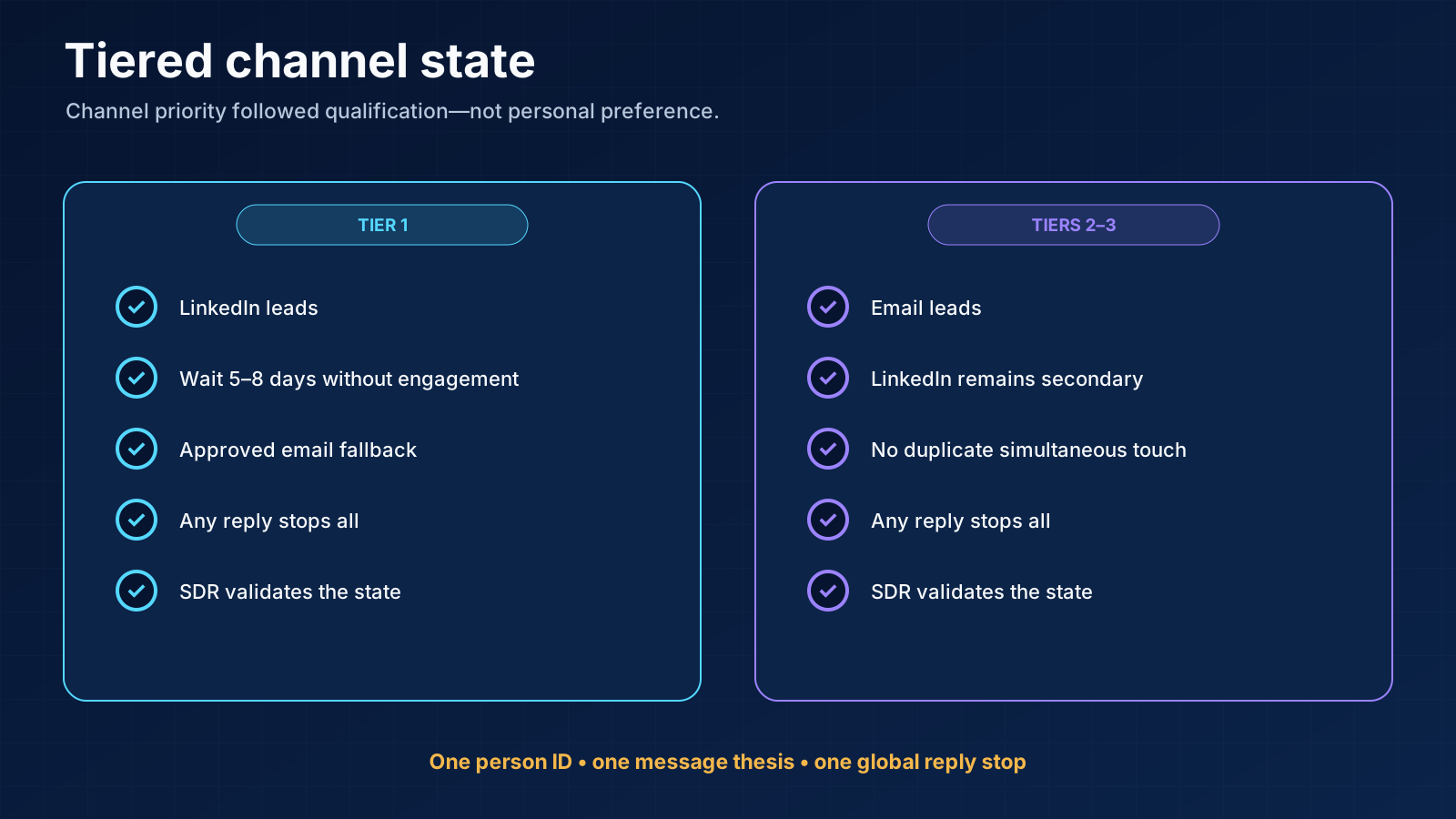
In our campaign, LinkedIn led for tier-one prospects. Email led for tiers two and three. A tier-one prospect could receive an email after five to eight days without LinkedIn engagement. Any reply in either channel stopped every remaining automated touch. An SDR read the reply and decided the next state. Only a validated positive or neutral record entered CRM.
That last rule is the most important. Cold records are not pipeline because they exist in a list. They become commercially meaningful after the person responds and a human validates the context.
This guide reconstructs the workflow from an anonymized campaign run from the beginning of summer 2026 through the evidence-review date. The offer was NextLevel AI reseller/partner products for marketing agencies. I built, launched, and monitored the workflow. Names, companies, sender identities, and raw screenshots are excluded.
Commercial and evidence disclosure: NextLevel AI is the first-party campaign owner and promoted product. This is an operator diary, not an independent NextLevel AI or Lemlist review. Luck My Sales received no affiliate payment, sponsorship, free access, consulting benefit, partnership benefit, or other consideration from Lemlist or the adjacent tools. Product behavior was checked against current Lemlist documentation on 18 August 2026.

Lemlist executes the state machine; the team still owns qualification, proof, stop rules, replies and CRM truth.

01 / workflow in one

The workflow in one line

source universe → AI-assisted qualification → human-approved tier → email/LinkedIn path → any reply stops all → SDR disposition → selective CRM admission
Lemlist owned execution state. It did not own market strategy.
LayerOwnerWhat had to be true before automation
ICP and offerHead/teamSegment, buyer, problem and partner offer were explicit
Source universeOpsCompany and person records had an origin and duplicate key
QualificationClaude Code plus human reviewCompany, customer base, current role, current business and competitor state were checked
TieringHuman-approved rulesTier determined channel priority, not personal preference
SequenceTeam/headMessage thesis, variants, timing, proof and stop states were approved
Sender healthOpsMailbox/domain state and cold-send limit were acceptable
ExecutionLemlistOnly approved records entered the active campaign
ReplySDRAny reply stopped automation and received a human disposition
CRMSeller/SDROnly validated positive or neutral records entered
If one of those rows is missing, the campaign is not ready for “AI autonomy.”

02 / Lemlist owns and

What Lemlist owns and what it does not

Lemlist's campaign documentation describes email, LinkedIn, call, delay, condition, and manual-task steps. Its current workflow also supports previews, schedules, and multichannel logic. Those capabilities are useful because one product can show the sequence path.
Lemlist can own:
  • campaign membership;
  • email and LinkedIn step order;
  • waits and conditions;
  • sender assignment;
  • message variants;
  • queued and completed activity;
  • reply inbox and platform classifications;
  • campaign-level reporting;
  • integrations and webhooks.
The sales team still owns:
  • why the segment matters;
  • whether the company and person fit;
  • whether a signal has commercial context;
  • which claims are current and defensible;
  • whether the sender account should be used;
  • which accounts must remain manual;
  • what a reply actually means;
  • whether a record belongs in CRM;
  • when the campaign pauses or dies.
The distinction prevents a common mistake: blaming the sequencer for a campaign that was never commercially coherent, or crediting the sequencer for a result caused by a better list and offer.

03 / start with a

Step 1: start with a qualification contract

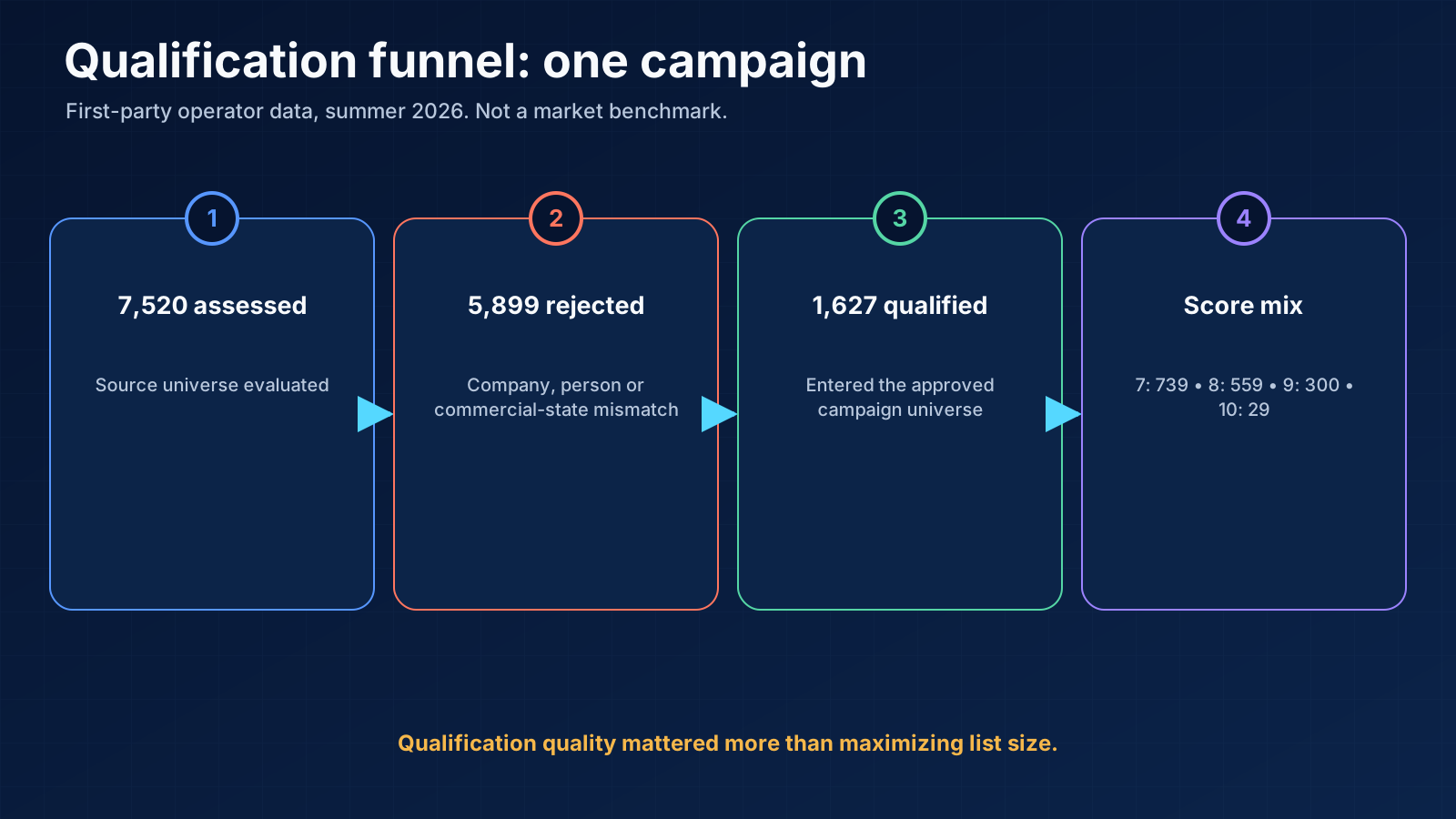
Our source universe was much larger than the final campaign. The recorded aggregate contained 7,520 assessed companies. We rejected 5,899 and qualified 1,627, a 21.6% qualification yield. Among qualified records, the fit scores were:
  • score 7: 739 records;
  • score 8: 559;
  • score 9: 300;
  • score 10: 29.
These are our internal fit states, not universal lead scores. A seven was good enough for a lower-priority path. A nine or ten had stronger evidence for the partner offer. The numbers demonstrate why sending software was only about 20% of our outreach budget model. Contacts/data and research/reasoning consumed the other 80%.
The qualification contract asked for more than industry and job title.

Company checks

  • Is the organization actually a marketing agency or relevant partner type?
  • Which clients or industries does it serve?
  • Is the company in the approved geography and size range?
  • Does the business model support reselling or implementing the offer?
  • Is the company itself a direct competitor or AI automation provider?
  • Is the site current and extractable?

Person checks

  • Does the person currently work at the company?
  • Is the role relevant to partnership, sales, growth, or delivery?
  • Does the person's current headline reveal another primary business?
  • Is the person a multi-founder whose active identity differs from the matched company?
  • Is the person already a customer, partner, opportunity, employee, or competitor?

Evidence checks

  • Which URL supports the company fit?
  • Which source supports the current role?
  • What is observation versus inference?
  • Which fact changes the offer or message?
  • How old is the evidence?
Claude Code acted as the reasoning layer that applied structured rules and researched the web context. A human reviewed early batches and ambiguous cases. The AI did not receive permission to turn an unsupported inference into a message.
Anonymized qualification funnel from 7,520 assessed records to 1,627 campaign records.
Anonymized first-party campaign from summer 2026; descriptive, not a benchmark.

04 / qualification miss that

The qualification miss that changed the rule

One rejected conversation taught us more than a perfect match.
The company was correct. The formal CEO role was correct. The agency served the right kind of clients. The message therefore looked defensible at company level. The person replied that they were not the right contact.
Deeper review showed why. The person was associated with several businesses, and their current primary commercial identity was AI automation. In practical terms, the person was closer to a competitor or peer than a reseller prospect. The data had not misspelled the name or matched the wrong domain. The qualification had checked company fit without adequately checking the person's current business.
We did not rewrite the follow-up to overcome the objection. We changed the qualification rule.
old rule: company fit + formal role
improved rule: company fit + current role + current primary business + competitor state
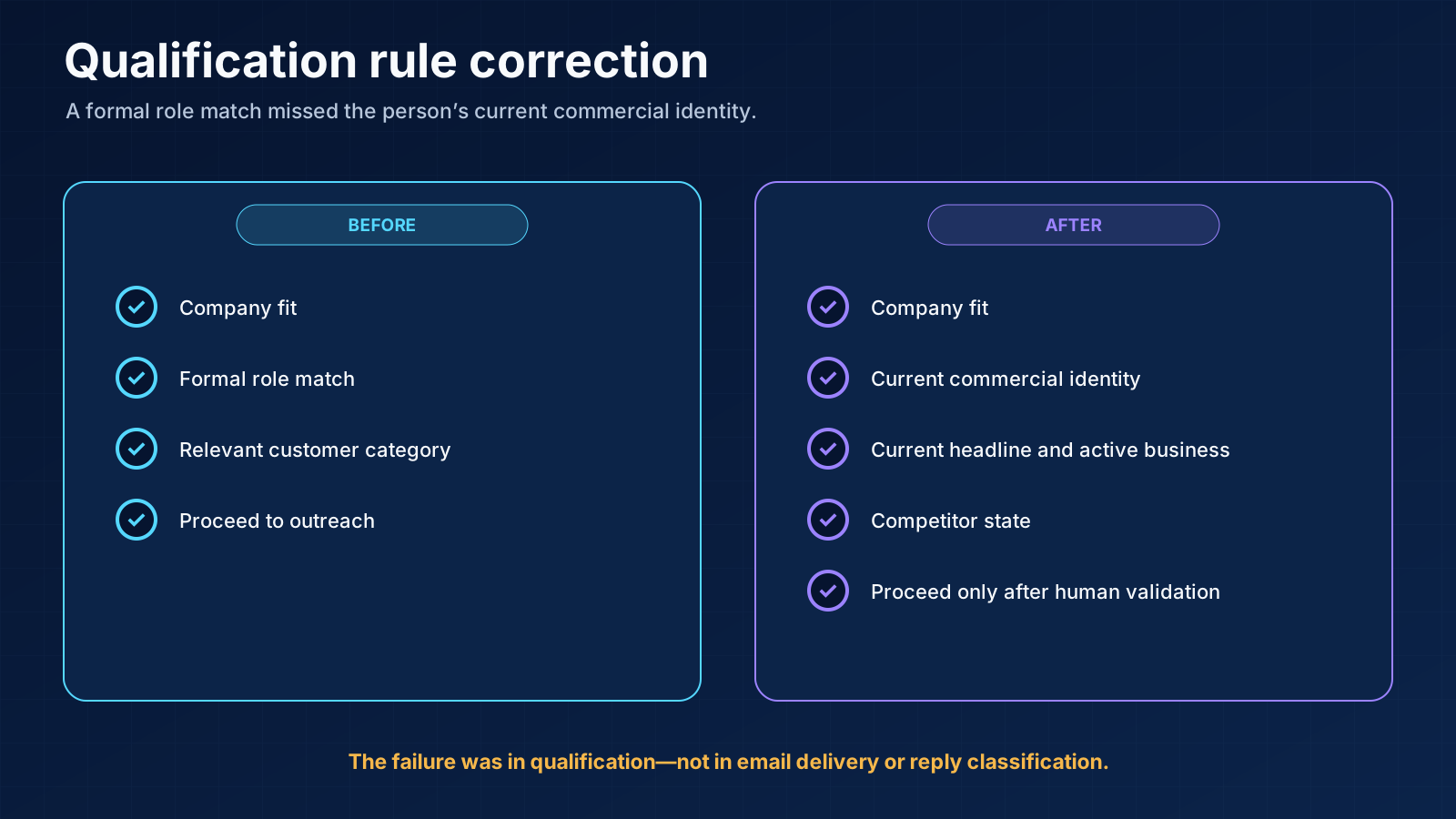
This is the core risk of AI-assisted outreach: the system can scale an early omission. More fluent personalization would have made the wrong outreach look more confident.
Lead qualification rule updated to check current commercial identity and competitor status.
The corrected rule checks current commercial identity, not only formal company fit.

05 / tier the list

Step 2: tier the list before choosing channels

We did not send the same multichannel sequence to every qualified person.

Tier one: strongest partner fit

LinkedIn led. These were the records where professional identity, public context, and potential relationship value justified a more visible approach. Email was prepared as a fallback and could run after five to eight days without LinkedIn engagement.

Tier two: solid fit, less need for social context

Email led. LinkedIn remained a research source or a later manual action. The team did not need to expose a LinkedIn account for every acceptable record.

Tier three: lower-confidence but still approved

Email led in smaller, controlled batches. The purpose was to validate whether the fit rules were too broad. Tier three did not receive more automation to compensate for weaker evidence.
The tier logic made multichannel conditional. It prevented the simplistic pattern of sending an invitation and email at the same moment because the tool could.

06 / write a sequence

Step 3: write a sequence contract before building steps

The sequence contract had seven fields.
  1. Eligibility: which fit score and exclusions allow enrollment.
  2. Channel lead: LinkedIn or email by tier.
  3. Message thesis: the partner problem, offer, and credible reason to contact.
  4. Evidence: current company and person context permitted in copy.
  5. Touch purpose: what new value each step adds.
  6. Stop: any reply, unsubscribe, negative state, sender warning, or discovered false fit.
  7. Owner: the SDR who takes over and the CRM admission rule.
Without this contract, a five-step sequence becomes five versions of “following up.”

07 / build the LinkedIn

Step 4: build the LinkedIn and email branches

The original connection request tested two closely related openings. Both described an AI voice-and-text sales chatbot and offered a tailored demo. Follow-ups then introduced the demo, a pilot, proof, price, a short video, and a close-the-loop message.
That structure was operationally real, but it was not editorially perfect. The early messages were long, feature-heavy, and sometimes repeated the same CTA. One variant used awkward language. The sequence also contained two claims that later failed the freshness check.
The improved sequence keeps the workflow but reduces the copy.

Tier-one LinkedIn path

Connection request: one relevant reason to connect, no feature dump. After acceptance: explain the specific partner opportunity and offer one tailored example. Follow-up 1: add a concrete workflow or client use case. Follow-up 2: offer a short demo or pilot with clear effort. Close: end the loop without guilt or false urgency.

Email-led path

Email 1: current evidence, business problem, partner offer, soft CTA. Email 2: a different use case or implementation detail. Email 3: current proof with a verified source and limitation. Close: confirm that the sequence will stop.
Each step must earn its place. A follow-up that adds no new information is only another interruption.
Tiered multichannel workflow with LinkedIn priority, email fallback and one reply stop.
Channel priority follows qualification, while every reply stops all remaining steps.

08 / A B test

Step 5: A/B test one meaningful variable

The connection request had two variants. That was acceptable as a copy test because the channel position and offer remained close. Yet an A/B label does not guarantee a useful experiment.
Before interpreting a winner, check:
  • comparable tier and fit distribution;
  • similar account age and sender conditions;
  • same geography and time window;
  • one deliberate copy difference;
  • enough eligible records;
  • acceptance and replies separated;
  • no simultaneous offer or channel change.
Our supplied evidence includes campaign rows from different dates and a later aggregate view. It also includes an operator estimate that AI-assisted work became about three times cheaper and twice as fast. The common denominator and unchanged variables were not complete enough to claim a causal copy winner. We therefore use the data as workflow evidence, not as “our AI version doubled replies.”
The correct use of A/B testing is diagnostic. If acceptance improves but meaningful replies do not, the connection request may be less specific. If replies improve but meetings do not, the offer or qualification may still be weak.

09 / preview every branch

Step 6: preview every branch and claim

Lemlist documents campaign preview. Use it as a production gate, not a final glance.
Preview:
  • missing first name, company, or custom demo field;
  • singular/plural and grammar variants;
  • every A/B version;
  • every branch condition;
  • existing connections and missing email addresses;
  • suppressed and duplicate contacts;
  • link destination and current offer;
  • sender identity and signature;
  • strategic or named accounts;
  • claims, prices, dates, and customer proof.
The claim audit caught an important problem. The original sequence said “+70% more qualified leads” and offered pricing from $89 per month. On 18 August 2026, the current official NextLevel AI case page described 100%+ more captured leads, not the same qualified-lead claim. The public site listed AI agent pricing from $500 per month, not $89.
We did not replace the old number with the new one automatically. “Captured leads” and “qualified leads” are different metrics. The safe correction was to remove the stale sequence copy and link only to current approved proof when relevant.
This is why campaign copy needs version dates and claim owners. A sequence can remain technically active after the commercial truth has changed.

10 / launch small and

Step 7: launch small and watch the right states

Our infrastructure did not start at maximum volume. Cold sends began around five per mailbox per day, moved toward 15 after roughly three weeks, and could approach 30 only while the mailbox remained healthy. Warm-up traffic was separate. Those were operating limits, not deliverability guarantees.
The first production batches received heavier review. After the workflow became stable, the team could sample more and review less. Automation did not begin with trust. It earned narrower supervision by producing consistent evidence.
The launch dashboard should separate:
  • approved contacts;
  • messages sent;
  • messages delivered;
  • LinkedIn requests sent;
  • connections accepted;
  • replies by channel;
  • positive, neutral, negative, wrong-person, OOO, and unsubscribe states;
  • booked and held calls;
  • accepted opportunities;
  • sender warnings and review time.
Do not use open tracking as the primary decision. Google says it cannot verify third-party open rates, and privacy features can distort them. Opens can be directional context, not proof that the message or offer worked.

11 / the campaign data

What the campaign data showed

The anonymized contact-level funnel reported:
EventCountPlatform-reported context
Companies assessed7,520Qualification universe
Rejected5,899Failed fit or evidence rules
Qualified/reached1,627Approved campaign contacts
Opened60537.2% in this contact-level view
Interaction28417.5% in this view
Replied583.6% of reached contacts in this view
Interested140.9% of reached contacts in this view
A separate message-level Lemlist view reported:
EventCountPlatform-reported rate where shown
Messages sent3,904
Delivered3,88999.6%
Opens1,01826.1%
Clicks641.6%
Replies581.5%
LinkedIn accepted24215.0%
Interested140.2%
Bounced150.4%
Unsubscribed3
Not interested190.3%
Interrupted/neutral251.5%
The views share some event counts but use different denominators. We preserve the platform labels instead of forcing them into one conversion chart.
The data supports limited conclusions:
  • most of the source universe was rejected before outreach;
  • the campaign coordinated email and LinkedIn;
  • 58 people replied and 14 were marked interested;
  • delivery and bounce events can be observed separately;
  • the workflow still needed a human after the reply.
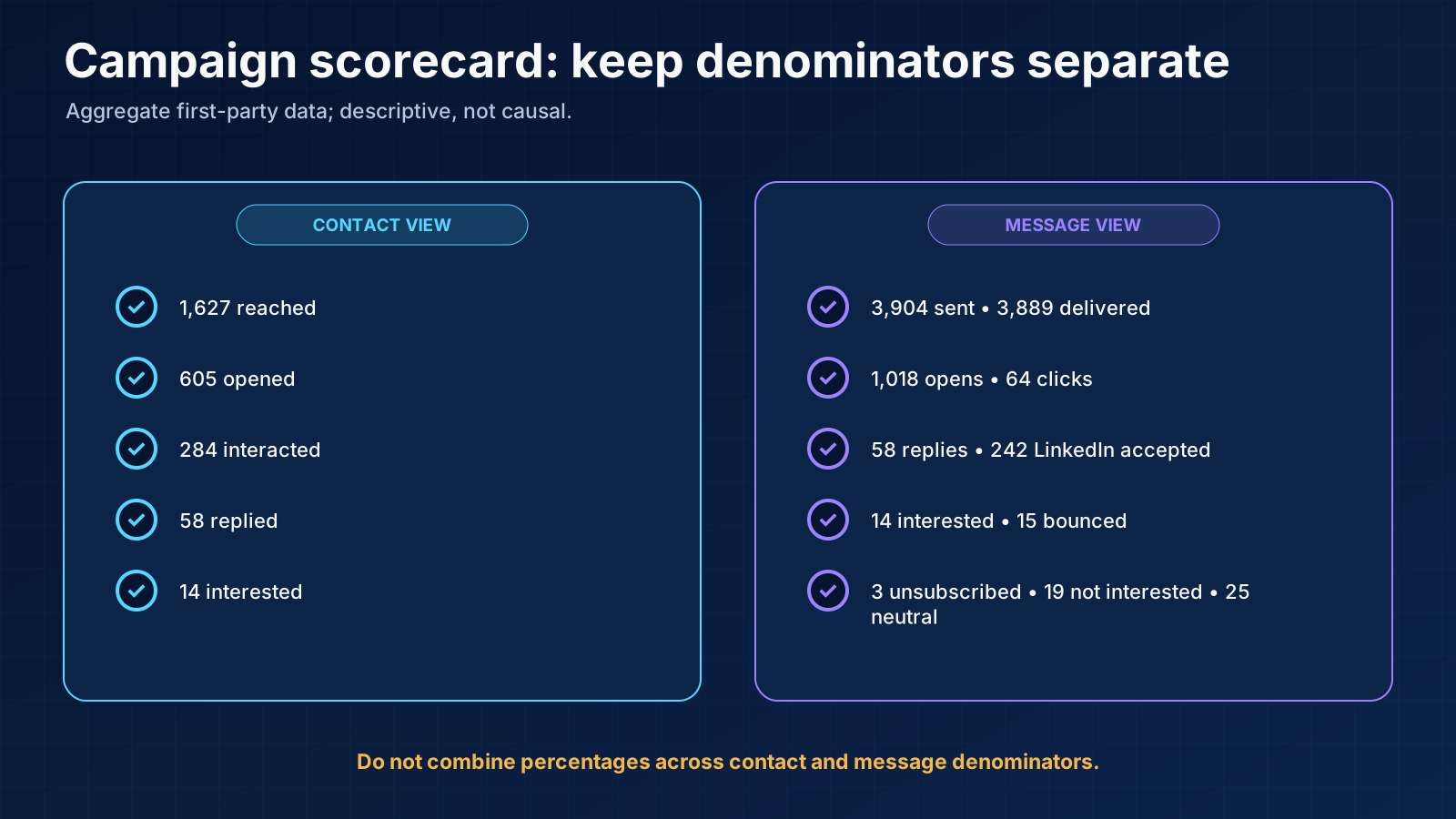
It does not prove that Lemlist caused the result, that AI copy beat human copy, or that this funnel will repeat in another market.
Contact-level and message-level campaign metrics shown with separate denominators.
Aggregate first-party data; contact and message percentages must not be combined.

12 / make any reply

Step 8: make any reply a global stop

A reply is evidence that the buyer has entered the conversation. Continuing an automated sequence after that moment is usually a failure of state, not persistence.
Our rule was simple:
any reply → stop email → stop LinkedIn → assign SDR → validate → choose next state
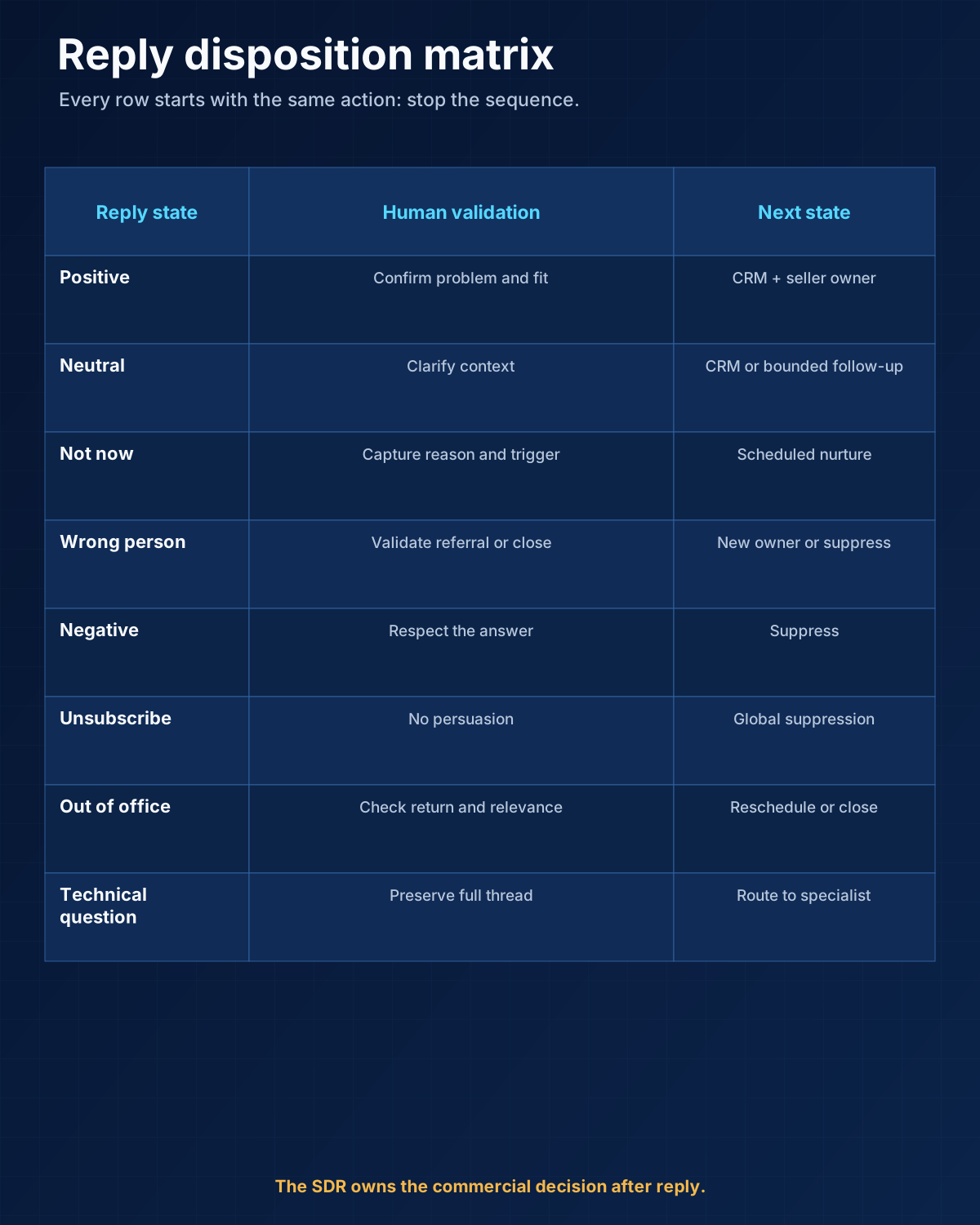
The rule covered positive and negative replies, questions, referrals, wrong-person messages, “not now,” unsubscribe, and OOO. The next action differed, but the automation stopped first.
DispositionSDR actionFuture automationCRM
PositiveQualify, answer, propose next stepNo generic sequenceAdmit after validation
Neutral/questionAnswer or get technical contextNo generic sequenceAdmit if commercially relevant
Later/not nowRecord reason and agreed dateControlled reactivation onlyOptional nurture state
Wrong person/referralVerify referral and account ownerDo not auto-contact referral blindlyAdd only validated referral
NegativeClose respectfullySuppress current motionNo opportunity
UnsubscribeConfirm global suppressionNever continueMinimal suppression record
OOOReview return date and ownerOptional controlled rescheduleUsually no admission yet
The tool may suggest a reply category. The SDR owns the interpretation. A polite wrong-person response may reveal a data problem, a current-business problem, or a valid referral. Those require different actions.
Human reply dispositions after every multichannel sequence is stopped.
The SDR validates every reply before CRM, nurture, suppression, rescheduling or specialist routing.

13 / keep cold noise

Step 9: keep cold noise out of CRM

We kept the unvalidated cold universe in Lemlist or the working outreach system plus a spreadsheet. We did not create thousands of CRM leads merely because contact data existed.
The CRM gate was:
positive or neutral reply → human validates commercial relevance → assign owner → create/update CRM record
The CRM record should include only the context needed for the next action:
  • person and company identity;
  • source campaign and channel;
  • human-validated disposition;
  • original evidence and message version;
  • reply summary or thread link;
  • owner;
  • next action and date;
  • lifecycle stage appropriate to the real state;
  • correction reason if qualification changed.
The cold sequence can store execution detail. CRM should store commercial truth.

14 / use monitoring as

Step 10: use monitoring as a decision system

The campaign did not expand on acceptance rate alone. We watched the whole funnel: connection acceptance, replies, interested replies, booked calls, held calls, partner opportunities, sender health, and human review time.
Use three decisions.

Expand

Expand a tier or message when qualification remains stable, sender accounts stay healthy, replies have commercial meaning, the SDR can respond promptly, and held calls justify the extra volume.

Revise

Revise when acceptance is reasonable but replies are weak, replies are mostly wrong-person, the message repeats generic features, or qualification produces the same false-fit pattern. Change one layer at a time.

Stop

Stop when sender health enters a red zone, LinkedIn shows an account warning, suppression fails, a claim becomes stale, strategic accounts enter automation, replies continue to receive scheduled touches, or the offer no longer matches the segment.
The kill switch must be faster than the campaign scheduler.

15 / launch diary what

A launch diary: what we checked as the campaign matured

Before the first batch

We reviewed every qualified record. We checked the company type, client base, current person, competitor state, and message variables. We also checked sender health and campaign branches. The purpose was not perfection. It was to find repeated error types while the batch was still small.

After the first replies

We compared the reply with the qualification reason. A wrong-person reply could mean the role was wrong, the person had another current business, or the offer did not fit the company. We did not treat all three as one data error. Each reason changed a different rule.
We also checked whether the sequence stopped across channels. This was more important than the sentiment label. A perfect label is not useful if another message still goes out.

After the first interested records

The SDR became the owner. The next step could require a partnership explanation, a technical answer, a demo, a commercial document, or a later date. Generic automation ended. The reply thread and approved context moved forward. The remaining cold list did not move into CRM with it.

When the list expanded

We did not relax the ICP because sender capacity was available. We reviewed rejected and borderline groups. If one segment produced weak fits, we changed the qualification rule before adding more records. If a source returned poor business-model evidence, we improved the source or stopped using that field.

When copy aged

We checked proof, pricing, links, and offer terms. The stale “+70% qualified leads” and “$89/month” lines show why this is a recurring task. A message can be grammatically correct and operationally dangerous because a commercial fact changed.

When the workflow looked stable

We reduced full-record review and moved toward sampling. We did not remove the kill switch. We kept watching reply categories, wrong-person reasons, sender warnings, and booked calls. Stability changed the review rate, not the ownership model.
This diary is the practical meaning of human-gated automation. The human does not click approve forever. The human identifies the risky decisions, verifies early production, and keeps control of exceptions and replies.

16 / Build the workflow

Build the workflow in Lemlist

Before opening the sequence editor

  • Approve ICP, exclusion, offer, and tier rules.
  • Verify sender identity and email infrastructure.
  • Create one person/account key across sources.
  • Define approved evidence and prohibited personal/sensitive data.
  • Assign the SDR and reply-response expectation.
  • Write CRM admission and global suppression rules.

In the sequence editor

  • Add the leading channel by tier.
  • Add waits with a reason, not random spacing.
  • Add only one meaningful A/B variable.
  • Add fallback email for tier-one LinkedIn silence where valid.
  • Keep named accounts out.
  • Configure reply stops and test them end to end.
  • Use clear close-the-loop copy.

Before launch

  • Preview every record and branch.
  • Test missing fields and broken links.
  • Verify all claims, prices, and proof against current sources.
  • Test unsubscribe, OOO, negative, and positive replies.
  • Confirm queued steps stop across both channels.
  • Review the first production batch manually.

After launch

  • Read every reply.
  • Inspect mailbox and account warnings.
  • Track platform denominators.
  • Review wrong-person and competitor patterns.
  • Update the qualification contract before adding volume.
  • Keep CRM free of unvalidated cold records.

17 / minimum event log

The minimum event log

For each active person, keep the source record ID, fit score, tier, channel path, sender, message version, current step, last event, reply state, human owner, suppression state, and CRM admission decision. Add a correction reason when a reviewer changes the fit.
This log answers the questions that matter after a problem. Which rule admitted the person? Which message and claim did they receive? Was another touch queued? Who read the reply? Did the change affect one record or the qualification logic for the whole batch?
Lemlist can provide much of the execution state. The team still needs a stable definition for each event and an owner for changes. A dashboard without a correction trail is reporting, not governance.
Review the log in the campaign meeting. Do not discuss only totals. Pick one good reply, one rejection, one wrong-person case, and one silent high-fit record. Each example tests a different part of the workflow.

18 / Frequently asked questions

Frequently asked questions

Can Lemlist run email and LinkedIn in one campaign?

Lemlist documents email, LinkedIn, call, delay, condition, and manual-task steps. The useful implementation gives each channel a defined role and uses one shared reply state. LinkedIn automation still carries platform-policy exposure.

Should email or LinkedIn go first in Lemlist?

Use the channel that matches the tier. In our workflow, LinkedIn led for the strongest partner prospects and email led for lower tiers. Email could follow tier-one LinkedIn silence after five to eight days.

How many follow-ups should a Lemlist campaign have?

There is no universal number. Each follow-up must add a new use case, proof, objection answer, or clear close. Stop when additional touches repeat the same request or the buyer replies.

Should Lemlist automatically answer replies?

Not in the workflow described here. A tool may classify or draft, but the SDR reads the buyer's message and owns the next action. This is especially important for objections, referrals, wrong-person replies, and technical questions.

Should every Lemlist contact sync to CRM?

No. We admitted only human-validated positive or neutral replies. An unresponsive cold record is not pipeline. Maintain suppression separately so excluded records do not re-enter later.

Is this a recommended universal campaign?

No. It is a bounded first-party workflow for marketing-agency partner outreach. Reuse the state model—qualification, tiers, conditional channels, any-reply stop, SDR disposition, and selective CRM admission—not the exact message or performance numbers.

19 / Final recommendation

Final recommendation

Lemlist can execute a clear multichannel workflow. It cannot decide whether the market, offer, evidence, or person is right unless the team supplies and reviews those rules.
Our strongest operating choices were not clever copy tricks. They were rejecting most of the source universe, tiering the approved records, letting one channel lead, using the second conditionally, stopping everything after any reply, and keeping cold noise out of CRM.
The campaign also exposed the limits of automation. A company-and-title match still missed the person's current business. A live sequence still contained stale proof and pricing. Both errors would have scaled without review. The fix was better qualification and claim governance, not more sending.
Continue with the AI Sales Outreach pillar, the AI Email Sales Outreach workflow, the Cold Email vs LinkedIn guide, the LinkedIn Outreach Tools comparison, the AI Cold Email Tools comparison, and the personalization-tools guide.

Research note

Methodology

  1. 01Anastasiia built, launched and monitored the anonymized first-party campaign from early summer 2026 through the evidence review.
  2. 02Names, companies, sender identities and raw screenshots are excluded; all workflow visuals are redrawn and anonymized.
  3. 03Contact-level and message-level denominators remain separate, and the campaign is not presented as an independent product benchmark.
Read the full methodology

Source ledger

Sources & editorial notes

  1. 01
    Create a Lemlist campaign

    Lemlist Help · Official product, platform, provider or standards source used for the bounded claim cited in this guide.

  2. 02
    Lemlist help center

    Lemlist Help · Official product, platform, provider or standards source used for the bounded claim cited in this guide.

  3. 03
    LinkedIn prohibited software and extensions

    LinkedIn Help · Official product, platform, provider or standards source used for the bounded claim cited in this guide.

  4. 04
    Current NextLevel AI case evidence

    NextLevel AI · Official product, platform, provider or standards source used for the bounded claim cited in this guide.

  5. 05
    Current NextLevel AI public offer

    NextLevel AI · Official product, platform, provider or standards source used for the bounded claim cited in this guide.

Corrections or primary material: contact the corrections desk.

About the author

Anastasiia Krynytska

Anastasiia Krynytska is a LeadGen Team Lead at Softermii and the lead editor of Luck My Sales. She covers AI-assisted outbound, account research, qualification, messaging, CRM handoffs and revenue workflows from a practitioner’s perspective.View author profile LinkedIn

Continue reading

01 · News analysis

AI sales is moving from assistant to operating layer

The category is expanding from drafting support into research, pipeline decisions, recommended actions and controlled execution.

Read news
02 · Field analysis

In AI sales, the handoff may be the product

Models are becoming accessible; durable value sits in the controlled transition from signal to seller action.

Read analysis
03 · Research framework

Sales AI Workflow Signals 2026

A launch framework for mapping the products, controls and buying questions shaping AI-enabled revenue work.

Read reports

Luck My Sales briefing

Useful context, once a week.

News, explanations and original research from this desk. No noise.
The newsletter is still being built. We will contact you when the first edition is ready.