Weekly industry intelligence · No noiseSubscribe to the Luck My Sales newsletterFree briefing

Independent intelligence on AI in sales

Menu

Operational guide · Prospecting & Outreach

AI Sales Outreach: How to Build a Human-Gated B2B Workflow

Build an AI sales outreach workflow with explicit evidence, permitted actions, reply stops, human handoff, CRM admission rules and measurable outcomes.
Editorial disclosure

AI may assist research organization and drafting. A human editor reviews every published page, checks material claims against the cited sources and owns the final decision. No company paid for placement in this article.

AI use policy

Agent-ready brief

AI takeaways

Keep the key points here, or take a source-aware text brief into Claude, ChatGPT or another AI workspace.
  1. 01The head owns the ICP, offer, commercial logic and strategy; routine execution can automate only after those decisions are explicit.
  2. 02Keep eligible record, signal, permitted action, reply, CRM lead and opportunity as separate states.
  3. 03Any reply stops every automated contact path and transfers the relationship to an SDR for validation.
  4. 04Admit only validated positive or neutral responses to CRM with an owner and next action.
  5. 05Pilot on a fixed sample and measure accepted outcomes, review time and total cost.
Includes summary, takeaways, sources and a use note.
AI sales outreach should automate repeatable research, drafting and execution only inside a sales motion the team already understands. The system needs a written rule for who is eligible, which evidence may support a message, what action is permitted, what stops the sequence and who owns the next step. When a buyer replies, the workflow has moved from campaign execution to a live relationship. That transition should be visible and human-owned.
This does not mean a person must approve every routine first message forever. Anastasiia Krynytska's operating rule is more specific: the head owns the ICP, offer, commercial logic and strategy; ordinary first touches and follow-ups may run automatically after the workflow has been built and checked; strategic or named accounts stay under human review; and any reply stops the automated sequence for SDR validation.
The difference matters. A “human in the loop” label can hide a weak control if nobody can say which decision the person owns. This guide turns the control into an Outreach Authority Contract, an eight-stage workflow, a reply handoff and a measurement plan.
Method and disclosure: The operating rules come from Anastasiia's documented work with a real Lemlist multichannel sequence. NextLevel AI was the first-party product context for that campaign, so the example is not an independent review of NextLevel AI or Lemlist. The supplied campaign interface does not have a confirmed measurement period or complete metric definitions, and this article makes no performance claim from it. Promotional claims from the original sequence are not repeated. The LinkedIn section also applies LinkedIn's current official policy, which prohibits unauthorized third-party automation.

Define the sales motion, evidence, authority, reply stop and CRM admission rule before automating execution.

01 / Definitions

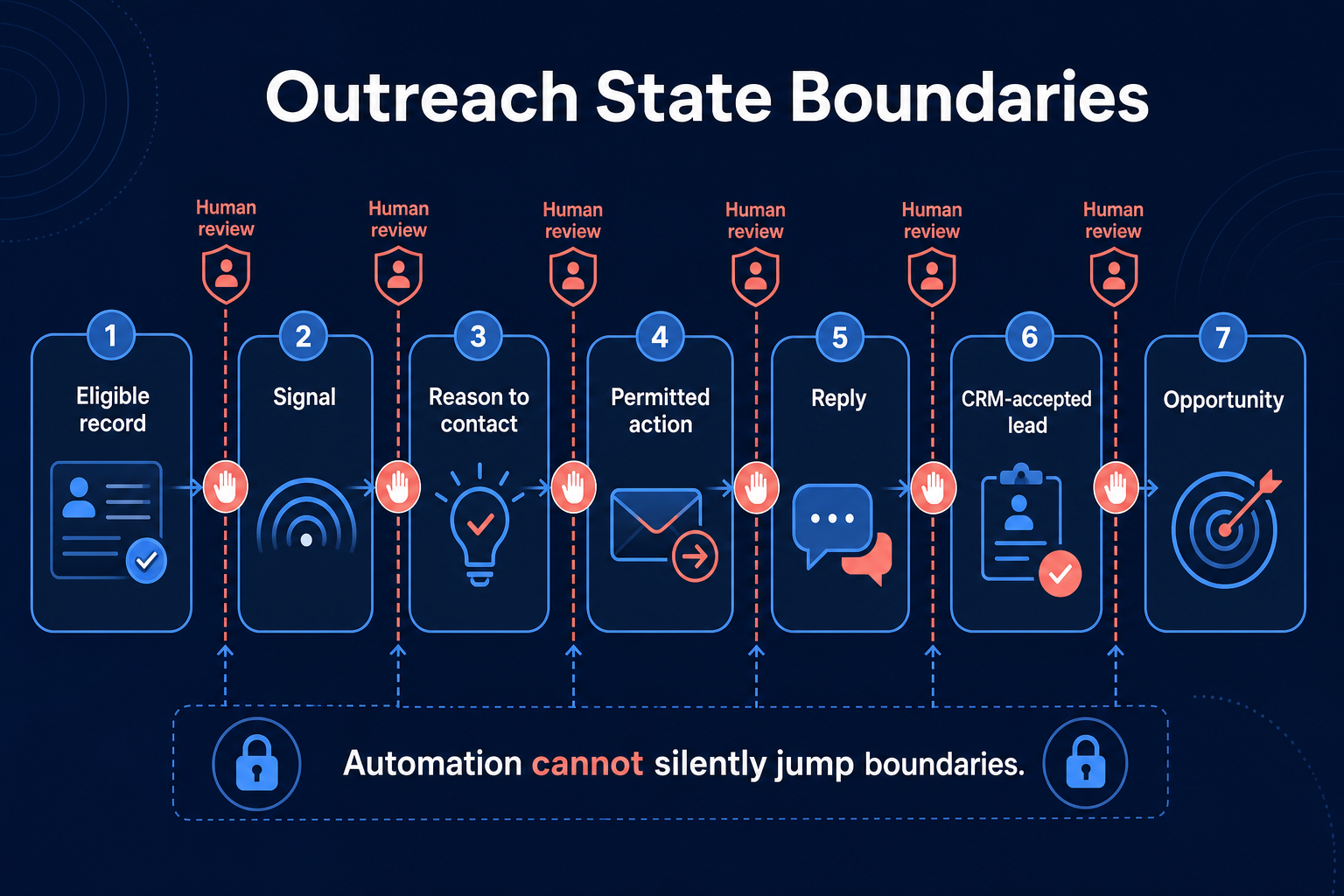
Fit, signal, permission, reply and opportunity are different states

AI outreach fails quickly when one useful clue becomes permission to do everything else. A company hiring salespeople can be a reason to research the account. It is not proof that the company intends to buy, that a particular person owns the problem or that an automated message is appropriate.
Use separate states:
StateQuestion answeredWhat it does not prove
Eligible recordDoes this person and account meet the approved outreach rules?Current need or permission
SignalDid a relevant professional event occur?Buyer intent
Reason to contactCan the team connect the signal to a plausible commercial problem?That the claim is true without a source
Permitted actionMay this channel and message type be used under team, platform and legal rules?That the buyer will welcome it
ReplyDid the recipient create new relationship context?Qualification or opportunity
CRM-accepted leadDid a person validate enough context to create a sales-owned record?A sales opportunity
OpportunityDid the record meet the team's explicit opportunity rule?Revenue
This separation also keeps the outreach guide from swallowing the whole funnel. Account discovery belongs in AI lead generation. Evidence gathering and seller review begin earlier in the AI prospecting workflow. Qualification and routing are later decisions with different owners.
Outreach state boundaries with human review gates between record, signal, reply, CRM lead and opportunity.
Automation should not silently move a record across sales-state boundaries.

02 / Start with the

Start with the sales motion, not the outreach tool

An outreach platform can schedule steps. A language model can draft copy. Neither can decide the company's commercial position.
Before building automation, the head or sales owner should write down:
  • the ICP and explicit exclusions;
  • the offer and the problem it addresses;
  • the segment or buying situation being tested;
  • the approved reasons to contact;
  • the channels the team may use;
  • the relationship-risk tiers;
  • the owner of campaign policy;
  • the owner after a reply;
  • the definition of a positive, neutral and negative outcome;
  • the rollback condition.
If the team cannot describe the ICP, offer and message logic without naming a tool, it is not ready to automate the motion. Automation would only repeat an undefined process at greater speed.
This is especially important for small and midsize B2B teams. Anastasiia's position is that companies of roughly 2–200 people are more exposed when professional human contact disappears. One buyer conversation can carry product, commercial and technical context that a large specialized team might distribute across roles. The company-size range is an operating view, not a universal threshold.

Match automation to the maturity of the sales motion

The same workflow is not appropriate at every company stage. A founder who is still learning why customers buy needs more direct conversation than a team repeating a proven motion. Treat automation as a maturity decision, not a software milestone.
At the first stage, the company is proving the pain and value. The founder or senior seller should use warm contacts, events, partners and direct conversations to hear the market in its own words. Every call can change the ICP, offer or onboarding. There is little to delegate because the learning itself is the work.
At the second stage, the company is proving monetization across its first group of customers. Research and list building can move to a freelancer or junior operator, but the commercial owner should still control the segment, message and sales conversations. Automating outreach before these choices settle creates more data without a reliable interpretation.
At the third stage, the team is proving one repeatable channel. This is the earliest sensible point for a governed AI outreach workflow. The ICP, offer and channel should be stable enough to write as rules. A person can then compare AI-supported work with the human baseline and see whether it saves review time or improves usable evidence.
Later stages add representatives, markets and operating complexity. They need stronger ownership, permissions, suppression, CRM state and reporting. More automation may be justified, but only because the underlying motion is clearer. Company growth expands the control system; it does not remove the need for one.

03 / Authority

Write an Outreach Authority Contract

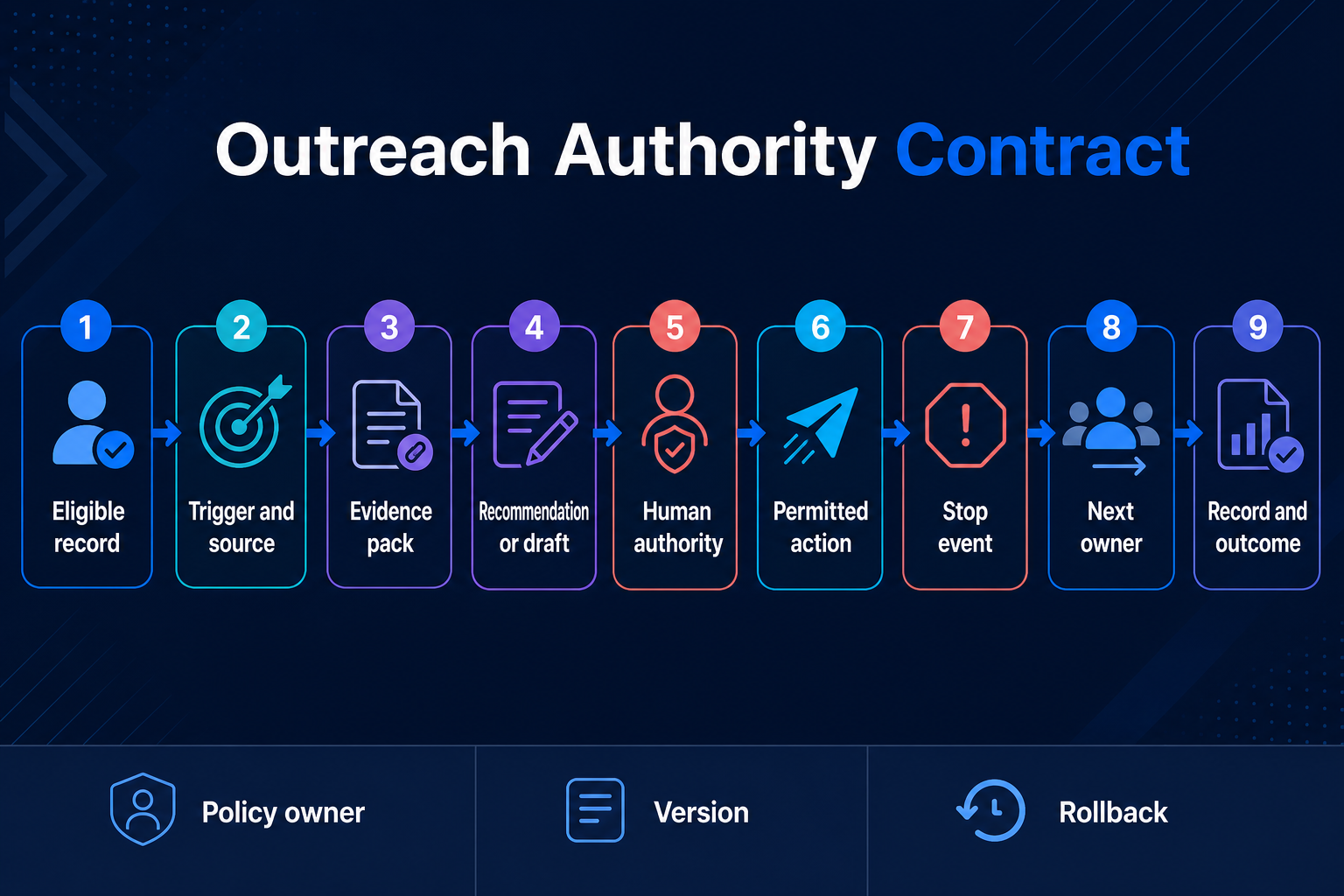
The Outreach Authority Contract is the central control for AI sales outreach. It is a short policy that connects a record, evidence, a proposed action and the next owner. It should exist before the workflow is translated into platform branches.
Contract fieldRequired decisionExample
Eligible recordWhich people and accounts may enter?Current role, approved segment, no active owner conflict
Trigger and sourceWhat event started the workflow?New role posted on company careers page, captured with date
Evidence packWhich facts may the system use?Current role, company source, approved CRM history
Recommendation or draftWhat may AI produce?One reason to contact and one message draft
Human authorityWhich actions need review?Named accounts always; normal cohort after calibration
Permitted actionWhat may the system execute?Email send, authorized network action or call task
Stop eventWhat freezes the workflow?Any reply, unsubscribe, hard bounce, owner conflict
Next ownerWho resolves the state?SDR, sales owner, technical specialist or suppression owner
Record and outcomeWhere are evidence and results stored?Outreach system before reply; CRM after validated acceptance
The contract also needs a policy owner, a technical owner, a version and a rollback rule. Without those fields, a team can see that something went wrong but cannot identify which rule created the action or which approved state should replace it.
A compact contract can look like this:

Eligible records are current contacts in the approved segment with no active customer, opportunity, partner or named-account conflict. AI may summarize current professional evidence and draft a message using the approved offer. Routine cohort messages may send after the campaign-level review; named accounts require record-level review. Any reply or suppression event stops all scheduled touches. An SDR validates the reply. Pre-reply records remain in the outreach workspace; positive or neutral validated replies enter CRM with owner and next step. The sales head owns policy versioning and rollback.

That paragraph is more useful than a generic instruction to “keep a human in the loop.” It names the loop.

Assign owners before assigning software
The contract works only when each decision has a named owner. In a small company, one person may hold several roles. The roles still need to be explicit.
The commercial policy owner, usually the founder, sales head or GTM leader, owns the ICP, offer, exclusions, channel strategy and definition of a successful outcome. AI may help organize evidence, but it does not approve a new market position.
The workflow owner, often RevOps, a GTM engineer or the operator running the campaign, translates that policy into fields, branches, prompts, sender rules and monitoring. This owner must be able to pause the system, identify the current version and restore the last approved configuration.
The conversation owner, normally an SDR or seller, takes control when a person replies. This role reads the thread, checks account history, corrects classification and decides whether the record moves to nurture, a technical question, a meeting or suppression.
The specialist owner joins when a reply needs product, legal, security, implementation or pricing context. Automation should route the question with its evidence and thread. It should not invent a confident answer because the primary SDR lacks the detail.
These roles prevent a common failure: everyone can see the automated activity, but nobody owns the exception. A workflow without an exception owner is not autonomous. It is unattended.
Nine-part outreach authority contract from eligible record through recorded outcome.
Define authority, evidence, permitted actions, stop events and ownership before automation runs.

04 / Workflow

Build the AI sales outreach workflow in eight stages

1. Resolve identity and existing ownership

Start with the record, not the message. Confirm the person's current role and company. Check for an existing customer, open opportunity, partner relationship, named account, recent seller-created record or suppression status.
A wrong identity can make every later step look technically correct while producing the wrong action. If evidence conflicts, stop the record and send it to review. Do not let the model choose the identity that makes the campaign easier.
Output: one eligible identity or a visible exception.

2. Build a source-linked evidence brief

The evidence brief should preserve the source URL, capture date and allowed claim. It should also separate an observation from the team's interpretation.
For example:
  • observed fact: the company lists three open customer-support roles;
  • source: official careers page, captured on a named date;
  • allowed claim: the company is recruiting for support roles;
  • inference: the team may be managing increased support demand;
  • prohibited claim: the company has a support crisis.
The distinction prevents a plausible inference from becoming a false statement. AI can help compress the source, but the workflow should retain the original evidence.
Output: a short evidence pack that a reviewer can inspect.

3. Select one commercial reason to contact

A random fact is not personalization. The reason to contact should connect a current professional signal to the recipient's role and a problem the offer can plausibly address.
Anastasiia allows current professional social and intent signals that connect to a commercial problem. She excludes personal-life details, sensitive data, stale or unverified facts and facts that have no commercial context.
Use five checks:
  1. Is the source current?
  2. Is the fact about the person's professional role or company?
  3. Does the recipient plausibly own or influence the problem?
  4. Can the message state the relevance without pretending to know intent?
  5. Would the sentence still make sense if the flattering detail were removed?
If the fifth answer is no, the message may be personalization theater.
Output: one sourced reason to contact, not a pile of facts.

4. Draft one message and one next action

The model should receive the approved offer, evidence, allowed claim, prohibited claims, tone and CTA. Ask it to draft from those inputs, not to browse freely and invent familiarity.
The first message needs a single commercial job: earn a response or a low-friction next step. Follow-ups should add a new reason to reconsider. They should not merely paraphrase the first message.
The real Lemlist workflow supplied for this article used a connection A/B test followed by tailored-demo, pilot, proof, video and close-the-loop touches. That sequence shows distinct jobs across a campaign. It does not prove that its exact order, timing or promotional claims will work elsewhere.
Output: a message linked to its evidence and purpose.

5. Apply the authority rule

Review the campaign at the level required by risk.
ActionDefault authority in Anastasiia's operating modelEscalation
Routine first messageMay automate after manual setup and calibrationReview if evidence is uncertain or risk increases
Routine follow-upMay automateStop if state changes
Strategic or named accountHuman reviewSales owner decides
Email sendMay automate inside approved sender and suppression rulesPause on infrastructure or policy failure
LinkedIn actionUse only a LinkedIn-authorized method or execute manuallyUnauthorized third-party automation is not recommended
Mass call taskMay automate when the team deliberately chooses that motionConversation and disposition remain accountable
Reply classificationSDR validates in the documented workflowTechnical or sales specialist joins when needed
CRM owner or lifecycle changeSales or SDR controlDo not let unattended outreach overwrite ownership
Unsubscribe or suppressionAutomatic stopNo sales override to continue the sequence
NIST's AI Risk Management Framework is not a sales standard, but its general principle is useful here: roles, application scope and human oversight should be defined and documented. The contract turns that broad governance principle into a sales-specific operating rule.
Output: approved action, exception or rejection with a reason.

6. Execute through a shared contact state

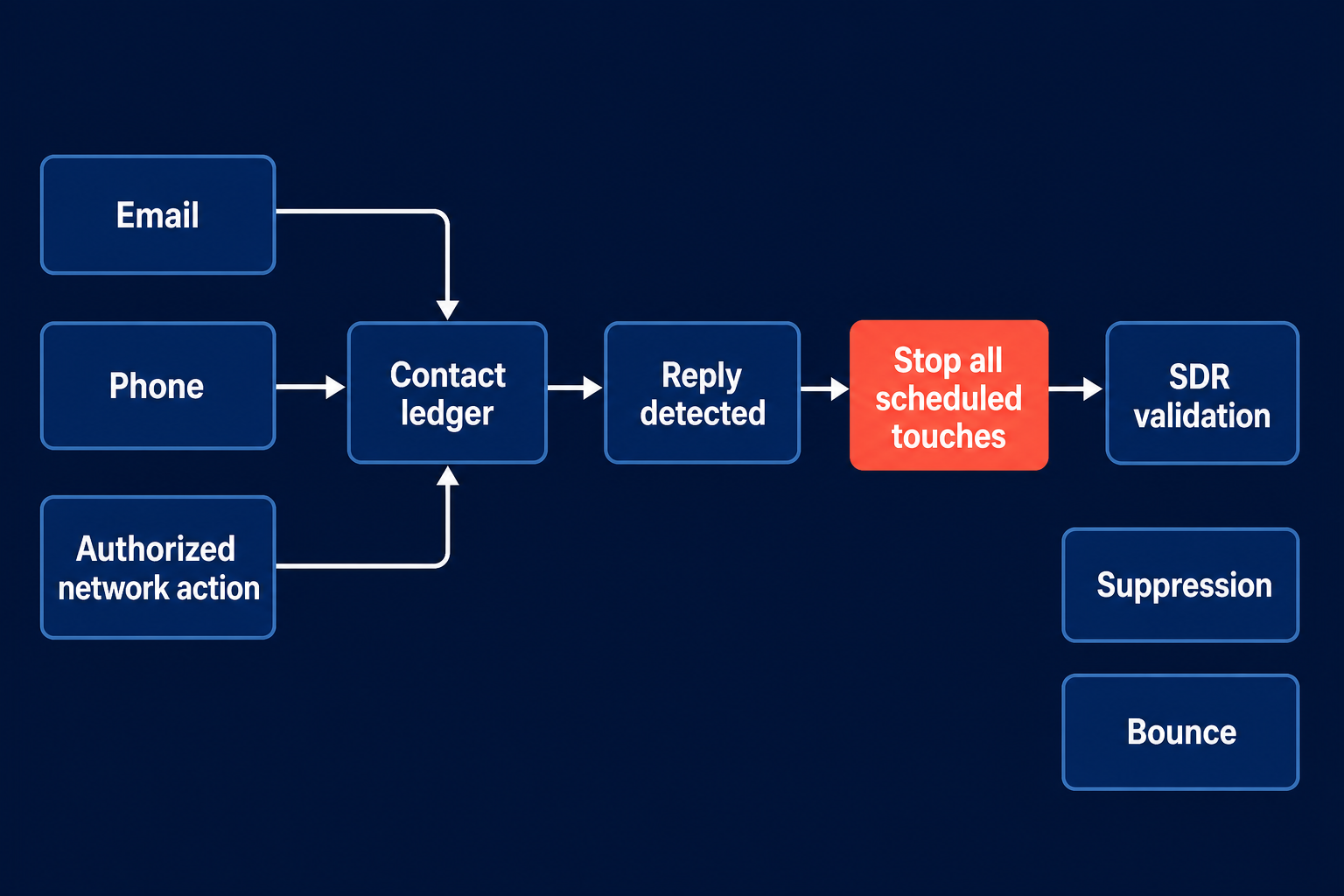
Email, phone and professional-network activity should read one contact state. If one channel receives a reply, the other channels should not continue because their own timers have not fired yet.
The channel executor needs to check, immediately before action:
  • current suppression state;
  • current reply state;
  • current owner;
  • active customer or opportunity conflict;
  • last completed touch;
  • channel permission and current platform policy;
  • sender or account health;
  • whether the evidence is still current.
LinkedIn's current User Agreement prohibits unauthorized bots and automated methods that add contacts or send messages. LinkedIn's help documentation also says third-party software that automates activity on its website is not allowed. A real past workflow is not permission to recommend a method that conflicts with current policy. Use native or expressly authorized capabilities, or keep the action human-executed.
Output: executed action with timestamp and version, or a named stop reason.

7. Stop every sequence when a reply creates context

In Anastasiia's documented workflow, any reply stops automation. The rule is deliberately broader than “stop on positive interest.”
Reply or eventAutomated actionHuman next step
Positive interestStop all touchesSDR validates need, context and next action
ObjectionStopSDR decides whether to answer, close or revisit
ReferralStopValidate the referred person and ownership before contact
Wrong personStopCorrect identity; do not silently enroll another contact
Not nowStopRecord a reason and a human-approved revisit condition
Unsubscribe or do not contactSuppressNo further sales touch
Out-of-officePauseSDR checks return date, delegation and whether resumption is appropriate
Ambiguous responseStopSDR reads the thread before classification
Hard bounceStop channelFix or remove the address; do not continue the same email path
This policy protects relationship context from being overwritten by the next scheduled step. It also acknowledges that reply classification is not only sentiment analysis. “Not the right person” can be negative for the current contact and useful for account research. A model can suggest a class, but the SDR owns the disposition in this workflow.
One error should not automatically invalidate a campaign that operates across hundreds of records. Investigate repeated patterns. A rising set of wrong-person replies may point to stale role data. Repeated “already speaking with your team” replies may show ownership or duplicate-suppression failure. Change the workflow when errors reveal a systemic cause, not merely because one exception exists.
Output: paused workflow, human owner and explicit disposition.

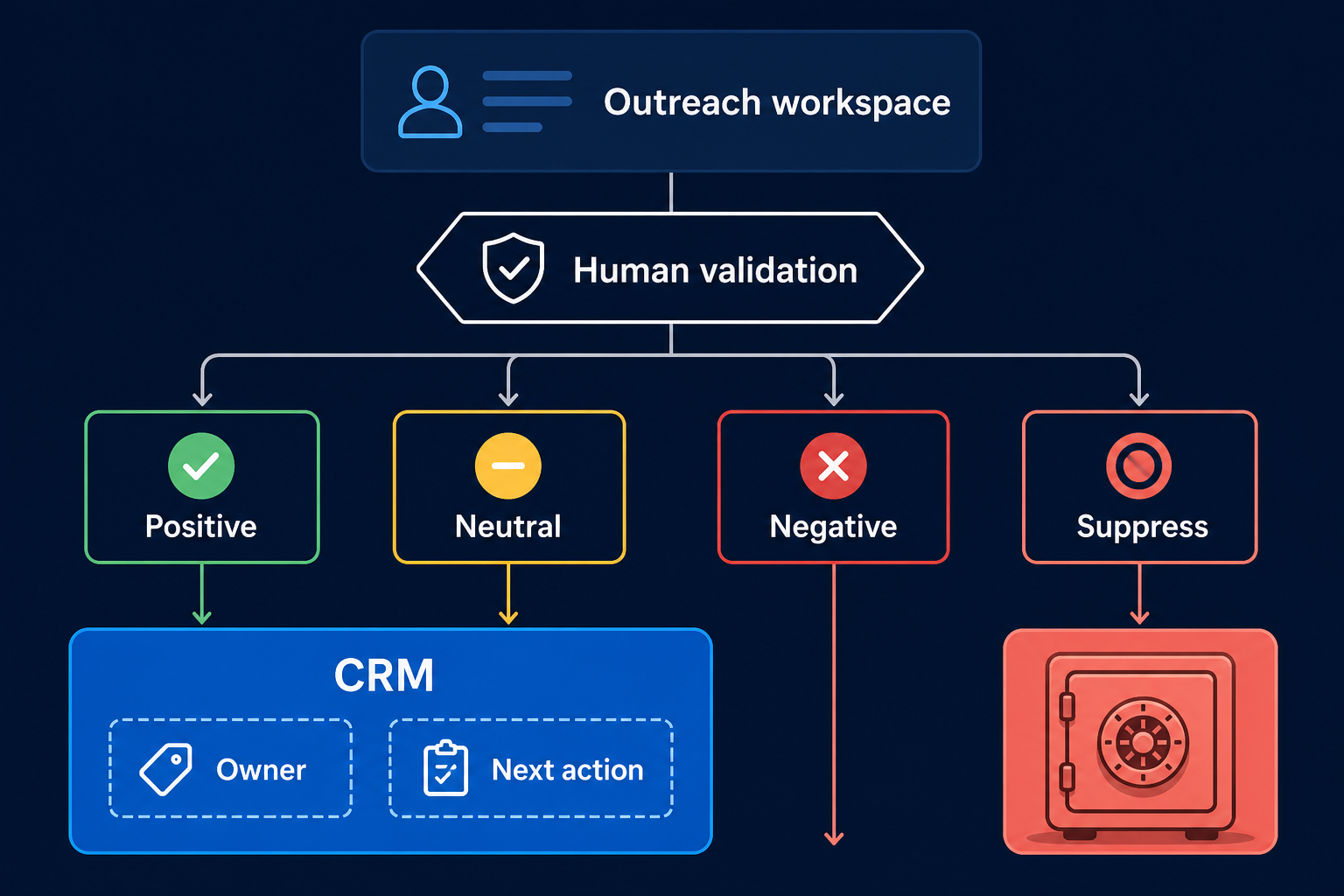
8. Admit validated replies to CRM

Anastasiia's CRM rule is intentionally selective. Pre-reply work stays in Lemlist or Instantly plus a spreadsheet. The team does not copy the entire cold list into CRM. A positive or neutral reply enters CRM only after human validation, using a process closer to inbound intake.
The outreach workspace should still preserve enough evidence to reconstruct what happened:
  • campaign and policy version;
  • record and evidence source;
  • message variant and completed touches;
  • reply or stop event;
  • SDR disposition;
  • correction reason;
  • suppression status.
When a validated record enters CRM, write only the fields the sales team will use:
  • source or campaign;
  • validated person and account;
  • reply summary or relevant thread link;
  • owner;
  • next action and date;
  • lifecycle or lead status;
  • correction or referral context.
This is an author operating policy, not a universal CRM architecture. Some organizations need all attempted contacts in a governed warehouse or CRM object. The principle is portable: do not make untouched cold records look like qualified pipeline.
Output: either a validated CRM lead with an owner or a closed/suppressed outreach record.

Preserve an outreach event and correction ledger
A current status field is not enough to explain the workflow. It shows where the record ended, but not which evidence, rule and action produced that state. Keep an event ledger in the outreach workspace or data layer even when the CRM receives only validated replies.
Each event should identify the contact and account, the previous state, the new state, the reason for change, the policy or campaign version, the responsible system and the human owner. Evidence events should retain their source and capture date. Message events should retain the approved variant. Stop events should show which future actions were cancelled. Corrections should preserve both the rejected value and the accepted replacement.
Consider an illustrative wrong-person reply. The record first passed identity review, entered a sequence and received a message. The recipient then said that another colleague owned the problem. The correct response is not merely to change the contact name. The workflow should stop, record the reply, invalidate the old ownership assumption and send the referral for human review. Only after the new person's role, account relationship, suppression state and existing owner are checked can another outreach decision be made.
That history helps the team distinguish a single exception from a repeated failure. If several records fail for the same role pattern, the owner can trace them to the same source or rule version. The team can then repair the identity step and re-review only the affected cohort. Without the ledger, the same correction looks like unrelated inbox work and the model receives no reliable feedback.
The ledger also makes rollback practical. A workflow owner can identify every record touched by a faulty rule, stop future actions and restore the last approved state. This is the operating value of auditability: not more reporting, but faster and safer correction.
Human validation gate admitting only positive or neutral outreach responses into CRM.
Validate the response before creating CRM clutter; admitted leads require an owner and next action.

05 / Coordinate email, LinkedIn

Coordinate email, LinkedIn and phone without hiding collisions

A multichannel campaign needs one control plane even when different products execute the steps.
Shared fieldWhy it matters
Contact and account identityPrevents duplicate or wrong-company outreach
Existing ownerProtects active relationships
Last completed actionPrevents simultaneous touches
Next scheduled actionMakes the plan inspectable
Reply stateStops every channel, not only the one that received the reply
Suppression statePrevents a new campaign from restarting contact
Channel authorizationKeeps platform and team rules current
Human ownerEnsures the buyer knows who is responsible
Do not treat channel volume as the purpose of the workflow. Email can scale operationally, phone can surface objections and calls can become a useful control point, while professional-network activity can add context. Each channel still needs a reason, a current state and an accountable owner.
For the channel-specific sender, cadence and event rules, use the companion AI email sales outreach guide.
Email, phone and authorized network actions merging into one ledger before reply detection and stop.
All authorized channels need one contact ledger and one deterministic reply stop.

06 / Adapt the control

Adapt the control model to the sales motion

The eight stages stay consistent, but the amount of review and the system of record should match the team. The following patterns are illustrative operating designs, not reported case results.

Founder-led service business

A founder-led consultancy or agency often has a narrow list and a high cost for a poor interaction. The team can research a small cohort with current professional signals, prepare one evidence brief per account and draft short emails. Routine accounts may enter the approved sequence after a campaign-level review. Named prospects, partners, referrals and previous conversations stay under record-level review.
The founder or first seller owns every reply because the response may reveal positioning, delivery or pricing information. Pre-reply records can remain in the outreach workspace and a spreadsheet. CRM admission happens after the reply is validated. The system should optimize the founder's research and preparation time, not create the impression of a large automated sales department.

Small SaaS team with a proven segment

A small SaaS company may have enough closed customers to define the ICP, but not enough pipeline to support separate research, SDR, RevOps and sales-operations teams. Its workflow can use account and contact data, source-linked research, one reasoning layer and one sender. The sales head approves the offer and message logic. An SDR owns the inbox and CRM intake.
This team benefits from clear campaign boundaries. One segment, one offer and a small number of message angles should run at a time. Replies stop every channel. Technical questions move to product or engineering with the thread attached. The team scales only after it can explain which evidence and message combination created useful conversations. Adding another tool before that point makes diagnosis harder.

Larger team with territories and named accounts

A larger revenue team needs the same evidence and reply controls, plus ownership precedence. An existing account or opportunity owner should normally take priority over a campaign assignment. Named accounts, partners, current customers and regulated segments need dedicated rules. Territory, product, language, skill and seller capacity can resolve the remaining assignments before any round-robin fallback.
The engagement platform may write more pre-reply activity to a governed CRM or warehouse than Anastasiia's lean model does. That is acceptable if the record type clearly separates a prospect from a qualified lead or opportunity. The larger team also needs permission groups, template ownership, audit history and a tested kill switch. Scale changes the storage and administration model, but it does not change the rule that a live buyer response has an accountable human owner.

07 / Workflow

Pilot the workflow on a fixed sample

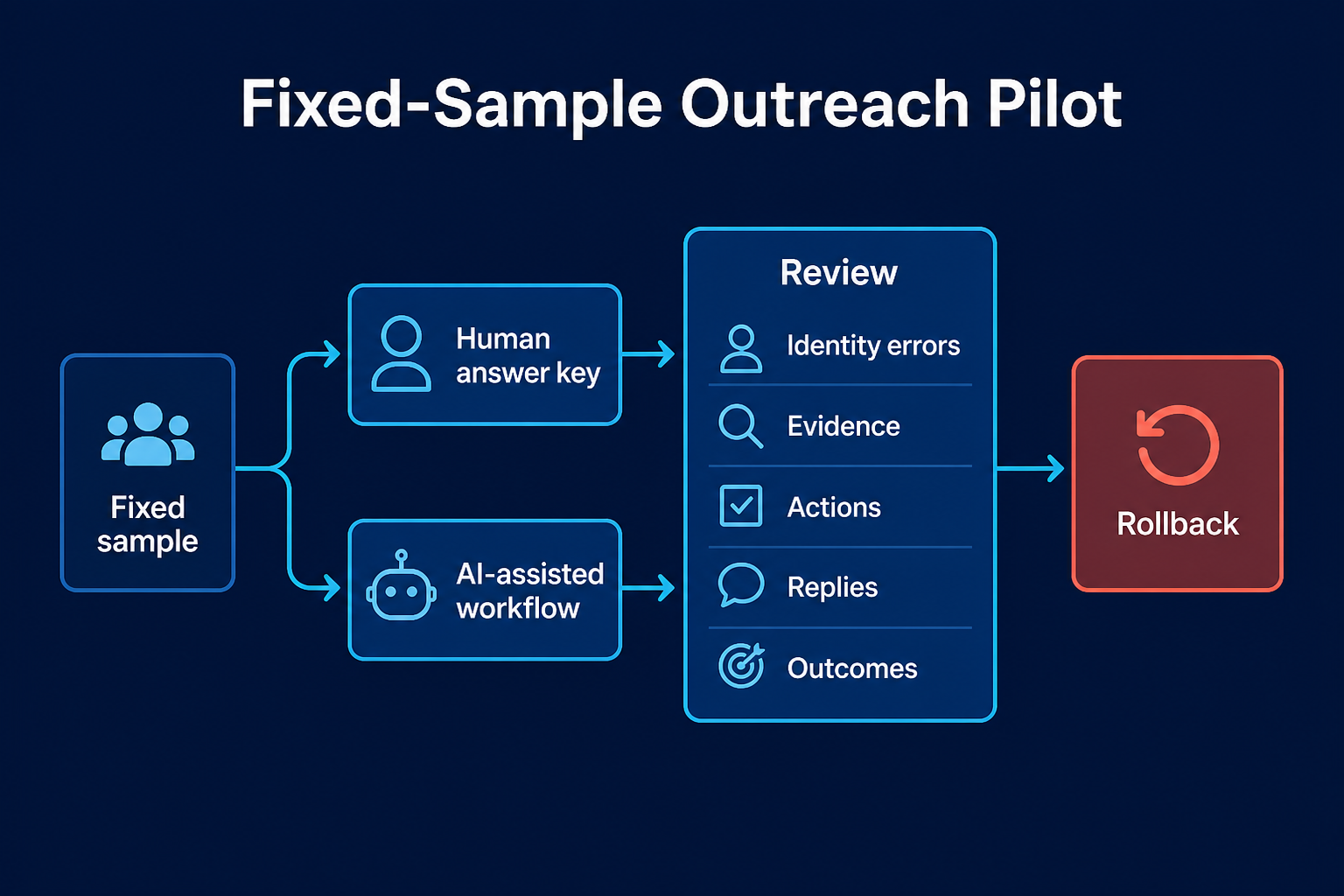
Before increasing autonomy, run the proposed workflow on a fixed sample that the team can review completely.
  1. Freeze the ICP, offer, evidence policy and exclusion rules.
  2. Create a human answer key for identity, eligibility, allowed claim, risk tier and permitted action.
  3. Run the AI-assisted workflow on the same records.
  4. Compare disagreements before live action.
  5. Launch only the approved risk tier.
  6. Review every reply and exception during the pilot.
  7. Roll back to the prior approved rules if stop or ownership failures appear.
Record the pilot with explicit denominators:
MeasureDefinition
Identity correction rateRecords with corrected person or company ÷ records reviewed
Evidence acceptance rateEvidence packs accepted by reviewer ÷ evidence packs reviewed
Action approval rateProposed actions approved ÷ proposed actions reviewed
Stop failure rateRecords touched after a stop event ÷ records with a stop event
Meaningful reply rateHuman-validated meaningful replies ÷ delivered messages or reached contacts, with the chosen denominator named
Held-meeting rateHeld meetings ÷ human-validated positive or neutral replies
Accepted-opportunity rateOpportunities accepted under the CRM rule ÷ held meetings or validated replies
Review timeHuman review minutes ÷ reviewed records
Total operating costTools, data, infrastructure and human time for the measured period
Calls and customers are Anastasiia's preferred downstream signals. Connection acceptance can help diagnose an earlier channel step, but it does not show revenue value. Sends, opens and clicks are operational signals, not the final outcome.
The supplied Lemlist campaign view is not used for a benchmark because its period and some metric definitions remain unconfirmed. That omission is a strength, not missing decoration. A precise unknown is safer than a false comparison.

Decide when to expand, pause or rebuild
Expand the workflow when evidence remains accurate, reviewers approve the intended actions, reply ownership has capacity and downstream outcomes survive human validation. Add volume in the working segment before adding a new segment, offer and channel at the same time. Otherwise the team cannot tell which change produced the result.
Pause when the system loses state integrity. Examples include a reply followed by another automated touch, an unsubscribe that does not propagate, an existing owner being overwritten, rising identity corrections or a queue that the SDR team cannot review promptly. A pause protects both the buyer relationship and the quality of the experiment.
Rebuild the affected stage when errors repeat around one cause. Wrong-person replies may point to stale identity data. Relevant replies with no meetings may point to weak handoff or objection handling. Delivered messages with little meaningful response may point to the segment, offer or reason to contact. Fix the causal stage rather than rewriting every prompt.
Stop the motion when the team cannot define a credible problem, offer and target after direct customer work. AI can make a proven motion faster. It should not be used to postpone the conclusion that the motion itself is not working.
Fixed-sample pilot comparing a human answer key with an AI-assisted outreach workflow.
Use the same sample and inspect identity, evidence, actions, replies and accepted outcomes.

08 / Failure modes

Failure modes AI magnifies

The motion is not proven

If the ICP, offer and channel are unclear, AI accelerates random testing without a stable baseline. Return to the human motion.

The evidence is stale

A polished message does not repair the wrong role, old company or unsupported inference. Fix identity and source freshness.

Personalization has no commercial meaning

Repeating a post or company fact can feel less relevant than a direct message about the recipient's work. Remove the fact unless it supports the reason to contact.

Channels have separate stop states

An email reply followed by an automated connection request shows that the system does not understand its own relationship state. Centralize reply and suppression events.

The sequence handles replies as another automation branch

A buyer response can contain a referral, correction, objection or technical question. Stop the campaign and give the complete thread to its owner.

CRM activity looks like pipeline

Thousands of imported cold records can create reporting volume without buyer engagement. Preserve operational data, but apply a clear admission rule before calling a record a lead.

The team changes too much after one exception

One wrong-person reply is not proof that a good workflow is broken. Search for a pattern, identify the cause and change one rule at a time.

09 / Reply control

Use the minimum tool roles required by the handoffs

An AI SDR is not one magic product. It is a combination of data, reasoning, execution and operating rules.
Anastasiia uses a 40/40/20 attention heuristic:
  • 40% on contact and account data;
  • 40% on reasoning or agentic work, such as controlled research and drafting;
  • 20% on sending.
This is not a measured allocation or industry benchmark. It is a reminder that sending is the smallest part of a reliable outreach system. A sender cannot repair weak data or commercial reasoning.
Choose the smallest stack that can preserve:
  1. source-linked evidence;
  2. approved message logic;
  3. channel execution;
  4. one reply and suppression state;
  5. human handoff;
  6. a usable record of outcomes.
If a product cannot export the evidence or explain the state transition, the team may be buying activity rather than control.

10 / Checklist

AI sales outreach checklist

Before configuration

  • Define ICP, exclusions, offer and accountable owner.
  • Separate signal, reason to contact and permitted action.
  • Write the Outreach Authority Contract.
  • Define named-account and existing-owner precedence.
  • Confirm current channel, platform and market rules.
  • Define reply, suppression and bounce stops.

Before launch

  • Build a human answer key on a fixed sample.
  • Verify identity and source freshness.
  • Review each message purpose, not only grammar.
  • Test cross-channel stops.
  • Confirm the reply owner can see the full thread.
  • Confirm CRM admission and rollback rules.

During the pilot

  • Review every reply and exception.
  • Measure corrections with denominators.
  • Watch for repeated failure patterns.
  • Keep changes versioned.
  • Do not widen autonomy because send volume is high.

Before scale

  • Confirm no stop or owner-state leakage.
  • Confirm evidence and action approval remain stable.
  • Review held meetings, customers and accepted opportunities.
  • Include human time and infrastructure in cost.
  • Keep named accounts and relationship decisions under the approved human rule.

11 / FAQ

Frequently asked questions

What is AI sales outreach?

AI sales outreach is a controlled workflow that uses AI to research approved records, summarize evidence, draft messages or recommend actions, then executes only the actions allowed by a written policy. It includes stop, handoff and record rules; it is not just AI-written copy.

How is AI sales outreach different from lead generation and prospecting?

Lead generation defines how potential accounts and contacts enter the wider funnel. Prospecting determines whether a specific person and account deserve sales attention and builds the evidence for that decision. Outreach begins when an eligible record, reason to contact and permitted channel action exist. It manages the message, sequence, reply, handoff and resulting record state.

Can AI send sales messages without human review?

Routine messages may send after the campaign, evidence policy and risk tier have been manually built and calibrated. Strategic accounts, uncertain evidence and live buyer replies need the human authority defined in the contract. Current platform policy may also prohibit a particular automated action.

What should happen when a prospect replies?

Stop every scheduled touch across channels. In Anastasiia's workflow, an SDR reads the reply, validates the disposition and chooses the next state. The system may suggest a class, but it does not continue the relationship unattended.

Should every cold contact enter CRM?

Not in Anastasiia's operating model. Pre-reply activity remains in the outreach system and spreadsheet. Only a positive or neutral reply that a person validates enters CRM. Other organizations can choose a different data architecture, but they should not report untouched records as qualified pipeline.

How should a team measure AI outreach?

Name the denominator for each stage. Measure evidence acceptance, action approval, stop failures, human-validated meaningful replies, held meetings, accepted opportunities, review time and total cost. Activity volume alone does not establish sales value.

When is a team not ready to automate outreach?

The team is not ready when it cannot explain its ICP, offer, exclusions, approved reasons to contact, reply owner and rollback rule without naming a product. Prove the human workflow first.

12 / Decision rules

Final operating rule

Automate a state only after the team understands the human decision behind it. Keep the evidence visible, name the permitted action, stop every channel when the buyer creates context and transfer the relationship to a person. That is the difference between AI sales outreach and a faster way to lose control.

13 / Method

Sources and methodology

  • NIST AI RMF Core — general guidance for defining application scope, roles and human oversight; not a sales-outreach standard.
  • LinkedIn User Agreement — current platform terms for unauthorized bots and automated methods.
  • LinkedIn: Automated activity — current product-policy explanation of prohibited third-party automation.
  • FTC CAN-SPAM compliance guide — US commercial-email overview, including B2B; not legal advice.
  • Owner-supplied sources K02 and K03 — first-hand Lemlist workflow, approval, reply-stop, sender and CRM policy evidence reviewed on 18 August 2026. Raw screenshots and PII are not included.

Research note

Methodology

  1. 01Operating rules come from Anastasiia Krynytska's documented Lemlist multichannel workflow.
  2. 02The NextLevel AI campaign is disclosed first-party context, not an independent product review.
  3. 03Official platform and policy sources support current product scope and channel rules.
Read the full methodology

Source ledger

Sources & editorial notes

  1. 01
    NIST AI RMF Core

    airc.nist.gov · Official product, platform, policy or regulatory source cited in this guide.

  2. 02
    LinkedIn User Agreement

    LinkedIn Help · Official product, platform, policy or regulatory source cited in this guide.

  3. 03
    LinkedIn: Automated activity

    LinkedIn Help · Official product, platform, policy or regulatory source cited in this guide.

  4. 04
    FTC CAN-SPAM compliance guide

    US Federal Trade Commission · Official product, platform, policy or regulatory source cited in this guide.

Corrections or primary material: contact the corrections desk.

About the author

Anastasiia Krynytska

Anastasiia Krynytska is a LeadGen Team Lead at Softermii and the lead editor of Luck My Sales. She covers AI-assisted outbound, account research, qualification, messaging, CRM handoffs and revenue workflows from a practitioner’s perspective.View author profile LinkedIn

Continue reading

01 · News analysis

AI sales is moving from assistant to operating layer

The category is expanding from drafting support into research, pipeline decisions, recommended actions and controlled execution.

Read news
02 · Field analysis

In AI sales, the handoff may be the product

Models are becoming accessible; durable value sits in the controlled transition from signal to seller action.

Read analysis
03 · Research framework

Sales AI Workflow Signals 2026

A launch framework for mapping the products, controls and buying questions shaping AI-enabled revenue work.

Read reports

Luck My Sales briefing

Useful context, once a week.

News, explanations and original research from this desk. No noise.
The newsletter is still being built. We will contact you when the first edition is ready.