Weekly industry intelligence · No noiseSubscribe to the Luck My Sales newsletterFree briefing

Independent intelligence on AI in sales

Menu

Pillar guide · AI prospecting

AI Lead Generation: How to Build a B2B Workflow That Produces Qualified Opportunities

Build a human-gated AI lead-generation workflow for B2B sales, from account sourcing and enrichment to CRM evidence and qualified outcomes.
Editorial disclosure

AI may assist research organization and drafting. A human editor reviews every published page, checks material claims against the cited sources and owns the final decision. No company paid for placement in this article.

AI use policy

Agent-ready brief

AI takeaways

Keep the key points here, or take a source-aware text brief into Claude, ChatGPT or another AI workspace.
  1. 01Define the commercial event that counts as qualified before adding AI to the workflow.
  2. 02Keep source evidence, AI suggestion, human approval, external action and CRM outcome separate and traceable.
  3. 03Review the first records, messages, sends, replies and qualification decisions before increasing automation.
  4. 04Measure qualified outcomes first; use connection, reply and efficiency metrics to diagnose the workflow.
  5. 05Treat tools as replaceable workflow components and stop when evidence, permission or control is insufficient.
Includes summary, takeaways, sources and a use note.
AI lead generation is the use of AI to help a sales team find, enrich, research, prioritize, contact, qualify and nurture potential buyers. The useful version does more than produce a list or draft messages. It connects every recommendation to a source, a human decision, a CRM record and an outcome that sales leadership can inspect.
That is where workflows fail. A model can identify 500 contacts, write 500 plausible emails and create 500 activities without producing a qualified opportunity. More activity is not the same as better lead generation.
This guide is designed for B2B sales leaders, sellers and RevOps practitioners. It covers outbound and inbound workflows while keeping the result close to revenue: an accepted lead, qualified conversation or opportunity under a predefined rule.
The workflow is tool-neutral. Clay, Apollo, Claude Code and lemlist appear because I have used them in the first-hand example described below. They are not a required stack, and comparable platforms can perform the same jobs.
Disclosure: I have no paid, affiliate, employment or client relationship with Clay, Apollo, Anthropic/Claude or lemlist. No company paid for inclusion in this guide.

Source → AI suggestion → Human gate → Action → CRM record → Revenue outcome

01 / Definitions

What AI lead generation is—and what it is not

AI lead generation supports the work between identifying a possible buyer and creating a qualified sales outcome: searching, enriching, summarizing evidence, ranking, drafting, classifying replies, routing and nurturing.
It does not establish that a person wants to buy. It cannot rescue an undefined ideal customer profile, a weak offer or a sales process that never records why leads were accepted or rejected.
The distinction matters because sales teams often use one word, “lead,” for several different states.
TermOperational meaning in this guideWhat it does not prove
ContactA person or account record that may enter researchFit, interest or permission to contact
Fit-qualified recordA record that passes documented account and contact criteriaCurrent buying intent
Positive replyA response that moves the conversation forwardThat the buyer has seen the full offer and price
Interested after pitchA response showing interest after the value proposition was presentedA qualified opportunity under a stricter commercial rule
Qualified outbound opportunityThe first positive response after the core offer and price have been presentedA closed deal or revenue
Qualified inbound leadA submission from an offer-aware page or CTA whose context already implies intentThat every form submission deserves sales time
These are operating definitions, not universal industry labels. Your CRM may use MQL, SAL, SQL or opportunity differently. The important requirement is not the acronym. It is whether sales, marketing and RevOps apply the same definition and preserve the event that caused the status to change.
Our supporting guide explains how AI assists lead qualification, including the evidence model, human approval gates, reply states and CRM audit trail behind that decision.
For the implementation layer after a reply arrives, see how AI lead scoring works across Gmail and CRM, including identity resolution, versioned recommendations and influence events.
Traditional automation executes predefined rules; predictive scoring estimates a rank; generative AI creates or transforms content; and an AI SDR product may combine research, scoring, drafting, sequencing and routing. Product labels overlap. Ask what the system observed, inferred and acted on—and which decision still belongs to a person.

02 / Revenue Trace

The Revenue Trace: where AI fits in a B2B lead-generation workflow

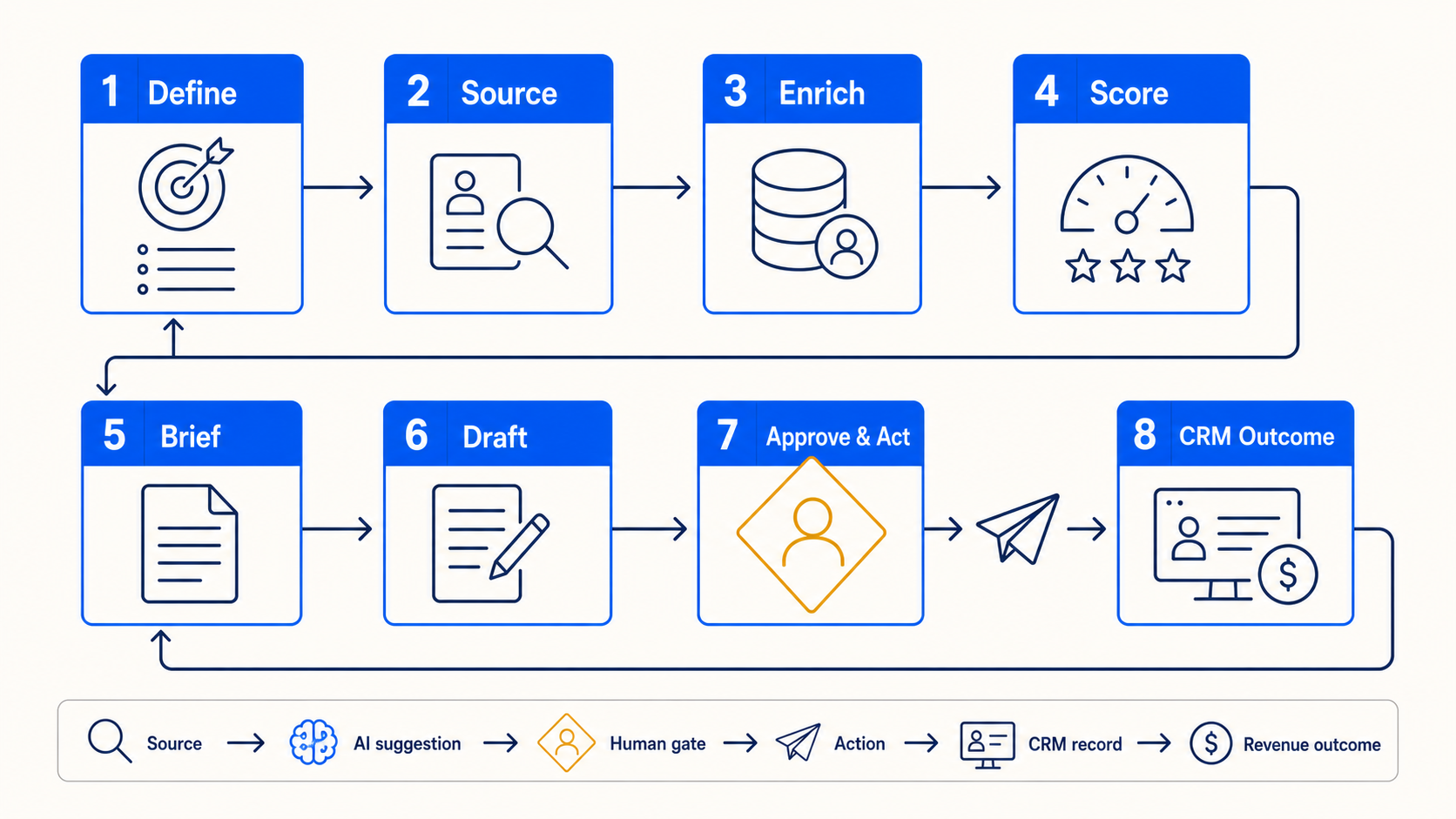
The Revenue Trace is a way to keep AI work connected to a commercial result. At every stage, the team records the input, the model’s contribution, the human decision, the system-of-record field and the next measurable outcome.
StageInputAI contributionHuman decisionCRM evidenceUseful outcome
DefineMarket, offer and sales processOrganize criteria and edge casesApprove ICP and qualification ruleRule version and ownerConsistent acceptance decision
SourcePermitted account and contact sourcesFind or normalize candidatesApprove source and target setSource URL/system and retrieval dateReviewable account sample
EnrichThin account/contact recordsAdd or refresh decision-relevant fieldsAccept, reject or leave unknownField source and freshnessMore complete records without hidden assumptions
ScoreFit, timing and evidence fieldsRank and explainOverride or approve recommendationComponent scores and reviewerBetter prioritization, not automatic qualification
BriefVerified public and company-owned evidenceSummarize facts and label inferencesConfirm the reason to contactEvidence links and unresolved gapsDefensible account context
DraftApproved brief and real offerDraft channel-appropriate variantsEdit and approve final wordingMessage version and hypothesisRelevant external action
QualifyReply, form context or call resultClassify and suggest routeConfirm disposition and next stepHuman decision and reasonQualified conversation or nurture path
LearnOutcomes and exceptionsSurface patternsUpdate, limit or retire the ruleChange log and outcomeBetter next decision
Eight-stage Revenue Trace from ICP definition and sourcing through human approval, CRM outcome and feedback.
The Revenue Trace connects every AI suggestion to evidence, a human decision and a downstream outcome.

1. Define the ICP, buying situation and qualification rule

Start with a profile that can reject accounts. Industry, geography, company size and business model may define basic fit, but they are rarely enough. Add an observable buying situation connected to the offer: a new sales leader, a regional expansion, a hiring pattern, a product launch, a technology migration or another current operating change.
Then define the event that changes the record’s status. In my outbound workflow, a qualified opportunity begins with the first positive response after the main offer and price are known. For inbound, the page or CTA can carry part of that context. A buyer requesting a demo from an offer-specific page is not the same as someone downloading a general checklist.
This definition prevents opens, clicks and generic replies from becoming pipeline merely because a dashboard needs a positive number.

2. Find accounts and contacts from permitted sources

Source permission comes before enrichment. Record where the account or contact came from, when it was retrieved and what use is permitted. A public page, licensed database, first-party CRM record and platform search result can have different limits.
In the workflow I used, Clay and Apollo supported account and contact sourcing. That does not mean every record available in either system should be contacted. The source system creates a candidate. The team’s ICP, suppression rules, territory logic and channel policy decide whether that candidate should proceed.
For LinkedIn-specific prospecting, use permitted product interfaces and approved integrations. LinkedIn’s current guidance says it does not permit third-party crawlers, bots, browser plug-ins or extensions that scrape or automate activity on its website. Our separate human-gated LinkedIn prospecting guide covers that channel in more detail.

3. Enrich and verify the account record

Enrichment should add only fields needed for the decision, such as current role, company domain, industry, company size, technology, verified work email, phone number or a recent company event.
Clay’s official documentation describes enrichment waterfalls that query providers in a chosen sequence. Apollo’s documentation describes saved-record, CRM, form, scheduled and API enrichment. Those capabilities are useful, but the workflow still needs three controls:
For every field, record its purpose, source and retrieval date, plus the rule used when two sources disagree.
Do not turn a missing value into a confident inference. Unknown is a valid state. A blank phone number is less damaging than a wrong number treated as verified. A previous job title should not become a reason to contact someone at a company they left.

4. Score fit, timing and evidence separately

A single score hides too much. A company can be a strong fit with no current buying signal. Another can show a timely event but sit outside the addressable market. A third can appear promising only because the underlying evidence is weak.
Use at least three components:
  • Fit score: how closely the account and contact match the approved profile.
  • Timing score: whether a current, observable situation makes the conversation relevant now.
  • Evidence confidence: whether the source is current, attributable and strong enough to support an action.
The final rank can combine them, but sellers should still see the components. The model should not silently convert a weak signal into a high-priority record.
In the internal dataset used later in this guide, 7,520 records were analyzed and 1,627 passed the fit-scoring process. Those 1,627 records were fit-qualified for campaign review. They were not yet qualified opportunities. That difference is easy to lose when one field is called qualified across every funnel stage.

5. Build a source-linked account brief

The account brief should help a seller answer three questions: why this company, why this person and why now?
A useful brief contains account and contact identifiers, verified fit criteria, the current signal and source, the hypothesis connecting it to the offer, unresolved gaps and the recommended next action.
Facts and inferences should be visibly different. “The company announced a new region” is a fact when linked to the announcement. “The expansion may increase reporting complexity” is an inference. A seller can use the second sentence as a hypothesis, but not as a claim that the buyer has admitted a problem.
This is why the handoff is part of the product. A polished recommendation without its evidence creates work for the seller and risk for the company.

6. Draft outreach from one verified reason to contact

Good AI-assisted outreach starts from one defensible reason, not a collage of personal details. Give the model the recipient’s role, the verified situation, the problem hypothesis, the proof your company is allowed to claim and the desired next step. Ask for a small number of concise variants.
The prompt should prohibit invented pain, unsupported compliments, fake familiarity, sensitive detail and any buying-intent statement stronger than the source supports.
In my workflow, Claude Code generated custom message drafts from enriched records. A person reviewed the first variants, corrected unsupported details and approved the message logic before records moved into lemlist or another outreach tool. Claude Code was a drafting and workflow component, not the sender with final authority.
The useful personalization often changed the commercial frame. It did not add an extra compliment. If a company source showed that an agency already worked in voice AI, the draft used a possible white-label partnership frame. It did not pretend the recipient was a conventional software buyer. If the site showed a different vertical or client model, the proposed use case changed with it. The evidence determined whether we proposed an AI receptionist, a sales agent or another workflow.
A late-sequence message could mention a missing chat experience only after a separate website check. Our internal wording was no chat widget detected during review. We did not use the absolute claim you have no chatbot. If the check was uncertain, the message lost that line.

7. Qualify, route and nurture with visible human gates

AI can summarize a reply, identify a likely objection or suggest a route. A person should confirm the commercial meaning when the response is ambiguous or the next action affects a buyer.
The disposition should match the evidence:
Observable eventAppropriate stateHuman question
Accepted connectionConnectedIs there a reason to start a conversation?
Generic replyRepliedDid the response move the offer forward?
Interest after the pitchInterested after pitchHas the buyer also seen the price and accepted a next step?
Positive response after offer and priceQualified outbound opportunityWho owns the next commercial action?
Submission from an offer-aware pageQualified inbound lead under the page ruleDoes the submission meet routing and exclusion criteria?
“Not now” with a defined timing signalNurtureWhat event and date should trigger review?
This prevents an AI classifier from upgrading a polite reply into an opportunity. It also prevents a useful “not now” from disappearing into a generic closed-lost field.

8. Write decisions and outcomes back to CRM

The CRM should preserve what the system suggested and what the person decided. If the human decision overwrites the model recommendation, the team loses the evidence needed to improve prompts, scores and source rules.
At minimum, write back the source, retrieval time, score components, evidence, AI suggestion, reviewer, approval state, message version, action, response and final disposition. The record should show what changed and why.
That feedback closes the loop. A good lead-generation system does not merely send more. It learns which records sales accepts, which reasons produce useful conversations and which rules create noise.

03 / Build the workflow

How to build a human-gated AI lead-generation workflow

Build the workflow around one operating decision, then approve the first output at every new stage. Human review is not a final safety click. It is how the team discovers whether sources, definitions, messages and routing rules work before mistakes scale.
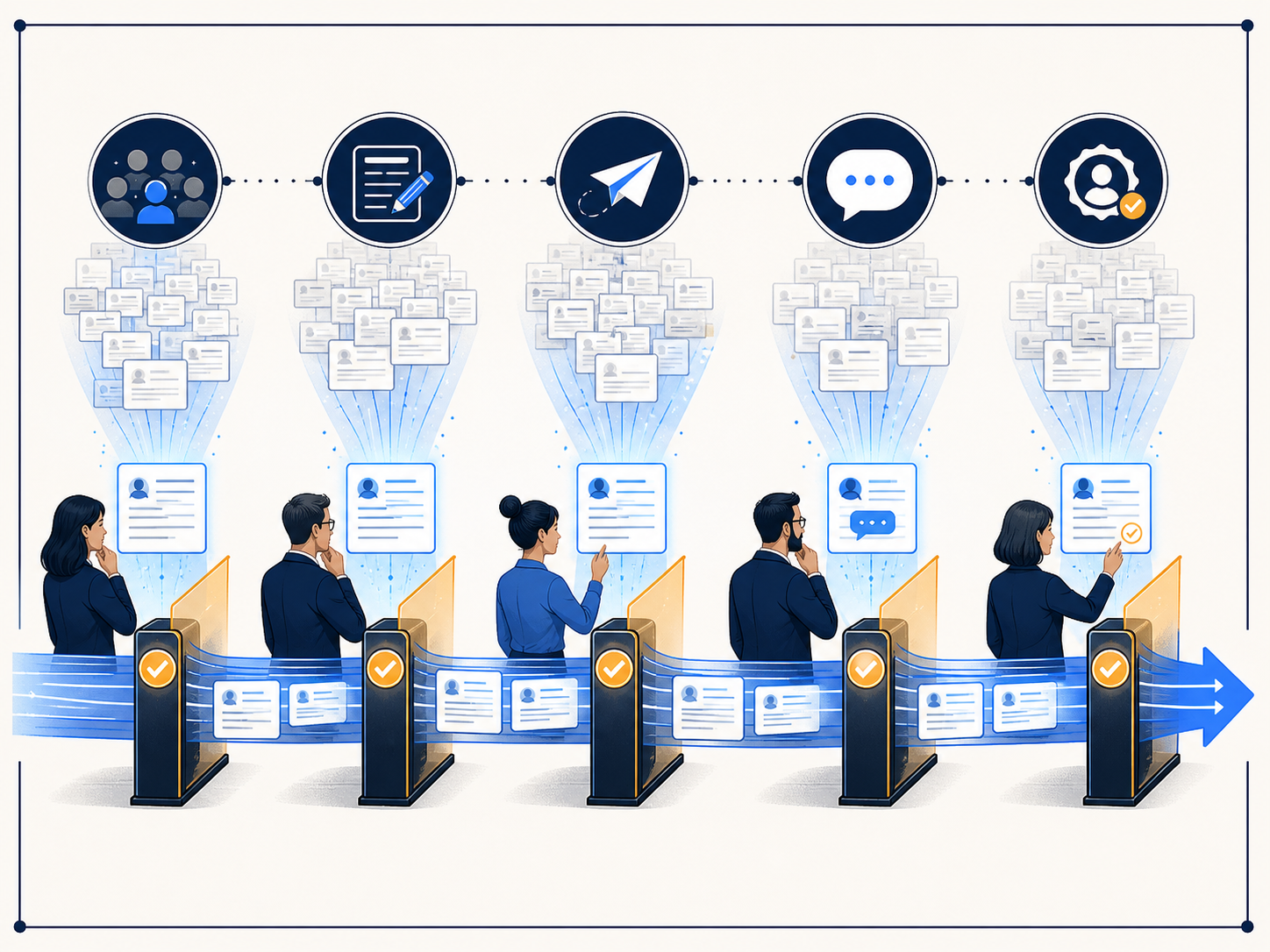
Human reviewers checking small samples at five stages before an AI-assisted sales workflow scales.
Review the first leads, drafts, sends, replies and qualification decisions before increasing automation.

Choose one operating decision and establish a baseline

Do not begin with “automate prospecting.” Choose one decision: which accounts enter research, which enriched records are accepted, which evidence supports a message, which replies reach a seller or which records enter nurture.
Document the current process first. Record the sample, period, numerator, denominator and owner. If the existing workflow cannot explain what counts as a positive reply or opportunity, adding AI will make the reporting faster, not clearer.

Write source, freshness and evidence rules before selecting a tool

Create a rule sheet that names permitted sources, required fields, freshness limits, conflict handling and prohibited inferences. A job title may need recent verification. A company announcement may remain relevant for months. A social post may be useful for one message and inappropriate for automated storage.
Tool selection comes after this sheet. Otherwise, the fields exposed by a vendor become the strategy by default.

Generate or enrich a controlled account sample

Start with a small batch that a seller can inspect record by record. The exact size depends on sales complexity, but it should be large enough to reveal repeated errors and small enough to correct without operational damage.
Review the first sample for wrong accounts, stale roles, duplicates, missing evidence, irrelevant fields, unverifiable records and channel suppressions. The sample is not a ceremonial pilot. Its rejection reasons become the first version of the operating rule.

What I checked in a 23-record pilot before allowing scale

In a later pilot, I started with an exported pool of more than 500 UK companies. The filters covered self-employed and 1–10-employee businesses using tools such as n8n or GoHighLevel. That export was a candidate pool, not a qualified-lead count. After qualification, enrichment and correction, 23 records entered the reviewed campaign batch. Every sequence step used the approved company and contact context. Campaign outcomes were not yet available when this guide was written.
The review combined model work, deterministic checks and human judgment:
CheckControl used in the pilotStop or correction rule
Company identityUse only a real, verified company domainDo not invent a domain or import an unresolved company
Contact identityMatch the enriched name and company to a current LinkedIn profileNo verified profile or a company mismatch stops the contact
Competitive fitCompare the company offer with the campaign's exclusion listExclude companies already selling a directly competing voice AI product
Vertical and offer fitRead the company's services, customer examples and project descriptions when availableKeep missing context unknown; do not manufacture a use case
Website chat stateRun a script-level check and inspect the visible siteMention only that no widget was detected during review; remove the claim if uncertain
Message constraintsDraft each step from the verified record and run a 290-character internal ceiling for LinkedIn invitationsShorten, correct or reject before the sequence is approved
The company record preserved the website, LinkedIn page, industry, size, location and description. It also stored a 1–10 ICP-fit score, a short qualification reason and the assigned segment. The linked contact record preserved the name, title and verified LinkedIn URL. This structure let me inspect the reason behind a message instead of reviewing prose without its evidence.

Rank recommendations without hiding the reason

Every prioritized record should show its score components and the evidence behind them. A seller needs to understand why record A sits above record B and how to challenge the ranking.
Use a review card such as:
FieldExample value
Fit8/10: approved industry, region and company size
Timing6/10: relevant hiring event, but no confirmed project
Evidence9/10: current first-party company source
AI suggestionReview for outbound
Human decisionApprove, reject or research
ReasonRequired free-text or coded disposition
Avoid opaque auto-rejection when the score affects access to human review. The team should be able to audit exclusions by segment and identify harmful or irrelevant proxy fields.

Require seller review before any external action

Before the first send in a new workflow, a named seller or RevOps owner should verify the account, current role, evidence, message claims, tone, offer and channel action. The reviewer must be able to change or reject the output.
In my process, human approval was mandatory for the first collected leads, first messages, first sends, first replies and first filtering decisions. AI did not perform any of those stages perfectly. The first reviewed sample exposed the corrections required before the next batch.
This is the central rule: the first output of every new stage is a test, not production truth.

Execute through an approved channel

Once the record and message pass review, execute through a permitted organizational workflow. Lemlist was one system used to import approved leads, preview per-lead content and launch outreach. Other sequencing, task or CRM tools can fill that role.
The execution system should preserve the approved records and content, owner, schedule, stop conditions, duplicate and suppression rules, reply and opt-out handling, and the identifier required for CRM write-back.
Technical capability is not permission. A tool may support a channel action that a platform agreement, local law or company policy restricts.

Record dispositions, exceptions and outcomes

Use structured dispositions instead of a single “good/bad lead” field. Record why a lead was rejected, what exception occurred, how a reply was interpreted and which next step was approved.
Useful dispositions include wrong account, wrong person, stale data, unsupported signal, duplicate, channel restriction, no response, negative reply, referral, nurture, interested after pitch, qualified opportunity and disqualified after conversation.
Free-text notes can add context, but the core categories should be reportable. Otherwise, the model cannot be evaluated and RevOps cannot locate where the process fails.

Update or retire the rule based on evidence

Review outcomes by segment, source rule, signal and message hypothesis. Do not teach the model to copy whichever message earned a reply. A negative answer from the right buyer may validate targeting. A positive answer triggered by an exaggerated claim may indicate risk.
Retire or narrow the rule when repeated seller rejections share one cause, evidence cannot be verified, a segment creates activity without qualified outcomes, risk exceeds likely value, review work grows or the underlying offer is still unstable.
Campaign results can vary sharply even when the stack looks similar. That is a reason to inspect segments and exceptions, not to search for one universal prompt.

04 / Tool selection

AI lead-generation tools by workflow stage

Select AI lead-generation tools by the job they perform and the evidence they preserve. A useful stack does not need the most products. It needs clear inputs, visible human gates, reliable handoffs and one system of record.
Workflow stageTool jobQuestions to askExample categories
Data and enrichmentFind, verify or refresh fieldsWhat is the source, freshness and conflict rule?Prospecting databases, enrichment waterfalls, validation services
Lead intelligence and intentSurface relevant changes or signalsCan a seller reopen the evidence?Company intelligence, first-party behavior, licensed intent data
Scoring and qualificationRank and route recordsAre components visible and overrideable?CRM scoring, predictive models, rule engines
Research and personalizationCreate a source-linked brief or draftWhich facts are allowed, and who approves?AI workspaces, coding agents, sales copilots
Outreach and nurturingExecute approved channel actionsAre previews, limits, suppressions and stop rules visible?Sequencing tools, task systems, marketing automation
CRM and measurementPreserve decisions and outcomesDoes write-back separate suggestion, approval and result?CRM, warehouse and revenue analytics

Data and enrichment systems

Evaluate data tools on coverage, provenance, freshness, validation, field control and cost per accepted record. More returned fields do not create better targeting unless they improve a defined decision.
Clay and Apollo served this stage in my workflow. Their documentation describes waterfall and multiple record-enrichment methods. Teams still need to test coverage and errors in their own market.

Lead-intelligence and intent systems

Lead intelligence should expose the observation behind a signal. “Hiring 12 BDRs” is inspectable. “High intent” is not useful unless the user can see the event, source and age. Keep first-party behavior, public change, licensed data and model inference distinct.

Scoring and qualification systems

Scoring tools should show component inputs, override history, routing action and maintenance owner, including how they handle missing data and feedback from disqualified opportunities.
Keep tool selection separate from scoring design. A dedicated comparison of lead-scoring software is a different buying task from defining the qualification rule. In this pillar, the rule comes first.

Research and personalization systems

Research systems should accept approved records, preserve source links, constrain output and support review. Claude Code was the custom drafting layer in my workflow; another coding agent, internal application or sales copilot could perform the same role.
The evaluation question is not whether the system can write an email. It is whether the seller can trace every material sentence to approved evidence and change the final message before it leaves the company.

Outreach and nurturing systems

Outreach tools should provide per-lead preview, schedules, duplicate handling, suppressions, reply detection and CRM write-back. Nurture tools should preserve the event and date that causes review.
Lemlist documents campaign imports, per-lead previews and multichannel steps. That is a capability description, not a recommendation to automate every action. The team remains responsible for configuration and use.

CRM, routing and measurement systems

The CRM remains the system of record even when enrichment, drafting and execution happen elsewhere. Define which system creates or updates each field and which values automation must not overwrite.
If a tool can write a score but not its reason, or an outcome but not its denominator, the integration is incomplete.

05 / Human review

What a seller or RevOps owner must still review

Human review should protect the decisions that can damage trust, waste seller time or change pipeline. The owner is not there to approve “AI use” in general. The owner reviews specific evidence and has the authority to reject the next action.

Account fit and current buying situation

Confirm that the company still matches the approved segment and that the contact still holds a relevant role. Review whether the supposed buying situation is current and connected to the offer. A funding announcement, hiring plan or technology change may be real without being commercially relevant.
The reviewer should be able to explain why this account, why this person and why now without repeating the model’s score.

Source accuracy, freshness and unsupported inference

Open the source behind any detail used for ranking or messaging. Check the publication date, company identity and whether the model has combined two different entities. Mark an inference as an inference.
Reject or research the record when the source is missing, too old for the decision, contradictory or not permitted for the intended use. A plausible summary is not a substitute for provenance.

Message claims, tone and proportionality

Read the message as the person whose name appears in the sender field. Could that seller defend every claim on a live call? Is the amount of personal detail proportionate? Does the message imply surveillance, a prior relationship or a problem the buyer never stated?
Remove language that turns a possibility into certainty. “Teams in this situation often see…” is more defensible than “You are struggling with…” when the source only confirms a company change.

Qualification, routing and next action

The person reviewing a reply decides whether it meets the documented threshold, belongs to another owner, needs clarification or should enter nurture. AI can propose a disposition, but it should not create an opportunity from a polite response without the required commercial event.
For ambiguous cases, preserve the original reply and the reviewer’s reason. That record becomes useful training material for both the team and future classification rules.

06 / CRM evidence

What belongs in the CRM

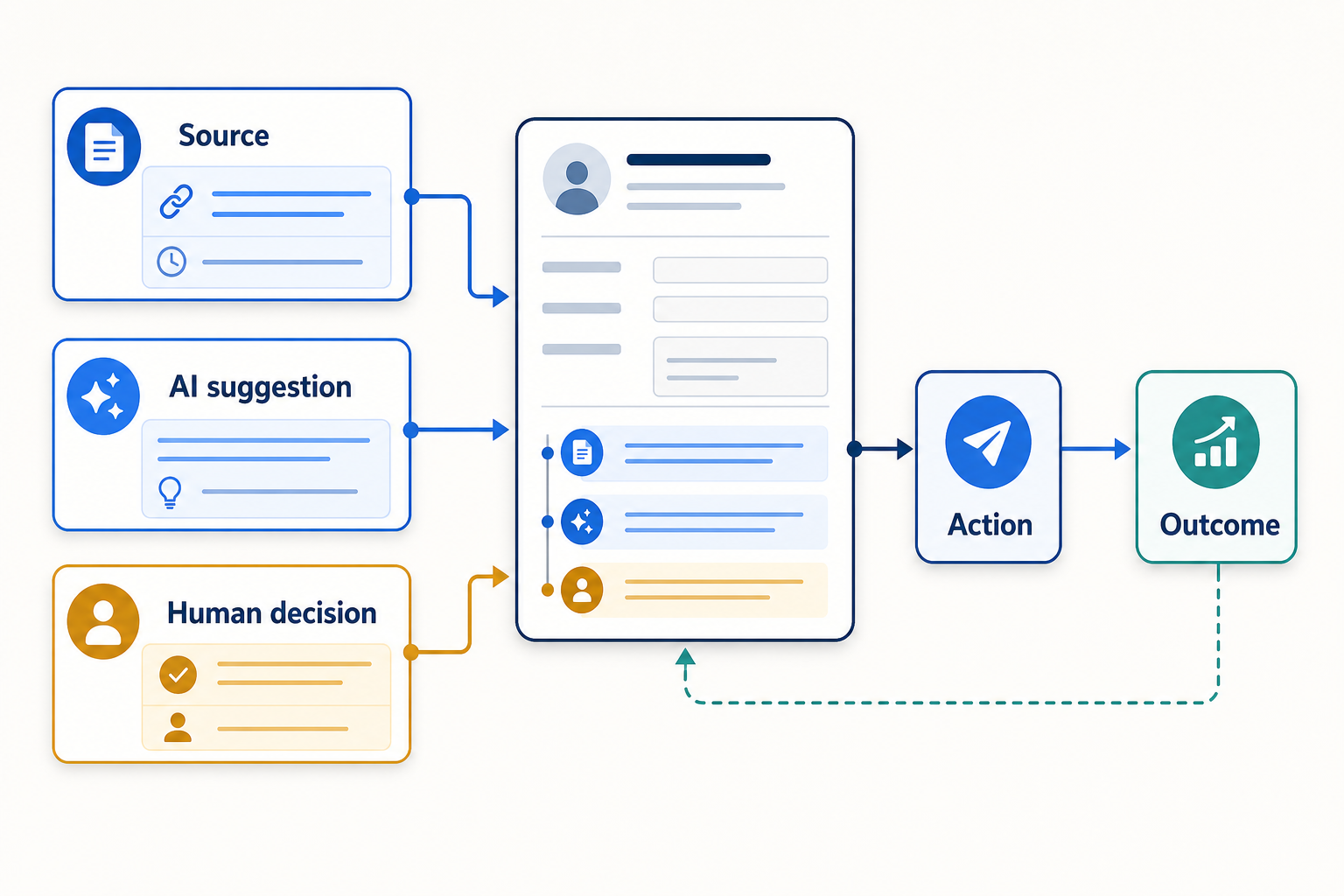
An AI lead-generation record needs enough structure to reconstruct the decision. Store the source, model suggestion, human approval, external action and outcome separately.

Source, timestamp and reason-to-contact fields

The minimum evidence layer includes the source system or URL, retrieval date, verified fact, inferred relevance, confidence and freshness status. The reason-to-contact field should be short enough for a seller to review but specific enough to challenge.

Model suggestion, reason, reviewer and approval state

Keep the AI suggestion, model or workflow version, component reasons, human reviewer, decision time and approval state. If the reviewer changes the score or route, store the override reason instead of replacing the original suggestion.

Message hypothesis, channel and external action

Record what the team expected the message to test, which version was approved, the channel, sender, action time and execution-system identifier. This turns outreach into a reviewable experiment instead of an isolated activity count.

Outcome, disqualification reason and next-review trigger

Use structured fields for reply type, interest, qualification, opportunity, disqualification reason, referral, nurture trigger and next-review date. Keep unknown downstream results blank. Do not infer a meeting, opportunity or customer because a previous stage looks positive.
CRM fieldExampleOwnerWhy it matters
Source recordCompany announcement URLResearch workflowLets a reviewer reopen the evidence
Retrieved at2026-08-11Research workflowSupports freshness checks
Fit / timing / evidence8 / 6 / 9Scoring workflowPreserves score components
AI suggestionReview for outboundAI workflowRecords what the system recommended
Human decisionApproved with editSellerKeeps accountability visible
Decision reasonRole verified; timing claim softenedSellerCreates usable feedback
Message versionOUT-ICP2-V3Outreach ownerConnects result to the tested hypothesis
External actionEmail sentExecution systemDistinguishes draft from action
DispositionInterested after pitchSellerPreserves the observed stage
Qualified opportunityNo / not yet assessedSales ownerPrevents premature pipeline inflation
Next reviewAfter pricing responseSales ownerMakes the next decision explicit
CRM record preserving source evidence, AI suggestion, human approval, external action and outcome as separate fields.
An auditable CRM handoff keeps the model’s suggestion separate from the seller’s decision and the real outcome.
The full Luck My Sales handoff analysis explains why these transitions often matter more than the model itself.

07 / Measurement

How to measure whether AI lead generation works

Measure qualified outcomes first. Use activity, response and efficiency measures to diagnose the workflow, not to declare success on their own.

Primary outcomes: qualified conversations, accepted leads and opportunities

Choose a primary outcome that matches the sales process. Examples include a lead accepted by sales under a documented rule, a qualified conversation, a held meeting that passes qualification or an opportunity created under a specific CRM stage rule.
For the outbound workflow in this guide, the commercial threshold is a positive response after the main offer and price are known. For offer-aware inbound pages, the submission context can satisfy part of that threshold, subject to routing and exclusion rules.
Primary outcomes should always have an owner and next action. A status with no person responsible for advancing or disqualifying it is not a useful sales outcome.

Diagnostic metrics: validity, approval, rejection, response and meeting rates

Diagnostic metrics show where the system is working or failing. Define the numerator and denominator next to every rate.
MetricFormulaWhat it diagnosesWhat it cannot prove
Record validity rateValid records ÷ records reviewedData qualityBuyer interest
Seller approval rateRecords approved ÷ records reviewedFit and evidence qualityMessage effectiveness
Rejection rateRecords rejected ÷ records reviewedRule or source problemsThat every rejected record was bad
Connection acceptance rateAccepted invitations ÷ invitations actually sentChannel/list relevanceQualified opportunity creation
Reply rateUnique contacts replying ÷ delivered or sent contacts, defined in advanceMessage/list responsePositive commercial intent
Interested-after-pitch rateInterested responses ÷ contacted recordsOffer engagementPrice acceptance or opportunity
Qualified-opportunity rateQualified opportunities ÷ contacted recordsCommercial resultClosed revenue
Meeting-held rateHeld qualified meetings ÷ contacted recordsConversation progressionOpportunity quality or revenue
Do not switch denominators between campaigns. An acceptance rate based on invitations sent cannot be recalculated from all contact records. A reply rate based on total messages is not comparable with a rate based on unique recipients.

An anonymized first-hand campaign funnel

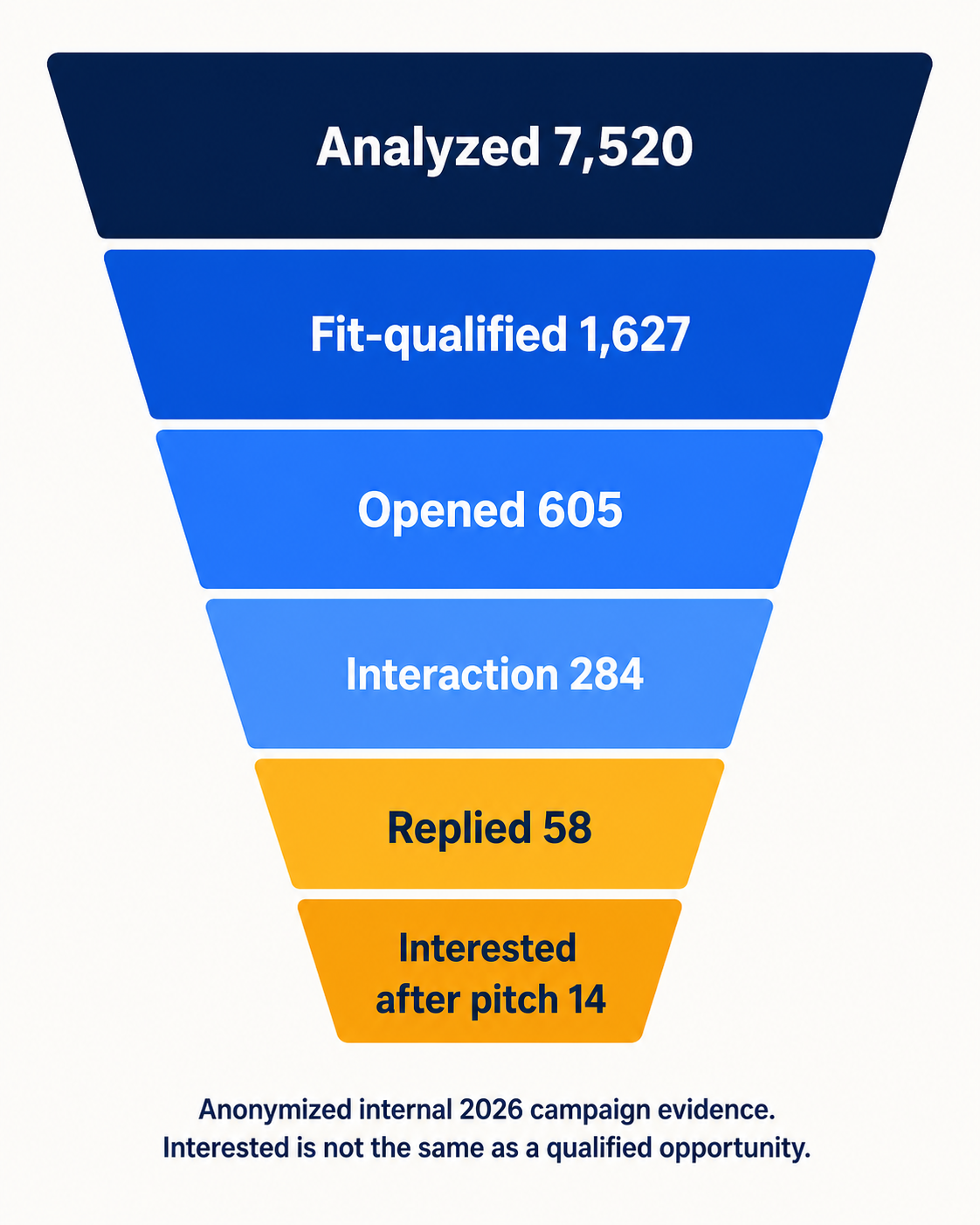
The following funnel comes from an anonymized internal 2026 campaign record from my workflow. The company, offer and buyer identities remain private.
Stage shownCountShare shownCorrect interpretation
Records analyzed7,520100.0%Starting records evaluated by the fit process
Records rejected5,89978.4%Records removed before campaign activation
Records retained as fit-qualified1,62721.6%Records that passed pre-campaign scoring, not qualified opportunities
Opened60537.2%Recorded opens; a diagnostic activity signal
Interaction28417.5%Campaign-defined engagement state
Replied583.6%Replies under the campaign record
Interested after pitch140.9%Interest after the offer pitch; price exposure is not confirmed
Anonymized funnel showing 7,520 analyzed records narrowed to 1,627 fit-qualified records, 58 replies and 14 interested responses after the pitch.
The funnel shows operational filtering and response stages; it does not show confirmed opportunities or revenue.
Fourteen of the 58 replies were labeled interested, or approximately 24.1% of recorded replies. That calculation describes the relationship between two campaign fields. It does not establish 14 qualified opportunities because the evidence does not confirm that the price had been presented. Calls, contracts and customers were blank in the supplied funnel.
The source material also showed five AI BDR campaign rows with materially different connection and response outcomes. The acceptance-rate denominator was people who were actually sent invitations, not every record in the contacts column. Because the sent count is not visible for each row, those rates should not be pooled or recalculated from the displayed contact totals.

What the comparison suggests—and what it cannot establish

Compared with the AI-assisted customized workflow, I observed that the earlier workflow had an approximately 10–15% lower connection rate and about 30% fewer replies on average.
That is a first-hand directional observation, not a controlled benchmark. The raw before-and-after rates, matched cohorts and stable denominator were not available for this article. List source, buyer segment, offer, channel and timing may also have changed. The evidence supports a practical hypothesis worth testing: better research and customization may improve response. It does not prove that this workflow will deliver the same uplift for another team.
The stronger lesson is visible in the campaign variation. AI assistance did not produce one uniform result. Sample review and segment-level learning mattered.

Efficiency metrics: time and cost per reviewed account

Efficiency belongs in the measurement plan even when conversion is the primary goal. Track research minutes per reviewed account, cost per enriched record, cost per seller-approved record, review time per message and cost per qualified opportunity.
Measure the full human workload. A workflow that generates briefs quickly but doubles verification time may move work rather than remove it. A system that rejects weak accounts earlier may be valuable even when reply rate stays flat.
The first-hand evidence used in this article does not contain reliable time or cost measures, so it cannot support an efficiency claim.

Baseline, sample, period and attribution limits

Before comparing workflows, record the segment, exclusions, source and freshness window, offer, price presentation, channel, sender conditions, sample, numerator, denominator, observation period, version changes, primary outcome and stop condition.
Keep caveats beside the number they qualify. A methodology page adds useful context, but it should not rescue a naked claim elsewhere. See the Luck My Sales methodology for our evidence states and correction protocol.

08 / Risk controls

Failure modes, compliance and operating risk

AI lead generation fails when weak inputs become confident actions. The operating response is not a generic warning. It is a visible signal, named human control and stop rule.
Failure modeObservable signalHuman controlStop rule
Weak or stale dataWrong role, duplicate or missing sourceReopen source and sample recordsPause when repeated errors exceed the team’s accepted threshold
False personalizationClaim cannot be tracedSeller removes or rewrites itNo source, no personalized claim
Biased or opaque scoringSegment rejected for unexplained reasonsAudit components and overridesNo automatic exclusion without a reviewable reason
Unauthorized platform actionTool automates restricted behaviorCheck current official termsDisable the action until permitted use is confirmed
Commercial-email noncomplianceMissing sender identity or opt-out processCompliance and operations reviewDo not launch until required controls work
Activity without pipelineSends rise while qualified outcomes do notCompare segment outcomesDo not scale based on activity metrics alone

Weak or disconnected source data

AI can organize incomplete data; it cannot make it current. Salesforce’s vendor-published 2026 survey of 4,050 sales professionals reported data-quality, duplicate-data and silo concerns around AI initiatives. It reinforces a constraint, not a product verdict: output depends on data the team can govern.
Stop the workflow when a reviewer cannot reopen the source or when repeated conflicts have no resolution rule. Add another provider only if it improves the specific field and decision; do not add tools to disguise a broken ownership model.

False personalization and fabricated buying signals

A model may produce a fluent reason to contact from weak evidence. It can confuse companies with similar names, present an old event as current or convert a general trend into a claim about one buyer.
Require source-linked claims and label inference. If the seller did not review the referenced post, article or event, the message should not imply that they did. The purpose of personalization is to make relevance clearer, not to make a generic message look observed.

Biased scoring and invisible exclusions

Scoring can encode historical territory choices, missing-data patterns or proxy fields that have little to do with buying fit. Review which fields influence rank, how missing values behave and whether one segment is excluded disproportionately.
Do not let an opaque score become the only path to seller attention. Maintain an exception route and sample rejected records. Sensitive or regulated use cases require specialist legal and compliance review beyond this guide.

Unauthorized scraping or automated engagement

Platform access and action rules change. Check the current agreement and help documentation for every channel before launch.
LinkedIn’s current prohibited-software guidance says the platform does not permit third-party crawlers, bots, browser plug-ins or extensions that scrape, modify or automate activity on LinkedIn. Its User Agreement also tells users to review AI-generated content before relying on or sharing it. Do not assume a vendor feature overrides those rules.

Commercial-email, deliverability and consent risk

For US commercial email, the Federal Trade Commission states that CAN-SPAM applies to commercial messages and makes no exception for business-to-business email. Its guidance covers accurate header information, non-deceptive subject lines, identification, a valid postal address, opt-out instructions, prompt honoring of opt-outs and monitoring vendors that send on a company’s behalf.
CAN-SPAM is not the only rule that may apply. Recipient location, data source, industry and channel can create additional requirements. This article provides operating considerations, not individualized legal advice. Consult qualified counsel for the jurisdictions and data involved.
Deliverability also needs operational controls: verified addresses, suppression lists, sender setup, volume limits, bounce handling and message quality. A legally permissible message can still damage a domain or brand when sent carelessly.

Activity growth without pipeline improvement

The easiest AI metric to improve is output volume. It is also one of the least useful. If messages, connections and replies rise while qualified conversations remain flat, diagnose the segment, evidence, offer and qualification rule before adding more volume.
The Microsoft 2026 Work Trend Index surveyed 20,000 AI-using knowledge workers across 10 markets and keeps human judgment central to organizational AI design. It is not sales-specific evidence, but the implication fits lead generation: prompting cannot substitute for rules, owners and feedback.

09 / Pilot plan

A practical pilot plan for a B2B revenue team

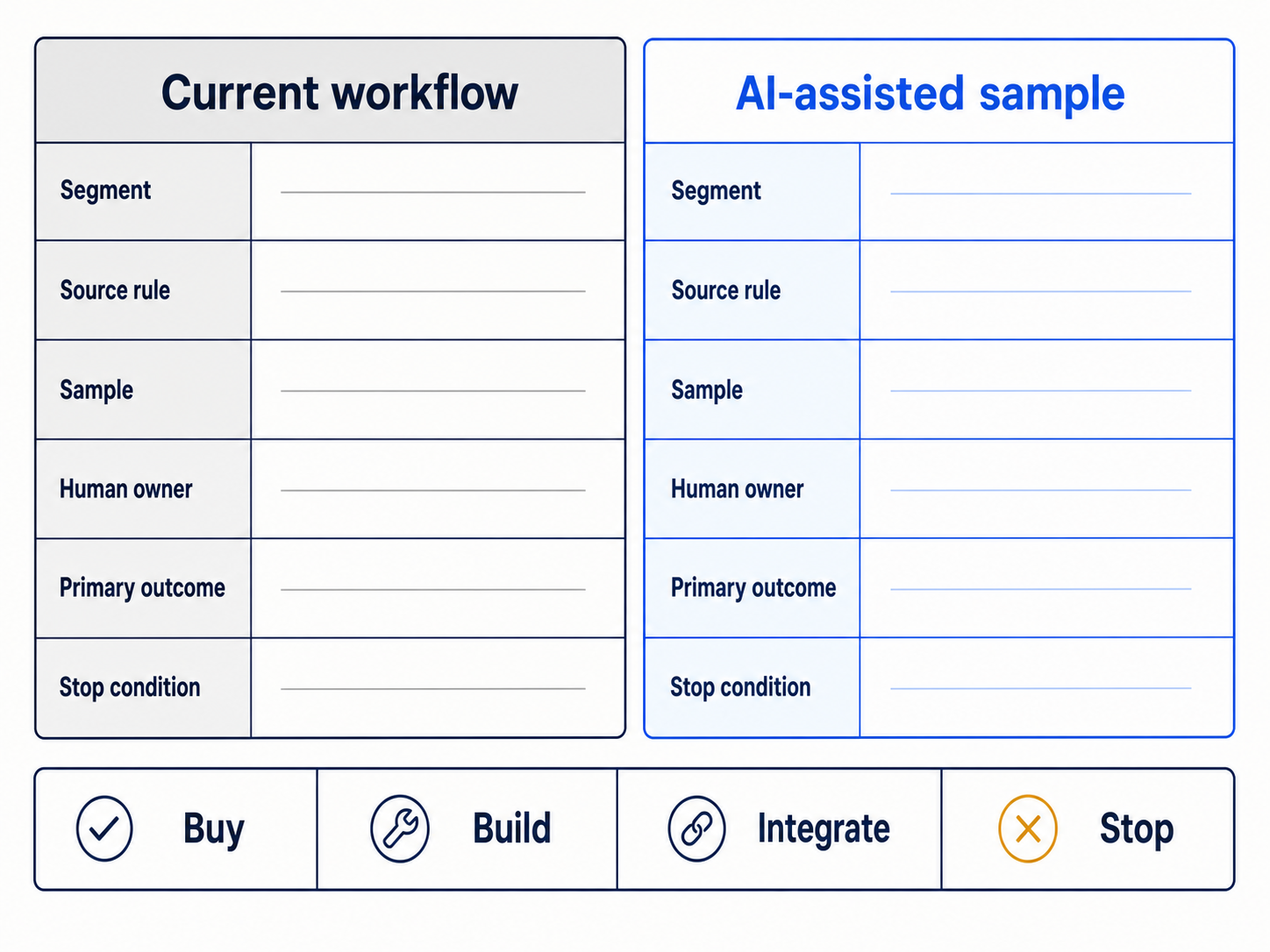
Run a narrow pilot that compares an AI-assisted sample with the current workflow under the same definitions. The pilot should support one of four decisions: buy, build, integrate or stop.

Scope one ICP, one signal, one owner and one channel

Choose one buyer segment, one observable signal, one accountable reviewer and one external channel. Fix the offer and qualification rule before the sample begins.
For example, test US B2B software companies in one size band, one current hiring or expansion signal, one SDR manager, outbound email only and a qualified-opportunity rule based on a positive response after the offer and price.
This is narrow by design. A pilot that changes list source, channel, offer and message at once cannot explain its result.

Compare a controlled AI-assisted sample with the current workflow

Use similar cohorts and the same outcome definition. Record the differences between workflows explicitly.
Pilot fieldCurrent workflowAI-assisted sample
SegmentSame documented segmentSame documented segment
Source ruleCurrent permitted sourcesSame sources unless source is the tested variable
SampleDefined unique accounts/contactsComparable unique accounts/contacts
Human ownerNamed reviewerSame reviewer or controlled assignment
Message/offerCurrent approved offerSame offer; documented drafting change
Primary outcomeOne defined qualified eventThe same qualified event
Diagnostic metricsValidity, approval, replySame formulas and denominators
Stop conditionExisting risk limitPredefined error, policy or quality limit
Blank scorecard comparing a current sales workflow with a controlled AI-assisted sample using the same fields and stop condition.
A useful pilot compares the same segment and outcome definition, then supports a buy, build, integrate or stop decision.
Do not choose a success threshold after seeing the results. Set it from the current baseline, expected operational value and risk tolerance.

Review exceptions before increasing automation

Inspect rejected records, corrected facts, rewritten messages, unusual replies and channel exceptions. Ask whether errors are random or systematic. A repeated error needs a rule, source change or stopped workflow—not more reviewer patience.
Scale only when the team can explain what the AI does, what the human decides and how mistakes are detected before external action.

Decide whether to buy, build, integrate or stop

  • Buy when a product covers the required workflow, evidence and controls with less operating cost than a custom system.
  • Build when the decision logic or data boundary is proprietary and the team can own maintenance, security and evaluation.
  • Integrate when existing systems cover the stages but need a controlled handoff and CRM write-back.
  • Stop when the baseline is undefined, the source is not permitted, evidence quality is too weak or the workflow does not improve a revenue-relevant decision.
The best pilot result is not always a purchase. A clear stop decision can prevent months of automation around an offer or process that still needs manual work.

10 / Checklist

AI lead-generation checklist

Before launch

  • Define the ICP and at least one observable buying situation.
  • Define contact, fit-qualified, reply, interested and qualified opportunity for this workflow.
  • Choose one primary outcome closer to revenue than activity volume.
  • Record permitted sources, freshness rules and prohibited inferences.
  • Decide which fields enrichment may add or overwrite.
  • Separate fit, timing and evidence confidence.
  • Require a source link for every material reason to contact.
  • Name the human owner for the first lead batch, first message, first send, first reply and first qualification decision.
  • Map the AI suggestion, human decision, action and outcome to separate CRM fields.
  • Define numerators, denominators, sample and observation period.
  • Configure suppressions, opt-outs, duplicate handling and channel limits.
  • Set stop conditions before seeing the results.

After the first run

  • Review rejected records and categorize repeated failure reasons.
  • Check whether sellers can reopen the evidence behind approved messages.
  • Compare outcomes by segment, source, signal and message hypothesis.
  • Separate all replies from positive replies and qualified outcomes.
  • Measure verification and review time, not generation time alone.
  • Confirm that CRM write-back preserved both the model suggestion and human override.
  • Check that no missing downstream state was silently converted into success.
  • Recheck current platform and legal requirements before expanding channels.
  • Update, narrow or retire rules that create noise.
Do not scale yet if reviewers cannot explain the ranking, source conflicts remain unresolved, the qualification rule is unstable, external actions bypass approval or activity is increasing without an accepted outcome.
Scale only when the team can show why a record entered, who approved the action, what reached the buyer and which outcome changed the next decision. If that chain breaks, fix the record before adding volume.

11 / FAQ

Frequently asked questions

What is AI lead generation?

AI lead generation uses AI to find, enrich, research, prioritize, contact, qualify or nurture potential buyers. A complete B2B workflow connects each suggestion to source evidence, human approval, CRM and a measurable outcome.

How do you use AI for lead generation in B2B?

B2B teams use AI for discovery, enrichment, signal research, scoring, briefs, message drafts, reply classification, routing and nurture. Humans still own source permission, factual approval, external actions, ambiguous replies and qualification.

Can AI generate qualified leads automatically?

AI can rank records against a rule, but weak activity signals should not create revenue opportunities automatically. Qualification requires a defined commercial event, preserved evidence and human validation of ambiguity.

What is the difference between AI lead generation and marketing automation?

AI lead generation may infer, rank, summarize or generate. Marketing automation executes predefined rules such as assignment, sequencing or nurture. Products often combine both, so inspect the actual decision and action.

What is the difference between an AI lead generator and an AI SDR?

An AI lead generator usually finds, enriches or ranks buyers. An AI SDR may also research, draft, sequence, classify replies and route records. Neither label proves that the system can operate safely without review.

Which parts of lead generation should not be fully automated?

Do not fully automate source permission, unsupported claims, first external actions, ambiguous replies, qualification or sensitive escalations. A named human must be able to reject, edit or stop the action.

What data does an AI lead-generation system need?

Use only permitted, current data required by the ICP and qualification rule: account, role, fit, signal, source, timestamp, confidence and relevant CRM history. Missing facts should remain unknown.

What should an AI lead-generation tool write to the CRM?

Write the source, timestamp, score components, evidence, AI suggestion, reviewer decision, action version, channel and disposition. Keep the AI recommendation separate from human approval.

How should a team measure AI lead generation?

Measure qualified conversations, accepted leads or opportunities first. Use activity and efficiency rates for diagnosis, with the numerator, denominator, sample and window beside every rate.

Are AI-generated leads accurate?

There is no universal accuracy rate. Test representative records, track field-level errors and measure seller acceptance under a documented rule for the source, field, market and freshness window.

12 / Evidence limits

First-hand evidence and limitations

The workflow and anonymized internal 2026 campaign evidence are attributed to Anastasiia Krynytska. The article does not identify the company, exact offer, clients or individual buyers. The supplied funnel ends at interested; call, contract and customer outcomes were blank. The owner-reported comparison with the earlier workflow lacks raw matched before-and-after rates, so it is presented as a directional observation rather than a benchmark or causal result.
The later 23-record pilot is process evidence, not performance evidence. The more-than-500-company UK export was the raw discovery pool, while 23 records formed the reviewed batch. The supplied captures document rules, data fields and selected sequence examples, but they are not an independent audit of every record. No response, opportunity or revenue result from that pilot was available for this article.
The named tools are examples from the author’s workflow. Anastasiia Krynytska reports no paid, affiliate, employment or client relationship with Clay, Apollo, Anthropic/Claude or lemlist. Comparable tools may fill the same workflow roles.
For corrections, source material or questions about this evidence, use the Luck My Sales corrections process.

Research note

Methodology

  1. 01Define contact, fit-qualified, interested and qualified-opportunity states before interpreting activity.
  2. 02Use official documentation for vendor capabilities, platform rules and US commercial-email requirements.
  3. 03Attribute the workflow and anonymized internal 2026 campaign evidence to Anastasiia Krynytska.
  4. 04Keep the 500-plus discovery pool, 23-record reviewed pilot and historical campaign funnel separate.
  5. 05Treat the reported connection and reply comparison as directional because matched raw baselines were unavailable.
  6. 06Keep missing calls, contracts, customers, time and cost outcomes blank rather than inferring success.
Read the full methodology

Source ledger

Sources & editorial notes

  1. 01
    State of Sales, 7th edition

    Salesforce, 2026 · Vendor-published survey of 4,050 sales professionals; used for current data-quality and system context, not independent proof of product outcomes.

  2. 02
    2026 Work Trend Index

    Microsoft · Survey of 20,000 AI-using knowledge workers across 10 markets plus Microsoft telemetry; operating-model context, not sales-specific conversion evidence.

  3. 03
    CAN-SPAM Act: A Compliance Guide for Business

    US Federal Trade Commission · US regulator guidance for commercial email, including B2B email; requirements should be rechecked near use.

  4. 04
    LinkedIn User Agreement

    LinkedIn · Official platform agreement and responsibility for AI-generated content.

  5. 05
    Prohibited software and extensions

    LinkedIn Help · Official restrictions on scraping and unauthorized automation on LinkedIn.

  6. 06
    Waterfalls

    Clay documentation · Official capability documentation for sequential enrichment providers.

  7. 07
    Enrichment Overview

    Apollo documentation · Official documentation for saved-record, CRM, form, scheduled and API enrichment.

  8. 08
    Claude Code documentation

    Anthropic · Official product documentation; the workflow description is based on author use, not a vendor performance claim.

  9. 09
    Create a lemlist campaign

    lemlist documentation · Official documentation for importing leads, reviewing a campaign and launching supported steps.

  10. 10
    Luck My Sales methodology

    Luck My Sales · Evidence states, source treatment, freshness and correction protocol.

  11. 11
    Luck My Sales AI use policy

    Luck My Sales · Permitted AI assistance and required human review.

Corrections or primary material: contact the corrections desk.

About the author

Anastasiia Krynytska

Anastasiia Krynytska is a LeadGen Team Lead at Softermii and the lead editor of Luck My Sales. She covers AI-assisted outbound, account research, qualification, messaging, CRM handoffs and revenue workflows from a practitioner’s perspective.View author profile LinkedIn

Continue reading

01 · News analysis

AI sales is moving from assistant to operating layer

The category is expanding from drafting support into research, pipeline decisions, recommended actions and controlled execution.

Read news
02 · Field analysis

In AI sales, the handoff may be the product

Models are becoming accessible; durable value sits in the controlled transition from signal to seller action.

Read analysis
03 · Research framework

Sales AI Workflow Signals 2026

A launch framework for mapping the products, controls and buying questions shaping AI-enabled revenue work.

Read reports

Luck My Sales briefing

Useful context, once a week.

News, explanations and original research from this desk. No noise.
The newsletter is still being built. We will contact you when the first edition is ready.