Weekly industry intelligence · No noiseSubscribe to the Luck My Sales newsletterFree briefing

Independent intelligence on AI in sales

Menu

AI cold email comparison · Cold email AI

Best AI Cold Email Tools for B2B Sales: Separate Data, Reasoning and Sending

Compare AI cold email tools by data, reasoning, writing, sending, reply handling, human review and the bottleneck each product should own.
Editorial disclosure

AI may assist research organization and drafting. A human editor reviews every published page, checks material claims against the cited sources and owns the final decision. No company paid for placement in this article.

AI use policy

Agent-ready brief

AI takeaways

Keep the key points here, or take a source-aware text brief into Claude, ChatGPT or another AI workspace.
  1. 01Allocate budget to data and reasoning before overinvesting in the sending layer.
  2. 02Clay, Apollo, Lavender and sending platforms solve different workflow jobs and should not be ranked as substitutes.
  3. 03AI may organize evidence, but the operator remains responsible for ICP, offer, allowed claim and source quality.
  4. 04Every reply should stop the sequence before classification, response or CRM admission.
  5. 05Run a same-input pilot and compare approved records, review time, cost, replies and state errors.
Includes summary, takeaways, sources and a use note.
The best AI cold email tool is not one product. A usable cold-email system needs contact data, qualification and research, message reasoning, sending infrastructure, reply handling, and a decision about what enters CRM. Products that call themselves AI SDRs often combine several of those jobs. They still inherit the quality of the ICP, offer, evidence, and rules supplied by the operator.
For a small B2B team, I would shortlist by bottleneck: use Clay/Claygent for custom research and qualification; Apollo for a practical contact-data foundation; Lavender for individual email coaching; Instantly, Smartlead, or Lemlist for execution; and Reply/Jason, Salesforge, or Regie.ai only after defining the agent's authority.
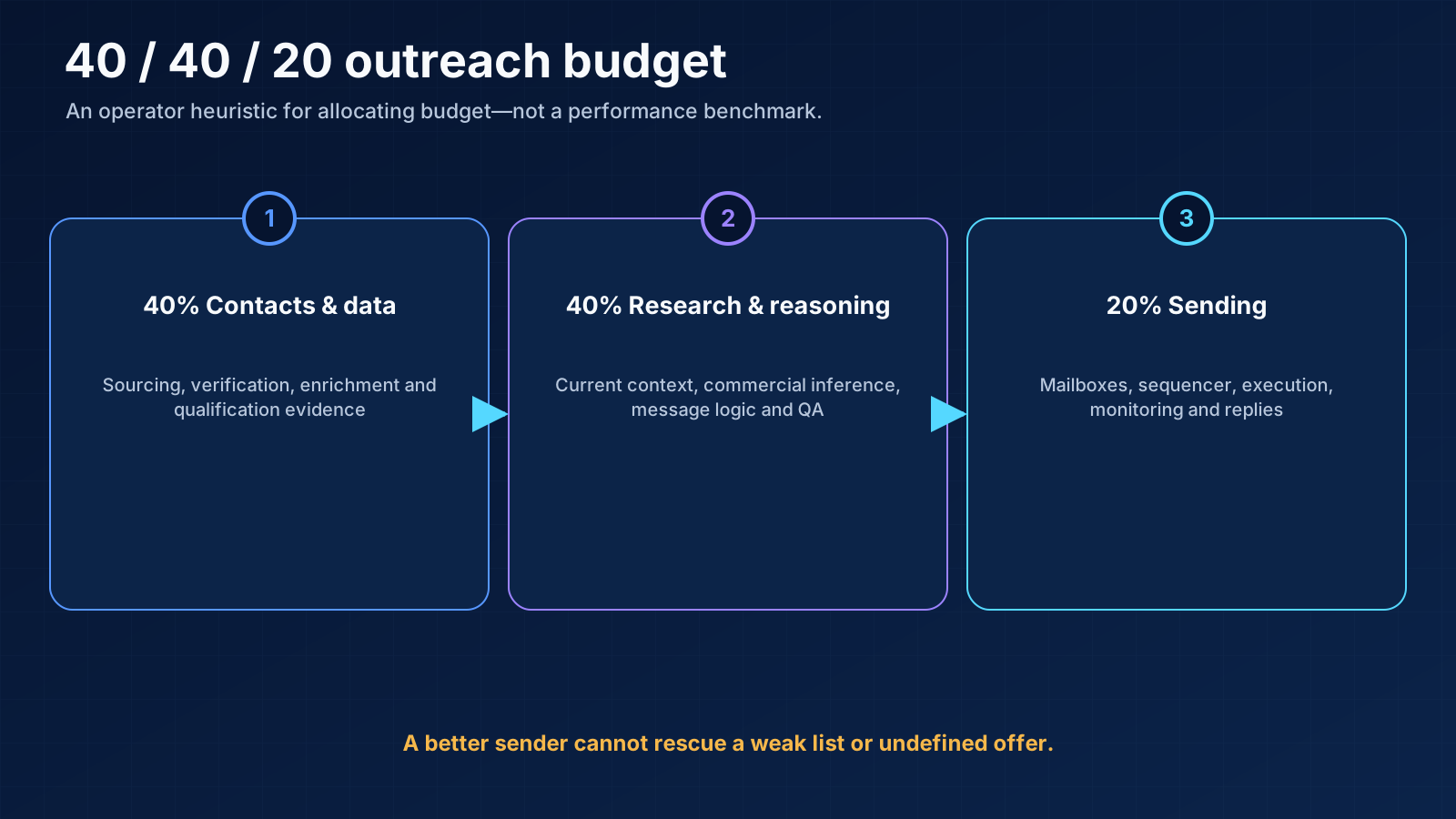
My operating budget model is 40% contacts and data, 40% research and reasoning, and 20% sending. It is an approximate allocation, not a universal law. It is useful because many teams do the opposite: they spend most of the attention on the sender, then feed it a weak list and generic copy.
Commercial disclosure: Luck My Sales received no affiliate payment, sponsorship, free access, consulting benefit, partnership benefit, or other consideration from any product in this comparison. I have used Clay/Claygent, Apollo, Instantly, Smartlead, Lemlist, and Reply in live workflows. Salesforge, Lavender, and Regie.ai are reviewed from current official documentation here. No product received a performance ranking from a controlled head-to-head test.

The stack is not the campaign: separate the layers, preserve evidence and grant authority only after the human process works.

01 / AI cold email

AI cold email tools at a glance

ToolPrimary layerEvidence in this guideBest fitMain human gate
Clay/ClaygentData orchestration, research, qualificationDirect useCustom ICP and signal logicInspect source, current business, fit and cost
ApolloContact data and engagement foundationDirect useSmall team needing data plus basic sequencesValidate identity, email, relevance and duplicate state
LavenderEmail coaching and message reviewDocumentation reviewedRep-led writing improvementSeller accepts or rejects the advice
Regie.aiAI sales-engagement workflowDocumentation reviewedLarger team seeking governed AI assistanceAdmin permissions, sequence and agent authority
InstantlyEmail-first execution, mailbox and reply workflowDirect useFocused cold-email operationSender health, list, sequence and reply stop
SmartleadHigh-control email execution and infrastructureDirect useAgencies and operations-heavy teamsGlobal suppression, mailbox limits and queue state
LemlistEmail plus LinkedIn multichannel executionDirect useSMB multichannel campaignsChannel order, named accounts and any-reply stop
Reply/JasonAI-assisted prospecting and sales engagementDirect broader useTeam exploring an agent-led workflowSources, enrollment, answer authority and CRM write-back
SalesforgeAI SDR, email and LinkedIn execution ecosystemDocumentation reviewedTeams consolidating outbound executionAgent scope, infrastructure and reply ownership
Snov.ioData, enrichment and email outreachDirect broader useCost-conscious integrated stackData freshness, sequence approval and suppression
The table does not identify a universal winner because the products are not interchangeable. Buying Clay to solve mailbox health is as misguided as buying Smartlead to discover product-market fit.

02 / AI cold email

“AI cold email tool” hides five purchases

1. Data and contactability

The system needs a company, a relevant person, a current role, a reachable address, and exclusions. It also needs to know what it does not know. A large list with missing current-business context is not a finished asset.

2. Qualification and research

The system needs rules for ICP, customer type, geography, company size, current commercial identity, competitor status, and an evidence-backed reason to contact. AI can apply those rules. It cannot invent a useful rule after the team has supplied a vague ICP.

3. Message reasoning and writing

The message should connect a verified observation to a plausible problem and a specific offer. Generated copy often fails because it paraphrases a random company fact without explaining why the fact matters.

4. Sending and infrastructure

The sender connects mailboxes, domains, schedules, limits, variants, suppression, and reply state. Infrastructure protects execution. It does not create demand.

5. Reply and CRM decisions

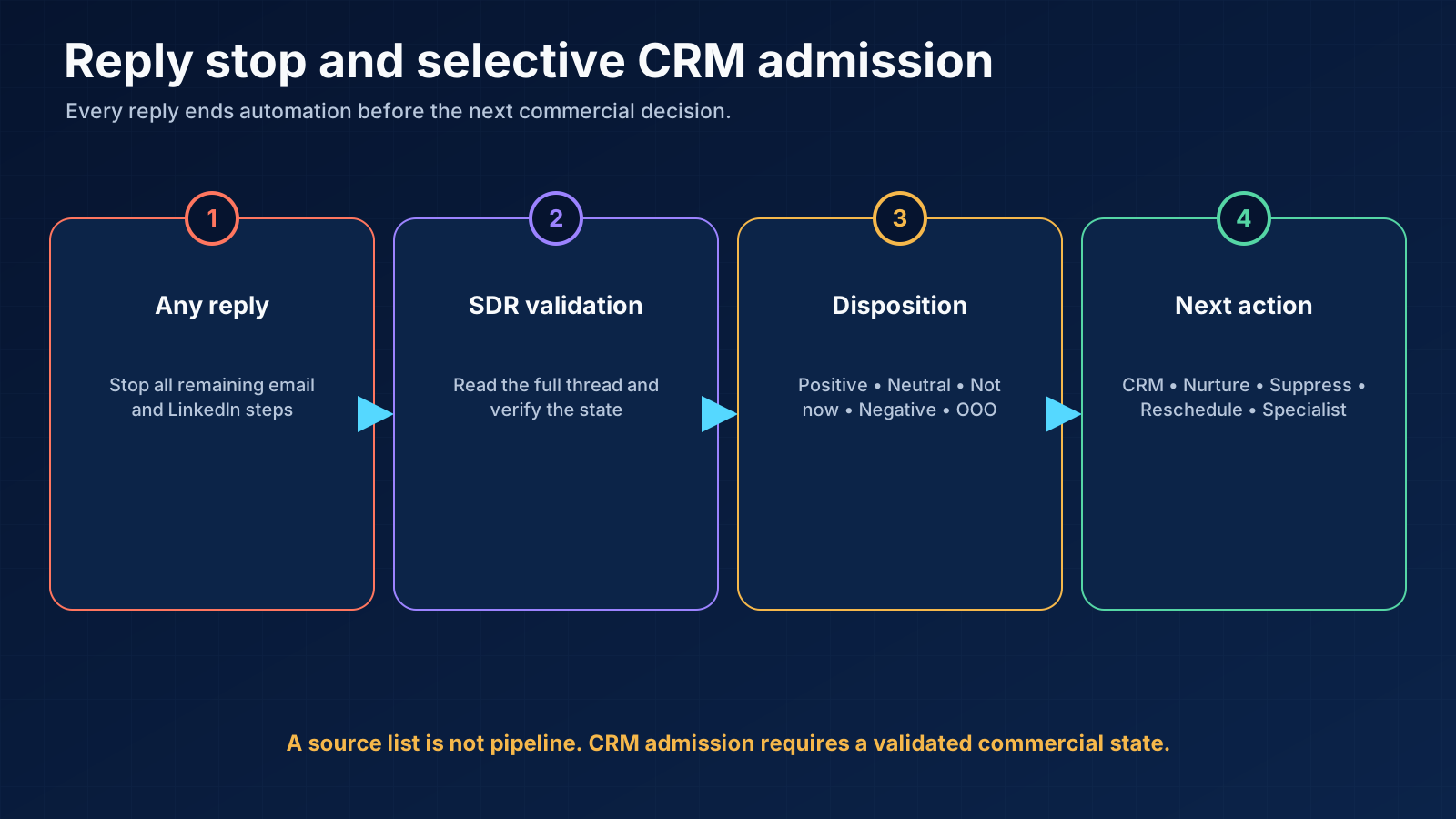
A buyer reply changes the workflow. In my rule, any reply ends all automated touches. An SDR reads the message, chooses the disposition, and decides the next step. Only a validated positive or neutral record enters CRM. The rest of the cold universe is not pipeline.
Before buying, write an authority contract:
Source → qualify → research → draft → approve → enroll → send → stop on reply → human disposition → selective CRM admission
If the product cannot show where a record is in that chain, automation will hide mistakes instead of removing work.
Anastasiia's approximate outreach budget split across data, reasoning and sending.
The 40/40/20 split is an operator budget heuristic, not a performance benchmark.

03 / we evaluated the

How we evaluated the products

We reviewed current official pages and help material on 18 August 2026. Direct-use labels mean the product appeared in live work. They do not mean every current feature or AI agent was tested. Documentation-reviewed labels verify only that the vendor describes a capability.
Each product was checked against the same questions.
  1. Which workflow object does it control?
  2. Can the operator inspect the source and timestamp behind research?
  3. Does AI suggest, prepare, or execute?
  4. Can a human approve the list, message, and named accounts?
  5. Can a reply, unsubscribe, bounce, or block suppress every related action?
  6. Who owns the conversation after a reply?
  7. What reaches CRM, and can that write be reversed?
  8. What is the total cost after data, credits, mailboxes, domains, implementation, and review time?
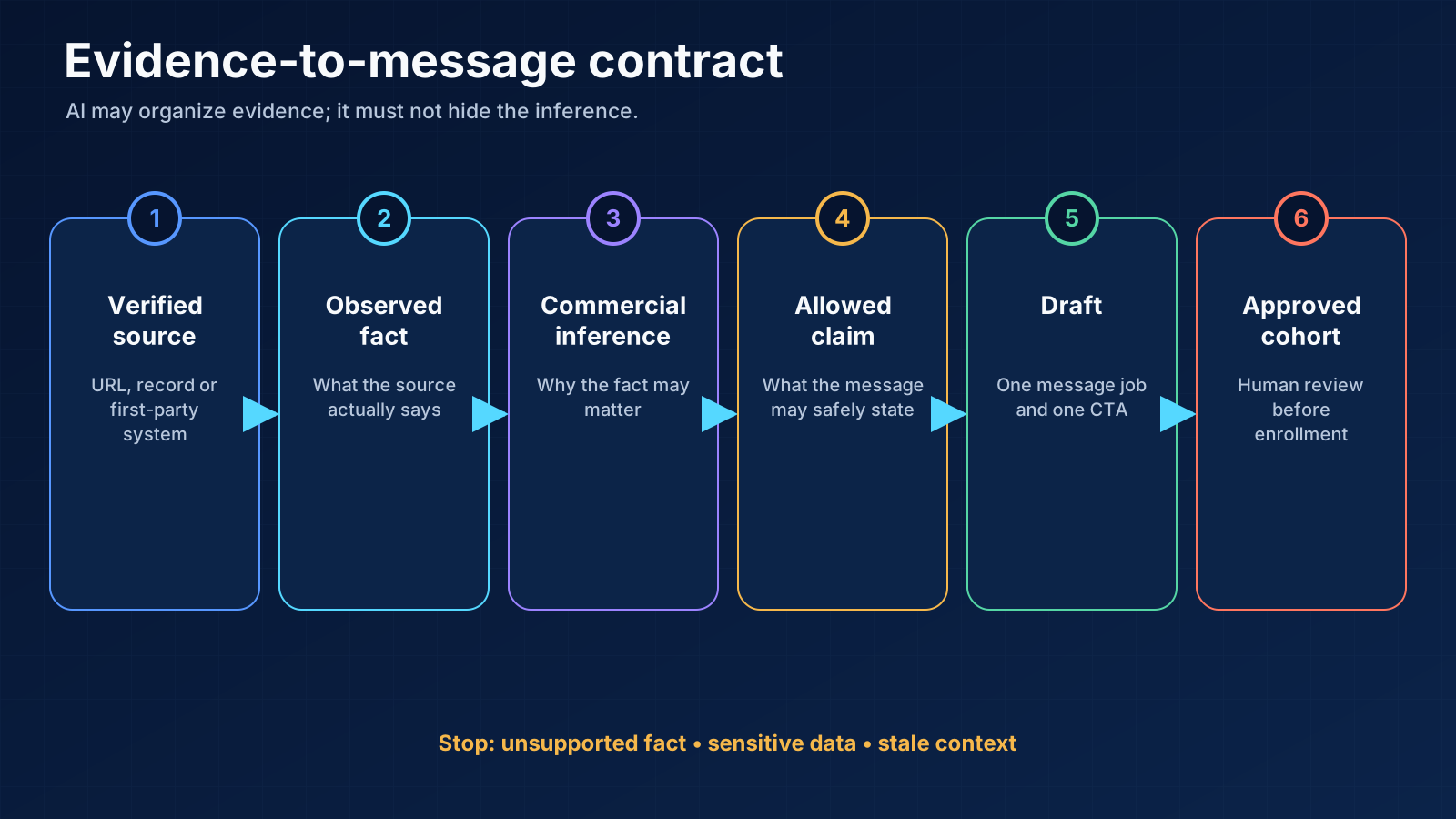
Vendor outcomes, database sizes, and inbox-placement claims were not used as editorial proof. Product prices and plan-specific features change; verify them during a live shortlist.
Evidence-to-message workflow that prevents false AI personalization.
AI may organize evidence, but it must not hide the commercial inference.

04 / Research and data

Research and data tools

Clay/Claygent: best for custom research and qualification logic

Claygent is designed for company and person research, qualification, signal detection, and structured output. Clay's official page describes prompt testing, structured data, reasoning visibility, and orchestration across GTM context. In practical terms, Clay becomes useful when the team can define a rule that a simple database cannot express.
We used it as part of the contact and “brain” layers. The important lesson came from qualification at scale. In one campaign, 7,520 companies were assessed, 5,899 were rejected, and 1,627 qualified. That does not prove Clay caused the result. It shows how much filtering remained after the initial universe existed.
The most instructive miss looked correct at first. The company matched. The person's formal role matched. Yet the person's current primary business made the offer irrelevant and potentially competitive. The fix was not a more fluent email. It was a qualification rule that checked the person's current commercial identity and competitor state, not only the company and title.
Clay is strongest when:
  • the ICP includes business-model or customer-base evidence;
  • the team needs several data sources or conditional research;
  • the output must include source URLs and structured reasons;
  • an operator can inspect errors and credit cost;
  • the same research logic will be reused across batches.
Clay is weak when the team has not yet agreed on qualification. A flexible system will execute inconsistent rules very efficiently.
Human gate: approve the ICP, review every early batch, inspect source and current-business evidence, and sample later batches after stability. Evidence label: direct use; aggregate is an operator case, not an independent product benchmark.

Apollo: best for a practical contact-data foundation

Apollo's sales-engagement platform combines contact data, enrichment, sequences, tasks, and AI-assisted functions. It can replace several early tools for a founder or small SDR team.
The convenience creates a temptation: discover, score, enroll, and send inside one system. Resist that at first. A database result should become a seller-approved record only after identity, role, company, email status, duplicate state, and current relevance are checked.
Apollo is often enough for a first repeatable motion. Add a specialist enrichment layer only if a pilot proves that missing context is causing false fits or expensive manual research. Otherwise the team buys complexity before it has a stable playbook.
Human gate: list approval and exclusion before enrollment. Evidence label: direct use in broader outreach workflows. Best fit: a small team that needs an economical source-and-engagement foundation.

Snov.io: best for a cost-conscious integrated data-and-email stack

Snov.io combines lead finding, enrichment, email verification, email outreach, warm-up-related products, CRM, and integrations. I have used it across broader outreach work. Like Apollo, its value is consolidation rather than a unique claim that it produces better messages.
Snov.io belongs on the shortlist when the team wants one lower-complexity environment and is willing to keep its own approval contract. Check data freshness, risky or catch-all handling, global unsubscribe behavior, mailbox assignment, and exportability.
Human gate: verify the record and sequence before the integrated stack sends. Evidence label: direct broader use. Best fit: cost-sensitive teams that prefer a combined finder, verifier, and sender.

05 / Reasoning writing and

Reasoning, writing and personalization tools

Lavender: best for coaching the rep who still owns the email

Lavender positions itself as an AI email coach. That is a different purchase from an autonomous writer or sender. It sits close to the seller and reviews a draft rather than owning the contact universe or mailbox system.
This narrower role can be an advantage. A team with good data and a working channel may not need another AI SDR. It may need consistent review of clarity, length, tone, mobile readability, and buyer focus.
The limitation is that a writing score can optimize the wrong message. A concise, readable email is still weak if the account should not have been contacted, the signal is irrelevant, or the offer is vague. Treat suggestions as coaching, not truth.
Human gate: the seller decides whether the recommendation preserves the evidence and commercial meaning. Evidence label: documentation reviewed. Best fit: rep-led teams with a writing-review bottleneck.

Regie.ai: best documented fit for governed AI sales engagement

Regie.ai positions itself as an AI sales-engagement platform with agents, content, prospecting, and seller workflows. It is closer to a governed revenue platform than a standalone copy tool.
That makes it relevant for larger teams with admin, CRM, sequence, and content-governance needs. It also means the purchase is not “AI writes emails.” The buyer must define agent enrollment, approved sources, messaging guardrails, sequence permissions, reply handling, CRM field authority, and audit access.
For a small founder-led team, the governance surface may be more than the motion requires. For a larger SDR organization, the same surface may be the reason to shortlist it.
Human gate: admin control over agent authority and content; seller ownership after reply. Evidence label: documentation reviewed. Best fit: a larger sales team that needs AI assistance inside governed engagement.

Why we did not name a personalization winner

The supplied evidence includes earlier and later campaign views plus an operator estimate that an AI-assisted approach was about three times cheaper and twice as fast. The denominator, fixed variables, and exact labor calculation were not sufficient for a causal head-to-head conclusion. Therefore, this guide does not say one writing system “won.”
That limit matters. Faster research can lower cost without improving replies. Better qualification can improve conversations even when the copy model is unchanged. A new offer can change outcomes more than a new writer. A valid comparison needs the same accounts, same offer, same sender conditions, same approval rules, and explicit metric definitions.

06 / Sending and deliverability

Sending and deliverability layers

Instantly: best for a focused email-first operation

Instantly combines email campaigns, lead and account features, mailbox and deliverability-related tools, a reply workflow, and AI functions. In our use, the important role was sending and operational control, not autonomous strategy.
Choose it when cold email is the main channel and the team wants a focused system. Verify:
  • mailbox connection and health visibility;
  • campaign schedule and per-mailbox limits;
  • risky-address and verification behavior;
  • global versus campaign-level unsubscribe;
  • duplicate prevention across campaigns;
  • reply ownership and the time between reply and human action;
  • API and export access.
The tool can help operate mailboxes. It cannot guarantee inbox placement. Google's sender guidance explicitly says third-party providers cannot guarantee messages will pass spam filters.
Human gate: sender health, list, sequence, and first production sends. Evidence label: direct use. Best fit: an email-first SMB or agency operation.

Smartlead: best for detailed sender and campaign control

Smartlead documents multiple sender accounts, campaign schedules and variants, inbox functions, infrastructure products, APIs, and agency-oriented operation. I have used it live. The practical differentiation is operational control, not a mystical delivery advantage.
Smartlead deserves a shortlist when the team has many mailboxes or clients and needs clear campaign state, suppression, reply categories, webhooks, and infrastructure visibility. It also deserves stronger governance because one configuration error can affect more senders.
Test whether unsubscribes are global where required, whether a paused record can still have queued mail, whether replies stop all relevant campaigns, and whether sender-level problems are visible before aggregate campaign metrics collapse.
Human gate: global suppression, mailbox limits, queue state, and reply owner. Evidence label: direct use. Best fit: agencies and operations-heavy cold-email teams.

Lemlist: best for a visible multichannel workflow

Lemlist supports email, LinkedIn steps, calls, delays, conditions, previews, and reply workflows. We used it in a real multichannel campaign in which lead tiers determined channel order.
Its value was a visible sequence and one human reply process. The campaign did not push every cold record into CRM. Any reply stopped automation. The SDR classified the message and admitted only positive or neutral validated records.
Lemlist fits when email must coordinate with LinkedIn or manual tasks. It is less compelling if the team needs only large-scale email infrastructure and already has a separate reply process.
Human gate: channel order, named accounts, sender health, and any-reply handoff. Evidence label: direct use in a disclosed first-party workflow. Best fit: SMB multichannel execution.

07 / Broad AI SDR

Broad AI SDR and agent-led platforms

Reply/Jason: best for testing a broader agent workflow with explicit limits

Reply's Jason AI is positioned as an AI SDR that can work across research, sequence creation, outreach, and meeting-related tasks. Reply has appeared in our live toolset, but this article does not claim a controlled test of every current Jason feature.
Before enabling broad authority, separate the jobs. Let the system research and draft first. Compare its output against a human answer key. Add enrollment only after identity and fit are stable. Keep replies human-owned until classification accuracy and escalation behavior are proven on real edge cases.
The question is not whether the agent can book a meeting. It is whether it can show which account it selected, which evidence it used, which message it sent, why it continued, and what it wrote to CRM.
Human gate: source review, enrollment, reply answer, and CRM write-back. Evidence label: direct broader Reply use plus current Jason documentation. Best fit: a team that has already proved the motion and wants to test broader assistance incrementally.

Salesforge: best documented fit for a consolidated outbound ecosystem

Salesforge presents email and LinkedIn outreach, AI SDR functionality, mailbox and deliverability-related products, inbox features, and supporting tools as one ecosystem. Consolidation can reduce integrations and move setup into one vendor.
It can also blur boundaries between infrastructure, message generation, sending, and replies. A buyer should map every component to the authority contract and refuse duplicate ownership. If Salesforge owns sending, another sender should not continue the same sequence. If an agent classifies replies, the SDR still needs a visible queue and override.
Human gate: agent scope, infrastructure health, reply owner, and CRM authority. Evidence label: documentation reviewed. Best fit: teams deliberately consolidating outbound execution.

08 / Sender requirements are

Sender requirements are not an AI feature

AI product pages often place deliverability near personalization, but the underlying requirements belong to email infrastructure and recipient providers.
Google currently requires all senders to Gmail accounts to use SPF or DKIM, valid forward and reverse DNS for sending infrastructure, TLS, valid formatting, and low spam rates. Senders over 5,000 messages per day to Gmail accounts face additional SPF, DKIM, DMARC, alignment, and unsubscribe requirements. Google also recommends gradual increases and monitoring, and says it cannot verify third-party open rates.
These requirements do not grant permission to send unsolicited mail. Google separately advises senders not to send to people who did not sign up. Laws and provider policies vary. Get legal review for the markets and data you use.
Do not use the primary business domain for cold bulk outreach. A separate sender system protects essential employee and transactional mail from direct campaign mistakes, although it does not erase brand or legal responsibility.
Our historical operation used roughly 100 sending domains or subdomains over time, often with four to six mailboxes each. The cold-send ramp began at five messages per mailbox per day, moved toward 15 after roughly three weeks, and could reach 30 only while healthy. Those are operator practices, not universal thresholds. Warm-up traffic was separate.
See the full cold email infrastructure setup guide before scaling any sender.

09 / reply and CRM

The reply and CRM contract

The buyer's reply is the end of automation, not another prompt for the system to improvise.
Reply stateAutomated actionHuman decisionCRM rule
Positive interestStop all touchesSDR qualifies and proposes next stepAdmit after validation
Neutral or questionStop all touchesSDR answers or gets technical contextAdmit if commercially relevant
Not nowStop current sequenceSDR records reason and reactivation dateOptional nurture record after validation
Wrong person/referralStopSDR verifies referral and account ownershipAdd only validated contact
NegativeStopSDR closes respectfullyDo not create opportunity
UnsubscribeGlobal suppressionAudit that suppression propagatedRetain minimum suppression record
OOOStop or controlled rescheduleSDR checks return date and policyUsually no CRM admission yet
Keeping every scraped or purchased record in CRM creates an illusion of pipeline. A thousand people who do not know your company are not a thousand leads. They are an unvalidated contact universe. CRM becomes useful when it stores a real commercial state and owner.
Cold email reply states and selective CRM admission.
Every reply ends automation before the next commercial decision.

10 / Three right-sized stack

Three right-sized stack patterns

Founder validating outbound

  • Apollo or Snov.io for a small list;
  • manual company and role verification;
  • one reasoning workspace;
  • one simple sender;
  • spreadsheet before response;
  • CRM only after a validated reply.
Do not buy an autonomous AI SDR while ICP and message are changing every week.

Small team with a repeatable email motion

  • Apollo plus optional Clay for specific evidence gaps;
  • Instantly or Smartlead as the email execution layer;
  • human-approved sequence and first batches;
  • shared reply queue with named SDRs;
  • global suppression and selective CRM admission.
Add Lavender if rep-written emails need coaching. Do not add it merely because the stack diagram has an empty “AI writing” box.

SMB coordinating email and LinkedIn

  • Sales Navigator or another approved source for professional context;
  • Clay for custom qualification where justified;
  • Lemlist for channel sequencing;
  • any-reply global stop;
  • human SDR disposition;
  • one CRM owner.
The stack should remain understandable on one page. If the operator cannot explain which tool owns a record at each state, integrations have become the problem.

11 / Match the stack

Match the stack to the bottleneck, not the trend

The budget model helps diagnose overbuying.

If data consumes more than 40%

Measure why. The team may be paying for overlapping databases. It may be enriching records that should have failed a basic company filter. It may be looking for perfect coverage in a market that is too small. Start with source consolidation, earlier exclusions, and a clear definition of a seller-approved record. Add Clay only when custom evidence closes a real gap.

If research and reasoning consume more than 40%

Find the repeated question. It may be “Does this agency serve appointment-led clients?” or “Is this person still operating the matched business?” Turn that question into a structured rule with a source and an unknown state. Do not turn it straight into an auto-enrollment rule. Compare the AI answer with a human answer key first.

If sending consumes more than 20%

The operation may have too many tools, too many mailboxes, or too much manual reconciliation. Pick one execution system. Move global suppression and reply ownership into a single documented path. Remove duplicate senders. A more expensive sender can be cheaper if it removes genuine operations work. A cheap sender can be costly if the team repairs state by hand.

If reply handling is the bottleneck

Do not solve it by letting an agent improvise every answer. First define dispositions, response ownership, service levels, approved knowledge, escalation, and CRM admission. Let AI summarize or draft inside that contract. Keep commercial objections, referrals, pricing, legal questions, and technical uncertainty visible to a person.

If no layer produces useful replies

Stop buying tools. Return to recent customers, lost deals, founder calls, and the offer. A tool cannot optimize a market that has not shown pain or a message that buyers do not understand.
The model is not a demand that every budget match 40/40/20 exactly. It is a warning when the smallest and most commoditized layer—sending—absorbs most of the system while qualification remains weak.
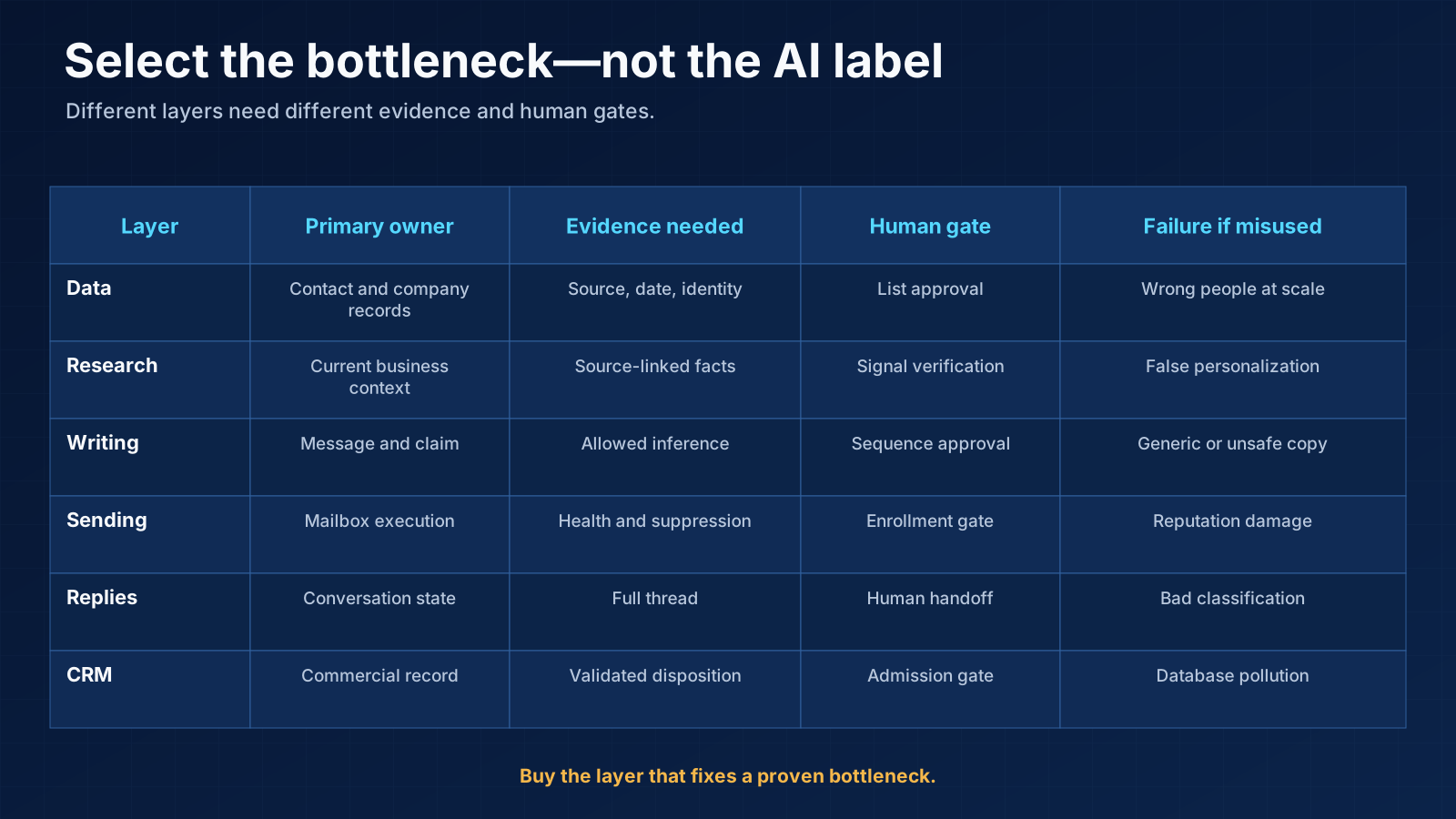
Decision matrix for selecting an AI cold email tool by workflow bottleneck.
Buy the layer that fixes a proven bottleneck.

12 / same-input pilot before

A same-input pilot before purchase

Use the same 100–200 approved accounts for two candidate architectures. Build a human answer key for identity, company fit, role fit, exclusion, current-business evidence, and acceptable message thesis.
Score:
  • correct records returned;
  • seller-approved records;
  • source coverage and freshness;
  • false claims or irrelevant facts;
  • review minutes per approved record;
  • credits and data cost;
  • sender setup and maintenance time;
  • delivered messages with explicit denominator;
  • meaningful and positive replies;
  • held meetings and accepted opportunities;
  • suppression and CRM errors.
Do not change the offer, audience, sender conditions, and message logic at the same time. If everything changes, the “winner” is a story, not a test.

13 / to ask in

What to ask in a product demo

Use one real but anonymized record. Ask the vendor to show the source, research output, message, approval event, sender, reply stop, disposition, and CRM write. Then introduce a false role, an existing customer, an unsubscribe, and a reply while another message is queued.
Ask what the agent cannot do. Ask which actions need admin permission. Ask where prompt, source, and message versions are stored. Ask whether suppression is global. Ask how data and state are exported. Ask how credits are charged when research fails or returns unknown.
A good demo shows uncertainty and recovery. A weak demo shows only the happy path. The team will spend more time on edge states than on the perfect record shown in a sales presentation.
Run the demo with the person who will operate the tool. A founder may care about speed. An SDR may care about the inbox. RevOps may care about state and exports. Security may care about access. All four views affect the real cost.

14 / Frequently asked questions

Frequently asked questions

What is the best AI tool for writing cold emails?

Lavender is a sensible shortlist for coaching seller-written emails. Claygent, Reply/Jason, Regie.ai, and broad platforms can generate or prepare copy in larger workflows. The best choice depends on whether the bottleneck is research, message review, or execution. No writer can compensate for a false fit or weak offer.

Which AI cold email tool is best for a startup?

Start with a practical data source and one sender. Apollo or Snov.io can simplify early data work; Instantly or Smartlead can run email; Lemlist makes sense if LinkedIn is part of the same state machine. Add Clay only when custom research solves a measured gap.

Can an AI SDR run cold email without human review?

It can execute many tasks, but the business should not grant broad authority before the human process is proven. Keep ICP, exclusions, sequence, sender health, strategic accounts, replies, suppression, and CRM admission under explicit human control.

Does email warm-up guarantee inbox placement?

No. Warm-up is a vendor practice, not a guarantee. Authentication, reputation, complaint rate, list quality, recipient behavior, content, provider rules, and sending patterns all matter. Google says no provider can guarantee its spam filters will accept mail.

Should cold prospects go into CRM?

Not by default. In the workflow described here, the cold universe stays in the outreach system and working sheet. A human-validated positive or neutral reply creates a CRM-worthy commercial state.

15 / Final recommendation

Final recommendation

Buy the layer that fixes the proven bottleneck.
Clay/Claygent is the strongest direct-use fit when custom qualification and research matter. Apollo is a practical foundation. Lavender is a focused coaching layer. Instantly and Smartlead fit email execution. Lemlist fits visible email-plus-LinkedIn state. Reply/Jason, Salesforge, and Regie.ai deserve consideration only after the team defines agent authority and human gates.
The stack is not the campaign. The operator still owns ICP, offer, evidence, message thesis, exclusions, sender health, reply handling, and CRM truth. A well-configured tool can make a working process cheaper and faster. It can also make an early mistake cheaper and faster to repeat.
Continue with the AI Email Sales Outreach workflow, the AI Sales Outreach pillar, the personalization-tools comparison, the AI SDR tools guide, and the Luck My Sales methodology and AI policy.

Research note

Methodology

  1. 01Direct-use evidence covers Clay/Claygent, Apollo, Instantly, Smartlead, Lemlist and Reply.
  2. 02Salesforge, Lavender and Regie.ai are evaluated from current official documentation, not a controlled head-to-head test.
  3. 03The 40/40/20 model is Anastasiia's approximate outreach-budget allocation rather than a performance benchmark.
Read the full methodology

Source ledger

Sources & editorial notes

  1. 01
    Claygent

    Clay · Official product, platform, provider or standards source used for the bounded claim cited in this guide.

  2. 02
    Apollo sales engagement

    Apollo · Official product, platform, provider or standards source used for the bounded claim cited in this guide.

  3. 03
    Instantly

    Instantly · Official product, platform, provider or standards source used for the bounded claim cited in this guide.

  4. 04
    Smartlead

    Smartlead · Official product, platform, provider or standards source used for the bounded claim cited in this guide.

  5. 05
    Lemlist

    Lemlist · Official product, platform, provider or standards source used for the bounded claim cited in this guide.

  6. 06
    Jason AI SDR

    Reply · Official product, platform, provider or standards source used for the bounded claim cited in this guide.

  7. 07
    Salesforge

    Salesforge · Official product, platform, provider or standards source used for the bounded claim cited in this guide.

  8. 08
    Lavender

    Lavender · Official product, platform, provider or standards source used for the bounded claim cited in this guide.

  9. 09
    Regie.ai

    Regie.ai · Official product, platform, provider or standards source used for the bounded claim cited in this guide.

  10. 10
    Snov.io

    Snov.io · Official product, platform, provider or standards source used for the bounded claim cited in this guide.

  11. 11
    Email sender guidelines

    Google · Official product, platform, provider or standards source used for the bounded claim cited in this guide.

Corrections or primary material: contact the corrections desk.

About the author

Anastasiia Krynytska

Anastasiia Krynytska is a LeadGen Team Lead at Softermii and the lead editor of Luck My Sales. She covers AI-assisted outbound, account research, qualification, messaging, CRM handoffs and revenue workflows from a practitioner’s perspective.View author profile LinkedIn

Continue reading

01 · News analysis

AI sales is moving from assistant to operating layer

The category is expanding from drafting support into research, pipeline decisions, recommended actions and controlled execution.

Read news
02 · Field analysis

In AI sales, the handoff may be the product

Models are becoming accessible; durable value sits in the controlled transition from signal to seller action.

Read analysis
03 · Research framework

Sales AI Workflow Signals 2026

A launch framework for mapping the products, controls and buying questions shaping AI-enabled revenue work.

Read reports

Luck My Sales briefing

Useful context, once a week.

News, explanations and original research from this desk. No noise.
The newsletter is still being built. We will contact you when the first edition is ready.