Weekly industry intelligence · No noiseSubscribe to the Luck My Sales newsletterFree briefing

Independent intelligence on AI in sales

Menu

AI SDR comparison & buyer's guide · AI SDR tools

Best AI SDR Tools for B2B Sales: Choose by Workflow, Not Autonomy

Compare seven AI SDR tools by workflow ownership, human controls, reply handling, operating cost and sales-motion fit.
Editorial disclosure

AI may assist research organization and drafting. A human editor reviews every published page, checks material claims against the cited sources and owns the final decision. No company paid for placement in this article.

AI use policy

Agent-ready brief

AI takeaways

Keep the key points here, or take a source-aware text brief into Claude, ChatGPT or another AI workspace.
  1. 01A writer, database or sender alone is not an AI SDR.
  2. 02SMBs should buy only after proving the ICP, offer, message and one repeatable channel.
  3. 03A composed stack can be safer than a suite when it preserves evidence and authority.
  4. 04Any reply changes the state and requires human SDR validation.
  5. 05Compare total operating cost per seller-accepted outcome on the same sample.
Includes summary, takeaways, sources and a use note.
The best AI SDR tool owns a bottleneck your team understands. It should never hide a contact's origin or the message logic. The next permitted action must also remain visible. A person must take control when a buyer replies.
This makes the purchase a workflow decision. It is not an autonomy contest. An AI SDR may research, write, send, handle replies and book. It may also update CRM. Those actions become useful after the team proves its sales motion.
This guide compares seven outbound products by owned job. It does not name a universal winner. Luck My Sales did not run one common product test. Official product documents were reviewed on 18 August 2026. A separate Lemlist workflow supports our operating rules. It does not support a product-performance ranking.
Disclosure: Owner records confirm no commercial relationship with six named vendors. They are Clay, Apollo, Anthropic/Claude, lemlist, HubSpot and Salesforce. The seven AI SDR candidates have no documented commercial declaration. Missing documentation does not prove that no relationship exists. No vendor paid for placement or set the order. NextLevel AI supplied first-party workflow context. We do not rank it here.

An SMB should automate only after a human team has proved the ICP, offer, message and channel.

01 / Buying decision

The short answer: choose the workflow owner, not the AI SDR label

Most small B2B teams face three choices. They can buy, compose or wait.
  • Buy an end-to-end AI SDR after the outbound motion works. One team must own rollout and test every permission.
  • Choose an agent-plus-rep or copilot model for more research support. Sellers should still approve consequential actions.
  • Compose a stack when source inspection and custom logic matter. This also makes components easier to replace.
  • Wait when the ICP, offer, message or channel changes weekly. Automation will spread that uncertainty faster.
Anastasiia Krynytska sets a stricter rule than most vendors. An SMB should first prove its ICP, offer, message and channel. Only then should it automate an AI SDR motion. Choose the workflow owner and bottleneck, not marketed autonomy.
Review this contract before each demo:
StartEvidenceActionStopHuman decisionRecordResult
ICP and offerSource recordPermitted actionAny replyHuman dispositionCRM activationAccepted outcome
Ask the vendor to show each transition. Otherwise, the team buys opaque activity.

02 / Definitions

What counts as an AI SDR tool?

An AI SDR performs several linked sales-development jobs. It can also take external action. A writer, contact database or sender alone does not qualify. Each can become one component of an AI SDR.
The category has five useful layers:
CategoryTypical ownershipWhat it does not prove
Full outbound agentSources, researches, writes, sends, follows up and may handle replies or bookThat the ICP, offer, source data or qualification rule is correct
Agent plus repAutomates much of the motion but exposes approval or escalation pointsThat every campaign should use the same autonomy mode
Sales copilotRecommends contacts, context and messages for a rep to reviewThat suggestions are accurate or commercially relevant
Component stackConnects data, enrichment, reasoning and execution toolsThat the operator designed a coherent campaign
Sending infrastructureDelivers approved sequences and applies configured stopsThat the records or messages deserve to be sent
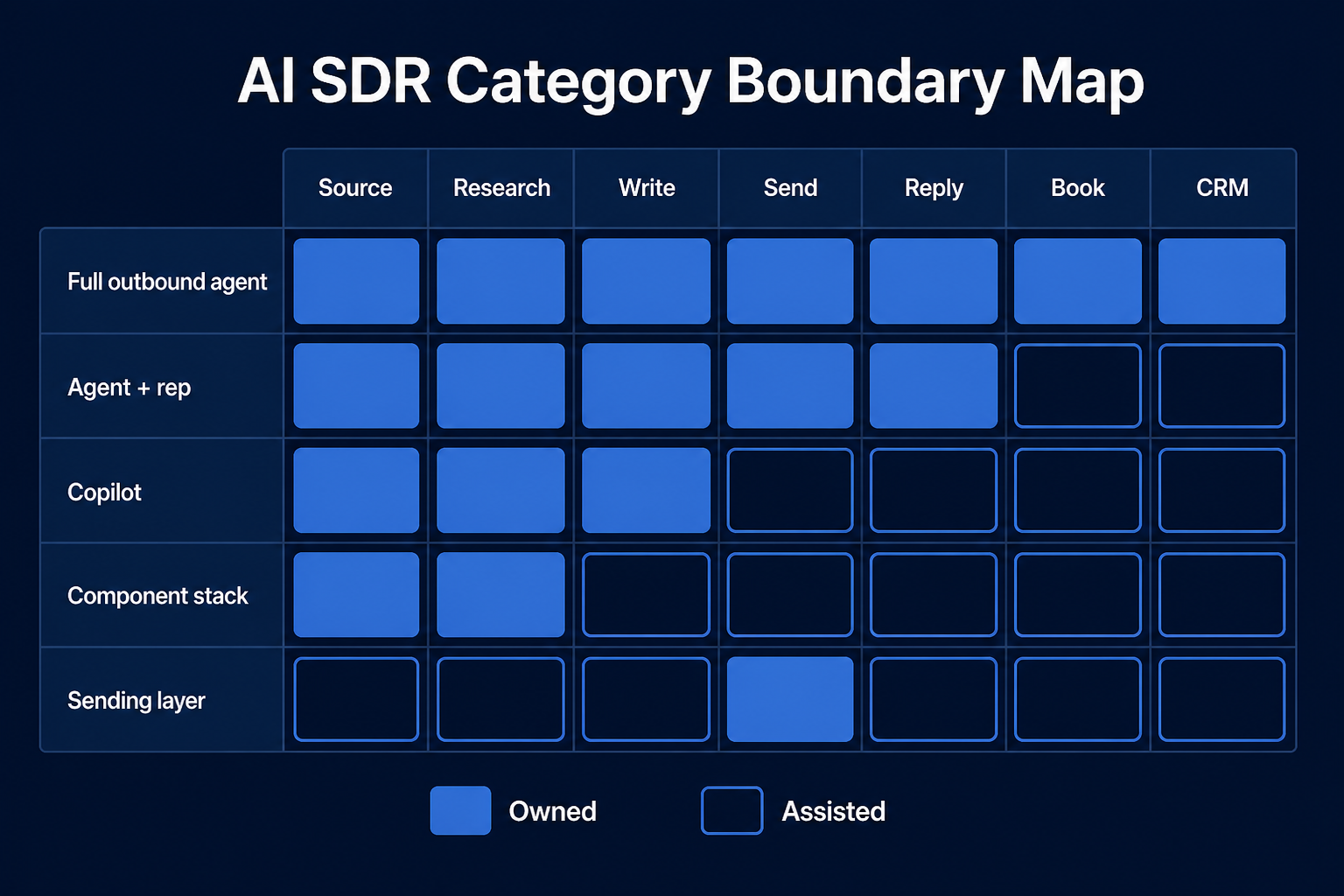
This boundary matters because many comparisons mix unlike products. We treat Amplemarket Duo as a copilot. We treat Regie.ai as a hybrid engagement platform. It coordinates agents and reps. Five other candidates are reviewed as broader outbound agents. They are Alice, Ava, AiSDR, Agent Frank and Jason. These labels describe documented scope, not measured quality.
AI SDR category matrix comparing workflow ownership from sourcing through CRM.
The category boundary is workflow ownership, not the AI label.

03 / When is an

When is an SMB ready for an AI SDR?

An SMB needs a process worth automating. Answer six questions before buying another platform:
  1. Who is the ICP? Use clear account and buyer rules. Avoid a vague buyer persona.
  2. What is the offer? State the problem, credible outcome and response reason.
  3. Which message works? Keep a reviewed sequence. Add examples of acceptable and rejected copy.
  4. Which channel is repeatable? Prove one path before adding email, LinkedIn, calls and more automation at once.
  5. Who owns replies? Name the person who validates each response. Cover interest, objections and referrals. Include timing and removal requests.
  6. What enters CRM? Define the activation rule and fields. Name the owner and next action before any write.
A founder still discovering value should stay close to sales. Research or list building can move earlier. An SDR becomes safer after the team documents its sales motion. The handoff needs an ICP, offer and channel, not instinct.
Start with the human-gated AI prospecting workflow. Then use the broader AI lead generation tool map.

04 / How Luck My

How Luck My Sales evaluates AI SDR tools

Five Phase 3 questions guide this documentation review:
  1. Workflow ownership: Which objects and stages does the product control?
  2. Evidence quality: Can users see each source, date and reason?
  3. Human and reply controls: Can teams review, stop and override actions? Can they transfer ownership?
  4. Execution safeguards: How does the product govern channels and suppression? How does it handle deliverability and CRM actions?
  5. Total cost and outcome: Which costs sit outside the subscription? Which accepted outcome will justify the total?
Two evidence labels appear in this article:
  • Used in a broader workflow: the product appeared in approved operating material. Its AI features were not compared under one controlled test.
  • Docs review: we read the current official pages. We make no hands-on claim. We also make no accuracy or performance claim.
The seven named AI SDR candidates are documentation-reviewed. The composed stack later in this guide includes products used in broader workflows.

05 / Comparison

Seven AI SDR tools at a glance

ProductBest fit by workflow jobDocumented control modelMain buyer checkEvidence
11x AliceBroad end-to-end outbound coverageProduct page describes automated prospecting, personalization, multichannel sequencing and handoffAsk to inspect data sources, reply behavior, CRM history and campaign-level kill switchDocumentation-reviewed
Artisan AvaFull AI BDR with adjustable reviewOfficial pricing FAQ documents approval-before-send controls, banned phrases and autonomous operationTest whether approval, reply escalation and CRM sync behave differently by risk tierDocumentation-reviewed
AiSDRSignal-led research and strategy before outreachOfficial pages describe prospecting, research, campaign strategy and omnichannel executionVerify which signals are sourced, which are inferred and where a human approves repliesDocumentation-reviewed
Salesforge Agent FrankExplicit co-pilot/autopilot choice plus email infrastructureOfficial page documents a knowledge base, prospecting, modes, personalization sources and separate infrastructureCount contacts, inboxes and infrastructure together; start in co-pilotDocumentation-reviewed
Reply.io JasonOne workflow from ICP and sequence to reply and bookingOfficial features document co-pilot/autopilot, multichannel execution, reply handlers and bookingConstrain knowledge, objections and replies before allowing autopilotDocumentation-reviewed
Regie.aiHybrid agent-and-rep orchestrationOfficial site describes agent and rep tasks in one engagement workflowConfirm task ownership, signal provenance and CRM mutation rightsDocumentation-reviewed
Amplemarket DuoHuman-in-the-loop signal and sequence preparationOfficial page says reps review, edit, regenerate, send or dismissValidate whether contact-level signals support the commercial hypothesisDocumentation-reviewed
The order is not a ranking. It moves from broad agents to hybrid and copilot approaches.

06 / Workflow

11x Alice: broad workflow ownership for teams prepared to audit it

Choose 11x Alice for broad outbound coverage. The buyer must have capacity to audit an automated motion. 11x documents prospecting from signals and account research. It also covers contact research and message creation. Sequences and follow-up are included. The workflow ends with a conversation handoff.
That scope reduces visible handoffs. It also hides more decisions inside one system. Ask for a live trace from source record to message. Follow it through reply classification, booking and CRM. Test wrong identity and weak-signal cases. Add named accounts, unsubscribes and ambiguous replies.
The product page promotes full automation and customer outcomes. Those remain vendor claims. This review did not establish them. The reviewed page gives little detail about per-message approval. Start with the narrowest available permissions. Keep named accounts outside autonomous enrollment.
Best fit: broad coverage after the sales motion works. Avoid this logic: a product will discover your GTM strategy.

07 / Artisan Ava: full

Artisan Ava: full AI BDR with visible approval controls

Choose Artisan Ava for a broad AI BDR with message guardrails. Artisan describes lead finding and enrichment. It also describes email, social, follow-up and booking work.
The Artisan pricing page explains controls more clearly. Its FAQ supports approval before sending. Teams can lock tone and calls to action. They can also set banned phrases and coach writing. Plans vary by lead volume, mailboxes and dialer seats. Sales supplies the price.
Those controls still need a real pilot. Reviewers need source evidence beside each approval. They must also see the exact external action. Inspect Ava's reply behavior and escalation rules. Then map every CRM field it may change.
Artisan also describes sending domains, CRM sync and security controls. These remain vendor statements. Review the setup and contract. Ask for the relevant security records.
Best fit: an integrated BDR motion with campaign guardrails. Avoid this logic: guided onboarding proves the sales motion works.

08 / AiSDR: signal-led prospecting

AiSDR: signal-led prospecting for teams that reject raw volume

Choose AiSDR when the motion begins with current signals and research. AiSDR's features cover prospecting, strategy and lead research. They also cover outreach and CRM integrations. The current site includes email, phone and LinkedIn.
This positioning may suit a team seeking fewer, grounded contacts. Still, separate the professional event from its inferred meaning. Then assess permission to contact the person. A job change or website visit can justify research. It does not prove intent.
AiSDR publishes a subscription figure and several outcome statements. We excluded those vendor outcomes. No common method supports them here. We also excluded the price from the comparison table. Credits, channels and contract periods change the scope. Data and implementation add more cost.
Ask the vendor to open the source behind a signal. Test how it handles conflicting evidence. Then inspect every reply path and unreviewed CRM write.
Best fit: signal-led prospecting and campaign preparation. Avoid this logic: a quality over volume slogan proves quality.

09 / Sender controls

Salesforge Agent Frank: co-pilot first with explicit infrastructure cost

Choose Agent Frank for an explicit review or autonomy choice. The team must also manage email infrastructure. Salesforge documents a company knowledge base. It also covers ongoing prospect research. The page lists goals and tone. It names the sources used for personalization. Buyers can choose co-pilot or autopilot mode.
Co-pilot is the safer pilot entry. It shows messages before the team grants more control. The official page also shows a key cost boundary. Email setup remains a separate cost. Buyers may connect mailboxes or use another Forge product. The agent price follows active contacts. That cost changes with sending capacity.
This is why subscription comparisons fail. One worksheet should include agent and data costs. Add the contact count. Then add domains and inboxes. Include warm-up, verification and review time.
Salesforge says Agent Frank can use websites, blogs and LinkedIn posts. Treat them as candidate sources, not safe facts. Current professional context can help. Exclude old or personal details. Also remove facts with no sales relevance.
Best fit: governed email-first work with a clear mode switch. Avoid this logic: the headline price represents the full cost.

10 / Authority

Reply.io Jason: end-to-end workflow with reply automation that needs a narrow contract

Choose Reply.io Jason for one path from ICP to booking. Reply.io's feature page documents playbooks and a knowledge base. It covers email, LinkedIn and phone sequences. It also includes co-pilot, autopilot, reply handlers and booking.
Reply automation carries the most risk in that chain. A bounded FAQ differs from a negotiation or objection. Sensitive sales questions need a separate rule. Define what the agent may answer before enabling autopilot. Also define escalation and permanent stop events.
The official pricing page shows tiered AI SDR plans. Contact and LinkedIn-account scopes vary. So buyers must review each denominator. Compare the full cost for each accepted sales result. Reply updated its AI Features Terms on 3 July 2026. Review the live order form and terms before purchase.
Best fit: one documented path from search to reply and booking. Avoid this logic: more automated steps always create more value.

11 / Regie.ai: hybrid orchestration

Regie.ai: hybrid orchestration for an established rep motion

Choose Regie.ai for one workflow shared by agents and reps. Regie.ai describes data, calls, email, sequences and reports. Its workflow separates agent and rep jobs. Agents can build lists and research. Reps can own calls, approvals and social tasks.
This hybrid model fits an established sales operation. It is less useful for a founder discovering the message. Agents can cover repetitive work. Reps can keep conversations that need more context. Ignore generic AI and human labels in a demo. Name the campaign owner for each task. Log every transition.
Regie.ai also promotes signal-driven outreach and CRM hygiene. Ask which source supports each signal. Check the matched person. Then check which CRM fields may change. Current public material sends buyers to sales for pricing.
Best fit: coordinated agent and rep work in an established team. Avoid this logic: one platform will fix weak targeting.

12 / Pilot

Amplemarket Duo: a copilot for signal review, not an autonomous replacement

Choose Amplemarket Duo when reps should decide which signals deserve action. Amplemarket's Duo page describes signal monitoring and prospect context. It also prepares multichannel outreach. Reps can review, edit, regenerate, send or dismiss. Their feedback can shape later suggestions.
This workflow gives a small team leverage without hiding decisions. We treat it as a sales copilot. It is not a full autonomous SDR here. This helps when research and drafting create the bottleneck.
The risk sits in the word intent. Social activity and job changes may justify research. The same applies to reviews and CRM events. None proves readiness to buy. Inspect the source, date, identity and commercial link before sending.
Best fit: rep-reviewed signals and prepared sequences. Avoid this logic: a signal label proves buying intent.

13 / Stack design

A governed AI SDR stack can be better than one suite

A composed stack can suit an SMB with working tools. It also needs an operator who owns every connection. The owner-approved heuristic splits attention this way:
  • 40% contact and data work: find the right accounts and people. Confirm identity. Check contactability and keep the source record.
  • 40% reasoning or agentic work: evaluate fit and current commercial reasons. Draft and validate each decision.
  • 20% delivery: run approved sequences. Apply simple limits and hard stops.
This is Anastasiia's rule of thumb. It is not a market benchmark.
Apollo and Sales Navigator appeared in broader workflows. They supported discovery and current job context. Clay coordinated enrichment. Claude Code supported custom research. It also supported decision logic. lemlist ran the multichannel sequences. Anastasiia recommends Instantly for a defined email role. Its current evidence comes from official documents.
LayerExample roleHuman responsibility
Data and contactApollo, Sales Navigator, ClayApprove ICP, entity match, source freshness and contactability
ReasoningClaude Code or another governed agentic layerDefine rubric, inspect evidence, reject weak reasons and approve strategy
Executionlemlist or InstantlyConfigure channel, schedule, suppression, reply stop and sender limits
System of recordCRM after validationActivate only accepted records, assign owner and preserve next action
A stack improves inspection and component replacement. It also adds implementation work and integration risk. Accountability can split across tools. A stack is not always cheaper. Add it when custom evidence creates enough accepted outcomes.
See our lead intelligence tools and AI lead generation tools comparisons.

14 / Authority

Use a reply and CRM contract

A reply turns an AI SDR into a company representative. The supplied Lemlist workflow automated normal first messages and follow-ups. It also automated routine LinkedIn steps after manual setup. Strategic and named accounts kept human review.
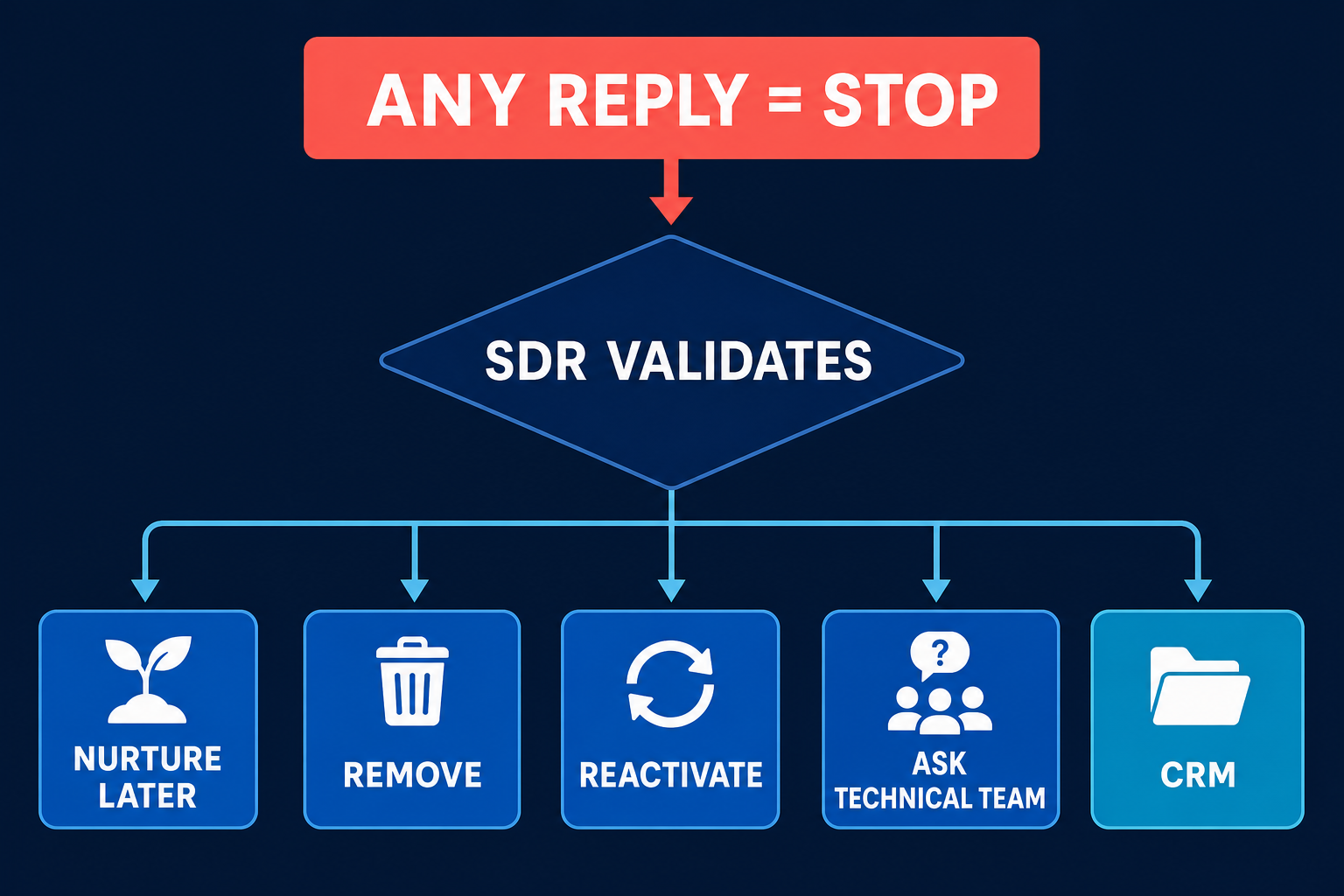
The permanent rule was simple: any reply stopped the sequence. An SDR validated the response and chose the next state:
  1. contact later or nurture;
  2. remove the person;
  3. reactivate at a defined time;
  4. ask the technical team for details;
  5. activate a validated positive or neutral lead in CRM.
Before replies, execution stayed in Lemlist or Instantly plus a spreadsheet. The team kept untouched cold lists outside CRM. Unengaged database rows are not qualified pipeline.
This evidence comes from a first-party NextLevel AI context. It supports the workflow rule. It does not prove performance for NextLevel AI or Lemlist.
Your contract should name the reply owner and allowed categories. Define forbidden answers and the maximum response delay. Add suppression behavior, CRM fields and a correction path. Keep reply handling human when the product cannot enforce this contract.
AI SDR reply stop followed by human SDR validation and five possible outcomes.
An AI SDR can automate the approved motion, but a reply changes the state.

15 / Total cost

Compare total operating cost, not the subscription headline

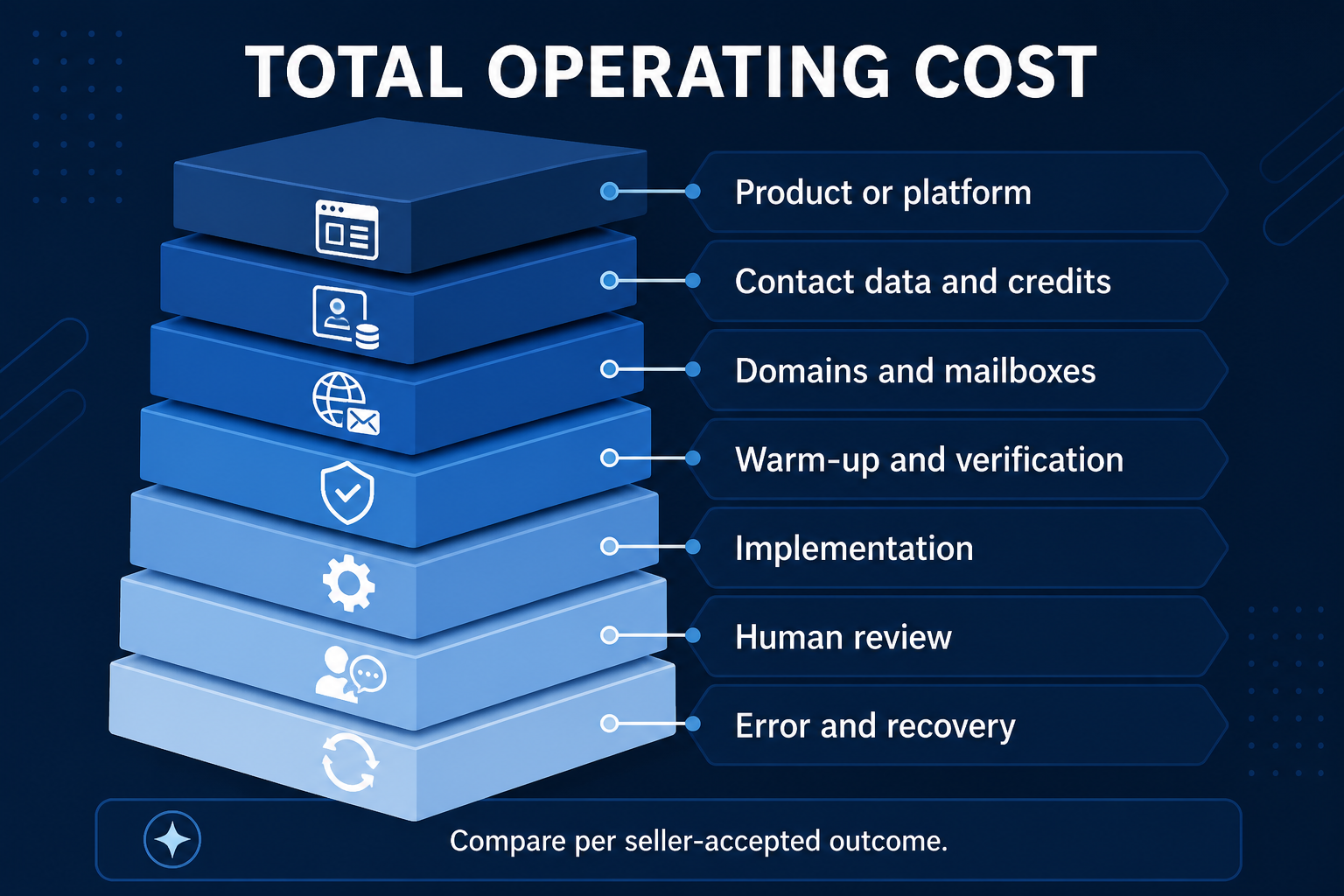
An AI SDR budget must cover every required input:
Cost lineWhat to record
Product or platformPlan, contract period, included contacts, users, channels and support
Contact data and enrichmentCredits, waterfalls, verification and refresh frequency
Domains and mailboxesDomains, mailbox count, provider and replacement capacity
Warm-up and monitoringRamp time, health checks and operational tooling
ImplementationICP, playbooks, knowledge base, CRM mapping, security and legal review
Human reviewMinutes per record, reply ownership, exception handling and coaching
Failure and recoveryBad data, damaged sender reputation, duplicate contact, CRM cleanup and lost account trust
Do not compare an AI SDR price with a salary. The scopes differ. Use one shared cost formula:
Cost metricFormula
Cost per accepted conversationTotal operating cost ÷ seller-accepted conversations
Run the same math for held meetings and accepted deals. Cheap volume should not look valuable by itself.
Seven-layer total operating cost stack for an AI SDR workflow.
Compare the full operating cost per seller-accepted outcome.

16 / Pilot

Run a same-sample AI SDR pilot

A fair pilot keeps commercial inputs constant. It tests failures before autonomy.
  1. Freeze the motion. Use one ICP, offer, message policy, channel scope and CRM rule.
  2. Select one current sample. Use the same accounts for each viable setup. First remove customers and active deals. Then remove suppressed and duplicate records.
  3. Create a human answer key. Mark the correct identity and fit. Then mark acceptable evidence. Add the contact reason and next action before running tools.
  4. Map permissions. List every action that each product may take. Cover research, drafting, enrollment, sending, replies, booking and CRM.
  5. Begin in copilot mode. Review every proposed contact and message. Continue until you can see the failure patterns.
  6. Test failure cases. Include stale roles, namesakes and existing owners. Add named accounts, opt-outs, wrong-person replies and ambiguous objections.
  7. Measure accepted outcomes. Count approved records, useful replies and held meetings. Add accepted deals, review time and total cost. Name every denominator.
  8. Test exit and recovery. Pause the campaign and export its records. Revoke access, correct CRM and confirm suppression survives shutdown.
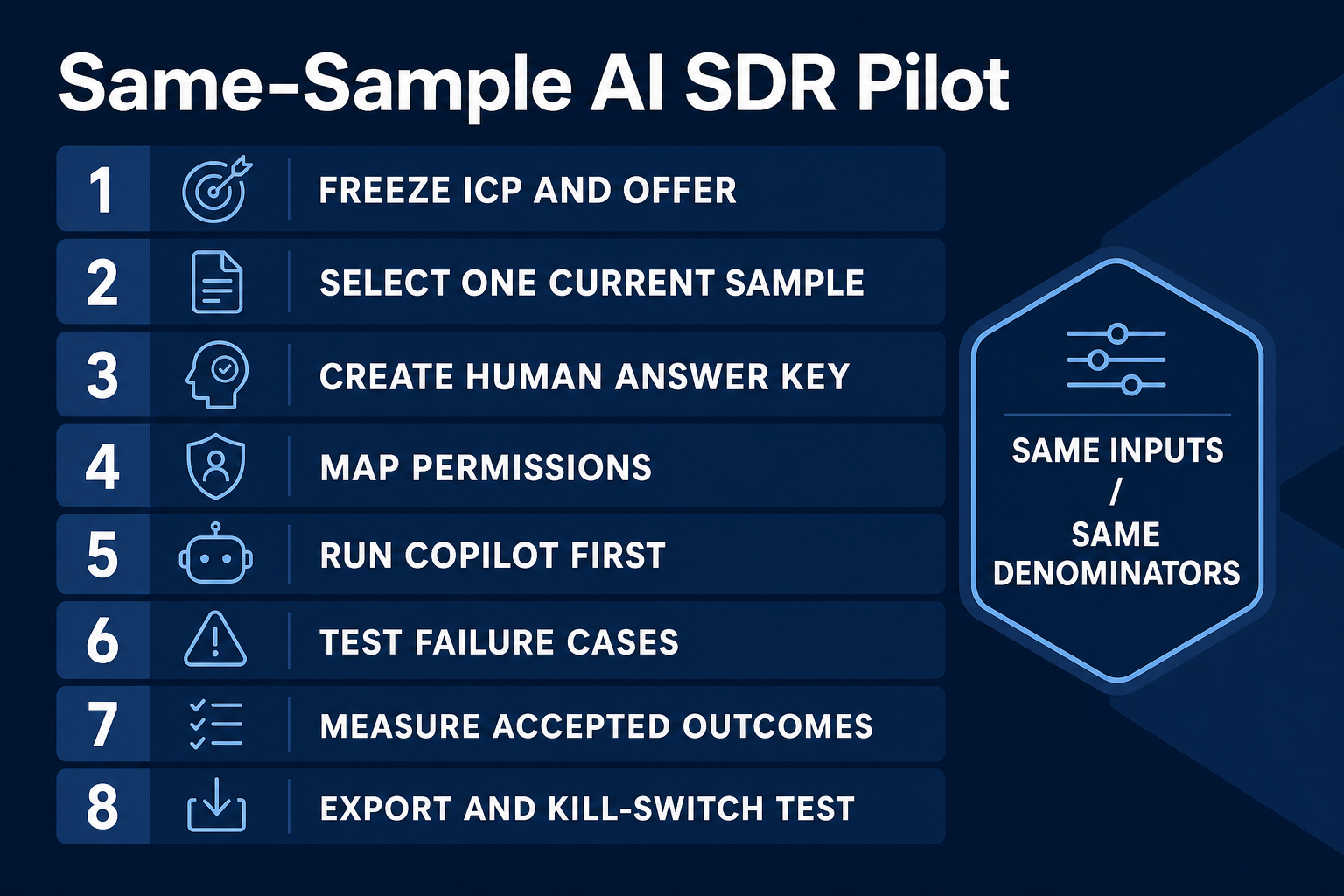
Expand autonomy by action, not a global vendor toggle. A team may automate research while retaining send approval. It may automate normal touches but exclude named accounts. It may classify replies while routing every response to a person. Start with the smallest permission that resolves the bottleneck.
Eight-step same-sample AI SDR pilot checklist.
Use the same inputs and denominators, then verify export and kill-switch behavior.

17 / Measurement

Measure accepted conversations and opportunities

Activity metrics help diagnose the system. They do not prove revenue value.
Track each denominator separately:
MetricFormula
Delivery rateDelivered messages ÷ attempted messages
Meaningful reply rateUsable commercial replies ÷ delivered messages
Positive reply rateDefined positive replies ÷ delivered messages
Held-meeting rateCompleted meetings ÷ named denominator
Opportunity acceptance rateAccepted opportunities ÷ held meetings
Cost per accepted outcomeTotal cost ÷ named accepted outcome
Review burdenHuman review minutes ÷ accepted outcomes
Open rate is a weak decision metric. Sends show capacity, not value. A calendar booking is also incomplete. The meeting may not occur or pass qualification.

18 / Failure modes

Failure modes and kill-switch conditions

Stop when the system cannot protect identity, permission, brand or CRM.
  • Any unsubscribe or suppression request continues to receive contact.
  • A reply does not stop the active sequence.
  • The system cannot show the source behind a material personalization claim.
  • A named account is enrolled without its required review.
  • Contacts are duplicated across tools or sellers.
  • The system answers topics outside its approved knowledge. These include price, security, law and product details.
  • CRM owner, stage or activity history changes without an audit path.
  • The team cannot pause, export, correct or revoke the workflow quickly.
  • Sender health deteriorates and the team responds by increasing volume.
A listed channel does not grant permission. LinkedIn's help page bans scraping without permission. It also bans bots that send messages or take similar actions. A vendor's feature list does not establish permission. Verify the method and current platform rules.
For US commercial email, the FTC's CAN-SPAM guide has no B2B exception. It requires accurate routing and a working opt-out. The promoted company still bears the legal duty. This is context, not legal advice. Rules vary by market, source and channel. Get legal review before launch when needed.

19 / Decision rules

Buy, compose or wait: recommendations by SMB motion

SMB situationRecommended pathWhy
Service business with a proven niche and repeatable email motionPilot a co-pilot or controlled full agentResearch and drafting can reduce labor, while reply context and named accounts stay human-owned
Small SaaS with product signals and an existing CRM processCompare a signal-led copilot, hybrid platform and composed stackProduct, CRM and professional signals may improve timing if the team can validate identity and meaning
Founder still changing ICP and offerWait; automate research or list preparation onlyThe founder still needs direct conversations to discover the sales system
Team with a few strategic accountsCompose a research stack and require per-account reviewVolume is not the bottleneck; account context and relationship ownership are
Established SDR team with clear playbooks and RevOps supportPilot a full or hybrid agent with action-level permissionsThe organization can define controls, evaluate failure cases and manage CRM audit
The most defensible best choice remains conditional:
  • Best for full documented workflow coverage: shortlist five broad agents. They are 11x, Artisan, AiSDR, Agent Frank and Jason. Test their controls on one sample.
  • Best for agent-and-rep orchestration: shortlist Regie.ai.
  • Best for human-in-the-loop signal review: shortlist Amplemarket Duo.
  • Best for custom evidence and replaceable layers: compare a governed stack.
  • Best for an unproved motion: buy nothing yet.
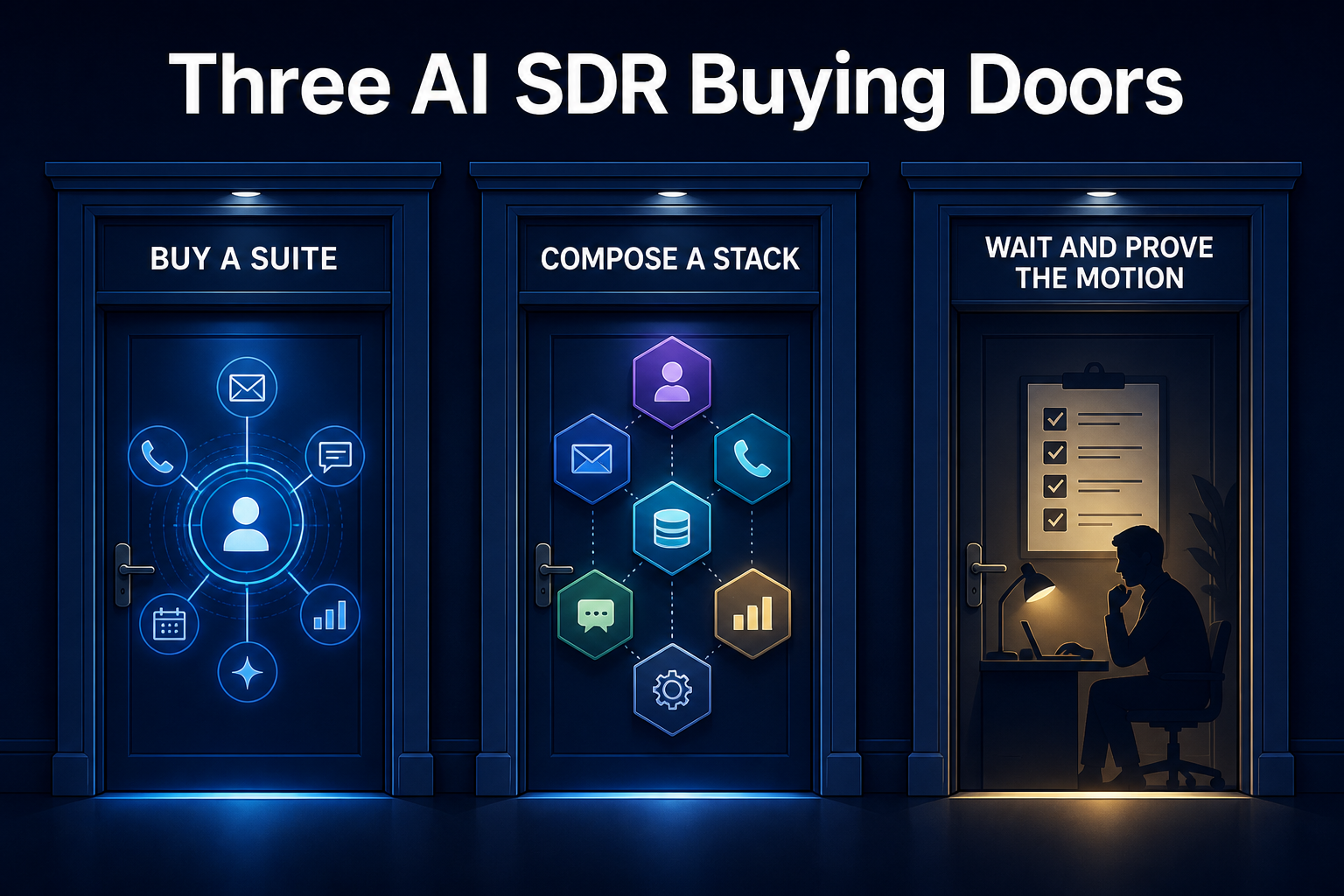
Three AI SDR buying paths: suite, composed stack or waiting to prove the sales motion.
Teams can buy a suite, compose a stack or postpone automation until the motion is proven.

20 / FAQ

Frequently asked questions

What is an AI SDR?

An AI SDR performs several connected sales-development jobs. These may include research, writing, outreach, replies, booking and CRM. The important definition is not AI. It is the set of owned actions and human controls.

What is the difference between an AI SDR agent and an AI SDR tool?

An agent usually executes more actions with less prompting. A tool may support one job, such as research or sending. Product labels still mean different things. Compare workflows, permissions and handoffs.

Can an AI SDR replace a human SDR?

It can automate parts of junior SDR work after process validation. It cannot own GTM strategy, ICP, offer or brand. People should keep consequential replies, named accounts and exceptions. Ask which task can move without hiding the decision.

Which AI SDR is best for a small B2B team?

There is no universal best product. Choose by the current bottleneck. Use a copilot for slow research and drafting. Use a controlled agent for a repeatable motion. Choose a stack when custom evidence matters. Wait when the motion remains unstable.

How much does an AI SDR cost?

Real cost includes the product, data, domains and inboxes. Count setup checks and CRM work. Add review time and failure recovery. Compare the full cost for each accepted sales result. We reviewed official prices on 18 August 2026. The ranking excludes them because scope and contracts change.

Should an AI SDR answer replies automatically?

Only within a narrow, tested contract. Every reply stopped the owner-supplied sequence. An SDR then validated the next state. This protects context, suppression and brand. Teams can automate bounded FAQs later. Objections and referrals need a clear handoff. So do material sales questions.

What should an AI SDR write to CRM?

Write only validated commercial state. An untouched cold list is not pipeline. After activation, keep the source and campaign. Keep status and owner too. Also preserve the next action and correction history. Keep owner and lifecycle changes auditable.

Should AI SDR tools automate LinkedIn outreach?

Do not assume a feature represents permitted platform behavior. LinkedIn bans scraping without permission. It also bans bots that send messages or take similar actions. Verify the vendor method and current terms before use.

21 / Method

Methodology, evidence limits and update policy

This comparison uses two kinds of evidence:
  1. Owner evidence: Anastasiia approved this operating evidence. Her broader workflow used five tools. They were Apollo, Clay, Claude Code, Sales Navigator and lemlist. She also recommends Instantly for a defined role. A real Lemlist sequence supplies the reply-stop and CRM rule.
  2. Official sources: we reviewed seven official product sites. They cover Alice, Ava, AiSDR, Agent Frank, Jason, Regie.ai and Duo. The review date was 18 August 2026.
We did not run a common-sample product test. We excluded vendor outcomes and database-size claims. We left out claims about accuracy and inbox placement. A numerical 1–7 ranking would create false precision. We do not claim live access to these products.
The 40/40/20 split is an author heuristic. It is not an industry benchmark. The Lemlist evidence documents a workflow, not vendor causality. Its first-party NextLevel AI context remains disclosed. It does not affect product placement.
Six products have confirmed no-relationship disclosures. They are Clay, Apollo, Anthropic/Claude, lemlist, HubSpot and Salesforce. The seven AI SDR candidates still lack a declaration. Recheck this before Phase 14. Workflow fit, not payment, sets placement.
Read the methodology and AI use policy. The AI lead qualification guide explains the wider human-control approach.
Update this comparison after a material product or pricing change. New product or policy facts can also trigger review. Reopen official sources instead of copying old tables.

Research note

Methodology

  1. 01Owner evidence covers Anastasiia Krynytska's documented multi-tool outreach workflow.
  2. 02Seven candidates are reviewed from official documentation; no common-sample product test was run.
  3. 03Vendor outcome and accuracy claims are excluded; unresolved relationship declarations remain disclosed.
Read the full methodology

Source ledger

Sources & editorial notes

  1. 01
    11x documents

    11x · Official product, platform, policy or regulatory source cited in this guide.

  2. 02
    Artisan describes

    Artisan · Official product, platform, policy or regulatory source cited in this guide.

  3. 03
    Artisan pricing page

    Artisan · Official product, platform, policy or regulatory source cited in this guide.

  4. 04
    AiSDR's features

    AiSDR · Official product, platform, policy or regulatory source cited in this guide.

  5. 05
    Salesforge documents

    Salesforge · Official product, platform, policy or regulatory source cited in this guide.

  6. 06
    Reply.io's feature page

    Reply.io · Official product, platform, policy or regulatory source cited in this guide.

  7. 07
    AI Features Terms

    Reply.io · Official product, platform, policy or regulatory source cited in this guide.

  8. 08
    Regie.ai describes

    Regie.ai · Official product, platform, policy or regulatory source cited in this guide.

  9. 09
    Amplemarket's Duo page

    Amplemarket · Official product, platform, policy or regulatory source cited in this guide.

  10. 10
    LinkedIn's help page

    LinkedIn Help · Official product, platform, policy or regulatory source cited in this guide.

  11. 11
    FTC's CAN-SPAM guide

    US Federal Trade Commission · Official product, platform, policy or regulatory source cited in this guide.

Corrections or primary material: contact the corrections desk.

About the author

Anastasiia Krynytska

Anastasiia Krynytska is a LeadGen Team Lead at Softermii and the lead editor of Luck My Sales. She covers AI-assisted outbound, account research, qualification, messaging, CRM handoffs and revenue workflows from a practitioner’s perspective.View author profile LinkedIn

Continue reading

01 · News analysis

AI sales is moving from assistant to operating layer

The category is expanding from drafting support into research, pipeline decisions, recommended actions and controlled execution.

Read news
02 · Field analysis

In AI sales, the handoff may be the product

Models are becoming accessible; durable value sits in the controlled transition from signal to seller action.

Read analysis
03 · Research framework

Sales AI Workflow Signals 2026

A launch framework for mapping the products, controls and buying questions shaping AI-enabled revenue work.

Read reports

Luck My Sales briefing

Useful context, once a week.

News, explanations and original research from this desk. No noise.
The newsletter is still being built. We will contact you when the first edition is ready.