Tool comparison & stack guide · Lead enrichment
11 B2B Lead Intelligence Tools—and the Stack That Makes Them Useful
AI may assist research organization and drafting. A human editor reviews every published page, checks material claims against the cited sources and owns the final decision. No company paid for placement in this article.
AI use policyAgent-ready brief
AI takeaways
Keep the key points here, or take a source-aware text brief into Claude, ChatGPT or another AI workspace.- 01Choose tools by the missing operational role, not by database size or a universal ranking.
- 02For a lean team, begin with one agentic work layer, one appropriate data source, one delivery route and a CRM.
- 03Treat Clay as an optional enrichment layer when budget and a controlled pilot prove that another provider closes a material gap.
- 04Use public engagement as a research cue, not consent, qualification or proof of purchase intent.
- 05Measure seller-accepted records, field correctness, freshness, traceability and cost before buying more volume.
When evidence is insufficient, lower confidence—not standards. AI recommends; a seller qualifies.
01 / Buying decision
The short answer: choose lead intelligence tools by their role
| If your problem is... | Add or improve this role | Shortlist from this guide | What a person must still decide |
|---|---|---|---|
| Research and filtering consume seller time | Agentic work layer | Codex or Claude Code | Rules, exceptions, approved output, and whether the evidence is sufficient |
| You cannot find enough suitable companies or contacts | Discovery source | Apollo or LinkedIn Sales Navigator | ICP fit, current role, and whether the person should be contacted |
| Records are incomplete, one provider has poor coverage, and the budget supports another layer | Optional enrichment and orchestration | Clay | Whether the measured gap justifies the cost, plus provider order, acceptance rules, and spend limits |
| You need private-company context or change events | Company intelligence | Crunchbase | Whether the event matters to this offer now |
| A seller needs a deeper reason to contact an account | Account research | Falcon | Which findings are factual, relevant, and safe to use |
| Good records never enter a consistent sequence | Delivery | Lemlist, Instantly, or LinkedHelper | Channel, copy, cadence, policy, and first-send approval |
| Warm leads or an old database need a phone path | Voice and reactivation | NextLevel AI or another reviewed voice platform | Consent, call purpose, script, escalation, status, and next action |
| The team cannot explain what happened after outreach | System of record | Your CRM | Stage, status, owner, outcome, and learning rule |
Which missing evidence or execution role prevents our sellers from creating qualified conversations?
02 / Category map
What a B2B lead intelligence tool should do
- Where did this claim come from?
- How current and well verified is it?
- Why does it matter to our approved ICP or buying situation?
- What action did a seller approve because of it?
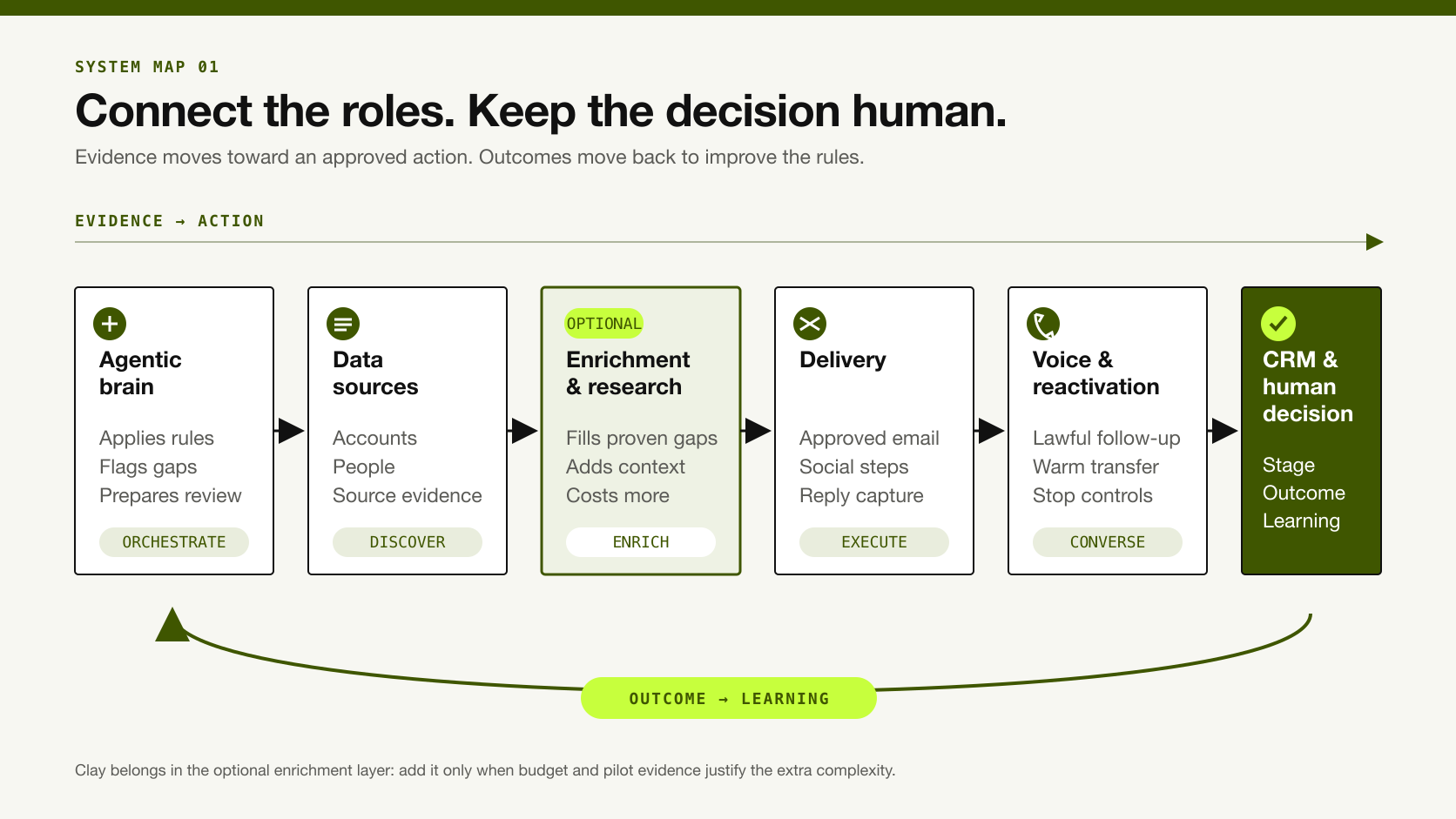
Keep the jobs separate even when one vendor combines them
| Layer | Primary job | Useful output | It should not silently control |
|---|---|---|---|
| Data source | Return companies, people, and observable attributes | A sourced candidate record | Qualification or outreach permission |
| Enrichment | Fill or refresh a known record | New field, source, and verification state | Acceptance of conflicting data |
| Research | Explain a company, role, trigger, or business problem | Evidence-linked account brief | A fabricated reason to contact |
| Agentic orchestration | Apply rules, call tools, transform records, and prepare recommendations | Review queue with rationale | Unreviewed sending or irreversible CRM changes |
| Delivery | Execute email, social, or call steps | Dated touch and response event | ICP fit or opportunity creation |
| CRM | Preserve identity, decisions, activity, and outcomes | Auditable record and next action | Truth inferred only from a vendor score |
Discover → Verify → Enrich → Interpret → Approve → Write to CRM → Measure
Measure seller-accepted intelligence
seller-accepted record is a company or contact that passes the team's documented checks and is approved for a defined next action by an accountable person. This is more useful than counting every row a database returns. Our AI lead-qualification guide defines the seller decision in more detail.Cost per seller-accepted record = pilot tool and usage cost ÷ unique records approved for the defined action
03 / Evaluation
How we evaluated these 11 solutions
- Workflow-used: present in the documented operating workflow supplied for this article.
- Owner-recommended: recommended by Anastasiia for a defined role; this does not imply a comparative test.
- Documentation-reviewed: capabilities checked against official product documentation; no hands-on claim is made.
04 / 11 tools
11 B2B lead intelligence tools compared by role and benefit
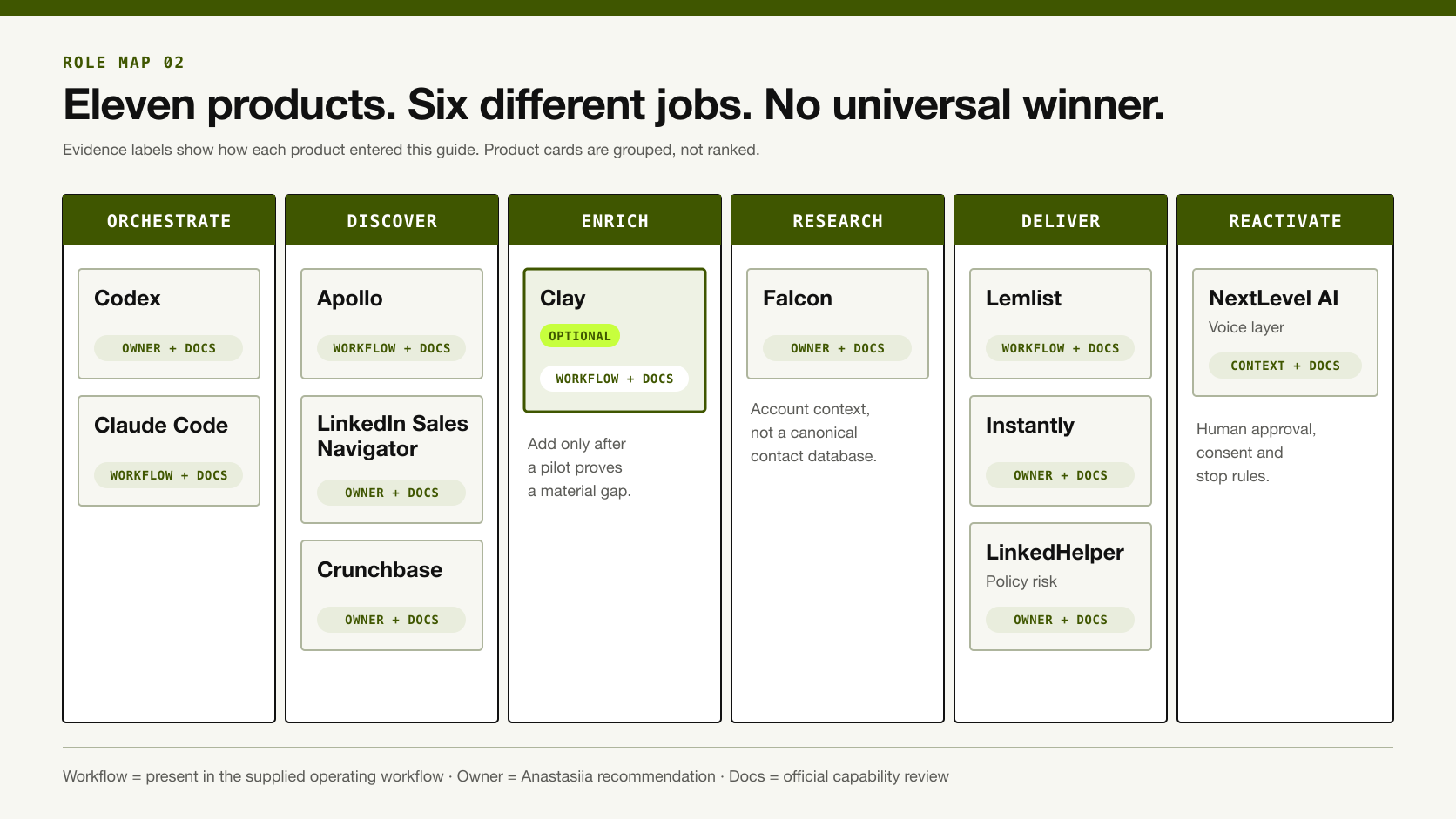
| Solution | Role in the stack | Practical benefit | Best fit | Evidence level | Main human gate or limitation |
|---|---|---|---|---|---|
| Codex | Agentic work layer | Builds and operates repeatable research, filtering, QA, and integration workflows | Small or midsize team able to define rules and tool access | Owner-recommended; documentation-reviewed | Keep permissions, sources, and consequential actions controlled |
| Claude Code | Agentic work layer | Processes structured inputs, applies workflow rules, and prepares customized outputs | Team already using programmable files, scripts, and connected tools | Workflow-used; documentation-reviewed | A human approves first records, copy, replies, and CRM actions |
| Apollo | Contact discovery and enrichment | Creates an economical starting list and fills company/contact fields | Lean outbound team needing one practical data source | Workflow-used; documentation-reviewed | Returned data still needs current-role, company, and contactability checks |
| LinkedIn Sales Navigator | Professional identity and relationship context | Finds current people and observes role, account, and content changes | LinkedIn-led B2B prospecting and relationship selling | Owner-recommended; documentation-reviewed | Does not independently verify email, phone, or commercial fit |
| Clay | Optional enrichment and orchestration | Combines providers, conditional logic, research, and controlled outputs | Budgeted team that has proved a complex ICP or single-source coverage gap | Workflow-used; documentation-reviewed | Not required for a lean stack; more providers create more cost and conflicting claims unless rules are explicit |
| Crunchbase | Private-company intelligence | Adds company, funding, market, and change context | Teams targeting startups, private companies, investors, or growth events | Owner-recommended; documentation-reviewed | A company event is context, not automatic buying intent |
| Falcon | Account research | Produces value-proposition-specific account research from public information | Sellers who need a defensible reason to contact a smaller account set | Owner-recommended; documentation-reviewed | It is not a substitute for a canonical contact database or human fact check |
| Lemlist | Multichannel delivery | Routes email, LinkedIn, phone, WhatsApp, and manual steps in one sequence | Team that wants conditional multichannel outreach and a shared inbox | Workflow-used; documentation-reviewed | Delivery behavior is not qualification; first sends and replies need review |
| Instantly | Email delivery | Runs email-first outreach and follow-up at scale | Team whose chosen channel is primarily cold email | Owner-recommended; documentation-reviewed | Verify deliverability, suppression, copy, and legal requirements independently |
| LinkedHelper | Budget LinkedIn execution | Automates LinkedIn tasks at lower operational cost | Team willing to accept and govern substantial platform-account risk | Owner-recommended; documentation-reviewed | LinkedIn says third-party automation of activity violates its rules |
| NextLevel AI | Voice and reactivation | Adds tailored phone and omnichannel follow-up to approved records | Warm-lead response, call-back flows, or permitted dormant-base reactivation | Owner workflow context; owner-recommended; documentation-reviewed | Free tailored prototype is supported; free production setup and outcomes are not established |
1. Codex — the operating brain for a connected stack
2. Claude Code — programmable filtering and flow assistance
3. Apollo — a practical starting database that still needs updating
4. LinkedIn Sales Navigator — current professional and social context
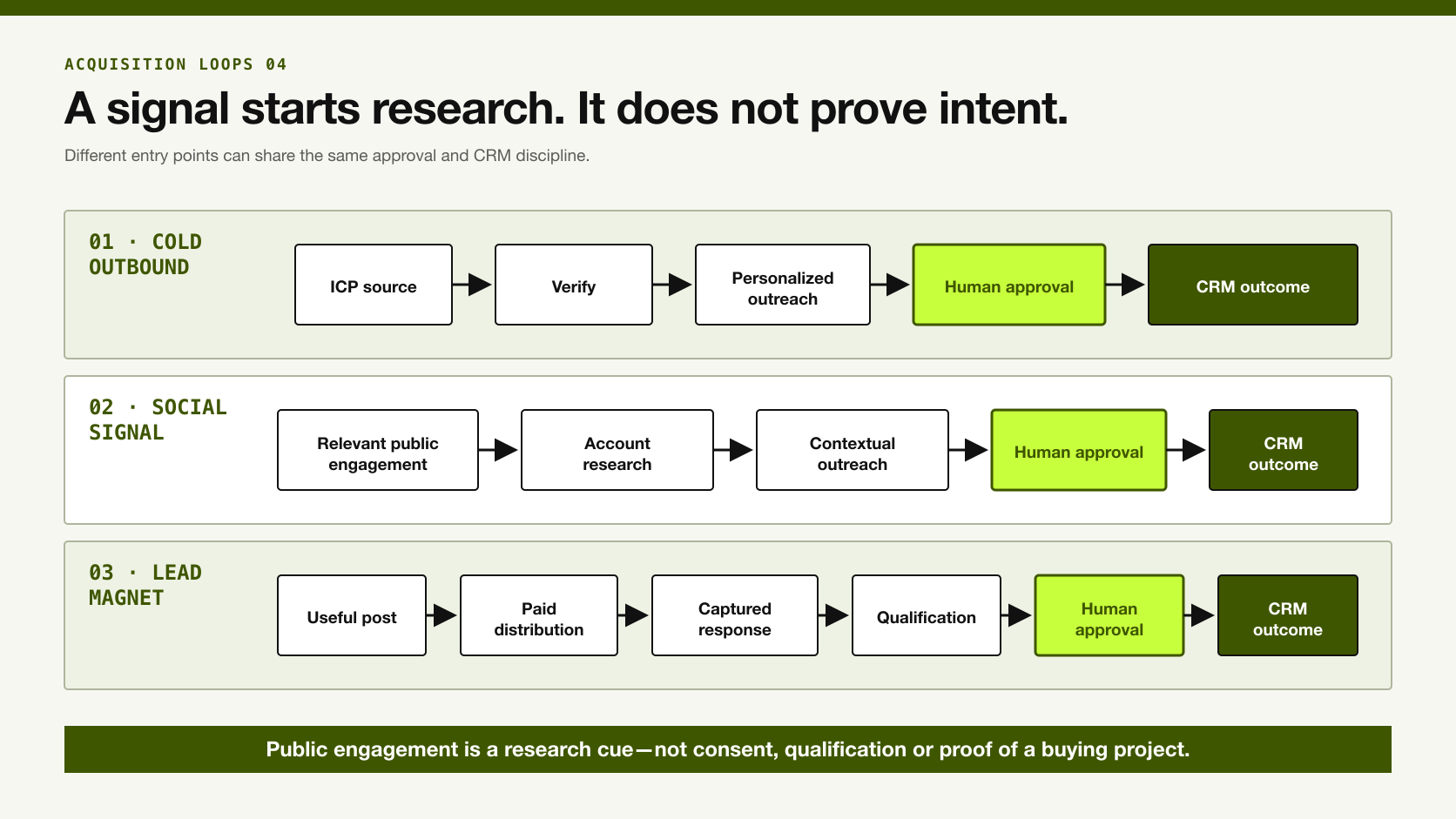
social signal, not confirmed intent. A person may like a post to learn, support a colleague, disagree, or save an idea. Engagement starts research. It does not prove a buying project.5. Clay — optional enrichment when the budget and evidence justify it
6. Crunchbase — private-company context and change signals
7. Falcon — account research shaped by your value proposition
8. Lemlist — multichannel delivery and response operations
9. Instantly — email-first delivery
10. LinkedHelper — lower-cost LinkedIn execution with material policy risk
11. NextLevel AI — tailored voice follow-up and database reactivation
05 / Stack recipes
Five practical stack recipes
1. Minimal outbound stack for a constrained budget
2. Research-heavy outbound stack
3. Social-signal stack
4. Lead-magnet-to-outreach loop
5. Dormant-database reactivation stack
06 / Budget
How I would allocate a small lead-intelligence budget
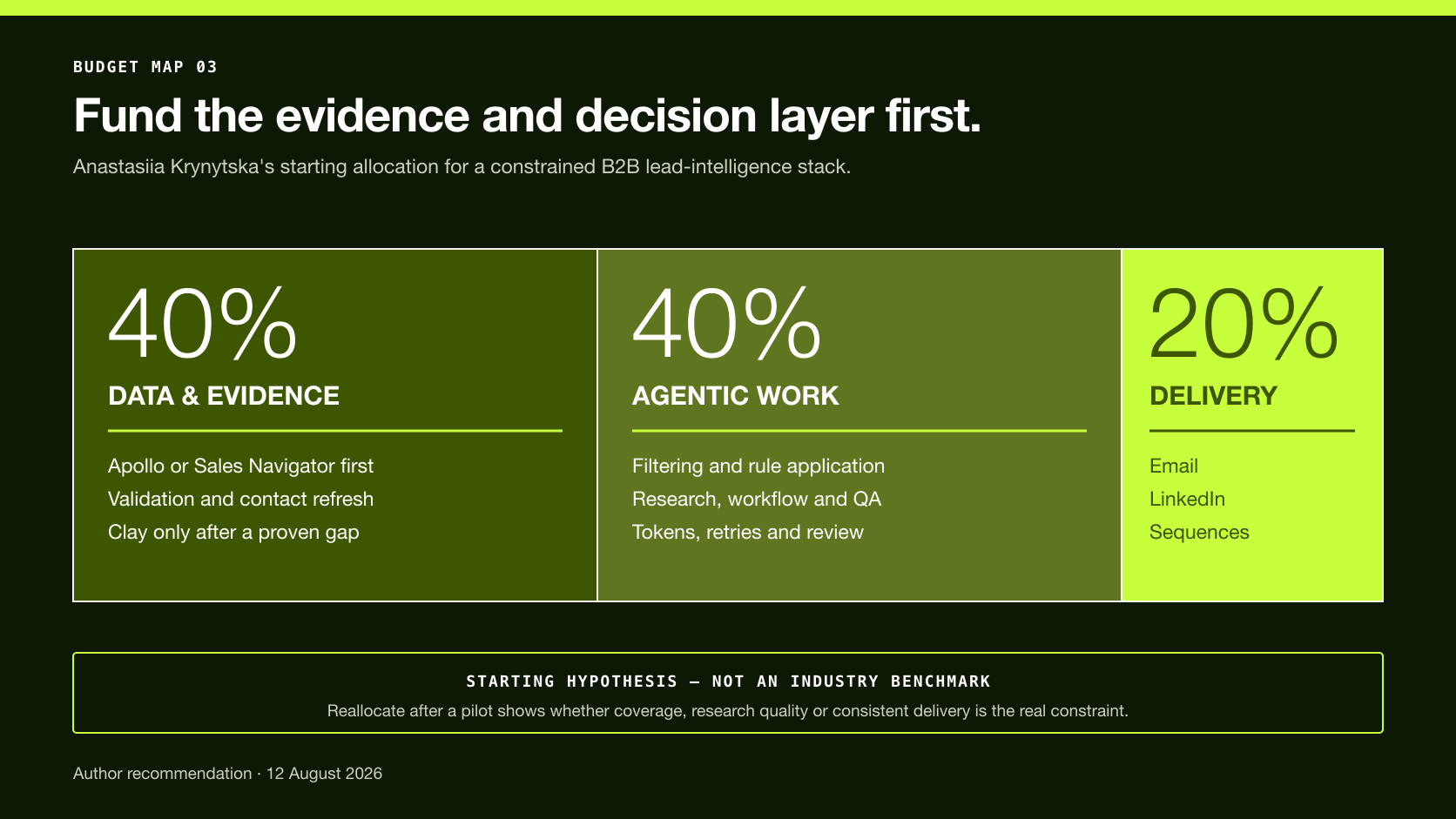
40%: data and evidence
40%: Codex, Claude Code, or another controlled agentic layer
20%: delivery
07 / Field case
What a 7,520-record workflow taught us about buying tools
- a real company connected to an outdated or commercially irrelevant role;
- a broad agency category that hid a client portfolio with the wrong sales motion;
- missing professional profiles or uncertain domains;
- confident copy built from a weak inference;
- a claimed website condition that had not been verified;
- a suitable account routed to the wrong product or channel.
08 / Pilot
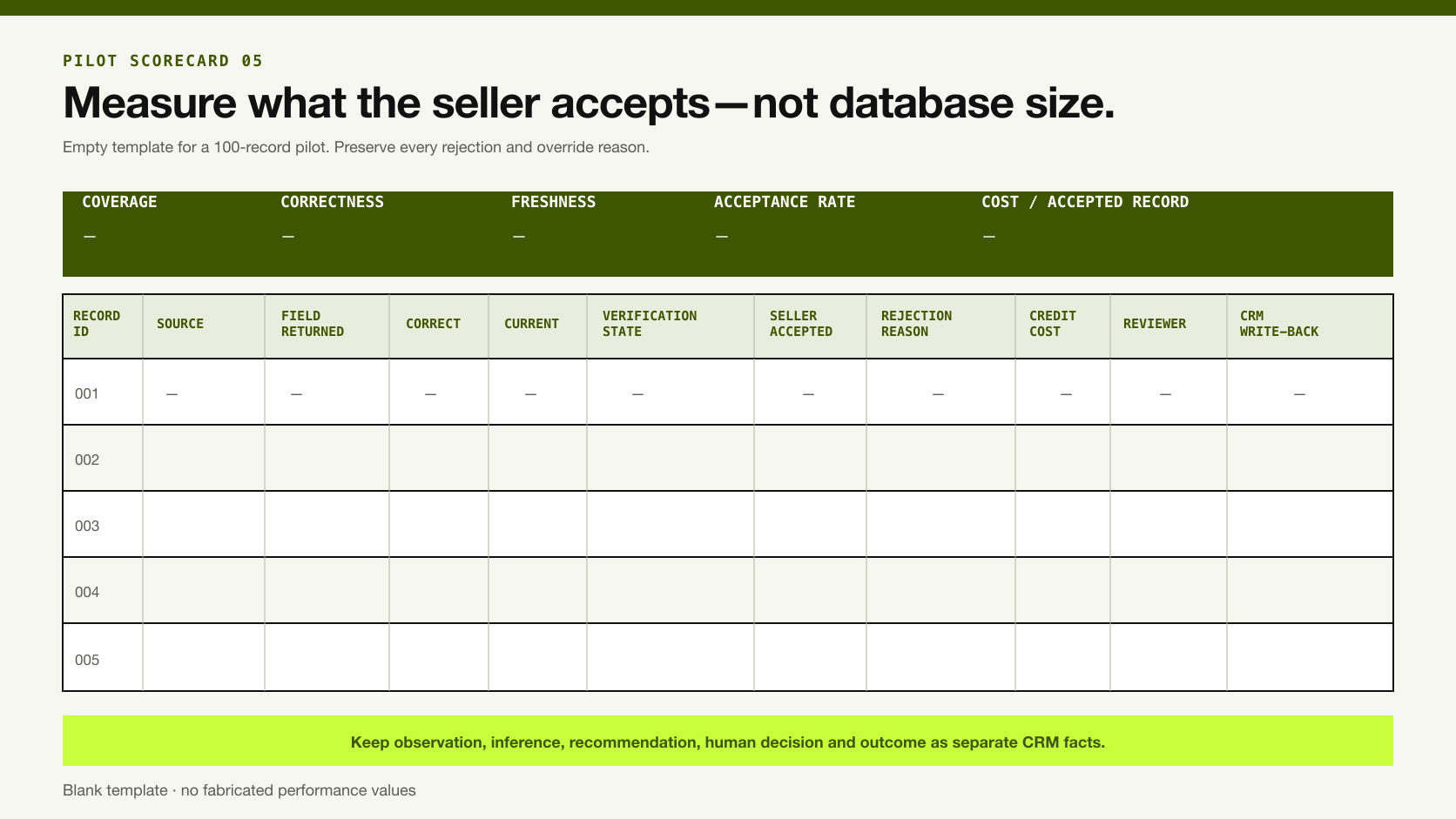
Run a 100-record lead-intelligence pilot before buying more volume
Step 1: define the action
For this record, the stack will recommend [research, reject, email, LinkedIn, call, or nurture]. A seller will approve or reject that recommendation.
accurate lead remains vague.Step 2: build a ground-truth sample
Step 3: evaluate fields separately
| Field | Returned? | Correct? | Current? | Verification state | Source traceable? | Seller accepted? |
|---|---|---|---|---|---|---|
| Company identity/domain | ||||||
| Current employer | ||||||
| Current role | ||||||
| Professional profile | ||||||
| Work email | ||||||
| Phone | ||||||
| Geography | ||||||
| Client/workflow fit | ||||||
| Research trigger |
bad data label. Each problem suggests a different fix.Step 4: record rejection reasons
- invalid domain;
- unresolved company match;
- stale role;
- wrong seniority or function;
- missing required profile;
- duplicate;
- competitor or excluded category;
- geography or policy block;
- weak client/workflow fit;
- contact data unavailable or unverified;
- evidence insufficient;
- seller rejected for another documented reason.
Step 5: test the handoffs
Step 6: calculate operating metrics
- coverage: records or fields returned ÷ records or fields requested;
- correctness: correct returned values ÷ values checked;
- freshness: current returned values ÷ values checked for recency;
- traceability: accepted values with a source and checked date ÷ accepted values;
- seller acceptance: unique records approved for the defined action ÷ records reviewed;
- cost per seller-accepted record: relevant pilot cost ÷ unique approved records;
- review time: reviewer minutes ÷ records reviewed.
Step 7: decide whether to buy, combine, or stop
09 / Failure modes
Failure modes to prevent before scale
Stale contact data becomes confident personalization
Firmographic fit hides workflow mismatch
Social engagement is promoted to purchase intent
Enrichment overwrites a better CRM value
Sending volume becomes the success metric
Automation outruns platform rules or consent
10 / FAQ
B2B lead intelligence tools FAQ
What is the best B2B lead intelligence tool?
What is the difference between lead intelligence and sales intelligence?
Is a lead database a lead intelligence solution?
Should a small team choose Apollo, Sales Navigator, or Clay?
Can Codex or Claude Code replace Apollo or Clay?
Does social intent mean somebody is ready to buy?
When should a lead-intelligence stack include voice AI?
What should a lead-intelligence tool write to the CRM?
11 / Final rule
Build the connection, then earn the right to scale
12 / Sources
Stats & sources
- OpenAI: Codex, Codex for work, and Codex for every role, tool, and workflow — official product positioning for multi-step work, connected tools, skills, and workflow support.
- Anthropic: Claude Code CLI reference and Model Context Protocol — official support for programmatic output and connected tools.
- Apollo: Prospect and Enrich and Organization Enrichment API — official discovery, enrichment, filtering, API, and matching capabilities. Vendor scale and outcome claims were excluded.
- LinkedIn Sales Navigator — official search, alerts, relationship, and plan-dependent CRM capabilities.
- Clay: Waterfalls, Sources, and Conditional runs — official orchestration and refresh behavior.
- Crunchbase data and Products & Services Insight — official private-company data positioning and coverage caveat.
- Falcon — official account-research positioning; product claims were not treated as independent performance evidence.
- Lemlist multichannel prospecting — official delivery channels, conditional flow, manual steps, and inbox capabilities.
- Instantly outreach — official description of email campaigns, automated follow-up, inbox and related sales-engagement features; performance claims were excluded.
- LinkedHelper and LinkedIn prohibited software — product capabilities and the platform's explicit automation restriction.
- NextLevel AI — official custom voice-agent, channel, integration, pricing, and free-prototype statements. No conversion or free production-setup claim is made.
- FTC: CAN-SPAM Act compliance guide — US commercial-email requirements, including B2B email.
- FCC: Declaratory Ruling on AI-generated voices — official US ruling that AI-generated voices fall within the TCPA's artificial or prerecorded voice restrictions.
- AI for Lead Generation, AI lead qualification, and lead-scoring criteria implementation — Luck My Sales workflow definitions, human gates, and CRM decision architecture.
Research note
Methodology
- 01Treat this as a role-based stack review rather than a controlled product ranking.
- 02Use official documentation for current product capabilities, platform rules and US outreach requirements.
- 03Attribute the 7,520-record case, 23-record review gate and 40/40/20 budget recommendation to Anastasiia Krynytska’s anonymized 2026 operating experience.
- 04Keep workflow-used, owner-recommended and documentation-reviewed evidence labels distinct.
- 05Exclude vendor database-size, accuracy, conversion and superlative claims unless independently established.
- 06Evaluate products on coverage, correctness, freshness, traceability, seller acceptance, review time and cost per seller-accepted record.
Source ledger
Sources & editorial notes
- 01Codex for every role, tool, and workflow
OpenAI · Official product positioning for multi-step work, connected tools and reusable workflow instructions.
- 02Claude Code CLI reference
Anthropic · Official documentation for programmatic output and agentic command-line workflows.
- 03Prospect and Enrich
Apollo · Official discovery, filtering and enrichment capabilities; vendor scale and outcome claims were excluded.
- 04LinkedIn Sales Navigator
LinkedIn · Official search, alerts, relationship and plan-dependent CRM capabilities.
- 05Waterfalls
Clay · Official documentation for configurable provider sequences and enrichment orchestration.
- 06Crunchbase data
Crunchbase · Official private-company data positioning; company events are treated as context rather than buying intent.
- 07Falcon
Falcon · Official account-research positioning; performance claims were not treated as independent evidence.
- 08Multichannel prospecting
Lemlist · Official delivery-channel and conditional-flow capabilities.
- 09Instantly outreach
Instantly · Official email-outreach and follow-up capabilities; vendor performance claims were excluded.
- 10Prohibited software and extensions
LinkedIn Help · Official restrictions relevant to third-party LinkedIn automation.
- 11NextLevel AI
NextLevel AI · Official custom voice-agent, channel and free tailored-prototype statements; no universal winner or conversion claim is made.
- 12CAN-SPAM Act: A Compliance Guide for Business
US Federal Trade Commission · US regulator guidance for commercial email, including B2B email.
- 13Declaratory Ruling on AI-generated voices
US Federal Communications Commission · Official US ruling on AI-generated voices under artificial or prerecorded voice restrictions.
- 14AI Lead Generation: Field-Tested B2B Workflow
Luck My Sales · Supporting human-gated workflow and CRM outcome architecture.
- 15Luck My Sales methodology
Luck My Sales · Evidence states, first-hand-source treatment, freshness requirements and correction protocol.