Weekly industry intelligence · No noiseSubscribe to the Luck My Sales newsletterFree briefing

Independent intelligence on AI in sales

Menu

Software comparison & buyer's guide · AI SDR tools

12 AI Lead Generation Tools for B2B Sales—Compared by Workflow Stage and Human Control

Compare 12 AI lead generation tools by workflow stage, evidence, human control, CRM write-back and the B2B sales motion each one fits.
Editorial disclosure

AI may assist research organization and drafting. A human editor reviews every published page, checks material claims against the cited sources and owns the final decision. No company paid for placement in this article.

AI use policy

Agent-ready brief

AI takeaways

Keep the key points here, or take a source-aware text brief into Claude, ChatGPT or another AI workspace.
  1. 01Design the sales motion and trust model before choosing products, then add the minimum tools and scale only after the connection works.
  2. 02Choose tools by the workflow stage and controlled decision; there is no honest universal ranking without a common test.
  3. 03Keep source evidence, AI recommendation, human approval, external action, CRM write-back and revenue outcome visible as separate events.
  4. 04Run viable tools or architectures on the same current records with one human-reviewed answer key and explicit denominators.
  5. 05Start a small team with one data source, one delivery path and one system of record; add a specialist only after a pilot proves a material gap.
Includes summary, takeaways, sources and a use note.
The best AI lead generation tool solves one defined sales problem. It does not hide the evidence, decision, or CRM result. A database can find contacts. An enrichment layer can add context. A signal platform can suggest timing. A sequencer can send approved messages. A CRM can preserve the relationship. Those jobs are connected, but they are not interchangeable.
This guide compares 12 products by workflow stage and controlled decision. It does not name a universal winner. Luck My Sales has no same-sample test across all 12 products. An ordinal ranking would therefore create false precision.
Six products appeared in broader sales workflows used by Anastasiia Krynytska. They are LinkedIn Sales Navigator, Apollo, Clay, HubSpot, Qualified, and lemlist. That is workflow exposure, not a controlled comparison of every native feature. Six other products are reviewed from current official documents only. They are Common Room, 6sense, Salesforce, Instantly, Amplemarket, and 11x.
Disclosure: Existing owner records cover six named vendors. They confirm no affiliate, client, employment, sponsorship, or paid relationship with Apollo, Clay, Anthropic/Claude, lemlist, HubSpot, or Salesforce. No commercial relationship is documented for the other products in this comparison. That absence is not a confirmed declaration. Those relationships must be checked again before publication. Product documentation was reviewed on August 17, 2026. No vendor paid for placement or determined the order.

Design the sales motion and trust model first. Build the sequence second. Choose the minimum tools third. Add scale only after the connection works.

01 / Buying decision

The short answer: choose the sales motion before the product

Anastasiia's approved operating rule is simple:

Design the sales motion and trust model first. Build the sequence second. Choose the minimum tools third. Add scale only after the connection works.

This order prevents a common buying error. Teams often ask one product to solve a different job. Clay can coordinate research and enrichment, but it becomes costly when a team expects it to see everything. Apollo can provide an economical database foundation, but records still need validation. Sales Navigator can show current professional context, yet it is harder to operate at high volume. None of these facts identifies one universal winner.
Use this decision contract for every candidate:
Object → Source evidence → AI suggestion or action → Human gate → External action → CRM write-back → Revenue outcome
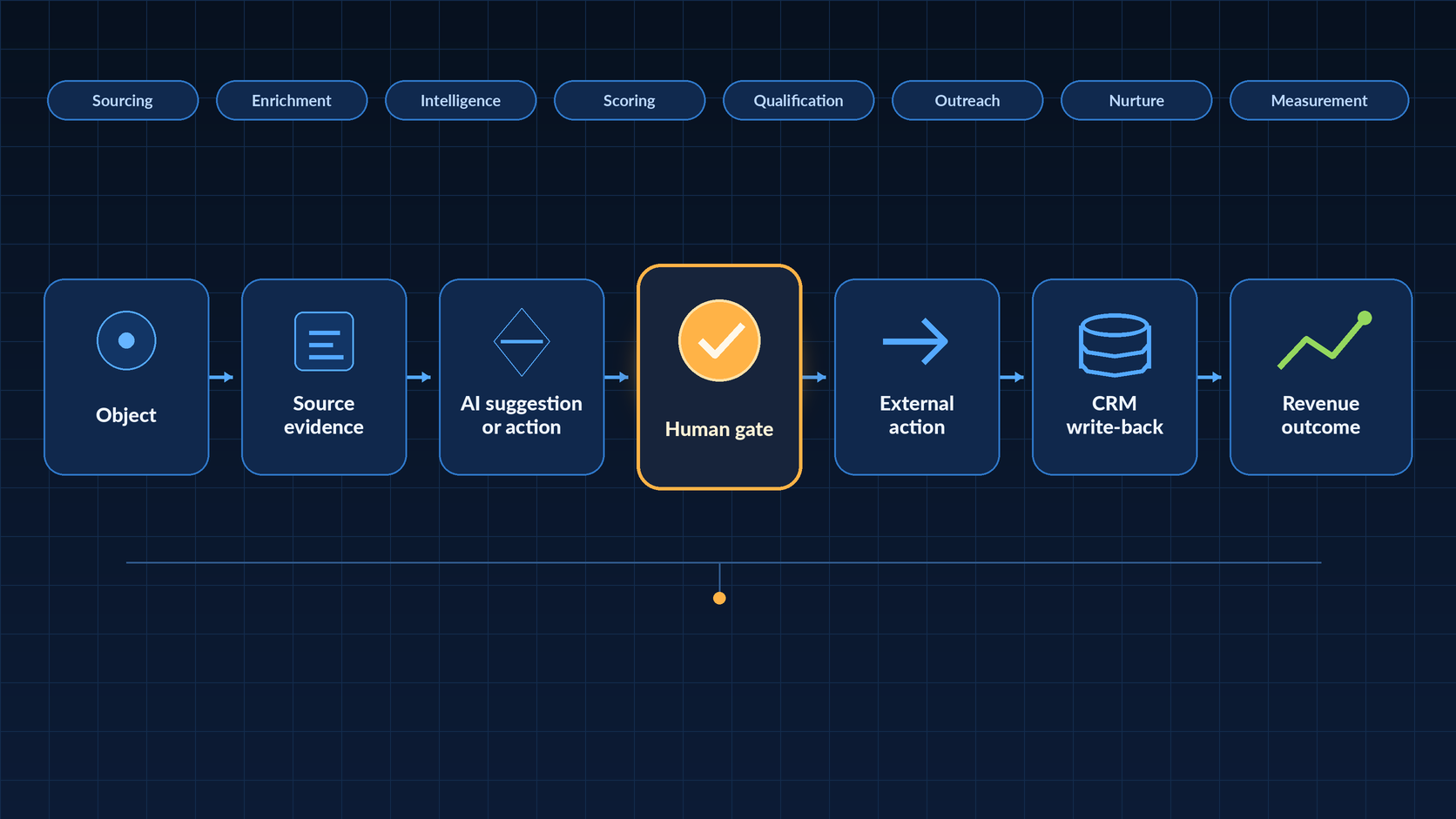
Tool Decision Contract connecting source evidence, AI action, human approval, CRM write-back and revenue outcome.
Compare AI lead-generation tools by the decision and handoff they control, not by feature count.
The object may be an account, contact, message, conversation, or CRM state. The human gate is the person who can approve, reject, edit, stop, or reverse a consequential action. The outcome should be closer to revenue than activity volume.

02 / Evaluation

How we evaluated AI lead generation tools

We included products that perform a distinct B2B lead-generation job. Each product also needed current official documentation that described its workflow. We excluded agencies, generic AI writers, consumer capture apps, and products whose AI feature was only decorative.
The comparison uses two evidence levels:
  • Used in a broader workflow: The product appeared in documented sales work. This does not mean its native AI module was tested against every other tool.
  • Documentation-reviewed: Capabilities were checked against official product material. No hands-on or accuracy claim is made.
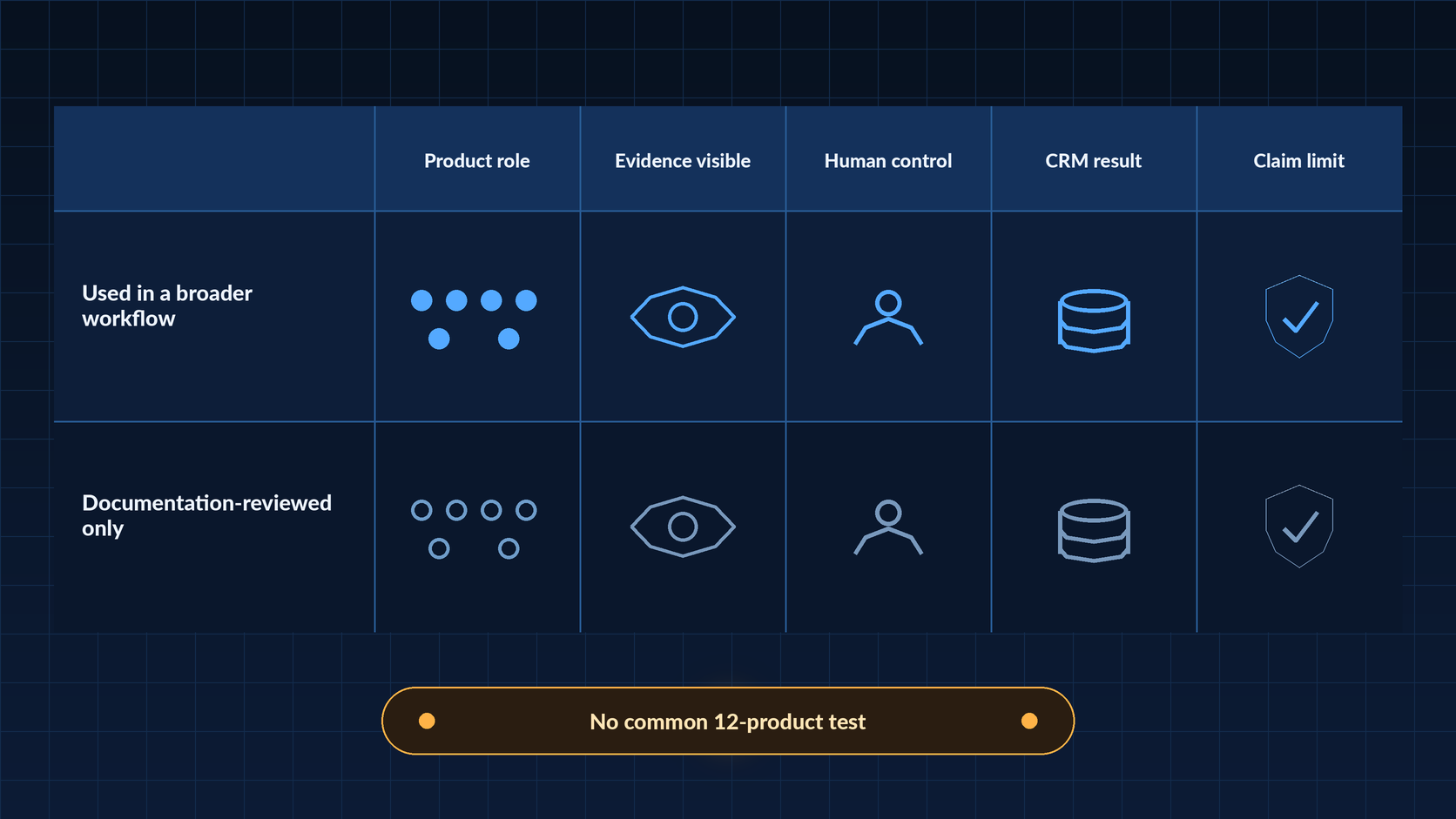
Evidence matrix separating broader-workflow exposure from documentation-only product research.
Workflow exposure and official documentation are different evidence levels; neither creates a universal winner.
The broader evidence inventory includes five more products. They are Claude Code or Codex, Warmly, NextLevel AI, Lusha, and LinkedHelper. They appeared in approved owner inputs or prior workflows. They are not added to this table. This page needs distinct jobs, not every logo in the wider stack. Claude Code and Codex remain relevant as custom operating layers. Warmly overlaps visitor signals. NextLevel AI is a disclosed first-party voice example. Lusha overlaps contact data. LinkedHelper also requires a prominent LinkedIn policy warning.
We did not use vendor database counts, customer outcomes, or accuracy claims as editorial proof. We also excluded volatile prices from the recommendation table. Pricing, credits, plans, and contracts can change. Buyers should verify them on the official page during a live shortlist.
The resulting evaluation treats identity resolution, recommendation provenance, permission boundaries, deterministic suppression, CRM reconciliation, and downstream attribution as separate operating controls.
Every recommendation must preserve its source timestamp, entity-resolution method, decision version, accountable reviewer, permitted action, and eventual CRM outcome.

03 / Comparison

The 12 tools at a glance

ProductPrimary workflow stageEvidence levelAI or automation roleRequired human checkBest fit when
LinkedIn Sales NavigatorAccount and contact discoveryUsed in a broader workflowSearch, alerts, account and lead insightsConfirm identity, role, relationship, and reason to contactCurrent professional context matters more than list volume
ApolloSourcing, enrichment, and outbound preparationUsed in a broader workflowSearch, enrichment, scoring, and workflowsValidate current role, contactability, duplicates, and CRM mappingA team needs an economical database-led starting point
ClayEnrichment, research, and orchestrationUsed in a broader workflowWaterfalls, conditional enrichment, and AI researchInspect sources, conflicting fields, cost, and write-backCustom evidence justifies an operations layer
Common RoomSignals and identity resolutionDocumentation-reviewedCombines signals and resolves people and accountsVerify the person, source, timestamp, and commercial meaningA team has useful signals across several systems
6senseAccount intent and prioritizationDocumentation-reviewedAccount intelligence and predictive prioritizationKeep account priority separate from contact permissionEnterprise ABM needs account-level timing context
HubSpotCRM scoring, workflow, and lifecycle controlUsed in a broader workflowFit and engagement scores, workflows, and CRM automationApprove consequential state, owner, and suppression changesThe CRM should remain the operating center
SalesforceCRM-native agents and measurementDocumentation-reviewedLead engagement, qualification, permissions, and analyticsTest agent access, sources, handoff, and opt-out behaviorAn enterprise wants AI inside governed CRM roles
QualifiedInbound conversation and routingUsed in a broader workflowWebsite qualification, routing, and meeting pathsReview questions, routing logic, fallback, and CRM resultSalesforce-centered teams need fast inbound handling
lemlistOutbound sequence executionUsed in a broader workflowCampaign steps, multichannel tasks, and reply handlingApprove the sample, message, launch, and reply stopA team wants reviewed multichannel campaign delivery
InstantlyEmail-first sourcing and executionDocumentation-reviewedSearch, enrichment, sending, and campaign controlsCheck risky emails, replies, suppression, and domain limitsCold email is the primary operating channel
AmplemarketSignal-led assisted outreachDocumentation-reviewedFinds signals, researches contacts, and drafts sequencesVerify signal context and the exact action before sendReps want a copilot across signals and outreach
11xHigh-autonomy outbound executionDocumentation-reviewedProspecting, research, multichannel follow-up, and handoffAudit permissions, identity, objections, stops, and CRM historyA team is prepared to govern a broad AI SDR workflow
The table is not a league table. It shows different operating architectures. A strong sourcing tool can still be a poor system of record. A flexible sequencer can still send the wrong message. A CRM agent can still act on weak source data.

04 / Sourcing

Sourcing and account discovery

LinkedIn Sales Navigator: current professional context

LinkedIn Sales Navigator supports lead and account search. It also offers saved lists, alerts, account insights, and plan-dependent CRM features. Its value is the professional graph. A seller can inspect a current role and shared context. Recent activity and relationship paths can also inform research.
Anastasiia has used Sales Navigator in broader sales workflows. Her approved position is practical. It is harder to operate at scale than a database. Yet it can expose more current employment and activity evidence. That helps when identity and relationship context matter more than list size.
The seller still owns the contact decision. A profile match does not prove current need. Public activity does not prove buying intent. A connection path does not create permission to automate outreach.
This boundary is important. LinkedIn's current prohibited-software guidance restricts third-party scraping and automation tools. Evaluate Sales Navigator as a permitted research and relationship surface. It does not authorize browser bots or automated messages.

Apollo: a database-led starting point

Apollo Prospect and Enrich combines discovery, company filters, enrichment, and workflows. Apollo also documents several enrichment paths. They include saved records, CRM, forms, schedules, and API workflows.
Apollo appeared in Anastasiia's documented workflow. Her approved view is that it offers an economical list-building base. The limit is clear: some returned records can be stale. A database match still needs four checks. Verify the current role, identity, contactability, and reason to contact.
Teams should test Apollo with current records from their market. Count unique records, not search results. Record which required fields are valid. Track duplicates and unresolved records. Review CRM mappings before activation. Configured enrichment may update existing fields.
Apollo fits a small or medium team that wants to start with one data surface. It becomes less suitable when a narrow sales motion requires custom evidence from several sources. That is the point where an orchestration layer may earn its cost.

05 / Enrichment

Enrichment, research, and identity resolution

Clay: flexible orchestration after a proven data gap

Clay's waterfall documentation describes an ordered sequence of data providers. A workflow can try each source in turn. It can preserve which provider returned a result. Clay can also run conditions and AI-assisted research before a handoff.
Clay appeared in the documented workflow. It supported enrichment and custom research under human review. That experience does not prove that Clay is more accurate than every source inside its tables.
Anastasiia's approved rule is that Clay is optional. Add it after a simpler source fails to provide enough accepted records. The sales motion must also need custom evidence, and the budget must support another operating layer.
The test is field-level. Which source produced the company, role, email, signal, or claim? What happened when two sources disagreed? Did the workflow leave a field blank or choose a plausible answer? Which data entered staging, and which data could overwrite the CRM?
Clay fits teams with a real RevOps owner. It is a poor fit when no one owns credits, schemas, conflicts, or exception review. Flexibility without governance creates a more expensive version of the same data problem.

06 / Signals

Buyer signals and account prioritization

Common Room: unify signals, then verify their meaning

Common Room Signals combines activity from several sources. Those sources include product, community, website, CRM, and calls. Person360 is positioned as the identity and enrichment layer behind those signals.
This profile is documentation-reviewed only. Luck My Sales has not run Common Room against the owner workflow.
The useful job is consolidation. A team may already have signals in several systems but lack one view of the person and account behind them. The risk is semantic inflation. A website visit, job change, community comment, or product event can justify research. It does not automatically establish intent, permission, or qualification.
Before activation, inspect the original event and timestamp. Check the person-account match and expiry rule. Then define the permitted action. A weak or anonymous signal may support account research. A verified signal may support seller review. Neither should create an opportunity by itself.
Common Room fits a signal-rich team with an identity problem. It is less useful when the underlying sources are sparse or no one can define what each signal changes.

6sense: account priority is not contact permission

6sense Sales Intelligence describes several account-level functions. They include account context, contact intelligence, intent data, and predictive tools. That makes it relevant to enterprise account-based sales.
This profile is documentation-reviewed only. Vendor material can establish the intended capability. It cannot establish predictive accuracy for the reader's market.
The key control is object separation. An account score concerns an account. It does not prove that one contact owns the problem. It also does not authorize a message. The workflow must still select a person, confirm a current role, document the signal, and decide which action is appropriate.
Test whether users can see why an account moved. Check when the input changed. Separate first-party evidence from third-party evidence. Store the account recommendation apart from the contact decision. Preserve the seller's override and later outcome.
6sense fits enterprise ABM teams that already have clean account data and a defined operating motion. It is too much infrastructure for a team that has not yet defined its ICP, contact rule, or CRM state contract.

07 / CRM

CRM-native scoring, nurturing, and measurement

HubSpot: keep the decision and history in the CRM

HubSpot documents fit, engagement, and combined lead scores. Its workflow tools can enroll records, run actions, and manage later state changes. The CRM can therefore hold the source fields, score, seller decision, owner, next action, and outcome.
HubSpot appeared in Anastasiia's broader sales workflows. This does not mean every HubSpot scoring or AI feature was tested in a common benchmark.
The benefit is proximity to the system of record. The risk is treating a workflow result as truth. A score can recommend priority. A lifecycle stage records an operating state. Neither proves buyer readiness without a rule and accountable owner.
Review enrollment, re-enrollment, and suppression before launch. A person who replied, opted out, or entered a live seller conversation should not restart an old automated path. Keep model recommendation, human decision, applied action, and outcome in separate fields or events.
HubSpot fits a team that wants one CRM-centered operating layer. It is a weak fit when teams expect native automation to repair poor identity, an undefined ICP, or disconnected channels.

Salesforce: govern the agent as a CRM user

Salesforce's official Agentforce Lead Nurturing setup describes the control surface. It covers agent users, permissions, trusted information, testing, activation, and analytics. The agent can support inbound response, questions, meetings, and later nurture tasks.
This profile is documentation-reviewed only. Luck My Sales has not compared Agentforce with the other products on one lead sample. Existing owner records confirm no affiliate, client, employment, sponsorship, or paid relationship with Salesforce.
The useful design principle is role governance. Treat the agent as a system actor with explicit access. Define which objects it may read. Define which records it may change. Limit the actions available to each job. Test its source library, fallback, opt-out, human handoff, and audit history.
Salesforce fits an enterprise that already governs permissions, data, and CRM processes. It can be an expensive distraction when the organization still lacks reliable fields and ownership rules. An agent inside the CRM is not safer merely because it is native. Its authority must still match the evidence.

08 / Inbound

Inbound qualification and routing

Qualified: connect the website conversation to Salesforce

Qualified for Salesforce describes a website-conversation layer. It can use Salesforce context, route a visitor, create a lead, and support booking. Qualified also publishes an implementation process. It includes launch and sign-off steps.
Qualified appeared in Anastasiia's broader workflow exposure. No same-sample qualification benchmark was supplied. The product should therefore be described by the role it played and its documented behavior.
The operating question is not whether chat can ask questions. Ask whether the conversation creates the correct state and handoff. Test a known target account and an unknown visitor. Add the wrong person, an unanswered question, an unavailable seller, and an opt-out. Inspect the transcript and route after each path. Then inspect the owner, meeting status, and CRM fields.
Qualified fits a Salesforce-centered team with meaningful inbound traffic and clear routing logic. It is less useful when traffic is low, questions are undefined, or CRM ownership is unreliable. Speed cannot compensate for a bad route.

09 / Outbound

Outbound execution

lemlist: sequence delivery needs a reply boundary

lemlist documents campaign sequencing. It also documents controls for stopping contact after replies or clicks. The product can coordinate campaign steps and manual tasks across an approved list.
lemlist appeared in Anastasiia's documented workflow. It served as an execution layer after research and human approval. That experience does not prove that its personalization, deliverability, or native AI is better than every alternative.
The first test should use a small batch. Review the record, source evidence, message, and sender. Check the sequence branch and suppression state. Then test a meaningful reply and an automatic reply. Add a wrong-person response, unsubscribe, and live seller handoff.
A sequencer should stop when the relationship changes. It should not send the next automated touch because one system missed a reply in another channel. lemlist fits teams that want controlled multichannel execution. It cannot repair a weak ICP, stale evidence, or irrelevant offer.

Instantly: email-first execution with consequential settings

Instantly's SuperSearch documentation covers search, enrichment, exports, and campaign transfer. Its campaign options include several key controls. They cover reply stops, risky-email behavior, sending rules, and unsubscribe headers.
This profile is documentation-reviewed only. Instantly was owner-recommended in an earlier stack discussion, but no direct workflow test was documented. That distinction remains visible.
The settings are the product evaluation. Does a reply stop only one contact or the whole company? What happens with an automatic reply? Can a risky email enter the campaign? Does the system detect replies sent to another address? Which events reach the CRM?
Instantly fits an email-first team that can govern sending infrastructure and suppression. It is a poor fit when high volume is being used to avoid a targeting problem. More inboxes increase capacity. They do not create a reason to contact.

10 / Automation

Products that attempt broader workflow ownership

Amplemarket: signal-led recommendations with a review path

Amplemarket Duo is positioned as an AI sales copilot. It monitors signals, gathers context, surfaces people, and prepares multichannel sequences. The official page also describes rep review, edits, dismissal, feedback, and more automated modes.
This profile is documentation-reviewed only. Vendor customer outcomes and claims about intent are not independent proof.
Amplemarket is useful for examining the boundary between assistance and execution. A rep may review a signal and draft before sending. Another configuration may automate more of the path. Buyers must verify the exact mode, permissions, and visibility in their plan.
Test whether the original signal is visible. Check whether the identity is correct. Reject a recommendation and inspect what is stored. Edit a message and confirm whether future output changes. Trigger a reply and verify that every related sequence stops.
Amplemarket fits teams that want one layer across signals and outbound preparation. It does not remove the need for CRM ownership or a human escalation rule.

11x: evaluate autonomy as authority, not as a feature count

11x Alice is positioned as an AI-led outbound layer. Official material describes prospecting from signals and account research. It also describes multichannel sequences, follow-up, and conversation handoff.
This profile is documentation-reviewed only. Customer pipeline and meeting figures are company-reported. They are not used to rank 11x against the other products.
The right evaluation question is authority. Which accounts may Alice select? Which sources may it use? Can a person inspect or approve messages? How are objections, wrong identities, unsubscribes, and sensitive replies handled? What enters the CRM before and after a handoff?
Run an autonomy test before a volume test. Use adversarial records and known exceptions. Confirm that the system stops safely when evidence is weak or the relationship changes. Preserve the agent action, seller decision, and later outcome as different events.
11x fits a team with a mature sales motion and a named governance owner. It is unsafe as a shortcut around unclear targeting, weak data, or absent CRM discipline.

11 / Stack design

How to connect the tools into a working stack

A stack should have one owner for each handoff. It should also have one system of record. More products do not create a stronger system when two tools control the same decision.

Minimum stack for a founder or small team

Start with one data source, one delivery path, and one record of truth. Apollo or Sales Navigator can support discovery. A simple reviewed email process may handle execution. HubSpot or another CRM should hold the accepted record and outcome.
Add Clay only when a pilot shows a material data or research gap. Add a custom Claude Code or Codex layer only when the team can maintain the prompts, rules, and output. Those products appeared in the owner workflow, but they are not a substitute for clear sales criteria.

Controlled outbound stack

Use this sequence:
  1. Define the segment and reason to contact.
  2. Source accounts and contacts.
  3. Enrich only fields needed for the decision.
  4. Review the first records and messages.
  5. Approve a small campaign batch.
  6. Stop automation when a meaningful reply arrives.
  7. Write the relationship state and next action to the CRM.
  8. Review later calls and opportunities before scaling.

Inbound-plus-outbound stack

Inbound and outbound systems must share relationship state. A website agent should not book a lead into one path while an outbound sequencer continues another. A meaningful conversation creates human ownership. Every channel should read that state before taking the next action.

Enterprise ABM and RevOps stack

Separate the objects. 6sense may prioritize an account. Common Room may surface a person-level event. Salesforce may govern an agent and CRM state. A sequencer may execute an approved touch. None should silently convert an account score into an opportunity.

12 / Buyer pilot

How to pilot tools on the same records
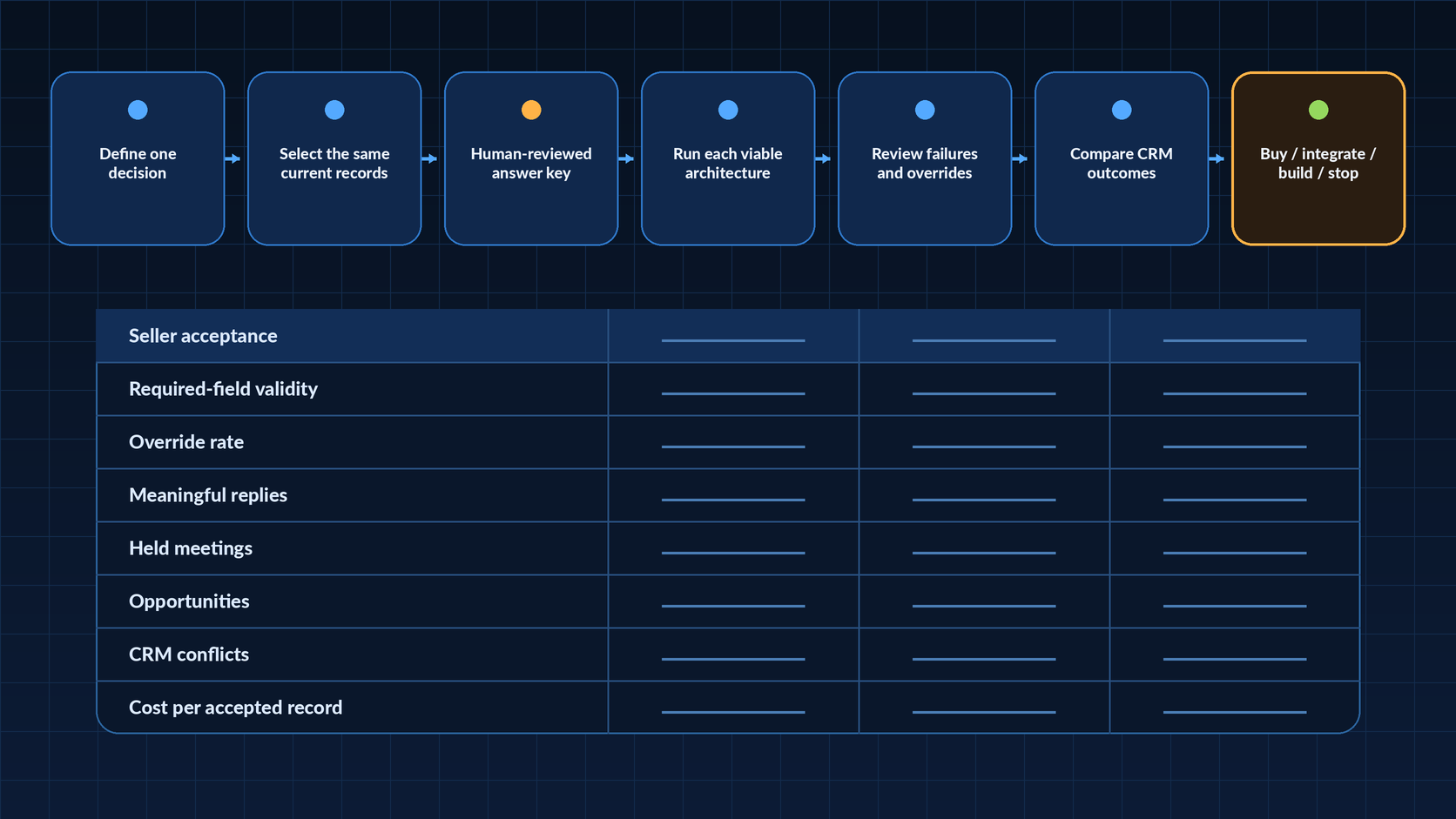
There is no honest universal ranking without a common test. Build one for your own decision.
Same-sample pilot for comparing AI lead-generation architectures with a human-reviewed answer key.
Test the same decision and records before selecting or scaling a tool.

Define the decision and answer key

Choose one action: accept for research, approve for outreach, route to a seller, enter nurture, or suppress. Use the same segment, geography, and freshness window. Have a qualified person label the correct identity, required evidence, and disposition.
The July 2026 owner workflow is process evidence, not a product bake-off. It analyzed 7,520 records and admitted 1,627 to outreach under its fit rule. The wider observational funnel later recorded 58 replies, 14 interested responses, nine calls, and four contracts. No matched control proves the stack caused those outcomes. A source inconsistency also affects the published rejected-record count, so this article does not derive it.

Test the failure path

Include records with:
  • the wrong company or contact;
  • an outdated role;
  • conflicting fields;
  • no source for a key claim;
  • an ambiguous signal;
  • a duplicate contact;
  • a meaningful reply;
  • an unsubscribe or do-not-contact state;
  • an unavailable owner;
  • a protected CRM field.

Use explicit denominators

MetricFormulaWhat it diagnoses
Seller acceptanceAccepted records / unique records reviewedWhether the output is usable for the defined action
Required-field validityValid required fields / fields checkedWhether data supports the decision
Override rateHuman overrides / recommendations reviewedWhere rules, data, or AI judgment disagree with operators
Meaningful reply rateMeaningful replies / delivered messagesWhether approved outreach starts relevant conversations
Held-meeting rateHeld meetings / meetings bookedWhether scheduling activity survives to a real conversation
Opportunity rateOpportunities under the CRM rule / accepted recordsWhether the workflow reaches a defined revenue state
CRM conflict rateUnresolved conflicts / records syncedWhether integration damages the system of record
Cost per accepted recordTotal pilot cost / seller-accepted recordsWhether another layer earns its cost
Do not combine unique-contact and message-attempt denominators. Do not claim causal lift because an outcome happened after AI was involved.

13 / Total cost

What AI lead generation software really costs

Subscription price is only one line. Count seats, credits, sending systems, domains, integrations, and setup. Add data cleanup, security review, and human QA.
Duplicate tools create hidden cost. Two sources may charge for the same record. Two scoring systems may produce conflicting priorities. Two sequencers may contact the same account. An agent may create activity that someone must later reconcile.
Ask for export and exit behavior before signing. The team should be able to recover source fields, suppression state, decisions, and history. A low starting price can become expensive when accepted records require manual repair.

14 / Risk controls

Risks and stop conditions

FailureDetectionImmediate actionOwnerCRM correction
Wrong identityDomain, role, or profile mismatchStop activationData ownerMark unresolved; preserve source conflict
Stale evidenceSource date exceeds the ruleReturn to researchResearch ownerRecord expiry and last checked date
Unsupported intentSignal has no clear commercial meaningLower confidenceSellerStore signal, not an intent conclusion
Weak message basisDraft contains an unsourced claimBlock sendSellerRecord rejection reason
Meaningful replyBuyer asks, objects, accepts, or declinesStop related automationSellerUpdate relationship state and owner
Unsubscribe or do not contactExplicit request or valid suppression eventSuppress immediatelyCompliance/RevOpsWrite channel and global suppression as required
CRM overwrite conflictTrusted value would be replacedQuarantine updateCRM ownerPreserve old/new values and approve manually
Missing outcome trailActivity cannot connect to later stateStop scalingRevOpsRepair event and attribution schema
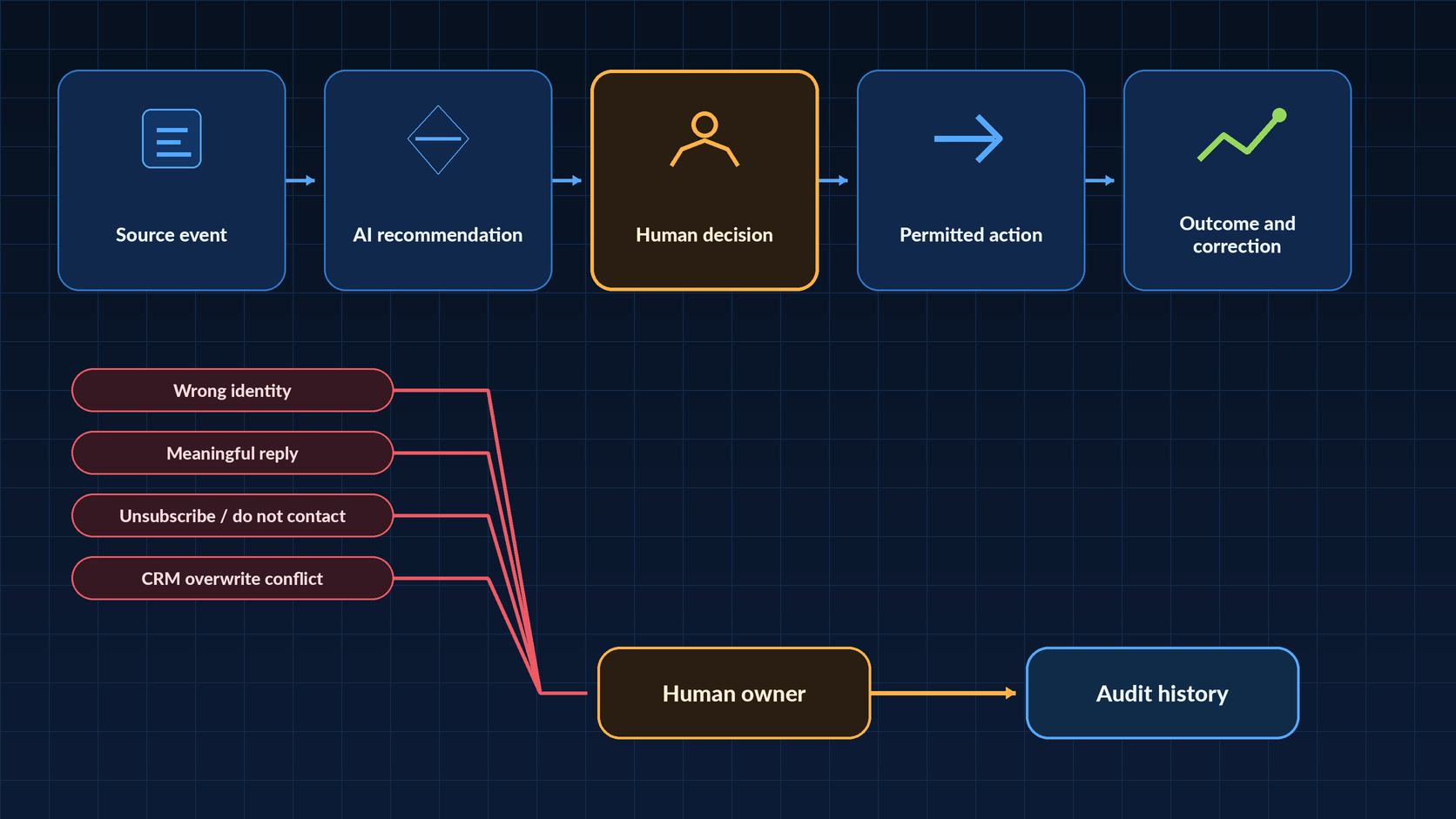
CRM control diagram separating source evidence, AI recommendation, human decision, action, and outcome with four stop conditions.
A safe stack stops on identity, relationship, permission or write-back failures and preserves the audit trail.
For US commercial email, review the FTC's current CAN-SPAM guidance. It applies to commercial messages and includes B2B email. Other markets and channels have different rules. This guide is operational guidance, not legal advice.

15 / Buyer checklist

Twelve questions to answer before signing

  1. Which object and decision will the product control?
  2. Which sources produce its recommendation?
  3. Can a reviewer inspect those sources?
  4. What happens when evidence conflicts or disappears?
  5. Which external action can AI take without approval?
  6. Can a person edit, reject, stop, and reverse that action?
  7. Does a meaningful reply stop every related sequence?
  8. Which CRM fields can the product read and write?
  9. Can it overwrite a trusted value?
  10. Which downstream outcome will evaluate it?
  11. What is the cost per seller-accepted record?
  12. Can the team export data, history, and suppression state at exit?
If a vendor cannot answer these questions, the gap belongs in the pilot. It should not be repaired with an assumption.

16 / Decision rules

Final decision rules by sales situation

  • Choose Sales Navigator or Apollo when the primary gap is discovery. Prefer Sales Navigator for current professional context. Prefer Apollo for a database-led starting point.
  • Add Clay when the sales motion needs custom evidence and a same-sample pilot proves that one source is insufficient.
  • Consider Common Room or 6sense when the team already has signals but lacks identity resolution or account priority. Do not treat a signal as qualification.
  • Keep HubSpot or Salesforce as the operating center when CRM state, permissions, and history matter more than another point solution.
  • Consider Qualified for meaningful inbound traffic inside a Salesforce-centered route.
  • Use lemlist or Instantly only after the target, message, stop rules, and CRM handoff are clear.
  • Evaluate Amplemarket or 11x by authority and failure behavior. Broader automation requires stronger controls, not less review.
These are architecture rules, not product endorsements. Your result depends on the market, data, offer, channel, configuration, and people who own the decisions.

17 / FAQ

Frequently asked questions

What is the best AI lead generation tool for B2B sales?

There is no universal best tool. Choose the product that solves one defined bottleneck and fits the sales motion. Compare its evidence, human control, CRM behavior, and downstream outcome on the same records. A database, sequencer, signal platform, and CRM agent solve different jobs.

What is the difference between an AI lead generator and lead-generation software?

An AI lead generator often means a product that returns contacts, companies, or suggested prospects. Lead-generation software is broader. It may enrich records, detect signals, score accounts, draft outreach, run sequences, qualify inbound conversations, or update a CRM. The label matters less than the controlled decision.

Can one tool handle sourcing, enrichment, outreach, and CRM?

Some platforms cover several stages. That does not mean they should own every decision. Keep source evidence, recommendation, external action, CRM state, and outcome separate. A broad platform still needs permissions, stop rules, human override, and a system of record.

Can AI lead generation software replace an SDR?

AI can reduce research, enrichment, drafting, routing, and follow-up work. It should not own an unclear sales decision. People still need to define the ICP, approve consequential actions, handle meaningful replies, protect relationships, and diagnose outcomes. High-autonomy tools require a clear handoff to a seller.

How many AI lead generation tools does a small team need?

Start with one data source, one delivery path, and one CRM or other system of record. Add a specialist only when a pilot proves a material gap. A minimum stack is easier to govern and cheaper to correct than a chain of overlapping products.

How should a company test lead-generation data quality?

Use the same current records for each viable tool. Define required fields and a human-reviewed answer key. Count valid fields, unresolved identities, duplicates, false accepts, false rejects, seller overrides, and accepted records. Do not compare vendor accuracy percentages that use different samples.

What should an AI lead-generation tool write back to the CRM?

Store the source event, link or ID, and checked date. Keep the AI recommendation and confidence. Add the human decision, owner, and permitted next action. Preserve suppression, applied action, and later outcome. Keep stable evidence separate from changing relationship state.

How much do AI lead generation tools cost?

The total includes fees, seats, credits, sending systems, integrations, setup, and human QA. Compare total pilot cost with seller-accepted records or another defined outcome. Verify current pricing and plan limits on official pages before purchase.

Are AI lead generation tools legal for cold email and LinkedIn outreach?

Legality and platform permission depend on the market, data, channel, and action. US commercial email must meet CAN-SPAM requirements. LinkedIn also restricts unauthorized scraping and automation. Review current official rules and obtain qualified legal advice for your situation.

How often should this comparison be updated?

Review it when pricing, plans, data sources, AI authority, CRM integrations, platform rules, or commercial relationships change. A material new same-sample test should also reopen the comparison. At minimum, recheck volatile product facts before each publication update.

18 / Final rule

The connection is the product

AI lead generation works when each handoff remains visible. The useful question is not which vendor has the longest feature list. It is whether the team can explain why a record moved, who approved the action, what changed in the CRM, and which outcome will correct the workflow.
Start with the sales motion. Build the sequence. Choose the minimum tools. Then earn the right to scale.
For the complete operating model, read AI Lead Generation: How to Build a B2B Workflow That Produces Qualified Opportunities. Use the focused guides for lead intelligence, data enrichment, lead scoring software, lead qualification tools, and automated lead nurturing.

Research note

Methodology

  1. 01Compare products by workflow stage, controlled decision, evidence, human control, CRM behavior and downstream outcome rather than by feature count or a universal rank.
  2. 02Label LinkedIn Sales Navigator, Apollo, Clay, HubSpot, Qualified and lemlist as used in a broader workflow; label Common Room, 6sense, Salesforce, Instantly, Amplemarket and 11x as documentation-reviewed only.
  3. 03Use current official documentation for product capabilities, LinkedIn platform restrictions and US commercial-email requirements; product documents were reviewed on August 17, 2026.
  4. 04Treat the July 2026 workflow as observational process evidence, keep unique-record and message-attempt denominators separate and do not infer vendor causality from later outcomes.
  5. 05Exclude vendor database counts, customer outcomes, accuracy claims, volatile prices and ordinal rankings from the recommendation method.
  6. 06Preserve the distinction between confirmed no-relationship disclosures and vendors for which no commercial relationship is merely documented; recheck the latter before publication.
  7. 07Evaluate viable tools on the same current records with one human-reviewed answer key, explicit failure cases and cost per seller-accepted record.
Read the full methodology

Source ledger

Sources & editorial notes

  1. 01
    LinkedIn Sales Navigator

    LinkedIn · Official lead and account search, list, alert, insight and plan-dependent CRM capabilities.

  2. 02
    Prohibited software and extensions

    LinkedIn Help · Official restrictions relevant to third-party scraping and LinkedIn automation.

  3. 03
    Prospect and Enrich

    Apollo · Official discovery, filtering and enrichment capabilities; vendor outcome claims are not treated as editorial proof.

  4. 04
    Enrichment Overview

    Apollo Knowledge Base · Official saved-record, CRM, form, schedule and API enrichment paths.

  5. 05
    Building a data waterfall

    Clay University · Official documentation for ordered provider sequences and enrichment orchestration.

  6. 06
    Signals

    Common Room · Official documentation for combining activity signals and resolving people and accounts.

  7. 07
    Sales Intelligence

    6sense · Official account intelligence, contact intelligence, intent and predictive-tool positioning.

  8. 08
    Build lead scores

    HubSpot Knowledge Base · Official documentation for fit, engagement and combined lead scores.

  9. 09
    Get to Know Agentforce SDR

    Salesforce Trailhead · Official setup guidance covering agent users, permissions, trusted information, testing, activation and analytics.

  10. 10
    Qualified for Salesforce

    Qualified · Official website-conversation, routing, lead-creation and booking capabilities for Salesforce-centered teams.

  11. 11
    Implementation

    Qualified · Official launch and sign-off process.

  12. 12
    Understand campaign sequencing

    lemlist Help Center · Official multichannel campaign-step and manual-task documentation.

  13. 13
    Stop emailing leads who replied or clicked

    lemlist Help Center · Official reply and click stop controls.

  14. 14
    SuperSearch

    Instantly Help Center · Official search, enrichment, export and campaign-transfer documentation.

  15. 15
    Campaign Options

    Instantly Help Center · Official reply stops, risky-email behavior, sending rules and unsubscribe-header controls.

  16. 16
    Duo

    Amplemarket · Official signal monitoring, research, sequence preparation, rep review and automation-mode positioning.

  17. 17
    Alice: Outbound lead generation

    11x · Official prospecting, research, multichannel follow-up and handoff positioning; company-reported outcomes are excluded.

  18. 18
    CAN-SPAM Act: A Compliance Guide for Business

    US Federal Trade Commission · US regulator guidance for commercial email, including B2B email.

  19. 19
    AI Lead Generation: How to Build a B2B Workflow That Produces Qualified Opportunities

    Luck My Sales · Supporting human-gated workflow, CRM and measurement architecture.

  20. 20
    Luck My Sales methodology

    Luck My Sales · Evidence states, source treatment, freshness requirements and correction protocol.

Corrections or primary material: contact the corrections desk.

About the author

Anastasiia Krynytska

Anastasiia Krynytska is a LeadGen Team Lead at Softermii and the lead editor of Luck My Sales. She covers AI-assisted outbound, account research, qualification, messaging, CRM handoffs and revenue workflows from a practitioner’s perspective.View author profile LinkedIn

Continue reading

01 · News analysis

AI sales is moving from assistant to operating layer

The category is expanding from drafting support into research, pipeline decisions, recommended actions and controlled execution.

Read news
02 · Field analysis

In AI sales, the handoff may be the product

Models are becoming accessible; durable value sits in the controlled transition from signal to seller action.

Read analysis
03 · Research framework

Sales AI Workflow Signals 2026

A launch framework for mapping the products, controls and buying questions shaping AI-enabled revenue work.

Read reports

Luck My Sales briefing

Useful context, once a week.

News, explanations and original research from this desk. No noise.
The newsletter is still being built. We will contact you when the first edition is ready.