Human-gated B2B workflow guide · RevOps automation
Automated Lead Nurturing: A Human-Gated B2B Workflow That Knows When to Stop
AI may assist research organization and drafting. A human editor reviews every published page, checks material claims against the cited sources and owns the final decision. No company paid for placement in this article.
AI use policyAgent-ready brief
AI takeaways
Keep the key points here, or take a source-aware text brief into Claude, ChatGPT or another AI workspace.- 01Define entry evidence, the unresolved buyer question, the permitted action, the owner, the expiry and the stop rule before enrollment.
- 02Use one active owner and one active channel so email, LinkedIn, communities and voice do not create conflicting contacts.
- 03Stop automation after a meaningful response; the seller owns replies, stage changes, meetings and any later return to automation.
- 04Keep source evidence, AI recommendation and human decision in separate CRM fields or events.
- 05Measure source, eligible, reachable, delivered, reply, held-call and revenue states with explicit denominators.
AI can scale reminders, but it should never downgrade a personal relationship back into automation.
01 / Operating model
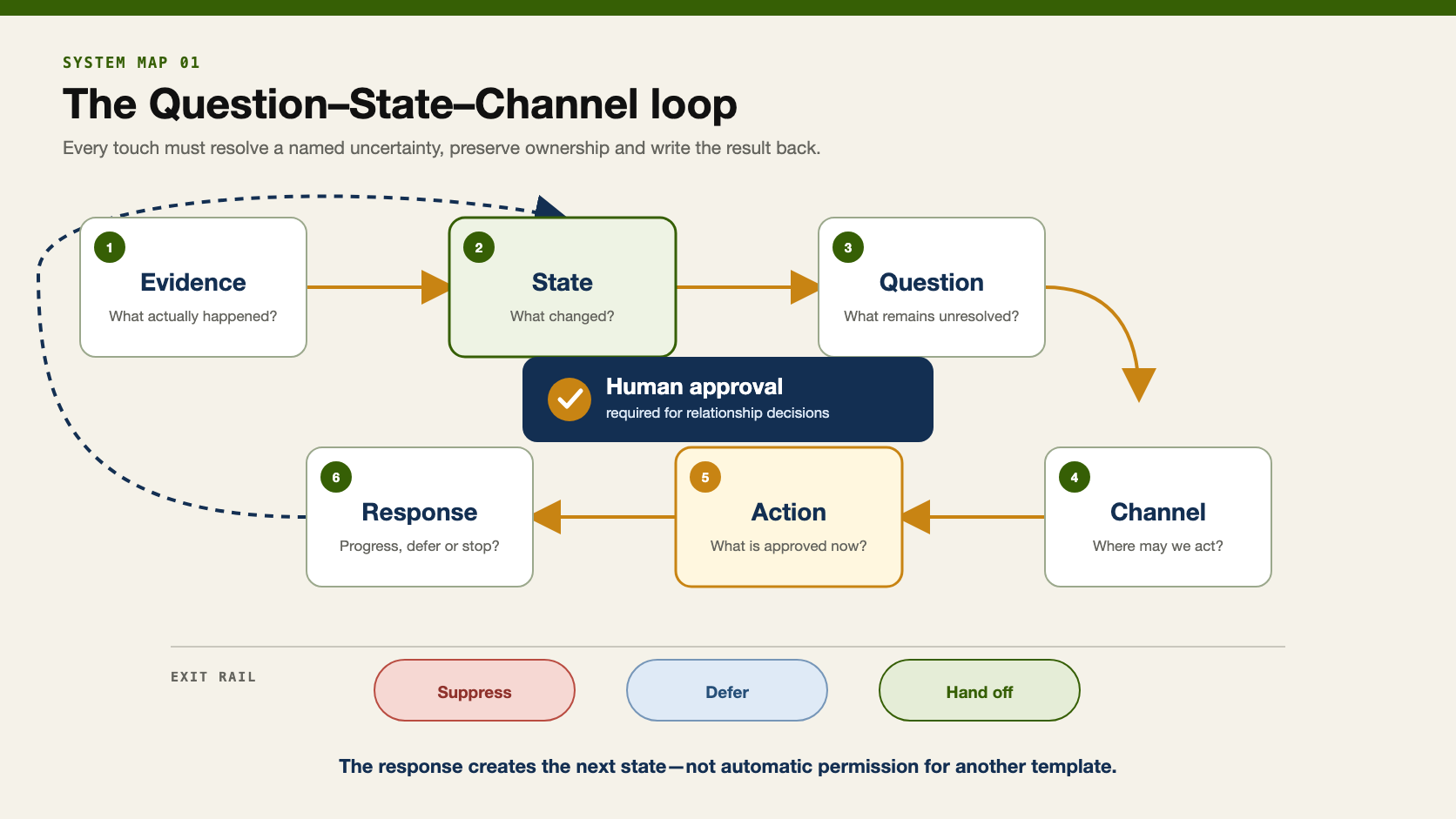
The short answer: nurturing is a controlled state machine, not a longer sequence
- Evidence: What actually happened?
- State: What does that event change?
- Question: What commercial uncertainty remains?
- Channel: Where is the next contact appropriate?
- Action: What may the system or seller do now?
- Response: Did the buyer progress, defer, object, redirect or opt out?
Evidence → state → unresolved question → allowed channel → approved action → response → new state
02 / Boundaries
Lead nurturing, marketing automation and sales follow-up are different jobs
| Concept | What it controls | Typical output | Accountable owner |
|---|---|---|---|
| Marketing automation | The infrastructure that detects events and runs configured actions | Email, task, field update, audience sync or workflow enrollment | Marketing operations or RevOps |
| Lead nurturing | The buyer-progress logic that decides why a record should receive another useful touch | New state, resolved question, deferral, handoff or stop | Named commercial owner |
| Sales follow-up | A seller action after interest, a question, a meeting or another meaningful commercial event | Reply, call, next-step agreement or opportunity decision | Seller or account owner |
Attempted to Contact, Connected or Bad Timing. Your CRM may use other labels. Keep the buyer’s state apart from the workflow that acts on it.qualified means.03 / State contract
Define a Nurture State Contract before writing messages
| Contract field | Question to answer | Example |
|---|---|---|
| Entry evidence | What observed event makes nurture appropriate? | Buyer said timing is wrong after discussing the offer |
| Current state | What is true now? | Interested, not ready |
| State reason | Why is the record in this state? | Budget review expected next quarter |
| Unresolved question | What must the next touch help answer? | Has the timing or internal priority changed? |
| Allowed channel | Which route is appropriate and permitted? | Email; no automated call without separate approval |
| Relationship depth | How personal has communication already become? | Seller-owned conversation |
| Automation right | What may automation still do? | Create a seller reminder; do not send autonomously |
| Human owner | Who makes the next commercial decision? | Account executive |
| Expiry | When must the state be reviewed or retired? | 90 days |
| Exit event | What moves the record out of nurture? | Meaningful reply, meeting, hard stop or fit change |
| Suppression rule | What must prevent any further direct outreach? | Unsubscribe or do-not-contact request |
A worked example: “not now” after a real conversation
- the automated path stops;
- the named seller owns the reply;
- no parallel channel starts by default;
- the CRM stores the response and the human decision separately; and
- any later automated follow-up requires a new human decision.
04 / Workflow
The seven-step human-gated automated lead-nurturing workflow
1. Preserve the source event and full context
- the complete reply, not an isolated sentiment label;
- the form and page that generated an inbound lead;
- the meeting outcome;
- the seller’s note after a call;
- the date and wording of a timing objection;
- the last offer, price or commitment discussed; and
- any explicit contact preference or restriction.
Warm, Negative or a score. Those labels are interpretations. The raw event is what another seller needs to audit the decision.2. Classify the state without erasing uncertainty
- interested, not ready;
- qualified but silent;
- inbound, no booking;
- wrong person;
- incumbent solution;
- explicit no;
- unsubscribed; or
- evidence insufficient.
3. Name the next unresolved question
| Current evidence | Useful unresolved question | Weak alternative |
|---|---|---|
| Timing objection | Has the stated constraint changed? | “Just checking in” |
| Inbound form without booking | Is the problem active, and does the lead want help choosing a next step? | Immediate multi-channel chase |
| Qualified lead went silent | Did priority, ownership or timing change? | Repeat the original pitch |
| Incumbent solution | Does a meaningful gap remain around channel, workflow or ownership? | Claim the incumbent is inferior |
| Wrong person | Who owns the problem now? | Continue selling to the same contact |
4. Choose the channel by state and relationship depth
- Email carried useful guides and lead magnets.
- A seller spoke to selected leads in relevant communities.
- Phone or voice AI supported an approved warm follow-up.
- The seller owned the contact once a real conversation began.
5. Approve the first action and consequential claims
- Make or imply a sales commitment.
- Quote a price or contract term.
- Answer an objection.
- Book or change a call.
- Change a lifecycle or deal state.
- Restart a personal conversation.
- Start an automated call.
- Move a record into retargeting or suppression.
6. Execute once, then listen
- what was sent or called;
- which source and rule allowed it;
- which channel executed it;
- which campaign or workflow generated it;
- who approved it;
- when the action occurred; and
- when the system must stop or review.
7. Let the response change ownership
05 / Stop rules
Trigger and stop rules for B2B lead nurturing
| Buyer event or evidence | Direct automated outreach | Human action | Long-term state | Hard prohibition |
|---|---|---|---|---|
| Interested, not ready with a stated date | Only if the contract explicitly allows it | Confirm timing and owner; approve next touch | Scheduled review | Do not exceed the agreed timing |
| Meaningful question or substantive reply | Stop immediately | Seller responds and updates the state | Human-owned | Do not return to automation by default |
| Qualified lead goes silent | One approved route based on prior context | Review account, timing and last promise | Recycle or pause | Do not launch conflicting channels |
| Inbound lead does not book | Low-risk reminder if consent and context allow | Review high-value or ambiguous records | Nurture or expire | Do not treat form completion as unlimited permission |
| “Not now” | Pause until the stated or approved review date | Record the reason and expected change | Deferred | Do not send generic short-cadence follow-ups |
No during nurture | Stop direct outreach | Confirm the state and close the active route | Distant defer; possible retargeting eligibility review | Do not start another sales sequence |
| Wrong person | Stop selling to that person | Correct identity and ask for referral only when appropriate | Reroute or disqualify | Do not interpret politeness as interest |
| Incumbent solution | Stop generic pitch | Determine whether a specific gap exists | Human review or defer | Do not manufacture an incumbent weakness |
| Unsubscribe or do not contact | Stop and suppress | Record the request and verify suppression | Suppressed | No direct marketing through another covered route |
| Evidence becomes stale or fit changes | Pause | Re-verify account and contact | Requalify or retire | Do not nurture an invalid identity |
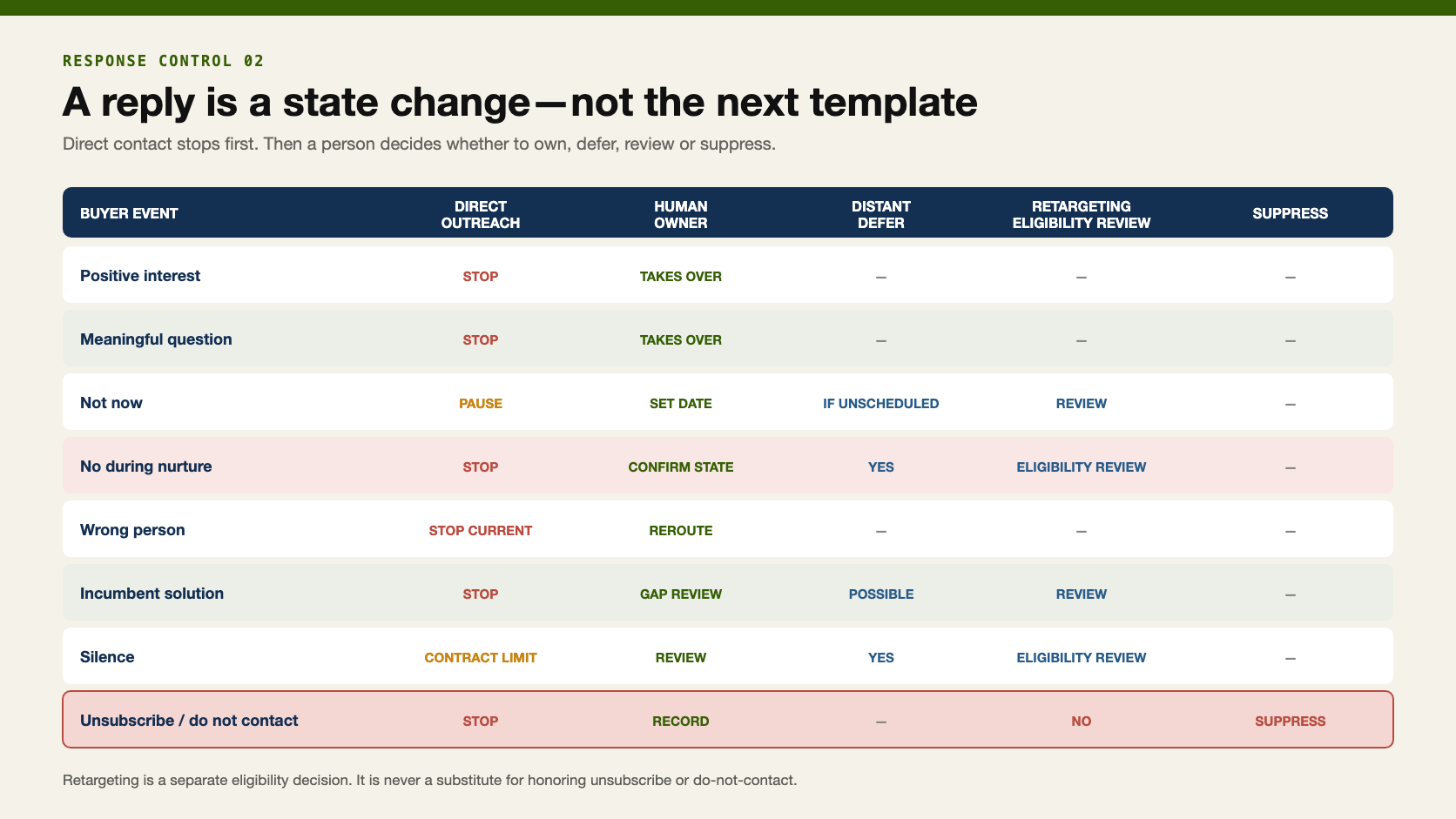
A “no” is not a reason to increase cadence
no during nurture moved the record into a very distant drawer, often a separately governed retargeting pool. It did not trigger another direct sequence.- A
noto the current sales conversation ends direct pursuit. - An
unsubscribeordo not contactrequest is an unconditional suppression state. - Retargeting is a separate processing and platform decision. It is not a loophole around an opt-out.
06 / Channel lock
Coordinate email, LinkedIn, communities, voice AI and humans with one channel lock
- useful ads or permitted retargeting;
- a lead magnet or useful email;
- a contextual email or approved warm call;
- a direct talk with a person; and
- a sales call and agreed next step.
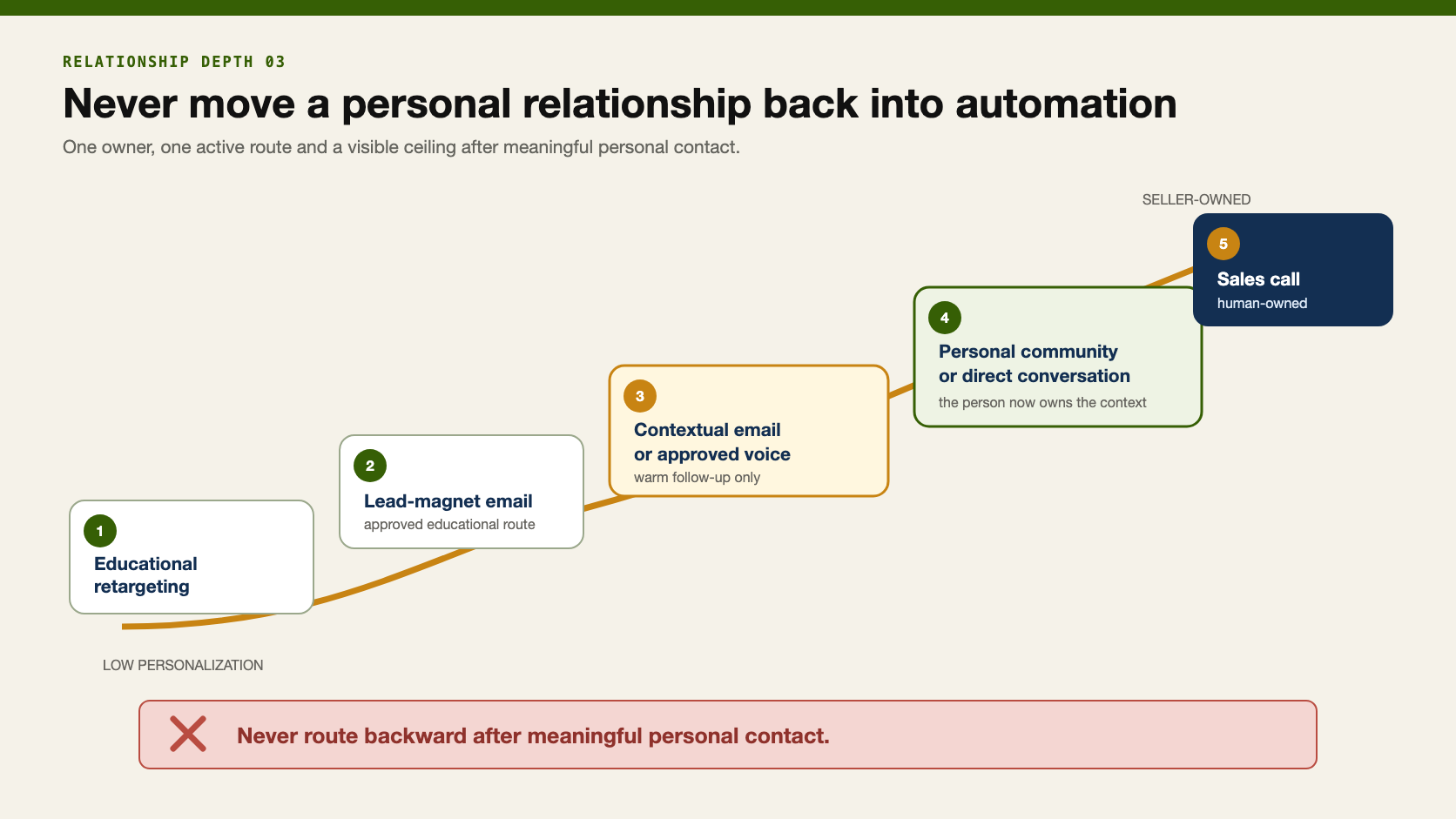
The channel-lock fields
active_contact_owner;active_channel;relationship_depth;automation_allowed;automation_scope;last_meaningful_response_at;next_allowed_action;next_action_not_before; andsuppression_state.
automation_allowed = false, the workflow creates a task rather than sending a message.Where voice AI can fit
- a person confirms the record, prior context and right to call;
- a person approves the allowed questions and transfer condition;
- the agent performs the bounded follow-up;
- a meaningful response triggers human ownership;
- the transcript and outcome enter the CRM; and
- no further automated route starts without a new decision.
07 / Playbooks
Four automated lead-nurturing playbooks to test
Playbook 1: interested but not ready
Playbook 2: qualified outbound lead that went silent
Playbook 3: inbound lead that did not book
Playbook 4: dormant CRM record with a new reason to contact
08 / Reply failures
Two replies that expose weak nurture automation
“I’m not the right person” is a routing problem
| Layer | What the system saw | What human review found | Revised rule |
|---|---|---|---|
| Company | Apparently matched ICP | The company fit was historical | Recheck current commercial identity |
| Contact | Executive title matched | The person operated across several companies | Resolve current role before outreach |
| Reply | Negative | Clear, rational rejection | Stop; do not nurture the objection |
“We already have something” is an incumbent-state question
| Weak automated response | Better human decision |
|---|---|
| Repeat that missed calls lose bookings | Acknowledge the incumbent and verify whether it handles phone calls or only online reservations |
| Claim the new product is better | Define the uncovered workflow, if one exists |
| Keep the sequence running | Stop automation and let a person decide whether one question is justified |
09 / CRM schema
Use a tool-neutral CRM field dictionary and event record
- Evidence: what happened;
- Recommendation: what AI or a rule proposes; and
- Decision: what the accountable person approved.
Lead Status field.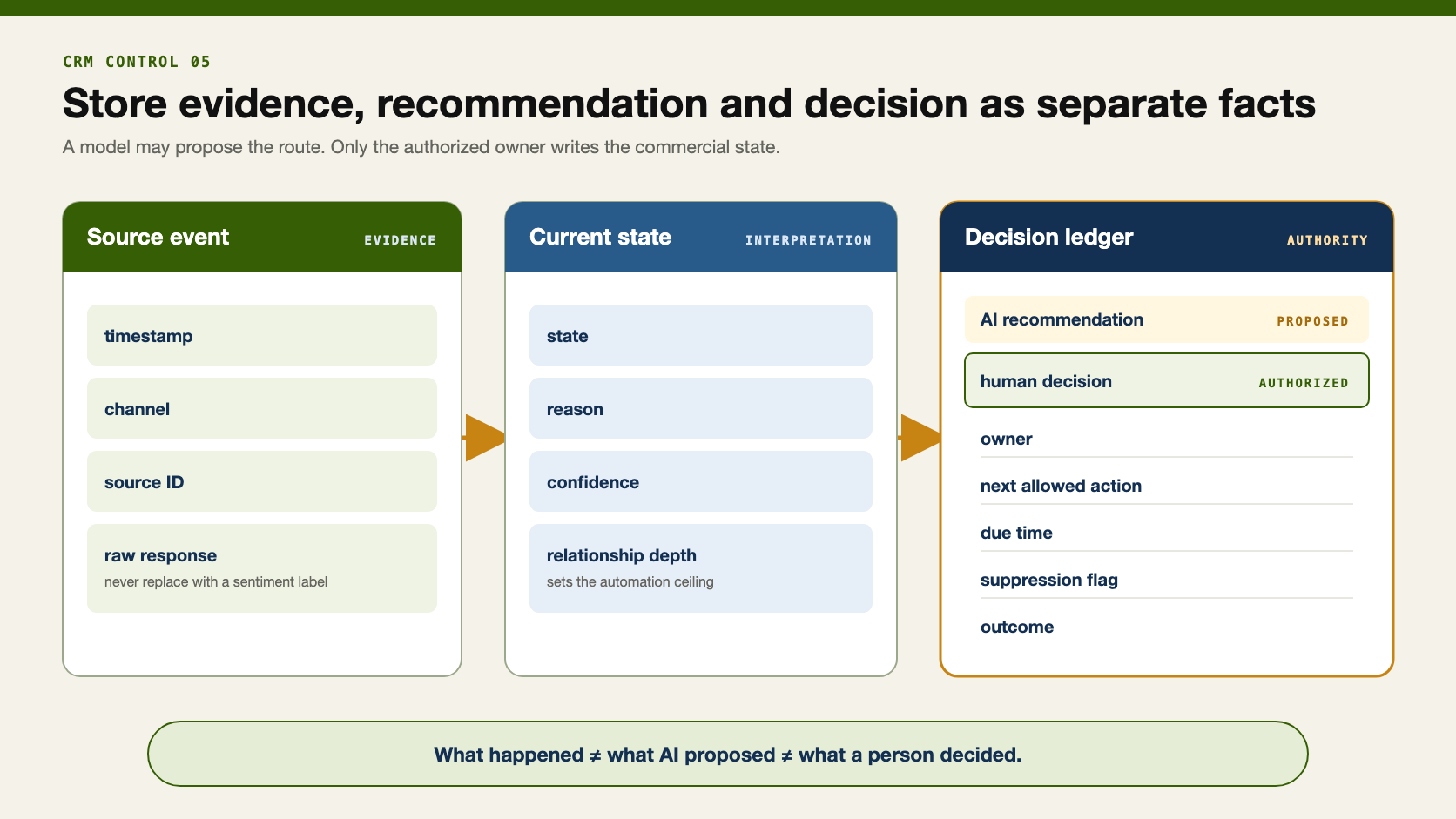
Recommended CRM fields
| Field | Purpose | Example | Write authority |
|---|---|---|---|
source_event_id | Links the state to the original message, form, call or note | reply_2024_11_28_1042 | System |
source_event_at | Preserves event time | ISO timestamp | System |
source_channel | Names where the event occurred | System | |
raw_response_ref | Preserves the complete response or transcript reference | Secure message ID | System |
nurture_state | Current controlled state | Interested—not ready | Human or approved rule |
state_reason | Explains why the state applies | Budget review next quarter | Human-approved |
state_confidence | Shows evidence certainty | High / medium / low | Model with review |
unresolved_question | States what the next touch must answer | Has timing changed? | Human-approved |
relationship_depth | Prevents backward routing | Personal conversation | Human/system rule |
active_contact_owner | Gives one person or team responsibility | Account executive | Human/CRM rule |
active_channel | Locks other sending routes | Human/CRM rule | |
automation_allowed | Controls whether a tool may act | False | Human/stop rule |
automation_scope | Limits what automation may do | Create reminder only | Human-approved |
next_allowed_action | Names the permitted step | Seller review | Human-approved |
next_action_not_before | Enforces timing | Review date | Human-approved |
suppression_state | Prevents prohibited contact | Do not contact | Human/compliance rule |
ai_recommendation | Stores the model proposal without making it truth | Defer 90 days | Model |
human_decision | Records accountable approval or override | Defer; no direct outreach | Human |
outcome_event | Connects the workflow to a meaningful result | Reply / held call / opportunity | System + human definition |
Example event
text source_event: Buyer said timing is wrong after reviewing the offer nurture_state: Interested — not ready state_reason: Internal budget review expected next quarter unresolved_question: Has the timing constraint changed? relationship_depth: Personal seller conversation active_contact_owner: Named seller active_channel: Seller email automation_allowed: false next_allowed_action: Create seller review task next_action_not_before: Buyer-approved review date ai_recommendation: Draft a contextual check-in human_decision: Hold; seller will contact personally suppression_state: none 10 / Field sample
What an anonymized dormant-base campaign actually produced
| Observed event | Count | Definition and limit |
|---|---|---|
| Delivered campaign messages | 124 | Campaign-level delivered email records; repeat-contact overlap across paths was not excluded |
| Replies | 17 | All recorded replies, not only positive replies |
| Completed sales calls | 2 | Held calls where the recipients understood the sales purpose |
| Confirmed later sales | Unknown | The author was not involved after the calls and cannot verify later revenue outcomes |
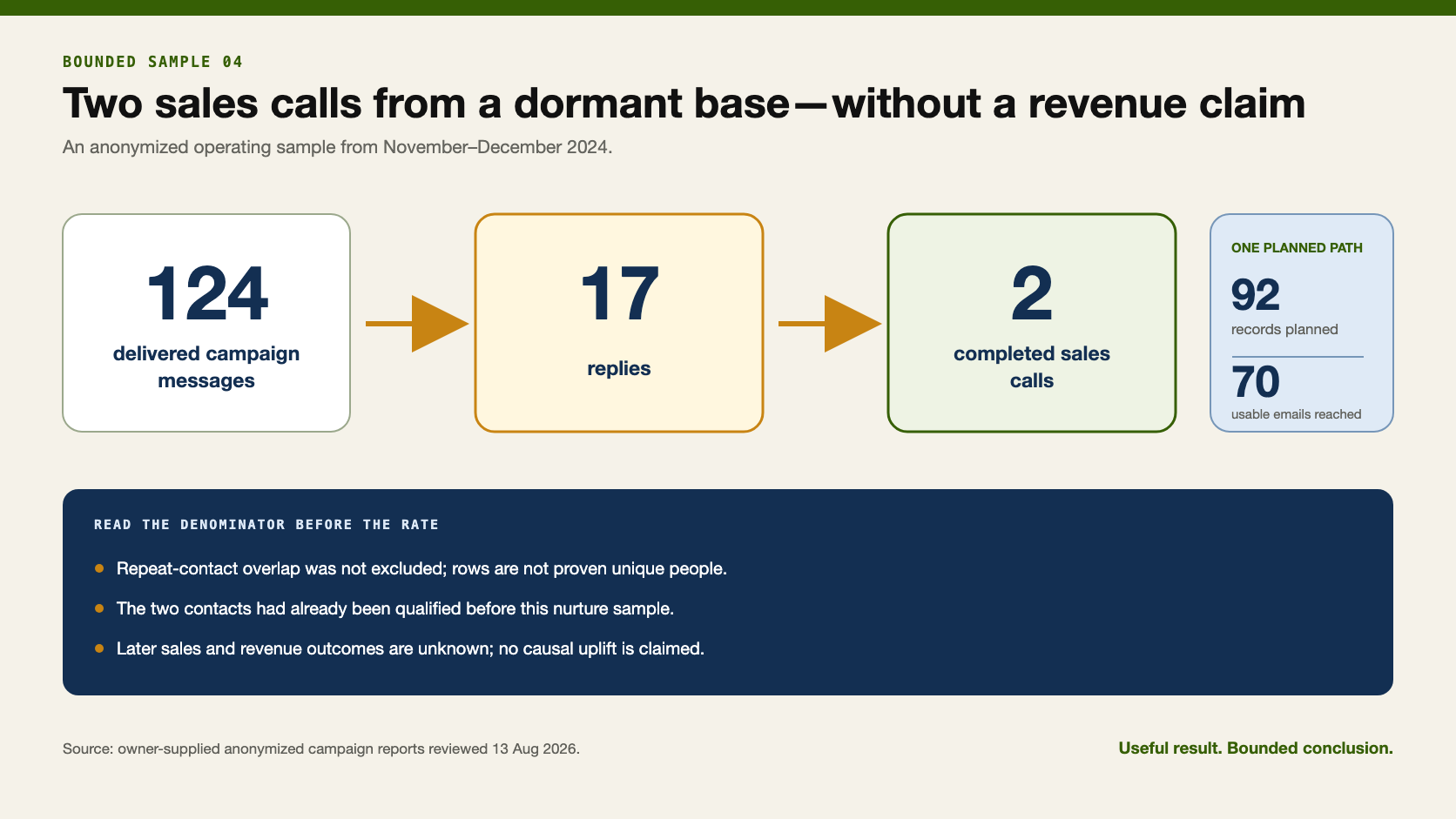
The more useful denominator lesson: 92 planned, 70 reached
- CRM records describe stored objects.
- Eligible records meet the state and policy rule.
- Reachable records have a currently usable approved channel.
- Delivered campaign messages show execution.
- Replies show response.
- Held calls show a stronger commercial outcome.
Expectations sheet for opens, replies, MQLs and SQLs. Those figures were plans, not results, so they are excluded. A forecast does not become evidence when a campaign ends.What this sample supports—and what it does not
- An old database can still produce real conversations when records are selected and approached with context.
- A stored-record count overstates the reachable audience.
- Held sales calls are a better outcome than opens or sends.
11 / Measurement
How to measure automated lead nurturing without crediting activity as revenue
| Layer | Definition | Why it matters |
|---|---|---|
| Source cohort | Records considered before validation | Shows the size of the original problem |
| Eligible cohort | Records that meet the Nurture State Contract | Prevents irrelevant records from entering |
| Reachable cohort | Eligible records with a usable permitted channel | Exposes stale-contact loss |
| Attempted actions | Messages or calls attempted | Measures workload, not success |
| Delivered/reached actions | Actions that reached the channel | Provides a valid activity denominator |
| Meaningful replies | Responses that change state or require a person | Measures commercial information gained |
| Human-accepted next steps | Replies a seller accepts for action | Separates model labels from seller value |
| Held meetings or calls | Conversations that occurred | Stronger than bookings alone |
| Opportunities | Records meeting your explicit CRM opportunity rule | Requires a consistent business definition |
| Contracts or revenue | Closed commercial result | Must not be inferred from earlier stages |
- percentage of actions with a visible source and approval;
- conflicting-channel incidents;
- meaningful replies that did not stop automation;
- time from response to human ownership;
- records re-enrolled after a stop state;
- suppression failures;
- state changes overturned by a seller;
- records expired without review; and
- opportunities or contracts by original nurture state.
12 / 30-day pilot
Run a 30-day automated lead-nurturing pilot
Week 1: define and freeze the cohort
- Select one state, such as
Interested—not readyorDormant—previously qualified. - Define the source event and minimum evidence.
- Remove invalid identities and channels.
- Separate unsubscribe/DNC records into suppression.
- Freeze the cohort so later additions do not change the denominator.
- Record the baseline counts: source, eligible and reachable.
Week 2: approve the contract and first actions
- Complete the Nurture State Contract.
- Name one unresolved question per segment.
- Assign one owner and active channel.
- Review the first 10–20 records individually.
- Approve copy, timing and any voice use.
- Test whether a meaningful reply unenrolls and locks every other path.
Week 3: inspect responses and exceptions
- wrong-person matches;
- incumbent solutions;
- stale timing reasons;
- replies that automation misclassified;
- repeated messages after a human took ownership;
- retargeting eligibility assumed without support; and
- records that re-entered through another workflow.
Week 4: evaluate state movement
- source, eligible, reachable and delivered counts;
- reply categories;
- human-accepted next steps;
- completed calls or meetings;
- suppression and collision incidents;
- seller overrides; and
- time to human ownership after a reply.
13 / Checklist
Automated lead-nurturing implementation checklist
- [ ] Every record has observable entry evidence.
- [ ] Every segment has one named unresolved question.
- [ ] The current state and state reason are separate.
- [ ] One owner and one active channel are visible.
- [ ] Relationship depth is recorded.
- [ ] The first consequential action has human approval.
- [ ] A meaningful reply immediately stops automation.
- [ ] Re-enrollment cannot bypass a human handoff.
- [ ] Repeated
noexits direct outreach. - [ ] Unsubscribe and do-not-contact create enforceable suppression.
- [ ] Retargeting has a separate lawful and platform basis.
- [ ] Voice use is approved for the exact record and purpose.
- [ ] Source evidence, AI recommendation and human decision remain separate.
- [ ] The cohort and every denominator are frozen before reporting.
- [ ] Held calls, opportunities and revenue use explicit definitions.
- [ ] Screenshots and exports are anonymized before publication or sharing.
14 / FAQ
Automated lead nurturing FAQ
What is automated lead nurturing?
What is the difference between lead nurturing and marketing automation?
Can AI nurture leads without a salesperson?
Which events should trigger a nurture workflow?
When should automated lead nurturing stop?
no. It should also stop when identity fails, the state expires or the buyer opts out. An unsubscribe or DNC request requires suppression, not another channel.How do email, LinkedIn and voice share one CRM state?
How should a team measure a nurture campaign?
Can automated nurturing reactivate an old CRM database?
15 / Methodology
Methodology, evidence and limitations
- First-hand records: Anastasiia Krynytska’s workflow notes and anonymous campaign records, reviewed in August 2026.
- Official product docs: HubSpot and Microsoft pages on stages, workflows, re-entry and lead qualification.
- Rules and platform terms: FTC email guidance, FCC material for covered calls and texts, and Meta’s audience terms.
Sources
- HubSpot: Use lifecycle stages.
- HubSpot: Create workflows.
- HubSpot: Manually unenroll records from workflows.
- HubSpot: Add re-enrollment triggers to a workflow.
- Microsoft Dynamics 365: Qualify the best leads.
- FTC: CAN-SPAM Act compliance guide for business.
- FCC: January 2026 order on consent-revocation implementation timing.
- Meta: Customer List Custom Audiences Terms.
- NextLevel: AI Sales Agent.
16 / Durable rule
The durable rule
Research note
Methodology
- 01Attribute the workflow and anonymized operating sample to Anastasiia Krynytska's first-hand records reviewed in August 2026.
- 02Report 124 delivered campaign messages, 17 replies and two completed sales calls as campaign-level observations, not unique-person or causal conversion rates.
- 03Keep the 92 planned versus 70 reached email path separate from the wider sample and exclude planned benchmark assumptions from observed results.
- 04Use official documentation for CRM mechanics, platform terms and US email and covered call/text rules.
- 05Disclose NextLevel as a first-party example and exclude unsupported performance, market and broad compliance claims.
- 06Do not publish private names, companies, email addresses, record IDs or screenshots from the source material.
Source ledger
Sources & editorial notes
- 01Use lifecycle stages
HubSpot · Official product documentation for lifecycle-stage and lead-status semantics; reviewed August 13, 2026.
- 02Create workflows
HubSpot · Official enrollment, action and workflow documentation; plan availability varies.
- 03Manually unenroll records from workflows
HubSpot · Official documentation for stopping later workflow actions and implementing handoff controls.
- 04Add re-enrollment triggers to a workflow
HubSpot · Official documentation used to explain re-entry risk after an exit or handoff.
- 05Qualify the best leads
Microsoft Dynamics 365 · Official product documentation for qualification criteria and later routing actions.
- 06CAN-SPAM Act: A Compliance Guide for Business
US Federal Trade Commission · Primary US regulator guidance for commercial email, including B2B email; not universal legal advice.
- 07TCPA consent-revocation implementation order
US Federal Communications Commission · January 2026 primary regulator document on implementation timing for one cross-topic consent-revocation provision.
- 08Customer List Custom Audiences Terms
Meta · Official platform terms for rights, permissions and lawful-basis representations when using customer-list data.
- 09AI Sales Agent
NextLevel · Disclosed first-party product example for bounded voice, SMS, email, CRM, booking and human-transfer capabilities; no performance claim is treated as independent evidence.
- 10Luck My Sales methodology
Luck My Sales · Evidence states, source treatment, freshness and corrections protocol.