Weekly industry intelligence · No noiseSubscribe to the Luck My Sales newsletterFree briefing

Independent intelligence on AI in sales

Menu

Channel decision guide · Social selling

Cold Email vs LinkedIn Outreach: Which Channel Should a Small B2B Team Use First?

Choose cold email or LinkedIn outreach by ICP, context, reach, infrastructure, account exposure, team capacity and one shared reply-stop rule.
Editorial disclosure

AI may assist research organization and drafting. A human editor reviews every published page, checks material claims against the cited sources and owns the final decision. No company paid for placement in this article.

AI use policy

Agent-ready brief

AI takeaways

Keep the key points here, or take a source-aware text brief into Claude, ChatGPT or another AI workspace.
  1. 01Cold email leads when verified reach, controlled tests and repeatable scale matter most.
  2. 02LinkedIn leads when the niche is narrow, professionally visible and worth manual account research.
  3. 03Email delivery, opens, connection acceptance and replies use different denominators and cannot be compared directly.
  4. 04Use one person ID, one channel order and one global reply stop to prevent duplicate touches.
  5. 05Test both channels early with small cohorts, then scale by meaningful replies, held calls and opportunities.
Includes summary, takeaways, sources and a use note.
Cold email should lead when you need verified reach, controlled experiments, and a repeatable channel outside one employee's social account. LinkedIn should lead when the niche is narrow, the buyers are active in professional digital communities, social context materially improves the message, or each account is valuable enough to justify manual research.
That is the decision. Generic reply-rate comparisons are a distraction. A good LinkedIn list can outperform a bad email list. A relevant email can outperform a templated LinkedIn sequence. Neither channel fixes an undefined ICP, weak offer, or missing reply owner.
Small teams should usually test both channels early on a limited, approved set. The word ‘test’ does not mean contacting every prospect twice. Give each person one shared state, define which channel leads, wait for the planned condition, and stop every automated touch after any reply.
Commercial disclosure: Luck My Sales received no affiliate payment, sponsorship, free access, consulting benefit, or other consideration from the products discussed. Anastasiia operated the anonymized Lemlist workflow used as the case. NextLevel AI is disclosed as the first-party offer context. The case illustrates coordination and measurement; it is not an independent product test or a universal channel benchmark.

Choose the lead channel by market constraints, then coordinate both through one person state, one stop and one owner.

01 / Cold email vs

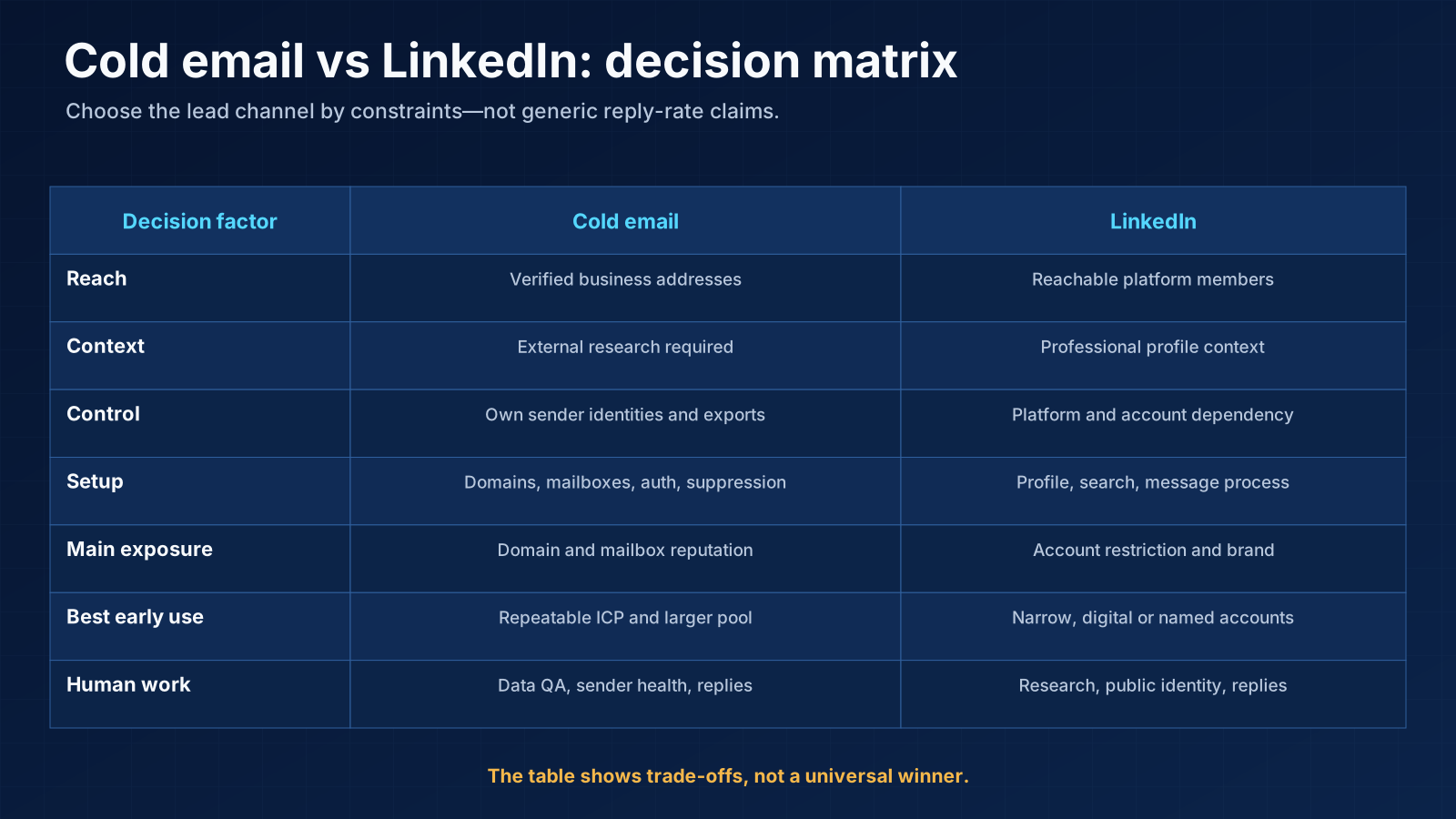
Cold email vs LinkedIn outreach at a glance

Decision factorCold emailLinkedIn outreach
ReachWorks when a valid business address can be found and used lawfullyLimited to reachable LinkedIn members and account access
ContextNeeds external company, role, and signal researchCurrent professional profile and network context are visible
ControlOwn domains, mailboxes, sender tools, and data exportsDepends on LinkedIn account and platform policy
SetupDomains, mailboxes, authentication, verification, suppressionProfile credibility, Sales Navigator or search, message process
Main exposureDomain/mailbox reputation, complaints, legal/provider rulesAccount restriction, brand representation, platform dependency
Best early useRepeatable ICP, larger pool, controlled testsNarrow niche, named accounts, digital-native audience
Human workData QA, copy, sender health, repliesResearch, account review, public identity, replies
Scale triggerStable list, sender health, meaningful repliesStable acceptance, replies, calls, no warning state
The table shows trade-offs, not a winner. The more important comparison is whether the team can operate the channel responsibly with the evidence and time it has.
Decision matrix comparing cold email and LinkedIn outreach for a small B2B team.
Choose the lead channel by constraints, not generic reply-rate claims.

02 / benchmarks do not

Why benchmarks do not decide the channel

Most “email vs LinkedIn” pages compare an email reply rate with a connection acceptance rate. Those are not the same event.
  • A delivered email means a mail server accepted a message.
  • An open is an unreliable tracking event, not a conversation.
  • A LinkedIn acceptance means a person accepted a connection.
  • A reply may be positive, neutral, negative, wrong-person, OOO, or unsubscribe.
  • A booked meeting can be unqualified or no-show.
  • An opportunity means the team accepted a real commercial state.
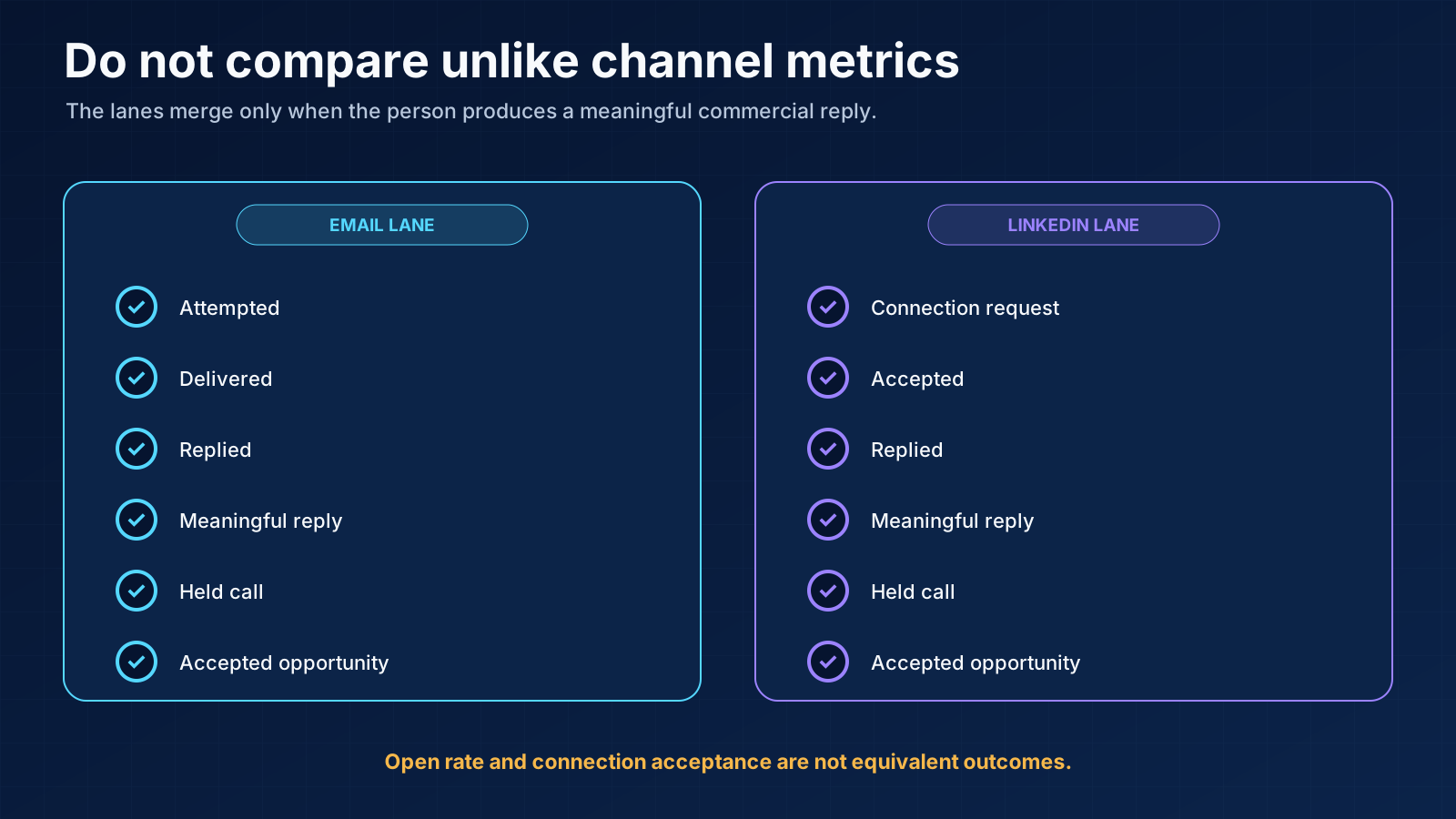
The denominator matters too. A platform can report replies as a share of messages, contacts, reached people, accepted connections, or delivered emails. Recalculating a rate without the platform's event definition can make the same campaign look better or worse.
In our anonymized workflow, one contact-level view reported 1,627 people reached, 605 opens, 284 interactions, 58 replies, and 14 interested records. A separate message-level view reported 3,904 sends and 3,889 delivered, with 58 replies and 242 LinkedIn acceptances. Both views are real. They are not one funnel with one denominator.
That is why this guide uses channel constraints and downstream states, not a generic winner percentage.
Email and LinkedIn metrics with separate denominators before meaningful replies.
Open rate and connection acceptance are not equivalent outcomes.

03 / When cold email

When cold email should lead

You have a repeatable, reachable account pool

Cold email is useful when the ICP can be expressed as companies and roles, valid business addresses can be found, and the team can maintain exclusions. It gives you an owned working dataset instead of making every action dependent on a social account.
This is especially helpful for a small SaaS or service company testing several message angles inside one stable segment. The team can define the list, keep the sender conditions consistent, change one variable, and compare meaningful replies.
Cold email should not lead merely because a database returned many addresses. The records still need current-role, business-model, customer-base, competitor, and suppression checks where relevant.

You need controlled message tests

Email supports clear sequence versions and message-level reporting. That makes it suitable when the team wants to compare two offers, pains, or CTAs under similar conditions.
The test is valid only if the audience, sender health, timing, and approval rules remain comparable. If one version goes to high-fit accounts from healthy mailboxes and the other goes to a broader list from new senders, the result says little about the copy.

LinkedIn context adds little to the sale

Some buyers use LinkedIn heavily. Others maintain a profile but do not use it as a buying channel. If the audience is reachable by business email and the offer does not benefit from a public founder identity, network path, or recent professional activity, email may be the more direct first touch.

You can operate sender infrastructure

Cold email requires more than a sequencer. Use separate sending infrastructure rather than the primary business domain. Configure authentication with the provider. Verify addresses. Maintain suppression. Increase volume gradually. Monitor errors, complaints, and reputation signals.
Google's current sender guidance requires SPF or DKIM for all senders to Gmail accounts and additional SPF, DKIM, DMARC, alignment, and unsubscribe controls for high-volume senders. Google also advises gradual volume increases and warns that open rates from third parties are not verified. These are provider rules, not permission to send unsolicited mail. Obtain legal review for the jurisdictions and data involved.
If the team cannot maintain domains, mailboxes, replies, and suppression, email is not the easier channel. It is only the easier send button.

04 / When LinkedIn should

When LinkedIn should lead

The niche is narrow and professionally visible

LinkedIn can lead when the target community lives visibly on the platform: IT services, SaaS, digital agencies, technology partnerships, or another professional niche where current roles and activity help identify the right person.
For a very small TAM, manual LinkedIn research can be more valuable than building a large email machine. The seller can see whether the person is active, what the current company does, and whether a mutual connection or recent professional topic improves the approach.

The offer is timely or unfamiliar

A trending solution often needs trust before scale. A complete founder profile, useful content, mutual context, and a short direct message can make the seller less anonymous. This does not mean automating likes or inventing familiarity. It means the professional identity is part of the evidence the buyer uses to decide whether to respond.

Each account deserves manual attention

LinkedIn should lead for strategic or named accounts when one relevant conversation is worth more than broad execution volume. Research the account, current owner, opportunity history, person, and reason to contact. Keep the request and message manual.
This is also the safest editorial recommendation because LinkedIn's policy says third-party software or extensions that scrape or automate activity are not allowed. No vendor can remove that platform dependency.

Email data is weak but identity is clear

Sometimes the company and person are visible, but a reliable address is not. LinkedIn can provide a legitimate first contact path without guessing an email. If the person accepts and engages, the conversation can move according to their preference.

05 / When neither channel

When neither channel is ready

Do not choose a channel when the real problem is earlier in the motion.
Pause outbound if:
  • the team cannot describe the ICP in operational criteria;
  • recent customers do not reveal a repeatable pain;
  • the offer is a generic “we help companies grow” promise;
  • the sender cannot explain why this account is relevant now;
  • no one owns replies within a reasonable working window;
  • current customers, partners, employees, and competitors are not excluded;
  • CRM ownership and suppression are inconsistent.
Founder-led sales is not a weakness at this stage. It is the fastest way to hear objections and refine the message. Delegate research or list building before delegating the commercial judgment the team has not yet learned.

06 / Three small-team scenarios

Three small-team scenarios

Scenario 1: narrow B2B service business

A founder sells a specialized service to UK digital agencies. The reachable universe is modest. The founder has a credible profile and relevant examples.
Lead channel: LinkedIn, manually for the first accounts. Support channel: email after five to eight days of silence for approved records with valid addresses. Reason: professional context and trust matter more than raw volume. Stop: any response in either channel suppresses the other. Scale: only after acceptance, meaningful replies, and booked calls show the full funnel works.

Scenario 2: small SaaS with a stable ICP

A SaaS team has 20 customers in one segment, a repeatable problem, a documented offer, and a larger reachable market. Buyers are not particularly active on LinkedIn.
Lead channel: cold email. Support channel: LinkedIn research and selected manual touches for high-value accounts. Reason: the team can run controlled list and message tests across a larger pool. Stop: one global contact state across sender and CRM. Scale: after sender health, meaningful replies, held meetings, and opportunity acceptance remain stable.

Scenario 3: named-account expansion

An account already has a customer relationship, opportunity history, partner owner, or executive connection.
Lead channel: neither automated channel. Use the existing relationship and assigned owner. Support channel: LinkedIn for research, email for a deliberate human follow-up. Reason: ownership and context matter more than sequencing efficiency. Stop: CRM account and opportunity ownership override every campaign rule.

07 / real cost beyond

The real cost beyond the license

Cold email costs include domains or subdomains, mailboxes, authentication work, verification, enrichment, sending software, monitoring, spare inventory, and operator time. Even a minimal setup can cost hundreds of dollars before the first email, especially once the team values its own implementation and review time.
LinkedIn costs include the professional account, Sales Navigator or research access, an optional execution tool, profile and content work, message review, reply handling, and the potential cost of restriction. A cheap automation license attached to a founder's most valuable professional account is not necessarily the cheaper system.
Use total operating cost:
licenses + data + infrastructure + implementation + review + reply handling + incident recovery
Also count opportunity cost. A founder spending 15 hours each week prospecting may need help. That does not mean hiring an SDR or buying an AI SDR before ICP and messaging are documented. The first delegation can be list research while the founder still owns conversations.

08 / to coordinate both

How to coordinate both channels without duplicate touches

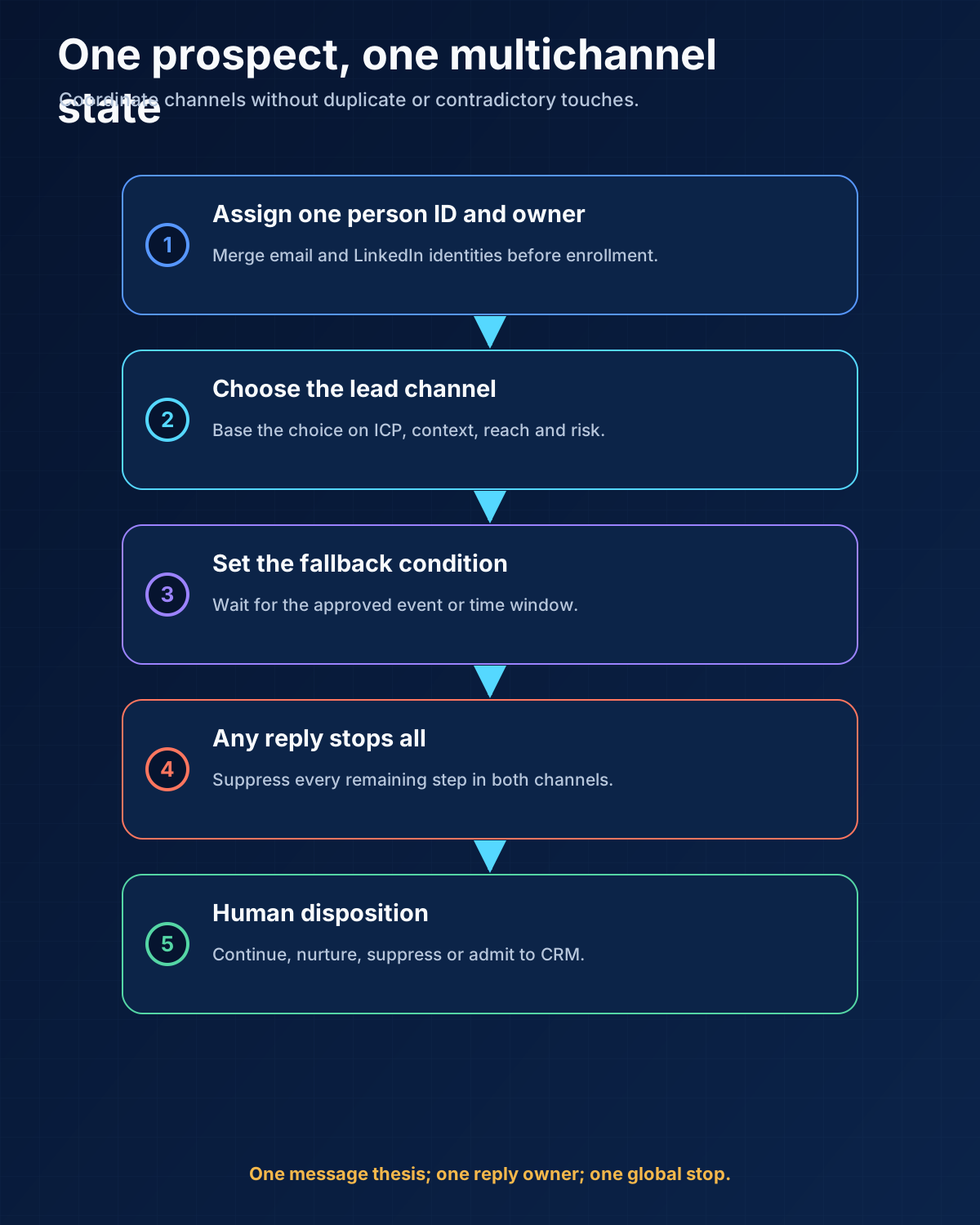
Treat a prospect as one state, not two campaign records.
StateEmail actionLinkedIn actionOwner
Approved, tier oneHold or prepare fallbackManual/approved first touchSDR or founder
LinkedIn pendingWait planned intervalNo extra messageSame owner
Silent after 5–8 daysSend approved email if validNo simultaneous follow-upSame owner
Tier two or threeEmail leadsLinkedIn research/manual exceptionSDR
Any replyStopStopSDR validates
Positive/neutralHuman follow-upHuman follow-up onlyNamed seller
Negative/unsubscribeSuppressClose respectfullySDR/ops
OOOControlled rescheduleNo duplicate touchSDR
Our real Lemlist workflow used this tiered logic. LinkedIn led tier one. Email led tiers two and three. Email could support tier one after LinkedIn silence. The useful feature was not “multichannel volume.” It was channel order plus one stop state.
The same approach works across tools if the systems share an identity key and suppression event. Test exact edge cases before production:
  • existing LinkedIn connection with no valid email;
  • valid email but pending connection request;
  • reply in email while a LinkedIn step is queued;
  • reply in LinkedIn while an email follow-up is queued;
  • multiple contacts at one account;
  • current customer or open opportunity;
  • unsubscribe, wrong person, and OOO.
If a queued step can still send after the reply event, the operator needs a manual kill switch and monitoring. Product defaults are not a substitute for an end-to-end test.
Multichannel outreach state machine that prevents duplicate email and LinkedIn touches.
Use one person ID, one reply owner and one global stop.

09 / practical decision tree

A practical decision tree

Start with the size and visibility of the market.

The market is small and every account matters

Lead with manual LinkedIn research or an existing relationship. Build a named-account list. Check CRM ownership. Read the person's current profile and company evidence. Write one message for the account. Use email as a deliberate fallback, not a second automated interruption.
This path is slower per account. It is often cheaper per learning. A founder can hear whether the pain, role, and offer are correct before creating infrastructure for a market that may contain only a few hundred serious accounts.

The market is larger and verified addresses exist

Lead with email. Use a separate sender system. Split the market into one stable segment at a time. Keep one message thesis and one version log. Use LinkedIn for research and for a smaller high-value tier.
Do not call the entire database the TAM. The usable market is the part that passes company fit, role fit, current-business, contactability, exclusion, and legal/provider review.

The audience is active on LinkedIn but the offer is unproven

Use LinkedIn manually. The goal is conversation, not acceptance volume. Ask short questions. Read objections. Do not deploy a five-step automation sequence to learn whether the offer makes sense. The founder or senior seller should own the first replies.

The offer works, but email delivery is unstable

Do not move all volume to LinkedIn as a workaround. Diagnose authentication, list quality, sender history, bounces, complaints, message behavior, and provider responses. LinkedIn can support high-value accounts while email is repaired, but it is not a substitute for sender operations.

LinkedIn accounts receive warnings or restrictions

Pause automation. Preserve the account. Follow LinkedIn's recovery instructions. Move essential conversations to human-owned channels where appropriate. Do not rotate through employee accounts to maintain the planned volume. The campaign plan is less valuable than the professional identities it depends on.

Both channels create replies, but meetings remain weak

The channel may not be the bottleneck. Review the reply quality, qualification, offer, CTA, follow-up speed, and meeting acceptance rule. A positive-sounding reply can still come from a person with no authority or active need. Fix the handoff before adding more contacts.

Both channels work and the SDR can handle demand

Keep a lead channel by tier. Add the second channel only where it adds reach or context. Protect one global state. Scale the qualified pool, not every possible action. Continue to sample messages and read replies even after the dashboard looks stable.
This tree produces a channel decision and a next diagnostic. It does not produce a permanent winner. The lead channel can change by segment, geography, account tier, and stage of the company's sales motion.

10 / 30-day channel validation

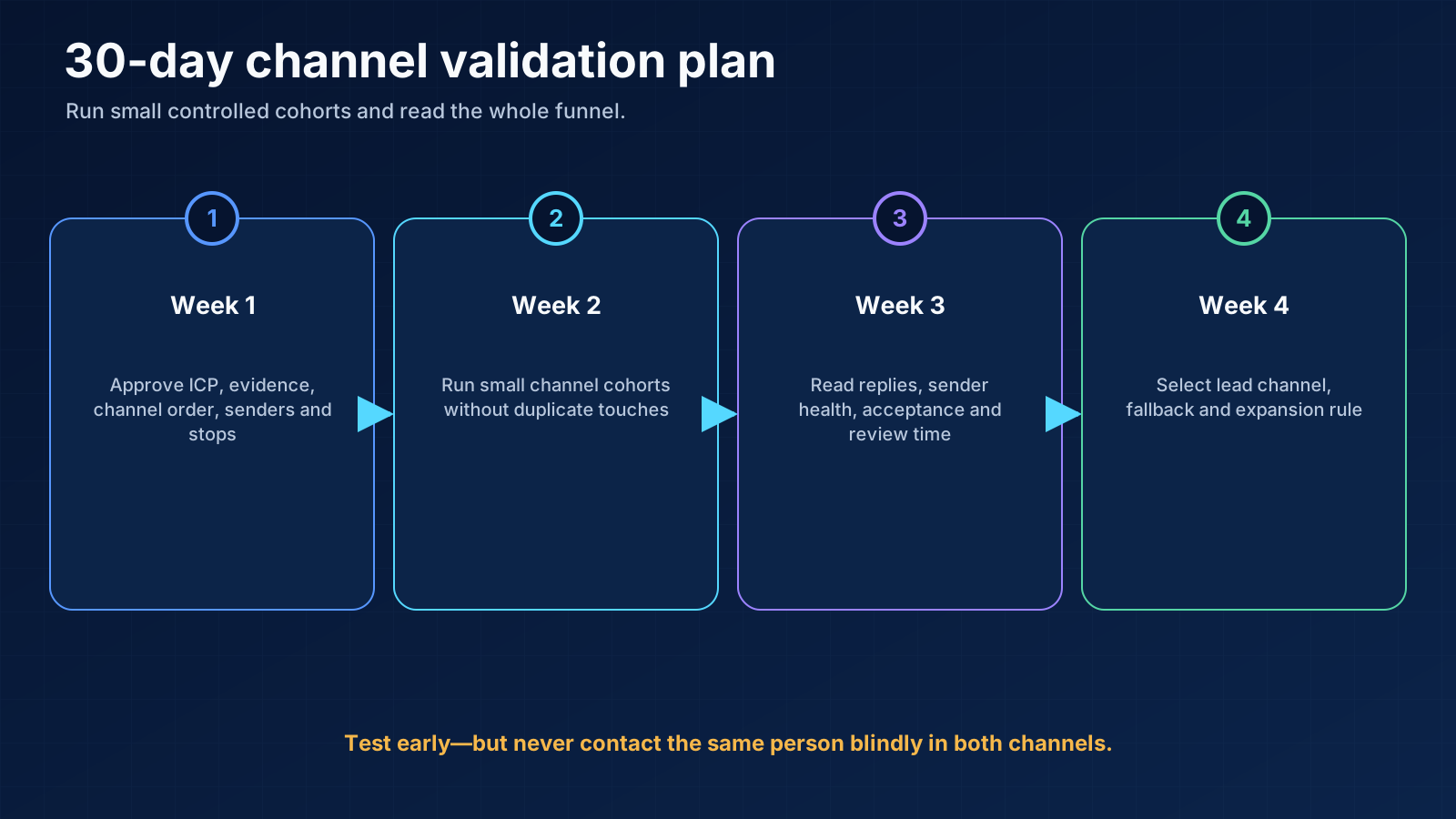
A 30-day channel validation plan

Days 1–5: define the common answer key

Choose one segment and one offer. Define company fit, role fit, exclusions, approved evidence, message thesis, and reply dispositions. Create one record ID used across the working sheet, email platform, LinkedIn tracker, and CRM where applicable.

Days 6–12: manual micro-tests

Use a small group for LinkedIn-led contact and a comparable group for email-led contact. Keep named accounts manual. Review every record and message. The goal is to find list and message defects before software multiplies them.

Days 13–21: controlled execution

Add the smallest useful automation only to ordinary approved records. Hold the offer stable. Monitor sender health and LinkedIn warnings. Read every reply. Track operator minutes, not only messages.

Days 22–30: combine carefully

Add the second channel by explicit condition, such as LinkedIn silence after a defined interval or a high-value email non-response. Test the global reply stop. Decide the lead channel by meaningful replies, held calls, and accepted opportunities, not by activity alone.
Thirty days may be too short for customer outcomes in a long sales cycle. It is still enough to expose qualification errors, broken suppression, weak reply ownership, and unreasonable review cost.
Thirty-day validation plan for cold email and LinkedIn outreach.
Run small controlled cohorts and read the whole funnel.

11 / the real campaign

What the real campaign data does and does not show

The anonymized first-party campaign began in early summer 2026 and was still active when the evidence was supplied. It targeted marketing-agency partner opportunities for NextLevel AI offers. We can publish the aggregate counts, but not the business identities or raw screenshots.
The data shows that a tiered email-and-LinkedIn system can be measured as one operational workflow. It also shows why one denominator is dangerous: 58 replies can be 3.6% of 1,627 reached contacts or 1.5% of 3,904 sent messages. Both percentages appeared in their respective platform views.
The data does not prove email beat LinkedIn, LinkedIn beat email, Lemlist caused the outcome, or AI personalization created uplift. There was no randomized channel allocation with controlled sender, copy, and audience conditions. The valid information gain is operational: qualification removed most of the original universe, channel order differed by tier, and a human owned every reply.

12 / minimum shared record

The minimum shared record

Both channels should read and write one compact prospect record. Store the company, person, current role, account owner, tier, evidence URL, evidence date, lead channel, last action, reply state, suppression state, and next human owner.
Do not store generated “insights” without their source. Do not let the email tool call a person silent while LinkedIn already contains a reply. Do not let LinkedIn automation contact a person marked as a customer or unsubscribe elsewhere.
This record can begin in a working sheet. It does not require a complex data warehouse. The requirement is one source of truth for contact state. CRM admission can still wait until a human validates a real conversation.
Review the record before each new channel. A five-day wait does not make old evidence current. Check the person, company, owner, and suppression state again. This small step prevents many duplicate and wrong-owner touches.
One shared state is simple. Keep it visible, current, and owned by a real person.

13 / Frequently asked questions

Frequently asked questions

Is LinkedIn outreach better than cold email for B2B?

LinkedIn is better when professional context, trust, and a narrow audience justify manual attention. Cold email is better when the team has verified reach, a repeatable segment, and the infrastructure to run controlled tests. The channel follows the motion.

Should I send email and LinkedIn messages at the same time?

Usually no. Coordinate them. Choose a leading channel by tier, add the second after a defined condition, and stop both after any reply. Simultaneous uncoordinated touches can look careless and create conflicting ownership.

Is LinkedIn automation safer than cold email automation?

They have different exposure. LinkedIn automation can risk the professional account and conflict with LinkedIn's policy. Cold email can damage domain and mailbox reputation and trigger provider, complaint, or legal problems. “Safer” depends on the exact workflow and controls.

Which result should decide whether to scale?

Use the funnel: accepted connections where applicable, meaningful replies, booked and held calls, accepted opportunities, and customers. Also measure review time, total cost, sender health, and account warnings. No single activity rate is enough.

Do I need an AI SDR to use both channels?

No. A working sheet, one email sender, Sales Navigator, and disciplined stop rules can coordinate a small pilot. Add AI for a defined research or drafting bottleneck. Add broader autonomy only after the human process works.

14 / Final recommendation

Final recommendation

Start with cold email when verified reach, controlled tests, and repeatable scale matter. Start with LinkedIn when the niche is narrow, the audience is professionally active, trust matters, and each account deserves research. Keep strategic accounts manual.
Test the second channel early, but do not double-contact people blindly. Use one record, one message thesis, one channel order, one global reply stop, and one human owner. That operating model matters more than a generic channel benchmark.
Continue with the LinkedIn Outreach Tools comparison, the AI Cold Email Tools comparison, the AI Email Sales Outreach workflow, the AI Sales Outreach pillar, and the personalization-tools guide.

Research note

Methodology

  1. 01The guide combines current platform and sender documentation with Anastasiia's first-hand Lemlist multichannel workflow.
  2. 02The campaign is used to show coordination and denominators, not to claim a universal channel winner.
  3. 03Channel choice remains conditional on ICP, contactability, visible context, team capacity and risk.
Read the full methodology

Source ledger

Sources & editorial notes

  1. 01
    LinkedIn prohibited software and extensions

    LinkedIn Help · Official product, platform, provider or standards source used for the bounded claim cited in this guide.

  2. 02
    Sales Navigator lead and account filters

    LinkedIn Help · Official product, platform, provider or standards source used for the bounded claim cited in this guide.

  3. 03
    Email sender guidelines

    Google · Official product, platform, provider or standards source used for the bounded claim cited in this guide.

  4. 04
    Create a Lemlist campaign

    Lemlist Help · Official product, platform, provider or standards source used for the bounded claim cited in this guide.

Corrections or primary material: contact the corrections desk.

About the author

Anastasiia Krynytska

Anastasiia Krynytska is a LeadGen Team Lead at Softermii and the lead editor of Luck My Sales. She covers AI-assisted outbound, account research, qualification, messaging, CRM handoffs and revenue workflows from a practitioner’s perspective.View author profile LinkedIn

Continue reading

01 · News analysis

AI sales is moving from assistant to operating layer

The category is expanding from drafting support into research, pipeline decisions, recommended actions and controlled execution.

Read news
02 · Field analysis

In AI sales, the handoff may be the product

Models are becoming accessible; durable value sits in the controlled transition from signal to seller action.

Read analysis
03 · Research framework

Sales AI Workflow Signals 2026

A launch framework for mapping the products, controls and buying questions shaping AI-enabled revenue work.

Read reports

Luck My Sales briefing

Useful context, once a week.

News, explanations and original research from this desk. No noise.
The newsletter is still being built. We will contact you when the first edition is ready.