Software comparison & buyer's guide · AI SDR tools
12 AI Lead Generation Tools for B2B Sales—Compared by Workflow Stage and Human Control
AI may assist research organization and drafting. A human editor reviews every published page, checks material claims against the cited sources and owns the final decision. No company paid for placement in this article.
AI use policyAgent-ready brief
AI takeaways
Keep the key points here, or take a source-aware text brief into Claude, ChatGPT or another AI workspace.- 01Design the sales motion and trust model before choosing products, then add the minimum tools and scale only after the connection works.
- 02Choose tools by the workflow stage and controlled decision; there is no honest universal ranking without a common test.
- 03Keep source evidence, AI recommendation, human approval, external action, CRM write-back and revenue outcome visible as separate events.
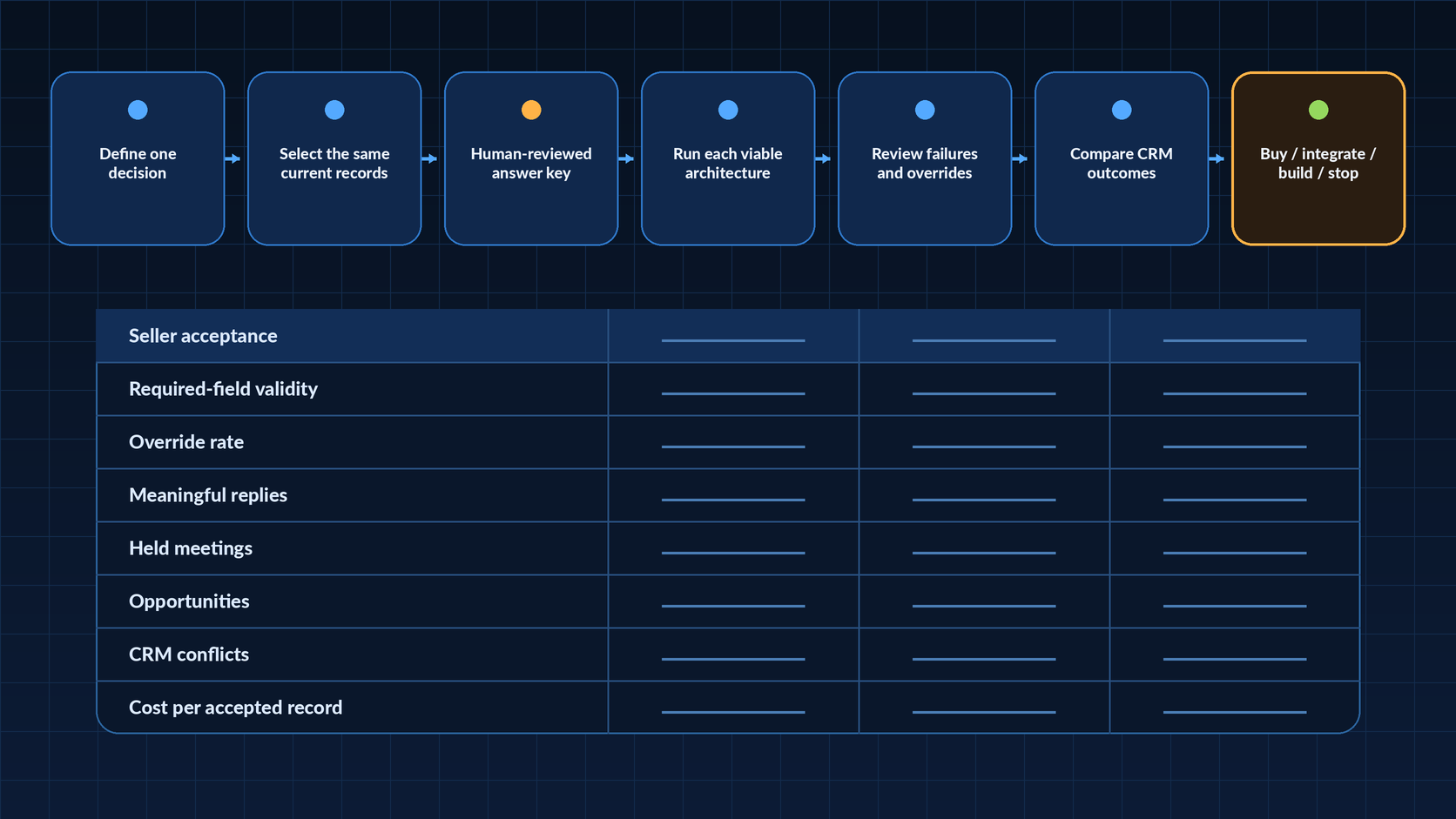
- 04Run viable tools or architectures on the same current records with one human-reviewed answer key and explicit denominators.
- 05Start a small team with one data source, one delivery path and one system of record; add a specialist only after a pilot proves a material gap.
Design the sales motion and trust model first. Build the sequence second. Choose the minimum tools third. Add scale only after the connection works.
01 / Buying decision
The short answer: choose the sales motion before the product
Design the sales motion and trust model first. Build the sequence second. Choose the minimum tools third. Add scale only after the connection works.
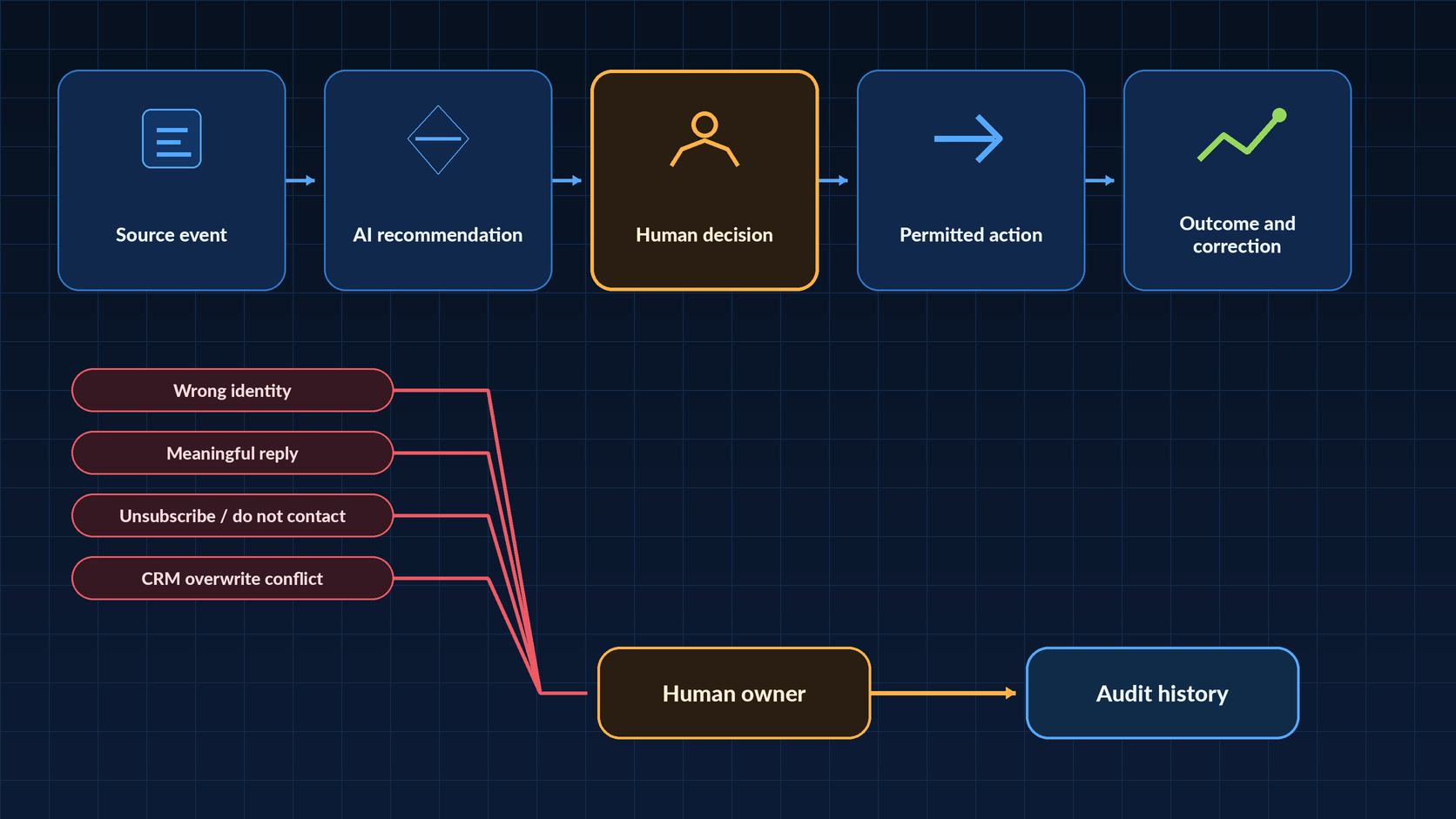
Object → Source evidence → AI suggestion or action → Human gate → External action → CRM write-back → Revenue outcome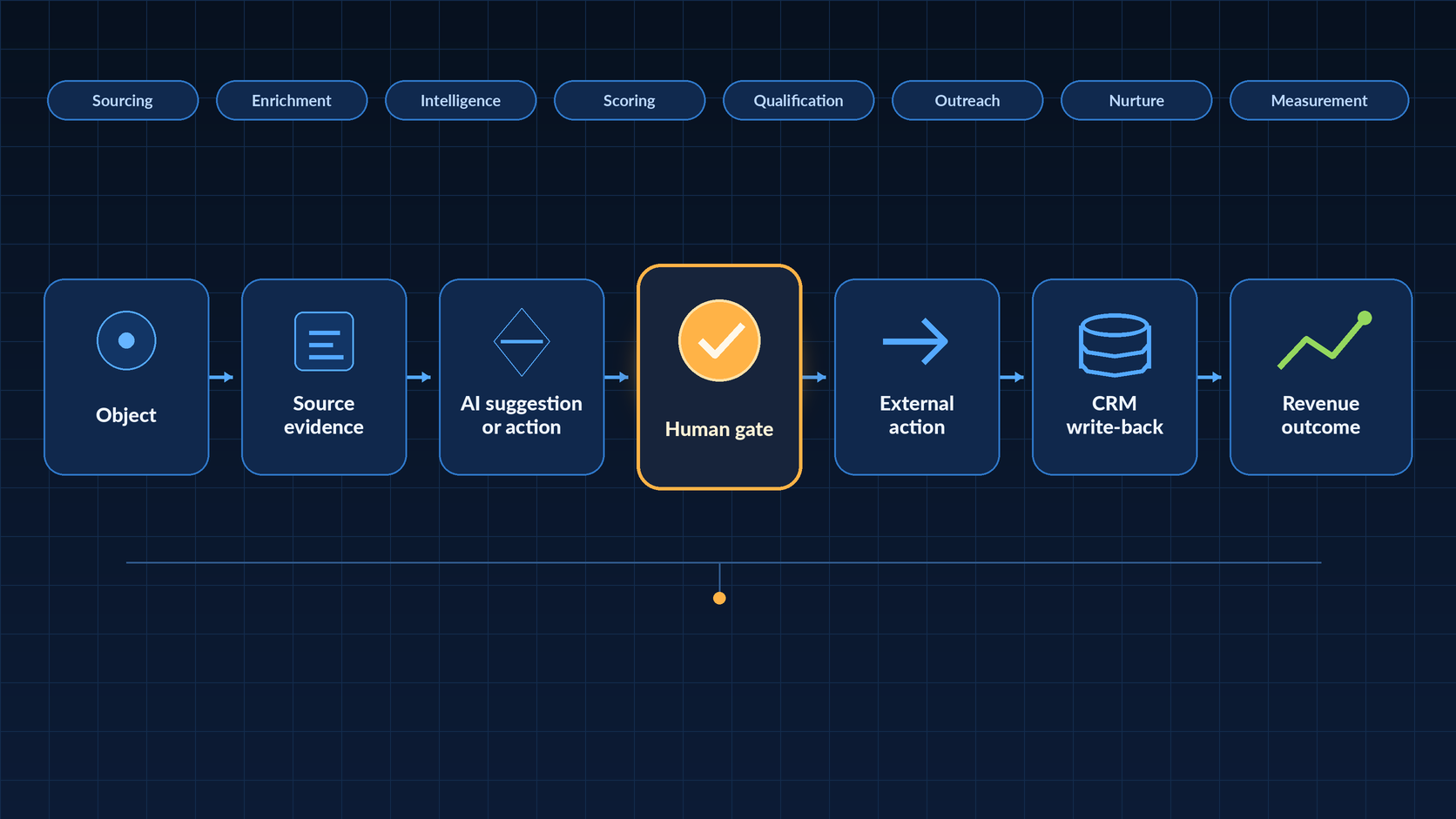
02 / Evaluation
How we evaluated AI lead generation tools
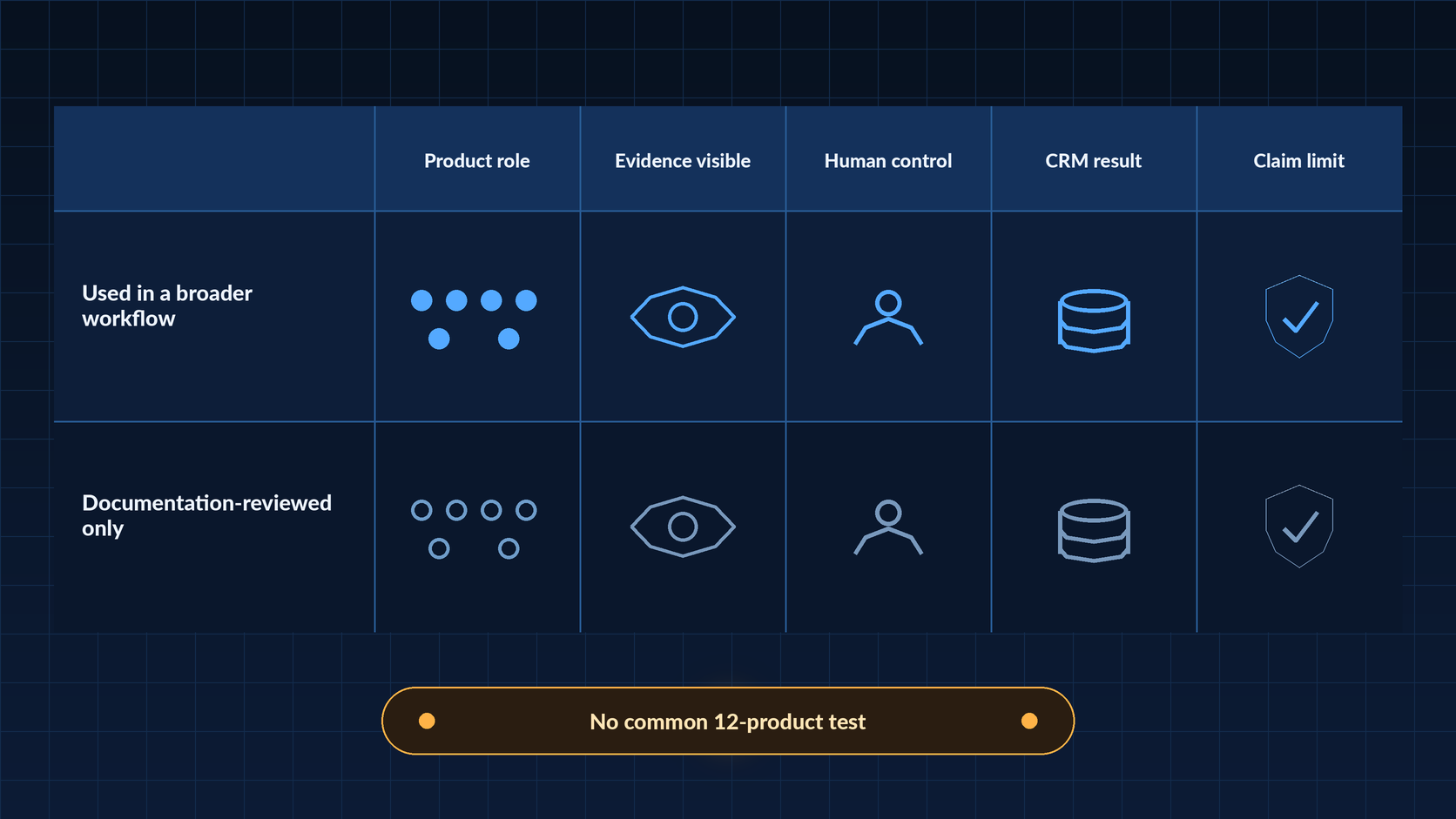
- Used in a broader workflow: The product appeared in documented sales work. This does not mean its native AI module was tested against every other tool.
- Documentation-reviewed: Capabilities were checked against official product material. No hands-on or accuracy claim is made.
03 / Comparison
The 12 tools at a glance
| Product | Primary workflow stage | Evidence level | AI or automation role | Required human check | Best fit when |
|---|---|---|---|---|---|
| LinkedIn Sales Navigator | Account and contact discovery | Used in a broader workflow | Search, alerts, account and lead insights | Confirm identity, role, relationship, and reason to contact | Current professional context matters more than list volume |
| Apollo | Sourcing, enrichment, and outbound preparation | Used in a broader workflow | Search, enrichment, scoring, and workflows | Validate current role, contactability, duplicates, and CRM mapping | A team needs an economical database-led starting point |
| Clay | Enrichment, research, and orchestration | Used in a broader workflow | Waterfalls, conditional enrichment, and AI research | Inspect sources, conflicting fields, cost, and write-back | Custom evidence justifies an operations layer |
| Common Room | Signals and identity resolution | Documentation-reviewed | Combines signals and resolves people and accounts | Verify the person, source, timestamp, and commercial meaning | A team has useful signals across several systems |
| 6sense | Account intent and prioritization | Documentation-reviewed | Account intelligence and predictive prioritization | Keep account priority separate from contact permission | Enterprise ABM needs account-level timing context |
| HubSpot | CRM scoring, workflow, and lifecycle control | Used in a broader workflow | Fit and engagement scores, workflows, and CRM automation | Approve consequential state, owner, and suppression changes | The CRM should remain the operating center |
| Salesforce | CRM-native agents and measurement | Documentation-reviewed | Lead engagement, qualification, permissions, and analytics | Test agent access, sources, handoff, and opt-out behavior | An enterprise wants AI inside governed CRM roles |
| Qualified | Inbound conversation and routing | Used in a broader workflow | Website qualification, routing, and meeting paths | Review questions, routing logic, fallback, and CRM result | Salesforce-centered teams need fast inbound handling |
| lemlist | Outbound sequence execution | Used in a broader workflow | Campaign steps, multichannel tasks, and reply handling | Approve the sample, message, launch, and reply stop | A team wants reviewed multichannel campaign delivery |
| Instantly | Email-first sourcing and execution | Documentation-reviewed | Search, enrichment, sending, and campaign controls | Check risky emails, replies, suppression, and domain limits | Cold email is the primary operating channel |
| Amplemarket | Signal-led assisted outreach | Documentation-reviewed | Finds signals, researches contacts, and drafts sequences | Verify signal context and the exact action before send | Reps want a copilot across signals and outreach |
| 11x | High-autonomy outbound execution | Documentation-reviewed | Prospecting, research, multichannel follow-up, and handoff | Audit permissions, identity, objections, stops, and CRM history | A team is prepared to govern a broad AI SDR workflow |
04 / Sourcing
Sourcing and account discovery
LinkedIn Sales Navigator: current professional context
Apollo: a database-led starting point
05 / Enrichment
Enrichment, research, and identity resolution
Clay: flexible orchestration after a proven data gap
06 / Signals
Buyer signals and account prioritization
Common Room: unify signals, then verify their meaning
6sense: account priority is not contact permission
07 / CRM
CRM-native scoring, nurturing, and measurement
HubSpot: keep the decision and history in the CRM
Salesforce: govern the agent as a CRM user
08 / Inbound
Inbound qualification and routing
Qualified: connect the website conversation to Salesforce
09 / Outbound
Outbound execution
lemlist: sequence delivery needs a reply boundary
Instantly: email-first execution with consequential settings
10 / Automation
Products that attempt broader workflow ownership
Amplemarket: signal-led recommendations with a review path
11x: evaluate autonomy as authority, not as a feature count
11 / Stack design
How to connect the tools into a working stack
Minimum stack for a founder or small team
Controlled outbound stack
- Define the segment and reason to contact.
- Source accounts and contacts.
- Enrich only fields needed for the decision.
- Review the first records and messages.
- Approve a small campaign batch.
- Stop automation when a meaningful reply arrives.
- Write the relationship state and next action to the CRM.
- Review later calls and opportunities before scaling.
Inbound-plus-outbound stack
Enterprise ABM and RevOps stack
12 / Buyer pilot
How to pilot tools on the same records
Define the decision and answer key
Test the failure path
- the wrong company or contact;
- an outdated role;
- conflicting fields;
- no source for a key claim;
- an ambiguous signal;
- a duplicate contact;
- a meaningful reply;
- an unsubscribe or do-not-contact state;
- an unavailable owner;
- a protected CRM field.
Use explicit denominators
| Metric | Formula | What it diagnoses |
|---|---|---|
| Seller acceptance | Accepted records / unique records reviewed | Whether the output is usable for the defined action |
| Required-field validity | Valid required fields / fields checked | Whether data supports the decision |
| Override rate | Human overrides / recommendations reviewed | Where rules, data, or AI judgment disagree with operators |
| Meaningful reply rate | Meaningful replies / delivered messages | Whether approved outreach starts relevant conversations |
| Held-meeting rate | Held meetings / meetings booked | Whether scheduling activity survives to a real conversation |
| Opportunity rate | Opportunities under the CRM rule / accepted records | Whether the workflow reaches a defined revenue state |
| CRM conflict rate | Unresolved conflicts / records synced | Whether integration damages the system of record |
| Cost per accepted record | Total pilot cost / seller-accepted records | Whether another layer earns its cost |
13 / Total cost
What AI lead generation software really costs
14 / Risk controls
Risks and stop conditions
| Failure | Detection | Immediate action | Owner | CRM correction |
|---|---|---|---|---|
| Wrong identity | Domain, role, or profile mismatch | Stop activation | Data owner | Mark unresolved; preserve source conflict |
| Stale evidence | Source date exceeds the rule | Return to research | Research owner | Record expiry and last checked date |
| Unsupported intent | Signal has no clear commercial meaning | Lower confidence | Seller | Store signal, not an intent conclusion |
| Weak message basis | Draft contains an unsourced claim | Block send | Seller | Record rejection reason |
| Meaningful reply | Buyer asks, objects, accepts, or declines | Stop related automation | Seller | Update relationship state and owner |
| Unsubscribe or do not contact | Explicit request or valid suppression event | Suppress immediately | Compliance/RevOps | Write channel and global suppression as required |
| CRM overwrite conflict | Trusted value would be replaced | Quarantine update | CRM owner | Preserve old/new values and approve manually |
| Missing outcome trail | Activity cannot connect to later state | Stop scaling | RevOps | Repair event and attribution schema |
15 / Buyer checklist
Twelve questions to answer before signing
- Which object and decision will the product control?
- Which sources produce its recommendation?
- Can a reviewer inspect those sources?
- What happens when evidence conflicts or disappears?
- Which external action can AI take without approval?
- Can a person edit, reject, stop, and reverse that action?
- Does a meaningful reply stop every related sequence?
- Which CRM fields can the product read and write?
- Can it overwrite a trusted value?
- Which downstream outcome will evaluate it?
- What is the cost per seller-accepted record?
- Can the team export data, history, and suppression state at exit?
16 / Decision rules
Final decision rules by sales situation
- Choose Sales Navigator or Apollo when the primary gap is discovery. Prefer Sales Navigator for current professional context. Prefer Apollo for a database-led starting point.
- Add Clay when the sales motion needs custom evidence and a same-sample pilot proves that one source is insufficient.
- Consider Common Room or 6sense when the team already has signals but lacks identity resolution or account priority. Do not treat a signal as qualification.
- Keep HubSpot or Salesforce as the operating center when CRM state, permissions, and history matter more than another point solution.
- Consider Qualified for meaningful inbound traffic inside a Salesforce-centered route.
- Use lemlist or Instantly only after the target, message, stop rules, and CRM handoff are clear.
- Evaluate Amplemarket or 11x by authority and failure behavior. Broader automation requires stronger controls, not less review.
17 / FAQ
Frequently asked questions
What is the best AI lead generation tool for B2B sales?
What is the difference between an AI lead generator and lead-generation software?
Can one tool handle sourcing, enrichment, outreach, and CRM?
Can AI lead generation software replace an SDR?
How many AI lead generation tools does a small team need?
How should a company test lead-generation data quality?
What should an AI lead-generation tool write back to the CRM?
How much do AI lead generation tools cost?
Are AI lead generation tools legal for cold email and LinkedIn outreach?
How often should this comparison be updated?
18 / Final rule
The connection is the product
Research note
Methodology
- 01Compare products by workflow stage, controlled decision, evidence, human control, CRM behavior and downstream outcome rather than by feature count or a universal rank.
- 02Label LinkedIn Sales Navigator, Apollo, Clay, HubSpot, Qualified and lemlist as used in a broader workflow; label Common Room, 6sense, Salesforce, Instantly, Amplemarket and 11x as documentation-reviewed only.
- 03Use current official documentation for product capabilities, LinkedIn platform restrictions and US commercial-email requirements; product documents were reviewed on August 17, 2026.
- 04Treat the July 2026 workflow as observational process evidence, keep unique-record and message-attempt denominators separate and do not infer vendor causality from later outcomes.
- 05Exclude vendor database counts, customer outcomes, accuracy claims, volatile prices and ordinal rankings from the recommendation method.
- 06Preserve the distinction between confirmed no-relationship disclosures and vendors for which no commercial relationship is merely documented; recheck the latter before publication.
- 07Evaluate viable tools on the same current records with one human-reviewed answer key, explicit failure cases and cost per seller-accepted record.
Source ledger
Sources & editorial notes
- 01LinkedIn Sales Navigator
LinkedIn · Official lead and account search, list, alert, insight and plan-dependent CRM capabilities.
- 02Prohibited software and extensions
LinkedIn Help · Official restrictions relevant to third-party scraping and LinkedIn automation.
- 03Prospect and Enrich
Apollo · Official discovery, filtering and enrichment capabilities; vendor outcome claims are not treated as editorial proof.
- 04Enrichment Overview
Apollo Knowledge Base · Official saved-record, CRM, form, schedule and API enrichment paths.
- 05Building a data waterfall
Clay University · Official documentation for ordered provider sequences and enrichment orchestration.
- 06Signals
Common Room · Official documentation for combining activity signals and resolving people and accounts.
- 07Sales Intelligence
6sense · Official account intelligence, contact intelligence, intent and predictive-tool positioning.
- 08Build lead scores
HubSpot Knowledge Base · Official documentation for fit, engagement and combined lead scores.
- 09Get to Know Agentforce SDR
Salesforce Trailhead · Official setup guidance covering agent users, permissions, trusted information, testing, activation and analytics.
- 10Qualified for Salesforce
Qualified · Official website-conversation, routing, lead-creation and booking capabilities for Salesforce-centered teams.
- 11Implementation
Qualified · Official launch and sign-off process.
- 12Understand campaign sequencing
lemlist Help Center · Official multichannel campaign-step and manual-task documentation.
- 13Stop emailing leads who replied or clicked
lemlist Help Center · Official reply and click stop controls.
- 14SuperSearch
Instantly Help Center · Official search, enrichment, export and campaign-transfer documentation.
- 15Campaign Options
Instantly Help Center · Official reply stops, risky-email behavior, sending rules and unsubscribe-header controls.
- 16Duo
Amplemarket · Official signal monitoring, research, sequence preparation, rep review and automation-mode positioning.
- 17Alice: Outbound lead generation
11x · Official prospecting, research, multichannel follow-up and handoff positioning; company-reported outcomes are excluded.
- 18CAN-SPAM Act: A Compliance Guide for Business
US Federal Trade Commission · US regulator guidance for commercial email, including B2B email.
- 19AI Lead Generation: How to Build a B2B Workflow That Produces Qualified Opportunities
Luck My Sales · Supporting human-gated workflow, CRM and measurement architecture.
- 20Luck My Sales methodology
Luck My Sales · Evidence states, source treatment, freshness requirements and correction protocol.