Weekly industry intelligence · No noiseSubscribe to the Luck My Sales newsletterFree briefing

Independent operator-led media on AI in B2B sales

Menu

Operator guide and evidence-led workflow · AI prospecting

I Built a Signal-Based Selling Workflow Across 7,520 Companies—Here’s What I Learned

A field-tested signal-based selling workflow with fit gates, signal half-lives, human review, CRM feedback and honest three-month funnel evidence.
Editorial disclosure

AI may assist research organization and drafting. A human editor reviews every published page, checks material claims against the cited sources and owns the final decision. No company paid for placement in this article.

AI use policy

Agent-ready brief

AI takeaways

Keep the key points here, or take a source-aware text brief into Claude, ChatGPT or another AI workspace.
  1. 01A filter describes eligibility, while a signal describes a time-bound change.
  2. 02Measure signal age from the event timestamp, not the day the feed delivered it.
  3. 03Automation may prepare evidence and a draft, but a person owns contact and message approval.
  4. 04The supported funnel is 7,520 analyzed, 1,627 ICP-qualified, 58 replies and 14 interested records.
  5. 05Start with three signals, one ICP, one owner and a 30-day decision to scale, revise or stop.
Includes summary, takeaways, sources and a use note.
Signal-based selling uses recent events to set sales priority. The event changes the reason to research an account now. It might be direct demand or first-party activity. It might be review research, hiring, funding, or a stack change. The event does not replace fit or human judgment.
I used this method for three months. The market covered US and European B2B technology firms. The recorded funnel was:
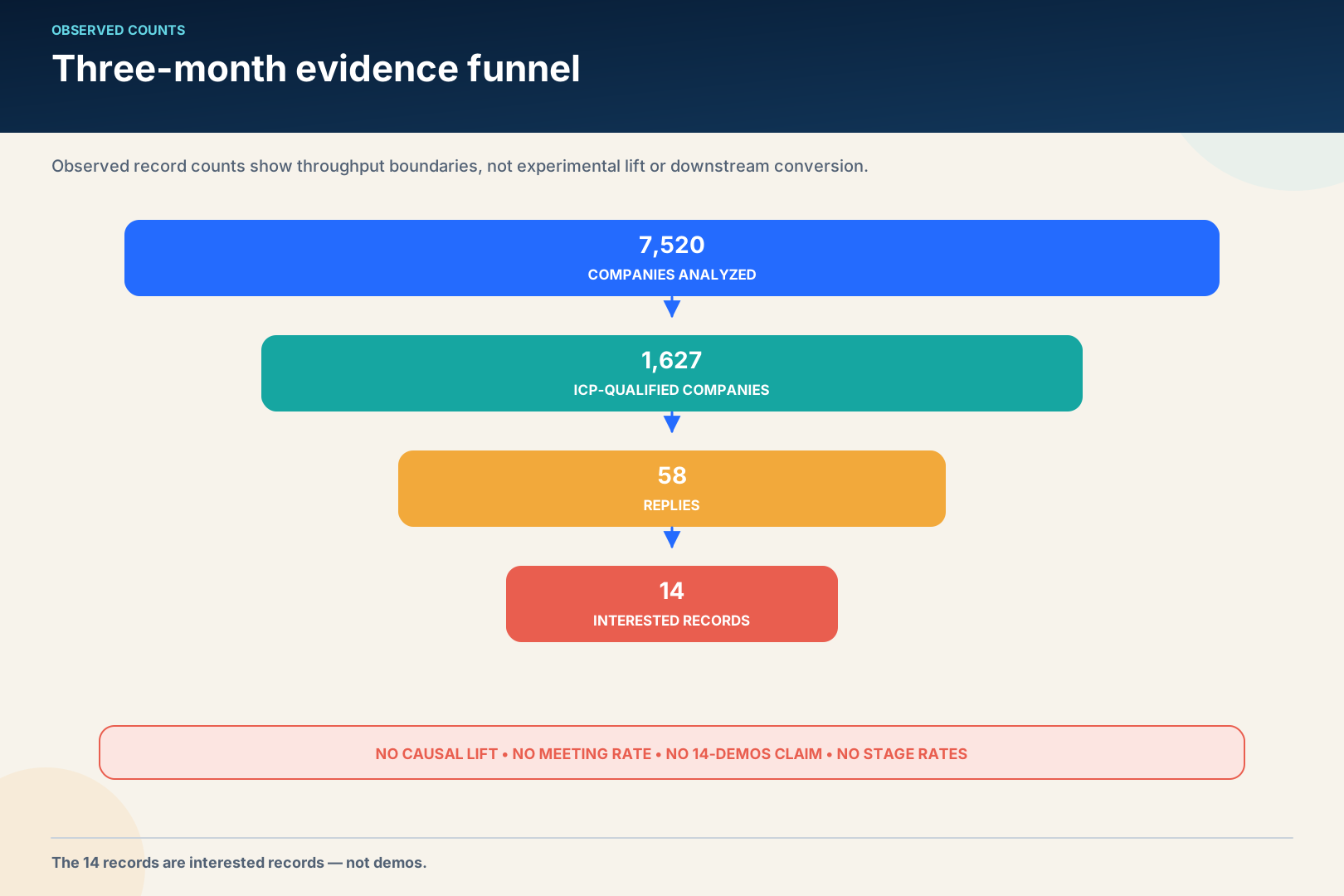
7,520 companies analyzed → 1,627 ICP-qualified companies → 58 replies → 14 interested records
Each number describes a different stage. “Analyzed” means the company entered research. “ICP-qualified” means it passed the company gate. “Reply” means a person responded. It does not mean the reply was positive. “Interested record” means the reply showed clear interest under our label.
I am not reporting 14 booked demos. One owner note used that phrase. The CRM and calendar evidence did not support it. I also do not calculate stage rates. The export did not prove complete record links. The safe result is an operating funnel. A large source list became a small approved queue. Fourteen records reached the interest state.

A signal changes sales priority; fit, freshness, a matching play, human approval and CRM feedback determine whether it deserves action.

01 / What Signal-Based Selling Actually Means

What Signal-Based Selling Actually Means

List-based outbound begins with static fit. Signal-based selling adds a time-bound reason to act now.
That distinction matters. A good account can remain a good account for years. A pricing-page return can be useful for hours or days. A job opening may be relevant for weeks. A funding event may change priorities, but it can also create months of internal distraction.
I define the method with six components:
  1. a stable ICP;
  2. an observable event;
  3. a known source and timestamp;
  4. a signal-specific useful window;
  5. a matching play;
  6. a human decision and CRM outcome.
No fit gate means more noise. No timestamp means stale trivia. No play means a dashboard fact. No review or write-back means no learning.
Signal-led work is not the same as ABM. ABM aligns work around named accounts. A signal flow can support ABM or inbound. It can also support PLG, growth, or outbound. Intent data is only one signal family.
For the source and resolution mechanics behind behavioral research, see our B2B intent data guide.

02 / A Filter Is Not a Signal

A Filter Is Not a Signal

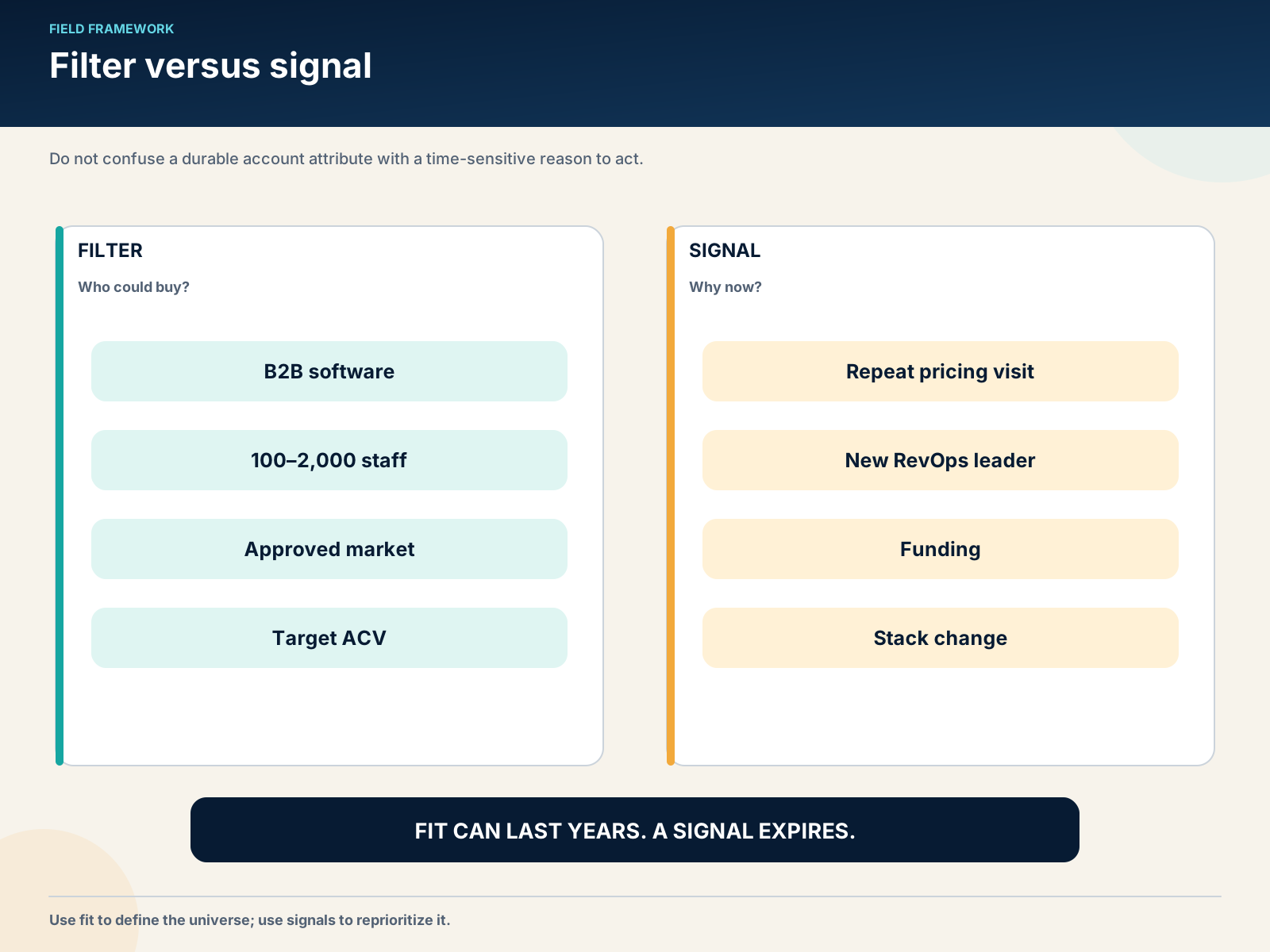
A filter describes eligibility. A signal describes change.
FilterSignal
B2B software companyA return visit to an implementation page
100–2,000 employeesA surge in hiring for a relevant team
United States or approved European marketA new expansion into an approved region
Uses HubSpotA recent change away from or toward a related technology
$20,000–$100,000 potential ACVProduct-comparison research this week
Revenue operations leader existsA new Head of RevOps joins
My campaign used the filter first. A company had to match the configured market, business model, size, geography, and commercial potential before a signal could change its priority.
One false positive passed the company and role filters. It then failed a current identity review. The firm looked right on paper. Current research showed a different active business. We rejected the record before outreach.
A static fit score can become stale. The case shows why teams must check again. The review belongs near the point of action.
Comparison of static account filters and time-bound selling signals.
A filter says who belongs in the market; a signal changes who deserves attention now.

03 / My Signal Hierarchy

My Signal Hierarchy

The hierarchy below is my operating playbook. It is not a universal market standard.

Tier 1: explicit demand

Examples include a demo request, a direct pricing question, a reply asking for a conversation, or a referral to the responsible person.
Explicit demand is strong because the person states an action or need. The team still checks identity, ownership, channel, and qualification. A request from a student or a vendor is not automatically an opportunity.

Tier 2: direct first-party behavior

Examples include repeat pricing-page activity, implementation-content activity, product usage changes, trial milestones, or multiple people from one target account engaging with owned properties.
The event is direct, recent, and tied to your environment. The limitation is identity. Company-level website activity may not reveal the person. Product activity may come from an existing user with no buying authority.
Common Room’s signal library includes pricing-page activity, product usage, organizational activity, community questions, and many other observable events. Its high, medium, and low labels are a vendor taxonomy, not a universal scoring system. See the Common Room signal library.

Tier 3: product-comparison or category research

G2 competitor or comparison activity can show that an account is researching a product environment. It is more specific than a broad topic. It remains account-level in many workflows.
G2 documents profile, pricing, alternatives, category, compare, and competitive signal types. See G2 Buyer Intent documentation.

Tier 4: relationship events

A former customer champion moving to an ICP account can be useful because a real relationship existed. A key stakeholder leaving an open opportunity can also be important.
The event should change ownership or research priority. It should not justify pretending that the person asked to be contacted at a new employer.

Tier 5: operational triggers

Hiring, funding, acquisitions, new-market expansion, executive appointments, and technology changes can create a plausible “why now.” They are public business events, not proof of a purchase.
These triggers worked best when the problem was directly connected. A Head of RevOps opening was more relevant to a revenue-operations offer than a generic hiring surge.

Tier 6: weak engagement

A like, follow, single low-value pageview, generic news mention, or broad topic match may support research. On its own, it rarely justified direct outreach in my workflow.
Weak does not mean useless. It means the action should be smaller: monitor, enrich, or wait for another signal.
<!-- Visual plan: six-tier signal hierarchy -->

04 / The Four Signal Half-Lives I Used

The Four Signal Half-Lives I Used

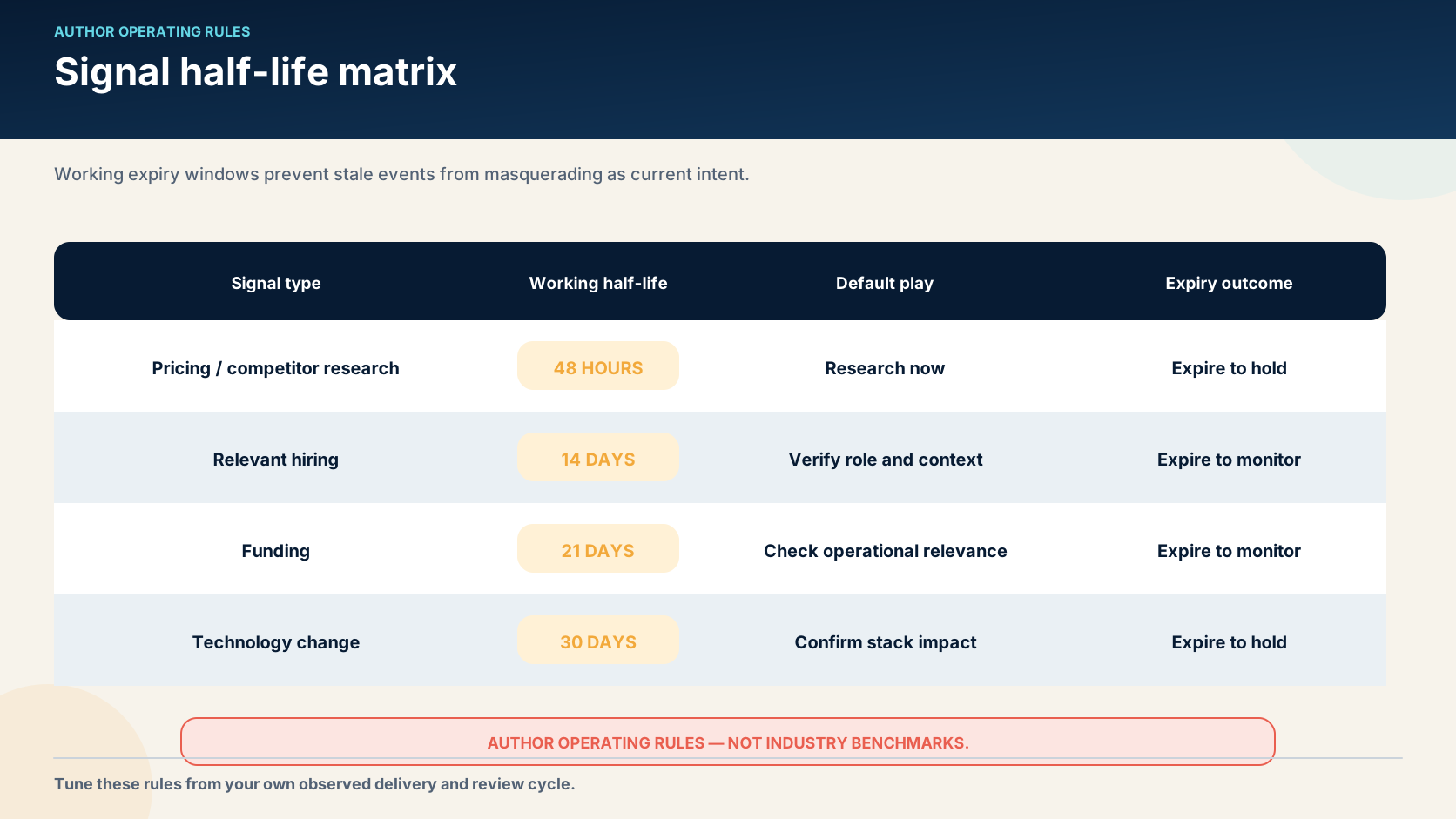
A signal half-life is its useful work window. It ties the event to one play. The term is my operating shorthand. It is not a measured law.
My rules were:
SignalOperating half-lifeWhyDefault play
Pricing or competitor research48 hoursEvaluation behavior can change quicklyImmediate human review; context-led outreach if approved
Relevant hiring14 daysA role opening stays current but priorities can shiftResearch job scope and operating problem
Funding21 daysCapital changes possibilities, not necessarily buying readinessVerify use of funds and business plan before contact
Technology change30 daysMigration or integration problems can persistConfirm the change, owner, and workflow consequence
These windows came from the operated campaign. They are not industry benchmarks. Another market, sales cycle, region, data source, or product should set different rules.
The window also starts at the event time, not the time the provider delivered the record. If a job post is 12 days old when it enters the workflow, only two days remain under a 14-day rule.

Why a play must be attached to the signal

A signal without a play creates generic outreach. The play defines:
  • what the event may mean;
  • which buyer role could own the problem;
  • what evidence must be verified;
  • what message angle is allowed;
  • which channel is permitted;
  • who approves;
  • what happens if evidence is missing;
  • when the record expires.
For pricing or competitor activity, the play focused on evaluation risks, implementation, and differentiation. For hiring, it focused on the role’s published responsibilities and the operational problem. For a stack change, it focused on migration or workflow continuity. For funding, it focused on public priorities rather than congratulatory noise.
Signal-based selling half-life matrix with 48-hour, 14-day, 21-day and 30-day operating rules.
The event clock starts when the event happened, not when the feed delivered it.

05 / The Signal-Based Selling Workflow I Built

The Signal-Based Selling Workflow I Built

The stack included Clay and Claygent for research and orchestration, Apollo for contact discovery, LinkedIn-based research, and outbound tools such as Lemlist, Instantly, Smartlead, and Reply in different workflow contexts. Product names are not the core result. The control sequence is.

Step 1: detect and preserve the event

Every record began with a source event. We kept the source, event type, event time, collection time, account clue, and raw context.
If the event could not be inspected, confidence dropped. A proprietary score could prioritize review, but it could not replace the source record.

Step 2: apply hard ICP rules

Clay handled structured checks against the target profile. We treated hard failures as deterministic:
  • wrong business model;
  • wrong market;
  • wrong geography;
  • company size outside the range;
  • commercial potential below the motion’s threshold;
  • duplicate, customer, or suppressed account;
  • inactive or mismatched commercial identity.
AI research could fill or summarize context. It could not waive a hard exclusion.

Step 3: validate the company now

The false-positive case showed why current identity matters. We checked the company website, offering, active market, location, and recent business context. A database label from last year did not override current evidence.
This step can use a broader lead intelligence stack, but the output must preserve source and freshness.

Step 4: resolve a plausible person

Apollo and LinkedIn research helped identify people who might own the problem. We checked current employment, role, business unit, geography, and relevance.
A provider match did not become a verified buyer automatically. The reviewer could choose another person, hold the account, or reject it.

Step 5: stack the evidence

I did not add points merely because more fields existed. I asked whether independent evidence supported the same commercial hypothesis.
A pricing-page return plus a relevant open role could strengthen the case. A broad topic surge plus a generic social like might be two weak events, not one strong case.
The record preserved each component so the reviewer could see whether “high intent” came from one direct event or several indirect ones.

Step 6: let a person decide

The human gate covered two decisions:
  1. Is this the right contact?
  2. Is this the right message and channel now?
The system could recommend. The operator approved, edited, held, or rejected.
Our broader AI lead qualification guide explains why a model’s recommendation and the human-applied status should remain separate records.

Step 7: personalize around the problem

The message used public or non-sensitive business context. It did not reveal hidden behavioral tracking.
My rule was:

“Focus on their pain, not your tracking.”

That rule is both a trust boundary and a quality check. If the message makes no sense without saying “we saw you,” the play probably lacks a buyer-relevant insight.

Step 8: route through an approved channel

The workflow used approved email or LinkedIn paths only after contact, message, suppression, and ownership checks.
Automation executed the approved action. It did not create its own permission. For ownership and exceptions after the decision, see our AI lead routing guide.

Step 9: write the decision and outcome to the CRM

We kept:
  • signal source;
  • event time;
  • half-life;
  • ICP state;
  • contact state;
  • reviewer;
  • approved play;
  • message version;
  • send time;
  • reply state;
  • interest state;
  • later opportunity state if documented;
  • rejection reason.
The CRM outcome closed the loop. A campaign platform’s sent or replied count was not enough.

Step 10: review false positives weekly
We grouped failures by source, signal, topic, ICP rule, contact error, timing, and message mismatch.
A recurring broad-topic failure led to a narrower topic or stricter stacking rule. A repeated wrong-role problem changed the contact-resolution step. A stale feed changed the useful window or source.
<!-- Visual plan: detect-to-CRM workflow with human gate -->
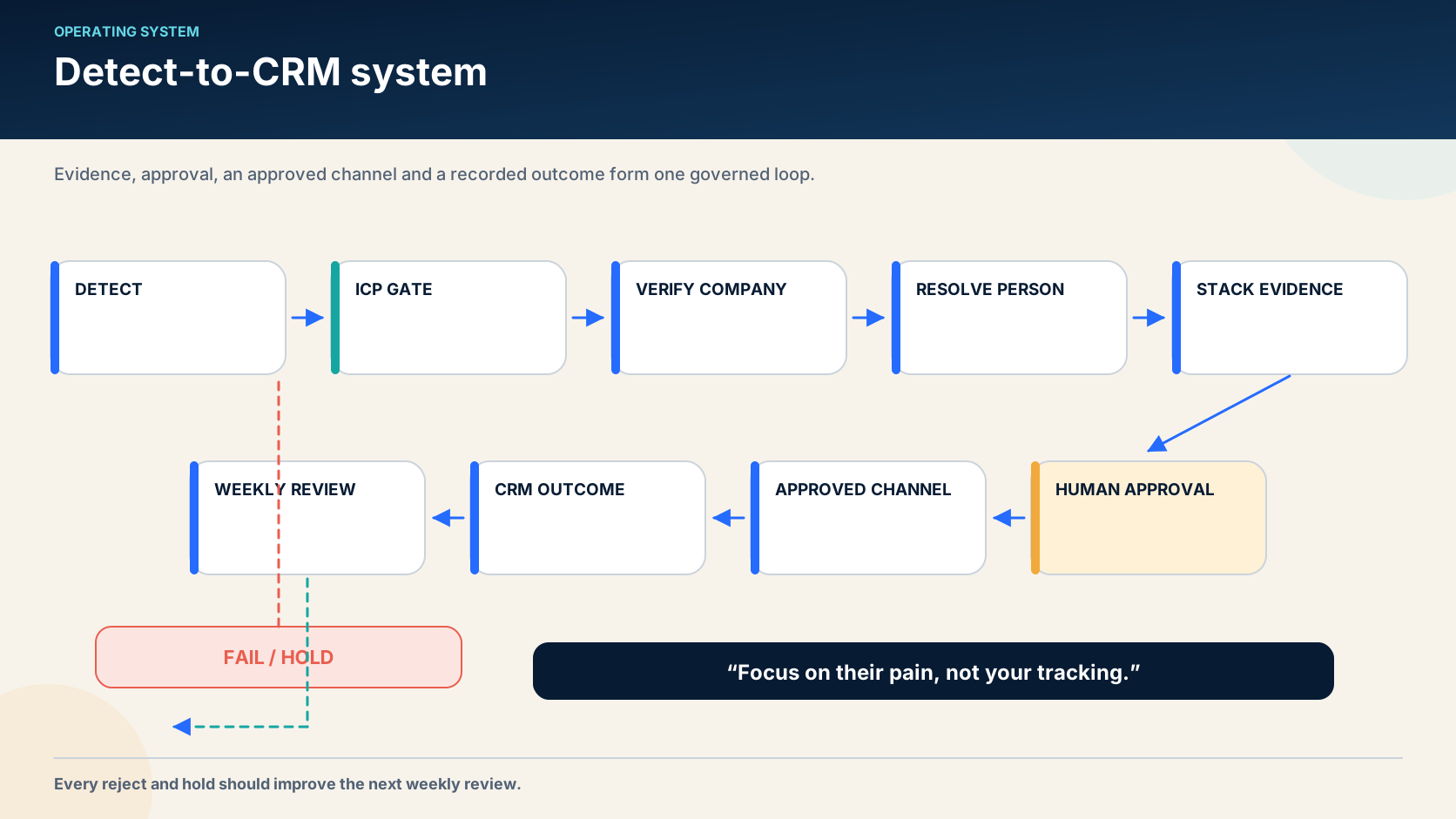
Signal-based selling workflow from event detection through human approval and CRM feedback.
Automation can prepare the record; the human gate owns the contact and message.

06 / A Lean Setup and a Mature Setup

A Lean Setup and a Mature Setup

Lean setup

A lean team can run signal-based selling with:
  • one ICP;
  • two or three signal sources;
  • a spreadsheet or lightweight table;
  • one research or enrichment workflow;
  • one CRM;
  • one approved channel;
  • one human owner;
  • a weekly review.
Start with signals you can inspect: a relevant job opening, a current technology change, a high-value first-party page, or an explicit reply. Keep volumes small enough to review.
A lean system is not primitive if it preserves evidence and outcomes. It can teach the team more than a large platform filled with unowned alerts.

Mature setup

A mature system may include a signal warehouse, account scoring, identity resolution, contact data, orchestration, multiple channels, CRM ownership rules, suppression, permissions, and dashboards.
Scale introduces new failure modes:
  • duplicate events;
  • conflicting account identities;
  • too many alerts;
  • hidden source lineage;
  • different teams contacting the same account;
  • stale scores;
  • automatic enrollment without human review;
  • missing outcome attribution.
A mature stack therefore needs stronger governance, not less. Each automated path needs a decision owner and a stop state.
The AI lead generation workflow provides a useful larger architecture: source, AI suggestion, human gate, action, CRM record, and revenue outcome.

07 / How to Reference a Signal Without Sounding

How to Reference a Signal Without Sounding Creepy

The first rule is not to disclose surveillance the buyer did not expect.

Do this

  • Refer to the public business problem.
  • Ask whether the observed change created a relevant operational issue.
  • Use the event to choose timing and research, not to prove intent.
  • Make the message valuable even if the signal hypothesis is wrong.
  • Give the recipient an easy way to say the issue is not relevant.
Example:

“I saw you’re hiring a Head of RevOps. Teams building that function often discover that lead routing and CRM ownership are harder than the tooling choice. Is that part of the role’s mandate, or is the team focused elsewhere?”

The event is public, the hypothesis is scoped, and the recipient can correct it.

Do not do this

  • “I noticed someone at your company visited our pricing page.”
  • “Our intent platform says you are in market.”
  • “Congrats on funding—want a demo?”
  • “You researched our competitor, so you must be evaluating alternatives.”
These lines overstate what the event proves. They also expose tracking rather than showing understanding.

Privacy and legal review

Signal workflows can process behavioral data and personal data. The European Commission says an organization relying on legitimate interests must consider the rights and freedoms of the people affected and provide information about the processing. See European Commission guidance.
This article is not legal advice. Review the source, jurisdiction, legal basis, transparency, retention, platform terms, suppression, and channel rules for your workflow. A publicly observable event is not unrestricted permission to enrich and contact any person.

08 / What the Three-Month Funnel Does and Does

What the Three-Month Funnel Does and Does Not Show

The campaign evidence is:
StageCountDefinition
Companies analyzed7,520Entered the company research workflow
ICP-qualified companies1,627Passed the configured company-fit gates
Replies58A recipient responded to campaign outreach; sentiment not implied
Interested records14Contained explicit interest under the campaign’s operating label
The funnel shows that filtering materially reduced the research universe before outreach outcomes appeared. It also shows why “companies found” is not the result.
It does not show causal lift from signal-based selling. There was no matched control cohort in the supplied evidence. It does not establish a meeting rate, opportunity rate, revenue contribution, or return on investment. The evidence does not reconcile 14 booked demos, so I do not publish that claim.
I also avoid calculating percentages from the visible numbers. A rate would imply that every stage had the same deduplicated record relationship and complete denominator. The available export did not prove that to the standard I want for publication.

Metrics I would track in the next run

  1. Signal arrival delay: event time to system arrival.
  2. Review delay: system arrival to human decision.
  3. ICP pass count: accounts passing every hard rule.
  4. Usable-signal count: records approved for a named play.
  5. Contact validation count: current relevant contacts confirmed.
  6. Activation count: approved actions actually executed.
  7. Reply states: positive, neutral, negative, wrong person, unsubscribe, and other.
  8. Interested records: explicit interest under a written rule.
  9. Qualified opportunities: only after the qualification definition is met.
  10. False-positive reasons: why signals were rejected.
  11. Operator minutes: research and review cost.
  12. Outcome by source and signal: not just by campaign.
A control cohort can help, but it must receive comparable data quality, message quality, timing, and sender treatment. Otherwise the test compares two workflows, not the presence of a signal.
Signal-based selling funnel from 7,520 analyzed companies to 14 interested records with evidence limits.
The supported final label is 14 interested records, not booked demos.

09 / Common Failure Modes I Saw

Common Failure Modes I Saw

Treating static fit as timing

A company looked perfect but had no recent reason to act. The fix was to keep it in the target market without elevating it to the current queue.

Using broad topics

The topic matched our category language but not the account’s commercial project. The fix was to narrow topics or require another signal.

Acting on stale events

A trigger reached the operator near the end of its useful window. The fix was to store event time and reject late arrivals.

Resolving the wrong company

A similar name or stale identity created a false match. The fix was current website and commercial-identity review.

Selecting any senior person

A senior title looked attractive but did not own the problem. The fix was role-specific contact validation.

Writing a generic congratulatory message

Funding and hiring created “congrats” outreach with no operational insight. The fix was to name the likely problem and invite correction.

Revealing the tracking

A message referenced private-looking behavior rather than buyer pain. The fix was the rule: focus on the pain, not the tracking.

Letting automation own the decision

A record entered a sequence because it crossed a score. The fix was separate human approval for contact and message.

Counting replies as success

Any response appeared positive in the dashboard. The fix was explicit reply states and an interest definition.

Losing the source in CRM

The account had a high score but no inspectable event. The fix was mandatory lineage fields before activation.

10 / A 30-Day Signal-Based Selling Launch Plan

A 30-Day Signal-Based Selling Launch Plan

Week 1: define one motion

Choose one ICP and three signal classes. I would start with:
  • high-value first-party activity;
  • one public operational trigger;
  • one review or topic source.
Define hard exclusions, half-life, owner, play, channel, and outcome. Do not start with 30 signals.

Week 2: review manually

Run records through fit, current identity, contact, and message checks. Do not send automatically.
Record rejection reasons and operator time. If reviewers disagree, the definitions are not ready.

Week 3: activate a small approved group

Use one message framework per signal. Keep a hold state. Preserve a comparable non-signal cohort only if the sample can support a fair comparison.
Review every reply and CRM write-back.

Week 4: tune or stop

Continue only when:
  • the signal arrives inside its useful window;
  • enough accounts pass the ICP gate;
  • contacts can be validated;
  • the message remains relevant without exposing tracking;
  • reviewers can act at the required speed;
  • outcomes can be traced to the original event.
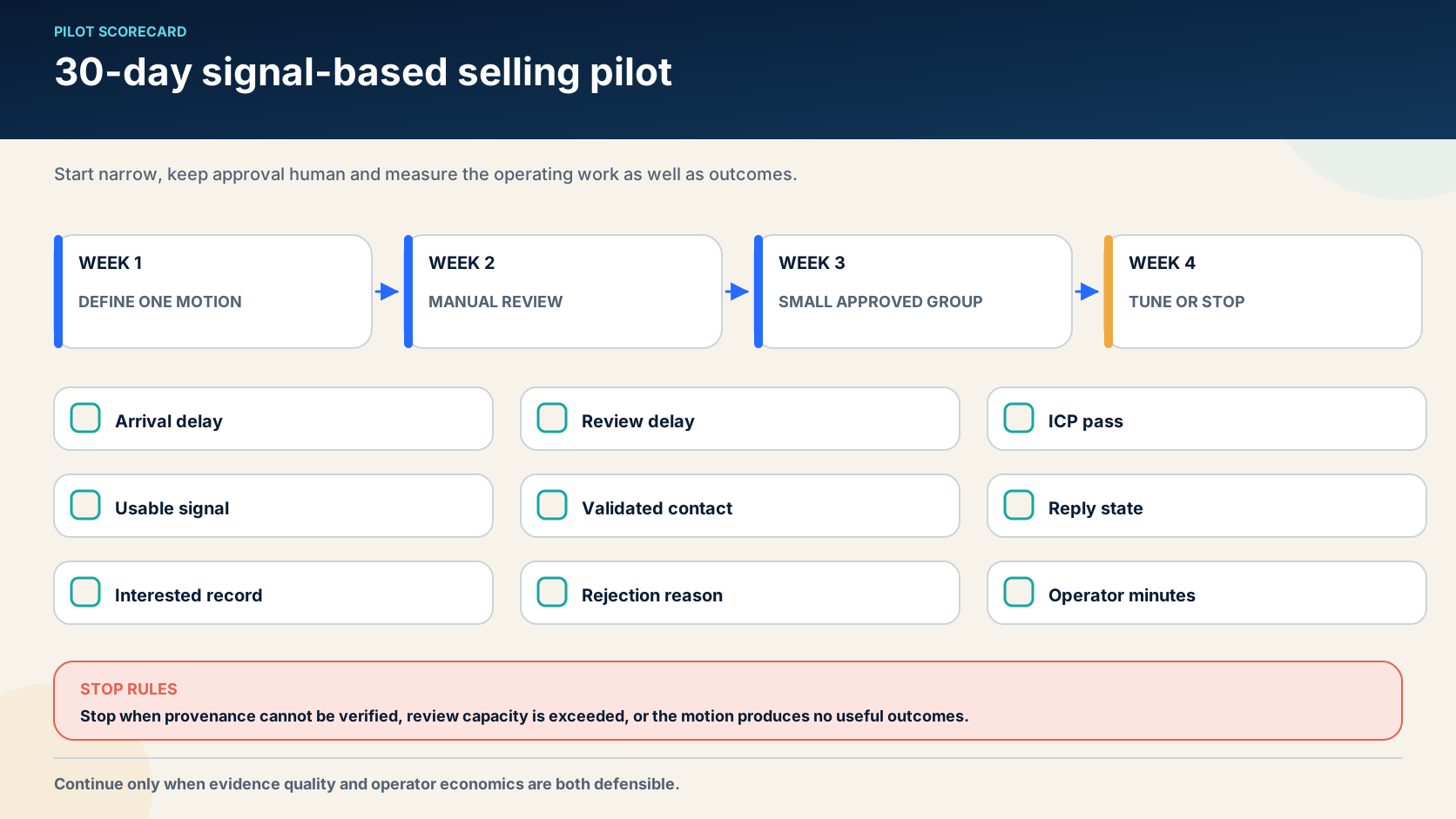
Stop or redesign when the feed creates mostly rejected records, the team cannot act in time, or the system cannot explain why an account was contacted.
<!-- Visual plan: thirty-day launch scorecard -->
Four-week signal-based selling launch scorecard with timing, validation, reply and rejection metrics.
Start with three signals, one ICP and one owner; scale only what survives review.

11 / Where Intent Data Fits

Where Intent Data Fits

Intent data is one input to signal-based selling. It covers research or engagement evidence from owned properties, review platforms, or third-party networks.
A complete signal system can also include product usage, relationship changes, hiring, funding, technology changes, community activity, and explicit replies. None of these automatically proves readiness.
Use the B2B intent data workflow to design source lineage, account resolution, contact resolution, and privacy controls. Use our B2B intent data providers comparison when deciding whether a specific source adds enough unique coverage.
The operating layer connects those inputs to a fit gate, half-life, play, human decision, CRM state, and outcome.

12 / A Worked Signal Record From Detection to

A Worked Signal Record From Detection to CRM

Consider a company that posts a Head of RevOps role.
The raw event contains the company name, job title, job URL, posting date, location, and role description. The signal class is relevant hiring. Under my operating rule, it has a 14-day useful window.
The event enters the ICP gate. The company matches the business model, market, geography, size, and commercial range. That pass makes the company eligible. It does not prove that the open role owns the problem we solve.
The research step reads the role description. If the job owns CRM governance, routing, attribution, and process design, the commercial hypothesis becomes more specific. If the role focuses on compensation or analytics unrelated to our offer, confidence falls.
The identity step finds the current sales or revenue leader. It also checks whether the open role is unfilled, whether a recruiter owns the process, and whether an existing relationship exists.
A human then decides whether there is a respectful play. The approved message asks about the operating problem described in the job. It does not assume that the company has started a software evaluation.
If no relevant person can be verified, the record moves to hold. If the job closes, the event expires. If another signal appears, such as a current technology change, the reviewer can reopen the case with both source records.
After contact, the CRM stores the reply state. “The new leader will assess that next quarter” is not an opportunity. It is useful timing evidence. The record may move to a dated nurture state with an owner.
This example shows the complete method. A public event created priority. Fit made the account eligible. Research shaped a hypothesis. A person chose the contact and message. The CRM recorded what happened.

A different play for pricing activity

A repeat pricing-page event uses a different rule.
The event may justify a faster review. It may also be more sensitive. The company match must not become a named-person claim.
The seller first checks whether the account is a customer, active opportunity, partner, or recently closed loss. Existing ownership overrides a new outbound play.
If no relationship exists, the seller reviews public company context and selects a problem-led message. The message can discuss evaluation criteria or implementation risk. It should not mention the pageview.
The same company may therefore receive no contact, an owner alert, a nurture update, or approved outreach depending on relationship and identity. The signal does not determine the action alone.

13 / How I Would Design a Signal Registry

How I Would Design a Signal Registry

A signal registry is a simple operating document. It prevents each tool or seller from inventing rules.
Each row contains:
  • signal name;
  • source;
  • observed event;
  • account or person granularity;
  • useful window;
  • ICP requirements;
  • required second signal;
  • target role;
  • allowed play;
  • prohibited message claims;
  • owner;
  • approval state;
  • CRM fields;
  • expiry rule;
  • outcome metrics.
The registry should be versioned. If a hiring signal changes from 14 to 21 days, record when and why. Historical results should retain the rule used at the time.

Separate event classes from vendor names

“Bombora intent” is a source label. “Topic surge for revenue operations” is an event class. “Pricing-page return” is an event class even if HubSpot, Dealfront, or another tool captures it.
This separation keeps the play stable when tools change. It also lets the team compare the same event across providers.

Add an evidence minimum

A weak signal may require another independent source. The registry can state:
  • one direct event is enough for research;
  • one topic event plus a fit trigger is enough for review;
  • two weak engagement events are not enough for outreach;
  • explicit demand routes to an owner after identity and suppression checks.
The evidence minimum is an operating rule. It should be tuned from outcomes.

Add a prohibited-action field

Some signals should never create automatic outbound. A customer usage drop may require customer-success review. A private community post may forbid extraction or external use. A person-level action may require specific transparency or consent.
The prohibited field makes those limits visible before automation.

14 / How to Keep Signal Stacking Honest

How to Keep Signal Stacking Honest

Signal stacking can improve a hypothesis. It can also create false confidence.
Three events are not independent merely because they came from three tools. A G2 comparison can feed 6sense. Bombora can feed Cognism. One article can produce topic activity across several resellers.
The stack therefore needs source lineage. Ask whether two records reflect the same observed behavior.
I use three tests.

Independence test

Did the events come from distinct source environments, or is one feed resold?

Meaning test

Do the events support the same commercial problem? A funding event and a pricing-page return may align. A generic hiring surge and a social follow may not.

Timing test

Are all events still current under their own useful windows? An old funding announcement should not strengthen a new pageview forever.
When the tests fail, keep the events separate. Do not increase the score merely because the row count increased.

Keep a decision log

For every stacked case, I would preserve the component events, their independent sources, event timestamps, delivery timestamps, identity confidence, reviewer decision, permitted action, and final CRM state. That audit trail makes retrospective analysis possible without pretending that a composite score explains which observation influenced the commercial outcome.
The log should also record rule changes, ownership overrides, suppression decisions, and disagreements between reviewers. When a threshold or half-life changes, the effective date matters because later performance cannot be compared honestly with earlier records that passed under a different operating definition.
A monthly calibration review can then separate source failure, account-resolution failure, contact-resolution failure, stale timing, message mismatch, and genuine lack of demand. Those categories require different corrections, whereas one blended “low conversion” label encourages the team to change several variables without learning which intervention mattered.

15 / How to Set a Human Review SLA

How to Set a Human Review SLA

A useful window is worthless if the queue waits longer than the signal.
I would set the SLA from the shortest approved play. If pricing activity uses 48 hours, the review queue needs an owner who can act inside that period. A weekly batch is incompatible with that play.
The SLA includes:
  1. event arrival;
  2. ICP decision;
  3. company validation;
  4. contact review;
  5. message review;
  6. ownership and suppression check;
  7. approved action.
Measure the median and the slow tail. A median of four hours can hide a group of records that waited four days.
When the team cannot meet the SLA, reduce signal volume. Do not automate the human decision simply to clear the queue.

Use workload limits

Set a daily review capacity. When the source exceeds it, prioritize direct and recent signals. Hold or discard weaker events.
A queue that grows without a rule becomes stale. The dashboard can still show high intent while the operational value has expired.

16 / How to Learn From Replies Without Overclaiming

How to Learn From Replies Without Overclaiming

A reply is evidence about several things.
A wrong-person reply may validate the company but reject the contact choice. A “not now” reply may validate the problem but reject timing. A negative reply may reveal that the hypothesis was wrong. An unsubscribe may expose channel or relevance problems.
Classify replies with source context:
  • explicit interest;
  • timing deferral;
  • wrong person with referral;
  • wrong person without referral;
  • no relevant problem;
  • existing solution;
  • active project elsewhere;
  • negative or complaint;
  • unsubscribe or suppression;
  • unclear.
The 58 replies in the three-month funnel should be analyzed this way before anyone labels them successful. The 14 interested records are one defined subset. They remain short of a booked meeting or qualified opportunity unless later evidence supports those states.

Feed the reply back to the right decision

If many replies say “wrong role,” adjust person resolution. If they say “not a priority,” adjust timing or signal strength. If they say “we do not do that,” adjust the ICP or company research. If they complain about tracking, change the message and privacy boundary.
A feedback loop that only changes copy will miss upstream failures.

17 / How Signal-Based Selling Fits Sales Ownership

How Signal-Based Selling Fits Sales Ownership

Signals can create conflicts when several teams watch the same account.
An account may belong to an SDR, account executive, customer-success manager, partner owner, or named-account program. The latest signal should not erase existing ownership.
I use an authority order:
  1. legal or suppression block;
  2. customer and active-opportunity ownership;
  3. partner or territory rule;
  4. named-account assignment;
  5. signal-created research queue;
  6. unassigned outbound pool.
A signal can alert the current owner. It should not reassign the account unless a separate routing rule allows that change.
This order keeps the event from causing duplicate outreach. It also gives the owner context without forcing an automatic message.

18 / The Economic Test for a Signal Motion

The Economic Test for a Signal Motion

The software fee is only one cost.
Count source subscriptions, enrichment, contact data, outreach tools, CRM work, integration maintenance, reviewer time, and seller time.
Then count the useful outputs:
  • approved research tasks;
  • validated contacts;
  • timely actions;
  • informative replies;
  • interested records;
  • qualified opportunities;
  • unique pipeline evidence.
A signal program can be worthwhile before revenue is measurable if it reduces waste and improves decision quality. That claim still needs a clear baseline.
In our campaign, the evidence supports the documented funnel and operating lessons. It does not support a return-on-investment number.
The next run should record operator minutes per accepted record and compare a similar non-signal cohort. That would make the economic question more answerable.

19 / The Core Lesson From 7,520 Companies

The Core Lesson From 7,520 Companies

The size of the analyzed universe was not the achievement. The discipline of rejection was.
Most companies did not pass the ICP gate. Most downstream records did not become replies. Fourteen reached the documented interest state.
The workflow was useful because it made each reduction explainable. It preserved the event, fit decision, identity decision, human approval, and response.
That is the standard I would use again: fewer unexplained scores, more inspectable evidence, and a person who owns the final action.

20 / Signal-Based Selling FAQ

Signal-Based Selling FAQ

What is signal-based selling?

Signal-based selling prioritizes accounts when a recent relevant event changes the reason to investigate or contact them. A valid workflow combines the signal with ICP fit, source lineage, recency, person validation, a matching play, human approval, and CRM feedback.
Some teams write the term as “signal based selling.” In this guide, signal based selling means the same event-led workflow; I use the hyphenated form in normal prose.

Which buying signals are strongest?

Explicit requests are strongest because the buyer states an action. Direct first-party behavior and product-comparison research can be useful but often remain company-level. Public triggers help with timing. Weak engagement usually supports research rather than direct outreach.

How is signal-based selling different from intent data and ABM?

Intent data is a family of research or engagement evidence. Signal-based selling is the workflow that decides how to act on many signal types. ABM coordinates activity around named accounts. The three approaches can work together.

How quickly should teams act?

Act within a signal-specific useful window. In my campaign, pricing or competitor activity used a 48-hour operating rule, hiring 14 days, funding 21 days, and technology change 30 days. These are my heuristics, not benchmarks.

Which tools are required?

No specific product is required. You need a signal source, account and contact validation, a review surface, an approved channel, a CRM, and a human owner. A spreadsheet can support the first pilot if it preserves lineage and outcomes.

How should signal-based selling be measured?

Track signal arrival, review speed, ICP passes, usable signals, contact validation, activation, reply states, interested records, qualified opportunities, false-positive reasons, operator time, and outcomes by source. Do not treat activity volume as pipeline.

Research note

Methodology

  1. 01The operating framework uses an anonymized three-month workflow covering US and European B2B technology companies.
  2. 02The four recorded stages use different denominators; no stage-rate, causal uplift, booked-demo or revenue claim is made.
  3. 03Signal half-lives are owner operating rules, not industry standards, and should be recalibrated from local outcomes.
Read the full methodology

Source ledger

Sources & editorial notes

  1. 01
    Go-to-market signals

    Common Room · official signal library; reviewed 2026-08-26. Vendor taxonomy; Intent labels are not universal standards

  2. 02
    Signal Trend Tracking

    Common Room · official product documentation; reviewed 2026-08-26. Vendor-authored; A trend is a prioritization input, not proof

  3. 03
    Buyer Intent

    G2 · official product documentation; reviewed 2026-08-26. Vendor-authored; Plan-dependent; Company activity does not identify a decision-maker

  4. 04
    How to identify buying signals

    Clay · official vendor workflow guide; reviewed 2026-08-26. Vendor educational source; No independent outcome proof

  5. 05
    Legal grounds for processing data

    European Commission · authoritative regulatory guidance; reviewed 2026-08-26. General information, not legal advice

Corrections or primary material: contact the corrections desk.

About the author

Anastasiia Krynytska

Anastasiia Krynytska is a LeadGen Team Lead at Softermii and the lead editor of Luck My Sales. She covers AI-assisted outbound, account research, qualification, messaging, CRM handoffs and revenue workflows from a practitioner’s perspective.View author profile LinkedIn

Continue reading

01 · News analysis

AI sales is moving from assistant to operating layer

The category is expanding from drafting support into research, pipeline decisions, recommended actions and controlled execution.

Read news
02 · Field analysis

In AI sales, the handoff may be the product

Models are becoming accessible; durable value sits in the controlled transition from signal to seller action.

Read analysis
03 · Research framework

Sales AI Workflow Signals 2026

A launch framework for mapping the products, controls and buying questions shaping AI-enabled revenue work.

Read reports

Luck My Sales briefing

Useful context, once a week.

News, explanations and original research from this desk. No noise.
The newsletter is still being built. We will contact you when the first edition is ready.