Weekly industry intelligence · No noiseSubscribe to the Luck My Sales newsletterFree briefing

Independent operator-led media on AI in B2B sales

Menu

Commercial comparison and buyer guide · Lead enrichment

I Compared B2B Intent Data Providers—Here’s What I’d Actually Shortlist

An evidence-labeled comparison of B2B intent data providers, including a same-account test, provider categories, contract checks and a 30-day bake-off.
Editorial disclosure

AI may assist research organization and drafting. A human editor reviews every published page, checks material claims against the cited sources and owns the final decision. No company paid for placement in this article.

AI use policy

Agent-ready brief

AI takeaways

Keep the key points here, or take a source-aware text brief into Claude, ChatGPT or another AI workspace.
  1. 01Topic, review-site, first-party, contact-data and orchestration products are different purchases.
  2. 02Evidence labels should distinguish operator use, same-account comparison, guided evaluation and documentation review.
  3. 03A company match or topic surge is not a named buyer and should not silently become one in the CRM.
  4. 04Compare providers on one fixed account set with blinded review and recorded rejection reasons.
  5. 05The 6sense and Bombora result describes one 200-account, one-month review—not a permanent market ranking.
Includes summary, takeaways, sources and a use note.
B2B intent data providers do different jobs. Some model research across publisher sites. Some watch software review activity. Some identify companies on your site. Others add account scores or contact data.
I would not choose from a “best tools” list. I would choose the source first. Then I would test account matches. I would check delivery time and the play. I would also count human review cost.
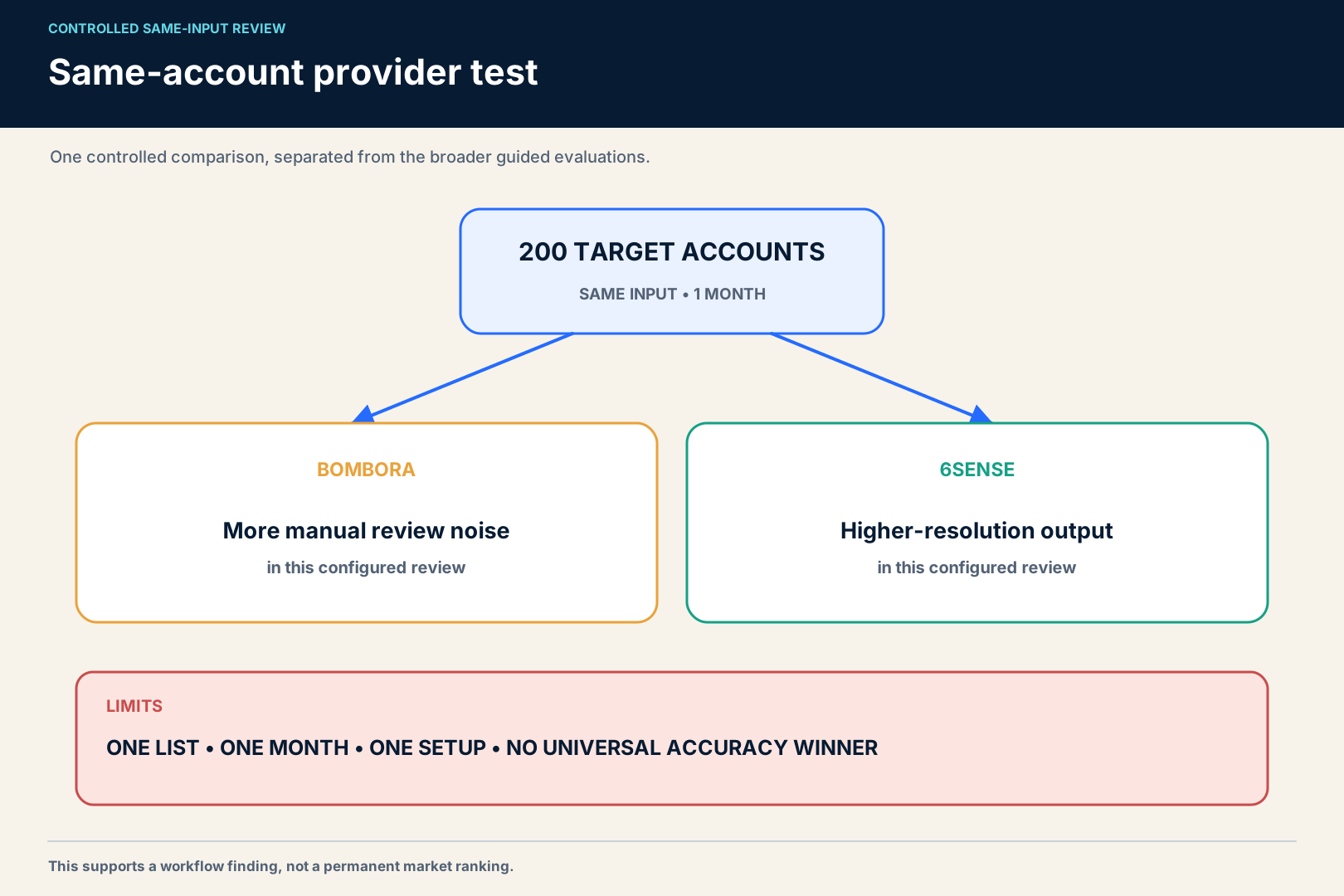
My strongest comparison used 200 target accounts. Bombora and 6sense saw the same list for one month. In that review, 6sense gave us more usable context. Bombora gave us more review noise. The result belongs to that list and setup. It is not a universal accuracy rank.
I also used first-party site signals and G2 research. Every other provider had a guided review. I also checked its current official docs. A guided review is not a hands-on test. Each profile shows its evidence level.

Choose the signal category before the provider, then compare usable resolution, freshness, rejection burden and total operating cost on the same target accounts.

01 / My B2B Intent Data Provider Shortlist by

My B2B Intent Data Provider Shortlist by Use Case

Research and account-platform sources

Use caseShortlistWhy it belongsEvidence levelMain caveat
Topic research and a portable feedBomboraAccount-level topic surge with a documented baseline modelSame-account test + official docsBroad topics created review noise in our sample
Enterprise account prediction and orchestration6sense or DemandbaseCombines intent with account intelligence and activation6sense same-account test; both guided review + docsHigher implementation and governance load
Software-review researchG2 or TrustRadiusObserves buyers researching products, categories, pricing, or comparisonsG2 operator-used; both guided review + docsMostly company-level; category activity can be broad
Technology research audiencesTechTarget Priority EngineFirst-party research within TechTarget’s technology content networkGuided review + docsStrongest fit is technology markets

First-party, contact, and orchestration sources

Use caseShortlistWhy it belongsEvidence levelMain caveat
HubSpot-native first-party intentHubSpot Buyer IntentWebsite behavior and company matching inside the CRM workflowGuided review + docsTracking, credits, consent, and plan rules apply
Contact data plus Bombora topicsCognismAdds contact research and Bombora-based intent filtersGuided review + docsIntent source overlaps Bombora; quote-based plan
Lean company-level website identificationDealfront Web VisitorsIdentifies companies visiting owned pages and exposes page activityGuided review + docsCompany identification is not a named buyer
Multi-source signal orchestrationCommon RoomCombines product, website, community, social, CRM, and public signalsGuided review + docsIt is an orchestration layer, not one universal data source
This table is not a rank. It maps different purchases.
A topic feed is not a review platform. A broad topic may not show named product research. Owned traffic can support a simpler first-party test. That test can come before an enterprise platform.
For the underlying distinctions among fit, research, triggers, account resolution, and contact resolution, start with the B2B intent data workflow.

02 / How I Compared the Providers

How I Compared the Providers

A fair comparison needs clear terms.

What “resolution” meant

Resolution measured correct account matches with useful source context. The record needed its event, date, or topic. A company name alone was not enough.
Resolution did not mean that the provider identified the decision-maker. Company identity and person identity remained separate.

What “usable signal” meant

A usable signal met all of these conditions:
  • the account passed every hard ICP rule;
  • the event or topic was relevant to the problem we sold;
  • the signal was recent enough for a defined play;
  • the source and event could be inspected;
  • a plausible contact or account owner could be found;
  • a human approved the next action.
A signal could be technically correct and still fail this definition.

What “manual disqualification” meant

Manual disqualification meant a reviewer rejected the account. The review covered fit, relevance, time, identity, and contact context.
Some third-party batches had a 70% rejection share. This was the highest share in a subset. It does not describe every provider. It also does not cover the full month. I include it because review time has a cost. It is not a market accuracy stat.

What we held constant

Bombora and 6sense received the same 200 accounts. The review lasted one month. We checked coverage and source detail. We also checked relevance, recency, and review work.
We did not hold every setting constant. Contract rights and upstream sources also differed. 6sense can combine several intent feeds. Bombora can appear inside other tools. We compared the output available to our workflow. This was not a lab test of one raw feed.

Evidence labels used in this guide

  • Controlled same-account test: same 200 accounts and month for Bombora and 6sense.
  • Operator-used source: used in an active workflow, but not in the same two-provider test.
  • Guided review: product was demonstrated or reviewed with vendor guidance.
  • Documentation review: current official pages were checked on August 26, 2026.
These labels protect the test claim.

03 / Choose the Signal Category Before the Provider

Choose the Signal Category Before the Provider

Topic-surge data

Topic providers look for research above a baseline. Bombora compares three recent weeks with twelve prior weeks. Its docs call scores of 60 or more “spiking.” That rule belongs to Bombora. It is not an industry standard. See Bombora’s intent overview and score documentation.
Choose topic data for off-site research. Use narrow terms tied to your sale. Avoid broad terms and tiny markets. Also avoid a feed your team cannot review.

Predictive account-intelligence platforms

6sense and Demandbase add account data and action. 6sense lists native intent and partner feeds. Those feeds include Bombora, G2, TrustRadius, and TechTarget. Demandbase lists keyword sets, history, and trends. See 6sense intent data and Demandbase intent.
These platforms need strong data owners. The team must define stages and CRM links. It must also watch outcomes. The system is too large without a stable ICP and play.

Review and comparison intent

G2 and TrustRadius watch research on their sites. G2 names six main signal types. They cover profiles, pricing, alternatives, categories, and comparisons. TrustRadius lists product, price, comparison, and category activity.
These events have clear product context. That can aid review. Identity remains the main limit. Company activity does not name the buyer. It also does not prove authority. See G2 Buyer Intent and the TrustRadius Intent Activity Glossary.

Technology-publisher intent

TechTarget uses research from its technology audience. Its account product shows scores, trends, and status. It also supports CRM and ABM work. Its sales product adds prospect context. See TechTarget Account Intent Feeds and Priority Engine for Sales.
The audience is both a strength and a limit. Technology vendors may value it. Other markets need their own coverage test.

First-party website intent

HubSpot and Dealfront match site visits to companies. HubSpot documents its tracking code and match rules. It also documents page rules, credits, and consent needs. Dealfront focuses on company visits and page activity.
Site evidence can be timely. It can also map to a named page. Traffic and match rates limit it. It does not prove the visitor’s role. See HubSpot buyer intent and Dealfront Web Visitors pricing and plan details.

Contact-plus-intent platforms

Cognism adds contacts to Bombora topic data. Admins choose the topics. Users can filter by score and seven-day trend. Intent sits in the Pro plan. Pricing uses a custom quote. See Cognism intent search and Cognism pricing.
The benefit is one work surface. The risk is feed overlap. Ask if you already buy Bombora elsewhere. Then test the added contacts, speed, and workflow.

Multi-source signal orchestration

Common Room combines many signal types. Sources include product, site, community, CRM, and public events. Its trend tool can track change. Teams can then build groups and alerts. See the Common Room signal library and signal trend documentation.
This category can reduce tool sprawl. Each source still needs review. A combined score can hide weak inputs. Keep the raw events visible.
<!-- Visual plan: provider-category map -->
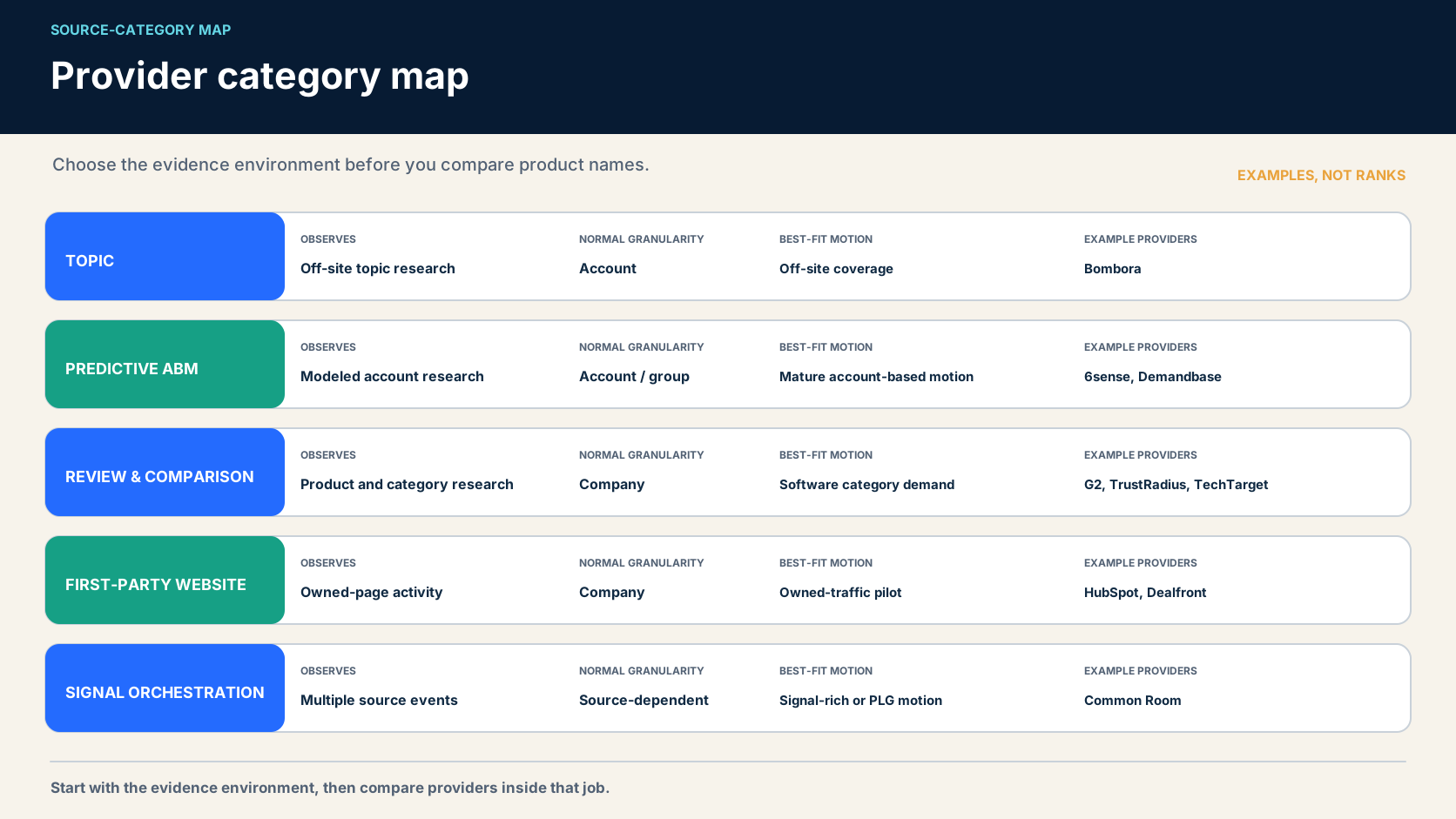
Category map of B2B intent data providers by topic, ABM, review, website and orchestration sources.
Start with the evidence environment, then compare providers inside that job.

04 / B2B Intent Data Providers Compared

B2B Intent Data Providers Compared

Topic, account-intelligence, and review sources

ProviderPrimary evidence sourceGranularityBest-fit buyerActivation modelEvidence in this guide
BomboraPublisher-network topic activityAccountTeams needing off-site topic coverageFeed, integrations, partner platformsControlled same-account test + docs
6senseNative and integrated intent inside account intelligenceAccount and buying-group context, configuration-dependentEnterprise ABM and revenue teamsPlatform orchestrationControlled same-account test + docs
DemandbaseKeyword and account-intelligence signalsAccountMature ABM and marketing operationsPlatform and data deliveryGuided review + docs
G2Product, category, pricing, alternatives, and comparison researchCompanySoftware vendors with relevant G2 demandDashboard, export, integrationsOperator-used + docs
TrustRadiusProduct, category, pricing, and comparison researchCompanyB2B technology vendorsAPI and subscription workflowsGuided review + docs

Publisher, first-party, contact, and orchestration sources

ProviderPrimary evidence sourceGranularityBest-fit buyerActivation modelEvidence in this guide
TechTargetTechnology-content researchAccount and prospect contextEnterprise technology vendorsFeeds, sales product, integrationsGuided review + docs
HubSpotOwned website activity plus CRM contextCompany and some contact-level signals, product-dependentHubSpot-centered teamsCRM-native workflowGuided review + docs
CognismBombora intent plus contact and company dataAccount plus contact researchTeams wanting one prospecting surfaceSearch, lists, CRM workflowsGuided review + docs
DealfrontOwned website visits matched to companiesCompanyLean European or B2B web-traffic teamsVisitor feed and CRM syncGuided review + docs
Common RoomMulti-source digital and business signalsAccount and contact, source-dependentPLG, community, developer, and signal-rich motionsAggregation, scoring, alerts, playsGuided review + docs
The table compares jobs, not forecast power. A public page can prove a feature exists. It cannot prove market coverage. It also cannot prove pipeline.
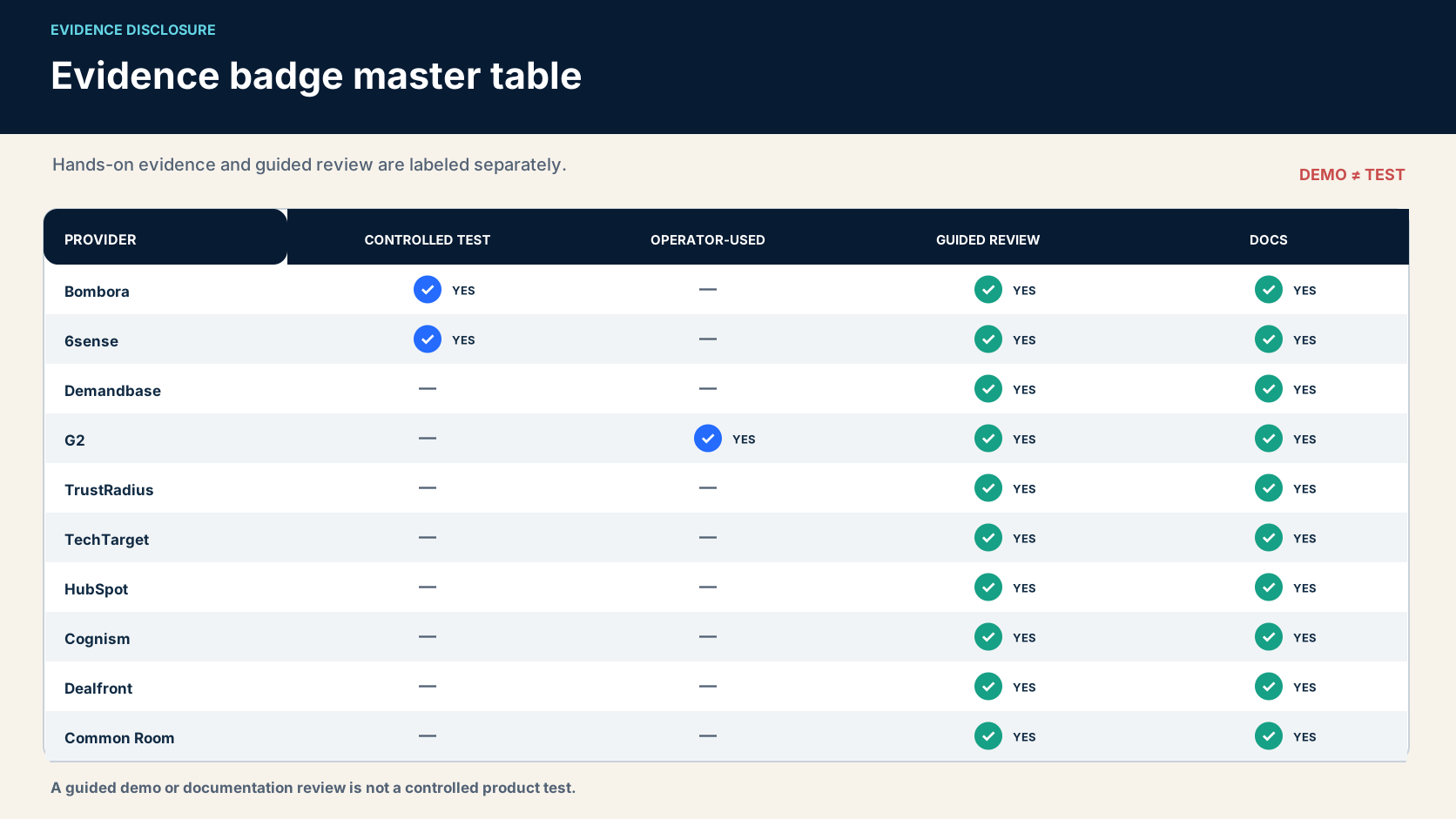
Evidence badge grid distinguishing tested, used, demonstrated and documentation-reviewed intent providers.
Evidence labels keep a product demo from turning into a hands-on claim.

05 / Provider Notes and My Verdicts

Provider Notes and My Verdicts

Bombora: shortlist for topic coverage, then narrow aggressively

Evidence: controlled same-account test, guided review, and official documentation.
Bombora offers a portable Company Surge signal. Many other tools resell that feed. Its baseline gives the score a clear frame.
Bombora created more review noise in our test. Broad topics caused part of it. I would still test it again. I would narrow the topics first. I would also hide vendor scores from reviewers.
Verdict: shortlist for topic research when off-site coverage matters and the team can tune and review it. Ask every reseller whether the signal is Bombora and what additional value the reseller adds.

6sense: shortlist when account intelligence and activation matter together

Evidence: controlled same-account test, guided review, and official documentation.
6sense gave us more usable context. That is what “higher resolution” means here. It does not mean every buyer was known. It does not prove a purchase forecast.
The platform supports stages, terms, feeds, and action. That range adds setup work. A small team may buy too much system.
Verdict: shortlist for an enterprise or mature mid-market account-based motion. Require a same-account proof against the cheaper setup you already have.

Demandbase: shortlist for mature ABM teams that want flexible keyword intent

Evidence: guided review and official documentation.
Demandbase documents lists, terms, trends, and history. It also supports many languages. The fit is a mature ABM team. That team may want intent inside one account system.
Base the choice on source and model clarity. Count setup work and activation. Ignore the largest public volume claim.
Verdict: evaluate beside 6sense when ABM maturity, regional coverage, and platform integration justify an enterprise process.

G2: shortlist for software-category and competitor research

Evidence: operator-used source, guided review, and official documentation.
G2 gave us clear research events. They covered competitors, products, prices, and comparisons. That context helped us set research order.
I am not publishing a “highest conversion” claim for G2. We lacked one stable event and denominator. I can support a narrower point. G2 events had clearer software review context than broad topics.
Verdict: shortlist if buyers use G2 in your category and the account-level limitation is acceptable.

TrustRadius: shortlist for another first-party technology-research view

Evidence: guided review and official documentation.
TrustRadius covers product and competitor research. It also covers categories, prices, and comparisons. Eligible plans can send data through an API.
TrustRadius and TechTarget need separate rows. They are separate firms. Their source sites and products also differ.
Verdict: compare directly with G2 using your category, account match, event coverage, and workflow. Do not assume one review site’s audience transfers to another.

TechTarget Priority Engine: shortlist for enterprise technology audiences

Evidence: guided review and official documentation.
TechTarget focuses on research in technology content. It offers account scores and trends. Its sales product also adds prospect context.
Market fit matters more than the brand. A large tech vendor may gain useful coverage. Other firms may not share that audience.
Verdict: test when your market overlaps its audience. Ask for coverage evidence against your named account list.

HubSpot Buyer Intent: shortlist for a CRM-native first-party pilot

Evidence: guided review and official documentation.
HubSpot links site activity with target rules. It can then create CRM work. This may cut setup for HubSpot teams.
The product still needs sound tracking. Match rates and page rules also matter. Credits and consent settings can limit use. Native does not mean accurate by default.
Verdict: a strong starting point for teams already in HubSpot. Compare the usable-signal rate with a simple analytics-plus-review process before adding external intent.

Cognism: shortlist when contact data and Bombora intent belong in one surface

Evidence: guided review and official documentation.
Cognism puts contact research beside Bombora intent. Teams can choose topics. They can also filter recent trends.
The key question is not whether Cognism “has intent.” Test whether the bundle saves contact research time. Then price that gain against feed overlap.
Verdict: evaluate for teams with European contact-data needs or a preference for a combined prospecting workflow. Trace the underlying signal.

Dealfront: shortlist for lean website-intent discovery

Evidence: guided review and official documentation.
Dealfront finds companies on your site. It also shows page activity. The site lists free and paid plans. Check the price again before buying.
It does not prove that a named leader visited. Site traffic limits the result. Company match rates also matter.
Verdict: useful for a low-friction first-party pilot. Start with high-value pages and repeat visits, not every pageview.

Common Room: shortlist when multi-source signals are the real problem

Evidence: guided review and official documentation.
Common Room brings many signals into one view. Sources include product, community, site, CRM, and public events. This differs from a single-source feed.
The risk is a score that hides its parts. A job, pageview, and social act may all be weak. Keep each source event visible.
Verdict: shortlist for PLG, community-led, developer-focused, or signal-rich motions with enough operational maturity to govern sources.

06 / The Stacks I Would Build

The Stacks I Would Build

Lean website-intent stack

Use first-party page activity, a company-identification tool, one enrichment source, HubSpot or another CRM, and a human review queue.
This stack is best when traffic exists, the ICP is clear, and the team wants to test behavior before buying third-party reach. Connect it to the field-proven controls in our data enrichment provider guide.

Review-led software stack

Use G2 or TrustRadius, CRM account ownership, contact resolution, and competitive enablement. Add topic intent only if the review-platform coverage misses enough target accounts to justify another source.

Enterprise ABM stack

Evaluate 6sense and Demandbase against the same account list and use case. Include Bombora or another source only when it adds unique, inspectable coverage. Require clear stage ownership and a CRM feedback loop.

Contact-plus-intent outbound stack

Use Cognism or another contact platform with intent, but compare the bundle with separate topic and contact tools. The winning stack is the one that creates more seller-accepted records at a sustainable review cost—not the one with more total records.

Multi-source signal stack

Use Common Room or a similar orchestration layer when product, community, website, and public signals already exist. Do not buy aggregation before defining the signal-to-play rules in the signal-based selling guide.
For a broader role-based map of research, enrichment, outreach, and CRM tools, see our B2B lead intelligence tools comparison.

07 / How to Run a 30-Day Provider Bake-Off

How to Run a 30-Day Provider Bake-Off

Step 1: freeze the input

Give every finalist the same named accounts, geography, category, and review period. Record exclusions before results arrive.

Step 2: hide the provider score

Ask a reviewer to assess company fit and signal usefulness without the hot/warm label. Scores can anchor judgment.

Step 3: define the required fields

Require:
  • source;
  • event or topic;
  • event time;
  • company identifier;
  • match confidence where available;
  • recency;
  • contact or buying-group context where offered;
  • integration path;
  • permitted-use and retention context.

Step 4: record every rejection

Use rejection reasons such as wrong company, ICP fail, broad topic, stale event, duplicate, customer, no relevant contact, or no matching play.

Step 5: measure review cost

Track minutes from arrival to decision. A cheap feed that consumes seller hours can be more expensive than a higher-priced source with fewer usable records.

Step 6: activate a small approved cohort

Use the same message rule and human approval. A provider comparison becomes invalid if one cohort receives better research or faster follow-up.

Step 7: compare outcomes by defined state

Track accepted-for-research, approved-for-outreach, reply, explicit interest, qualified opportunity, and other relevant states separately. Do not call every reply a positive result.

Step 8: choose or stop

Buy only if a provider adds unique usable coverage, reduces review work, improves timely action, or replaces another contract. Stop if it merely adds another score to the CRM.
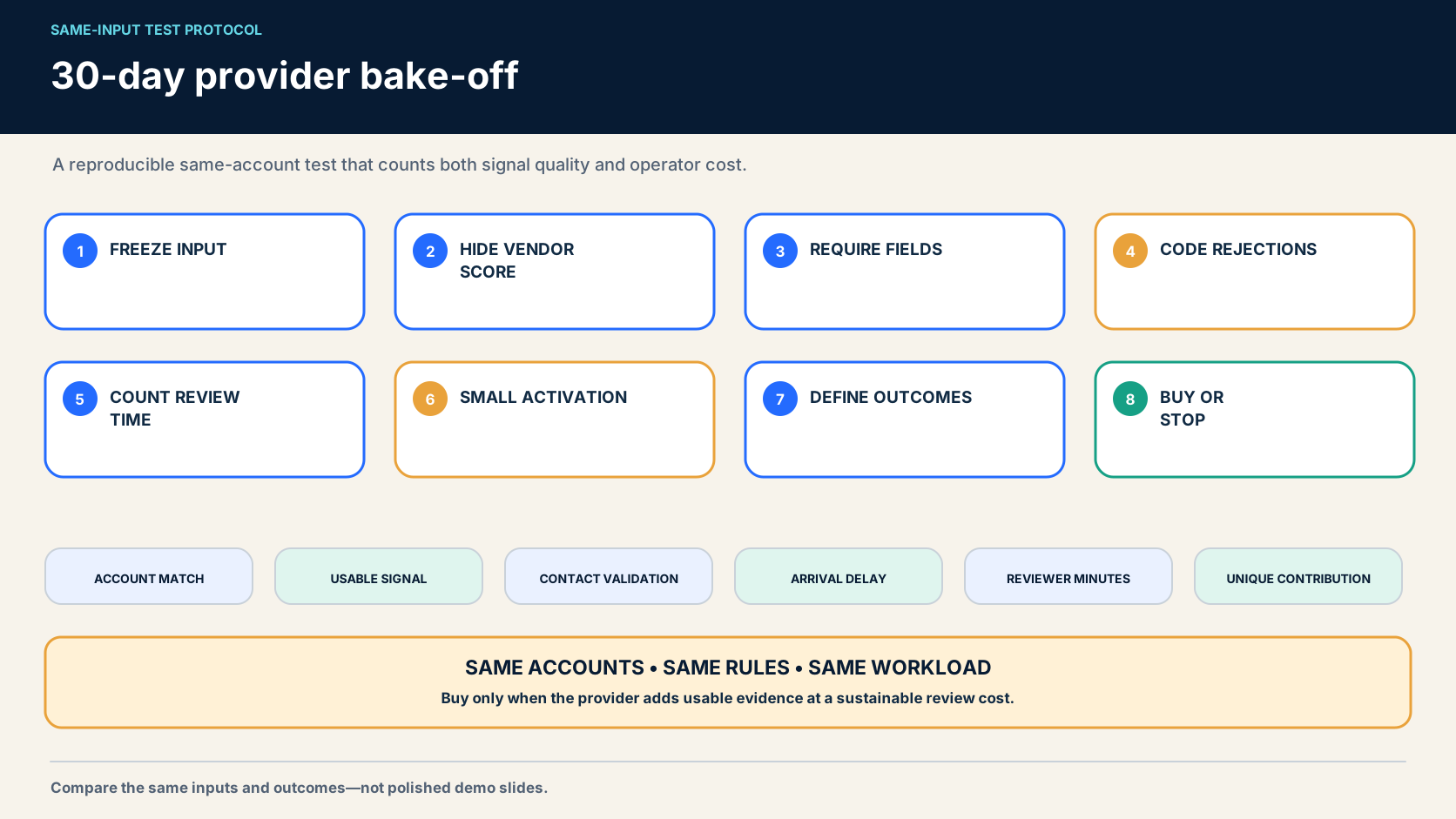
Eight-step B2B intent provider bake-off using the same accounts and blinded human review.
Compare providers with the same accounts, rules and workload—not their demo slides.

08 / How I Would Analyze the Provider Bake-Off

How I Would Analyze the Provider Bake-Off

A provider evaluation needs more than a coverage percentage because coverage can reward a system for returning irrelevant companies, stale events, duplicated sources, or records that require expensive manual reconstruction. I would therefore preserve the full denominator from the original named-account list and calculate every later metric from a documented stage rather than quietly removing inconvenient records.
Account coverage rate is the share of submitted accounts for which the provider returns any record during the agreed evaluation window. This establishes reach, but it says nothing about commercial fit, source relevance, identity confidence, freshness, or whether the returned evidence supports a permissible action.
Correct-resolution rate is the share of returned records matched to the intended corporate entity after a reviewer checks domains, subsidiaries, rebrands, regional entities, and ambiguous company names. This metric prevents impressive coverage from hiding systematic account-resolution errors that sellers must repair before activation.
Usable-signal rate is the share of reviewed records that pass the written ICP, relevance, recency, source-lineage, contact-resolution, suppression, and play requirements. I would publish the definition beside the percentage because a vendor’s proprietary “high intent” label is not equivalent to a seller-approved record under our operating rules.
Unique-evidence rate measures how often the provider contributes a relevant event that our existing website, CRM, review-platform, enrichment, or licensed-topic sources did not already expose. This is especially important when several platforms resell Bombora, incorporate G2, or synchronize the same first-party activity through different interfaces.
Median activation latency measures elapsed time from the original event to human approval, while the ninetieth percentile exposes records that wait too long for their play. A provider can deliver quickly and still create stale outreach if account resolution, contact verification, legal review, ownership checks, or queue capacity delay the final decision.
Operator cost per accepted record combines reviewer minutes, seller research, data correction, integration maintenance, and exception handling rather than treating the subscription as the complete cost. I would compare that operational figure with the existing stack because a cheaper contract can become more expensive when every usable record requires manual reconciliation.
Outcome quality must preserve reply states, explicit interest, qualified opportunity, rejection, unsubscribe, wrong-person response, and no response as separate categories. I would not compress those states into a conversion metric, and I would avoid causal attribution unless a comparable cohort receives equivalent research quality, message quality, sender treatment, and follow-up timing.
Finally, I would segment the results by geography, company size, industry, domain structure, signal category, and delivery method before making a purchasing decision. An aggregate winner can conceal severe weaknesses in the exact market where the sales team needs coverage, so the procurement recommendation should identify both the useful segment and the conditions under which the result may fail to transfer.
<!-- Visual plan: thirty-day same-account bake-off worksheet -->

09 / Pricing and Contract Traps

Pricing and Contract Traps

Most enterprise B2B intent data providers use tailored quotes. That makes contract structure more important than a headline price.
Ask these questions:
  1. Is the intent source native, licensed, or resold?
  2. Are topics, keywords, accounts, seats, exports, or API calls limited?
  3. Are historical data and real-time alerts included?
  4. Which integrations require another plan or service?
  5. Is implementation mandatory?
  6. Can data be exported if the contract ends?
  7. How long may signals be retained?
  8. Are subsidiaries and global accounts resolved consistently?
  9. Does the contract include security, privacy, and deletion commitments?
  10. What operator time is required every week?
I include manual review as a budget line. Our highest observed third-party rejection share reached 70% in some batches. Even if the feed fee is fixed, the review cost rises with low-quality volume.
Avoid exact price comparisons unless every plan, region, term, and access date is visible. Dealfront publishes a free and paid Web Visitors structure. Cognism says pricing is tailored. Many enterprise platforms require a quote. Those facts can change, so verify them again before procurement.

10 / My Final Decision Framework

My Final Decision Framework

Choose the provider that passes these gates in order:
  1. Use case: name the decision the signal should improve.
  2. Source: know what behavior the provider actually observes.
  3. Market coverage: test a named account list, not a slide.
  4. Resolution: separate account, contact, and buying-role evidence.
  5. Recency: confirm the event arrives before the play expires.
  6. Activation: assign an owner, action, approval, and CRM write-back.
  7. Acceptance: measure how many reviewed records become usable.
  8. Cost: include subscription, implementation, overlap, and review time.
  9. Governance: confirm legal basis, transparency, retention, security, and suppression.
  10. Outcome: trace later commercial states without inventing attribution.
A team should not buy an intent platform yet if it cannot define its ICP, has no play for the signal, cannot review records in time, or cannot write outcomes back to the CRM.
B2B intent data providers can improve prioritization. They cannot create market fit, person identity, permission, or seller judgment. The shortlist is conditional because the right source is the one that reduces uncertainty in your specific motion.

11 / What the Same-Account Review Changed for Me

What the Same-Account Review Changed for Me

The 200-account review changed how I read vendor output.
Before the review, I expected coverage to be the main differentiator. A provider that returned more target accounts appeared stronger. After manual review, coverage became only the first question.
The useful questions were:
  • Did the provider return the correct account?
  • Could I inspect the event or topic?
  • Did the signal arrive inside a useful window?
  • Did it add evidence that another source did not already provide?
  • Could the reviewer choose a relevant person?
  • Did the record support a specific play?
  • How many minutes did the decision take?
6sense gave us more usable context in the configured comparison. Bombora gave us a portable topic model but more records that needed rejection or another signal. That does not make 6sense the permanent winner.
A different test could favor Bombora. Narrower topics might reduce noise. A company with a different market could value reach more than context. A team using Bombora through another platform might receive better account and contact resolution around the same underlying feed.
The proper conclusion is that the workflow, source, and account list must be tested together.

Why a demo is not a test

A guided demo can confirm that a capability exists. It can show the interface, filters, workflow, and available fields. It cannot establish coverage for your accounts.
A vendor may use a polished sample. The sample may come from a category with strong data density. The score may depend on settings or sources not included in your proposed package.
I use a demo to form questions. I use a named-account test to make a buying decision.

Why official documentation is necessary but incomplete
Official documentation can establish current product behavior. It can also reveal plan limits, source relationships, refresh windows, and data granularity.
Documentation remains vendor-authored. It does not prove predictive performance. A claim such as “identifies in-market accounts” should be read as product positioning until your test defines and observes the relevant state.
This is why every provider profile in this guide combines a capability source with an evidence label.
One-month comparison sending the same 200 target accounts through Bombora and 6sense with sample limits.
The comparison supports a workflow finding, not a permanent market ranking.

12 / Build the Evaluation Dataset Before the Sales

Build the Evaluation Dataset Before the Sales Call

Do not let the vendor choose the only accounts in the proof.
I would create four groups.

Group 1: obvious target accounts

These companies clearly fit the ICP. They test basic market coverage.

Group 2: difficult identity cases

Include subsidiaries, companies with common names, recently rebranded firms, global companies with regional domains, and remote-first businesses. These cases expose account-resolution limits.

Group 3: known non-targets

Include customers, partners, competitors, tiny firms, and companies outside the geography. They test whether your suppression and fit gates work.

Group 4: known recent research

Where lawful and available, include accounts with recent first-party or review activity already visible to your team. They provide a known event against which timing and account matching can be checked.
The evaluation should not reveal expected answers to the reviewer. Keep a separate answer sheet. This makes the review less vulnerable to a vendor score.

Use an evidence sheet for each returned record

The reviewer records the provider, source, account, signal, event time, receipt time, topic or page, fit state, contact state, play, decision, rejection reason, and minutes spent.
A free-text note is not enough. Structured reasons make providers comparable.
For example, “bad lead” hides whether the account was wrong, the topic was broad, the person was stale, or no play existed. Those failures require different fixes.

13 / Questions That Expose Data Lineage

Questions That Expose Data Lineage

The phrase “proprietary intent” is not a sufficient answer.
Ask the provider to separate:
  • data collected on properties it owns;
  • data collected through a cooperative;
  • licensed partner feeds;
  • bidstream or advertising data;
  • your first-party website data;
  • CRM and marketing data;
  • public business events;
  • model-generated scores or stage predictions.
Then ask which elements appear in the exported record.
A platform can combine many sources well. The risk appears when the combined score hides overlap. If 6sense imports Bombora and G2, and your company licenses those sources elsewhere, the platform may be valuable for orchestration while some raw evidence is duplicated.
That duplication is not automatically waste. A platform may improve identity, workflow, and activation. It should be priced and evaluated as that added layer.

Ask what person-level means

“Person-level intent” can describe very different evidence.
It might mean a known user performed an action. It might mean the provider found likely contacts at an account showing company-level activity. It might mean a person consumed content inside the provider’s environment.
Ask for the exact observed event and identity path. Do not let a buying-group recommendation become a claim that a named person generated the signal.

Ask about event time and delivery time

A daily feed can be sufficient for a 30-day topic trend. It may be too slow for a 48-hour pricing-page play.
Require both timestamps. Then measure delay in your market. “Real time” should be an observed delivery interval, not a slide label.

Ask how false positives are corrected

A provider should explain how customers report wrong accounts, broad topics, stale contacts, and duplicate records. Ask whether corrections affect future output and whether the audit trail remains visible.
Your internal CRM should also store the rejection. The vendor may improve its feed, but your team still needs its own learning record.

14 / How I Would Compare Commercial Terms

How I Would Compare Commercial Terms

A provider contract has several cost layers.

Data scope

Record the markets, topics, keywords, products, domains, historical window, and refresh frequency included. A cheaper package can be unusable if the needed source or region is missing.

Access scope

Record seats, workspaces, exports, API access, integrations, and warehouse delivery. A dashboard-only plan may create manual work that disappears in the sales proposal.

Activation scope

Record alerting, audience sync, CRM write-back, orchestration, and contact access. Some providers sell intent separately from contacts. Some bundle them. Some rely on partners.

Service scope

Record implementation, onboarding, taxonomy design, support, and data review. A required services package changes the first-year cost.

Governance scope

Record data-processing terms, security review, retention, deletion, subprocessors, usage restrictions, and audit support. A cheaper source can be more expensive if it cannot pass procurement.

Exit scope

Record export rights, deletion commitments, renewal dates, price changes, and access after termination. The team should not lose the source history needed to explain past decisions.
I would calculate a monthly operating cost:

contract allocation + implementation allocation + overlapping data + reviewer time + seller time + integration maintenance

This formula is an internal planning tool, not an accounting standard. It makes the invisible labor visible.

15 / Four Provider Combinations I Would Avoid

Four Provider Combinations I Would Avoid

Two platforms reselling the same feed with no added value

If both products depend on Bombora, compare what each adds. Do not pay twice for the same account topic unless identity, workflow, or activation justifies the overlap.

Enterprise prediction before ICP agreement

A model cannot settle a leadership dispute about the target market. Freeze the hard fit rules before testing predictive stages.

Review intent without category demand

G2 or TrustRadius may be strong sources, but only when buyers research your category there. Ask for named-account coverage and event volume before buying.

First-party visitor identification without meaningful traffic

A low-traffic website may not create enough high-value events. Measure relevant visits first. A free plan does not make sparse data useful.

16 / The Provider Proof I Would Require at

The Provider Proof I Would Require at Renewal

The renewal review should be stricter than the purchase review. By then, real outcomes exist.
I would ask for a source-level report showing received records, resolved accounts, ICP passes, usable signals, contacts validated, actions approved, replies, explicit interest, qualified opportunities, and operator time.
Each metric needs a definition. A provider-influenced opportunity is not the same as a provider-sourced opportunity. A company may already be in an active deal when a signal arrives.
I would also compare unique contribution. If the provider mostly repeats first-party events or another licensed feed, quantify the records that would have been missed without it.
The right renewal answer may be to keep the provider. It may also be to reduce topics, remove a duplicate source, move to a smaller plan, or replace the platform with a lean stack.

17 / My Shortlist Is Conditional by Design

My Shortlist Is Conditional by Design

A ranking would be easier to read. It would also be less honest.
Bombora and 6sense have the strongest first-hand comparison evidence in this guide. G2 has operator-used evidence. The remaining products have guided-review and official-documentation evidence. Those states are not equivalent.
My shortlist therefore tells you which products deserve a test for a given problem. It does not tell you which vendor will produce the most pipeline.
The best B2B intent data providers are the ones that add unique evidence. That evidence must be timely and easy to inspect. The buying decision happens only after the same-account review.
Intent data tools should also reduce review work. Buyer intent data tools that only add volume do not pass my buying test. I compare B2B intent data providers by the records the sales team can approve and explain.

18 / B2B Intent Data Provider FAQ

B2B Intent Data Provider FAQ

Which B2B intent data provider is best?

There is no universal best provider. Bombora fits topic-surge coverage. 6sense and Demandbase fit mature account programs. G2 and TrustRadius fit review research. TechTarget fits technology audiences. HubSpot and Dealfront fit owned website activity. Test your accounts and play. That is how I compare B2B intent data providers.

How much do intent data tools cost?

Pricing ranges from free first-party visitor plans to quote-based enterprise contracts. Compare the feed, seats, topics, exports, setup, contacts, and review time. Verify current pricing before purchase. Buyer intent data tools can look cheap until review work is counted.

Can intent providers identify individual buyers?

Some products add contact-level context or connect known first-party activity to a contact. Many feeds identify only a company. A company-domain match must not become a claim that a named person performed the research.

Is Bombora data resold by other platforms?

Yes. Official documentation from 6sense and Cognism describes Bombora integrations or usage. Ask whether a platform’s signal is native, Bombora, or another licensed source, and what unique resolution or workflow value the reseller adds.

Are free buyer intent tools useful?

They can be useful for a pilot when your website has enough relevant traffic. A free tool still needs valid tracking, account matching, ICP checks, contact research, human approval, and CRM outcomes.

How should two providers be tested fairly?

Give them the same accounts, period, topics, and acceptance rules. Blind reviewers to provider scores, code rejection reasons, track operator time, and activate only a small, equally treated cohort. Report the limits of the comparison.

Research note

Methodology

  1. 01The comparison combines current first-party documentation, guided evaluations and one owner-supplied 200-account same-list review of 6sense and Bombora over one month.
  2. 02Unequal access levels remain visible; products reviewed through a demo or documentation are not described as hands-on tests.
  3. 03Provider capabilities, plans, contracts, data rights and resolution rules are mutable and must be reconfirmed for the buyer's market and account.
Read the full methodology

Source ledger

Sources & editorial notes

  1. 01
    Intent data and Company Surge

    Bombora · official product page; reviewed 2026-08-26. Vendor-authored; Performance claims are attributed

  2. 02
    Intent Data

    6sense · official product page; reviewed 2026-08-26. Vendor-authored; Plan-dependent

  3. 03
    B2B buyer intent data

    Demandbase · official product page; reviewed 2026-08-26. Vendor-authored; Volume and accuracy claims not independently validated here

  4. 04
    Buyer Intent

    G2 · official product documentation; reviewed 2026-08-26. Vendor-authored; Plan-dependent; Company activity does not identify a decision-maker

  5. 05
    TrustRadius Intent Activity Glossary

    TrustRadius · official product documentation; reviewed 2026-08-26. Vendor-authored; Package-dependent

  6. 06
    Account Intent Feeds

    TechTarget · official product page; reviewed 2026-08-26. Vendor-authored; Technology-market focus

  7. 07
    Use buyer intent

    HubSpot · official product documentation; reviewed 2026-08-26. Vendor-authored; Feature and credit limits are plan-dependent

  8. 08
    Using Intent in your Search

    Cognism · official product documentation; reviewed 2026-08-26. Vendor-authored; Package rules can change

  9. 09
    Web Visitors pricing

    Dealfront · official pricing page; reviewed 2026-08-26. Time-sensitive; Company identification is not person identity or purchase proof

  10. 10
    Go-to-market signals

    Common Room · official signal library; reviewed 2026-08-26. Vendor taxonomy; Intent labels are not universal standards

Corrections or primary material: contact the corrections desk.

About the author

Anastasiia Krynytska

Anastasiia Krynytska is a LeadGen Team Lead at Softermii and the lead editor of Luck My Sales. She covers AI-assisted outbound, account research, qualification, messaging, CRM handoffs and revenue workflows from a practitioner’s perspective.View author profile LinkedIn

Continue reading

01 · News analysis

AI sales is moving from assistant to operating layer

The category is expanding from drafting support into research, pipeline decisions, recommended actions and controlled execution.

Read news
02 · Field analysis

In AI sales, the handoff may be the product

Models are becoming accessible; durable value sits in the controlled transition from signal to seller action.

Read analysis
03 · Research framework

Sales AI Workflow Signals 2026

A launch framework for mapping the products, controls and buying questions shaping AI-enabled revenue work.

Read reports

Luck My Sales briefing

Useful context, once a week.

News, explanations and original research from this desk. No noise.
The newsletter is still being built. We will contact you when the first edition is ready.