Weekly industry intelligence · No noiseSubscribe to the Luck My Sales newsletterFree briefing

Independent intelligence on AI in sales

Menu

Software comparison & buyer's guide · AI SDR tools

10 Lead Scoring Software Tools Compared by the Sales Decision They Can Defend

Compare 10 B2B lead-scoring tools by the decision they support, then test explanations, overrides, CRM history and outcomes on the same records.
Editorial disclosure

AI may assist research organization and drafting. A human editor reviews every published page, checks material claims against the cited sources and owns the final decision. No company paid for placement in this article.

AI use policy

Agent-ready brief

AI takeaways

Keep the key points here, or take a source-aware text brief into Claude, ChatGPT or another AI workspace.
  1. 01Choose lead-scoring software by the object, decision and permitted action—not by one universal product ranking.
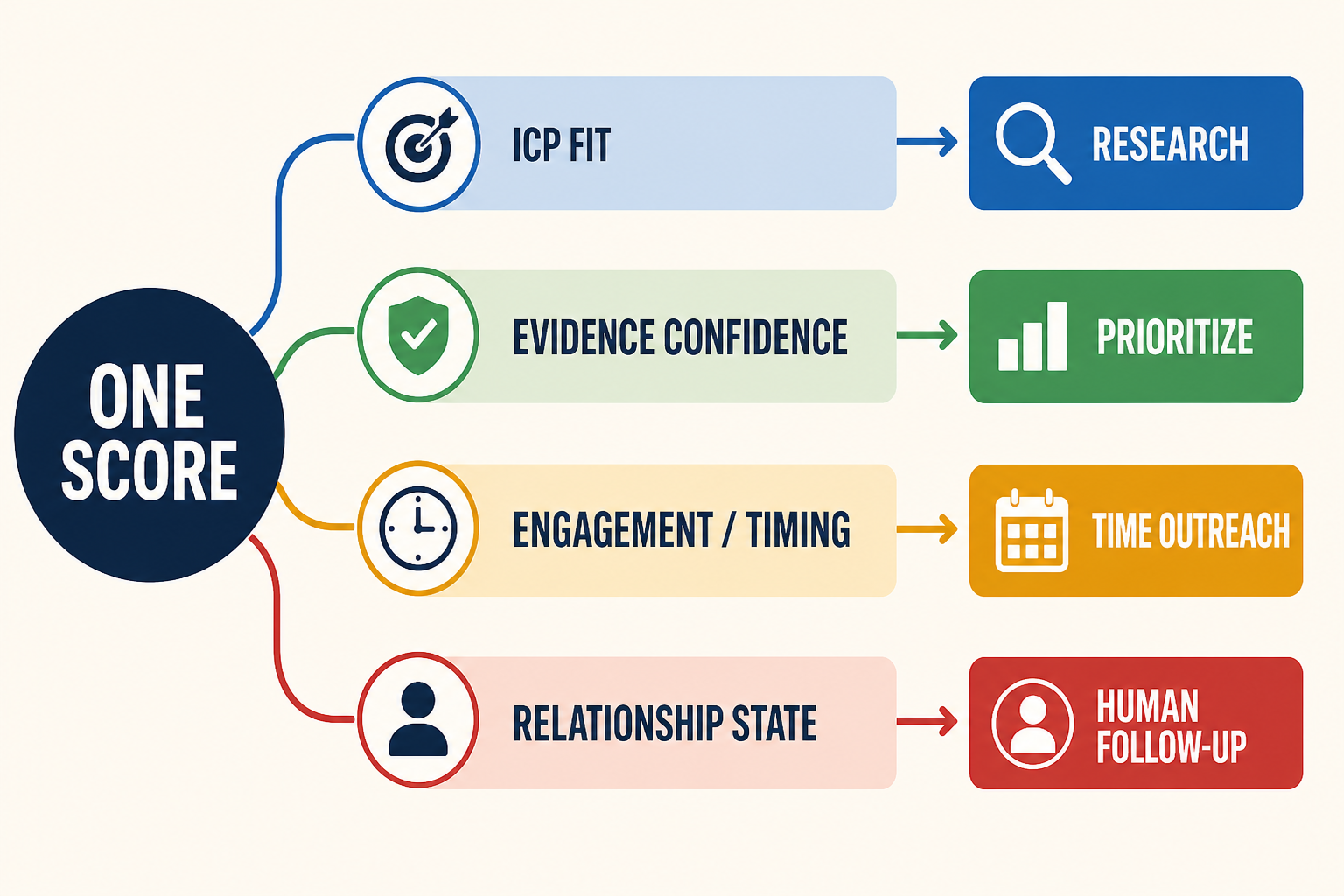
  2. 02Keep ICP fit, evidence confidence, engagement and relationship state visible as separate facts.
  3. 03Disqualify any workflow that cannot preserve a usable human override and stop a consequential action.
  4. 04Run competing systems on the same current records and compare seller acceptance, overrides, held calls and opportunities with explicit denominators.
  5. 05Treat the July 2026 fit distribution as an observational routing sample, not proof of vendor accuracy or causal revenue lift.
Includes summary, takeaways, sources and a use note.
Defensible lead scoring software shows why a record deserves one seller-controlled action.
HubSpot may fit inbound, Apollo may fit outbound and ActiveCampaign may fit lifecycle work; data-rich or mature organizations may require MadKudu, 6sense or custom logic.
These are different jobs. A contact-fit score should not become an opportunity stage. A website visit should not erase a poor ICP match. A predictive buying stage should not authorize a message. Once someone replies, the relationship belongs to a human and the CRM. It no longer belongs to the original fit model.
I used native scoring in only Warmly and Zoho. HubSpot and Apollo were part of the broader operational workflow, not the scoring test, while the other profiles rely on current product documentation. This is not an accuracy ranking.
My operating rule: A score cannot rescue the wrong ICP, the wrong offer or premature GTM infrastructure.
Disclosure: Luck My Sales has no affiliate, commercial or client relationship with these vendors. We reviewed the product documents on August 13, 2026. Plans and features can change.

A score cannot rescue the wrong ICP, the wrong offer or premature GTM infrastructure.

01 / Buying decision

The short answer: choose lead scoring software by the decision it controls

Use CRM-native scoring when the decision already lives in the CRM. Use outbound scoring to prioritize a sourced list. Use lifecycle scoring to start or stop nurture. Use PLG scoring when product events are meaningful. Use an ABM platform when the account and buying group—not one contact—are the real object.
Sales situationStrong shortlistWhat the score should controlFirst question to ask
HubSpot-centered inbound salesHubSpotContact/company priority and workflow entryCan fit and engagement remain separate?
Salesforce enterprise lead managementSalesforce Einstein Lead ScoringLead review priorityCan a seller reject the recommended action even though the prediction is read-only?
Outbound list buildingApolloWhich people or organizations deserve research firstDoes the score reflect our ICP, or merely our past prospecting activity?
Enterprise ABM6sense, Demandbase, ZoomInfoWhich accounts and buying groups deserve coordinated attentionWhat history and intent data produced the account state?
Email and lifecycle automationActiveCampaignWhich contacts enter, leave or change nurtureWhich points expire, and which should remain stable?
Configurable CRM on a smaller budgetZoho CRMRecord priority and approved workflow triggersWhich scoring types are rules and which are Zia predictions?
Data-rich SaaS or PLG motionMadKudu / HG InsightsFit plus likelihood to buyIs the training outcome clean, current and commercially useful?
Real-time web and person signalsWarmlyTiming, alerting and action readinessDoes the signal update timing without overwriting fit?
Custom qualification workflowSource + optional Clay + rules/LLM + staging + CRMResearch and routing recommendationWho reviews the record before CRM write-back or outreach?
Best fit is our editorial view of the job each product performs. It is not a measured accuracy score.

Why one composite score is often the wrong design

One number can hide four different questions:
StateQuestionTypical evidenceSafe useUnsafe inference
ICP fitIs this the kind of account or person we serve?Vertical, company model, role, geography, exclusionsResearch and account priorityThey are buying now
Evidence confidenceHow much of the record is verified?Source, date, identity match, conflicts, missing fieldsReview depth and routing confidenceLow evidence means low commercial value
Engagement and timingIs there recent attention or activity?Visits, replies, content activity, product usage, intentTiming and channel choiceActivity proves budget or authority
Relationship stateWhat has happened between this person and us?Reply, objection, call, nurture request, opportunityHuman-owned next actionA model may restart automation freely
The original fit score can stay stable after a reply. The relationship state changes instead. Software should not raise fit because a prospect replied. It should not lower fit because the reply was negative. Either change would blur two facts: who the person was and what happened after contact.
This separation supports audits and protects the relationship. A meaningful reply should stop the automated sequence. The seller should make the next decision.
Four distinct lead-scoring states: ICP fit, evidence confidence, engagement and relationship state.
One composite score can hide four questions that change at different speeds and require different owners.

02 / Decision contract

Define the scoring job before comparing products

A lead scoring system needs a decision contract before it needs a vendor. Write one sentence:

We score [object] to estimate [target event or state] so [owner] may take [permitted action], subject to [human gate].

For example: We score contacts to estimate ICP fit. An SDR may use the result to choose a research queue, but a seller must approve any activation.
That differs from: We score accounts to estimate an in-market stage. Marketing and sales then coordinate ads and account research.

Contact scores, account scores and opportunity scores are not interchangeable

A contact score may use title, function, email response or profile activity; an account score may use organizational traits, technology, website intent and buyer evidence; a deal score may use stage age, buyer activity, stakeholders, next steps and prior patterns.
All three can produce a number between 0 and 100. The shared scale does not make them interchangeable.
This is where many software comparisons fail. They compare contact rules with enterprise account intent. Then they ask which has “better AI.” Ask better questions. Which object does the system evaluate? What outcome did it learn from? Which action may the result trigger?

Rules-based, predictive and AI-assisted scoring require different evidence

ModelWhat it needsMain strengthMain failure mode
Rules-basedDefined criteria, exclusions and point logicTransparent and fast to changeEncodes assumptions and team politics as numbers
PredictiveClean historical outcomes and stable inputsFinds patterns humans may missLearns old process bias, leakage or a weak target event
AI-assisted/customSources, prompts/rules, evidence schema and reviewHandles unstructured research and organization-specific logicProduces plausible unsupported conclusions without strict evidence controls
Predictive scoring can fail when conversions are scarce or stages are inconsistent. A changed revenue motion can also weaken the model. Five tested factors may beat a model trained on the wrong outcome.
The first score is a testable commercial theory, not an external benchmark. Each organization starts with its current ICP, offer and brand, then uses market outcomes to discover which factors work together.

03 / Evaluation

How we evaluated lead scoring software

We compared the ten products below by the commercial decision they support, not by the size of their feature list.

Evidence levels

Evidence labelProductsWhat the label means
Hands-on scoringWarmly, ZohoThe scoring implementation was used directly.
Workflow-usedHubSpot, ApolloThe broader operational workflow incorporated the product, but its native scoring was not independently tested here.
Official documents reviewedSalesforce Einstein, 6sense, Demandbase, ActiveCampaign, MadKudu/HG Insights, ZoomInfoThe comparison relies on current first-party documentation, not independent product operation.

Eight evaluation dimensions

DimensionTest question
Object and decisionWhat does the system score, and which action follows?
Inputs and provenanceCan the user trace each material input and its date?
Model requirementsDoes it use rules, past outcomes, intent, activity or a blend?
Explanation and historyCan a seller see factors, revisions and the active version?
Decay and exceptionsCan temporary activity fade while exclusions still win?
Action and ownershipDoes the score filter, route, write to CRM or only advise?
Human overrideCan a seller reject the action and preserve the decision trail?
Operating costWhich plan, data, integration and ongoing maintenance remain?
Human override is a mandatory operational control. A vendor may keep its model score read-only. A seller must still be able to reject the advice and stop automation.

04 / 10 tools

Ten lead scoring software tools compared
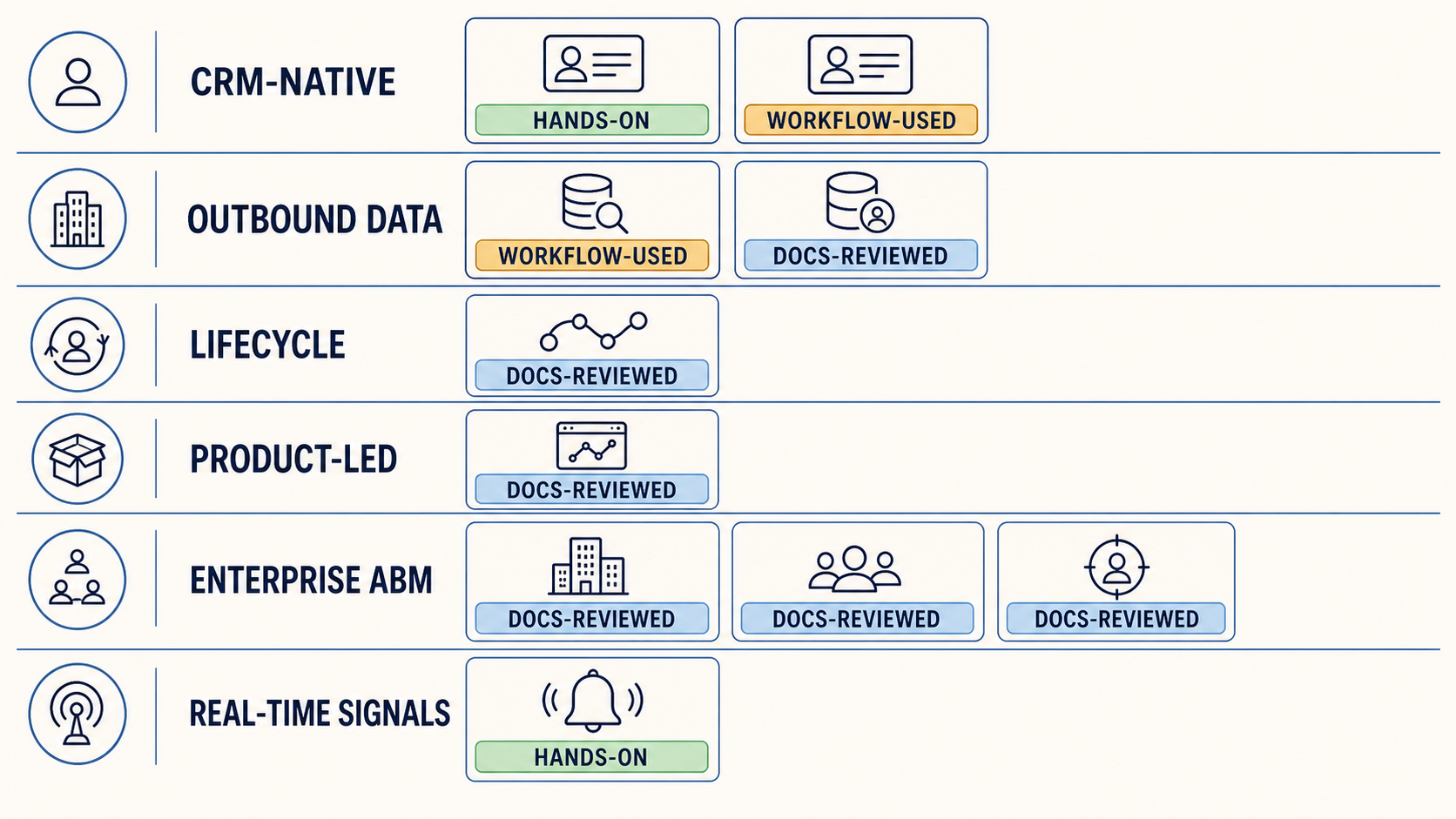
Ten lead-scoring products grouped by scoring job and evidence level in this guide.
The comparison maps products to different decisions and distinguishes hands-on use from workflow use and documentation review.
ProductBest scoring jobObjectModel emphasisUseful visibility/controlEvidence in this guideMain limitation
HubSpotCRM-native fit and engagementContacts, organizations, dealsRules and selected AI scoresSeparate/combined scores, decay, history, workflowsWorkflow-used; docs reviewedPlan gates; thresholds can be confused with lifecycle truth
Salesforce EinsteinEnterprise lead conversion priorityLeadsPredictive historical similarityPositive/negative factors, reportsDocs reviewedPrediction is read-only; needs clean conversion history and action override
ApolloOutbound database priorityPeople, organizationsAI auto-scores and custom criteriaContributing criteria, filters, CRM syncWorkflow-used; docs reviewedStrong before outreach, not a relationship-state system
6senseAccount fit, intent and buying stageAccounts, contactsPredictive ABM modelsSeveral distinct fit, intent, reach and stage outputsDocs reviewedHigh data and operating maturity burden
DemandbaseAccount journey orchestrationAccountsCriteria, intent, engagement and pipeline predictionConfigurable journey stagesDocs reviewedAccount journey is not an individual-contact qualification model
ActiveCampaignLifecycle and nurture rulesContactsRules and automationPositive/negative points, expiry, triggersDocs reviewedLimited for enterprise account and buying-group decisions
Zoho CRMConfigurable CRM record scoringMultiple CRM modulesManual rules and Zia scoresScorecards, factors, feedback, workflow useHands-on scoring; docs reviewedSeveral scoring modes and limits require careful governance
MadKudu / HG InsightsSaaS fit plus likelihood to buyLeads/accounts depending modelRules, decision trees and predictive behaviorValidation data, signals, thresholds, overridesDocs reviewedNeeds meaningful historical and behavioral outcomes
WarmlyReal-time timing and intent signalsPeople and accountsWeighted first-, second- and third-party signalsContributing signals and action triggersHands-on scoring; docs reviewedSignal strength can be mistaken for stable fit or permission
ZoomInfo CopilotEnterprise account data and prioritizationAccounts and buying groupsFit, intent, first/third-party signalsAccount summaries, alerts, analytics, prioritizationDocs reviewedVerify override, history and local transparency in a live evaluation

1. HubSpot: best for CRM-native fit and engagement scoring

HubSpot is a clear choice when the full relationship already lives there; its current lead scoring documentation covers contact and organizational fit, engagement and combined deal scores; rules may add or subtract points, engagement events may decay, and inclusion or exclusion lists control which records receive a score.
Separate properties let a team inspect fit and engagement, while combined scores remain available for workflows that need them; Marketing Hub Enterprise also offers selected AI fit and engagement scores. Its documentation requires at least 50 contacts: half converted and half not. That minimum does not prove the sample suits every revenue motion.
Choose HubSpot when: the CRM already owns the inbound or lifecycle process and the team needs visible rules, decay and workflow actions; watch out for: turning a score threshold into a lifecycle-stage definition because it may suggest MQL review, but should not make the sales decision final.

2. Salesforce Einstein Lead Scoring: best for enterprise conversion patterns

Einstein Lead Scoring compares current leads with converted leads. Salesforce shows major positive and negative field effects. Its reports cover score spread and conversion rate by score.
The predictive lead score is read-only, which protects its audit trail. The seller still controls the action, and a high score never bypasses contact policy, account ownership or human review; Salesforce now uses Agentforce Sales naming across its wider package, but this evaluation preserves the exact feature name, Einstein Lead Scoring.
Choose Salesforce Einstein when: Salesforce anchors the commercial process and the organization has reliable histories for converted and unconverted leads that represent the event it wants to model; watch out for: a consistent but obsolete conversion pattern that answers yesterday's question after routing, territory or offer changes.

3. Apollo: best for prioritizing an outbound database

Apollo belongs near the start of an outbound workflow; its Scores Overview covers AI and custom scores for people and companies; auto-scores use company, account and prospecting activity, while admins can choose custom filters and inspect the contributing criteria.
This makes Apollo valuable for deciding which sourced records deserve research, but operators should inspect what the auto-score learned from their behavior; saving many records of one type can reinforce a habit rather than validate an ICP; the synced score should remain a prospecting recommendation, not a post-reply relationship state.
Choose Apollo when: you need B2B data and first-pass priority in one place. Watch out for: using prospecting similarity as purchase intent; after a reply, route the relationship to the CRM and a person.

4. 6sense: best for enterprise account intent and buying-stage prioritization

6sense is not a simple lead-points tool; its Scores Overview separates account fit, contact fit, contact engagement, in-market status, account reach, buying stages and person-level intent; this keeps organizational fit and timing apart from old outreach and one person's activity.
The 6sense model needs account and deal history. It also uses CRM or MAP, activity and intent data. It still cannot fix a broken deal process.
Choose 6sense when: an established ABM program has linked account history, clear product categories and a revenue-operations owner for each action; watch out for: collapsing fit, intent, reach and stage into a single “hot account” label when the product exposes several states that should stay separate.

5. Demandbase: best for account journey stages and ABM orchestration

Demandbase uses Journey Stages for accounts; rules may use fit, intent, activity, pipeline and deal data, and each account sits in one stage; its documentation includes example thresholds, but operators should not copy product defaults as evidence about a local sales cycle.
Demandbase is strongest when marketing and sales agree on account progression, engagement and ownership before an MQA appears.
Choose Demandbase when: the team runs a mature ABM program and the core decision concerns an account's journey; watch out for: calling an account stage a contact qualification because one active person does not identify the full buying committee or its relationship owner.

6. ActiveCampaign: best for lifecycle scoring and nurture automation

ActiveCampaign supports points that may add, subtract, remain or expire. Its rules can trigger automation or recalculate a score.
That supports three practical questions: Is human review due? Should an activity signal expire? Should the contact change nurture paths?
It is less suited to a complex buying group. Several email opens may justify a new nurture state. They do not prove that the account has budget, authority or a live deal.
Choose ActiveCampaign when: the score controls email and contact nurture. Watch out for: permanent point inflation that makes an old contact look active after the buying moment passes; keep expiring points apart from stable fit attributes.

7. Zoho CRM: best for configurable scoring with visible factors

Zoho CRM combines manual rules with several Zia scoring types; inputs may include fields, linked records, activities and SalesSignals; Zoho documents factors, feedback, workflows, approval controls and data minimums for selected predictive uses.
I have used Zoho scoring directly. It does not remove implementation work. Its value is keeping the score close to the CRM record. A smaller sales organization can still inspect the rules, factors and actions.
Manual rules, health scores, engagement scores and conversion predictions answer different questions; admins should therefore name each score by its decision, not only its range.
Choose Zoho when: the team wants flexible scoring inside its CRM without an enterprise ABM platform, and someone can govern the different modes; watch out for: letting automation act merely because a score crossed a threshold; keep a human override for messages, calls, CRM stages and opportunities.

8. MadKudu / HG Insights: best for data-rich SaaS fit and behavior models

MadKudu's current customer-fit documentation covers company, person and tech data; its models can use points or decision trees, plus test data and overrides; this architecture suits SaaS organizations that can join acquisition, CRM and product evidence while keeping stable fit apart from buying likelihood.
The target outcome must be worth learning. If the label is “created an account,” the model may predict sign-ups instead of revenue, while inconsistent sales stages can encode broken operations at scale.
Choose MadKudu/HG when: a SaaS or PLG team has reliable past outcomes, meaningful product events and a named model owner; watch out for: training-label leakage and obsolete history; use a later validation set, review false positives and confirm that inputs available at scoring time drive the prediction.

9. Warmly: best for real-time signals and action readiness

Warmly scores recent web, social, research and fit signals. Teams can weight those signals and trigger actions.
I have used Warmly directly. The valuable part is timing. A recent visit, return session or relevant signal can tell a team where to look now, but it should not rewrite the underlying ICP or give an autonomous system permission to message a person.
Live-data tools can invite bold claims. A signal is an observation. “This account is buying” is an interpretation. Check the identity, date, page or event before acting. Also check the existing relationship and its sales owner.
Choose Warmly when: live website or person signals should guide review timing and the team knows what each signal should trigger; watch out for: confusing poorly resolved activity with a verified buyer, or letting a signal overwrite fit or consent.

10. ZoomInfo Copilot: best for enterprise data, signals and account prioritization

ZoomInfo Copilot joins sales data with account fit and buyer-group context; its release notes cover Account Fit Scores, WebSights spikes, intent and priority views.
This can move a large data set closer to a seller's daily queue. It does not explain every priority by default. Test the sources and stale-field rules in a live account. Check score history, override behavior and CRM write-back.
I reviewed ZoomInfo documents but did not test its scoring implementation, so its claims confirm features rather than a relative rank; choose ZoomInfo when: an enterprise sales organization already relies on its data and wants research, signals and priority views near the seller's workflow; watch out for: treating suite breadth as proof of fit and check whether the licensed tools cover the accounts your team sells to.

05 / Architecture

Which lead-scoring architecture fits your revenue motion?

The product comparison becomes valuable only after you match it to the revenue motion. Team size is relevant, but data maturity and decision risk matter more.
Revenue motionScoring architectureMinimum useful inputsHuman decision that remainsCommon premature purchase
Founder-led or early B2BTransparent rules in a CRM or staging tableIdeal-customer evidence, exclusions, role, offer fit, verified channelWhether to research or contact the personPredictive scoring before consistent outcomes exist
CRM-centered inboundSeparate CRM fit and engagement scoresForm/source, company and role evidence, lifecycle activityWhether the record is commercially acceptedAutomatic lifecycle changes from one threshold
Outbound prospectingDatabase score plus evidence validationPerson-role-company match, online activity, ICP and channel qualitySeller acceptance and message approvalBuying enrichment before validating the offer
Product-led SaaSFit plus product/behavior modelAccount attributes, activation events, product usage and revenue outcomesWhether product interest justifies sales contactTraining on sign-up instead of revenue value
Enterprise ABMAccount fit, intent, buying group and journey statesCRM/MAP history, opportunities, intent, account identity and ownershipCoordinated account actionCalling one engaged contact a qualified account
Custom mid-market workflowSource + rules/LLM + staging + CRMVersioned evidence, exclusions, confidence and reviewer fieldsEvery CRM change and outreach actionLetting generated reasoning write directly to production CRM

Small B2B teams should buy control before prediction

A small team rarely lacks a score. It lacks enough verified evidence to know whether the score means anything. Start with a short ruleset, explicit exclusions and a review queue. Make the score explainable in one screen.
The founder or seller should answer three questions: Why did this record qualify? Which fact is weakest? What changes because the score is 8 rather than 6?
If the third answer is “nothing,” the extra precision is decoration.

CRM-centered teams should keep fit and lifecycle separate

HubSpot, Salesforce and Zoho make sense when the CRM already owns the relationship. The scoring layer may prioritize work, but the CRM should retain its owner, events, model or rule version and stop reason; after a reply, the original fit score stays in history while a person controls status, stage, disposition and next action.
For field-level setup, see our guide to lead scoring across Gmail and CRM.

Outbound teams should score reachability and activity without mistaking them for fit

In outbound work, an apparently good ICP record may still be commercially dead: the person may have the right title and company but no current activity, a stale profile or no usable channel. That does not make the account a bad fit. It makes this contact or channel a poor next move.
For campaigns with hundreds of records, three factors may guide research. They are role, offer fit and visible activity. Smaller, valuable lists need a higher bar. Check current posts, relevant likes and earlier responses. Add direct buying evidence and deeper account research.

Product-led teams need an outcome model, not a feature-usage contest

Product events matter only when they predict the target business result. One team invite may signal activation, while another may demonstrate routine setup. A return visit by a senior buyer may carry more weight. Define the commercial event first, then test which earlier product signals still hold in a later period.

Enterprise ABM teams need several states, not a universal hot-account number

Keep account fit, intent, engagement, reach and buying stage separate. They lead to different actions. An in-market account with low reach may need research. A high-fit account with low intent may belong in awareness. Each active deal stays with its current owner.
The benefit of an enterprise platform comes from coordinated action and history, not from putting a larger number beside the account name.

A custom LLM workflow can be rational when judgment is richer than history
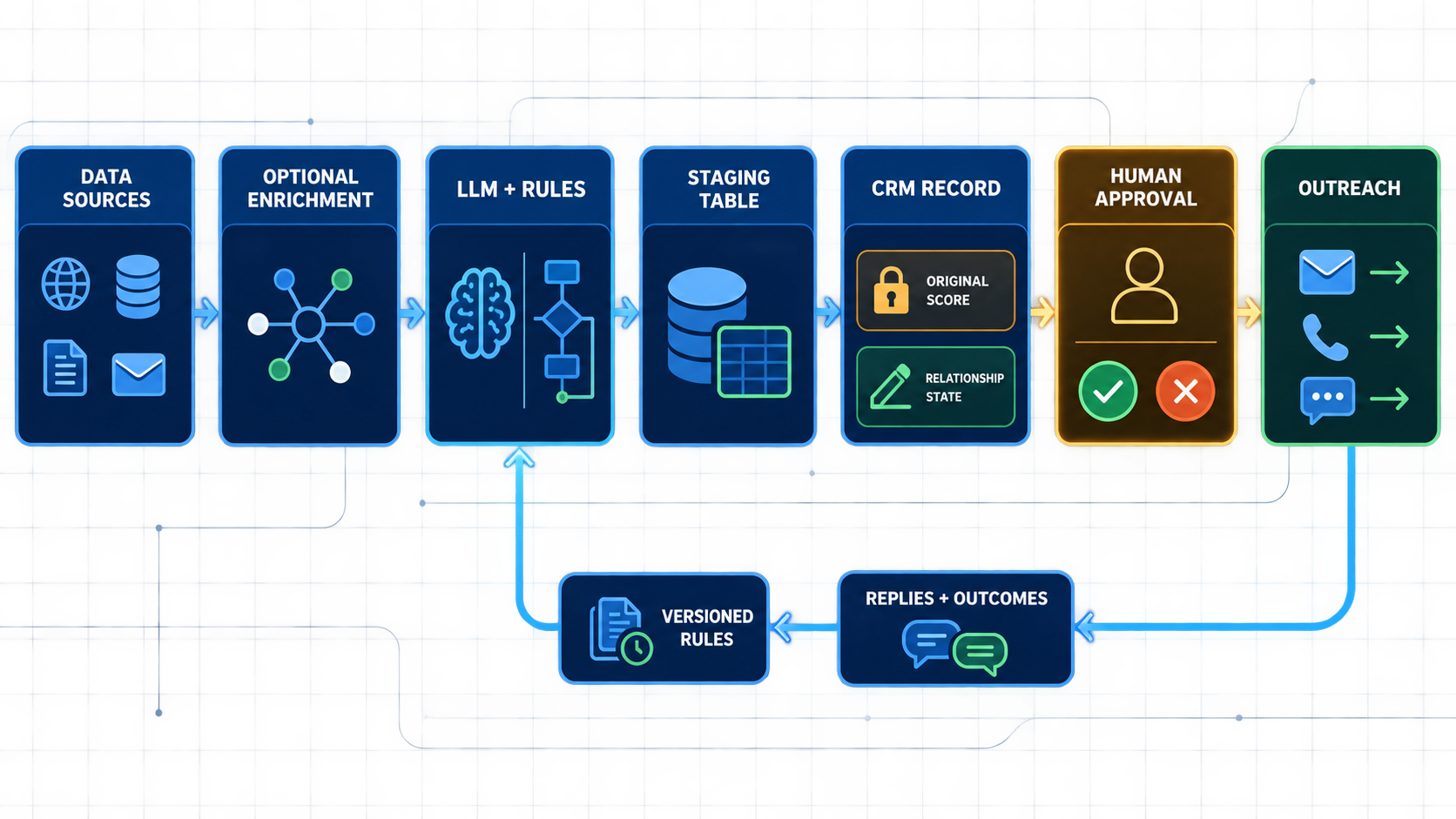
The July 2026 workflow used Apollo as its base source. Clay enriched records when needed, and Sales Navigator added checks. Claude Code applied rules, checks and fit logic. Sheets held the review, Lemlist sent messages, and HubSpot stored the record.
Custom human-gated lead-scoring stack from source data and enrichment through Claude Code, staging, human approval, outreach and HubSpot.
A custom stack can make local qualification logic explicit, but each consequential action still passes through a human gate.
The LLM never became the sales owner. It filtered records, checked evidence, changed staging fields and drafted reasons. Human reviewers approved records and first messages. They approved sends, replies, CRM updates and calls. Nurture and closing decisions also stayed with people.
Anastasiia Krynytska estimates that this practical GTM stack starts near $800 per month. It can exceed $4,000 per month with extensive enrichment and token consumption. This is an operator range, not a market benchmark. Clay usually drives the largest variable cost; Apollo adds data expense; Lemlist remains comparatively fixed; Claude Code becomes another material variable because deeper validation, qualification and personalized reasoning consume more tokens as record volume grows. Check current prices against your workflow and volume.
The custom path is not always cheaper. It buys control while creating ongoing maintenance. Operators must own prompt versions, rules, field maps and exception queues. They must allocate token budget and preserve an audit trail.

06 / First-hand sample

What a 1,627-record qualification sample can and cannot prove
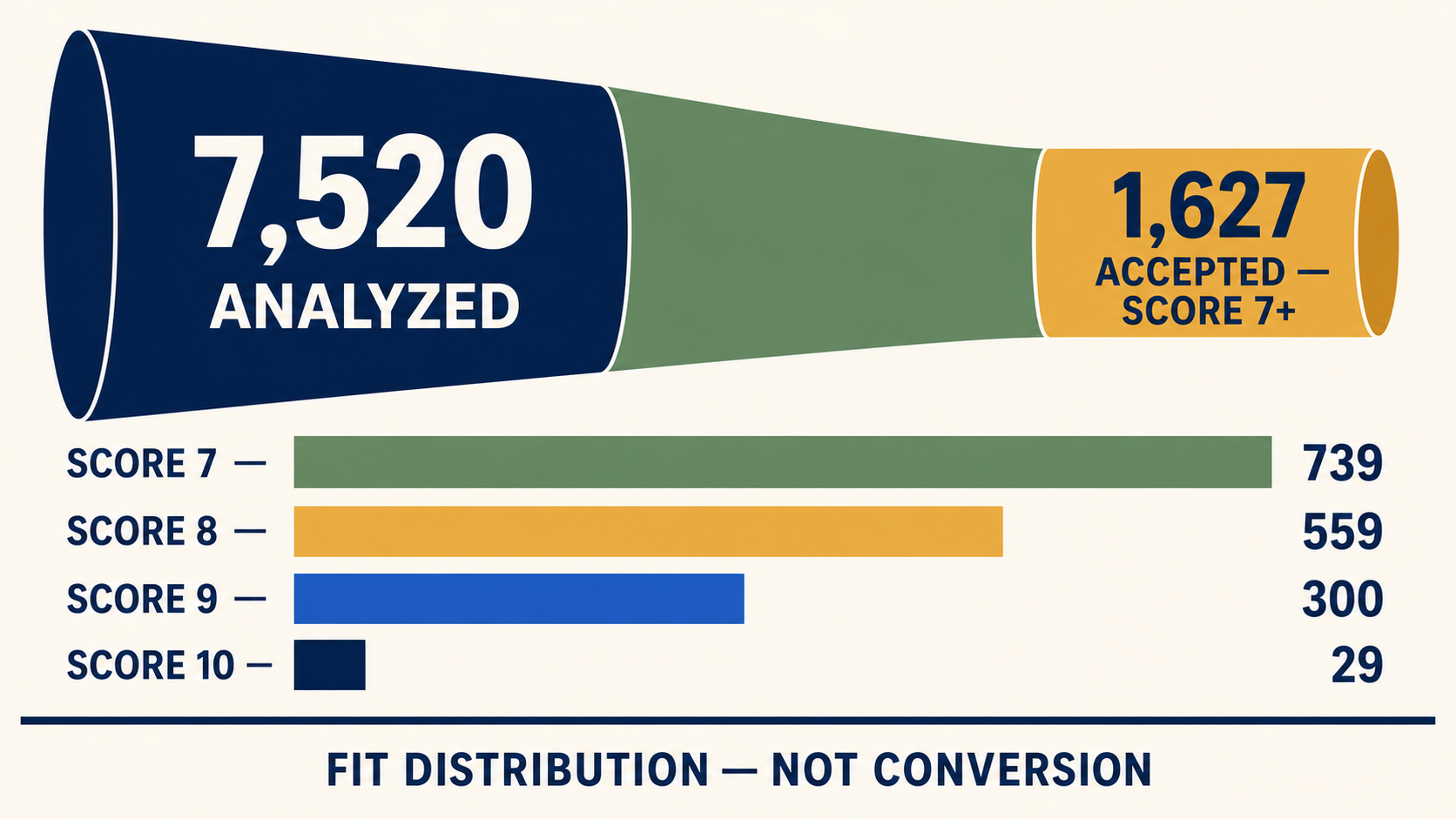
The operating sample below came from one anonymized July 2026 workflow. It shows how a score became a routing hypothesis. It is not a controlled comparison among the ten products above.
July 2026 qualification funnel from 7,520 analyzed records to 1,627 accepted records split across fit scores 7, 8, 9 and 10.
The distribution documents one human-reviewed routing workflow; it does not establish universal thresholds or vendor accuracy.

The documented 7–10 fit scale and routing rule

The workflow reviewed 7,520 records and accepted 1,627 with a fit score of 7 or more:
Fit scoreAccepted recordsShare of accepted setOriginal route
773945.4%Email
855934.4%LinkedIn
930018.4%LinkedIn
10291.8%LinkedIn
Total1,627100%
The score assessed similarity to the current ideal-customer hypothesis. It included ICP fit and relevance to the commercial offer. We also checked whether each person was active online. An inactive contact may never see or answer a digital approach.
The rule determined the channel and review order; it did not create a deal or authorize a pitch.

An anonymized rubric that preserves the logic

We reduced the private prompt to this public decision schema:
```text OBJECT Score the current person-role-company record for fit with the stated offer.
EVIDENCE - company business model and client verticals - person's current function and time in role - evidence the offer solves a real problem for that company or its clients - current online activity and usable channel - exclusions: competitors, wrong current employer, stale role, missing identity, wrong client economics or a problem already solved by the current product stack
OUTPUT - fit score: 1-10 - evidence confidence: high / medium / low - concise reasons with source and date - missing or conflicting evidence - recommended review route: LinkedIn / email / reject / manual research
CONTROL AI recommends. A seller approves the record, channel, message and CRM action. When evidence is insufficient, lower confidence—not standards. ```
This is a rubric, not a universal formula. Dental, SaaS and reseller campaigns should not give the same weight to the same facts.

High fit did not guarantee a reply or buying moment

Some low-scored Tier 3 email records still produced positive replies: the team reported two or three from about 800 lower-priority records; this was not a controlled rate comparison, but it demonstrates that scoring narrows review without removing commercial surprise.
The best-fit group covered dental, legal, estate, solar and hospitality firms. It also covered finance and accounting firms. These fields matched an offer about missed calls and customer conversations. Another product may require a different list.

The defensible score emerges at the intersection of ICP, offer and brand

There is no external “correct score of 8” that every company can buy. Each organization begins with an ideal-customer hypothesis shaped by its active offer and brand. Market evidence then tests whether that audience has a reason to care.
Replies and seller outcomes calibrate that hypothesis at the intersection of ICP, offer, brand, channel and timing; the valuable model may depend on five factors unique to that organization rather than a portable vendor threshold. A lower-scored segment may still respond when the offer feels more novel there.
Old triggers such as funding, events or executive changes now attract crowded outreach; they can still matter, but recent activity and explicit problem evidence give better context.

Seller outcomes should recalibrate rules without rewriting history

Keep the score that existed when the decision was made. Record later outcomes in separate fields. Store the seller choice, reply type, call, deal, loss reason and override.
When outcomes reveal a pattern, publish a new rule or model version. Do not rewrite old scores. The previous values show what the organization knew at decision time; this historical evidence helps compare model versions. It also separates scoring gains from changes in offer, channel or market.

Limitations of the sample

  • It came from one workflow and one offer context.
  • It did not run the same records through all ten vendors.
  • The score threshold guided routing rather than proving purchase probability, and contact activity or channel access shaped the route.
  • Message, sender, brand, market, timing and human follow-up affected later outcomes; the sample supports the workflow and the need to tune it, but it does not prove vendor accuracy or causal revenue lift.

07 / Buyer test

Run a same-sample lead-scoring software evaluation
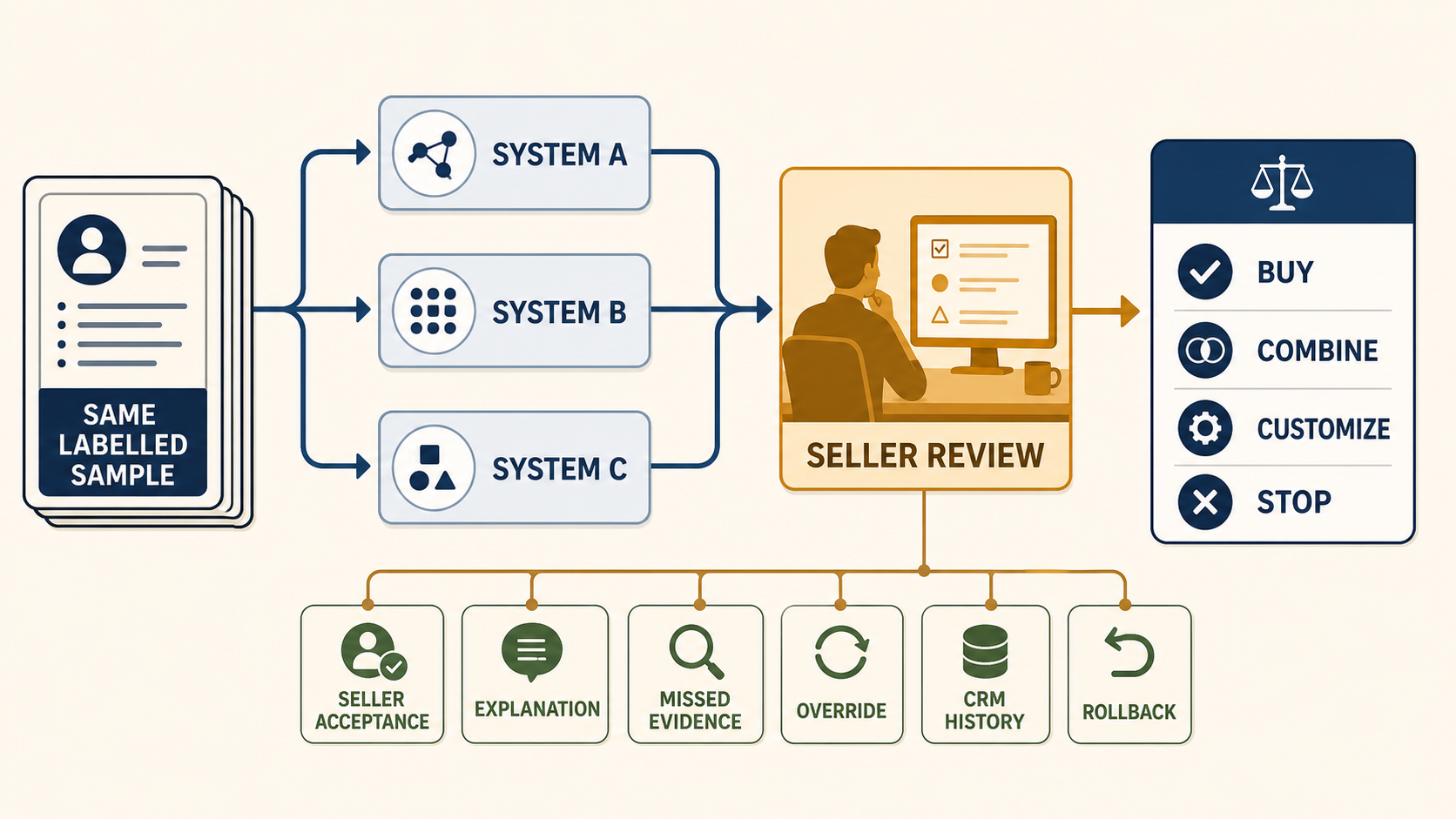
Do not choose a platform from its demo account. Give each viable system the same decision and records. Use the same review criteria too.
Same-sample lead-scoring software evaluation comparing decision fit, evidence, errors, overrides, CRM behavior and downstream outcomes.
A defensible software test holds the decision, records and review criteria constant across every viable system.

1. Write the decision contract

Name the object, target state, owner and allowed action, then add the human gate and expiry. “Prioritize accounts” is too vague; a testable rule is more useful: “Recommend 20 accounts each week for seller research; never send or change an opportunity stage without approval.”
Also define the cost of each mistake. A false positive wastes seller time and risks trust. A false negative hides a potential buyer. The acceptable balance depends on the action. Automated messages need a higher bar than a private research queue.

2. Build a labeled historical and live-review sample

Use records from active markets, offers and data conditions. Include wins, losses and non-responses. Add records rejected by sellers. Include stale roles, duplicate records, unclear people and missing proof.
Train and test predictive systems on different periods. For rules, keep a holdout that the rule author never saw. Add a fresh live sample for human review. Old CRM outcomes may preserve a sales process that no longer works.

3. Compare error patterns, not just average scores

For each system, inspect:
  • coverage: how many records receive a usable score;
  • transparent reasons: can a seller review the evidence;
  • wrong priorities: records with high scores that a seller rejects;
  • missed value: lower-scored records with strong later evidence;
  • wrong people and stale data;
  • whether the score settles after a short-lived event;
  • score spread across a broad segment.
A model can demonstrate an attractive conversion curve while still making dangerous errors in a small but valuable segment.

4. Test explanations, overrides, write-back and rollback

Ask a seller to explain the advice without a vendor deck. Then reject it. The workflow should capture the reviewer and reason. It should show which action stopped and what stayed unchanged.
Test a field conflict. New data should first land in a review field. It must not replace a trusted CRM value without approval. Then test a rule or model revision. Old decisions should link to the version that produced them.
Any product without a usable human override fails this test. Model depth cannot fix that gap.

5. Measure downstream decisions with explicit denominators

Useful measures include:
MeasureFormulaWhat it diagnoses
Coveragescored eligible records / eligible recordsWhether the system can act on the real dataset
Seller acceptanceseller-approved recommendations / reviewed recommendationsWhether the queue is useful to operators
Override rateoverridden recommendations / reviewed recommendationsRule-model disagreement and governance load
Qualified conversation ratequalified conversations / contacted accepted recordsFit plus offer and execution quality
Held-call rateheld calls / contacted accepted recordsDownstream commercial progress
Opportunity ratecreated opportunities / contacted accepted recordsRevenue relevance with a clear denominator
Maintenance timemonthly hours for data, rules, mappings and exceptionsTrue operating burden
Cost per accepted recommendationtotal scoring operating cost / seller-accepted recommendationsWhether sophistication produces useful decisions
Do not optimize for open rate because it is easy to measure. A model trained on email openers may avoid the buyers sales needs.

6. Decide whether to buy, combine, customize or stop

Buy when the product fits the object, evidence, action and team. Combine products when two clear layers are needed. One example is CRM fit plus outside account intent. Customize when local judgment matters more than a generic model. Stop when the score cannot change a decision safely.
The stopping option matters. A transparent view, a few exclusions and a seller-owned queue may outperform an elaborate scoring platform that nobody trusts.

08 / Scorecard

Lead-scoring software evaluation scorecard

Leave the weight column blank until sales, marketing and operations agree on the decision; the vendor should not choose it for you.
CriterionWeightEvidence to requestPass condition
Decision fitNamed decision, owner and permitted actionScore has one defined job
Correct objectContact/account/opportunity data modelObject matches the revenue motion
Source provenanceField and signal source, timestampReviewer can trace material evidence
Freshness/conflictsRefresh policy and conflict behaviorStale and conflicting data are visible
ExplanationContributing factors on a real recordSeller can explain the recommendation
Model requirementsTraining labels, minimums, history and exclusionsTeam has suitable data
Decay/recalculationExpiry and score-change behaviorTemporary evidence fades safely
Human overrideLive rejection and stop testRequired: seller can stop the action
CRM historyModel/rule version, prior values and actorDecision can be audited
Write-back/rollbackStaging, approval and reversal testNo silent destructive overwrite
Security/complianceData-flow and contractual reviewMeets the company's actual obligations
Maintenance burdenNamed owner, monthly hours and dependenciesWork is staffed and budgeted
Total operating costLicenses, credits, data, implementation and usageCost fits the volume and accepted output
Outcome measurementSeller acceptance through opportunity metricsDenominators and stop rules are explicit

09 / FAQ

Frequently asked questions about lead scoring software

What is lead scoring software?

Lead scoring software rates people, organizations, accounts or deals. It uses set rules or learned patterns. The result should support one named decision. This could mean research, nurture or account review. Do not call it a purchase probability unless that exact outcome was tested.

Which lead scoring software is best for B2B sales?

There is no universal winner. HubSpot or Zoho can fit CRM-native work. Apollo can rank an outbound list, while ActiveCampaign can run nurture. MadKudu/HG suits data-rich SaaS. 6sense or Demandbase suit mature ABM. The choice must match the object, evidence, action, human gate and team capacity.

What is the difference between rules-based and predictive lead scoring?

Rules-based scoring applies criteria and points chosen by the team. Predictive scoring learns patterns from labeled past outcomes. Rules are easier to inspect but still encode assumptions. Predictive models may find hidden links but need clean, stable history. Neither approach can rescue the wrong target event.

Should fit and engagement be separate scores?

Usually, yes: fit describes market match, while engagement describes recent behavior. They change at different speeds and support different actions. One website visit should not qualify a poor-fit account.

Is CRM-native lead scoring better than a standalone platform?

CRM-native scoring operates well when the decision and history already live there. Standalone tools may add outside intent, product information or specialized models. The integration must preserve evidence, owners, overrides and history.

How much historical data does predictive lead scoring need?

There is no universal number. Some vendors state a minimum data volume. That minimum does not prove model stability. The dataset must reflect the active offer, market and process. It needs enough positive and negative outcomes. It must also avoid leakage and leave a later test sample. If these conditions fail, start with transparent rules.

Can Apollo or Clay be used for lead scoring?

Apollo offers custom scores for people and organizations. Clay can provide data and workflows for a custom score. Both need source tracking, conflict review and human approval before outreach.

How often should a lead score change?

Stable fit should change only when verified company or role evidence changes. Engagement and intent may change fast and should decay. Replies, calls and deals change the relationship state. Store that state apart from the original fit score. Each state needs its own date and owner.

Should lead scoring software automatically change a CRM stage?

Not by default. A score can suggest review or add a record to a queue. It may also start low-risk internal work. A seller should approve stages, messages, calls, nurture and deal decisions. A seller must be able to stop the system.

How should a sales team test lead-scoring accuracy?

Use a current same-sample evaluation with a written decision contract; review coverage, reasons, errors and seller decisions. Then count overrides, held calls and deals with clear denominators. The goal is a safer and more defensible sales decision.

10 / Limitations

Methodology, disclosure and evidence limits

This guide compares scoring jobs and controls, not lab accuracy. I used scoring in Warmly and Zoho. HubSpot and Apollo supported the broader operational workflow, but not a native scoring test. The other six profiles rely on official documents.
Anastasiia Krynytska provided the anonymized July 2026 sample from her work. It shows the qualification logic, routes and limits. It does not prove a vendor caused the result. Another organization may not repeat it.
Luck My Sales has no affiliate, commercial or client link to these products. Recheck packaging, prices and model behavior in a live test. The guide does not replace review by legal, privacy, security or HR teams.
Use three guides for deeper reading: model design, data validation and the wider AI lead generation workflow.

11 / Sources

Primary product sources

ProductFirst-party or primary source reviewed
HubSpotUnderstand the lead scoring tool
SalesforceEinstein Lead Scoring
ApolloScores Overview
6senseScores Overview; Predictive Modeling Overview
DemandbaseGetting Started with Journey Stages
ActiveCampaignContact Scoring
Zoho CRMScoring Rules and Zia Scores
MadKudu/HGCustomer Fit
WarmlySignals; Intent Scoring
ZoomInfoCopilot release materials

Research note

Methodology

  1. 01Compare products by the scoring object, commercial decision, evidence, explanation, action and human control rather than by feature count.
  2. 02Label Warmly and Zoho as hands-on scoring; label HubSpot and Apollo as workflow-used without a native scoring test; use official documentation for the remaining product profiles.
  3. 03Attribute the anonymized 7,520-record July 2026 workflow, 1,627 accepted records, channel routing and practical stack-cost range to Anastasiia Krynytska's first-hand operating records.
  4. 04Preserve fit score, relationship state, seller decision and downstream outcome as separate facts.
  5. 05Do not claim a universal score threshold, vendor accuracy ranking, controlled lift or causal revenue result.
  6. 06Exclude private names, company identities, contact details and unsupported vendor performance claims.
Read the full methodology

Source ledger

Sources & editorial notes

  1. 01
    Understand the lead scoring tool

    HubSpot Knowledge Base · Official documentation for contact and company fit, engagement and combined scoring capabilities.

  2. 02
    Einstein Lead Scoring

    Salesforce Help · Official documentation for predictive lead scores, field factors and reporting.

  3. 03
    Scores Overview

    Apollo Knowledge Base · Official documentation for AI and custom people and company scores.

  4. 04
    6sense Scores Overview

    6sense · Official documentation for distinct account, contact, intent, reach and buying-stage outputs.

  5. 05
    Getting Started with Journey Stages

    Demandbase · Official documentation for account journey-stage configuration.

  6. 06
    Contact Scoring in ActiveCampaign

    ActiveCampaign Help · Official documentation for contact points, expiry and automation.

  7. 07
    Scoring Rules and Zia Scores

    Zoho CRM Help · Official documentation for manual and Zia scoring modes.

  8. 08
    Customer Fit

    MadKudu / HG Insights · Official documentation for customer-fit models, test data and overrides.

  9. 09
    Signals and Intent Scoring

    Warmly · Official documentation for weighted signals and action triggers.

  10. 10
    ZoomInfo Copilot Summer Release

    ZoomInfo · Company release materials for account-fit, intent and prioritization capabilities; not independent performance evidence.

  11. 11
    Lead Scoring Criteria Implementation

    Luck My Sales · Supporting model-design, human-gate and CRM audit architecture.

  12. 12
    Luck My Sales methodology

    Luck My Sales · Evidence states, first-hand-source treatment, freshness requirements and correction protocol.

Corrections or primary material: contact the corrections desk.

About the author

Anastasiia Krynytska

Anastasiia Krynytska is a LeadGen Team Lead at Softermii and the lead editor of Luck My Sales. She covers AI-assisted outbound, account research, qualification, messaging, CRM handoffs and revenue workflows from a practitioner’s perspective.View author profile LinkedIn

Continue reading

01 · News analysis

AI sales is moving from assistant to operating layer

The category is expanding from drafting support into research, pipeline decisions, recommended actions and controlled execution.

Read news
02 · Field analysis

In AI sales, the handoff may be the product

Models are becoming accessible; durable value sits in the controlled transition from signal to seller action.

Read analysis
03 · Research framework

Sales AI Workflow Signals 2026

A launch framework for mapping the products, controls and buying questions shaping AI-enabled revenue work.

Read reports

Luck My Sales briefing

Useful context, once a week.

News, explanations and original research from this desk. No noise.
The newsletter is still being built. We will contact you when the first edition is ready.