Weekly industry intelligence · No noiseSubscribe to the Luck My Sales newsletterFree briefing

Independent operator-led media on AI in B2B sales

Menu

Sales call analysis comparison · Sales AI comparisons

Top AI Tools for Sales Call Analysis: Compare Evidence, Coaching and CRM Write-Back

Compare AI tools for sales call analysis by transcript evidence, coaching, CRM write-back, languages, governance and total operating cost.
Editorial disclosure

AI may assist research organization and drafting. A human editor reviews every published page, checks material claims against the cited sources and owns the final decision. No company paid for placement in this article.

AI use policy

Agent-ready brief

AI takeaways

Keep the key points here, or take a source-aware text brief into Claude, ChatGPT or another AI workspace.
  1. 01Start with the evidence job: revenue intelligence, engagement, CRM-native analysis, meeting intelligence or a custom phone workflow.
  2. 02Run the same recording, rubric and CRM mapping through every finalist.
  3. 03Regional language and speaker quality can matter more than a generic accuracy claim.
  4. 04CRM write-back needs a policy gate that separates proposed fields from approved changes.
  5. 05Total cost includes implementation, review, correction, adoption, governance and exit—not only the license.
Includes summary, takeaways, sources and a use note.
The top AI tools for sales call analysis do not all solve the same job. Gong and Chorus focus on conversation and revenue intelligence. Salesloft Conversations connects call evidence to a sales-engagement workflow. HubSpot makes the strongest sense when Smart CRM is already the operating center. Avoma combines meeting analysis with coaching and meeting workflow. A custom or contact-center layer may be better when phone channels, regional languages, or AI-agent handoffs are the actual constraint.
Do not choose from a generic “best tools” list. Choose the evidence source, action, human gate, and system of record you need to own.
This comparison uses hands-on operator experience where explicitly stated and current official product information elsewhere. We did not run a formal same-call benchmark across every product, so there is no fabricated overall winner.

Sales call analysis tools should be compared by workflow job and common evidence, because a generic ranking hides different product boundaries and operating costs.

01 / Shortlist by workflow job

Shortlist by workflow job
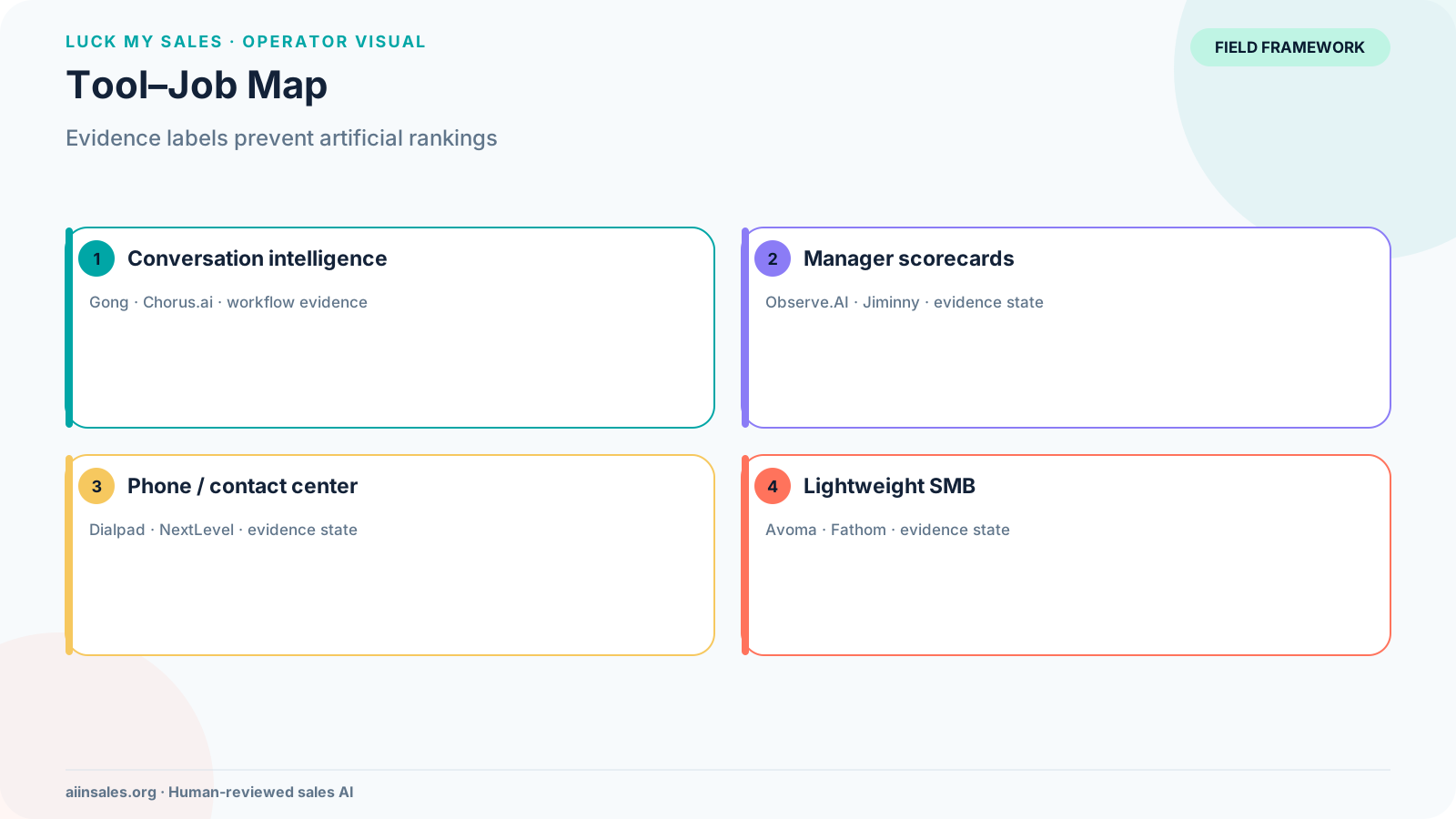
Four-part map of sales call analysis tools by workflow job and evidence state.
A job-based shortlist prevents unrelated products from sharing one artificial ranking.
“Strong shortlist” does not mean “best for everyone.” It means the product maps credibly to the job and deserves a controlled test.

02 / How we evaluated the category

How we evaluated the category

Sales call analysis has at least seven layers:
  1. recording and consent;
  2. transcription and speaker attribution;
  3. summaries and searchable evidence;
  4. objection, intent, topic, and next-step extraction;
  5. scoring and coaching;
  6. CRM or workflow action;
  7. human review and correction.
Most tools market several layers. The buyer still needs to know which layer is mature for its specific calls and which layer is only a configurable promise.
We use four evidence labels:
  • hands-on: operated in real work;
  • first-party operator: workflow evidence from a product or system connected to the author’s team, disclosed separately;
  • officially verified: supported by current vendor documentation;
  • pilot required: performance depends on the buyer’s calls, languages, data, permissions, or process.
We do not convert official marketing claims into independent outcome claims. We also do not rank products by a list of features that were never tested under equivalent conditions.

03 / Comparison matrix

Comparison matrix

ProductPrimary operating centerAnalysis and evidenceCoaching layerCRM/workflow roleEvidence state here
Gongrevenue conversation platformrecording, transcript, search, trackers, interaction signalsscorecards, libraries, manager reviewdeal and pipeline context with CRM connectionshands-on plus official
ChorusZoomInfo platformcaptured interactions and conversation insightscoaching and team performance workflowsZoomInfo and CRM-connected revenue workflowofficial/researched
Salesloft ConversationsSalesloft platformtranscript, summary, action items, key moments, trackersscorecards and conversation reviewlinks evidence to deals and Salesloft activityofficial
HubSpot Conversation IntelligenceHubSpot Smart CRMcaptured voice data, tracked terms, call insightscoaching and review inside HubSpotnative workflows and CRM contexthands-on HubSpot context plus official
Avomameeting and revenue workflowtranscript, summaries, topics, trackers, talk patternscustom scorecards, AI scoring, coaching recommendationsCRM-connected meeting follow-throughofficial
ExecVisioncoaching intelligenceconversation analysis and targeted feedbackcoaching plans and methodology alignmentconfirm current CRM and workflow fitofficial
The table deliberately avoids unsupported transcript-accuracy numbers, current prices, and “winner” labels. Those require a controlled test and live commercial verification.

04 / Gong: broad conversation and revenu…

Gong: broad conversation and revenue workflow

Gong is the product in this set that I have used directly. It can be useful when calls are not isolated files but evidence feeding coaching, deal inspection, and pipeline work.
The advantage is breadth. Managers can inspect conversations, use trackers and scorecards, find examples, and connect call evidence to revenue context. The risk is buying that breadth before the team has enough pipeline, calls, manager time, CRM hygiene, and governance to use it.
I would not make Gong a default purchase for an early small team. My practical threshold is about USD 20,000 in monthly active pipeline before I would seriously evaluate the economics. That is an operator heuristic, not a formal ROI study, guarantee, or Gong requirement.
Gong belongs on the shortlist when the organization needs a conversation evidence layer across a meaningful revenue process. If the main job is “give five founders searchable notes,” a lighter solution may be better.

05 / Chorus: evaluate inside the ZoomInf…

Chorus: evaluate inside the ZoomInfo decision

Chorus is ZoomInfo’s conversation-intelligence product. It should be evaluated both as a call-analysis system and as part of the broader ZoomInfo architecture.
That can be attractive when ZoomInfo already supplies the team’s data and go-to-market workflow. The integration story may reduce fragmentation. It can also make comparison harder if the buyer assumes suite ownership automatically creates process fit.
We did not operate Chorus in the same environment as Gong. Do not read this inclusion as a hands-on endorsement or transcript winner claim.
Test Chorus with the same calls and CRM sandbox used for other candidates. Measure material transcript corrections, evidence citation, manager review, write-back behavior, data ownership, and total suite economics. If the ZoomInfo relationship does not remove actual work, ecosystem fit is only a label.

06 / Salesloft Conversations: evidence i…

Salesloft Conversations: evidence inside sales engagement

Salesloft positions Conversations as a way to transcribe, analyze, summarize, and connect customer conversations to deals. Its official Conversations API exposes summary, action items, key moments, and media-related data.
This makes it relevant when Salesloft already owns sequencing and seller workflow. A seller may benefit from fewer context switches between outreach activity, conversation evidence, and next action.
The pilot should verify how the system handles your CRM source of truth. Check whether summaries and actions attach to the correct account and opportunity, whether seller corrections persist, and whether Salesloft and CRM automations can conflict.
Also verify which Conversations features and API access are included in the proposed package. Product capability on a documentation page is not proof that it is available in the exact commercial tier being considered.

07 / HubSpot Conversation Intelligence:…

HubSpot Conversation Intelligence: strongest when HubSpot is already the center

HubSpot says its conversation-intelligence product brings voice data into Smart CRM, supports coaching, tracked terms, and workflows, and works with HubSpot calling plus named calling integrations.
This can be operationally simple for a team already using HubSpot for contacts, companies, deals, owners, lifecycle stages, and automation. The conversation does not need to travel into a separate system before becoming part of the record.
The risk is letting convenience justify broad write-back. In our work with HubSpot-connected conversational workflows, incomplete inputs produced incomplete intelligence. We had to redesign the evidence flow with automation so the model could receive structured context before proposing a category or action.
Use HubSpot when its CRM is genuinely the operating center. Test calling-source coverage, permissions, object mapping, plan requirements, and human approval for qualification, stage, forecast, pricing, promises, and ownership.

08 / Avoma: meeting analysis, scorecards…

Avoma: meeting analysis, scorecards, and coaching

Avoma’s official materials describe meeting transcription and summaries, custom scorecards, trackers, topics, talk-pattern insights, AI scoring, and coaching recommendations. This makes it a credible candidate for teams that want meeting intelligence and structured coaching without automatically buying the broadest revenue platform.
The important test is not whether Avoma can generate a recap. Check whether managers can define the rubric, see cited evidence, correct scores, and turn the result into one useful coaching action. Verify current add-ons and licensing, because some coaching capabilities may depend on packaging.
Use real calls in the team’s languages and channels. A meeting-first workflow may perform differently from phone-heavy sales or AI-agent conversations.

09 / ExecVision: methodology-led coachin…

ExecVision: methodology-led coaching as the main job

ExecVision positions itself around conversation analysis, targeted feedback, coaching plans, and coaching aligned to the team’s methodology.
It belongs in the comparison when the organization’s primary need is systematic manager coaching rather than a broad revenue-intelligence platform. The buyer should still verify current integrations, capture sources, product direction, permissions, and evidence linkage.
A coaching product is only valuable when the rubric is based on real winning behavior and managers use the correction loop. If the company has not defined how a good discovery or objection-handling moment appears in evidence, software will automate ambiguity.

10 / Transcript, speaker, and language q…

Transcript, speaker, and language quality
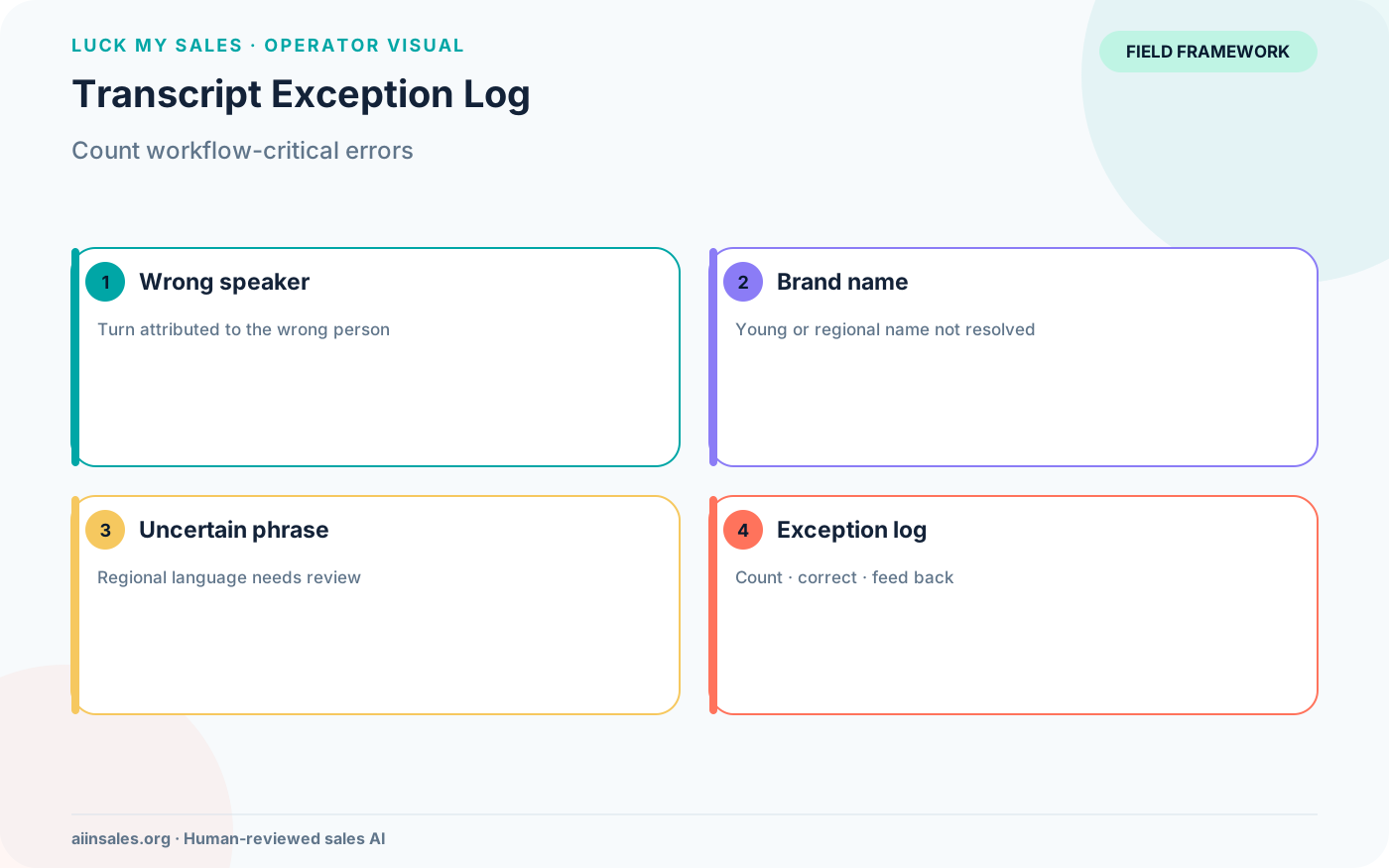
Anonymized transcript review highlighting speaker, brand-name and regional-language exceptions.
Count the errors your workflow cares about instead of repeating a generic accuracy percentage.
Build a test set containing:
  • the languages and regional accents the team actually encounters;
  • company, person, and product names;
  • numbers, dates, currencies, and quantities;
  • multiple speakers and interruptions;
  • phone and video audio;
  • fast speech, poor microphones, and background noise;
  • code switching between languages;
  • an AI-agent to human handoff.
Record material corrections. A missing filler word is not equivalent to changing $15,000 into $50,000. A punctuation error is not equivalent to swapping buyer and seller.
NextLevel has first-party experience with MENA-related voice and conversation workflows, but that is not an independent reason to rank it over the products above. Regional language quality must be tested with representative calls for every candidate.

11 / Evidence, objections, intent, and n…

Evidence, objections, intent, and next steps

Call analysis should make the commercial evidence easier to inspect.
For each extracted item, require:
  • the claim or label;
  • the source timestamp;
  • nearby context;
  • confidence or uncertainty;
  • missing information;
  • recommended action;
  • human owner.
An objection classifier may tag “we already have a vendor.” A seller still needs to determine whether the buyer is satisfied, contractually locked in, deflecting, or open to a supplemental solution.
A next-step extractor may find “send me the deck.” It should not silently convert that into a qualified opportunity or an agreed meeting. AI can propose follow-up. A human owns the customer commitment.
The best product is not the one that finds the most signals. It is the one that produces fewer unsupported conclusions and makes correction quick.

12 / CRM write-back and decision rights

CRM write-back and decision rights
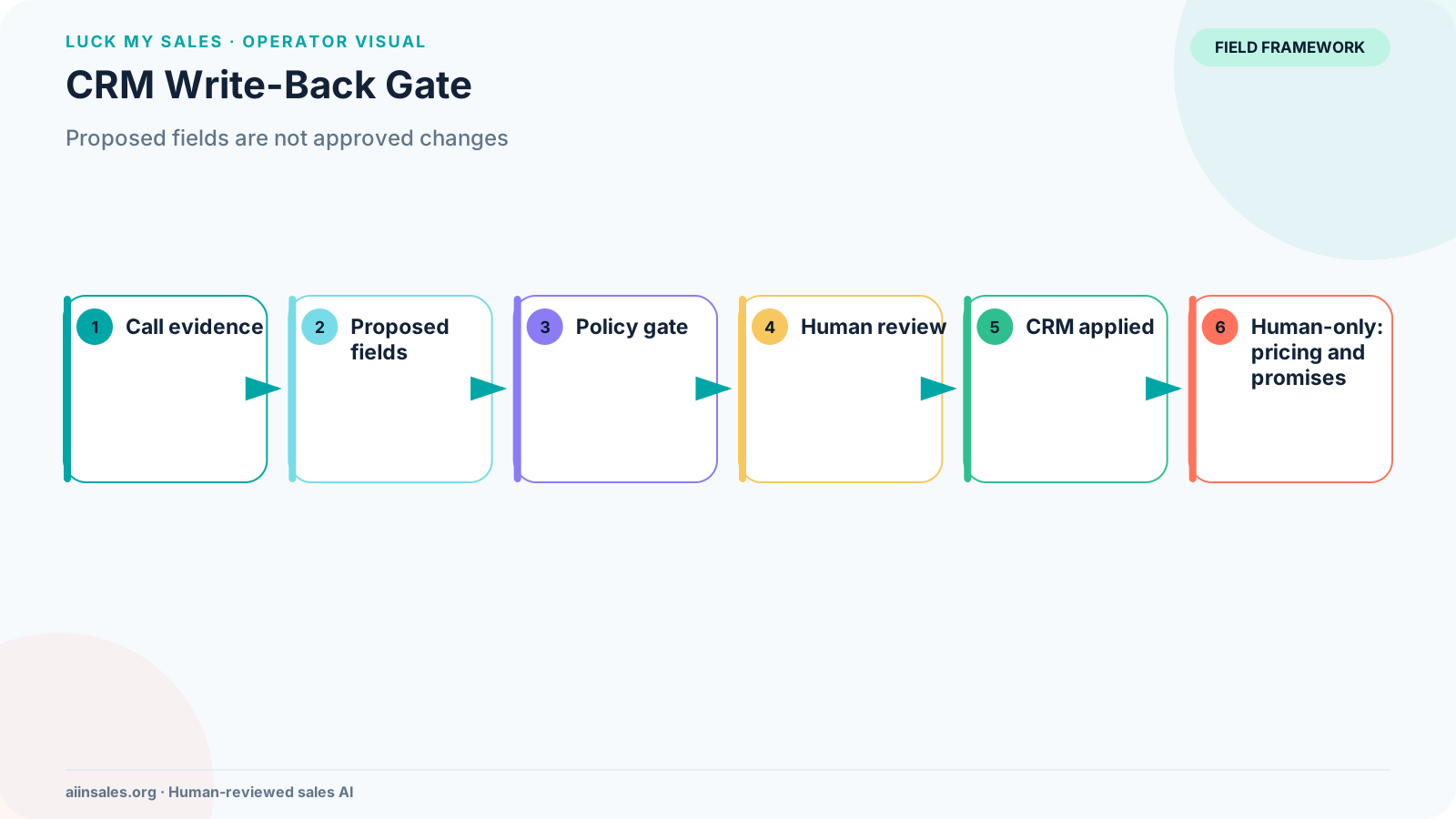
CRM write-back workflow with a policy gate and human-only path for pricing and promises.
A useful integration distinguishes proposed fields from approved changes.
ActionSafe starting position
Attach recording or transcriptautomate after identity matching is proven
Draft summaryautomate, label as AI-generated, keep evidence link
Store topics or descriptive tagsautomate after taxonomy testing
Create internal draft taskautomate after rule check and owner notification
Draft customer follow-upAI drafts; seller reviews and sends
QualificationAI recommends; SDR or seller decides
Opportunity stageAI recommends; seller decides
ForecastAI flags risk; authorized leader decides
Pricing and commercial proposalretrieve human-approved inputs only; human authors final proposal
Account ownerAI may recommend; sales makes the final change
Test duplicates, stale owners, merged records, parallel opportunities, and conflicting automations. “Native CRM integration” does not eliminate the need for a field contract.

13 / Governance, consent, and retention

Governance, consent, and retention

Every shortlisted tool may process sensitive buyer and employee conversations. Evaluate:
  • recording notice and consent controls;
  • storage and data residency;
  • access by role and team;
  • retention and deletion;
  • export and portability;
  • model-training policy;
  • audit logs;
  • redaction and sensitive-call handling;
  • seller correction and dispute process;
  • use of scores in employment decisions.
AI scores must not decide termination, pay, commission, promotion, or discipline. Managers should not use a transcript as if it were infallible. Human and organizational context remains necessary.

14 / Cost and readiness

Cost and readiness
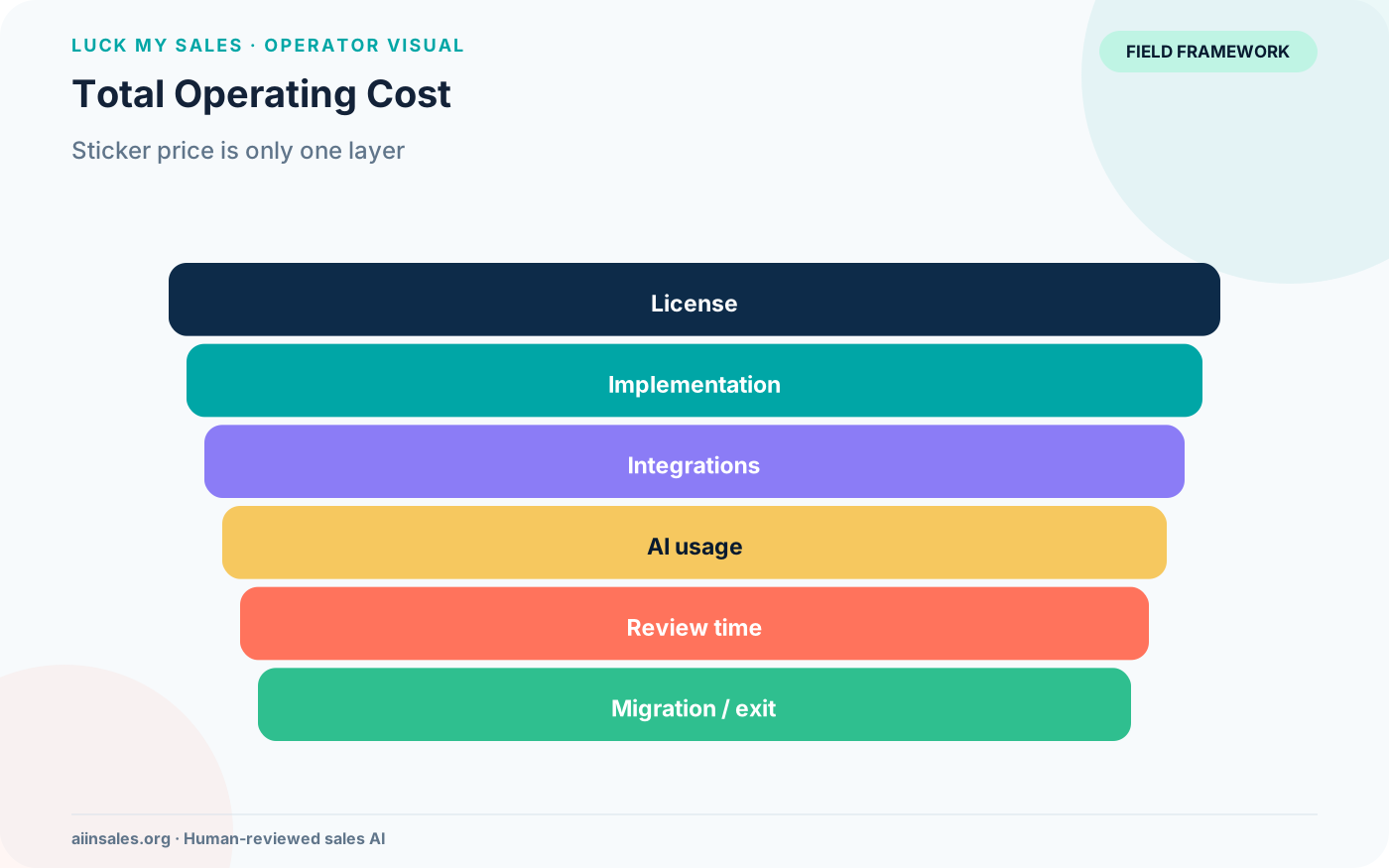
Total operating cost stack for sales call analysis software.
Sticker price is only one layer of call-analysis cost.
  • licenses and required modules;
  • recording or telephony costs;
  • AI or usage credits;
  • CRM and data integrations;
  • implementation and migration;
  • admin and manager review;
  • seller training;
  • compliance and security work;
  • overlapping tools that remain;
  • correction and cleanup.
Before buying, the team should have a minimally closed loop: a conversation reaches the correct record, stages and owners are defined, next actions are tracked, outcomes return to the CRM, and humans can correct AI output.
Without that loop, a sophisticated tool produces more summaries while the pipeline stays unreliable.

15 / Best tool by team architecture

Best tool by team architecture

The same product can be a good decision for one team and an expensive detour for another. Map the operating architecture before comparing demos.

Founder-led or very small sales team

The founder usually needs reliable recording, a searchable transcript, an accurate summary, and a short list of agreed actions. They can still review most important calls personally.
Prioritize low setup effort, predictable cost, and clean export to the existing CRM or task system. A broad coaching and forecasting platform may add more administration than value. If the founder is not maintaining basic stages and next steps, call analysis will not repair that habit.
The first automation can be modest: attach the call, draft the summary with citations, and propose a follow-up task. Keep qualification, pricing, and commitments manual.

SMB sales team with a working CRM

An SMB team benefits when managers can no longer inspect enough calls manually but still have direct knowledge of accounts. HubSpot-native analysis, Avoma, Salesloft Conversations, or a carefully scoped Gong evaluation may fit, depending on the existing stack.
Prioritize manager queues, custom rubrics, seller correction, CRM matching, and cost per active seller. Avoid buying separate products for recording, notes, coaching, and workflow if one existing platform already covers the real job well enough.

Mature revenue and enablement organization

A larger organization may need standardized scorecards, conversation libraries, pipeline inspection, governance, multiple teams, and a supported change-management program. Gong, Chorus, Salesloft, or another enterprise platform becomes more credible here.
Prioritize permissions, regional policy, integrations, data export, rubric versioning, manager calibration, and adoption reporting. A technically accurate transcript is not sufficient if the organization cannot govern access or operate coaching at scale.

Phone-heavy or contact-center sales

Meeting-oriented products are not automatically suitable for high-volume phone workflows. Verify telephony capture, IVR and transfer handling, call disposition, real-time versus post-call needs, agent handoffs, retention, and regional language quality.
The best answer may be a contact-center intelligence product or a custom evidence layer rather than one of the meeting-first names in the main table. Only include a vendor in the final shortlist after official support for the required channel and integration is confirmed.

AI voice-agent workflow

An AI agent creates a different evidence model. The system should preserve what the user said, what the agent said, what tools the agent called, what data it collected, why it classified the interaction, and when it transferred control to a human.
A plain transcript misses tool actions and hidden state. The evaluation should include conversation logs, structured fields, consent, failed validation, escalation, CRM writes, and final outcome. This is an area where custom orchestration may matter more than a familiar conversation-intelligence brand.

16 / Custom workflow versus packaged pla…

Custom workflow versus packaged platform

The market is moving toward systems that combine established infrastructure with custom AI orchestration. “Custom” should not mean rebuilding every component. It means controlling the evidence and actions that are unique to the business.
A packaged platform is usually better when the team wants supported recording, mature permissions, broad integrations, standard manager workflows, and a predictable vendor relationship.
A custom layer is reasonable when:
  • the team needs nonstandard CRM objects or routing rules;
  • regional languages or channels require special handling;
  • an AI voice or web agent creates evidence outside ordinary meetings;
  • summaries need business-specific structure;
  • actions cross several systems through n8n or another orchestrator;
  • human approval must be inserted at precise decision points;
  • the company wants to replace several narrow SaaS tools with one controlled workflow.
The custom path creates its own obligations: monitoring, security, model evaluation, prompt and schema versioning, retries, audit logs, and ownership when a vendor API changes.
Compare build and buy on the same jobs. For each, calculate who maintains capture, consent, terminology, evidence links, CRM mapping, review queues, and correction feedback. A custom demo can look cheap before those responsibilities are priced. A platform can look complete before unused modules and implementation time are priced.

17 / Red flags in demos and sales calls

Red flags in demos and sales calls

The following claims require more evidence:
  • “We analyze 100% of calls.” Ask what happens to unsupported channels, failed recordings, consent exclusions, and poor audio.
  • “Our summaries are accurate.” Ask for claim-to-timestamp review on an unfamiliar call.
  • “We detect objections automatically.” Test indirect objections and surrounding context.
  • “We integrate with your CRM.” Ask for the exact objects, fields, directions, permissions, and conflict rules.
  • “Managers save hours.” Measure the full review and correction workflow with your rubric.
  • “The model supports many languages.” Test your regional calls, names, and code switching.
  • “AI coaches every seller.” Ask who defines the rubric, corrects scores, and connects feedback to outcomes.
  • “No setup is required.” Clarify terminology, access, retention, ownership, and workflow rules.
A strong vendor should be comfortable showing uncertainty and limitations. A call-analysis system that never says “insufficient evidence” is likely converting ambiguity into confidence.

18 / What the same call should reveal ac…

What the same call should reveal across every product

A useful comparison needs a stable input. Use one representative sales call and keep the evaluation questions unchanged. The call should include a real commercial problem, an objection, a named stakeholder, an uncertain detail, and an agreed next action. It should also include normal noise, interruptions, and product terminology.
First test capture. Confirm that the meeting or phone call appears without manual rescue. Check the seller, buyer, account, and opportunity association. A missed call or wrong CRM match is a workflow failure even when the transcript would have been accurate.
Then test the transcript. Review names, companies, amounts, dates, products, speakers, and the buyer’s exact objection. Do not reward a product for punctuation while it changes a commercial fact. Count material errors and the time needed to correct them.
The summary test comes next. A useful summary distinguishes what the buyer said from what the model inferred. It should identify the current process, pain, consequence, stakeholder, objection, and next step when those facts exist. It should say “not established” when budget, timing, or authority is missing.
Now test evidence links. Every important statement should lead back to a recording moment or transcript segment. The reviewer should not need to search the full call to confirm a score. Unsupported summaries are convenient notes, not decision evidence.
The recommendation test should be conservative. The product may suggest a follow-up question, task, or manager review. It may recommend keeping a stage unchanged. It should not invent pricing, a commercial promise, a close date, or a forecast change.
Next, test coaching. Give every product the same small rubric. Ask whether the seller confirmed the current process, captured a consequence, handled the objection, and agreed a next action. Have two managers review the output. If the managers disagree, fix the rubric before blaming the model.
Test CRM write-back last. Use a sandbox or controlled record. Review the proposed destination, field, old value, new value, source evidence, confidence, and owner. Test duplicates, missing opportunities, stale ownership, and rollback. A clean happy-path demonstration is not enough.
This common-call approach prevents feature lists from dominating the decision. It reveals whether a product can operate inside the buyer’s real system.

19 / Product fit by the primary evidence…

Product fit by the primary evidence job

Teams often shortlist too many products because they begin with the category name. Start with the evidence job instead.
Choose a broad conversation and revenue platform when managers need call evidence connected to deals, pipeline review, coaching, and revenue decisions. Gong and Chorus sit closer to this job. The buyer still needs to test ecosystem fit, governance, language quality, and cost.
Choose a sales-engagement-native option when the central problem is evidence inside an existing sequence and seller workflow. Salesloft Conversations may reduce context switching for a team already operating in Salesloft. That advantage matters only if the captured channels and CRM writes are reliable.
Choose a CRM-native option when HubSpot already controls meetings, contacts, companies, deals, tasks, and reporting. HubSpot conversation intelligence can be easier to govern inside that system. It is less compelling when the company expects the product to repair a fragmented stack by itself.
Choose a meeting-workflow product when summaries, notes, trackers, scorecards, and coaching around scheduled meetings are the main need. Avoma fits this evaluation path. Verify required packages and the exact integrations used by the team.
Choose a coaching-focused platform when managers already have a methodology and need conversation evidence to support it. ExecVision belongs in this path. The team must still define observable criteria and correction rules.
Choose a custom or contact-center workflow when standard meeting capture is not the main channel. This may apply to AI voice agents, regional phone systems, specialized languages, or unusual routing. A custom system creates more control but also more monitoring, security, and maintenance work.
These paths can overlap. That does not mean the buyer needs every layer. Select the first product based on the bottleneck that creates the most review work or risk today.

20 / The cost of a false positive action

The cost of a false positive action

Accuracy should be weighted by consequence. A weak summary sentence is annoying. A wrong account association can expose private information. A false “qualified” label can pollute forecasts. An invented next step can create an embarrassing customer message.
Define action classes before deployment. Search and summaries can usually tolerate review after generation. Draft tasks and notes should show their source. Stage, forecast, pricing, opportunity ownership, and external communication need stronger approval.
Measure the cost of correction too. Ten small transcript edits may matter less than one incorrect CRM write that takes an hour to trace. The pilot should therefore report errors by type and impact, not only an average accuracy score.
This approach makes product selection more realistic. The best tool is not the one with the highest generic AI score. It is the one that keeps high-impact mistakes visible and recoverable inside the team’s workflow.

21 / A short scorecard for the buying co…

A short scorecard for the buying committee

Give each reviewer one area. Sales checks whether the output helps a seller. Managers check the evidence and coaching queue. RevOps checks identity, CRM writes, correction, and rollback. Security and legal check consent, access, retention, deletion, and export.
Use pass, fail, or needs work. Avoid a false level of precision. A product either preserves a key amount or it does not. A manager either reaches the cited moment quickly or searches the whole call. A CRM action either lands on the right record or creates risk.
Set hard gates before cost scoring. Capture, identity, evidence, consent, and reversibility are hard gates. Price, interface preference, and extra analytics come after them. A cheap product that fails a hard gate is not a bargain.
Keep one written example for every result. Store the call identifier, observed output, correction, reviewer, and product response. This makes the final decision auditable. It also gives the vendor a precise issue to fix.
End with an owner and next decision date. A pilot without a named decision owner often becomes unpaid implementation work. A product should enter production only after the team knows who monitors it.

22 / A 30-day pilot structure

A 30-day pilot structure

The pilot needs enough time for managers and sellers to use the system after the novelty fades.

Week 1: policy, capture, and baseline

Configure only approved channels and users. Document consent and retention. Build the test set and record the current time required for notes, follow-up, call review, and CRM updates.
Do not turn on broad write-back. Confirm identity matching and transcript availability first.

Week 2: summaries and evidence

Review summaries, speakers, names, numbers, objections, and next steps. Count material corrections by reason. Require evidence links for claims.
Compare different call types and languages rather than averaging everything together.

Week 3: coaching and workflow

Apply one small rubric. Managers sample AI-selected calls, correct scores, and give one specific coaching action. Sellers verify summaries and proposed next steps.
Enable only low-risk CRM actions in a sandbox or limited production scope.

Week 4: outcomes and operating decision

Measure review time, correction rate, seller use, task completion, CRM cleanup, and policy exceptions. Interview managers and sellers about friction. Recalculate total cost using the actual operating work.
Decide one of four outcomes:
  • expand the current workflow;
  • keep the product but narrow the use case;
  • extend the pilot to resolve a specific uncertainty;
  • stop because evidence, economics, or adoption is insufficient.
Do not call a pilot successful because calls were recorded. Success means the team can use the evidence to make a better or faster decision under defined controls.

23 / Internal linking: where call analys…

Internal linking: where call analysis fits in the sales AI system

Call analysis should connect to adjacent workflows rather than become an isolated content or software category.
Use the broader AI conversation intelligence for sales guide to define the evidence contract and human decision gates. Use the Gong vs Chorus.ai comparison when those two products are the final shortlist. Connect approved call evidence to CRM automation, revenue intelligence, lead routing, and coaching only after the source and owner remain visible.
This architecture prevents a common mistake: using the same AI summary as proof for qualification, forecast, coaching, and follow-up without checking whether each decision requires different evidence.

24 / The Common-Input Evaluation Sheet

The Common-Input Evaluation Sheet
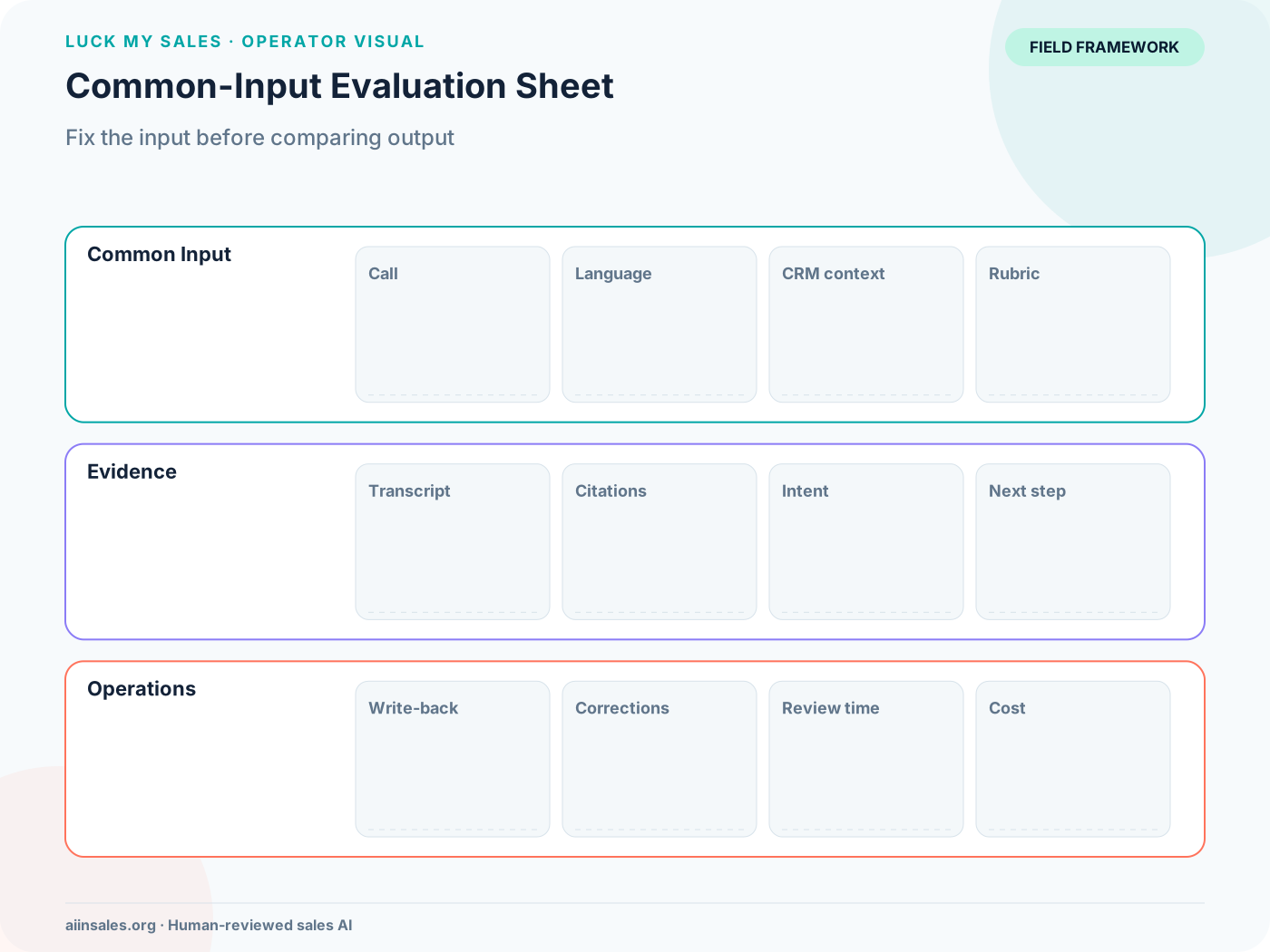
Common-input worksheet for comparing sales call analysis tools using the same recording and rubric.
Fix the input before comparing the output.
TestInputMeasureEvidence to save
Captureapproved calls from every channelcoverage and failurescall IDs and exclusion reasons
Transcriptmixed languages, accents, and audiomaterial correction ratecorrected names, speakers, numbers
Summarysame transcript and CRM contextunsupported or omitted factsclaim-to-timestamp review
Objection/intentknown commercial momentsclassification and contextreviewer decision and reason
Next stepexplicit and ambiguous examplesagreement versus recommendationsource moment and final owner action
Coachingone approved rubricscore correction and manager timebefore/after score with explanation
Searchknown topics and phrasesprecision and retrieval timereturned moments
CRMsandbox object mapmatching, write-back, rollbackaudit log and corrected fields
Governancereal roles and policyaccess, retention, deletionpolicy test result
Economicsequivalent operating scopeannualized total cost and timequote assumptions and internal effort
Do not combine all criteria into one decorative score unless weights reflect the real buying decision. A phone-heavy regional team may weight language and telephony far above coaching libraries. A large enablement team may do the opposite.

25 / Commercial disclosure and limits

Commercial disclosure and limits

The author/team is affiliated with NextLevel.AI. Its workflow is included as first-party operator evidence, not as an independently ranked recommendation.
There are no affiliate payments, sponsorships, free-access benefits, consulting relationships, or other commercial relationships with Gong, Chorus/ZoomInfo, Salesloft, HubSpot, Avoma, or ExecVision.
This article does not claim a same-call benchmark or universal ranking. Features, packaging, integrations, and pricing change; verify them in official documentation and a controlled pilot.

26 / Frequently asked questions

Frequently asked questions

What are the top AI tools for sales call analysis?

Strong candidates include Gong, Chorus, Salesloft Conversations, HubSpot Conversation Intelligence, Avoma, and ExecVision. The right shortlist depends on whether the operating center is revenue intelligence, ZoomInfo, sales engagement, CRM, meetings, or coaching.

Which AI sales call analysis tool is best for small teams?

A lightweight meeting or CRM-native workflow is often more rational than a broad revenue platform. Choose based on call volume, manager capacity, integration needs, and total cost.

Can AI accurately score sales calls?

AI can apply a narrow observable rubric consistently, but managers must sample and correct it. Vague criteria produce vague scores. Do not use AI scores as automatic employment or compensation decisions.

Should sales call analysis update the CRM automatically?

It can automate low-risk descriptive fields and internal tasks after testing. Qualification, opportunity stage, forecast, pricing, commercial promises, and account ownership should remain human-owned.

How do I compare transcript accuracy?

Run the same representative calls through each candidate and count material errors involving speakers, names, numbers, languages, and commercial meaning. Ignore harmless formatting differences.

Is a conversation-intelligence platform worth the cost?

It is worth evaluating when call volume, pipeline, coaching, governance, and review work are large enough that better evidence changes decisions. If the process and CRM are not ready, fix the loop first.

Research note

Methodology

  1. 01The shortlist is organized by workflow job rather than an artificial universal ranking.
  2. 02Hands-on evidence is stated explicitly; other product capabilities are bounded to current official sources.
  3. 03No formal same-call benchmark across every listed product is claimed; the article provides a reproducible pilot method instead.
Read the full methodology

Source ledger

Sources & editorial notes

  1. 01
    Gong conversation intelligence

    Gong · Official product or documentation source used for bounded capability claims; current packaging and features may change.

  2. 02
    ZoomInfo Chorus

    ZoomInfo · Official product or documentation source used for bounded capability claims; current packaging and features may change.

  3. 03
    Salesloft Conversations

    Salesloft · Official product or documentation source used for bounded capability claims; current packaging and features may change.

  4. 04
    Salesloft Conversations API

    Salesloft Developers · Official product or documentation source used for bounded capability claims; current packaging and features may change.

  5. 05
    HubSpot conversation intelligence

    HubSpot · Official product or documentation source used for bounded capability claims; current packaging and features may change.

  6. 06
    Avoma conversation intelligence

    Avoma · Official product or documentation source used for bounded capability claims; current packaging and features may change.

  7. 07
    Avoma conversation-intelligence add-on documentation

    Avoma Help · Official product or documentation source used for bounded capability claims; current packaging and features may change.

  8. 08
    ExecVision sales coaching

    ExecVision · Official product or documentation source used for bounded capability claims; current packaging and features may change.

Corrections or primary material: contact the corrections desk.

About the author

Anastasiia Krynytska

Anastasiia Krynytska is a LeadGen Team Lead at Softermii and the lead editor of Luck My Sales. She covers AI-assisted outbound, account research, qualification, messaging, CRM handoffs and revenue workflows from a practitioner’s perspective.View author profile LinkedIn

Continue reading

01 · News analysis

AI sales is moving from assistant to operating layer

The category is expanding from drafting support into research, pipeline decisions, recommended actions and controlled execution.

Read news
02 · Field analysis

In AI sales, the handoff may be the product

Models are becoming accessible; durable value sits in the controlled transition from signal to seller action.

Read analysis
03 · Research framework

Sales AI Workflow Signals 2026

A launch framework for mapping the products, controls and buying questions shaping AI-enabled revenue work.

Read reports

Luck My Sales briefing

Useful context, once a week.

News, explanations and original research from this desk. No noise.
The newsletter is still being built. We will contact you when the first edition is ready.