
AI SDR comparison & buyer's guide · AI SDR tools
Best AI SDR Tools for B2B Sales: Choose by Workflow, Not Autonomy
AI may assist research organization and drafting. A human editor reviews every published page, checks material claims against the cited sources and owns the final decision. No company paid for placement in this article.
AI use policyAgent-ready brief
AI takeaways
Keep the key points here, or take a source-aware text brief into Claude, ChatGPT or another AI workspace.- 01A writer, database or sender alone is not an AI SDR.
- 02SMBs should buy only after proving the ICP, offer, message and one repeatable channel.
- 03A composed stack can be safer than a suite when it preserves evidence and authority.
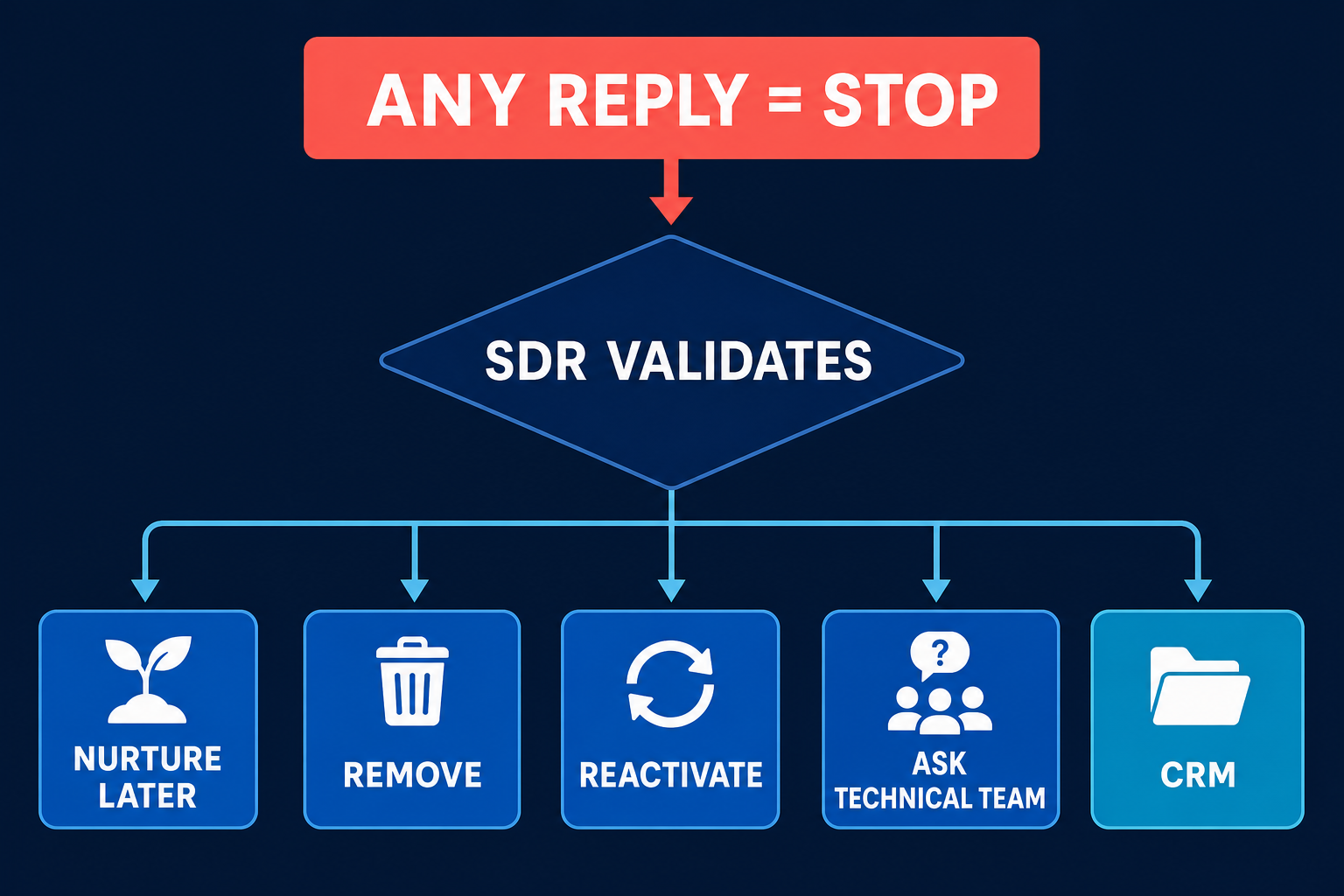
- 04Any reply changes the state and requires human SDR validation.
- 05Compare total operating cost per seller-accepted outcome on the same sample.
An SMB should automate only after a human team has proved the ICP, offer, message and channel.
01 / Buying decision
The short answer: choose the workflow owner, not the AI SDR label
- Buy an end-to-end AI SDR after the outbound motion works. One team must own rollout and test every permission.
- Choose an agent-plus-rep or copilot model for more research support. Sellers should still approve consequential actions.
- Compose a stack when source inspection and custom logic matter. This also makes components easier to replace.
- Wait when the ICP, offer, message or channel changes weekly. Automation will spread that uncertainty faster.
| Start | Evidence | Action | Stop | Human decision | Record | Result |
|---|---|---|---|---|---|---|
| ICP and offer | Source record | Permitted action | Any reply | Human disposition | CRM activation | Accepted outcome |
02 / Definitions
What counts as an AI SDR tool?
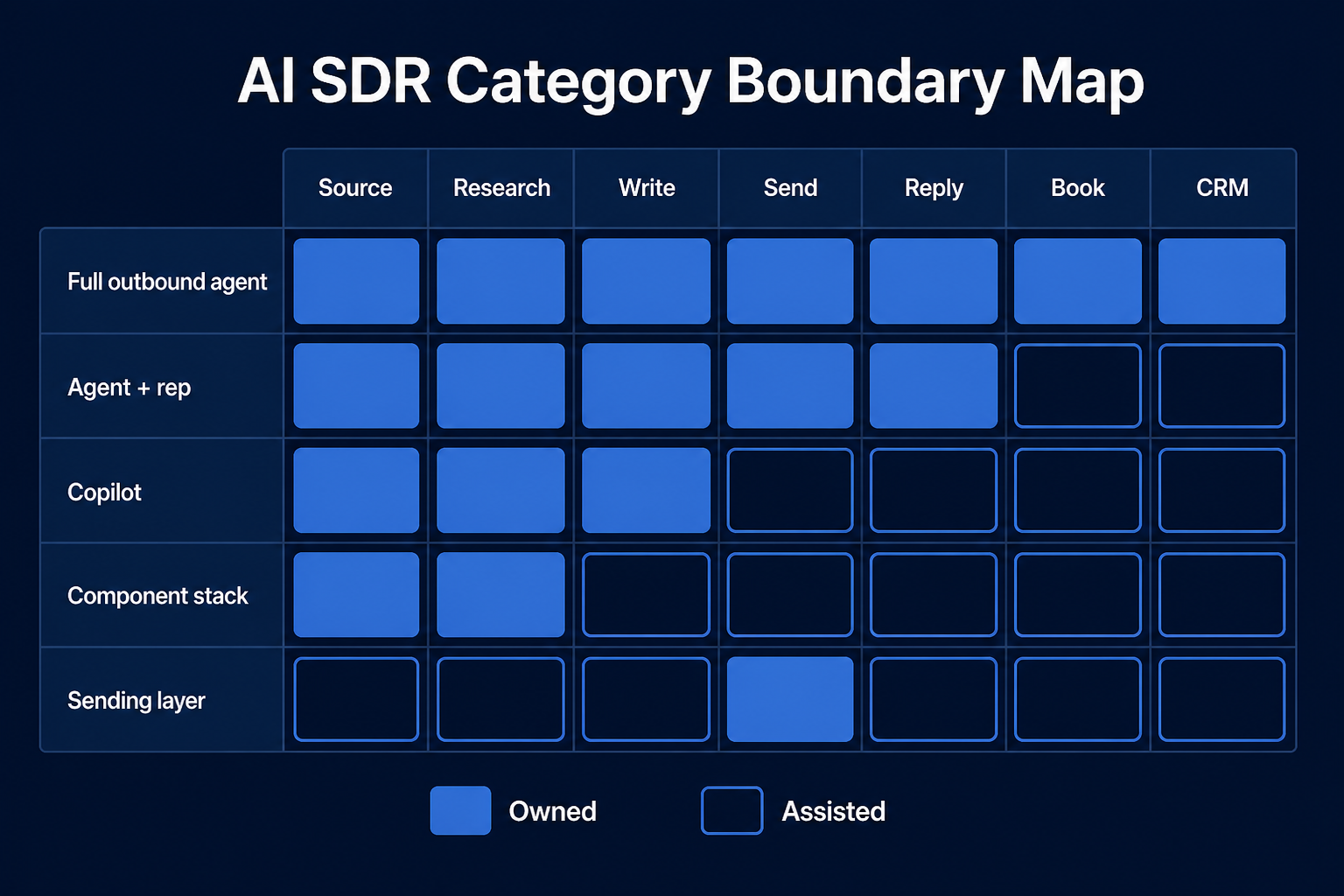
| Category | Typical ownership | What it does not prove |
|---|---|---|
| Full outbound agent | Sources, researches, writes, sends, follows up and may handle replies or book | That the ICP, offer, source data or qualification rule is correct |
| Agent plus rep | Automates much of the motion but exposes approval or escalation points | That every campaign should use the same autonomy mode |
| Sales copilot | Recommends contacts, context and messages for a rep to review | That suggestions are accurate or commercially relevant |
| Component stack | Connects data, enrichment, reasoning and execution tools | That the operator designed a coherent campaign |
| Sending infrastructure | Delivers approved sequences and applies configured stops | That the records or messages deserve to be sent |
03 / When is an
When is an SMB ready for an AI SDR?
- Who is the ICP? Use clear account and buyer rules. Avoid a vague buyer persona.
- What is the offer? State the problem, credible outcome and response reason.
- Which message works? Keep a reviewed sequence. Add examples of acceptable and rejected copy.
- Which channel is repeatable? Prove one path before adding email, LinkedIn, calls and more automation at once.
- Who owns replies? Name the person who validates each response. Cover interest, objections and referrals. Include timing and removal requests.
- What enters CRM? Define the activation rule and fields. Name the owner and next action before any write.
04 / How Luck My
How Luck My Sales evaluates AI SDR tools
- Workflow ownership: Which objects and stages does the product control?
- Evidence quality: Can users see each source, date and reason?
- Human and reply controls: Can teams review, stop and override actions? Can they transfer ownership?
- Execution safeguards: How does the product govern channels and suppression? How does it handle deliverability and CRM actions?
- Total cost and outcome: Which costs sit outside the subscription? Which accepted outcome will justify the total?
- Used in a broader workflow: the product appeared in approved operating material. Its AI features were not compared under one controlled test.
- Docs review: we read the current official pages. We make no hands-on claim. We also make no accuracy or performance claim.
05 / Comparison
Seven AI SDR tools at a glance
| Product | Best fit by workflow job | Documented control model | Main buyer check | Evidence |
|---|---|---|---|---|
| 11x Alice | Broad end-to-end outbound coverage | Product page describes automated prospecting, personalization, multichannel sequencing and handoff | Ask to inspect data sources, reply behavior, CRM history and campaign-level kill switch | Documentation-reviewed |
| Artisan Ava | Full AI BDR with adjustable review | Official pricing FAQ documents approval-before-send controls, banned phrases and autonomous operation | Test whether approval, reply escalation and CRM sync behave differently by risk tier | Documentation-reviewed |
| AiSDR | Signal-led research and strategy before outreach | Official pages describe prospecting, research, campaign strategy and omnichannel execution | Verify which signals are sourced, which are inferred and where a human approves replies | Documentation-reviewed |
| Salesforge Agent Frank | Explicit co-pilot/autopilot choice plus email infrastructure | Official page documents a knowledge base, prospecting, modes, personalization sources and separate infrastructure | Count contacts, inboxes and infrastructure together; start in co-pilot | Documentation-reviewed |
| Reply.io Jason | One workflow from ICP and sequence to reply and booking | Official features document co-pilot/autopilot, multichannel execution, reply handlers and booking | Constrain knowledge, objections and replies before allowing autopilot | Documentation-reviewed |
| Regie.ai | Hybrid agent-and-rep orchestration | Official site describes agent and rep tasks in one engagement workflow | Confirm task ownership, signal provenance and CRM mutation rights | Documentation-reviewed |
| Amplemarket Duo | Human-in-the-loop signal and sequence preparation | Official page says reps review, edit, regenerate, send or dismiss | Validate whether contact-level signals support the commercial hypothesis | Documentation-reviewed |
06 / Workflow
11x Alice: broad workflow ownership for teams prepared to audit it
07 / Artisan Ava: full
Artisan Ava: full AI BDR with visible approval controls
08 / AiSDR: signal-led prospecting
AiSDR: signal-led prospecting for teams that reject raw volume
quality over volume slogan proves quality.09 / Sender controls
Salesforge Agent Frank: co-pilot first with explicit infrastructure cost
10 / Authority
Reply.io Jason: end-to-end workflow with reply automation that needs a narrow contract
11 / Regie.ai: hybrid orchestration
Regie.ai: hybrid orchestration for an established rep motion
AI and human labels in a demo. Name the campaign owner for each task. Log every transition.12 / Pilot
Amplemarket Duo: a copilot for signal review, not an autonomous replacement
intent. Social activity and job changes may justify research. The same applies to reviews and CRM events. None proves readiness to buy. Inspect the source, date, identity and commercial link before sending.13 / Stack design
A governed AI SDR stack can be better than one suite
- 40% contact and data work: find the right accounts and people. Confirm identity. Check contactability and keep the source record.
- 40% reasoning or agentic work: evaluate fit and current commercial reasons. Draft and validate each decision.
- 20% delivery: run approved sequences. Apply simple limits and hard stops.
| Layer | Example role | Human responsibility |
|---|---|---|
| Data and contact | Apollo, Sales Navigator, Clay | Approve ICP, entity match, source freshness and contactability |
| Reasoning | Claude Code or another governed agentic layer | Define rubric, inspect evidence, reject weak reasons and approve strategy |
| Execution | lemlist or Instantly | Configure channel, schedule, suppression, reply stop and sender limits |
| System of record | CRM after validation | Activate only accepted records, assign owner and preserve next action |
14 / Authority
Use a reply and CRM contract
- contact later or nurture;
- remove the person;
- reactivate at a defined time;
- ask the technical team for details;
- activate a validated positive or neutral lead in CRM.
15 / Total cost
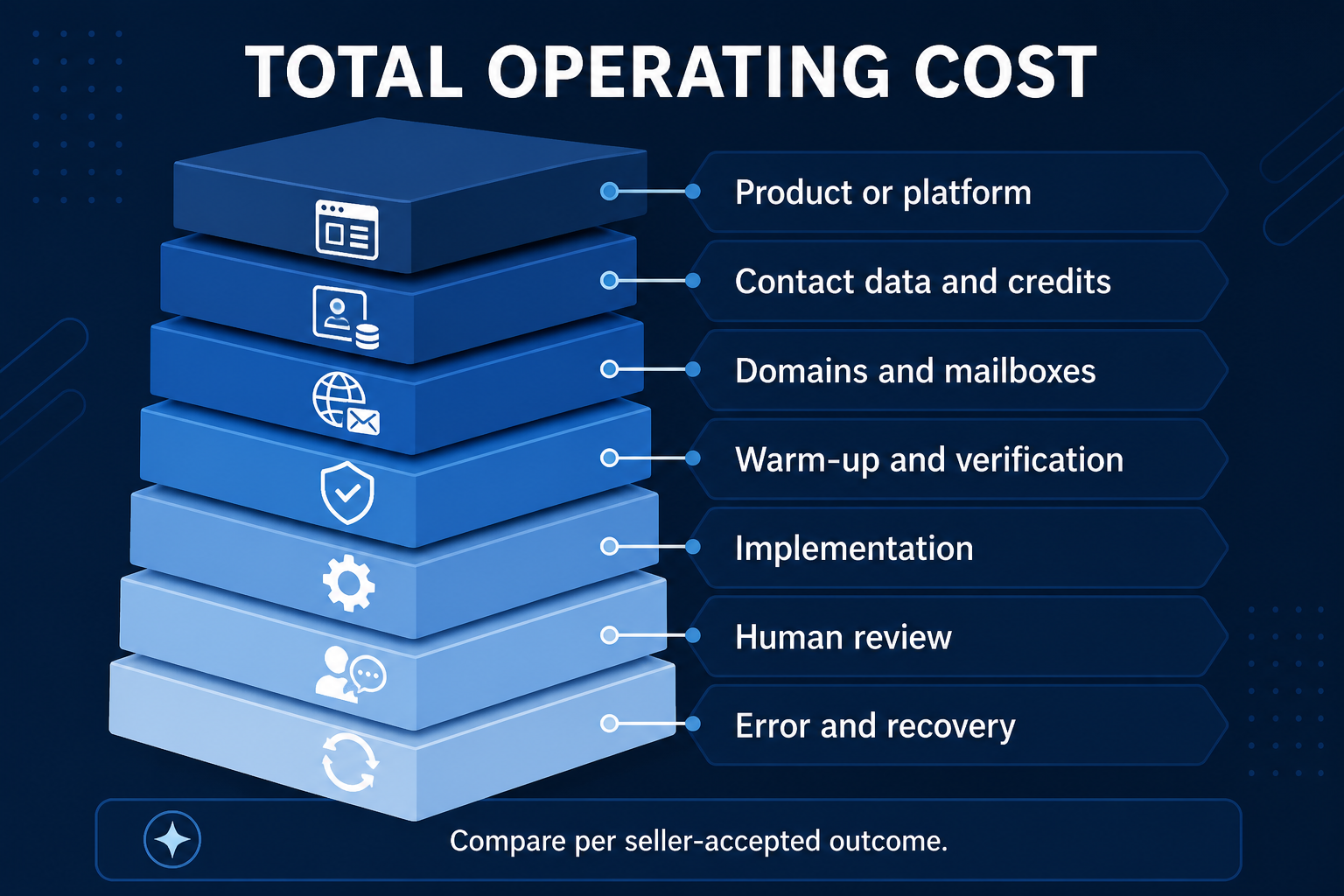
Compare total operating cost, not the subscription headline
| Cost line | What to record |
|---|---|
| Product or platform | Plan, contract period, included contacts, users, channels and support |
| Contact data and enrichment | Credits, waterfalls, verification and refresh frequency |
| Domains and mailboxes | Domains, mailbox count, provider and replacement capacity |
| Warm-up and monitoring | Ramp time, health checks and operational tooling |
| Implementation | ICP, playbooks, knowledge base, CRM mapping, security and legal review |
| Human review | Minutes per record, reply ownership, exception handling and coaching |
| Failure and recovery | Bad data, damaged sender reputation, duplicate contact, CRM cleanup and lost account trust |
| Cost metric | Formula |
|---|---|
| Cost per accepted conversation | Total operating cost ÷ seller-accepted conversations |
16 / Pilot
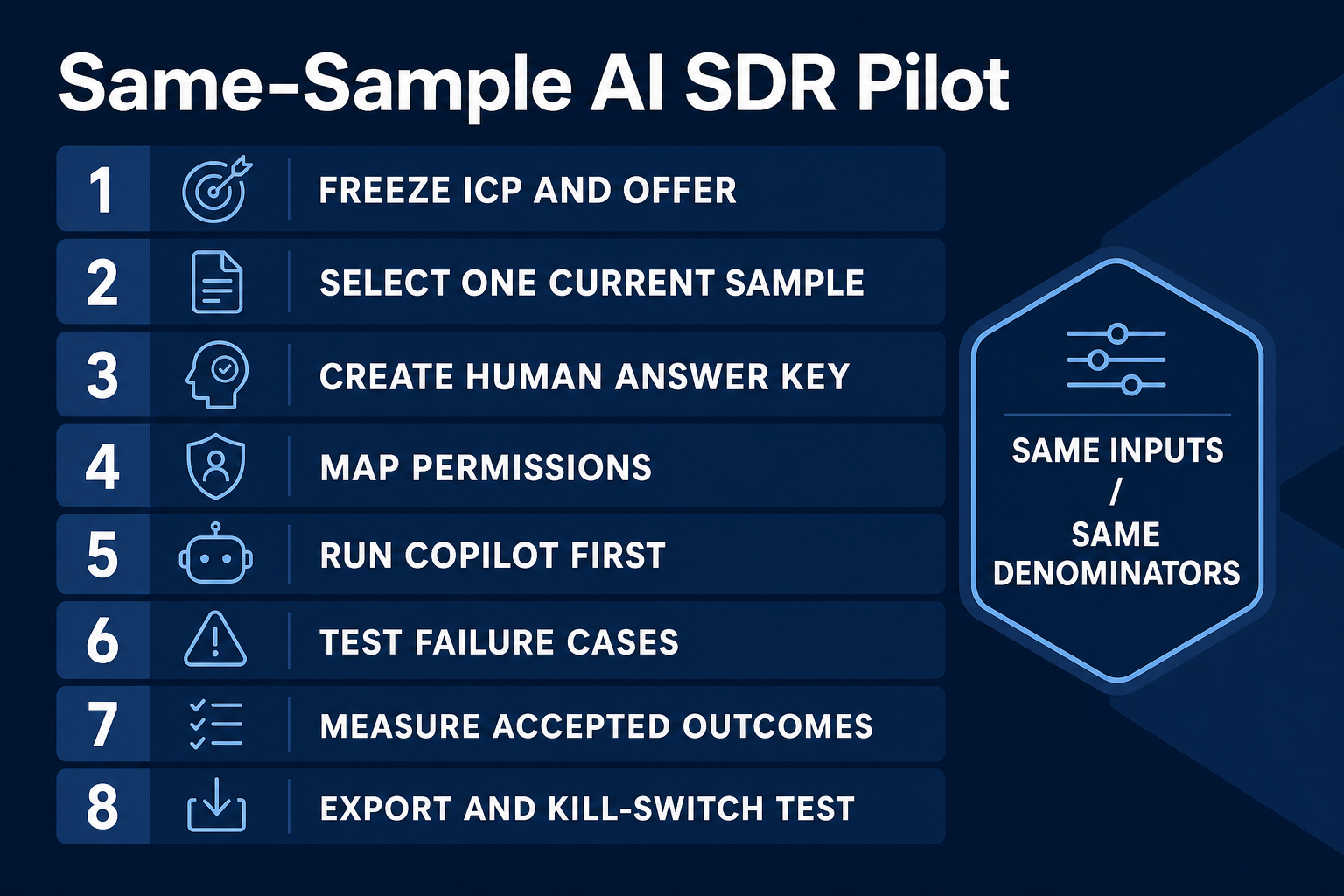
Run a same-sample AI SDR pilot
- Freeze the motion. Use one ICP, offer, message policy, channel scope and CRM rule.
- Select one current sample. Use the same accounts for each viable setup. First remove customers and active deals. Then remove suppressed and duplicate records.
- Create a human answer key. Mark the correct identity and fit. Then mark acceptable evidence. Add the contact reason and next action before running tools.
- Map permissions. List every action that each product may take. Cover research, drafting, enrollment, sending, replies, booking and CRM.
- Begin in copilot mode. Review every proposed contact and message. Continue until you can see the failure patterns.
- Test failure cases. Include stale roles, namesakes and existing owners. Add named accounts, opt-outs, wrong-person replies and ambiguous objections.
- Measure accepted outcomes. Count approved records, useful replies and held meetings. Add accepted deals, review time and total cost. Name every denominator.
- Test exit and recovery. Pause the campaign and export its records. Revoke access, correct CRM and confirm suppression survives shutdown.
17 / Measurement
Measure accepted conversations and opportunities
| Metric | Formula |
|---|---|
| Delivery rate | Delivered messages ÷ attempted messages |
| Meaningful reply rate | Usable commercial replies ÷ delivered messages |
| Positive reply rate | Defined positive replies ÷ delivered messages |
| Held-meeting rate | Completed meetings ÷ named denominator |
| Opportunity acceptance rate | Accepted opportunities ÷ held meetings |
| Cost per accepted outcome | Total cost ÷ named accepted outcome |
| Review burden | Human review minutes ÷ accepted outcomes |
18 / Failure modes
Failure modes and kill-switch conditions
- Any unsubscribe or suppression request continues to receive contact.
- A reply does not stop the active sequence.
- The system cannot show the source behind a material personalization claim.
- A named account is enrolled without its required review.
- Contacts are duplicated across tools or sellers.
- The system answers topics outside its approved knowledge. These include price, security, law and product details.
- CRM owner, stage or activity history changes without an audit path.
- The team cannot pause, export, correct or revoke the workflow quickly.
- Sender health deteriorates and the team responds by increasing volume.
19 / Decision rules
Buy, compose or wait: recommendations by SMB motion
| SMB situation | Recommended path | Why |
|---|---|---|
| Service business with a proven niche and repeatable email motion | Pilot a co-pilot or controlled full agent | Research and drafting can reduce labor, while reply context and named accounts stay human-owned |
| Small SaaS with product signals and an existing CRM process | Compare a signal-led copilot, hybrid platform and composed stack | Product, CRM and professional signals may improve timing if the team can validate identity and meaning |
| Founder still changing ICP and offer | Wait; automate research or list preparation only | The founder still needs direct conversations to discover the sales system |
| Team with a few strategic accounts | Compose a research stack and require per-account review | Volume is not the bottleneck; account context and relationship ownership are |
| Established SDR team with clear playbooks and RevOps support | Pilot a full or hybrid agent with action-level permissions | The organization can define controls, evaluate failure cases and manage CRM audit |
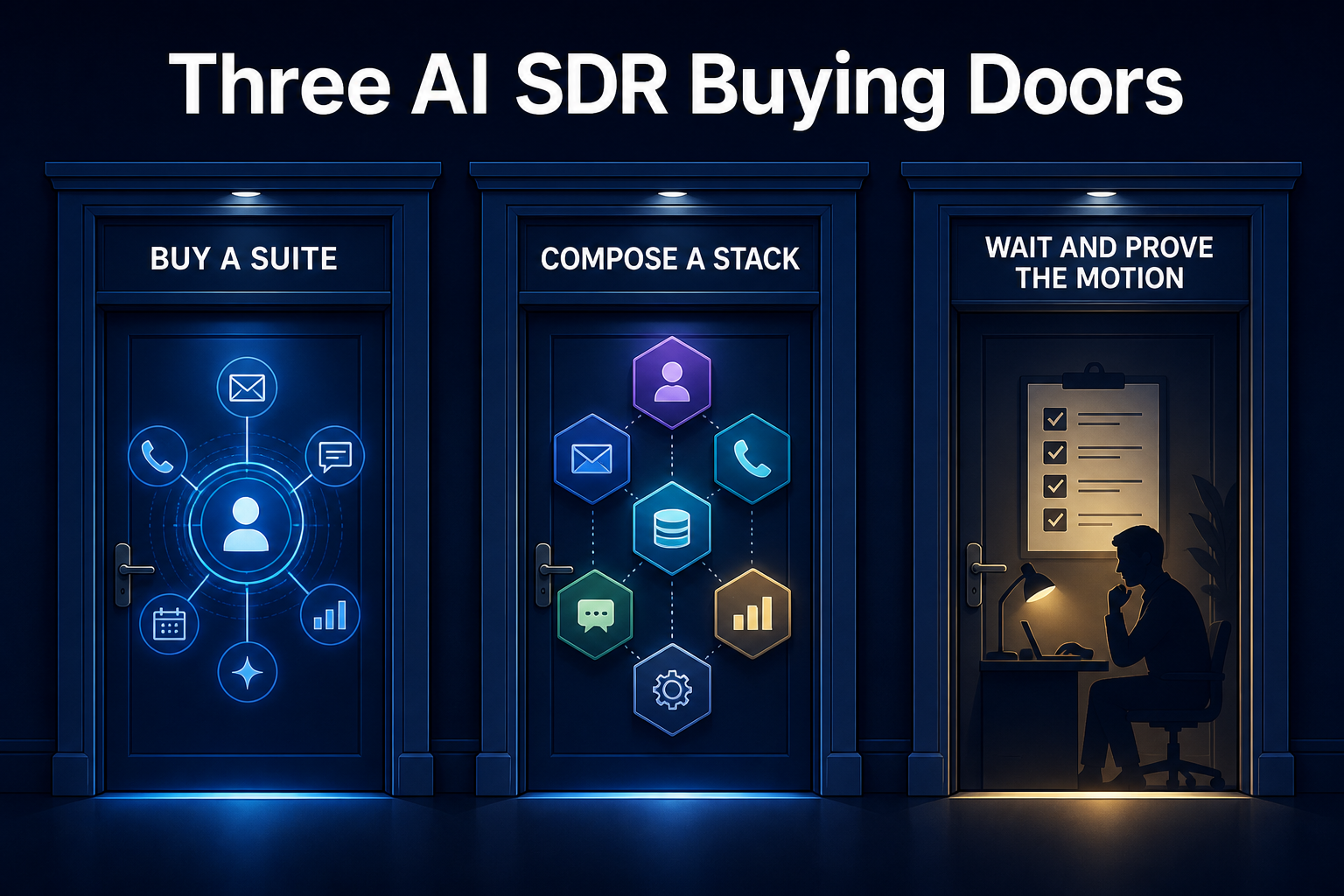
best choice remains conditional:- Best for full documented workflow coverage: shortlist five broad agents. They are 11x, Artisan, AiSDR, Agent Frank and Jason. Test their controls on one sample.
- Best for agent-and-rep orchestration: shortlist Regie.ai.
- Best for human-in-the-loop signal review: shortlist Amplemarket Duo.
- Best for custom evidence and replaceable layers: compare a governed stack.
- Best for an unproved motion: buy nothing yet.
20 / FAQ
Frequently asked questions
What is an AI SDR?
AI. It is the set of owned actions and human controls.What is the difference between an AI SDR agent and an AI SDR tool?
Can an AI SDR replace a human SDR?
Which AI SDR is best for a small B2B team?
How much does an AI SDR cost?
Should an AI SDR answer replies automatically?
What should an AI SDR write to CRM?
Should AI SDR tools automate LinkedIn outreach?
21 / Method
Methodology, evidence limits and update policy
- Owner evidence: Anastasiia approved this operating evidence. Her broader workflow used five tools. They were Apollo, Clay, Claude Code, Sales Navigator and lemlist. She also recommends Instantly for a defined role. A real Lemlist sequence supplies the reply-stop and CRM rule.
- Official sources: we reviewed seven official product sites. They cover Alice, Ava, AiSDR, Agent Frank, Jason, Regie.ai and Duo. The review date was 18 August 2026.
Research note
Methodology
- 01Owner evidence covers Anastasiia Krynytska's documented multi-tool outreach workflow.
- 02Seven candidates are reviewed from official documentation; no common-sample product test was run.
- 03Vendor outcome and accuracy claims are excluded; unresolved relationship declarations remain disclosed.
Source ledger
Sources & editorial notes
- 0111x documents
11x · Official product, platform, policy or regulatory source cited in this guide.
- 02Artisan describes
Artisan · Official product, platform, policy or regulatory source cited in this guide.
- 03Artisan pricing page
Artisan · Official product, platform, policy or regulatory source cited in this guide.
- 04AiSDR's features
AiSDR · Official product, platform, policy or regulatory source cited in this guide.
- 05Salesforge documents
Salesforge · Official product, platform, policy or regulatory source cited in this guide.
- 06Reply.io's feature page
Reply.io · Official product, platform, policy or regulatory source cited in this guide.
- 07AI Features Terms
Reply.io · Official product, platform, policy or regulatory source cited in this guide.
- 08Regie.ai describes
Regie.ai · Official product, platform, policy or regulatory source cited in this guide.
- 09Amplemarket's Duo page
Amplemarket · Official product, platform, policy or regulatory source cited in this guide.
- 10LinkedIn's help page
LinkedIn Help · Official product, platform, policy or regulatory source cited in this guide.
- 11FTC's CAN-SPAM guide
US Federal Trade Commission · Official product, platform, policy or regulatory source cited in this guide.