Weekly industry intelligence · No noiseSubscribe to the Luck My Sales newsletterFree briefing

Independent operator-led media on AI in B2B sales

Menu

Operational prospect-research guide · AI prospecting

How AI Sales Agents Research Prospects Before Outreach

Build an AI prospect research workflow that separates facts from inference, checks freshness and conflicts, records sources and stops weak leads before outreach.
Editorial disclosure

AI may assist research organization and drafting. A human editor reviews every published page, checks material claims against the cited sources and owns the final decision. No company paid for placement in this article.

AI use policy

Agent-ready brief

AI takeaways

Keep the key points here, or take a source-aware text brief into Claude, ChatGPT or another AI workspace.
  1. 01Research, enrichment and personalization are different stages with different evidence standards.
  2. 02Capture a source and date for every material field and verify volatile facts before present-tense use.
  3. 03Separate verified fact, bounded inference and sales hypothesis in the decision record.
  4. 04Make contradiction, missingness, suppression and negative fit first-class action states.
  5. 05Keep research approval separate from message drafting and channel permission.
Includes summary, takeaways, sources and a use note.
How AI sales agents research prospects before outreach begins with a source-linked decision record, created before they draft a message or enroll a contact. The record should separate verified facts from bounded inference and sales hypotheses, show contradictory or missing evidence, check suppression and end with an allowed action: approve, review, reject or do not contact.
The output is not a personalization hook. It is a compact answer to three questions:
Is this the correct account and person?
Does current evidence support a relevant reason to contact them?
What may the outreach workflow say or do next?
AI can collect and normalize more records than a seller can inspect manually. That is useful only if the source, date and correction path remain visible. A true fact from an obsolete source can still create a false message.
Method and disclosure: this guide uses an owner-supplied Clay plus LLM/Claude Code workflow. The operating stack also used BuiltWith or Wappalyzer, LinkedIn Sales Navigator, Hunter or Apollo and Clay enrichment. Product names describe the real stack, not an accuracy endorsement or commercial recommendation. The supplied dataset totals and usable-yield range remain outside the public result because domains, records, contacts and qualified leads were not reconciled into one denominator. Named first-person attribution is unresolved, so the experience is described in neutral voice.

Prospect research should produce a source-linked decision record with visible freshness, contradictions and permission boundaries before any message is drafted or contact is enrolled.

01 / Research is not the same as enrichment

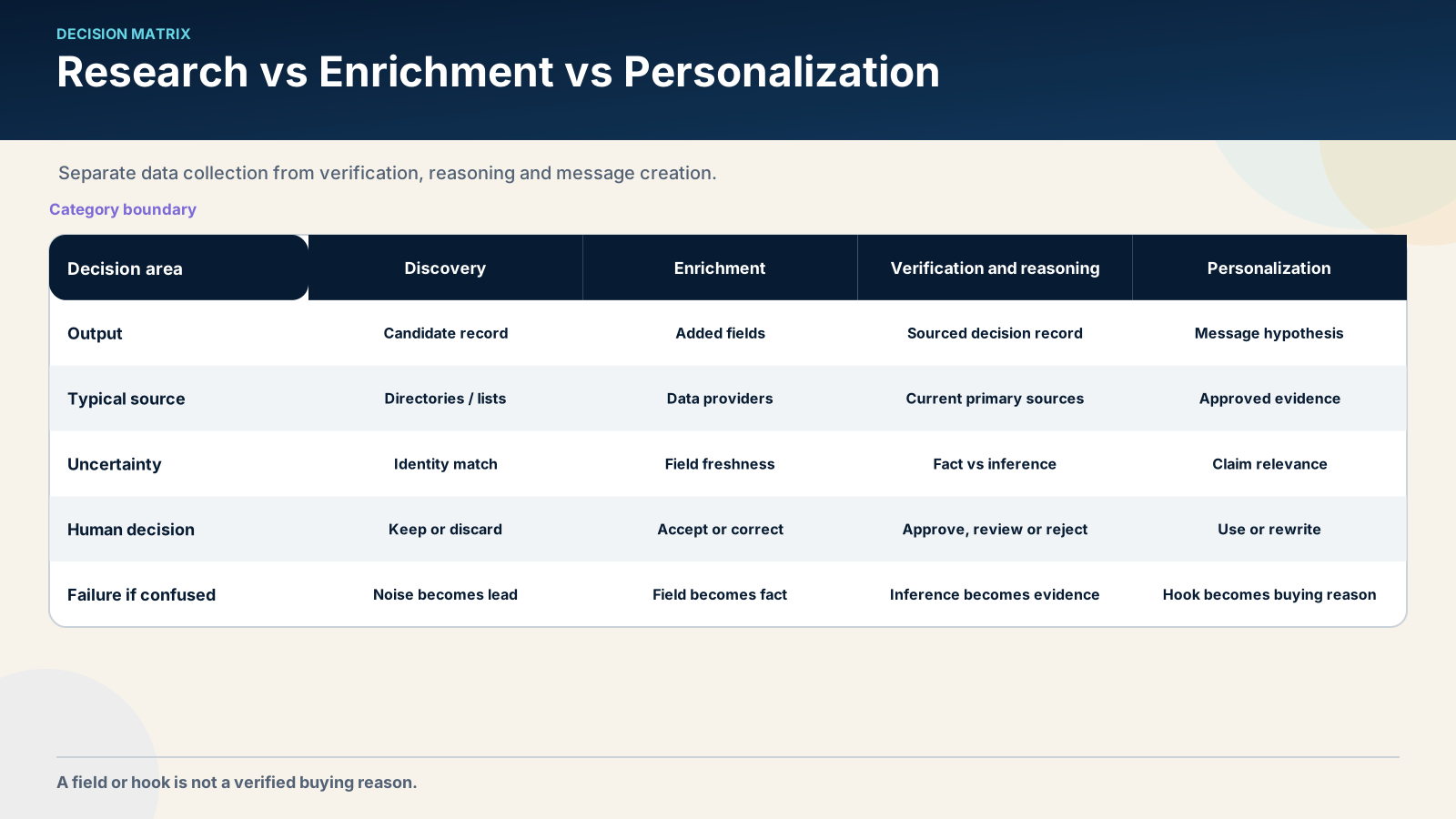
Research is not the same as enrichment or personalization

These steps create different outputs.
StepInputOutputCommon failure
DiscoveryICP filters, lists and sourcesCandidate accounts or peopleCandidate treated as qualified
EnrichmentCandidate identityAdditional firmographic, role, contact or technology fieldsAdded field treated as current truth
Verification and reasoningSources, dates and decision ruleSourced prospect decision recordInference hidden as fact
ScoringVerified evidence and policyPriority or action stateNumber hides missing evidence
PersonalizationApproved facts and offerMessage hypothesis or draftInteresting detail with no commercial link
OutreachEligible record, permission and approved messageChannel actionResearch output treated as consent
A verified email address is a deliverability input. It is not consent, ICP fit or buying intent. A technology detected on a website is a research clue. It is not proof that the company currently uses the product in the way your offer assumes.
Comparison of prospect discovery, enrichment, verification and personalization outputs.
Tools can add data or draft language; the research layer decides what the evidence actually supports.

02 / How AI sales agents research prospects before

How AI sales agents research prospects before outreach safely

A bounded job contract could read:

For this approved account list, collect current public and licensed professional evidence, verify company and role, check a defined ICP rubric and contradictions, and return a sourced decision record. Do not infer sensitive traits, invent pain or enroll anyone automatically.

Required outcomes:
  • approve for message drafting;
  • review because evidence is incomplete or conflicting;
  • reject for weak fit or wrong identity;
  • suppress or do not contact;
  • route to an existing owner.
Do not force every record into a score. A missing source is an outcome.

03 / Build a trusted-source hierarchy

Build a trusted-source hierarchy

The right source depends on the claim.

Company identity and current offering

Prefer:
  • official company site;
  • current product or pricing pages;
  • official legal, investor or registry records where relevant;
  • current company newsroom or hiring page.
Use third-party databases as discovery and cross-check sources, not final authority for material claims.

Current role and professional context

LinkedIn Sales Navigator documents filters for current company, title, function, seniority, geography, account growth, activity and buyer-intent labels. These filters help narrow a list. They can be incomplete or stale, and vendor-defined intent does not prove active buying.
LinkedIn also warns in its Sales Navigator search guidance that browser plugins and extensions can result in limitations or restrictions. Use authorized product workflows and current terms. Do not treat access to a profile as permission to scrape or automate contact.

Technology evidence

BuiltWith documents technology-usage and historical website-technology filters. Wappalyzer is another technographic source used in the owner workflow. These tools can identify candidate evidence, but detection can be old, indirect or wrong. Open the current target domain, record the last-seen date and check for contradictory technology signals.

Contact evidence

Hunter's verification documentation says it returns a verification status and confidence score. Apollo can also supply contact and enrichment data in the operator stack. Verification is probabilistic and time-sensitive. Store provider, status and date. Never translate verified into permission to contact.

Enrichment and orchestration

Clay's enrichment documentation describes individual enrichments, templates and recipes across integrations. Clay can coordinate a waterfall of sources and trigger downstream reasoning. The table still needs field-level provenance. Clay output is not a source if the value came from another provider.

04 / Use a source-grounded research workflow

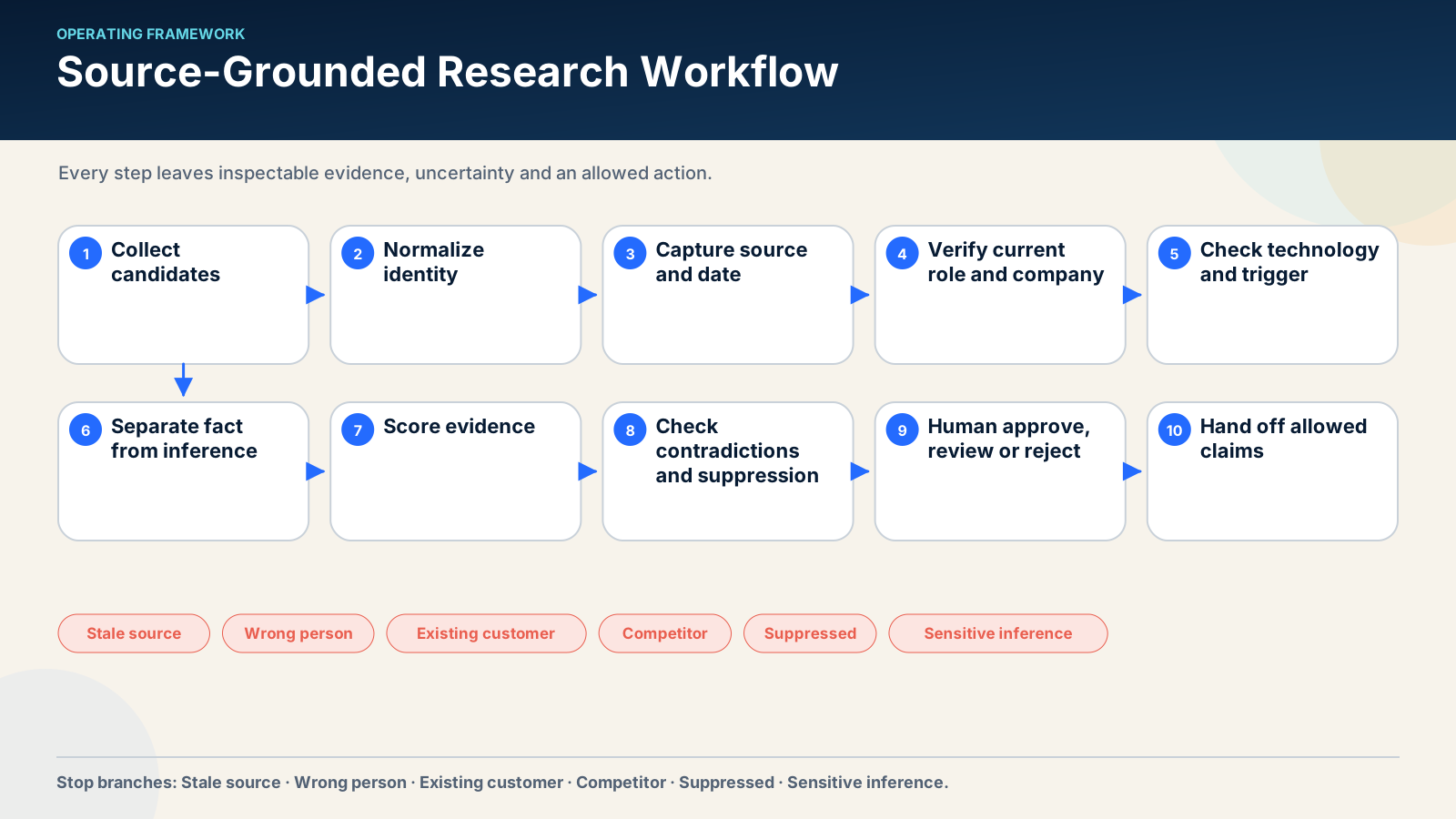
Use a source-grounded research workflow

1. Collect candidates from an approved source

Start with an account list, territory or saved search approved by the sales owner. Record the query, filters, date and owner. Do not begin from a scraped universe with unknown provenance.

2. Normalize identity

Create stable account and contact IDs. Normalize domain, company name, LinkedIn URL, location and current role. Resolve:
  • parent and subsidiary;
  • duplicate domains;
  • personal versus company email;
  • namesakes;
  • consultants with several roles;
  • acquired or renamed companies;
  • archived or parked domains.
Do not let the model merge records because the names look similar.

3. Capture source and date for every material field

Required provenance fields:
  • value;
  • source URL or system;
  • provider;
  • captured date;
  • source date where available;
  • verification state;
  • freshness window;
  • conflicting value;
  • allowed use.
This makes later correction possible. It also prevents one stale enrichment from silently becoming a current message claim.

4. Verify company and role

Check the company domain, current activity and the person's present role. A person can still appear in historical pages after changing jobs. A company can keep an old site online after pivoting or closing.
Use at least one current authoritative source for material claims. When identity remains uncertain, route to review.

5. Evaluate ICP evidence

Turn the ICP into observable conditions. For example:
  • company type and size range;
  • geography;
  • target department;
  • current role and seniority;
  • approved technology condition;
  • active hiring in the target department;
  • exclusion categories;
  • existing customer, partner or competitor state.
The owner described scores 7–10 as a high-fit range that combined strong ICP match, confirmed technology, active hiring in the target department and direct decision-maker contact. The individual meaning of 7, 8, 9 and 10 was not supplied. Therefore the public workflow uses action states rather than pretending that four precise thresholds are known.

6. Separate fact, inference and hypothesis

Use these fields:
Evidence stateExample
Verified factCompany lists three current operations roles
Bounded inferenceThe team may be expanding operations capacity
Sales hypothesisFaster qualification could help the new team
Prohibited claim“Your team cannot keep up with demand”
The message may mention the verified fact. It may ask whether the inference is relevant. It cannot state the hypothesis as hidden knowledge.

7. Check contradictions and negative fit

Before approval, check:
  • wrong current role or company;
  • existing customer, partner or active opportunity;
  • competitor or excluded category;
  • prior contact and owner conflict;
  • unsubscribe or suppression;
  • stale domain or source;
  • technology evidence that disagrees;
  • weak connection between fact and offer;
  • sensitive or personal inference;
  • missing decision-maker evidence.
The negative-fit gate should run before any copy is drafted.

8. Assign an action state

Use:
  • Approve: identity, fit, current evidence and reason to contact are complete.
  • Review: promising record with specific missing or conflicting evidence.
  • Reject: wrong identity, weak fit or unsupported commercial link.
  • Suppress: contact or account cannot enter the workflow.
If the organization keeps a numeric score, map every range to one of these actions and retain the reason. The score never grants permission by itself.

9. Hand off allowed claims

The message writer receives only:
  • approved facts;
  • source and date;
  • bounded inference;
  • offer connection;
  • prohibited claims;
  • uncertainty;
  • allowed channel and action;
  • human reviewer.
This is enough to draft a relevant message without exposing the model to unnecessary personal data or unsupported fields.
Source-grounded prospect research workflow from candidate collection to human approval or rejection.
Every stage should leave a field that can be inspected and corrected.

05 / Use a Prospect Research Decision Record

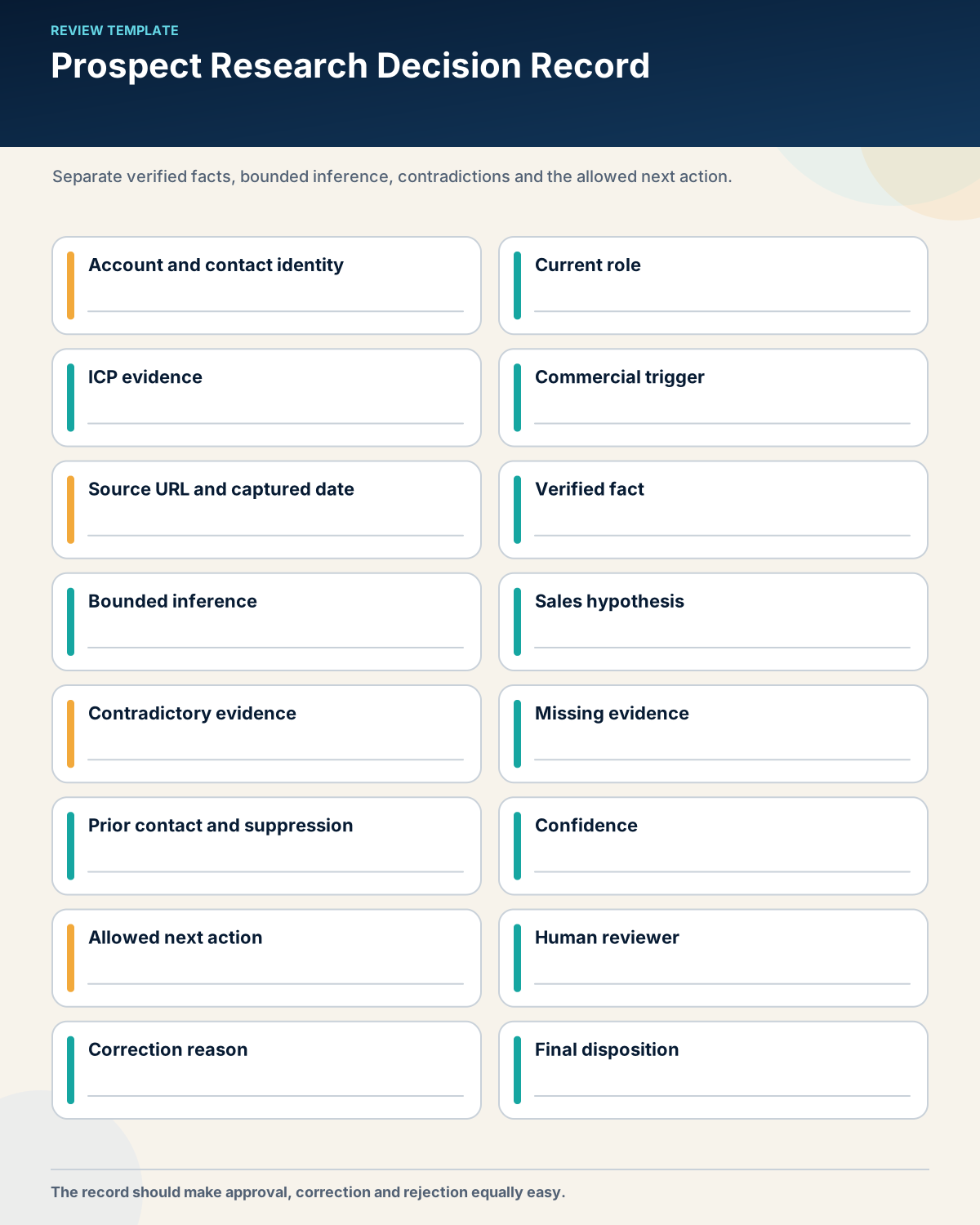
Use a Prospect Research Decision Record

FieldDecision to record
Account and contact identityStable IDs, domain, current role and company
ICP evidenceCriteria met and source behind each
Commercial triggerCurrent fact, not a generic intent label
Source and dateOpenable URL/system and captured timestamp
Verified factExact statement the source supports
Bounded inferencePlausible meaning with uncertainty
Sales hypothesisWhat the seller wants to test
Contradictory evidenceCurrent facts that weaken the case
Missing evidenceRequired field that remains unknown
Prior contact and suppressionOwner, customer, opportunity, reply and opt-out state
Action stateApprove, review, reject or suppress
Allowed next actionDraft, ask researcher, route owner or close
Reviewer and versionPerson, rule set and timestamp
Correction and final dispositionWhat changed and why
The record should fit on one screen. More research is not always better. Stop when the evidence can support the decision or when a decisive contradiction appears.
Prospect research decision record separating verified facts, bounded inference, hypothesis, contradictions and allowed action.
The record should make approval, correction and rejection equally easy.

06 / The stale archived-domain failure

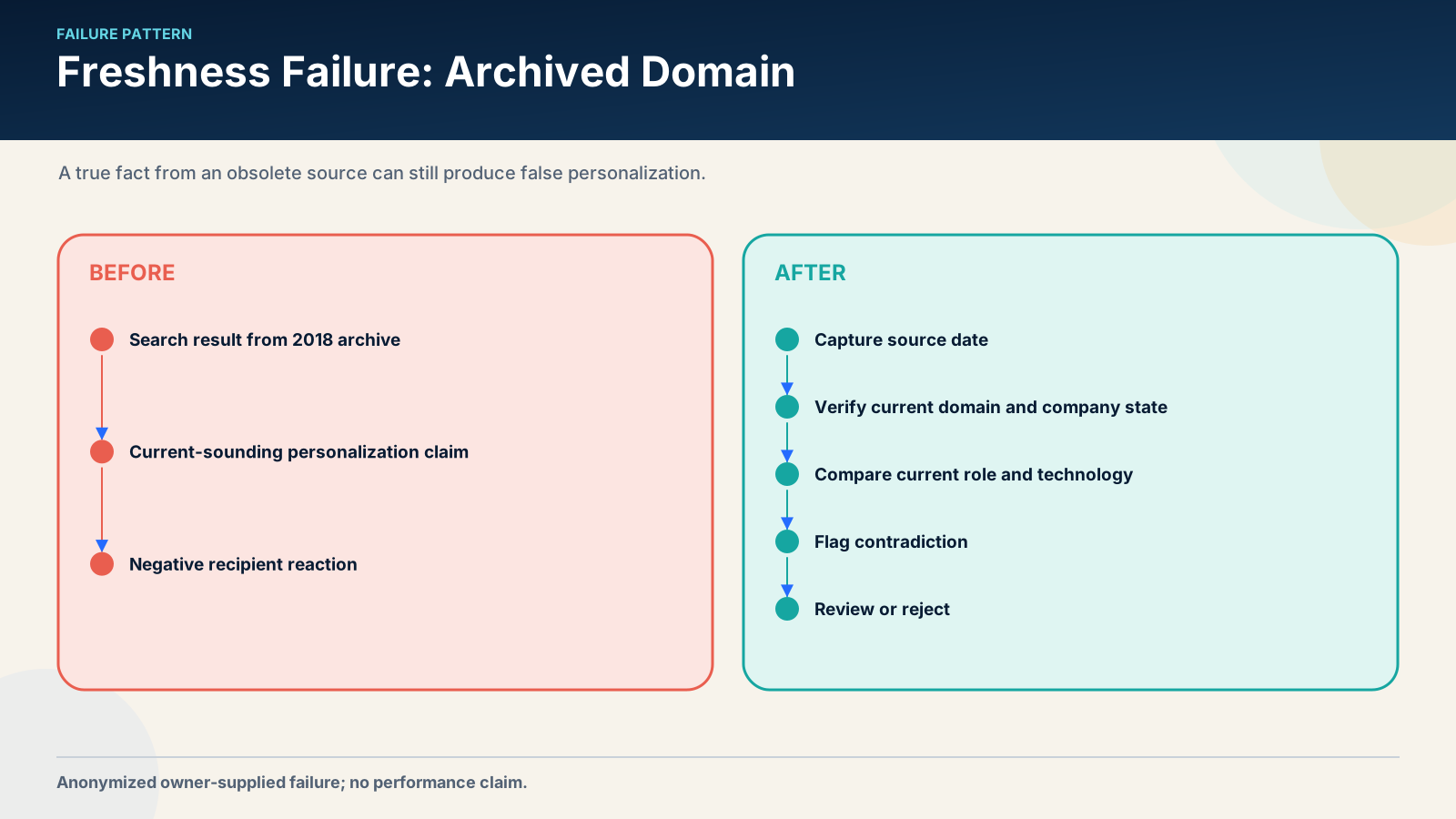
The stale archived-domain failure

The owner supplied one useful failure. The workflow found content from 2018 on an archived domain and used it as if it described the current business. The resulting personalization was wrong and triggered a negative reaction.
The correction was a freshness gate:
  1. capture source publication and retrieval dates;
  2. check the current domain state;
  3. verify current company and role;
  4. compare current technology and activity;
  5. flag archived or contradictory evidence;
  6. route to review or reject.
The important lesson is not “use newer sources.” Some old facts remain valid. The system needs an explicit current-state check for any fact that supports a present-tense claim.
Archived-domain research failure corrected with date, current-state and contradiction checks.
A true fact from an obsolete source can still produce false personalization.

07 / Set field-specific freshness and recrawl rules

Set field-specific freshness and recrawl rules

One global expiry period is too crude. Company founding year may remain stable for years, while a person's role, an open job, a technology signal or an email status can change quickly. Set the refresh rule from the volatility and consequence of the field.
Use a registry such as:
Field familyRefresh decisionFailure behavior
Legal identity and domainRecheck on domain, ownership or name conflictPause merge or route to identity review
Current role and employerRecheck before a present-tense person claimRemove the claim or reject the contact
Product and pricingRecheck before connecting the offer to a feature or tierDo not make the product claim
Technology useRecheck detection date and current-site evidenceLabel as uncertain; ask rather than assert
Hiring and newsRequire a current source and relevant departmentTreat as historical context after expiry
Contact statusReverify near the intended send and check suppressionDo not enroll until current
Existing owner or opportunityRead from the CRM at action timeRoute to the owner; block duplicate outreach
The registry should name the source of authority, review interval, owner and action on expiry. Do not silently delete stale facts. Preserve them as historical evidence while preventing present-tense use.
Refresh at the decision boundary, not only when the list was imported. A record can wait in a research queue while the role or relationship changes. Before message drafting, recheck volatile fields, current ownership and suppression. Before an actual send, the outreach service should check them again.
When sources disagree, store both values and their dates. Apply a deterministic authority rule where possible; otherwise use review. The model should not resolve a company identity or current employment conflict merely by selecting the more plausible text.
This is the operational core of prospect research before outreach: source age changes what the evidence is allowed to support.

08 / Keep human approval at the decision boundary

Keep human approval at the decision boundary

The reviewer should inspect:

Identity

  • Is this the correct company, domain and person?
  • Is the role current?
  • Is there an existing owner or relationship?

Evidence

  • Can the source be opened?
  • Is it current enough for this claim?
  • Does it support the exact wording?
  • Is contradictory evidence visible?

Commercial link

  • Does the fact relate to the recipient's responsibility?
  • Is the problem phrased as a hypothesis when necessary?
  • Is the offer relevant?

Permission

  • Is the person eligible for the intended channel?
  • Are suppression and prior replies checked?
  • Does current platform and legal policy allow the action?
The human should be able to correct the record, not only accept or reject it. Corrections become training and QA data for the ruleset.

09 / Measure research quality

Measure research quality

Do not report research volume as success.

Source coverage

Records with required openable source fields ÷ reviewed records

Freshness failure rate

Records rejected or corrected for stale evidence ÷ reviewed records

Human approval rate

Approved records ÷ reviewed records
This is useful only with stable criteria and a clear sample.

Correction rate

Records changed by the reviewer ÷ reviewed records
Tag identity, source, fact, inference, score, suppression and action corrections.

False-positive rate

Records approved by the agent but rejected by the human answer key ÷ agent-approved records

Downstream quality

Track human-validated replies, qualified conversations, held meetings and sales-accepted opportunities for the approved cohort. Research quality can improve seller decisions without directly causing conversion.

Review burden

Human research-review minutes ÷ approved records
The owner supplied 26 operated batches and several dataset totals, but the domains, records, contacts and qualified leads are different populations. Until their relationship is defined, the 12–31% usable-yield range should not appear as a public KPI.

10 / Build batch QA that finds systematic errors

Build batch QA that finds systematic errors

Reviewing only the records the agent approved misses false negatives and overactive suppression. Create a batch sample with four groups:
  1. agent-approved records;
  2. records routed to review;
  3. rejected records;
  4. suppressed or duplicate records.
Include random cases from each group and targeted cases from higher-risk segments, such as recent role changes, redirects, subsidiaries, ambiguous technologies and named accounts. Report the targeted risk sample separately so it does not distort the population estimate.
For each record, a reviewer should answer:
  • Was the account and person identity correct?
  • Could every material source be opened?
  • Did the source support the exact fact?
  • Was the fact fresh enough for its allowed use?
  • Were inference and hypothesis labeled correctly?
  • Was contrary or missing evidence visible?
  • Was the ICP and exclusion rule applied consistently?
  • Was the action state correct?
  • Did owner and suppression checks pass?
  • Would the allowed claim be appropriate in a message?
Tag the first failing stage rather than writing a generic correction. Useful categories include discovery, identity, source, freshness, fact extraction, inference, ICP policy, suppression, owner conflict and action mapping. A cluster of stale-role failures calls for a source or refresh change. It is not primarily a prompt problem.
Re-review a small set of cases across reviewers to check agreement. If two trained reviewers often disagree on ICP fit, the rubric is not ready for automation. Resolve the definition and update the answer key before promoting the agent.
Connect the research record to downstream events with stable IDs, but do not turn reply or meeting rate into the only quality signal. A poor message, offer or timing can obscure good research. Conversely, one positive reply does not validate an unsupported claim. Measure the research decision and the later sales outcome as related but distinct stages.

11 / Pass an evidence contract to message drafting

Pass an evidence contract to message drafting

The handoff from research to outreach should be a narrow schema, not the entire enrichment table. Include:
json { "account_id": "stable-account-id", "contact_id": "stable-contact-id", "approved_facts": [ {"claim": "...", "source": "...", "captured_at": "..."} ], "bounded_inference": "...", "offer_connection": "...", "prohibited_claims": ["..."], "missing_or_conflicting": ["..."], "action_state": "approved_for_draft", "reviewer": "...", "policy_version": "..." }
The drafting workflow may use approved facts and phrase the inference as a question. It may not introduce a new claim from an enrichment field that the research gate rejected. The sending workflow separately checks channel permission, current suppression, owner, campaign rules and the latest record state.
This separation prevents a common shortcut: research, generate and enroll in one irreversible step. Use the AI Sales Outreach guide for the campaign boundary and the AI Email Sales Outreach guide for message review. The methodology should preserve source and evidence rules across both stages.

12 / Failure modes

Failure modes

Enrichment is treated as truth

Store provider, date, status and conflict. Verify material fields.

The model invents pain

Require the fact, inference and prohibited-claim fields.

A tool-defined intent label drives outreach

Open the underlying event and connect it to the account and offer. Intent is a hypothesis until verified.

A public detail is personal rather than commercial

Exclude sensitive traits, family, health, politics and unrelated personal life. Public availability does not make use appropriate.

The score hides missing evidence

Add missingness and contradiction as first-class states. Let the result be review or reject.

The agent enrolls immediately after research

Separate the research approval event from message drafting and channel permission.

13 / Frequently asked questions

Frequently asked questions

How do AI sales agents research prospects before outreach?

They collect candidates from approved sources, normalize identity, capture source and date, verify current company and role, assess ICP evidence, separate fact from inference, check contradictions and suppression, then route a decision record to a human.

Which prospect sources are most reliable?

Reliability depends on the claim. Use official company sources for current company facts, authorized professional sources for roles, technographic tools as clues and verification providers for contactability. Keep provenance and cross-check material claims.

Is a verified email safe to contact?

Verification only estimates whether the address can receive mail. It does not establish consent, legal permission, relevance or absence of suppression.

Should prospect research use a numeric score?

It can, if every component has evidence and every range maps to an action. Do not let the score hide missing data or grant outreach permission by itself.

How fresh should prospect data be?

Set freshness by field volatility and claim. Current role, active technology, job openings and contact status need shorter windows than founding year. Always verify any fact used in present-tense personalization.

Can AI personalize immediately after enrichment?

It should not. First create and approve the research record. Then pass only the allowed facts, inference and prohibited claims into drafting.

14 / Readiness checklist

Readiness checklist

Before research enters outreach, confirm:
  • candidate provenance is known;
  • account and contact identities are stable;
  • every material field has a source and date;
  • current role and company are verified;
  • technographic and contact data retain provider status;
  • facts, inferences and hypotheses are separate;
  • contradictions and missing evidence are visible;
  • customer, competitor, owner and suppression checks run;
  • sensitive inference is prohibited;
  • scores map to approve, review, reject or suppress;
  • a human can correct the record;
  • message drafting receives only approved claims.
AI prospect research is valuable when it reduces uncertainty before the first message. If it merely creates a plausible hook faster, it has automated writing—not research.

Research note

Methodology

  1. 01Tool capabilities were checked against current first-party documentation on 25 August 2026.
  2. 02The source hierarchy, decision record and archived-domain failure reflect anonymized owner-supplied operating evidence.
  3. 03Provider documentation is not treated as proof of field accuracy, consent, commercial fit or downstream sales performance.
Read the full methodology

Source ledger

Sources & editorial notes

  1. 01
    Clay

    Clay · Primary, official or disclosed research source used for the bounded claim cited in this guide; scope and current status require rechecking.

  2. 02
    LinkedIn Sales Navigator

    LinkedIn · Primary, official or disclosed research source used for the bounded claim cited in this guide; scope and current status require rechecking.

  3. 03
    Hunter

    Hunter · Primary, official or disclosed research source used for the bounded claim cited in this guide; scope and current status require rechecking.

  4. 04
    BuiltWith

    BuiltWith · Primary, official or disclosed research source used for the bounded claim cited in this guide; scope and current status require rechecking.

Corrections or primary material: contact the corrections desk.

About the author

Anastasiia Krynytska

Anastasiia Krynytska is a LeadGen Team Lead at Softermii and the lead editor of Luck My Sales. She covers AI-assisted outbound, account research, qualification, messaging, CRM handoffs and revenue workflows from a practitioner’s perspective.View author profile LinkedIn

Continue reading

01 · News analysis

AI sales is moving from assistant to operating layer

The category is expanding from drafting support into research, pipeline decisions, recommended actions and controlled execution.

Read news
02 · Field analysis

In AI sales, the handoff may be the product

Models are becoming accessible; durable value sits in the controlled transition from signal to seller action.

Read analysis
03 · Research framework

Sales AI Workflow Signals 2026

A launch framework for mapping the products, controls and buying questions shaping AI-enabled revenue work.

Read reports

Luck My Sales briefing

Useful context, once a week.

News, explanations and original research from this desk. No noise.
The newsletter is still being built. We will contact you when the first edition is ready.