
Implementation guide · RevOps automation
AI Lead Routing: How to Assign Inbound Leads Without Hiding the Sales Decision
AI may assist research organization and drafting. A human editor reviews every published page, checks material claims against the cited sources and owns the final decision. No company paid for placement in this article.
AI use policyAgent-ready brief
AI takeaways
Keep the key points here, or take a source-aware text brief into Claude, ChatGPT or another AI workspace.- 01Write a Routing Decision Contract before choosing a routing tool or drawing automation branches.
- 02Run existing account or opportunity ownership, named accounts and partner obligations before territory, skills, capacity or round robin.
- 03Let AI interpret only approved enrichment evidence, form answers and CRM history; keep policy and ownership deterministic.
- 04Send every unresolved conflict to a managed exception queue with an owner, reason, SLA and final disposition.
- 05Preserve source, rule and model versions, route reason, final owner, seller acceptance, override and outcome in the CRM.
- 06Use shadow routing and explicit denominators before automatic assignment; this guide makes no routing-performance claim.
Automation does not print money. It repeats a process. If the human process is unclear or poorly refined, automation repeats the confusion faster.
01 / Decision boundaries
Lead capture, qualification, scoring, and routing are different decisions
qualified lead, hides several decisions. Keep each state separate.| State | Question | Output | Accountable owner |
|---|---|---|---|
| Capture | What happened, where, and when? | Source event and submitted data | Marketing or source owner |
| Qualification | Is a sales action justified now? | Qualify, nurture, reject, or review | Seller or qualification owner |
| Scoring | How should this record be prioritized? | Fit, engagement, or risk recommendation | RevOps and sales |
| Routing | Which eligible owner should receive it? | Named seller, team, or exception queue | RevOps or routing owner |
| Acceptance | Did the assigned seller accept responsibility? | Accepted, rejected, timed out, or reassigned | Named seller and manager |
02 / Decision contract
Write a Routing Decision Contract before choosing a tool
For an accepted inbound record, assign an eligible owner under the approved precedence rule, preserve the evidence and rule version, and send every unresolved conflict to a named review queue.
Step 1: Name the decision and its eligible input
- the object being routed: contact, lead, account, conversation, or opportunity;
- the trigger event and source timestamp;
- the minimum identity fields;
- the qualification state required before routing;
- consent, suppression, regional, or policy checks that must already pass;
- the conditions that make the record ineligible.
Step 2: Set precedence before distribution
- Existing account or opportunity owner. Preserve the active relationship before any optimization rule.
- Named account owner. Apply the account plan even when another seller appears available.
- Partner ownership. Keep the referral or channel obligation attached to the record.
- Territory or product. Restrict the eligible team by market coverage or product knowledge.
- Language or skill. Match the buyer's required language or the sales motion.
- Availability or capacity. Remove owners who cannot accept work under the current policy.
- Round robin. Distribute only among the owners who remain eligible.
ownership before optimization. A predicted close rate, fast response history, or lower workload should not silently redirect a buyer away from an existing commercial relationship.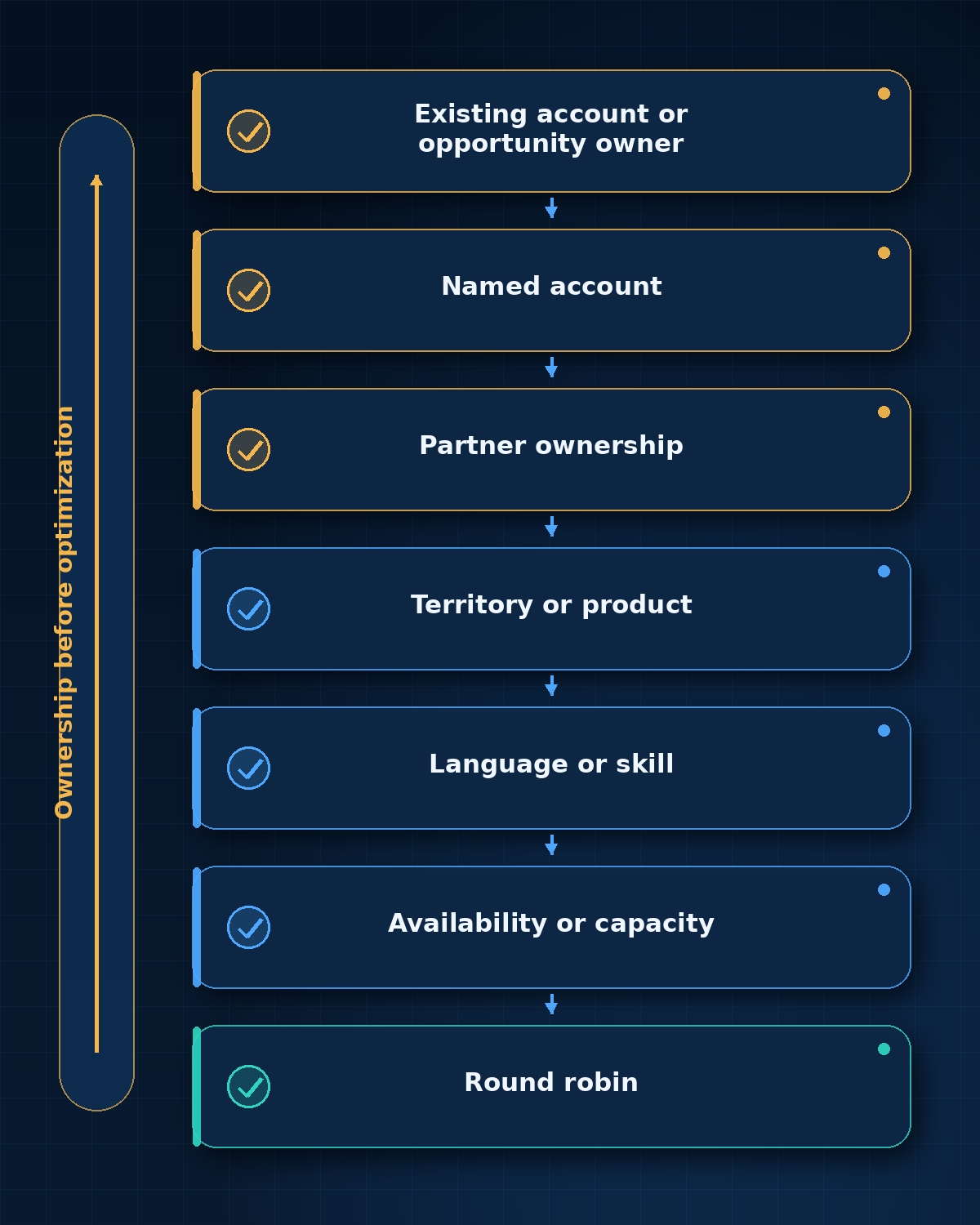
Step 3: Define permitted evidence and its source
| Routing input | Permitted source | Use | Required control |
|---|---|---|---|
| Existing owner | CRM account and opportunity records | Hard precedence | Current object, owner, and timestamp |
| Named account | Approved account-plan field | Hard precedence | Named account list owner |
| Partner relationship | Referral or partner record | Hard precedence | Partner ID and current status |
| Territory or product | Approved CRM fields | Eligibility | Versioned mapping table |
| Language or skill | Form answer, verified profile, or seller-skill table | Eligibility or review | Source and confidence |
| Availability or capacity | Current seller status and capacity table | Distribution | Refresh time and fallback |
| Enrichment evidence | Current provider output and linked source | Recommendation or review | Source URL, retrieved date, and unknown state |
| CRM history | Prior activity, meetings, email events, owner history | Context and conflict check | Event time and object match |
Step 4: Define allowed destinations and the fallback
- a named seller;
- an account, partner, territory, product, or language team;
- a capacity-controlled pool;
- an exception queue with a named human owner;
- a non-sales route that is already approved by the qualification policy.
Step 5: Limit what AI may decide
- summarize approved enrichment evidence and keep the source links;
- classify approved form answers against a versioned rubric;
- identify possible conflicts in CRM history;
- recommend a territory, product, language, or skill class;
- explain which evidence supports the recommendation;
- return
unknownorreviewwhen evidence is missing or contradictory.
- overwrite an existing account or opportunity owner;
- invent missing firmographic, identity, intent, or consent data;
- infer a sensitive attribute that the routing policy does not permit;
- change the precedence order;
- create a new routing class without approval;
- hide the inputs, model or rule version behind a final owner field;
- send a high-risk or conflicting record past the exception queue.
Step 6: Specify the CRM event and seller acceptance
Contact owner = Alex. Preserve:| Field or event | What it records |
|---|---|
routingEventId | Unique decision event |
sourceEvent / sourceAt | Entry source and source time |
recordCreatedAt | CRM creation time |
inputSnapshotRef | Approved fields used by the decision |
ownershipChecks | Existing account, opportunity, named-account, and partner results |
ruleVersion | Precedence and eligibility version |
aiModelVersion | Model used, if any |
aiEvidenceRefs | Source-linked evidence used by AI |
proposedRoute / routeReason | Recommendation and concise reason |
confidence / unknowns | Evidence state, not decorative certainty |
finalOwner | Person or queue receiving responsibility |
reviewer / overrideReason | Human decision when a route changes |
assignedAt / acceptedAt | Route and seller-acceptance times |
reassignedAt / reassignmentReason | Route correction |
outcome / outcomeAt | Nearest commercial result |
accepted means, how long the seller has, and what happens after rejection or timeout.Step 7: Define success, rollback, and ownership of the contract
text Decision: Assign an accepted inbound contact to an eligible sales owner. Trigger: Approved inbound event after identity and policy checks. Precedence: Existing owner → named account → partner → territory/product → language/skill → availability/capacity → round robin. AI inputs: Approved enrichment evidence, form answers, and CRM history. AI output: Recommended eligible class, evidence links, unknowns, and reason. Forbidden: Ownership override, invented data, silent policy change, direct high-risk route. Fallback: RevOps exception queue; named owner and SLA required before go-live. CRM write-back: Event ID, source, input reference, rule/model versions, route, reason, final owner, timestamps, acceptance, override, and outcome. Success: Correct accepted owner, low reassignment, controlled workload, useful outcome. Rollback: Disable live assignment and return to the last approved ruleset. Policy owner: [name/role] Technical owner: [name/role] Version: [number] Approved: [date] 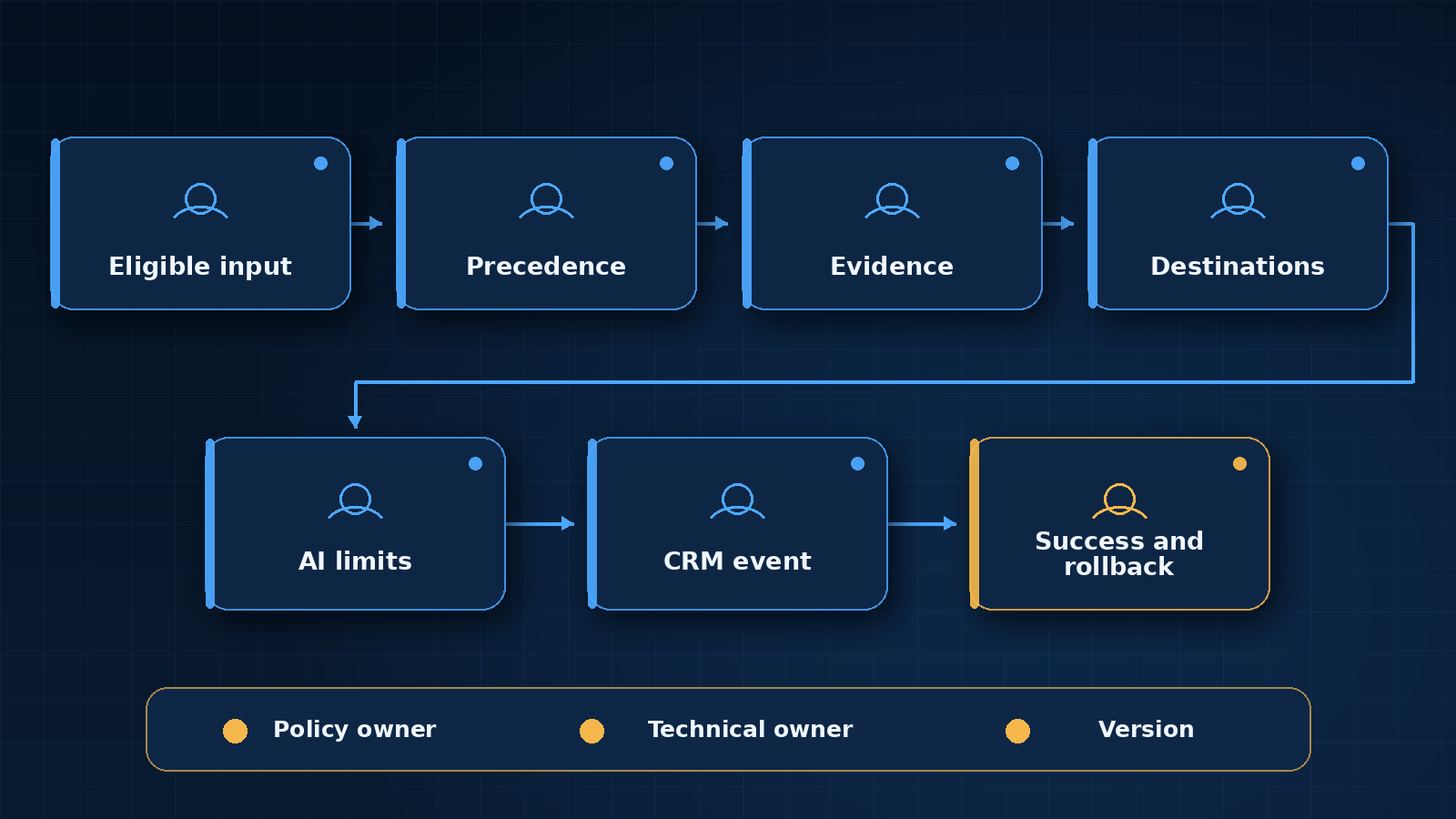
03 / Human-gated workflow
Build a human-gated AI lead-routing workflow
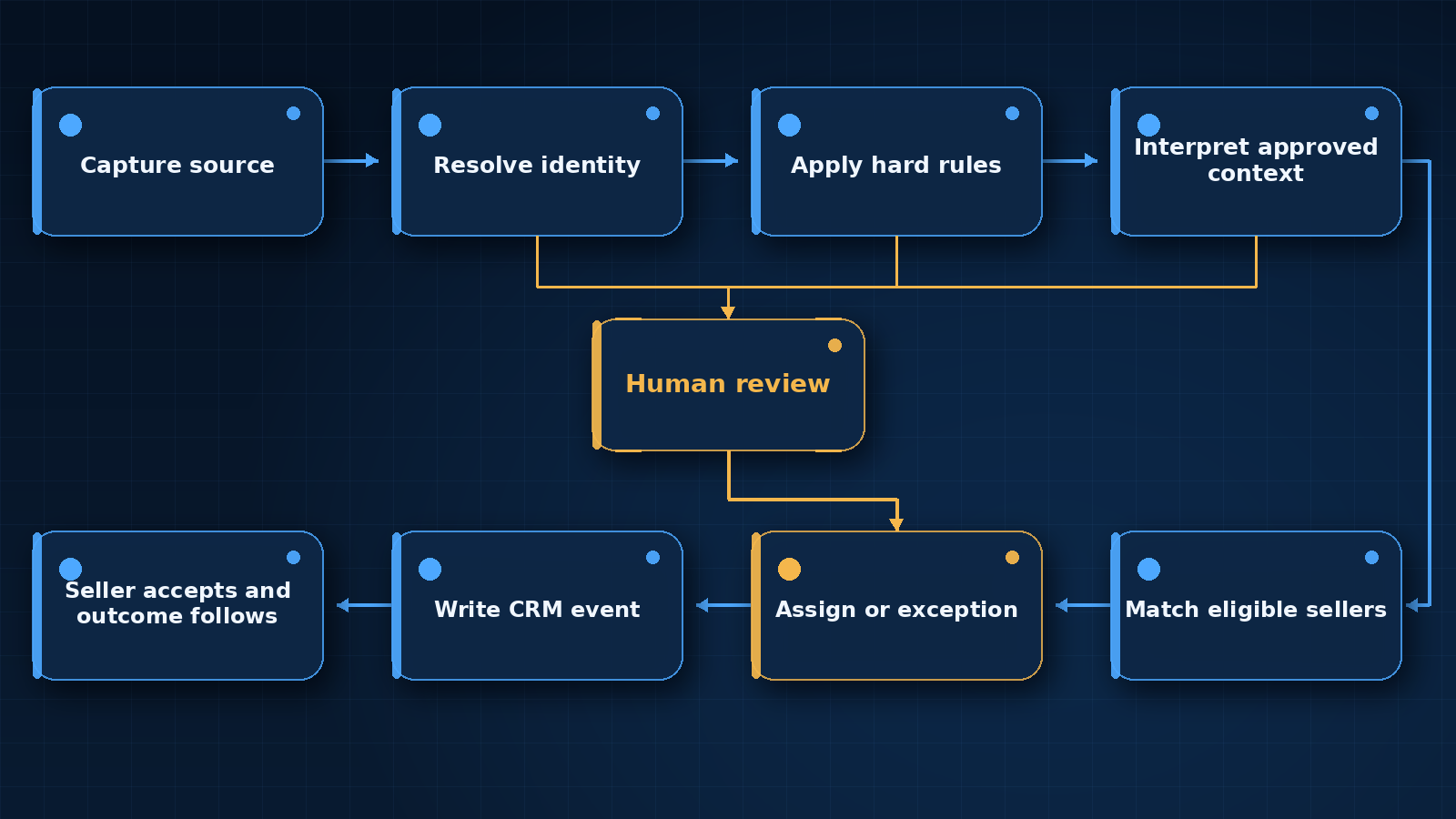
1. Capture the source, CTA, and submitted context
2. Validate identity, duplicates, and existing relationships
3. Apply deterministic ownership and exclusion rules
4. Use AI for approved context, not hidden policy
- Which approved product or territory class does the form answer support?
- Does CRM history show a possible ownership conflict?
- Which facts are confirmed, inferred, contradictory, or unknown?
review.5. Match only eligible sellers
6. Send conflicts and low-confidence cases to an exception queue
- a named operational owner;
- a response SLA;
- reason codes;
- the evidence needed to decide;
- permitted buyer-facing actions while the record waits;
- an escalation path;
- a final disposition field.
7. Write the complete route to the CRM
8. Record seller acceptance, reassignment, and outcome
04 / Routing methods
Choose a routing method for the actual constraint
| Method | Use it when | Required data | Main failure | Fallback |
|---|---|---|---|---|
| Existing ownership | A relationship or active process already exists | Current account, opportunity, and owner links | Stale or conflicting ownership | Human ownership review |
| Named account | Account planning controls coverage | Approved named-account list | Old list or missing subsidiary mapping | Account-plan owner |
| Partner ownership | Referral or channel terms matter | Partner ID and current status | Lost attribution or conflicting account owner | Partner operations review |
| Territory/product | Coverage or expertise is defined by market | Clean region, segment, and product fields | Gaps, overlaps, or stale mappings | Territory/product queue |
| Skill/language | Buyer context requires a capability | Verified requirement and seller-skill table | Inferred need or overstated skill | Skill-review queue |
| Capacity/availability | Eligible sellers have different current loads | Current status and capacity | Stale presence or gaming the capacity field | Managed team queue |
| Round robin | Remaining sellers are genuinely interchangeable | Eligible pool and rotation state | Fairness without fit; reset errors | Team manager |
| Historical-outcome model | A mature team has adequate, representative outcomes | Versioned outcome data and coverage analysis | Past allocation bias becomes future policy | Shadow recommendation only |
05 / Exception handling
Handle the exceptions that break clean routing diagrams
| Exception | Do not | Required action | Final record |
|---|---|---|---|
| Duplicate people with different owners | Pick the newest record silently | Resolve identity and preserve both record IDs | Merge/keep decision and owner rationale |
| Contact matches an active opportunity | Send to round robin | Protect the opportunity owner or escalate conflict | Opportunity link and rule fired |
| Named account conflicts with partner referral | Let availability decide | Apply the approved ownership agreement | Reviewer and precedence exception |
| Missing territory or product | Guess from weak evidence | Request evidence or use a managed queue | Unknown reason and next review time |
| Contradictory enrichment | Choose the most confident vendor | Inspect sources and current social profile | Accepted fact and rejected evidence |
| No seller available | Leave the record invisible | Alert a named queue owner and start SLA | Queue, reason, timestamp, escalation |
| Recycled lead with prior seller history | Treat as a new anonymous lead | Review relationship recency and active work | Preserved prior owner and decision |
| Unsupported region or policy block | Route to the nearest team | Apply the approved hold or reject state | Rule, notice, and permitted next action |
06 / CRM audit trail
Make each routing decision auditable in the CRM
- the source and form event;
- record creation;
- the assigned owner;
- lifecycle stage and lead status;
- a page-view or activity event;
- meeting and email events;
- an AI-generated summary with source links;
- the processing-consent field.
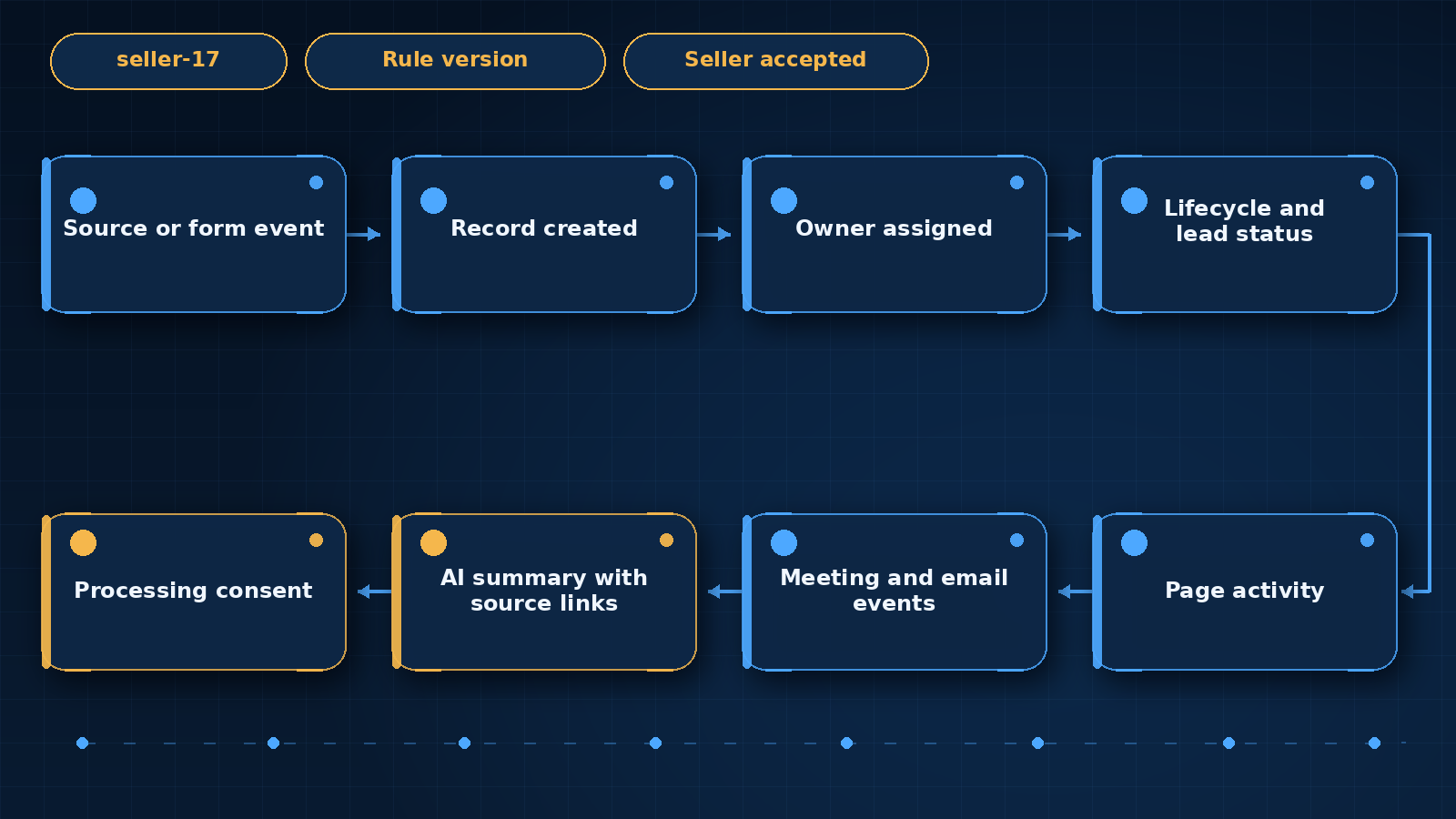
json { "sourceEvent": "high-intent form submitted", "recordCreatedAt": "2026-08-03T12:02:00Z", "lifecycleStage": "sales-ready", "leadStatus": "intro-call workflow", "ownershipChecks": ["existing relationship checked", "partner checked"], "proposedRoute": "eligible product-and-language team", "routeReason": "approved form answers and CRM history matched current rule", "finalOwner": "seller-17", "activityRefs": ["page-view-event", "meeting-event", "email-event"], "aiEvidenceRefs": ["source-1", "source-2", "source-3"], "processingConsent": "recorded", "ruleVersion": "routing-contract-1.0", "assignedAt": "2026-08-03T12:03:00Z", "acceptedAt": "2026-08-03T12:12:00Z" } 07 / Shadow pilot
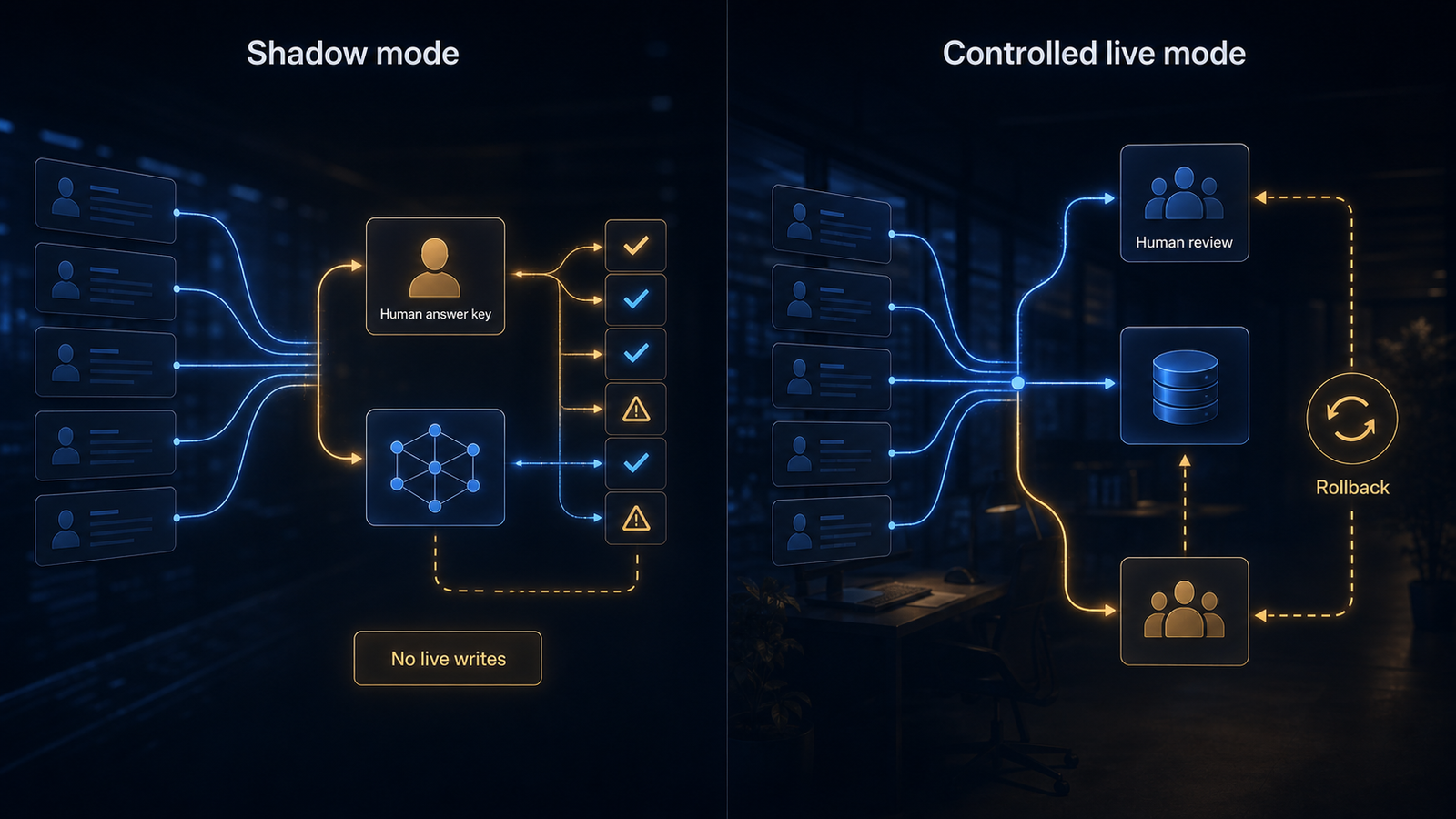
Run a shadow-routing pilot before automatic assignment
1. Freeze the contract and sample
2. Create a human answer key
3. Run the proposed route without CRM owner writes
4. Compare routes and workload
- exact owner agreement;
- eligible-team agreement;
- protected-owner violations;
- false routes to an ineligible owner;
- unresolved and no-owner cases;
- human-review rate;
- workload distribution by seller and segment;
- explanation completeness;
- latency from source to proposed route.
5. Roll out by risk
08 / Measurement
Measure accepted-owner latency, route stability, and outcomes
| Metric | Definition | Diagnostic use |
|---|---|---|
| Route latency | assignedAt − eligibleAt | Automation and queue delay |
| Accepted-owner latency | acceptedAt − eligibleAt | Time to accountable ownership |
| No-owner rate | Eligible records with no owner ÷ eligible records | Broken mappings or capacity |
| Protected-owner violation rate | Routes that break hard ownership ÷ protected-owner records | Precedence control |
| Reassignment rate | Reassigned records ÷ assigned records | Route stability |
| Misroute rate | Human-confirmed wrong routes ÷ reviewed routes | Correctness on reviewed sample |
| Exception rate | Exception records ÷ eligible records | Data and policy burden |
| Exception SLA pass rate | Exceptions resolved within SLA ÷ resolved exceptions | Queue operation |
| Workload skew | Distribution by eligible seller and segment | Fairness and coverage |
| Held-conversation rate | Held conversations ÷ accepted routes | Nearest commercial usefulness |
| Opportunity rate | Valid opportunities ÷ accepted routes | Later sales relevance |
09 / Tool choice
Decide whether CRM-native rules or a dedicated router are justified
| Option | Good fit | Warning sign |
|---|---|---|
| CRM-native rules | Few ordered routes, clean fields, simple ownership, one admin team | Complex lead-to-account matching, many conflicts, weak audit history |
| General workflow automation | Several sources and APIs, custom review queue, manageable logic | Business policy scattered across undocumented steps |
| Dedicated routing platform | Many territories, account matching, capacity, scheduling, and strict SLAs | More configuration than the team can own or audit |
| Custom AI-assisted layer | Approved context cannot be expressed as fixed fields and the team can maintain evaluation | Model output writes owners directly or evidence cannot be replayed |
10 / Launch checklist
AI lead-routing implementation checklist
Before configuration
- [ ] Define the object, trigger, and accepted input state.
- [ ] Approve the ownership precedence ladder.
- [ ] Name the source of truth for each input.
- [ ] Separate hard rules, AI recommendations, and distribution logic.
- [ ] Define eligible destinations and one managed fallback.
- [ ] Assign policy and technical owners.
Before shadow mode
- [ ] Version the Routing Decision Contract.
- [ ] Build a representative sample and human answer key.
- [ ] Save evidence links, unknowns, rules, and model version.
- [ ] Include protected-owner and exception cases.
- [ ] Block live CRM owner writes and buyer messages.
Before go-live
- [ ] Set the exception owner, SLA, and escalation.
- [ ] Preserve assigned, accepted, rejected, and reassigned timestamps.
- [ ] Test CRM synchronization and competing workflows.
- [ ] Approve automatic and human-gated risk tiers.
- [ ] Define alert and rollback thresholds.
After launch
- [ ] Review protected-owner violations and misroutes first.
- [ ] Compare accepted-owner latency with assignment latency.
- [ ] Inspect reassignments, unresolved records, and workload skew.
- [ ] Connect routes to held conversations and valid opportunities.
- [ ] Revise a versioned rule only after diagnosing repeated errors.
- [ ] Keep the original route event after every correction.
11 / FAQ
Frequently asked questions
What is AI lead routing?
What is the difference between lead routing and lead scoring?
Should an AI system assign leads automatically?
Which lead-routing rules should run before AI?
How do you route a lead that belongs to an existing account?
What happens when no seller is available?
What should a routing system write to the CRM?
How do you measure lead-routing accuracy?
Is round-robin routing fair or effective?
When does a team need dedicated lead-routing software?
12 / Methodology
Sources and methodology
- First-hand scope: Anastasiia has worked with website form/chat, product-trial, event, partner/referral, email, and phone inbound sources. The article does not claim a measured routing lift or product test.
- Enrichment estimate: the
roughly 90% usefulstatement is Anastasiia's operator estimate. No formal sample, denominator, or accuracy method was supplied. Social-profile evidence still requires human inspection. - CRM example: one private HubSpot record was reviewed only for the allowed event structure. It is not published and is not a routing benchmark.
- Product evidence: Salesforce, Microsoft Dynamics, HubSpot, and Chili Piper links support documented mechanics only. They do not prove commercial performance or universal suitability.
- Governance evidence: NIST AI RMF provides general human-oversight context, not a lead-routing standard.
- Commercial scope: this article contains no product ranking or paid placement. Any future commercial mention must be disclosed beside the relevant product and cannot buy an unsupported position.
Research note
Methodology
- 01Attribute the website form/chat, product-trial, event, partner/referral, email and phone inbound-source scope to Anastasiia Krynytska.
- 02Present the roughly 90% enrichment-usefulness figure only as Anastasiia's operator estimate with no formal sample, denominator or accuracy method; social profiles still require human inspection.
- 03Treat the 2–200-person professional-touch recommendation as Anastasiia's operating position, not a universal company-size rule.
- 04Use official vendor documentation only for current product mechanics and NIST only for general human-oversight principles.
- 05Use one private CRM record only to derive an anonymized event structure; never publish the screenshot, PII, company details, emails or message content.
- 06Make no product-testing, routing-accuracy, conversion-lift or causal performance claim because no dated answer-key sample or controlled comparison was supplied.
Source ledger
Sources & editorial notes
- 01Set Up Lead Assignment Rules
Salesforce Help · Official product documentation used for ordered assignment rules and owner write-back mechanics.
- 02Guidelines for Setting Up Web-to-Lead
Salesforce Help · Official product documentation used for web capture, validation, custom fields, queues and default ownership.
- 03Create and activate assignment rules
Microsoft Learn, Dynamics 365 Sales · Official product documentation used for ordered rule execution, conditions and seller or team assignment.
- 04Understand record distribution in assignment rules
Microsoft Learn, Dynamics 365 Sales · Official product documentation used for capacity, availability and the possible unassigned state.
- 05Choose your workflow actions
HubSpot Knowledge Base · Official product documentation used for owner rotation and cross-CRM synchronization cautions.
- 06Workflows FAQ
HubSpot Knowledge Base · Official product documentation used for the new-contact ownership synchronization delay.
- 07Creating a Concierge Router
Chili Piper Help · Official product documentation used for form inputs, assignment paths and catch-all behavior; not outcome proof.
- 08NIST AI RMF Playbook
US National Institute of Standards and Technology · Primary governance resource used for general human-role, oversight and monitoring principles; it is not a lead-routing standard.
- 09AI Lead Qualification
Luck My Sales · Supporting guide used for the boundary between qualification and routing.
- 10Lead Scoring Criteria Implementation
Luck My Sales · Supporting guide used for scoring design and human-control boundaries.
- 11AI Lead Generation
Luck My Sales · Parent workflow guide used for the broader path from source to revenue evidence.
- 12Automated Lead Nurturing
Luck My Sales · Supporting guide used for records that should not enter sales yet.
- 13Lead Qualification Tools
Luck My Sales · Adjacent product comparison linked without turning this guide into a routing leaderboard.
- 14Luck My Sales methodology
Luck My Sales · Evidence states, first-hand-source treatment, freshness requirements and correction protocol.
- 15Luck My Sales AI use policy
Luck My Sales · Permitted AI assistance and required human editorial review.