
B2B service buyer's guide · AI prospecting
Outsourced Lead Qualification: How to Choose a B2B Service Without Losing Control
AI may assist research organization and drafting. A human editor reviews every published page, checks material claims against the cited sources and owns the final decision. No company paid for placement in this article.
AI use policyAgent-ready brief
AI takeaways
Keep the key points here, or take a source-aware text brief into Claude, ChatGPT or another AI workspace.- 01Keep the ICP, definition of qualified, exceptions and final CRM acceptance under an internal owner.
- 02Delegate research and list building before outreach; add an SDR only after one ICP, message and channel work together.
- 03Test providers with a written Qualification Service Contract, a bounded work sample and a controlled pilot.
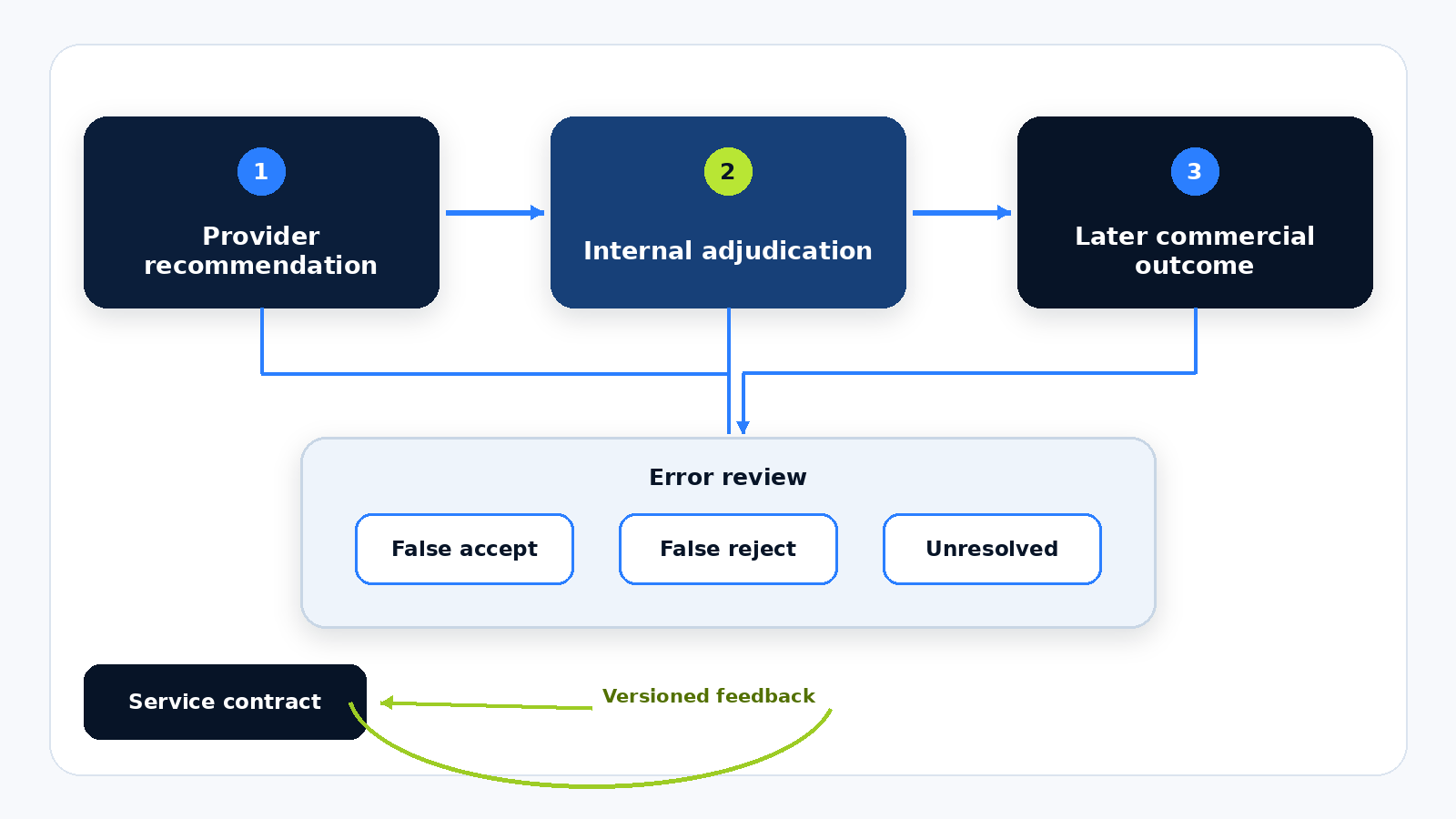
- 04Keep provider recommendation, internal adjudication and later commercial outcome as separate records.
- 05Measure sales acceptance, false accepts, false rejects, unresolved cases, held meetings and full operating cost—not calendar volume alone.
Outsource execution, not the meaning of qualified.
01 / Decision
The short answer: outsource execution after the sales motion works
| Current state | Safe delegation | Keep internal |
|---|---|---|
| The founder is still discovering the buyer and offer | Nothing material | Customer conversations, ICP, value proposition, message and channel |
| The ICP is clearer, but outreach is still being tested | Research and list building | Message, sending, replies and qualification |
| One ICP, message and channel already work | Bounded SDR execution and first-pass qualification | Exceptions, strategic accounts, final acceptance and opportunity state |
| Qualified calls exceed the founder's closing capacity | Selected AE work after a controlled handoff | Sales standards, coaching and complex deals |
| Several AEs reliably perform against the same standard | Sales management and scaled SDR/marketing capacity | Strategy, governance and material changes to the motion |
02 / Service scope
What outsourced lead qualification actually includes
| Service job | Typical input | Defensible output | Decision that remains internal |
|---|---|---|---|
| Inbound response | Form fill, demo request or event scan | Verified identity, answers and recommended route | Whether the record is sales accepted |
| Outbound research | Target account list or market definition | Current company, role, source record and fit recommendation | Whether the account deserves contact |
| Outbound conversation | Approved list, message and channel | Reply state, buyer-supported context and next-step recommendation | Meaning of an ambiguous reply |
| Event follow-up | Attendee or scanned-lead list | Contact result, stated interest and nurture state | Whether event interest creates an opportunity |
| Reactivation | Dormant CRM records | Current identity, relevance and response state | Whether the old relationship should reopen |
| Multilingual or after-hours coverage | Approved queue and language rules | Conversation record and escalation | Sensitive interpretation and final commercial state |
03 / Delegation
Use the founder-stage delegation model
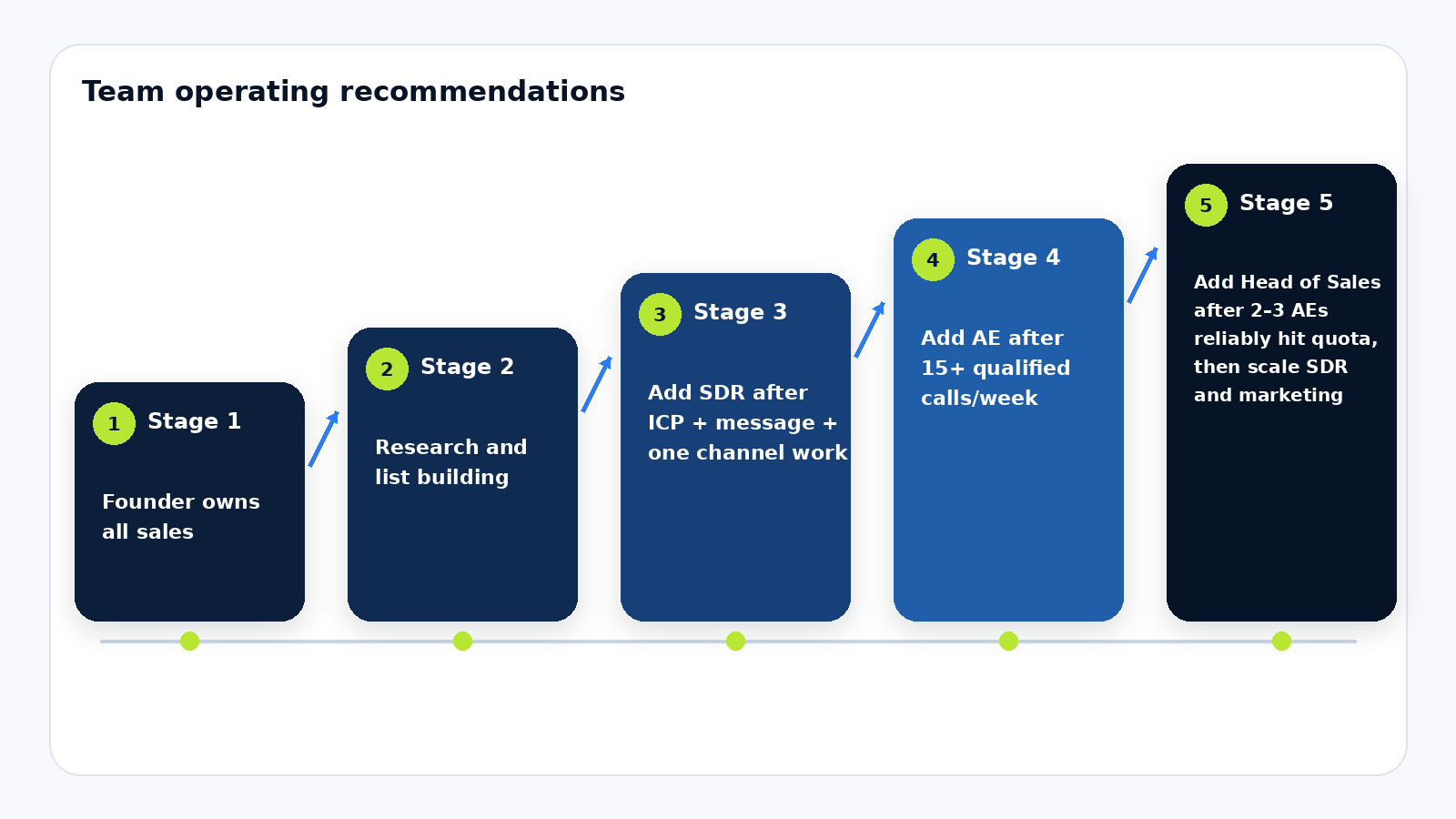
Stage 1: delegate nothing
Stage 2: delegate research and list building only
Stage 3: add an SDR only after one motion works
- one defined ICP;
- one message that opens relevant conversations;
- one permitted channel with a repeatable operating process.
Stage 4: add an AE after qualified calls exceed founder capacity
Stage 5: add a Head of Sales after repeatable AE performance
04 / Service contract
Write a Qualification Service Contract before the RFP
| Contract field | Required decision |
|---|---|
| Event | What exact state may advance? |
| Evidence | Which buyer statement or verified source supports it? |
| Unknown | What happens when evidence is absent or conflicts? |
| Permitted action | May the provider research, contact, book, route or update CRM? |
| CRM record | Which fields preserve the recommendation and source? |
| Owner | Who accepts, rejects or corrects the result? |
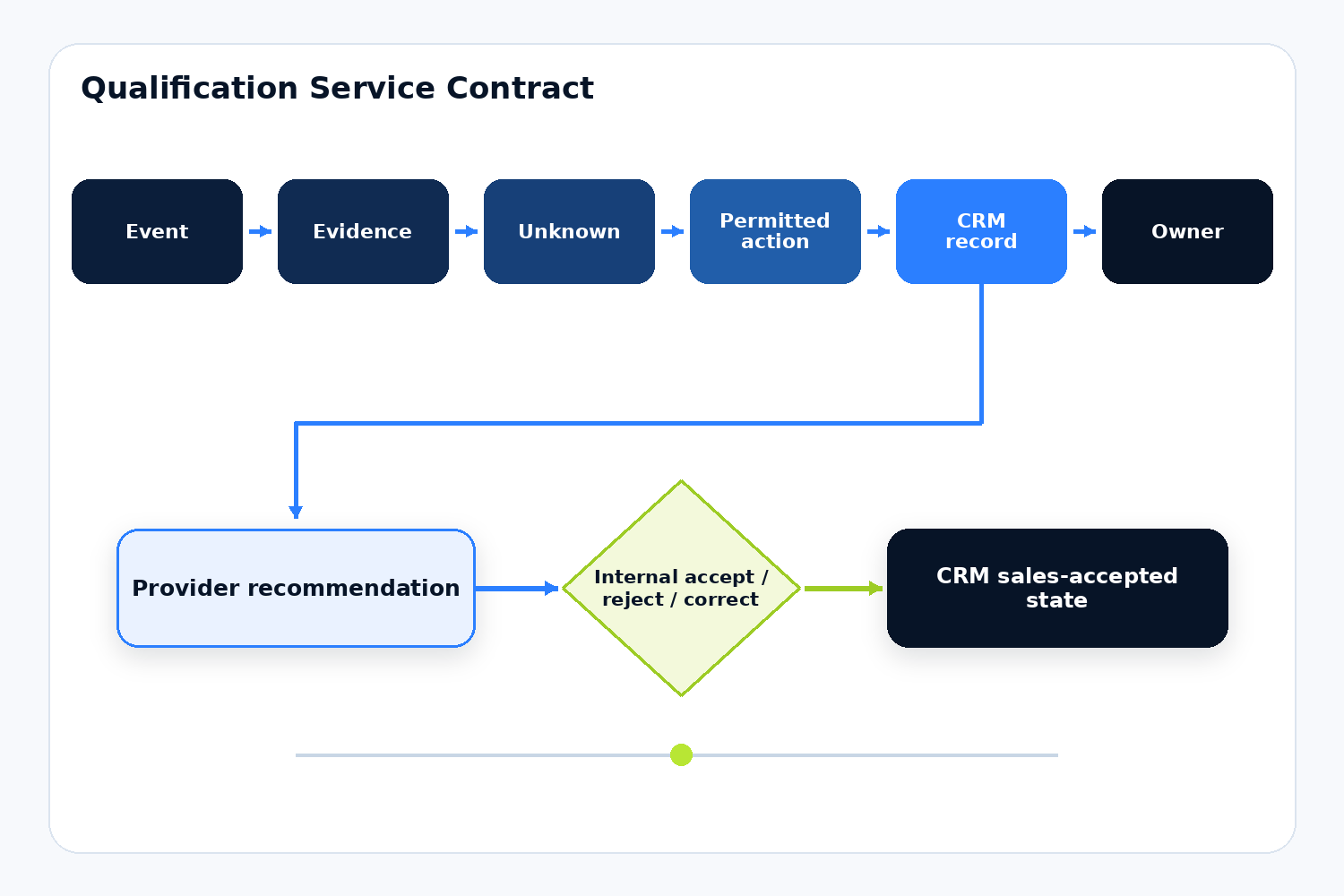
Define the qualification event
valid record → contacted → conversation → provider-qualified → sales accepted → held meeting → opportunitySeparate facts, buyer statements and interpretations
| Evidence type | Example |
|---|---|
| Verified fact | Current employer, role or company location |
| Buyer statement | A stated project, limit or time frame |
| Interpretation | The provider's view that the record is ready for sales |
unknown rather than turning it into a negative or a made-up fact.Define permitted actions and stop conditions
| Stop trigger | Required action |
|---|---|
| A real reply arrives | Assign a named human owner |
| A buyer opts out | Stop the contact path and update suppression |
| The contact has an active account or deal | Route to the current owner |
| Source evidence conflicts with CRM | Pause and review the record |
| A high-value account appears | Send it to the named account owner |
| The talk moves into legal, price, security or technical detail | Escalate to the right internal role |
| The AI summary lacks a source | Block write-back and check the record |
| The approved script no longer fits | Stop and seek a new approval |
05 / Service models
Compare the service model, not the provider slogan
| Model | Best fit | Main advantage | Main risk | Control to require |
|---|---|---|---|---|
| Shared agents | Variable inbound or event volume | Flexible capacity | Limited product context and agent continuity | Narrow script, structured fields and frequent calibration |
| Dedicated SDRs | Complex B2B motion with steady volume | Deeper offer and market knowledge | Higher setup and management burden | Named team, training record and change control |
| US-based team | US hours or a domestic operating requirement | Time-zone and market familiarity | Location can be mistaken for quality proof | Test the same work; verify actual requirement |
| Nearshore or offshore team | Extended hours, language or cost flexibility | Coverage and scalable labor | Context, handoff and data-transfer risk | Language QA, access limits and escalation owner |
| Human-led service | Nuanced first conversations | Judgment and adaptation | Script drift and inconsistent notes | Call review, calibration and structured CRM fields |
| AI-assisted service | Research, transcription, summaries and prioritization | Faster preparation and consistent structure | Unsupported claims or hidden data use | AI-use inventory and human review |
| AI-voice service | Approved, repeatable phone task | Consistent coverage | Consent, disclosure, interruption and trust risk | Legal review, transfer rule and full call audit |
06 / Hiring
Use a five-stage hiring process
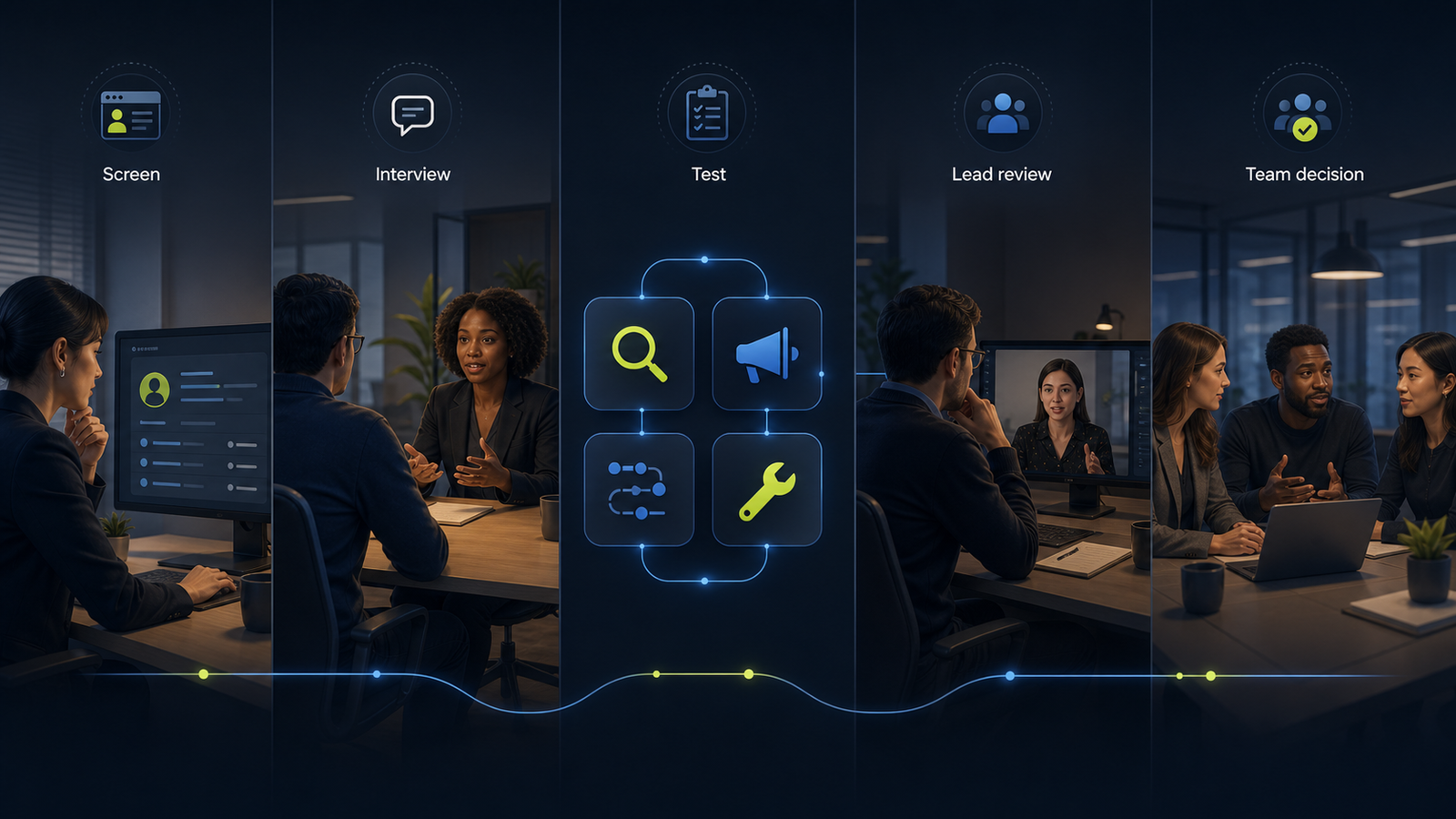
1. Screen relevant experience
2. Run an introductory assessment
3. Give a bounded test assignment
- inspect company profiles and directories, then infer which clients the company targets;
- design a detailed campaign for 50 contacts using the specified constraints: healthcare, the Nordics, company size up to 50 employees and market expansion;
- write a three-message sequence that progresses to a call invitation, then add a follow-up after one week of silence;
- name a preferred SDR service or tool and explain its advantages.
| Evaluation signal | What good work shows | Common warning |
|---|---|---|
| Research and target inference | Profiles and directories support a plausible target-client view | Target is asserted without connecting the source clues |
| Campaign planning | The 50-contact plan connects segment, channel, message and next action | A contact count is supplied without an operating sequence |
| ICP comprehension | Message reflects company, role and buying situation | Generic personalization |
| Value translation | Offer connects to a plausible current problem | Company biography replaces buyer relevance |
| Channel fit | Message length and ask suit the channel | Same copy used everywhere |
| Instruction following | Explicit request and format are honored | Important detail is ignored |
| Evidence discipline | Claims match supplied facts and portfolio proof | Unsupported experience or performance claim |
| Brand representation | Clear, credible and respectful language | Awkward, inflated or careless wording |
| Commercial context | Candidate sees why the buyer may act now | Message asks for a call without a reason |
| CTA | Next step is specific and proportionate | Vague “let's connect” close |
| Tool reasoning | Candidate explains a preferred SDR service or tool and its relevant advantages | Preference is named without a use case or trade-off |
4. Add a team-lead review call
5. Hold a final team discussion
07 / Brand & context
Protect brand representation and commercial context

Weak brand representation
Low-quality meetings
Missed commercial context
08 / CRM handoff
Require a clear CRM handoff
| CRM field | Purpose |
|---|---|
| Lead source and provider | Shows origin and accountable service |
| Contacted channel and timestamp | Reconstructs the interaction |
| Source record | Preserves verified company and contact evidence |
| Qualification questions | Shows the approved questions used |
| Buyer-supported answers | Separates statements from inference |
| Unknowns and conflicts | Prevents missing data from becoming false certainty |
| Provider disposition | Records the external recommendation |
| Recommendation reason | Explains why the state was proposed |
| Transcript or recording reference | Supports review when lawful and available |
| Internal acceptance | Records accept, reject or correct |
| Rejection/correction reason | Feeds calibration |
| Next action and owner | Prevents an accepted record from stalling |
| Held meeting and opportunity state | Connects service output to a later outcome |
09 / AI & data
Ask how the provider uses AI and customer data
| AI-use field | Provider answer required |
|---|---|
| System | Which product or model is used? |
| Purpose | What task does it perform? |
| Data | Which contact, company, CRM or conversation data enters it? |
| Output | What does the model create or recommend? |
| Review | Who checks the output before action or CRM write-back? |
| Retention | How long is input and output stored? |
| Subprocessors | Which other companies receive the data? |
| Correction | How can the client challenge and repair an output? |
| Voice | Does the system generate or simulate a human voice? |
compliant as a full answer.10 / Cost
Calculate setup and operating cost without relying on a headline price
Setup components
| Cost area | Work to include |
|---|---|
| Sales design | ICP, qualification, message, script and objection playbook |
| Selection | Hiring, provider review and test assignment |
| Pilot | Sample, review rule and decision design |
| Data | Source, checks and needed enrichment |
| Channels | Inbox, domain, phone and channel setup |
| CRM | Fields, routes and integrations |
| Enablement | Provider training and team-lead time |
| Risk | Security, privacy and legal review |
| QA | Scorecard, call review and report design |
Ongoing components
| Cost area | Work to include |
|---|---|
| Service | Labor, retainer or outcome fee |
| Stack | Data and software plans |
| Channels | Send systems and delivery work |
| Internal work | Management and review time |
| Change | Message and playbook updates |
| CRM | Admin work and data repair |
| QA | Samples and disagreement review |
| Calendar quality | Rejected calls, no-shows and replacement terms |
| Risk | Security checks and vendor changes |
| Exit | Termination, export and transition |
11 / Pilot
Run a controlled provider pilot
1. Freeze the input
2. Freeze the qualification rule
provider-qualified and sales accepted separately.3. Approve the first messages or calls
4. Adjudicate disagreements
5. Connect the handoff to outcomes
6. Apply a predeclared decision
- scale when quality, control and cost meet the agreed rule;
- revise when a correctable pattern appears;
- narrow when only one segment or task works;
- stop when brand, compliance, data or commercial risk exceeds value.
12 / SLA
Put outcome and error metrics in the SLA
| Metric | Calculation | What it tells you | Limitation |
|---|---|---|---|
| Time to first permitted action | Time from eligible intake to first approved action | Coverage and queue speed | Fast does not mean relevant |
| Conversation rate | Conversations / valid contacted records | Whether the channel reaches people | Does not prove fit or intent |
| Provider-qualified rate | Provider-qualified / reviewed records | Provider decision volume | Depends on provider definition |
| Sales-accepted rate | Internally accepted / provider-qualified | Handoff alignment | Internal review can also be wrong |
| False-accept rate | Rejected provider-qualified / audited provider-qualified | Weak handoffs | Needs consistent adjudication |
| False-reject rate | Internally accepted provider-rejected / audited rejected | Missed value | Requires review of rejected records |
| Unresolved rate | Unresolved / reviewed records | Evidence quality and rule clarity | A high rate may be honest |
| Held-meeting rate | Held / booked meetings | Calendar quality | Still not opportunity quality |
| Opportunity rate | Opportunities / sales-accepted records | Downstream commercial movement | Attribution remains shared |
| CRM completeness | Complete required records / reviewed records | Handoff discipline | Complete fields can still be wrong |
| QA defect rate | Material defects / audited interactions | Operating quality | Depends on sample design |
| Complaint or opt-out rate | Complaints or opt-outs / contacted records | Buyer and channel risk | Interpret by channel and audience |
| Total cost per accepted record | Full service cost / sales-accepted records | Operating efficiency | Does not include later conversion alone |
14 / Adjudication
Adjudicate provider decisions before changing the contract
15 / RFP checklist
Outsourced lead qualification RFP checklist
| Area | Questions to ask |
|---|---|
| Scope | Which tasks are in and out? What does qualified mean? Which proof is required? How are unknowns handled? Which acts need client approval? |
| People | Are agents shared or dedicated? Who trains and leads them? How often is live work checked? How are script changes approved? How are language and market skills tested? |
| CRM and data | Which systems and fields can the team use? What is written after each contact? Are proof, advice and client choice kept apart? Which other vendors or AI systems see the data? What happens at exit? |
| Quality | How are false accepts and false rejects checked? Does the report split booked and held calls? How is sales acceptance stored? Which later result links to the handoff? What rules govern the pilot? |
| Terms | Which setup, data, tools, QA and management costs are left out? What happens to rejected calls and no-shows? Can the client export all history? How does exit work? |
16 / FAQ
Frequently asked questions
What is outsourced lead qualification?
When should a B2B company outsource lead qualification?
Is outsourced qualification the same as appointment setting?
Is an outsourced SDR the same as a qualification provider?
How much do lead qualification services cost?
Should I choose shared agents or dedicated SDRs?
Can a lead qualification service use AI?
What should the provider write to CRM?
Which metrics should be in the SLA?
Who owns compliance when outreach is outsourced?
17 / Operating rule
The operating rule
Research note
Methodology
- 01Use team-level operating input across outsourced SDRs, call centers, appointment setters and qualification providers without converting it into personal Anastasiia experience.
- 02Label the roughly 90% adaptation estimate and the frequent or very frequent failure observations as qualitative team-level input without a denominator.
- 03Treat the 15-qualified-calls and two-to-three-AE thresholds as team operating recommendations supplied by the owner, not market benchmarks.
- 04Summarize the current owner-supplied four-part SDR test framework; keep separate raw candidate responses private and exclude them as evidence.
- 05Use current provider and comparison pages only for search-intent and category-gap analysis, not as independent performance proof or a provider ranking.
- 06Use FTC, FCC and NIST primary sources for narrow regulatory and supplier-risk statements, with legal and jurisdiction caveats beside the claims.
- 07Exclude unsupported private screenshot figures, universal pricing, invented tests, named-provider recommendations and causal revenue claims.
Source ledger
Sources & editorial notes
- 01CAN-SPAM Act: A Compliance Guide for Business
US Federal Trade Commission · Current US federal guidance for commercial email, including outsourced sending responsibility; not individualized legal advice.
- 02Complying with the Telemarketing Sales Rule
US Federal Trade Commission · Current US federal telemarketing guidance used for the narrow B2B-call caveat; other FCC, state and sector rules may apply.
- 03FCC 24-17 Declaratory Ruling
US Federal Communications Commission · Primary ruling used for the statement that TCPA artificial or prerecorded voice restrictions include AI-generated voices.
- 04NIST SP 1305: Cybersecurity Supply Chain Risk Management
US National Institute of Standards and Technology · Voluntary supplier-risk guidance adapted for CRM access, data lifecycle, subprocessors and exit planning.
- 05How AI Assists Lead Qualification
Luck My Sales · Supporting guide for evidence states, human gates and qualification decision design.
- 0610 Lead Qualification Tools Compared
Luck My Sales · Separate software comparison used to preserve the service-versus-tool boundary.
- 07B2B Data Enrichment Providers
Luck My Sales · Supporting provider guide for source-linked research and enrichment evidence.
- 08Luck My Sales methodology
Luck My Sales · Evidence states, source treatment, freshness, disclosure and correction protocol.