Weekly industry intelligence · No noiseSubscribe to the Luck My Sales newsletterFree briefing

Independent operator-led media on AI in B2B sales

Menu

Operator workflow guide · Lead enrichment

Sales Data Enrichment: How to Validate B2B Records Before Outreach or CRM Write-Back

Learn how to enrich, verify and qualify B2B sales records before outreach or CRM write-back, using evidence, human review and correction rules.
Editorial disclosure

AI may assist research organization and drafting. A human editor reviews every published page, checks material claims against the cited sources and owns the final decision. No company paid for placement in this article.

AI use policy

Agent-ready brief

AI takeaways

Keep the key points here, or take a source-aware text brief into Claude, ChatGPT or another AI workspace.
  1. 01Start with the seller action and required evidence, not the provider or number of fields.
  2. 02A correct company and valid email can still be the wrong commercial prospect.
  3. 03Keep cold records in a staging layer until reply or another explicit admission event justifies CRM write-back.
  4. 04Review early batches heavily because AI errors become cheaper to scale only after the rules are stable.
  5. 05Report accepted yield and rejection reasons against the full input denominator.
Includes summary, takeaways, sources and a use note.
Sales data enrichment is not the act of adding more columns to a spreadsheet. It is the controlled process of turning a raw company or contact into a record a seller can safely use for a defined action.
That distinction matters. A tool can correctly find a company name, employee count, LinkedIn URL and job title while still giving you the wrong prospect. The person may have moved into a different business. The company may sell to the wrong client base. A marketing agency may look relevant by category but have no clients for whom your offer makes commercial sense. A clean email address can still belong to someone you should not contact.
In my workflows, enrichment is complete only when the record has enough current evidence to answer three questions:
1. Is this the right company and person? 2. Is there a commercially relevant reason to include them? 3. Is the evidence strong enough for the next action—outreach, routing or CRM admission?
Clay and Claygent can orchestrate sourcing and field work. Claude Code can inspect websites and apply a structured qualification rubric. Neither should silently promote a record into an active campaign or CRM. I use explicit rules, evidence states, confidence, rejection reasons and a human batch review before activation.

Separate sourcing, enrichment, verification, qualification and CRM admission so that a technically clean record cannot masquerade as a commercially useful lead.

01 / What sales data enrichment actually

What sales data enrichment actually means

Sales data enrichment adds or updates information around a company, person or account so that a sales team can make a better decision. The useful output is not “more data.” It is a record with traceable evidence, a current state and a clear permitted use.
Several adjacent processes are often collapsed into the same label:
  • Sourcing finds candidate companies or people.
  • Enrichment adds fields or evidence from additional sources.
  • Verification checks whether a value—such as an email, role or domain—is valid and current enough to use.
  • Cleansing standardizes formats, removes duplicates and resolves obvious errors.
  • Qualification decides whether the record matches the commercial requirements for a particular motion.
  • Intent analysis looks for evidence that may indicate a current buying situation.
  • Activation sends the accepted record into an outreach, routing or sales workflow.
These are separate jobs. A sourced record is not qualified. An enriched record is not verified. A verified email does not prove ICP fit. A high fit score does not prove buying intent. A contact should not enter CRM merely because an enrichment tool returned enough fields to make the row look complete.
This is the same boundary behind our data enrichment provider comparison: providers should be compared by the evidence and fields you need, not by the size of the database alone. It also connects to AI lead qualification, where the question is not whether AI can produce a score, but whether a seller can understand and correct the reasoning behind it.

02 / Start with the action not

Start with the action, not the provider

Before selecting a data source, define the decision the record must support.
For example, a cold-email campaign may need:
  • a current business domain;
  • a relevant company and geography;
  • a current decision-maker or operator;
  • a deliverable business email;
  • evidence that the company or its clients experience the problem in the offer;
  • exclusions for competitors, current customers, partners and unsuitable business models.
An inbound-routing workflow may need something different:
  • the submitted form and free-text request;
  • existing account and opportunity ownership;
  • CRM history;
  • product, region, language and capacity rules;
  • enough evidence to recommend a route without overwriting the named owner.
A CRM-admission decision is stricter again. It must answer whether the record deserves a durable place in the system of record, which owner should see it, which source and consent state apply, and how a wrong value can be corrected.
Write the decision as a contract:
action → required fields → acceptable evidence → freshness limit → conflict rule → reviewer → correction path
Only then decide whether Apollo, Clay, a first-party form, a website fetch, LinkedIn context or another source can supply the evidence. Apollo's official enrichment documentation describes the workflows its product supports. Clay's waterfall documentation explains how multiple providers and conditions can be orchestrated. Those pages describe capabilities. They do not transfer responsibility for your commercial rules to the vendor.

03 / The seven states of a

The seven states of a sales record

A practical enrichment workflow needs visible states. I use seven because they stop teams from treating every populated row as ready.
StateWhat it meansWhat it does not mean
RawA candidate identifier existsThe company is real, current or relevant
SourcedThe record came from a named source at a known timeThe source is correct
EnrichedAdditional fields or evidence were addedThe added values agree or are current
VerifiedCritical identity or contact fields passed defined checksThe record is commercially suitable
CurrentRole, company and relevant evidence are fresh enough for the actionThe person wants contact
ICP-fitThe record satisfies the campaign's business rulesThe evidence is strong enough to activate automatically
Seller-acceptedA permitted reviewer approved the record for the named actionThe record is permanently correct or suitable for every future motion
The states should be stored separately. Do not replace enriched with qualified because one score crossed a threshold. Do not use one field called status to combine deliverability, qualification, campaign progress and opportunity stage.
A seller-accepted record is also action-specific. A company can be accepted for account research but rejected for automated email. A person can be accepted for a manual LinkedIn message but excluded from bulk outreach. A lead can be accepted for temporary campaign staging but not yet admitted to CRM.
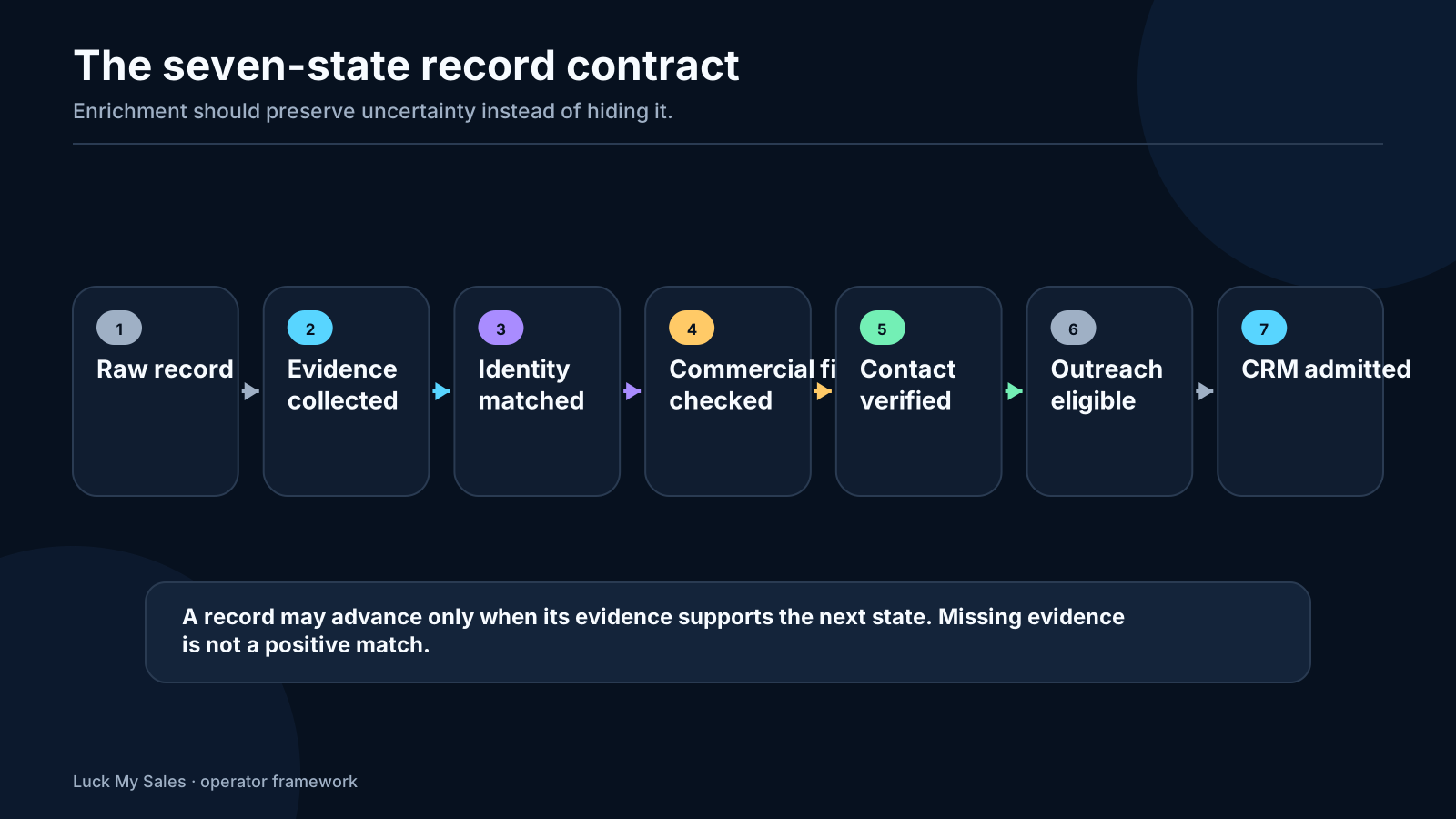
Seven-state contract for a raw sales record moving through sourcing, enrichment, verification, qualification, activation and CRM admission.
A state contract prevents an enriched record from being mistaken for a qualified relationship.

04 / The operator workflow Clay plus

The operator workflow: Clay plus Claude Code

The most useful real example from our work is a reseller-partner qualification workflow. We were not simply searching for “marketing agencies.” We needed agencies whose client portfolio created plausible resale opportunities for AI receptionist, sales-agent or voice-workflow products.
That changes the unit of analysis. The agency label is not enough. The system has to inspect the types of clients the agency serves, the commercial processes those clients run and the evidence available on the public website.

1. Define the ICP and evidence rules

The rules began with the commercial model: the product would be sold through an agency to its clients. Therefore, qualification had to evaluate the client portfolio and resale potential—not whether the agency itself currently used voice AI.
Strong evidence included public proof that the agency served clients with:
  • meaningful inbound calls or enquiries;
  • appointment, reservation or booking flows;
  • lead qualification or sales-development work;
  • customer support or receptionist demand;
  • dispatch, scheduling, reactivation or high-value lead follow-up;
  • a business model where missed calls or slow response plausibly caused lost revenue.
The workflow also required deeper checks for ambiguous categories. A digital-first agency was not automatically a poor fit. A marketing agency was not automatically a good fit. An agency serving other agencies was not automatically disqualified. Each case required evidence one level below the label.
The scoring rule deliberately limited certainty. Scores of 8–10 required strong, observable evidence. Limited evidence generally capped a record at 5–6. “The company probably has this problem” was not enough.

2. Source a broad candidate set

Clay can collect companies from criteria such as geography, industry, size and description keywords. In one separate sourcing snapshot, a source operation added 532 rows and the working table showed 468 rows after the operation and subsequent handling. That is a sourcing count, not a qualified-lead count.
This distinction should remain visible in reporting:
source rows ≠ unique companies ≠ enriched records ≠ seller-approved records
If a dashboard reports only the largest number, the team cannot see where quality is being lost or improved.

3. Normalize and deduplicate

The next layer resolves domains, company names, known duplicates and obvious geographic or business-category exclusions. Deduplication should use more than the visible company name. Trading names, redirected domains, parent companies and local branches can create duplicate outreach even when the strings differ.
At this stage I retain the source and observation time. A normalized value should not erase the original. If Company A Ltd becomes Company A, the system needs both the raw value and normalized value so a reviewer can audit the change.

4. Fetch company-level evidence

The workflow then examines the company's public pages: services, industries, case studies, client portfolio, testimonials, partner pages and other relevant evidence. The goal is not to create a generic summary. It is to answer the qualification questions.
A website fetch should produce evidence objects such as:
FieldExample structure
Claim“Agency serves dental clinics with patient-recall campaigns”
Source URLExact page used
Observed atDate and time
Evidence typeService page, case study, client list, testimonial
ConfidenceHigh, medium or low
Commercial meaningWhy this supports or weakens the reseller use case
If the page is inaccessible, thin or contradictory, the correct output is insufficient evidence, not a confident guess.

5. Apply the qualification rubric with Claude Code

Claude Code can process the evidence against explicit rules and return structured output. In our workflow, the useful fields were:
  • client profile;
  • evidence found;
  • plausible product use cases;
  • reseller potential;
  • confidence;
  • score;
  • reasoning;
  • disqualification reason where relevant.
The “brain” is not valuable because it writes longer summaries. It is valuable when it consistently applies the same commercial rubric across many heterogeneous websites, exposes why it made the decision and routes uncertain cases for review.
In one operating series, 703 leads were evaluated across 26 batches. The broader tracking history contained 2,354 already-seen domains: 702 imported and 1,652 disqualified. Among the 703 evaluated records, the score distribution recorded 400 at score 7, 205 at score 8, 89 at score 9 and four at score 10. Only about 13% reached the 9–10 “gold” band.
Those figures describe that workflow and its rules. They do not prove that 13% is a normal market rate. Different ICP criteria, source quality and evidence thresholds will change the yield. In observed batches, usable yield ranged roughly from 12% to 31%, while 70%–88% of candidate records could be rejected during deeper web validation. That is not a failure of enrichment. It is what happens when a broad list meets a narrow commercial definition.

6. Review in batches

I do not manually reproduce every enrichment step. I review the evidence and decisions in batches.
The first batches get the strongest scrutiny:
  • Are the rules producing the intended commercial interpretation?
  • Are strong scores supported by evidence rather than category assumptions?
  • Are competitors and adjacent providers excluded?
  • Are multi-business founders evaluated by their current relevant work, not a legacy company?
  • Are uncertain records clearly marked?
  • Are rejection reasons useful enough to improve the next batch?
Once the workflow is stable, sampling can replace full review for lower-risk states. But named accounts, unusual scores, evidence conflicts and records close to the acceptance threshold still deserve direct review.

7. Activate only the approved set

Approved records can move into Lemlist, Instantly or another campaign staging layer with the fields required for the message. One real campaign view included custom demo URLs, job titles, interaction fields and campaign state. Those fields supported execution outside CRM.
That architecture is deliberate. Thousands of strangers who have never replied are not automatically CRM assets. We keep cold candidates in the campaign platform and structured working files. A record enters CRM after a positive or neutral response, a meaningful inbound action or another validation event defined by the sales process.
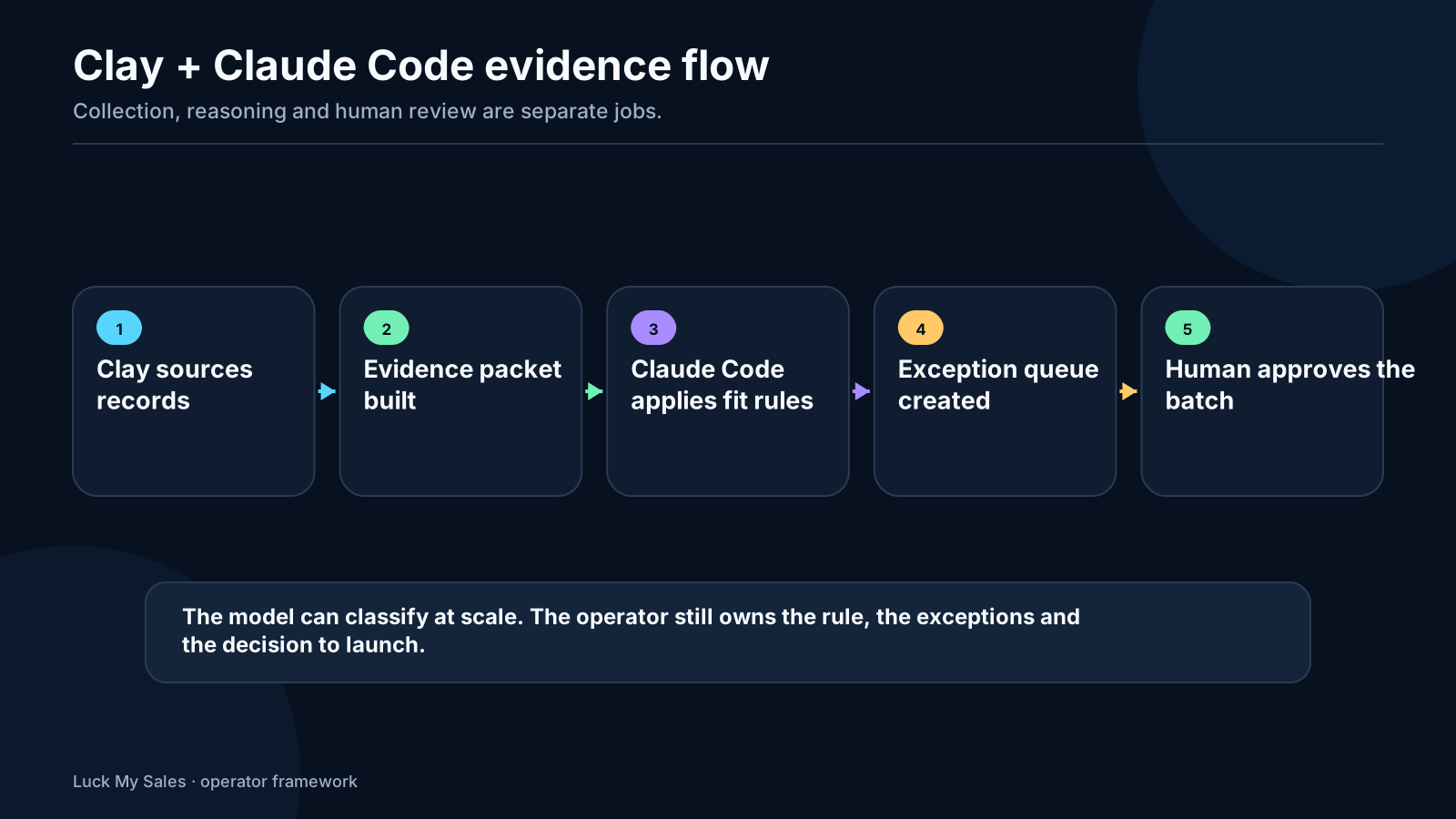
Clay and Claude Code evidence flow with sourcing, enrichment, commercial-fit checks and human review.
Clay orchestrates fields; the reasoning layer tests commercial fit; the operator owns the gate.

05 / Correct identity wrong commercial fit

Correct identity, wrong commercial fit

One of the most important failure patterns is a record that is technically correct but commercially wrong.
In a real case, the system correctly matched a person to an agency and correctly identified the agency's client segment. The outreach still failed because the person had moved psychologically and commercially into an AI-automation business and was effectively an adjacent competitor. A legacy company association was true, but it was not the most relevant description of the person's current work.
The buyer replied that they were not the right person. The mistake was not a broken email lookup. It was a qualification gap: the workflow validated company fit but did not sufficiently test the person's current primary business and competitive position.
This kind of case will continue to happen. AI will not reach 100% accuracy, and public evidence is incomplete. The correct response is not to declare the entire workflow useless after one miss. In outbound campaigns with hundreds of records, individual misses are expected. The response is to record the correction reason and decide whether it reveals a repeatable rule.
Here, the useful rule was:
For multi-company founders, inspect current headline and active commercial identity; exclude direct AI-automation competitors even when a legacy agency fits.
That is how enrichment improves: not by pretending errors disappear, but by converting meaningful errors into versioned rules.
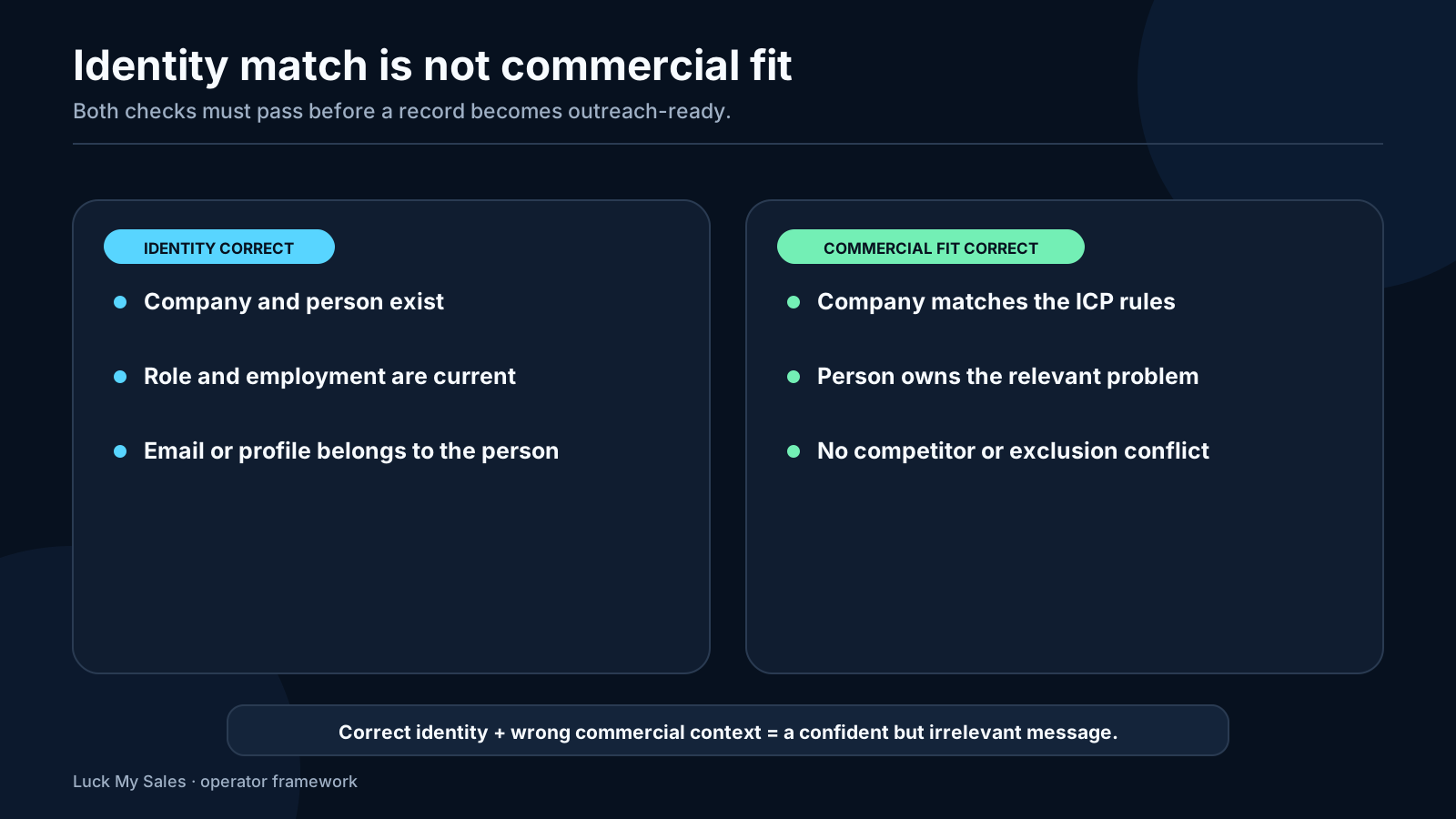
Matrix separating identity accuracy from commercial fit in B2B enrichment.
Identity accuracy and commercial usefulness are separate decisions.

06 / The preoutreach gate and the

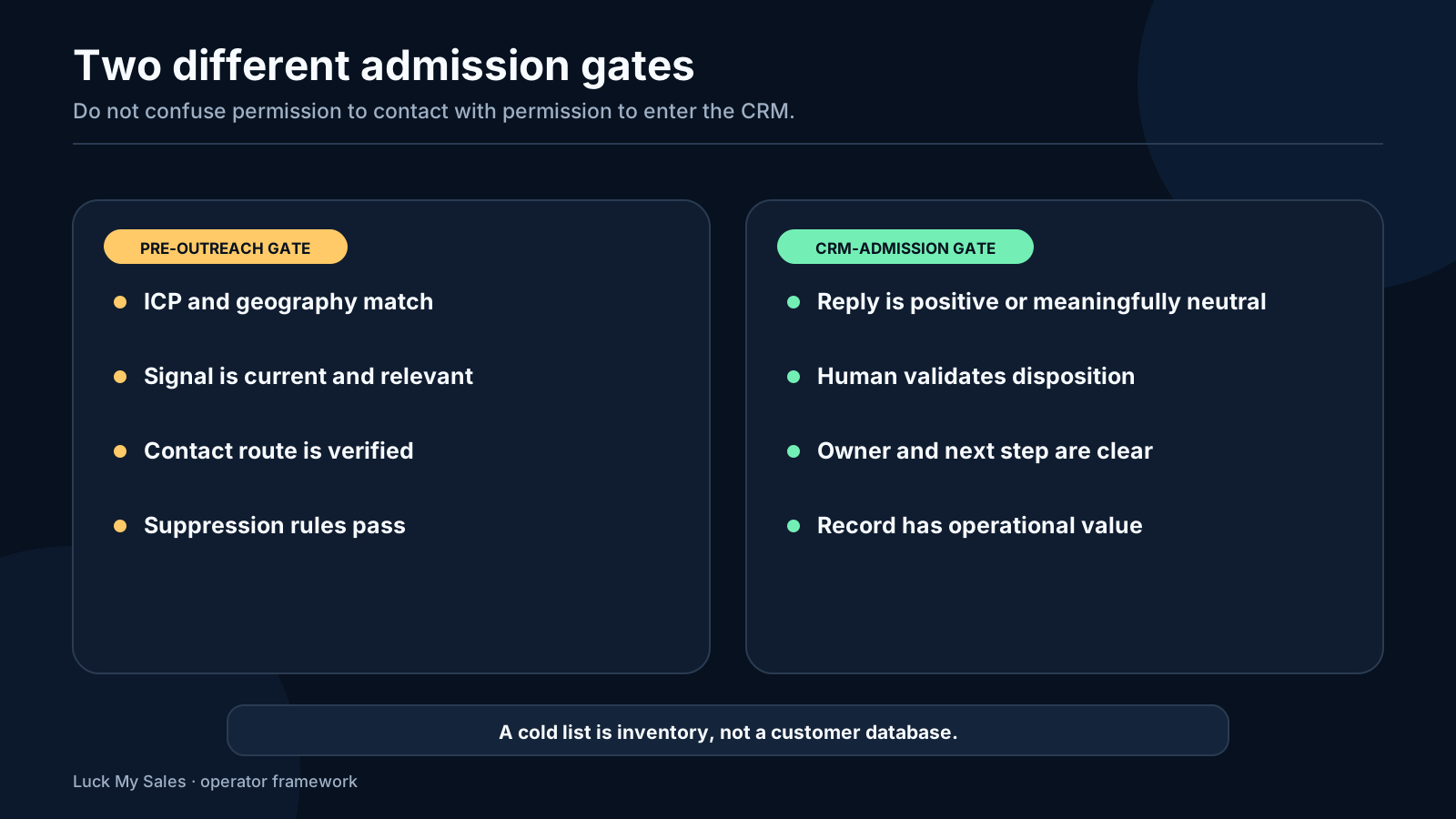
The pre-outreach gate and the CRM-admission gate

The same evidence threshold should not control every action.

Pre-outreach gate

This gate asks whether a candidate may enter a defined campaign. It should check:
  • company and person identity;
  • current commercial fit;
  • contactability;
  • exclusions and suppression;
  • source and freshness;
  • evidence for the message angle;
  • campaign-specific acceptance.
The output can remain in a campaign table. It does not need to pollute CRM.

CRM-admission gate

This gate asks whether the record has become meaningful enough for durable sales ownership. Common admission events include:
  • positive reply;
  • neutral reply requiring follow-up;
  • meeting request;
  • verified inbound form or conversation;
  • partner referral;
  • explicit account-research decision by a seller.
At admission, write the source, owner, current disposition, next step and evidence. Do not copy every temporary enrichment field. Keep provenance for fields that may change and avoid overwriting a seller-confirmed value with a cheaper automated guess.
The gate protects both CRM hygiene and seller attention. A CRM with 10,000 cold names is not necessarily more valuable than one with 500 validated commercial relationships. Volume without state produces a false sense of pipeline.
Two gates comparing permission to start outreach with permission to create a CRM relationship record.
Passing the outreach gate does not automatically justify CRM admission.

07 / Controlled CRM writeback

Controlled CRM write-back

When enrichment writes to CRM, use a reversible structure.
For each material field, retain:
  • candidate value;
  • previous value;
  • source URL or provider;
  • observation date;
  • confidence;
  • rule version;
  • reviewer or automation identity;
  • final applied value;
  • correction reason if rejected.
Prefer four write modes:
  1. Draft: propose the value without changing the canonical field.
  2. Append: add evidence or a note while preserving existing data.
  3. Reversible update: change a field while keeping history and rollback.
  4. Blocked overwrite: prevent automation from changing owner, pricing, opportunity state or another protected field.
This also supports the accuracy and minimization principles in the EU's General Data Protection Regulation. This article is not legal advice; the point is operational. More personal data is not automatically better. Collect what the defined sales action requires, retain provenance and establish a correction path.

08 / Activate accepted records outside the

Activate accepted records outside the CRM first

In a cold outbound workflow, an accepted record does not need to become a CRM contact immediately. I prefer to activate the first touch in the campaign workspace and keep the CRM clean until the prospect has produced a meaningful positive or neutral response.
This is not the same as hiding outreach activity. The campaign layer still needs a durable record. It should preserve the company and person identifiers, qualification version, accepted evidence, signal, segment, message variant, sender, enrollment time, suppression state and later reply. The difference is that this state lives beside Clay, the sender and the operating sheet instead of filling the CRM with thousands of people who have never acknowledged the company.
For one of our workflows, accepted records could carry fields such as a tailored demo URL, industry, role, interaction type and a reason for the chosen offer. Those fields existed to support a defined campaign action. They were not proof that the person was a sales-qualified lead. A generated demo URL proves that an asset was prepared; it does not prove fit, interest or consent.
The activation contract should answer five questions before enrollment:
  1. Which evidence made this record eligible?
  2. Which campaign, offer and message version may use it?
  3. Which channel is allowed, and which sender owns the contact?
  4. Which event stops all automated contact?
  5. Which response is strong enough to admit the person to CRM?
This separation also makes correction easier. If the company is relevant but the current person has moved into a competing AI business, the operator can reject or reroute the record before it contaminates account ownership and lifecycle reports. If an email bounces, the team can correct delivery data without changing the commercial-fit decision. If a person replies neutrally, the SDR can review the context and decide whether to create a CRM lead, schedule a later action or suppress future contact.

Keep qualification and messaging versions together

An outbound result should remain traceable to the rule set that selected the record. Store a qualification version and a message version. When response quality changes, you can then ask whether the list changed, the commercial rule changed or the message changed.
Without versions, teams often “improve the campaign” by changing the ICP, evidence sources, scoring thresholds and copy at the same time. A positive or negative result then has no interpretable cause. Versioning does not create experimental certainty, but it prevents obvious attribution mistakes.

Promote a record only after a meaningful event

CRM admission can be triggered by a positive reply, a neutral reply that needs seller follow-up, a booked conversation or another explicit event defined by the team. An open, click, page view or AI score is not enough on its own. Those are signals for review, not proof of a sales relationship.
At admission, write the minimum context the seller needs: source, evidence summary, qualification version, message or asset used, reply text or conversation, owner and next step. Do not copy every research field simply because it exists. The CRM should help a seller act and later explain the outcome.

09 / Build a correction loop not

Build a correction loop, not a static enrichment job

Every seller correction should become structured feedback. “Bad lead” is too vague. Record whether the problem was identity, current role, company model, geography, client portfolio, competing offer, unreachable contact, missing evidence or a rule that no longer matches the market.
Review corrections in batches. A single wrong-person result can happen in a good workflow, especially at outbound volume. A repeated reason is more useful. If current-role errors cluster around founders with several companies, add an active-business check. If a category repeatedly passes Clay filters but fails commercial review, improve the business-model rule. If evidence is unavailable in a particular geography, lower confidence or route those records to manual research.
The goal is not a system that claims 100% accuracy. It is a system that knows what it checked, exposes what it could not verify and turns human corrections into the next rule version.

10 / How to measure enrichment without

How to measure enrichment without hiding the denominator

Do not judge the workflow by the number of populated fields. Use a funnel with explicit denominators.
MetricDenominatorWhat it diagnoses
Source coveragecandidate recordsWhether the source can find required evidence
Verification passenriched recordsWhether critical fields are usable
ICP acceptanceverified recordsWhether sourcing matches the commercial definition
Seller acceptanceAI-recommended recordsWhether recommendations survive human review
Correction ratereviewed or activated recordsWhether the logic creates repeatable errors
Review timeaccepted recordsWhether automation actually reduces operator effort
Cost per accepted recordseller-accepted recordsWhether provider and model spend is economically useful
Meaningful reply ratedelivered contactsWhether accepted data supports relevant outreach
Held meetingsaccepted contacts or repliesWhether the motion progresses beyond activity
Downstream metrics do not prove that enrichment caused the result. Offer, message, channel, sender reputation and sales handling also matter. Enrichment should be treated as one controllable input in the system.
The most honest evaluation compares versions under similar conditions. Hold the offer and audience as stable as practical, change one part of the evidence or qualification workflow, and record where the funnel changed. If seller acceptance rises but meaningful replies do not, the review standard may be too generous. If replies improve but meetings do not, the problem may be qualification after response rather than list quality.

11 / A 100record pilot

A 100-record pilot

Before enriching thousands of contacts, run a 100-record pilot.

Step 1: select a representative sample

Include obvious fits, ambiguous fits and known exclusions. Do not use only the easiest records.

Step 2: define the required evidence

List every field, acceptable source, freshness threshold and protected field. State what insufficient evidence means.

Step 3: run the full workflow

Source, enrich, verify, qualify and produce structured reasoning. Record provider and model cost separately.

Step 4: review the decisions

Have a seller approve, reject or correct each recommendation. Tag the reason: wrong company, wrong person, competitor, geography, missing commercial fit, insufficient evidence, invalid contact or another defined category.

Step 5: revise the rules

Change a rule only when the evidence shows a repeatable pattern. Preserve the old rule version so the team can explain why outcomes changed.

Step 6: activate a bounded set

Send only the accepted records into a small campaign. Track delivery, meaningful replies, held meetings and seller handling. Stop if source quality, brand relevance or deliverability deteriorates.

Step 7: decide whether to scale

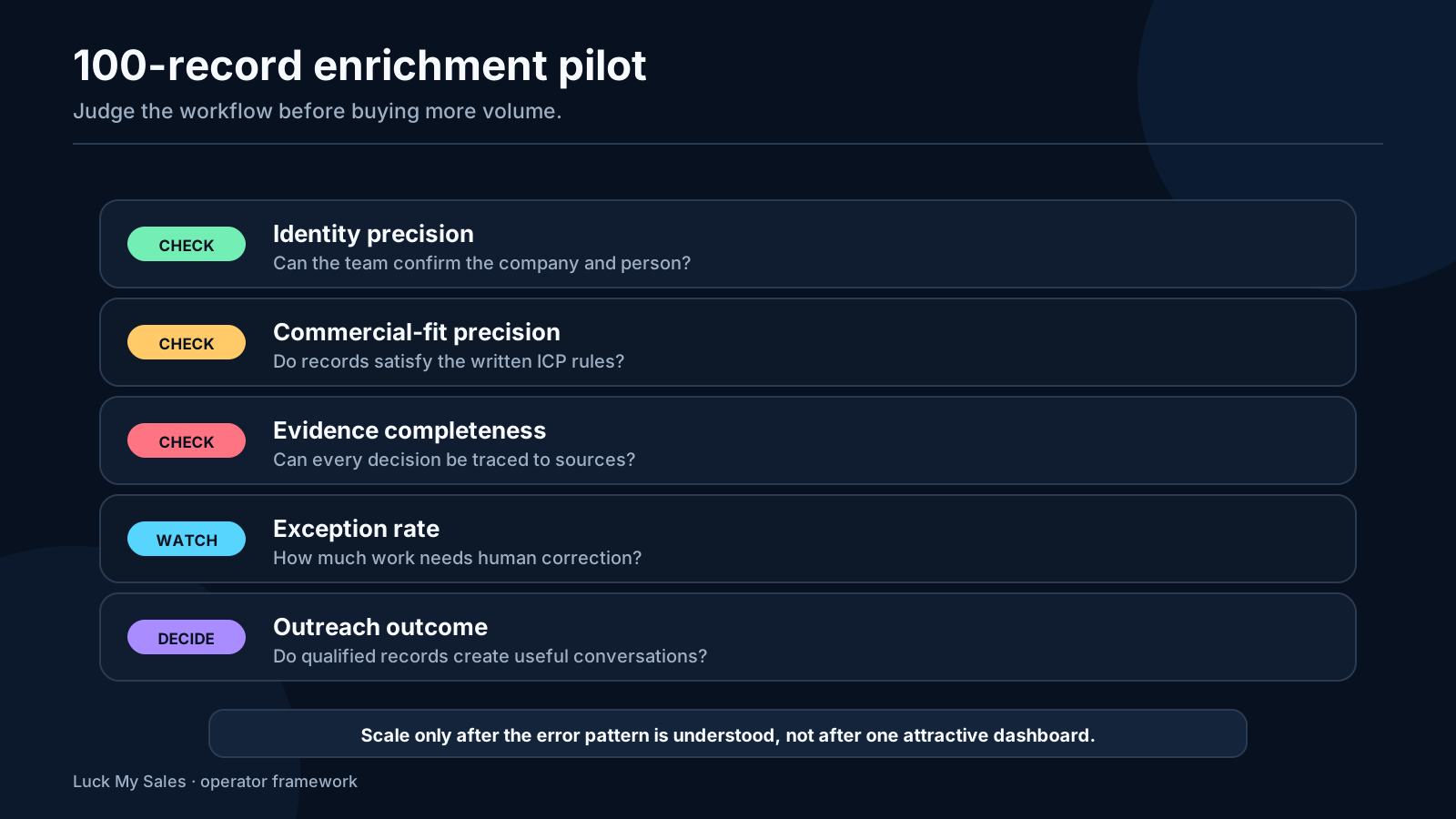
Scale when the workflow produces enough seller-accepted records at an acceptable review time and cost—and when the downstream motion shows useful conversations. Do not scale because the table looks complete.
Scorecard for a 100-record sales data enrichment pilot with evidence, acceptance, correction and outcome measures.
Use a small, reviewable denominator before scaling the enrichment workflow.

12 / Common failure modes

Common failure modes

Treating enrichment as truth

Every provider and model can be wrong or stale. Store evidence states and confidence.

Qualifying from category labels

“Marketing agency,” “SaaS” or “healthcare” is not a complete ICP. Inspect the commercial process and client base.

Scoring without evidence

A score without observable reasons is a sorting trick. Require citations and a rule version.

Importing cold candidates into CRM

Keep unvalidated campaign records in staging. Admit them after a defined validation event.

Overwriting seller-confirmed values

Use draft, append and reversible updates. Protect owner, stage, pricing and other consequential fields.

Hiding rejection

If 80% of records are rejected, report it. That may show the validation gate is doing its job—or that sourcing is too broad. You need the denominator to know which.

Scaling before the first batches are stable

Errors multiply faster than benefits. Review early batches intensely, then reduce review only where risk and evidence justify it.

13 / Frequently asked questions

Frequently asked questions

What is data enrichment in B2B sales?

It is the process of adding and updating evidence around companies and people so a sales team can make a defined decision. It should include provenance, freshness, verification, qualification and a correction path—not only added columns.

How does enriched data improve sales calls?

It can give the seller current role, company, problem and interaction context before the call. That may improve preparation and relevance, but it does not guarantee call success. The seller still needs to verify important facts and respond to the conversation.

Should every enriched lead go into CRM?

No. Cold candidates can remain in a campaign or staging layer. Admit a record to CRM after a meaningful response, verified inbound action, seller research decision or another explicit event.

Can AI automate sales data enrichment?

AI can collect evidence, normalize it, apply rules, recommend a score and route uncertain records. Humans should define the commercial requirements, review early batches, protect consequential fields and own corrections.

What is the difference between enrichment and qualification?

Enrichment adds or updates evidence. Qualification applies commercial rules to decide whether the record fits a specific motion. A record can be richly enriched and still fail qualification.

What should I compare in sales data enrichment providers?

Compare field coverage, source transparency, freshness, verification, waterfall control, exportability, cost per seller-accepted record and how easily your team can review and correct the output. Database size alone is not enough.

14 / The practical rule

The practical rule

Build the enrichment workflow backward from the seller's next action. Keep sourcing, evidence, verification, qualification and activation as separate states. Make uncertain output visible. Review the first batches heavily. Keep cold strangers out of CRM until the relationship becomes meaningful.
The goal is not a larger database. It is a smaller set of records that a seller can trust enough to act on—and a system that can explain and repair the mistakes that remain.

Research note

Methodology

  1. 01The workflow is based on Anastasiia's direct operating experience with Clay, Claude Code and company-by-company commercial-fit validation.
  2. 02First-party counts are anonymized and presented with their original scope; they are not universal enrichment benchmarks.
  3. 03Official Clay, Apollo and EU sources support bounded product and data-governance claims.
Read the full methodology

Source ledger

Sources & editorial notes

  1. 01
    official enrichment documentation

    Apollo · Official, primary or category source used for the bounded claim cited in this guide; current feature scope may change.

  2. 02
    waterfall documentation

    Clay · Official, primary or category source used for the bounded claim cited in this guide; current feature scope may change.

  3. 03
    General Data Protection Regulation

    European Union · Official, primary or category source used for the bounded claim cited in this guide; current feature scope may change.

  4. 04
    10 B2B Data Enrichment Providers and Tools Compared by the Record You Need

    Luck My Sales · Existing first-party comparison defining seller-accepted records and field-level evidence.

  5. 05
    How AI Lead Scoring Works Across Gmail and CRM

    Luck My Sales · Existing first-party guide separating source evidence, recommendation, human decision and CRM action.

  6. 06
    AI Lead Routing: How to Assign Inbound Leads Without Hiding the Sales Decision

    Luck My Sales · Existing first-party guide defining decision contracts and human ownership precedence.

Corrections or primary material: contact the corrections desk.

About the author

Anastasiia Krynytska

Anastasiia Krynytska is a LeadGen Team Lead at Softermii and the lead editor of Luck My Sales. She covers AI-assisted outbound, account research, qualification, messaging, CRM handoffs and revenue workflows from a practitioner’s perspective.View author profile LinkedIn

Continue reading

01 · News analysis

AI sales is moving from assistant to operating layer

The category is expanding from drafting support into research, pipeline decisions, recommended actions and controlled execution.

Read news
02 · Field analysis

In AI sales, the handoff may be the product

Models are becoming accessible; durable value sits in the controlled transition from signal to seller action.

Read analysis
03 · Research framework

Sales AI Workflow Signals 2026

A launch framework for mapping the products, controls and buying questions shaping AI-enabled revenue work.

Read reports

Luck My Sales briefing

Useful context, once a week.

News, explanations and original research from this desk. No noise.
The newsletter is still being built. We will contact you when the first edition is ready.