Weekly industry intelligence · No noiseSubscribe to the Luck My Sales newsletterFree briefing

Independent intelligence on AI in sales

Menu

B2B service buyer's guide · AI prospecting

Outsourced Lead Qualification: How to Choose a B2B Service Without Losing Control

A provider-neutral guide to deciding what qualification work to outsource, evaluating the team, protecting CRM evidence and running a controlled pilot.
Editorial disclosure

AI may assist research organization and drafting. A human editor reviews every published page, checks material claims against the cited sources and owns the final decision. No company paid for placement in this article.

AI use policy

Agent-ready brief

AI takeaways

Keep the key points here, or take a source-aware text brief into Claude, ChatGPT or another AI workspace.
  1. 01Keep the ICP, definition of qualified, exceptions and final CRM acceptance under an internal owner.
  2. 02Delegate research and list building before outreach; add an SDR only after one ICP, message and channel work together.
  3. 03Test providers with a written Qualification Service Contract, a bounded work sample and a controlled pilot.
  4. 04Keep provider recommendation, internal adjudication and later commercial outcome as separate records.
  5. 05Measure sales acceptance, false accepts, false rejects, unresolved cases, held meetings and full operating cost—not calendar volume alone.
Includes summary, takeaways, sources and a use note.
Outsourced lead qualification works when an external team performs a defined research or conversation task, but it fails when the buyer also outsources the meaning of qualified.
Your company should still define the ideal customer profile (ICP), disqualifiers, accepted evidence and final CRM state. The provider can research, contact, ask approved questions and recommend a disposition; an internal owner accepts, rejects or corrects that recommendation.
The operating input behind this guide comes from team-level work across outsourced SDRs, call centers, appointment setters and dedicated qualification providers. The team hired or controlled the work, reviewed the output and received leads; this does not establish that Anastasiia personally performed every activity across all four models.
Across that team-level work, the operating estimate is that about 90% of outsourced sales assignments require adaptation after the first version. This is not a measured industry benchmark.
This provider-neutral guide includes a five-stage hiring process, the current four-part SDR test framework, a Qualification Service Contract, CRM fields, pilot metrics and stop rules.
Method and disclosure: Team-level operating input and the owner-supplied test framework inform this guide. Separate raw candidate responses remain private and are not evidence. No provider is ranked or named as a recommendation. Unsupported private screenshot figures are excluded. This is an operating guide, not legal advice.

Outsource execution, not the meaning of qualified.

01 / Decision

The short answer: outsource execution after the sales motion works

Do not outsource lead qualification to discover your ICP, message and channel at the same time: a provider can adapt a working motion, but it cannot reliably invent all three and still give you a clean test of quality.
Use this decision rule:
Current stateSafe delegationKeep internal
The founder is still discovering the buyer and offerNothing materialCustomer conversations, ICP, value proposition, message and channel
The ICP is clearer, but outreach is still being testedResearch and list buildingMessage, sending, replies and qualification
One ICP, message and channel already workBounded SDR execution and first-pass qualificationExceptions, strategic accounts, final acceptance and opportunity state
Qualified calls exceed the founder's closing capacitySelected AE work after a controlled handoffSales standards, coaching and complex deals
Several AEs reliably perform against the same standardSales management and scaled SDR/marketing capacityStrategy, governance and material changes to the motion
A small team should keep decisions with high impact in-house, including ICP changes, new messages, real replies, exceptions and new opportunities.

02 / Service scope

What outsourced lead qualification actually includes

Lead qualification services can cover many jobs, so set the scope before you compare providers.
Service jobTypical inputDefensible outputDecision that remains internal
Inbound responseForm fill, demo request or event scanVerified identity, answers and recommended routeWhether the record is sales accepted
Outbound researchTarget account list or market definitionCurrent company, role, source record and fit recommendationWhether the account deserves contact
Outbound conversationApproved list, message and channelReply state, buyer-supported context and next-step recommendationMeaning of an ambiguous reply
Event follow-upAttendee or scanned-lead listContact result, stated interest and nurture stateWhether event interest creates an opportunity
ReactivationDormant CRM recordsCurrent identity, relevance and response stateWhether the old relationship should reopen
Multilingual or after-hours coverageApproved queue and language rulesConversation record and escalationSensitive interpretation and final commercial state
Qualification is not the same as lead generation: lead generation creates or sources records, while qualification assesses whether a record deserves a defined sales action.
Qualification is also not the same as appointment setting: a booked meeting is a calendar event, whereas a qualified lead has passed an agreed rule with reviewable evidence. A meeting may still be wrong, cancelled or rejected by sales.
An outsourced SDR role is broader and may cover research, messages, outreach, replies and booking, while a qualification provider may own just one filter between interest and a sales handoff.
Software is another category: if your problem is product selection, see our comparison of lead qualification tools; if the problem is decision design, start with how AI assists lead qualification.

03 / Delegation

Use the founder-stage delegation model
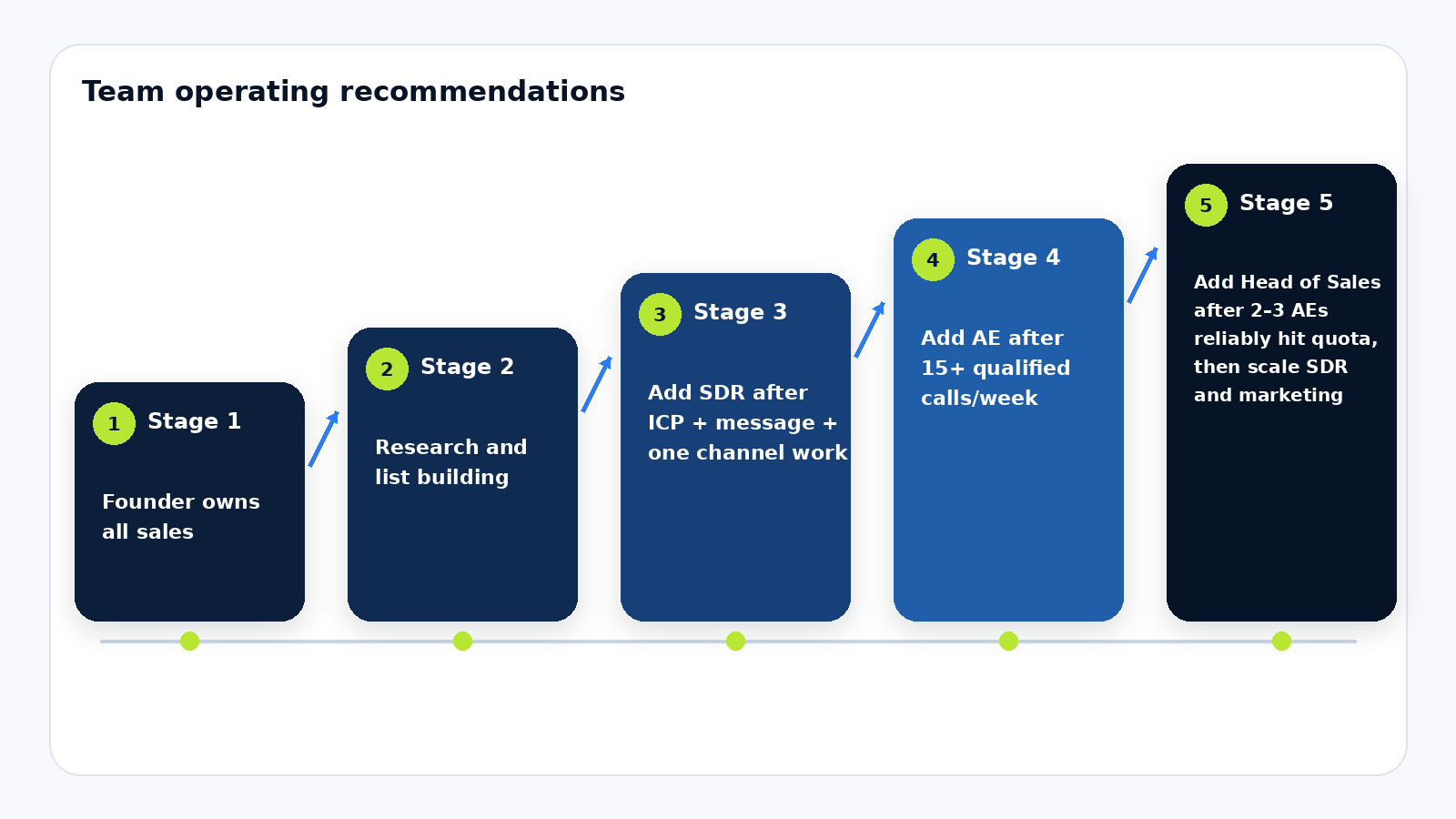
Delegation should follow evidence rather than impatience.
Five-stage founder sales delegation model from founder-led work to scaled sales and marketing.
Delegation should follow evidence from a working sales motion.

Stage 1: delegate nothing

The founder should speak with buyers and own the first sales work, because the goal is to learn how the market describes the problem, which objections matter and why people say yes.
At this stage, an external team creates distance from the strongest source of learning. Volume can make that distance harder to see.

Stage 2: delegate research and list building only

Once the founder can define a sound ICP, another person may build lists and prepare the research, while the founder still controls the message, channel and replies.
The safe output is a source-linked recommendation, not an approved outreach list: check the company, role and location first, followed by relevance and the usable channel.
For a detailed evidence workflow, use our B2B data enrichment provider guide.

Stage 3: add an SDR only after one motion works

An SDR becomes useful after three elements work together:
  1. one defined ICP;
  2. one message that opens relevant conversations;
  3. one permitted channel with a repeatable operating process.
The SDR may then run that bounded motion, while the founder or sales owner still reviews early records, replies and handoffs.
Do not interpret a full calendar as validation; check whether held conversations match the agreed buyer and problem.

Stage 4: add an AE after qualified calls exceed founder capacity

The early-stage operating recommendation behind this guide is at least 15 qualified calls each week before closing passes to an AE; this team-level working rule is not a broad benchmark.
Below that level, another closer may split a thin learning loop, while the founder can often learn more by handling the calls and improving the motion.

Stage 5: add a Head of Sales after repeatable AE performance

A Head of Sales becomes useful after two or three AEs hit quota under the same sales motion; this team-level working rule is not a market statistic.
At that point, the company can scale SDR and marketing capacity with stronger evidence, and the manager has a repeatable system to coach instead of being asked to invent the system from zero.

04 / Service contract

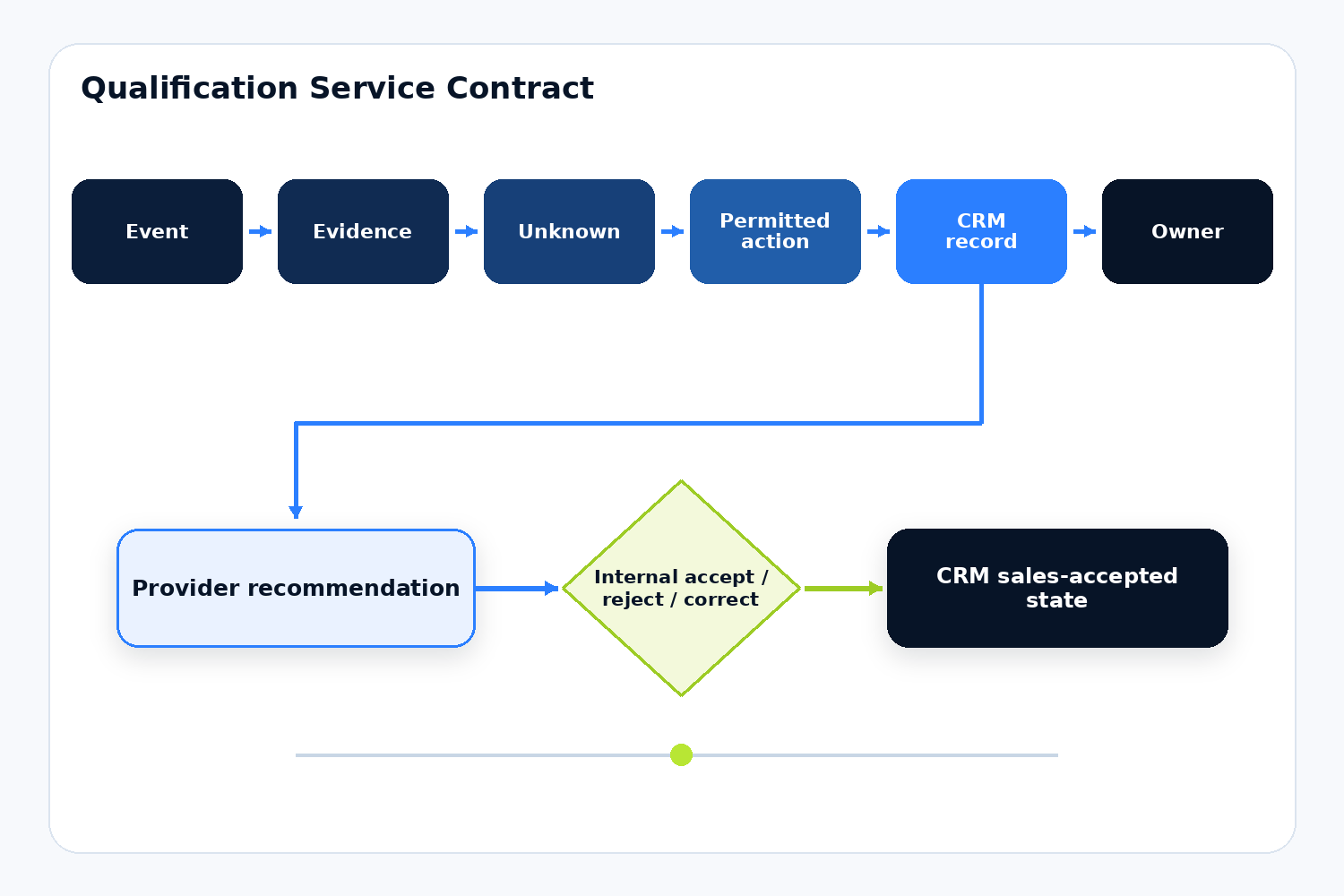
Write a Qualification Service Contract before the RFP

A qualification contract is an operating record that sets what the provider may see and advise, as well as what the provider may change.
Use six fields:
Contract fieldRequired decision
EventWhat exact state may advance?
EvidenceWhich buyer statement or verified source supports it?
UnknownWhat happens when evidence is absent or conflicts?
Permitted actionMay the provider research, contact, book, route or update CRM?
CRM recordWhich fields preserve the recommendation and source?
OwnerWho accepts, rejects or corrects the result?
Six-field Qualification Service Contract with an internal approval gate before CRM acceptance.
The contract defines what a provider may observe, recommend and change.

Define the qualification event

Avoid a circular rule such as “a qualified lead is a lead that meets our qualification criteria”; name the event instead.
For outbound, it may be an ICP match who accepts a sales talk that addresses a stated problem. For inbound, it may be a valid contact with a relevant use case and a clear path to the next step; for events, it may be an attendee with a current project who also asks for follow-up.
Keep these states separate:
valid record → contacted → conversation → provider-qualified → sales accepted → held meeting → opportunity
The provider-qualified state is a recommendation, not the sales-accepted state.

Separate facts, buyer statements and interpretations

The provider should distinguish three evidence types:
Evidence typeExample
Verified factCurrent employer, role or company location
Buyer statementA stated project, limit or time frame
InterpretationThe provider's view that the record is ready for sales
AI summaries can blur these types, so require a source link or transcript note for each key claim; mark missing proof as unknown rather than turning it into a negative or a made-up fact.

Define permitted actions and stop conditions

Write what the provider may do without approval and when that permission ends.
Useful stop conditions include:
Stop triggerRequired action
A real reply arrivesAssign a named human owner
A buyer opts outStop the contact path and update suppression
The contact has an active account or dealRoute to the current owner
Source evidence conflicts with CRMPause and review the record
A high-value account appearsSend it to the named account owner
The talk moves into legal, price, security or technical detailEscalate to the right internal role
The AI summary lacks a sourceBlock write-back and check the record
The approved script no longer fitsStop and seek a new approval
Once a meaningful reply arrives, a named person should own the relationship so the record does not fall back into a generic sequence.

05 / Service models

Compare the service model, not the provider slogan

The correct model depends on complexity, volume, language, channel and the cost of a wrong decision.
ModelBest fitMain advantageMain riskControl to require
Shared agentsVariable inbound or event volumeFlexible capacityLimited product context and agent continuityNarrow script, structured fields and frequent calibration
Dedicated SDRsComplex B2B motion with steady volumeDeeper offer and market knowledgeHigher setup and management burdenNamed team, training record and change control
US-based teamUS hours or a domestic operating requirementTime-zone and market familiarityLocation can be mistaken for quality proofTest the same work; verify actual requirement
Nearshore or offshore teamExtended hours, language or cost flexibilityCoverage and scalable laborContext, handoff and data-transfer riskLanguage QA, access limits and escalation owner
Human-led serviceNuanced first conversationsJudgment and adaptationScript drift and inconsistent notesCall review, calibration and structured CRM fields
AI-assisted serviceResearch, transcription, summaries and prioritizationFaster preparation and consistent structureUnsupported claims or hidden data useAI-use inventory and human review
AI-voice serviceApproved, repeatable phone taskConsistent coverageConsent, disclosure, interruption and trust riskLegal review, transfer rule and full call audit
Do not assume that a domestic agent is automatically better or that a lower-cost location is automatically worse; test language, context, evidence discipline and handoff quality on the same assignment.

06 / Hiring

Use a five-stage hiring process
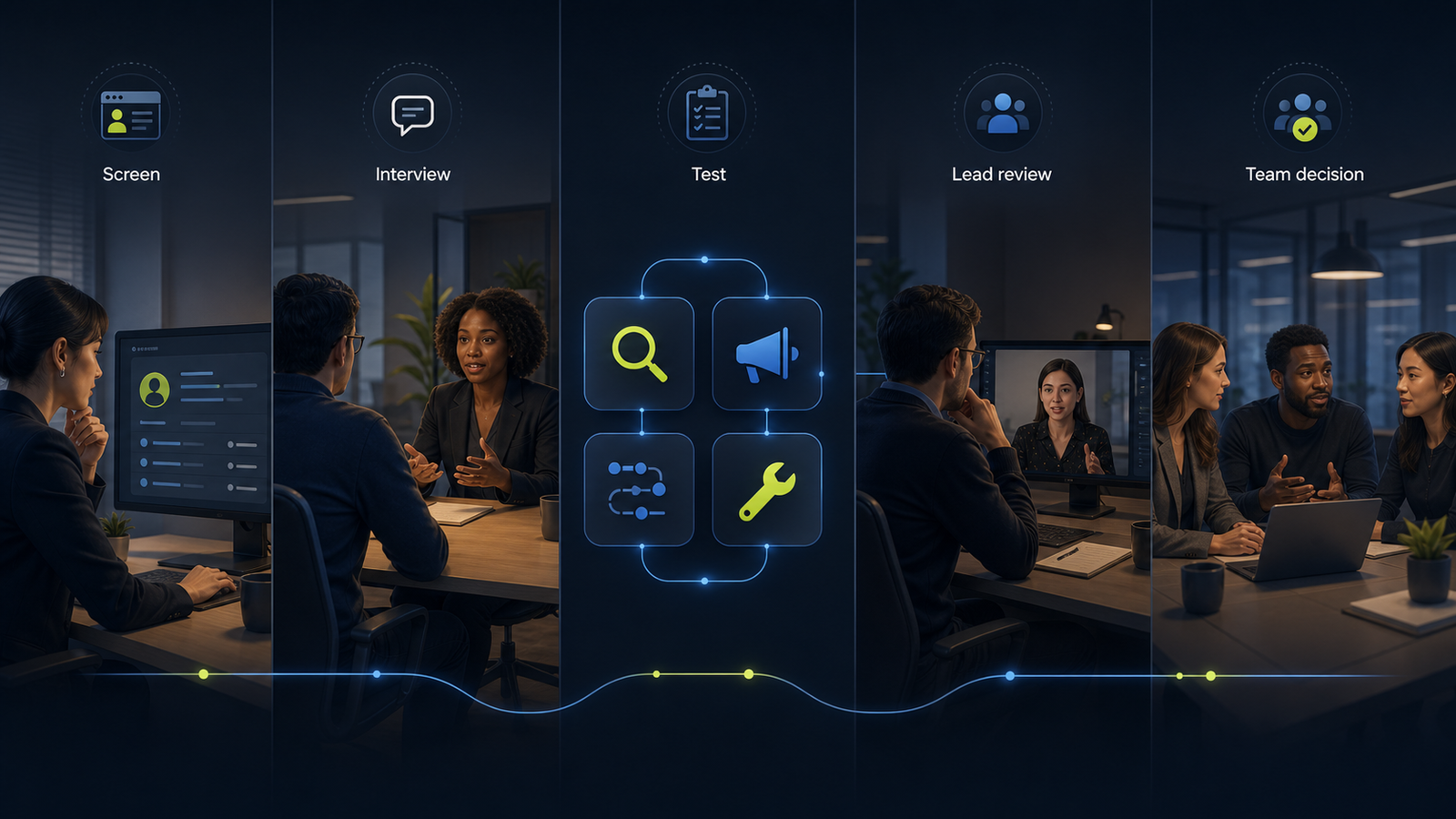
The team-level hiring process behind this guide has five stages, each designed to remove a different uncertainty.
Sales team evaluates an outsourced SDR through five stages without exposing private candidate work.
A bounded test shows how a candidate researches targets, plans a campaign, structures a sequence and explains a tool choice.

1. Screen relevant experience

Check the work, market, channel and responsibility, because “B2B sales experience” is too broad.
Ask what the person personally researched, wrote, sent, handled and recorded, as well as what happened after the meeting; separate direct work from team-level claims.

2. Run an introductory assessment

Use the interview to test listening and commercial reasoning: give the candidate an imperfect scenario and ask which information is missing before they act.
A strong candidate does not only sound confident; they can explain the decision, ask useful questions and identify a risky assumption.

3. Give a bounded test assignment

The current owner-supplied SDR test behind this guide has four parts:
  1. inspect company profiles and directories, then infer which clients the company targets;
  2. design a detailed campaign for 50 contacts using the specified constraints: healthcare, the Nordics, company size up to 50 employees and market expansion;
  3. write a three-message sequence that progresses to a call invitation, then add a follow-up after one week of silence;
  4. name a preferred SDR service or tool and explain its advantages.
The design tests more than grammar: it reveals research synthesis, target-client inference, campaign planning, constraint following, sequence logic, CTA quality and the candidate's ability to explain a tool choice.
Use a scorecard like this:
Evaluation signalWhat good work showsCommon warning
Research and target inferenceProfiles and directories support a plausible target-client viewTarget is asserted without connecting the source clues
Campaign planningThe 50-contact plan connects segment, channel, message and next actionA contact count is supplied without an operating sequence
ICP comprehensionMessage reflects company, role and buying situationGeneric personalization
Value translationOffer connects to a plausible current problemCompany biography replaces buyer relevance
Channel fitMessage length and ask suit the channelSame copy used everywhere
Instruction followingExplicit request and format are honoredImportant detail is ignored
Evidence disciplineClaims match supplied facts and portfolio proofUnsupported experience or performance claim
Brand representationClear, credible and respectful languageAwkward, inflated or careless wording
Commercial contextCandidate sees why the buyer may act nowMessage asks for a call without a reason
CTANext step is specific and proportionateVague “let's connect” close
Tool reasoningCandidate explains a preferred SDR service or tool and its relevant advantagesPreference is named without a use case or trade-off
A separate attachment contains raw candidate responses. Keep them private: they are not evidence for this guide and must not be published without consent.

4. Add a team-lead review call

The team lead should review the test with the candidate, asking why they chose the angle, evidence and CTA, as well as what they would change after a negative reply.
This call reveals whether the candidate can accept feedback and adapt, which a polished test alone does not show.

5. Hold a final team discussion

The final talk should cover ownership, team contact and when to raise a risk; confirm who checks early work and ask how the person handles doubt and mistakes.
The goal is not unanimous enthusiasm but a shared view of the candidate's operating risk and support needs.

07 / Brand & context

Protect brand representation and commercial context

Across the team-level outsourced work behind this guide, weak brand representation and missed commercial context were frequent problems, while low-quality meetings were very frequent.
These are qualitative team observations, not measured market rates.
Human reviewer catches weak brand representation and missing commercial context before outsourced outreach continues.
Script completion is not the same as a sound commercial decision.

Weak brand representation

The message may be grammatically poor, inflated or centered on the vendor, and it may claim expertise that the supplied evidence does not support; the buyer experiences this as your company speaking.
Review the first messages at record level rather than approving only a reusable template, which can become inaccurate when the company, role or situation changes.

Low-quality meetings

A provider can satisfy a calendar target while sending sales weak conversations, because the contact may lack fit, need, authority or a reason to act and may have accepted only a vague networking call.
Define which evidence must exist before booking, then track whether sales accepted the record and whether the meeting was held instead of paying attention only to calendar volume.

Missed commercial context

An agent may follow the script and still miss the point: they can record a timeline without understanding the project or hear “not now” without capturing the condition that would change the answer.
Use call review and disagreement analysis, then update the playbook when several cases reveal the same missing context.

08 / CRM handoff

Require a clear CRM handoff

Every provider-qualified record should show both what happened and what remains uncertain.
CRM fieldPurpose
Lead source and providerShows origin and accountable service
Contacted channel and timestampReconstructs the interaction
Source recordPreserves verified company and contact evidence
Qualification questionsShows the approved questions used
Buyer-supported answersSeparates statements from inference
Unknowns and conflictsPrevents missing data from becoming false certainty
Provider dispositionRecords the external recommendation
Recommendation reasonExplains why the state was proposed
Transcript or recording referenceSupports review when lawful and available
Internal acceptanceRecords accept, reject or correct
Rejection/correction reasonFeeds calibration
Next action and ownerPrevents an accepted record from stalling
Held meeting and opportunity stateConnects service output to a later outcome
The provider should not overwrite the original evidence; store the recommendation, internal decision and later outcome as separate events.

09 / AI & data

Ask how the provider uses AI and customer data

An outside team may use AI to research, draft, assist calls, transcribe, summarize or score, and it may also use a synthetic voice; ask for an AI inventory before you share CRM data.
AI-use fieldProvider answer required
SystemWhich product or model is used?
PurposeWhat task does it perform?
DataWhich contact, company, CRM or conversation data enters it?
OutputWhat does the model create or recommend?
ReviewWho checks the output before action or CRM write-back?
RetentionHow long is input and output stored?
SubprocessorsWhich other companies receive the data?
CorrectionHow can the client challenge and repair an output?
VoiceDoes the system generate or simulate a human voice?
The NIST supply-chain guide says buyers should define and share supplier needs; apply that idea to CRM access and other vendors, covering data life, deletion, incidents and exports as well.
For US sales email, the FTC CAN-SPAM guide says there is no B2B exception, and a company also keeps a legal role after it hires another sender.
Most B2B calls are exempt from parts of the FTC sales-call rule, although the rule still has some exceptions and FCC, state or sector rules may also apply. Check the current FTC guide and seek legal review for the exact campaign.
The FCC says TCPA limits for artificial or recorded voices include AI voices, so its 2024 ruling belongs in an AI-voice review; do not accept compliant as a full answer.

10 / Cost

Calculate setup and operating cost without relying on a headline price

The visible retainer or per-meeting fee is only one component, so build the comparison from the work required.
When you compare lead qualification services, include setup work and ongoing internal review.

Setup components

Cost areaWork to include
Sales designICP, qualification, message, script and objection playbook
SelectionHiring, provider review and test assignment
PilotSample, review rule and decision design
DataSource, checks and needed enrichment
ChannelsInbox, domain, phone and channel setup
CRMFields, routes and integrations
EnablementProvider training and team-lead time
RiskSecurity, privacy and legal review
QAScorecard, call review and report design

Ongoing components

Cost areaWork to include
ServiceLabor, retainer or outcome fee
StackData and software plans
ChannelsSend systems and delivery work
Internal workManagement and review time
ChangeMessage and playbook updates
CRMAdmin work and data repair
QASamples and disagreement review
Calendar qualityRejected calls, no-shows and replacement terms
RiskSecurity checks and vendor changes
ExitTermination, export and transition
Do not publish a universal market price from a provider list; ask each candidate to map price to the same scope, volume, language, channel and acceptance rule.
Pricing also changes incentives: a per-meeting model can reward calendar volume, a per-qualified-lead model can reward a loose definition, and a retainer can reduce short-term pressure but still hide weak output. Contract the quality rule and audit process before selecting the payment model.

11 / Pilot

Run a controlled provider pilot

Do not begin with the full database; start with one bounded source, segment and channel.

1. Freeze the input

Record the lead source, ICP, exclusions, period and data state, then remove active opportunities, customers and suppressed contacts before the provider receives the list.

2. Freeze the qualification rule

Approve the questions, evidence, unknown state and handoff, while defining provider-qualified and sales accepted separately.

3. Approve the first messages or calls

Review early work at the record level, checking relevance, accuracy, tone and permitted action; do not scale from a polished template alone.

4. Adjudicate disagreements

Compare the provider's disposition with an internal reviewer, inspecting false accepts, false rejects and unresolved records.
A false accept passes the provider but fails the internal rule, while a false reject is rejected by the provider but later meets the internal rule; an unresolved record lacks enough evidence for either state.

5. Connect the handoff to outcomes

Track accepted records through held meetings and opportunity creation, because a positive reply or booked call is only an intermediate event.

6. Apply a predeclared decision

Choose one result:
  • scale when quality, control and cost meet the agreed rule;
  • revise when a correctable pattern appears;
  • narrow when only one segment or task works;
  • stop when brand, compliance, data or commercial risk exceeds value.
The first pilot should optimize learning rather than visible activity.

12 / SLA

Put outcome and error metrics in the SLA

Define the top and base number for each metric, including its time frame and owner.
MetricCalculationWhat it tells youLimitation
Time to first permitted actionTime from eligible intake to first approved actionCoverage and queue speedFast does not mean relevant
Conversation rateConversations / valid contacted recordsWhether the channel reaches peopleDoes not prove fit or intent
Provider-qualified rateProvider-qualified / reviewed recordsProvider decision volumeDepends on provider definition
Sales-accepted rateInternally accepted / provider-qualifiedHandoff alignmentInternal review can also be wrong
False-accept rateRejected provider-qualified / audited provider-qualifiedWeak handoffsNeeds consistent adjudication
False-reject rateInternally accepted provider-rejected / audited rejectedMissed valueRequires review of rejected records
Unresolved rateUnresolved / reviewed recordsEvidence quality and rule clarityA high rate may be honest
Held-meeting rateHeld / booked meetingsCalendar qualityStill not opportunity quality
Opportunity rateOpportunities / sales-accepted recordsDownstream commercial movementAttribution remains shared
CRM completenessComplete required records / reviewed recordsHandoff disciplineComplete fields can still be wrong
QA defect rateMaterial defects / audited interactionsOperating qualityDepends on sample design
Complaint or opt-out rateComplaints or opt-outs / contacted recordsBuyer and channel riskInterpret by channel and audience
Total cost per accepted recordFull service cost / sales-accepted recordsOperating efficiencyDoes not include later conversion alone
Do not collapse these metrics into one “lead quality score,” because the disagreement shows where the service contract or sales motion needs work.

13 / Failure modes

Failure modes a provider dashboard can hide

Definition drift

The provider starts with a strict rule. Under volume pressure, qualified becomes anyone who accepts a call. Audit the evidence, not just the label.

Script drift

Agents adapt wording until the message no longer reflects the approved offer. Version the script. Review real interactions.

Duplicate or conflicting outreach

The provider contacts an active customer, opportunity or relationship owner. Synchronize exclusions and suppression before every campaign.

Unsupported AI summaries

The summary adds a pain point or timeline the buyer did not state. Keep transcript references and let an internal owner correct the record.

CRM overwrite

The service changes lifecycle or opportunity state without preserving the previous value. Use separate recommendation and acceptance fields.

Hidden subcontractors

The contracted provider passes work or data to another team or AI system. Require a current subprocessor list and change notice.

Premature scale

The campaign grows before sales audits the first handoffs. Activity rises while context, brand and data quality fall.

14 / Adjudication

Adjudicate provider decisions before changing the contract
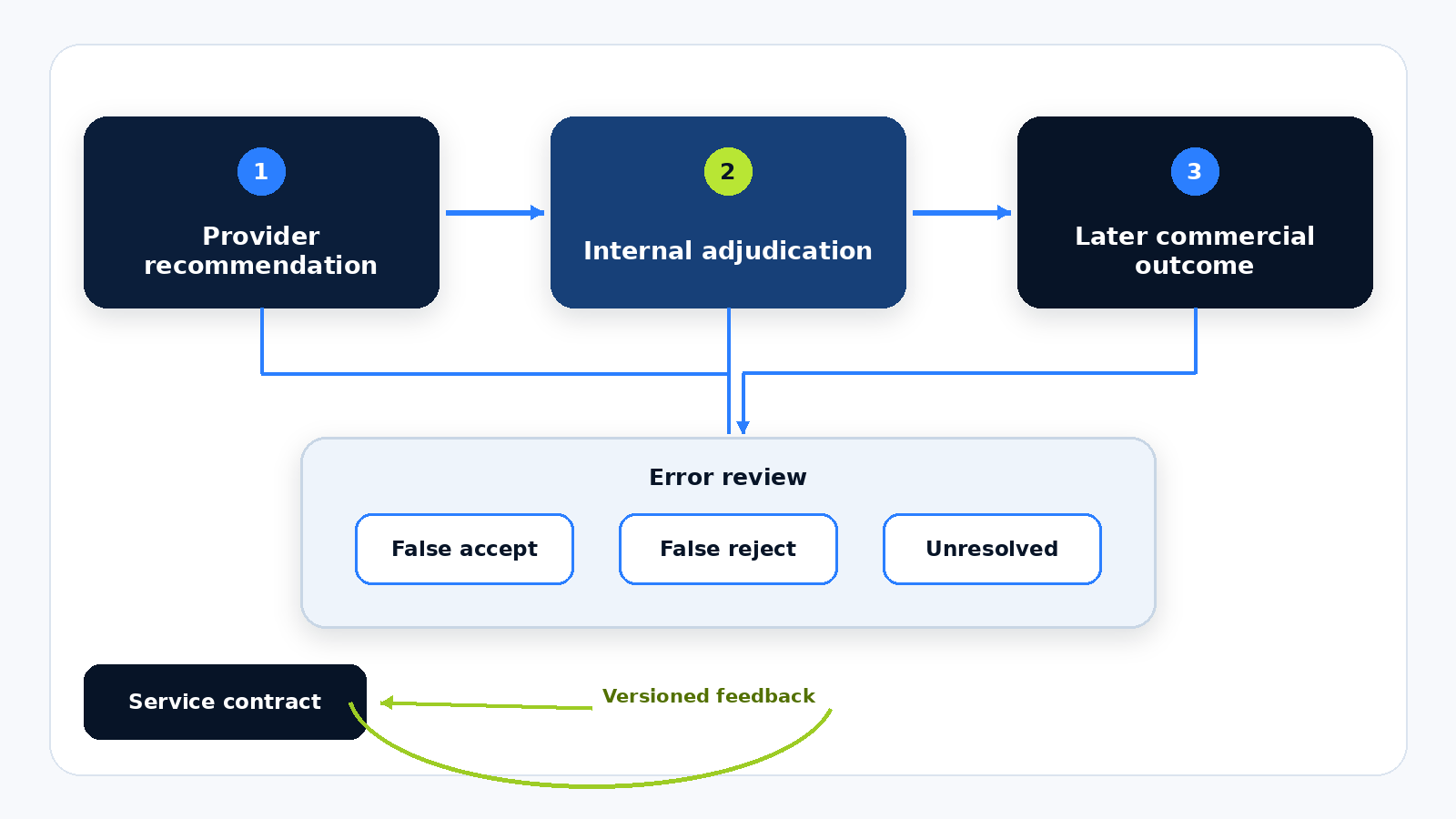
A provider pilot needs an adjudication process, because the internal reviewer and the external qualifier can disagree for valid reasons. The review should compare both decisions with the same written rule, the same source record and the same conversation evidence.
Select records from every provider disposition rather than reviewing only successful meetings. Include accepted records, rejected records, nurture records and cases marked unresolved, because each group exposes a different control problem.
Ask an internal reviewer to assess the record before seeing the provider's label when practical. This reduces confirmation bias and makes the disagreement more useful for training, contract design and future quality checks.
Classify each disagreement by cause instead of treating every mismatch as poor agent work. Useful classes include missing data, unclear criteria, weak questions, unsupported interpretation, CRM conflict, script drift and a genuine difference in commercial judgment.
A false accept means that the provider advanced a record that failed the approved internal rule. A false reject means that the provider stopped a record that later passed the same rule after internal review.
Neither error rate should be read without the unresolved rate and sample design. A provider that admits uncertainty may appear less productive while protecting the team from more expensive false certainty.
Review rejected records as seriously as accepted ones. Payment models and calendar targets often make accepted meetings visible, while potentially valuable rejected records remain outside routine sales review.
Compare disagreement by segment, channel, agent and qualification criterion. A concentrated pattern usually points to a specific training, data or policy problem, while random variation may require a larger review sample.
Separate provider error from motion error. A skilled agent cannot repair an ICP that includes the wrong company type, a message with no current reason to respond or a channel that buyers do not use.
Keep the first rule version frozen long enough to observe a stable pattern. Constant changes during the pilot make it impossible to tell whether the provider improved or the definition simply moved.
When a rule changes, record the version, reason, approver and effective date. Apply the new version to future work, then recheck a small historical sample before comparing results across periods.
The internal reviewer also needs calibration. If two sales leaders apply the same rule differently, the provider cannot meet a stable acceptance standard until the client resolves that internal disagreement.
Use the review meeting to decide one operational change at a time. Change the data source, question, script, route or acceptance rule, then observe whether the targeted error falls without creating another one.
Do not use opportunity creation as the sole adjudication truth. Later sales outcomes add valuable evidence, but deal size, seller skill, timing and offer changes can affect the result after qualification.
The strongest pilot record therefore keeps three states: the provider recommendation, the internal adjudication and the later commercial outcome. That structure supports correction without pretending that any single reviewer has perfect foresight.
End the pilot with a written decision memo. Record the tested scope, observed errors, accepted limits, cost components, required changes and the evidence that supports a scale, narrow, revise or stop decision.
Provider recommendation compared with internal review and later sales outcomes in a controlled pilot.
Keep three states so the team can correct the service without pretending any reviewer has perfect foresight.

15 / RFP checklist

Outsourced lead qualification RFP checklist

Use these questions before requesting a proposal:
AreaQuestions to ask
ScopeWhich tasks are in and out? What does qualified mean? Which proof is required? How are unknowns handled? Which acts need client approval?
PeopleAre agents shared or dedicated? Who trains and leads them? How often is live work checked? How are script changes approved? How are language and market skills tested?
CRM and dataWhich systems and fields can the team use? What is written after each contact? Are proof, advice and client choice kept apart? Which other vendors or AI systems see the data? What happens at exit?
QualityHow are false accepts and false rejects checked? Does the report split booked and held calls? How is sales acceptance stored? Which later result links to the handoff? What rules govern the pilot?
TermsWhich setup, data, tools, QA and management costs are left out? What happens to rejected calls and no-shows? Can the client export all history? How does exit work?

16 / FAQ

Frequently asked questions

What is outsourced lead qualification?

Outsourced lead qualification gives an outside team one part of the process. It may research, contact, ask questions or sort leads. The provider should recommend a state from approved proof. The client still defines qualified and owns final sales acceptance.

When should a B2B company outsource lead qualification?

Outsource after the ICP, message and one channel produce repeatable sales talks. Early teams should keep buyer learning in-house. They may delegate research and list work before outreach.

Is outsourced qualification the same as appointment setting?

No. Appointment setting places a meeting on a calendar. Qualification checks whether the person and situation meet an agreed sales rule. A booked meeting may still be unqualified, rejected, cancelled or never held.

Is an outsourced SDR the same as a qualification provider?

Not always. An outsourced SDR may research, send messages, handle replies and book meetings. A qualification provider may handle just the evidence and first talk. Its work ends at the sales handoff.

How much do lead qualification services cost?

Cost depends on the scope, team, language and channel. Data, tools, setup, QA and internal work also matter. Compare each bid with one written scope. Do not rely on a headline fee.

Should I choose shared agents or dedicated SDRs?

Use shared agents for narrow work with uneven volume and a simple script. Use dedicated SDRs when the work needs more context. Test both with the same acceptance rule when unsure.

Can a lead qualification service use AI?

Yes. AI can help with research, drafts, calls, notes, summaries and routes. Require an AI list, tight data access and human review. Add a clear repair path. AI voice also needs a legal and process review.

What should the provider write to CRM?

Store the source, channel, time, buyer answers and unknowns. Add the provider state, reason and next action. Keep the internal choice and later result apart.

Which metrics should be in the SLA?

Include sales acceptance and review errors. Track open cases, held meetings and new deals. Add CRM gaps, QA defects, complaints and full cost per accepted record. Define the base and time frame for each one.

Who owns compliance when outreach is outsourced?

The answer depends on the channel, campaign and law. In the US, a company keeps a role under CAN-SPAM after hiring a sender. Check current rules and seek legal review for the exact campaign.

17 / Operating rule

The operating rule

Do not hire a provider to replace a sales decision your team has not learned to make.
First, define the buyer, problem, message and evidence. Then delegate one bounded job. Review early work. Keep the provider's advice apart from the internal choice. Scale when accepted sales talks and new deals support the cost and risk.
The service should make the decision easier to inspect. It should not make responsibility disappear.

Research note

Methodology

  1. 01Use team-level operating input across outsourced SDRs, call centers, appointment setters and qualification providers without converting it into personal Anastasiia experience.
  2. 02Label the roughly 90% adaptation estimate and the frequent or very frequent failure observations as qualitative team-level input without a denominator.
  3. 03Treat the 15-qualified-calls and two-to-three-AE thresholds as team operating recommendations supplied by the owner, not market benchmarks.
  4. 04Summarize the current owner-supplied four-part SDR test framework; keep separate raw candidate responses private and exclude them as evidence.
  5. 05Use current provider and comparison pages only for search-intent and category-gap analysis, not as independent performance proof or a provider ranking.
  6. 06Use FTC, FCC and NIST primary sources for narrow regulatory and supplier-risk statements, with legal and jurisdiction caveats beside the claims.
  7. 07Exclude unsupported private screenshot figures, universal pricing, invented tests, named-provider recommendations and causal revenue claims.
Read the full methodology

Source ledger

Sources & editorial notes

  1. 01
    CAN-SPAM Act: A Compliance Guide for Business

    US Federal Trade Commission · Current US federal guidance for commercial email, including outsourced sending responsibility; not individualized legal advice.

  2. 02
    Complying with the Telemarketing Sales Rule

    US Federal Trade Commission · Current US federal telemarketing guidance used for the narrow B2B-call caveat; other FCC, state and sector rules may apply.

  3. 03
    FCC 24-17 Declaratory Ruling

    US Federal Communications Commission · Primary ruling used for the statement that TCPA artificial or prerecorded voice restrictions include AI-generated voices.

  4. 04
    NIST SP 1305: Cybersecurity Supply Chain Risk Management

    US National Institute of Standards and Technology · Voluntary supplier-risk guidance adapted for CRM access, data lifecycle, subprocessors and exit planning.

  5. 05
    How AI Assists Lead Qualification

    Luck My Sales · Supporting guide for evidence states, human gates and qualification decision design.

  6. 06
    10 Lead Qualification Tools Compared

    Luck My Sales · Separate software comparison used to preserve the service-versus-tool boundary.

  7. 07
    B2B Data Enrichment Providers

    Luck My Sales · Supporting provider guide for source-linked research and enrichment evidence.

  8. 08
    Luck My Sales methodology

    Luck My Sales · Evidence states, source treatment, freshness, disclosure and correction protocol.

Corrections or primary material: contact the corrections desk.

About the author

Anastasiia Krynytska

Anastasiia Krynytska is a LeadGen Team Lead at Softermii and the lead editor of Luck My Sales. She covers AI-assisted outbound, account research, qualification, messaging, CRM handoffs and revenue workflows from a practitioner’s perspective.View author profile LinkedIn

Continue reading

01 · News analysis

AI sales is moving from assistant to operating layer

The category is expanding from drafting support into research, pipeline decisions, recommended actions and controlled execution.

Read news
02 · Field analysis

In AI sales, the handoff may be the product

Models are becoming accessible; durable value sits in the controlled transition from signal to seller action.

Read analysis
03 · Research framework

Sales AI Workflow Signals 2026

A launch framework for mapping the products, controls and buying questions shaping AI-enabled revenue work.

Read reports

Luck My Sales briefing

Useful context, once a week.

News, explanations and original research from this desk. No noise.
The newsletter is still being built. We will contact you when the first edition is ready.