
Weekly industry intelligence · No noiseSubscribe to the Luck My Sales newsletterFree briefing

Independent operator-led media on AI in B2B sales

Menu

Conversational AI pricing guide · Sales AI comparisons

Conversational AI Platform Pricing: What Voice, Usage, Integrations and Human Review Actually Cost

Model conversational AI platform pricing across subscriptions, voice minutes, messages, outcomes, integrations, implementation, human review, overages and failure cost.
Editorial disclosure

AI may assist research organization and drafting. A human editor reviews every published page, checks material claims against the cited sources and owns the final decision. No company paid for placement in this article.

AI use policy

Agent-ready brief

AI takeaways

Keep the key points here, or take a source-aware text brief into Claude, ChatGPT or another AI workspace.
  1. 01Define the workflow and accepted outcome before collecting vendor quotes.
  2. 02Normalize subscriptions, minutes, messages, outcomes, AI, telephony and integrations in one monthly model.
  3. 03Include implementation, human review, correction, failure, overage and exit costs.
  4. 04Model launch month, steady state and a stress case separately.
  5. 05Treat the reported USD 500 as a monthly strong-outbound subscription, not a one-time setup fee or universal market benchmark.
Includes summary, takeaways, sources and a use note.
Conversational AI platform pricing is rarely one number. The invoice may count seats, minutes, messages, conversations, outcomes, model tokens, knowledge retrieval, quality analysis, phone numbers, transfers or concurrency. The operating cost also includes the work that makes the system safe: integration, prompt and knowledge maintenance, CRM hygiene, review and exception handling.
That is why “$0.07 per minute” and “$0.99 per resolution” are not directly comparable. They do not buy the same unit, include the same stack or represent the same business outcome.
The useful equation is:
> Monthly operating cost = fixed platform cost + channel usage + AI and knowledge + telephony + integrations + implementation amortization + human review + failure and overage cost
Then divide that total by an accepted outcome you define, such as a qualified lead with evidence, a valid booking that was held, or a service case resolved without recontact.
The price of the AI is the easy part. The price of a controlled business result is the number that matters.

The meaningful price is not a seat, minute or outcome headline; it is the full operating cost of a controlled and accepted business result.

01 / Conversational AI pricing at a glance

Conversational AI pricing at a glance
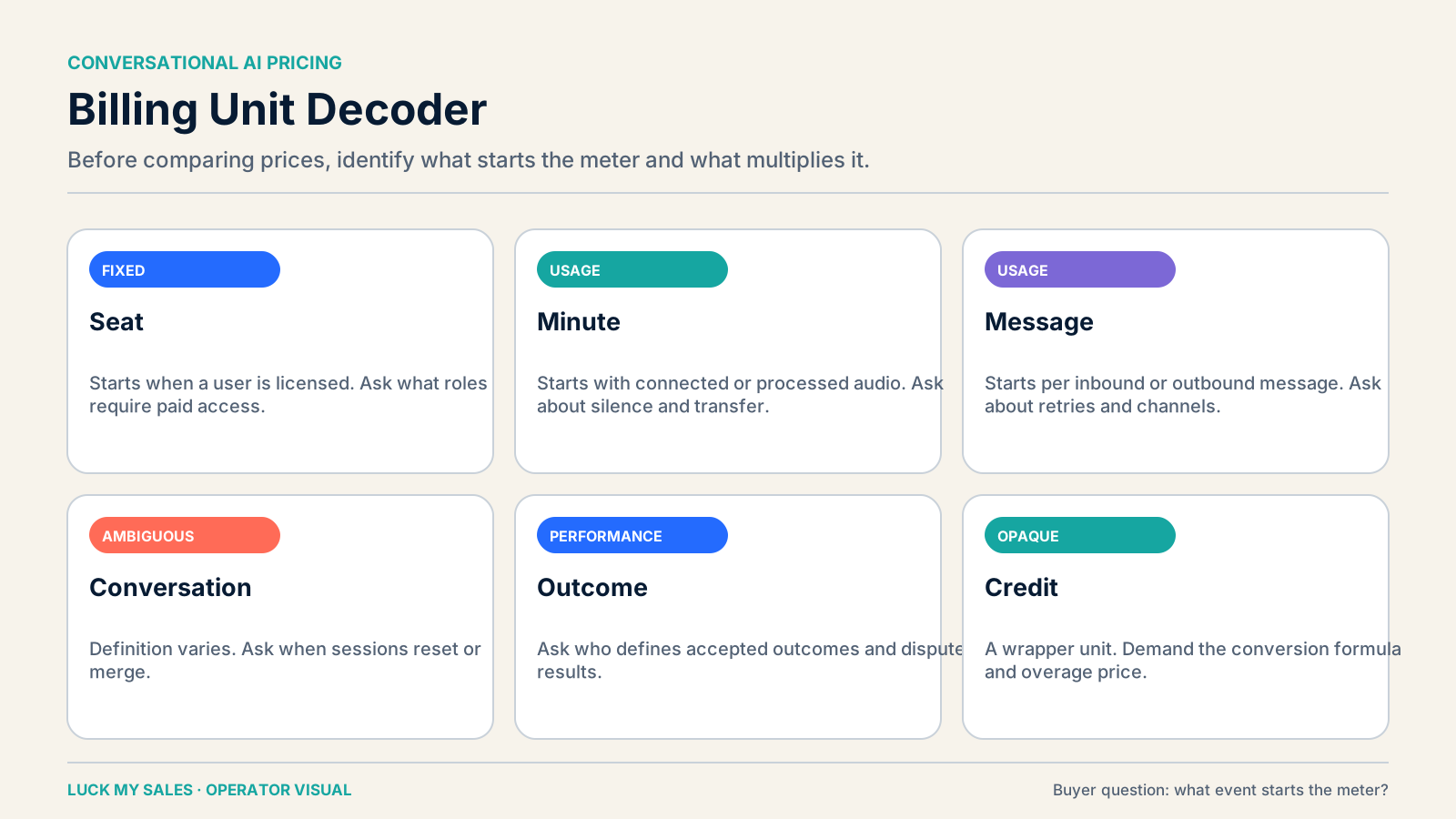
Decoder for common conversational AI billing units and their cost risks.
A headline billing unit is comparable only after its inclusions, exclusions and denominator are defined.
Billing modelExampleWhat it simplifiesWhat it can hide
Platform or seat feeMonthly subscription per workspace/userBudgeting and accessUsage, implementation and adoption
Voice minuteBland, Retell, Twilio componentsCall workloadTelephony, transfers, models, QA, concurrency
MessageRetell chatText volumeLong conversations and downstream actions
OutcomeIntercom FinBusiness-facing unitOutcome definition and denominator
Conversation/sessionCommon service-agent packagingCustomer interactionReopens, transfers and partial success
Credits/tokensAI, knowledge or analysis add-onsShared consumptionHard-to-forecast mix of jobs
Quote-based enterprise contractBroad platforms and managed deploymentsBundled procurementMinimums, overages and implementation scope
Do not choose a model because it sounds aligned. Outcome pricing is only useful when the outcome is defined honestly. Per-minute pricing is only transparent when all minute-level dependencies are visible.

02 / First define the workflow you are pricing

First define the workflow you are pricing

The phrase “conversational AI platform” can refer to very different systems:
  • a voice API and orchestration layer your team assembles;
  • a chat or service agent sold per outcome;
  • an inbound qualification and booking workflow;
  • an outbound calling workflow;
  • a cross-channel enterprise agent with governance and integrations;
  • a managed deployment with implementation and operations included.
Write the job before collecting quotes. A useful statement is:

Handle English and Arabic inbound calls for one service line, answer from an approved knowledge source, collect five qualification fields, offer only calendar slots validated by middleware, write evidence and summary to HubSpot, and hand uncertain or commercial exceptions to a person.

Now the price can be normalized. Without that statement, one vendor may quote a voice transport layer while another quotes a managed result.

03 / Billing model 1: fixed platform and sea…

Billing model 1: fixed platform and seat fees

A fixed fee can cover access, environments, users, phone numbers, integrations, analytics or a usage allowance. It may also unlock lower usage rates.
Bland AI's official billing page, effective 5 December 2025 and accessed 24 August 2026, illustrates the pattern. It lists a free Start plan at $0.14 per connected minute, a Build plan at $299 per month plus $0.12 per connected minute, and a Scale plan at $499 per month plus $0.11 per connected minute. Transfer and other channel charges are separate. Bland AI billing
This does not mean Build is automatically cheaper at a certain volume. You must include the features you need, the actual chargeable minute definition, transfers, numbers, messaging and operational work. A lower rate attached to a subscription can still cost more if the team does not need the unlocked capacity or controls.
For seat-priced tools, model the real user population. Sales teams often buy seats for managers, operations and administrators as well as active agents. Ask whether view-only, QA, developer and contractor access is charged.

04 / Billing model 2: the voice-minute stack
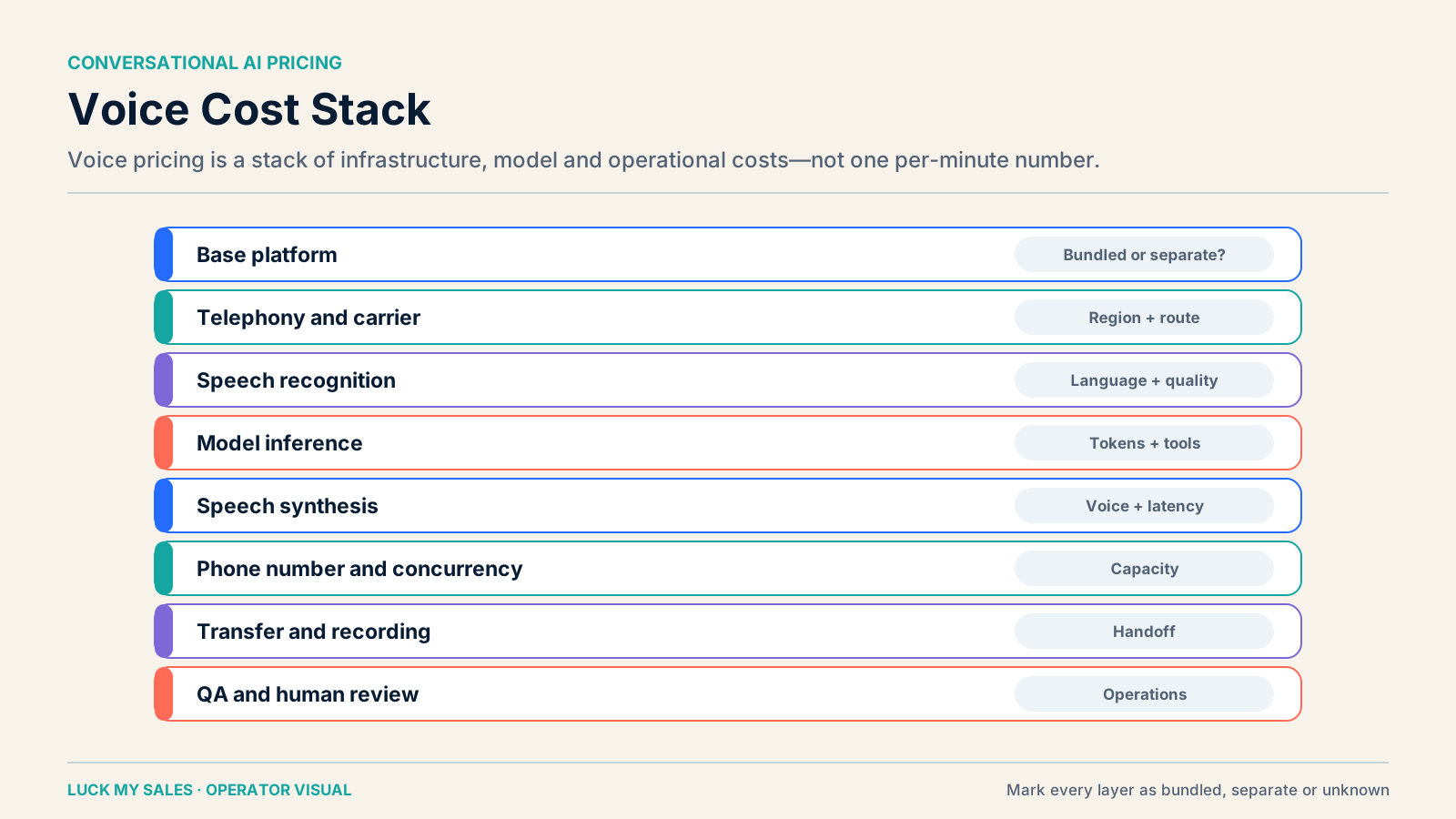
Billing model 2: the voice-minute stack

Components that can make up the real cost of one conversational AI voice minute.
One voice minute can contain telephony, speech, model, synthesis, knowledge, transfer, storage and capacity charges.
A “voice AI minute” can contain several technical layers:
  1. telephony connection and phone number;
  2. speech recognition;
  3. orchestration and turn taking;
  4. language-model inference;
  5. text-to-speech;
  6. knowledge retrieval;
  7. call transfer or SIP connection;
  8. recording, storage and quality analysis;
  9. concurrency or burst capacity.
Some platforms bundle most of these. Others expose or pass through separate charges.

Bland AI price example

As noted above, Bland publishes connected-minute rates tied to plan levels. Its billing page also lists a minimum outbound attempt charge and separate messaging or transfer costs. Treat the minute as one line in the model, not the total. Bland AI billing

Retell AI price example

Retell's official pricing page accessed 24 August 2026 lists voice AI pricing from $0.07 to $0.31 per minute, depending on the selected configuration, and chat from $0.002 per message. Its documentation also lists separate knowledge-base usage, AI quality analysis after an included allowance and burst-concurrency pricing. Retell pricing, Retell knowledge base, Retell AI QA, Retell concurrency
The range is more informative than one teaser rate. Your actual voice, model and provider choices determine the cost. Add the knowledge, QA and burst features you intend to use.

Twilio ConversationRelay price example

Twilio lists ConversationRelay at $0.07 per minute on its conversational AI pricing page. The page explicitly separates ConversationRelay from the voice channel charges required for the call. It also presents other modular components such as orchestration, intelligence, memory and knowledge. Twilio conversational AI pricing
This is the clearest example of why a headline minute is not a complete call price. The conversational layer and the channel are different lines.

05 / Connected minutes, attempted calls and …

Connected minutes, attempted calls and transfers

Ask vendors to define the clock.
  • Does billing start while the phone rings?
  • Are voicemail detections chargeable?
  • Is silence chargeable?
  • Are both legs charged after a transfer?
  • Are failed outbound attempts billed at a minimum?
  • Does a call rounded to the next minute cost more than measured seconds?
  • Does the transfer continue AI billing after the human joins?
  • Is recording or post-call analysis another minute charge?
For inbound sales, transfer behavior matters. A short qualification call followed by a long transfer can move the cost from AI to telephony or double the active legs. For outbound, connect rate matters because attempted-call charges can accumulate even when few people answer.
Use three volume fields, not one: attempts, connected calls and connected minutes. Add transfers and average transferred minutes separately.

06 / Billing model 3: messages, conversation…

Billing model 3: messages, conversations and outcomes

Text channels avoid telephony but introduce different denominators.
A message-priced system charges for each message or a defined subset. A session-priced system may group many turns into one conversation. An outcome-priced system charges when a named result is reached.
Retell's current chat entry price is expressed per message. The final cost depends on how many messages a useful interaction requires and which other components apply. Retell pricing
Intercom Fin uses outcome-based pricing. According to Intercom's official outcome documentation accessed 24 August 2026, pricing distinguishes different outcomes: a resolution, procedure handoff or disqualification is listed at $0.99, while qualification is listed at $9.99. Only one outcome is charged per conversation, and unsuccessful attempts are not charged. Voice requires contacting sales. Intercom Fin AI Agent outcomes
Those units should not be compared as if every “resolution” and “qualification” has equal economic value. Read the platform's exact classification rules and audit samples.

07 / Denominator warning: who decided the ou…

Denominator warning: who decided the outcome was successful?
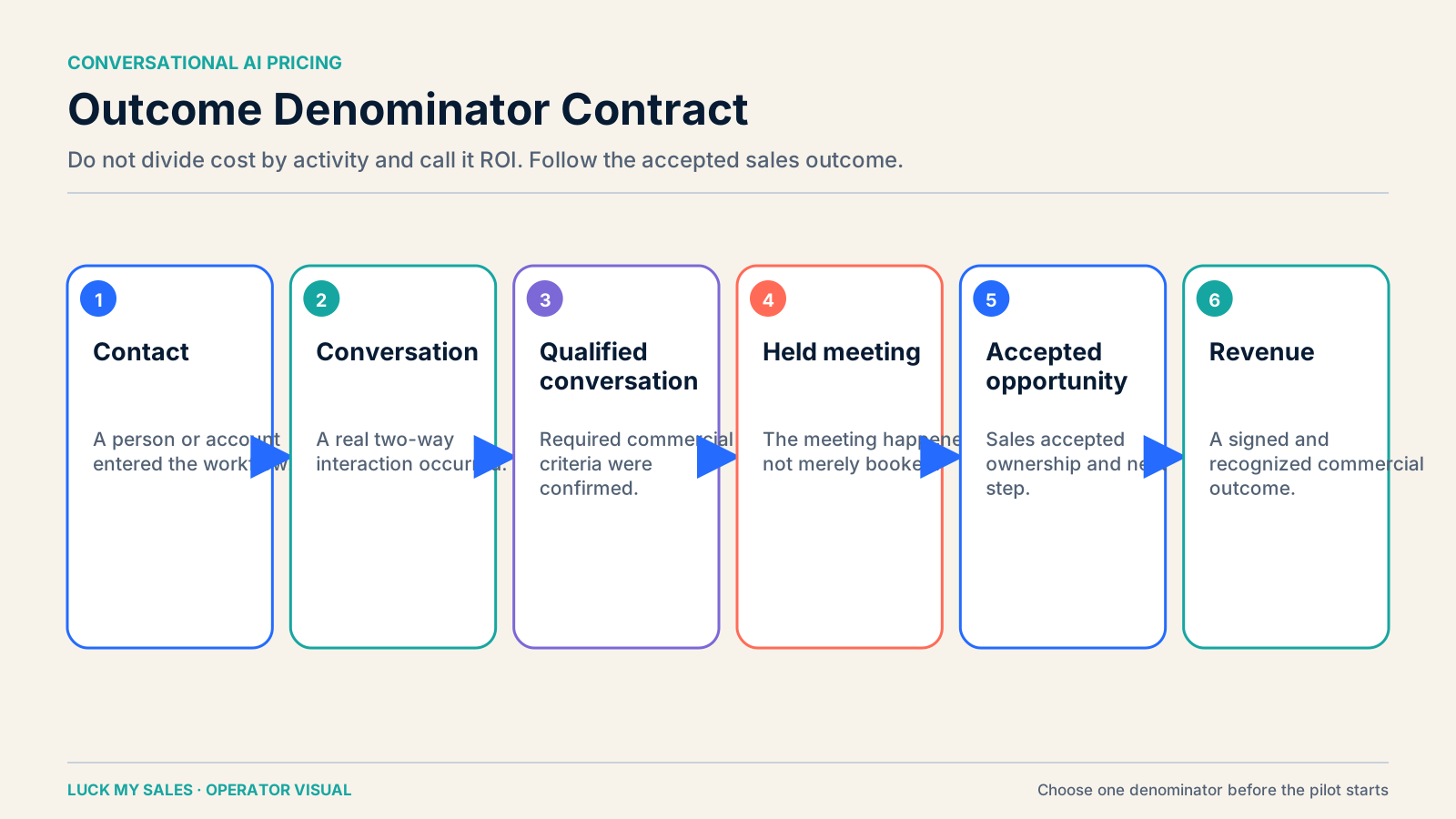
Rules defining the accepted sales outcome used to calculate conversational AI cost.
Cost per outcome is credible only when the outcome, evidence, exclusions and human acceptance rule are explicit.
An outcome bill is only as trustworthy as its denominator and dispute process.
For sales qualification, define:
  • required identity and company fields;
  • ICP or exclusion rules;
  • evidence required for budget, authority, need and timing;
  • whether a meeting must be booked;
  • whether the meeting must be held;
  • whether a seller must accept the lead;
  • how duplicates, spam and tests are treated;
  • how corrections affect the bill.
A platform-reported “qualified conversation” may be useful operationally, but finance may need seller-accepted qualification or a held meeting. Track both. Do not rename the platform event to match the business outcome.

08 / AI, model, knowledge and data charges

AI, model, knowledge and data charges

The conversational layer depends on information and computation.

Models

Some platforms bundle model use into the minute or outcome. Others pass through or mark up model charges. Ask which model is used by default, whether fallback models cost more and whether your prompt or context length changes the rate.

Knowledge retrieval

Knowledge can be priced by storage, document, query, token or minute. Retell, for example, documents knowledge-base usage at $0.005 per minute after an included allowance. Retell knowledge base
The financial risk is rarely storage alone. Someone must remove stale pages, approve sensitive material, resolve contradictions and test answers after changes.

Enrichment and verification

A sales agent may call data providers, validate email or phone, identify an account, check CRM ownership and inspect prior activity. Each dependency can have a separate credit model. Count it per attempted record and per accepted outcome.

Analysis and QA

Post-conversation scoring, sentiment, intent extraction and quality analysis may consume another paid unit. Retell documents the first 100 analyzed minutes as free and additional AI QA at $0.10 per minute. Retell AI QA
Do not enable every analysis because it exists. Pay for the fields that change a decision or reduce review.

09 / Implementation is part of price

Implementation is part of price

A platform can be inexpensive and the deployment expensive.
Implementation work includes:
  • workflow and decision-rights design;
  • approved knowledge collection;
  • prompts, tools and deterministic validation;
  • CRM and calendar integration;
  • identity, duplicate and ownership rules;
  • consent, retention and security review;
  • test conversations and adversarial cases;
  • dashboards and error queues;
  • seller and operations training;
  • launch monitoring and rollback.
Estimate internal hours by role and external implementation fees. If the work is a one-time launch, amortize it over a realistic period such as six or twelve months. Do not amortize a recurring maintenance burden.
The author has repeatedly seen teams underestimate the transition required to make old infrastructure AI-friendly. Attaching an agent to an inconsistent CRM, stale knowledge base or unreliable calendar does not remove those problems. It scales them.

10 / Human review is not free—and removing i…

Human review is not free—and removing it is not the goal

Review should be concentrated where it protects commercial decisions.
Use this capacity formula:

Monthly review hours = conversations × sampled share × average review minutes ÷ 60 + exception cases × average exception minutes ÷ 60
For example, an illustrative workload of 1,000 conversations, a 10% sample, three minutes per sampled review, 40 exception cases and eight minutes per exception requires about 10.3 review hours per month. This is arithmetic, not a performance benchmark.
Measure corrections by type. A 5% correction rate in cosmetic summaries is different from a 5% rate in qualification, pricing or ownership. Weight consequential errors more heavily.
The goal is not zero human work. It is to remove repetitive review from low-risk cases and keep accountable judgment at the commercial gates.

11 / Hidden costs that appear after launch

Hidden costs that appear after launch

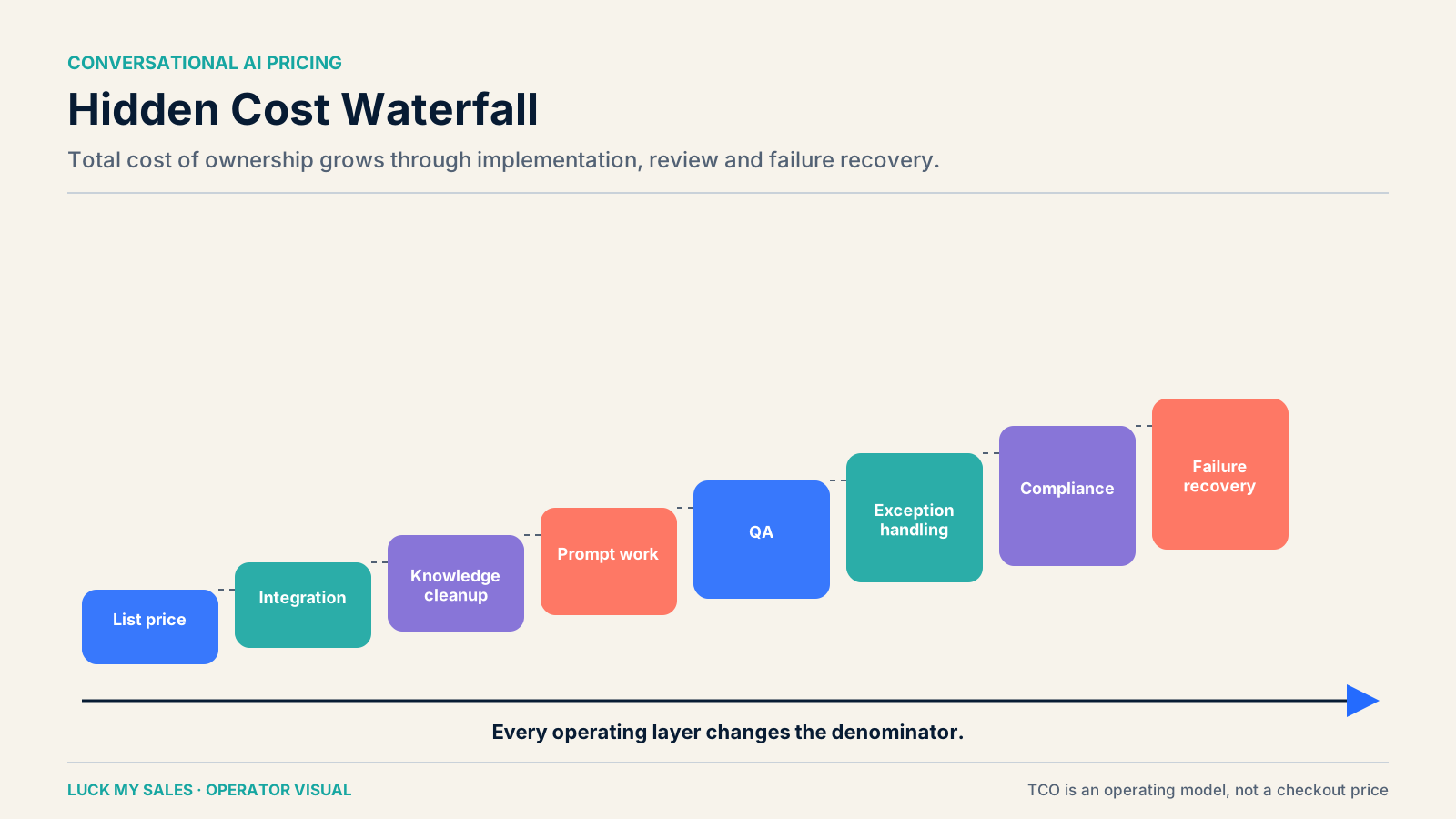
Hidden implementation and operating costs added to conversational AI list price.
The invoice is only one layer of total cost; implementation, review, correction, governance and failure accumulate after launch.

Knowledge maintenance

Pricing, product scope, availability and policies change. Assign an owner and review frequency. A stale answer can cost more than a thousand cheap minutes.

Prompt and workflow maintenance

New intents, languages and failure modes require updates. Separate prompt changes from rule and integration changes so the team can identify causes.

CRM cleanup

If the agent creates duplicate contacts, overwrites trusted fields or admits weak leads, seller time and reporting quality fall. Prevent pollution with create/fill/overwrite permissions.

Exception operations

Someone must handle uncertain identity, unavailable calendars, high-value accounts, policy questions, angry users and tool failures. Price the queue and its service level.

Retry and recovery

Failed API calls, timeouts and interrupted transfers may trigger repeated model or channel usage. Ask whether retries are billed and how duplicate actions are prevented.

Adoption

An unused dashboard, ignored summary or untrusted score is wasted spend. Include manager and seller operating time in the pilot.

12 / Failure cost: the line most calculators…

Failure cost: the line most calculators omit

Model at least five failure categories:
FailureDirect costCommercial costControl
Wrong answerAI/channel usageLost trustGrounded source and handoff
Invalid bookingConversation plus calendar actionNo-show and seller timeDeterministic validation
Bad qualificationOutcome fee and reviewLow-quality meetingEvidence rule and seller acceptance
Duplicate contactRepeated usageBrand and compliance riskShared suppression ledger
Wrong CRM writeIntegration and correctionPipeline/reporting damageField-level contract and rollback
Do not turn speculative lost revenue into a precise ROI claim. Record actual corrections, no-shows, rejected leads and recovery time during the pilot.

13 / Governance and compliance costs

Governance and compliance costs

Governance can require security review, data-processing agreements, regional storage, access controls, consent design, retention, deletion workflows and audit logs.
The vendor supplies controls. Your organization defines lawful and appropriate use.
Budget for:
  • legal and security review;
  • configuration and documentation;
  • periodic access review;
  • deletion and data-subject request handling;
  • incident response and vendor changes;
  • call-recording notice and consent where required.
These costs may be small for a narrow SMB pilot and substantial for a regulated enterprise. They still belong in the same comparison.

14 / A spreadsheet-ready TCO calculator

A spreadsheet-ready TCO calculator

Build one row per cost component and one column per vendor. Use the same workload.

Workload inputs

  • monthly inbound conversations;
  • outbound attempts, if in scope;
  • connect rate;
  • average connected minutes;
  • messages per chat;
  • transfer rate and transferred minutes;
  • peak concurrent sessions;
  • languages and regions;
  • knowledge and QA usage;
  • records enriched or verified;
  • sampled review share;
  • exception rate and time;
  • implementation and maintenance hours.

Cost formulas

Voice usage Connected minutes × bundled or component minute rate.
Outbound attempts Unconnected attempts × minimum attempt rate, where applicable.
Transfers Transferred calls × transferred minutes × applicable channel and platform rates.
Chat Conversations × messages per conversation × message rate, or billed sessions/outcomes under the vendor definition.
Human review Review hours × loaded hourly cost.
Implementation amortization One-time internal and external implementation cost ÷ chosen amortization months.
Monthly TCO All recurring components + amortized implementation + review + expected recovery cost.
Cost per accepted outcome Monthly TCO ÷ seller-accepted qualified leads, held meetings or another named denominator.
Keep platform-reported outcomes in a separate row. That lets finance compare billing with business acceptance.

15 / Three illustrative scenarios

Three illustrative scenarios
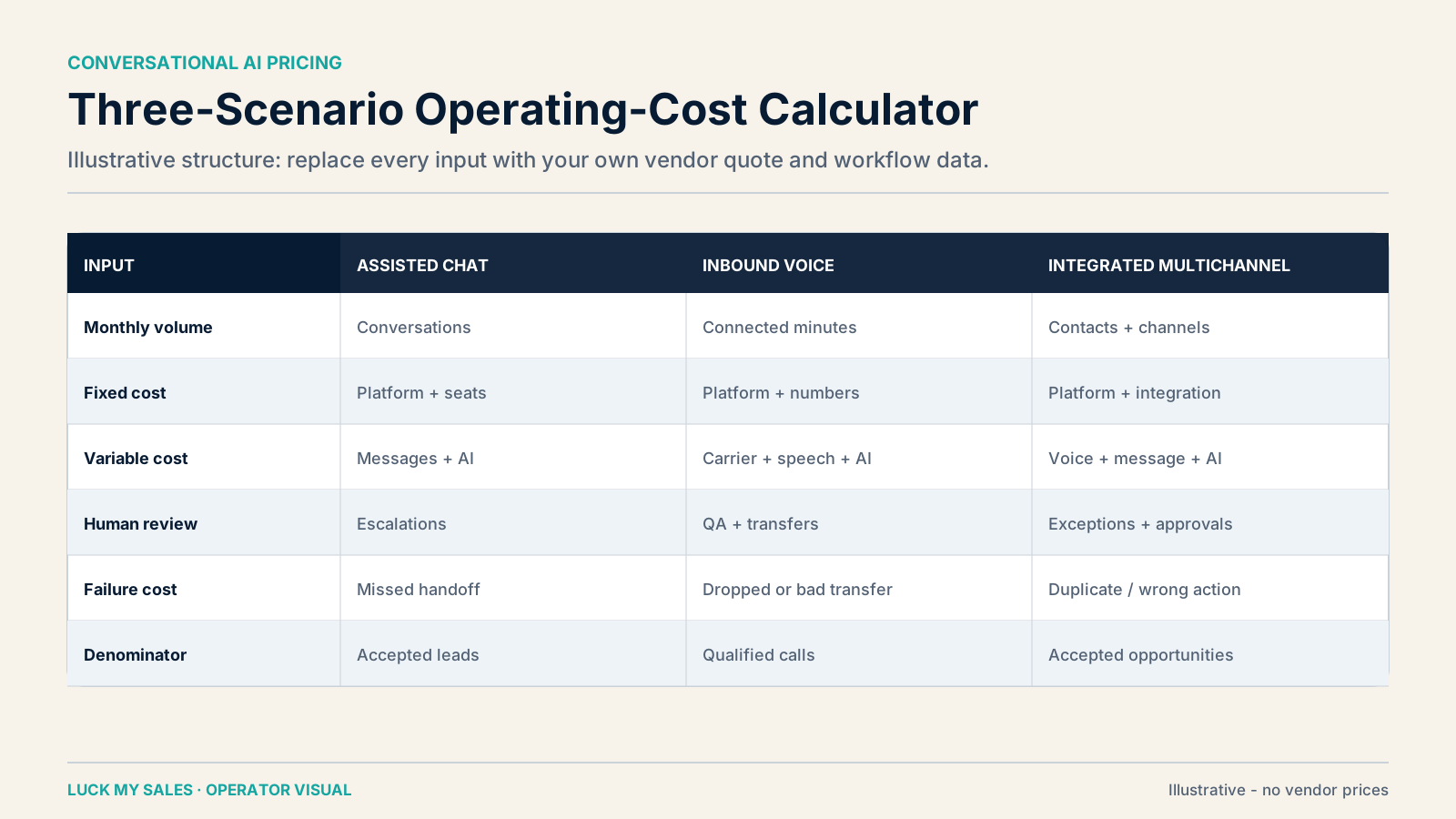
Calculator comparing conservative, expected and stress-case conversational AI costs.
Conservative, expected and stress cases reveal which assumptions actually control the budget.
These scenarios are calculation templates, not vendor quotes or expected results.

Scenario A: narrow inbound voice pilot

Assumptions: 500 connected calls, four minutes each, 2,000 connected minutes, one language, no outbound, one CRM, 10% QA sample and a small exception queue.
Model:
  • platform subscription, if any;
  • 2,000 voice minutes at the configured rate;
  • telephony and number;
  • knowledge and QA;
  • integration maintenance;
  • sampled review and exceptions.
This scenario tests whether the platform can qualify and book safely. It does not need enterprise analytics.

Scenario B: chat qualification

Assumptions: 2,000 conversations, 12 messages each, 24,000 messages, qualification evidence, CRM creation and human review of uncertain cases.
For message pricing, multiply messages by the current rate and add the other layers. For outcome pricing, estimate platform-classified qualifications, then compare them with seller-accepted qualifications. Do not assume they are identical.

Scenario C: multi-region voice and chat

Assumptions: multiple languages, variable telephony destinations, peak concurrency, transfers, separate knowledge collections, security review, 24/7 exception coverage and two CRM environments.
Here the cheapest base minute may be irrelevant. Language quality, concurrency, routing, audit and maintenance can dominate. Ask for a workload-specific quote and a controlled pilot.

16 / Where the reported $500 monthly outboun…

Where the reported $500 monthly outbound subscription fits

The author has clarified that a separate NextLevel context used a $500 monthly subscription for an already strong outbound setup. It was not a minimum starter setup.
Its included layers have not been itemized for this pricing analysis. It therefore is not used as a conversational AI platform benchmark, vendor quote or calculator input. Outbound sourcing, enrichment, sequencing and sending are a different cost scope from an inbound voice/chat platform.
For that adjacent workflow, see our AI sales outreach guide. Do not combine the $500 figure with voice minutes and call it total platform cost.

17 / Contract questions that prevent pricing…

Contract questions that prevent pricing surprises

18 / A practical quote audit before procurement

A practical quote audit before procurement

A quote should survive a finance review and an operations review. The finance review checks money, term and downside. The operations review checks whether the quoted system can complete the stated workflow.
Start with the workload statement. Attach it to every request for proposal. Vendors should price the same languages, channels, volumes, integrations, hours and service level.

Step 1: rebuild the quote from units

Copy every charge into a separate row. Do not preserve the vendor's marketing groups. Separate fixed fees, included usage, overage, channel costs, AI components, implementation and support.
For voice, record attempts and connected minutes. For chat, record conversations and messages. For outcome pricing, record all conversations and expected billed outcomes. Keep the original currency and tax treatment visible.
Add a definition beside each unit. “Minute” must state when the clock starts. “Conversation” must state when a session reopens. “Qualification” must state what evidence and action complete it.
If the definition is missing, mark the row unresolved. Do not replace missing terms with an optimistic assumption.

Step 2: separate included capacity from useful capacity

A plan may include thousands of minutes or many users. That allowance has value only when the workflow can use it safely.
Check channel, geography and concurrency limits. Check whether premium voices, models or languages consume the same allowance. Check whether transferred calls remain inside the bundle.
Now calculate expected utilization. Divide expected usage by included usage. A low ratio can make a cheap bundle expensive per useful unit. A high ratio can create overage risk.
Run a downside case at half the expected volume. Minimum commitments often punish slower adoption. Run an upside case at twice the expected peak to expose concurrency and overage costs.

Step 3: price implementation deliverables

Implementation is not one generic row. Split it into concrete outputs:
  • workflow and decision-rights design;
  • knowledge collection and cleanup;
  • conversation and prompt design;
  • tool and API integration;
  • calendar and CRM validation;
  • consent, retention and access configuration;
  • test cases and quality review;
  • launch support and documentation.
Name the owner for every output. A vendor fee does not remove internal review. Internal work does not disappear because the supplier calls the project “self-service.”
Estimate hours by role. Use a loaded internal rate for engineering, RevOps, sales management, security and subject experts. Keep one-time launch work separate from recurring maintenance.

Step 4: model the exception queue

Every production agent creates cases it cannot finish. Price the queue before launch.
Estimate the share of conversations with uncertain identity, missing evidence, unavailable slots, policy questions, high-value accounts or failed tools. Multiply cases by the average handling time.
Add the cost of delayed response. Do not invent lost revenue. Use observed service time, seller time and missed service levels from the pilot.
Assign a queue owner and operating hours. A 24/7 agent with a Monday-to-Friday exception team does not provide a complete 24/7 workflow.

Step 5: normalize support and service levels

“Premium support” is not a measurable service. Ask for response and resolution targets by severity. Ask who handles telephony, model, platform and integration incidents.
Record included support hours and paid professional services. Check whether launch support expires. Check the cost of a new language, channel, workflow or CRM environment.
Ask for the rollback route. The team should be able to pause actions while preserving evidence and incoming demand. A kill switch that requires vendor engineering is an operating dependency.

Step 6: audit the denominator

The final comparison needs one accepted business denominator. Choose it before opening vendor dashboards.
For inbound sales, a useful denominator may be a seller-accepted qualified lead. Another may be a valid booking that was held. Keep both if the workflow has meaningful no-show risk.
For service, the denominator may be a resolved issue without recontact. A platform-reported resolution remains a separate metric until the business validates it.
Calculate cost per platform outcome and cost per accepted outcome. The gap reveals rejection, repeat contact and recovery work. It also prevents a vendor label from becoming your finance definition.

Step 7: write the decision note

The final note should fit on one page. State the workload, expected TCO, downside TCO, accepted outcome, main dependency and stop condition.
Include the evidence state for every price. Mark public list prices with access dates. Mark quotes with validity dates and confidentiality limits. Mark internal estimates as estimates.
Do not choose a vendor only because its expected case is cheapest. A slightly higher expected cost may buy stronger controls or lower downside. The note should make that trade-off explicit.

19 / Pricing an AI-friendly transition

Pricing an AI-friendly transition

Many teams budget only the new agent. They ignore the changes required around it.
A conversational agent needs structured knowledge, reliable identity, controlled CRM fields and deterministic tools. If those layers are weak, the transition becomes a separate project.
Price four transition buckets.

Data and knowledge

Remove duplicate pages and expired offers. Resolve conflicting product details. Assign source owners and update dates. Build an approval route for sensitive content.
This work benefits the whole revenue system. It should still appear in the business case because the agent cannot operate safely without it.

CRM and ownership

Define account matching, duplicates, lifecycle stages and opportunity ownership. Restrict create, fill and overwrite permissions. Add correction reasons and rollback.
An agent connected to an unstructured CRM creates faster inconsistency. Cleanup after launch is usually more expensive than defining the contract first.

Tools and deterministic rules

Move calendar, availability, pricing and suppression decisions into validated services. The model can collect inputs and suggest an action. Middleware should confirm the action against live policy.
Budget retries, logs and monitoring. A tool call that works in a demo may fail under stale tokens, rate limits or regional time changes.

People and operating rhythm

Name the knowledge owner, workflow owner and commercial approver. Train them on the exception queue and change process. Schedule a weekly review during the pilot.
Automation can reduce routine work. It does not remove ownership. A clear owner is a cost line and a control.
The transition budget should decline after launch, but it will not fall to zero. Products change, offers change and customer language changes. Include a monthly maintenance allowance.

20 / A 90-day budget structure

A 90-day budget structure

Use three gates instead of approving one large annual promise.

Gate 1: design and sandbox

Fund workflow design, knowledge preparation and a sandbox integration. Keep volume low. The exit condition is a complete test route with visible evidence and a working pause control.

Gate 2: controlled pilot

Fund real usage, concentrated review and exception handling. Limit the workflow, team and geography. The exit condition is an accepted outcome with stable correction and review costs.

Gate 3: measured expansion

Expand only the proven route. Add one language, channel or use case at a time. Recalculate the quote when the workload changes.
This structure protects the buyer from annual capacity that the team cannot yet use. It also gives the supplier clear acceptance criteria.
At every gate, compare expected cost with actual cost. Explain the variance by unit, not by broad narrative. The variance itself is evidence for the next budget decision.
Ask every vendor:
  1. What exactly is the billed unit?
  2. When does the meter start and stop?
  3. What is included in the headline rate?
  4. Which model, voice and telephony charges are separate?
  5. Are failed attempts, voicemail, silence, retries or transfers billed?
  6. How are messages, sessions or outcomes deduplicated?
  7. Can we audit and dispute an outcome classification?
  8. What are minimums, concurrency limits and burst charges?
  9. Which features consume credits?
  10. What implementation and support are included?
  11. What are retention, export and deletion terms?
  12. What happens to price at renewal or volume change?
  13. How quickly can we pause the system and billing?
  14. Can we export logs, prompts, knowledge and records if we leave?
Put the answers into the calculator. Sales slides are not a cost model.

21 / How to normalize two vendor quotes

How to normalize two vendor quotes

Quotes often arrive in incompatible shapes. One includes onboarding and a minute allowance. Another separates every component. A third promises an outcome but requires a minimum annual commitment.
Create a normalized quote table with these rows:
RowVendor AVendor BVendor C
Contract term and minimum
Fixed monthly platform fee
Included usage
Effective base usage rate
Telephony and numbers
Model, voice and knowledge
Transfers, retries and burst
QA, analytics and storage
Implementation
Support and service level
Internal monthly operation
Expected monthly TCO
Accepted-outcome denominator
Cost per accepted outcome
Convert annual prepayment to a monthly accounting view, but keep cash timing visible. Divide included usage by the expected workload, not the maximum capacity in the sales deck. Add a downside case for lower volume because minimum commitments can make the effective unit cost rise sharply.
When a quote bundles implementation, ask for the deliverables: conversation design, knowledge migration, integrations, test cases, go-live support and post-launch tuning. “Onboarding included” may mean one call and documentation; it may also mean a managed deployment. The label is not enough.
For outcome pricing, request a historical sample or sandbox report that shows total conversations, billed outcomes, failed attempts, transfers, repeats, disputes and seller acceptance. You are buying a denominator as much as an agent.

22 / Model launch month and steady-state mon…

Model launch month and steady-state month separately

Month one is rarely representative. It contains implementation work, concentrated QA and low volume. A later month may have higher usage, lower review per case and recurring maintenance.
Build three views:

Launch cost

  • integration and security setup;
  • knowledge preparation;
  • prompts and tool definitions;
  • test calls and pilot support;
  • training and launch monitoring;
  • temporary parallel operation.

Steady-state cost

  • subscription and usage;
  • routine review and exceptions;
  • knowledge and prompt maintenance;
  • phone numbers, storage and analytics;
  • operational owner time.

Change cost

  • new language, country or channel;
  • new product and knowledge set;
  • CRM migration or field change;
  • material pricing or policy update;
  • vendor model or feature change;
  • incident and rollback.
A platform can look expensive in month one and efficient later. It can also look cheap in the pilot because the vendor supplies hands-on support that disappears after purchase. Ask which launch services are temporary.

23 / Build, buy or managed service: where th…

Build, buy or managed service: where the money moves

The three approaches do not remove cost; they allocate it differently.

Build on infrastructure

You may see low transparent channel and model rates. Internal engineering, monitoring, security and maintenance become larger. This is rational when the workflow is strategically important, the team needs control and usage can justify the operating layer.

Buy a packaged platform

You pay more for prebuilt conversation, integration and administration features. Time to a controlled pilot may be lower. Check whether the packaged workflow fits before customizing it into a costly bespoke system.

Buy a managed outcome

Implementation and operations move to the supplier. The contract, acceptance criteria and change process become critical. A managed provider should still expose evidence, corrections, logs and cost drivers.
Do not call internal engineering “free.” Do not call vendor professional services “software.” Compare the full owner and workload.

24 / Budget the control plane

Budget the control plane

The control plane is the work that decides what the agent may know and do. It includes:
  • approved source ownership;
  • tool and field permissions;
  • escalation and human handoff;
  • exception queue and service level;
  • correction logging;
  • experiment and change approval;
  • kill switch and rollback;
  • periodic cost and quality review.
For a narrow SMB workflow, one person may own these responsibilities for a few hours each week. For multiple regions and channels, they become a formal operating function. Either way, put the hours into TCO.
A cheap agent without a control owner is not cheap. The cost appears later as stale answers, duplicate actions, CRM cleanup and seller distrust.

25 / FAQ

FAQ

How much does a conversational AI platform cost?

It depends on the billing unit and workload. Current public examples range from per-message and per-minute usage to monthly plans and outcome fees. Calculate the full operating stack and cost per accepted outcome.

Is per-minute or outcome pricing better?

Neither is inherently better. Per-minute pricing is transparent when every component is known. Outcome pricing is aligned when the outcome definition, audit and denominator match your business.

What costs are usually excluded from voice AI pricing?

Common exclusions include telephony, numbers, premium voices or models, knowledge, QA, transfers, concurrency, storage, integration, implementation and human review. Verify each vendor's current terms.

Should I include human review in AI ROI?

Yes. Review and exception work are operating costs. They are also controls that protect the sales process. Measure them instead of assuming they disappear.

How do I compare two platforms with different pricing models?

Give both the same workload, normalize all components and divide by the same accepted business outcome. Keep vendor-classified outcomes separate from seller-accepted outcomes.

Does the cheapest conversational AI platform have the lowest TCO?

Not necessarily. A cheaper unit can create higher integration, maintenance, review or failure costs. Compare the controlled workflow, not the unit alone.

Is the $500 monthly outbound setup a conversational AI platform price?

No. It is an author-reported monthly subscription for a strong outbound setup in a separate context. The scope is not itemized and it is excluded from the platform calculator.

26 / Final recommendation

Final recommendation

Do not ask vendors only, “How much is a minute?” Ask, “What does it cost us to produce one accepted outcome under this workload, with these controls?”
Build the calculator before the demo. Date every public price. Expose implementation, QA, review, overage and failure. Keep platform events separate from business acceptance.
The best pricing model is the one your team can audit, forecast and stop—not the one with the smallest number on the first slide.

Research note

Methodology

  1. 01Dated vendor examples use official pricing and documentation pages accessed on 24 August 2026 and must be rechecked before purchase.
  2. 02All scenario calculations are illustrative unless a dated vendor price is explicitly reproduced; no conversion or ROI outcome is claimed.
  3. 03The owner-reported USD 500 monthly subscription for a strong outbound setup is kept separate because its included layers are not documented well enough to decompose.
Read the full methodology

Source ledger

Sources & editorial notes

  1. 01
    Intercom pricing FAQs

    Intercom · Official product or documentation source used for bounded capability or pricing claims; current packaging, prices and features may change.

  2. 02
    Fin AI Agent outcomes

    Intercom · Official product or documentation source used for bounded capability or pricing claims; current packaging, prices and features may change.

  3. 03
    Bland AI billing

    Bland AI · Official product or documentation source used for bounded capability or pricing claims; current packaging, prices and features may change.

  4. 04
    Retell AI pricing

    Retell AI · Official product or documentation source used for bounded capability or pricing claims; current packaging, prices and features may change.

  5. 05
    Retell AI quality assurance

    Retell AI · Official product or documentation source used for bounded capability or pricing claims; current packaging, prices and features may change.

  6. 06
    Retell knowledge base

    Retell AI · Official product or documentation source used for bounded capability or pricing claims; current packaging, prices and features may change.

  7. 07
    Retell concurrency

    Retell AI · Official product or documentation source used for bounded capability or pricing claims; current packaging, prices and features may change.

  8. 08
    Twilio conversational AI pricing

    Twilio · Official product or documentation source used for bounded capability or pricing claims; current packaging, prices and features may change.

Corrections or primary material: contact the corrections desk.

About the author

Anastasiia Krynytska

Anastasiia Krynytska is a LeadGen Team Lead at Softermii and the lead editor of Luck My Sales. She covers AI-assisted outbound, account research, qualification, messaging, CRM handoffs and revenue workflows from a practitioner’s perspective.View author profile LinkedIn

Continue reading

01 · News analysis

AI sales is moving from assistant to operating layer

The category is expanding from drafting support into research, pipeline decisions, recommended actions and controlled execution.

Read news
02 · Field analysis

In AI sales, the handoff may be the product

Models are becoming accessible; durable value sits in the controlled transition from signal to seller action.

Read analysis
03 · Research framework

Sales AI Workflow Signals 2026

A launch framework for mapping the products, controls and buying questions shaping AI-enabled revenue work.

Read reports

Luck My Sales briefing

Useful context, once a week.

News, explanations and original research from this desk. No noise.
The newsletter is still being built. We will contact you when the first edition is ready.