Weekly industry intelligence · No noiseSubscribe to the Luck My Sales newsletterFree briefing

Independent operator-led media on AI in B2B sales

Menu

Commercial comparison and buyer guide · Product comparisons

AI Sales Agents for B2B Teams: Four Approaches Compared

Compare four AI sales-agent approaches by bounded job, channels, implementation burden, permissions, human handoff, total cost and pilot risk.
Editorial disclosure

AI may assist research organization and drafting. A human editor reviews every published page, checks material claims against the cited sources and owns the final decision. No company paid for placement in this article.

AI use policy

Agent-ready brief

AI takeaways

Keep the key points here, or take a source-aware text brief into Claude, ChatGPT or another AI workspace.
  1. 01AI sales agent is a job category, not one interchangeable product type.
  2. 02NextLevel.AI, Bland AI, Intercom Fin and Vapi represent different implementation and channel choices.
  3. 03Grant autonomy action by action through an explicit permission matrix.
  4. 04Compare total operating cost, including integration, monitoring, review and recovery.
  5. 05Run a pilot with stop conditions that can reject the product as clearly as it can justify expansion.
Includes summary, takeaways, sources and a use note.
The best AI sales agent is the one that owns a clearly bounded job without hiding the evidence, action or human handoff. AI sales agents may be configured multichannel systems, programmable voice platforms, inbound website agents or developer infrastructure for custom call workflows. These are different purchases. A feature checklist that treats them as interchangeable will produce a misleading winner.
This guide compares four current approaches: NextLevel.AI, Bland AI, Intercom Fin and Vapi. It does not rank them from first to fourth. Instead, it asks what each product is documented to do, who must build the missing workflow, which actions require human authority and what a credible pilot would need to prove.
The short version is:
Consider NextLevel.AI when you want a configured multichannel outbound sales workflow and accept a service-led implementation model.
Consider Bland AI when voice is the primary channel and your team can design pathways, webhooks, telephony and operating controls.
Consider Intercom Fin when the job is inbound website sales inside a broader customer-agent and helpdesk context.
Consider Vapi when you have developers who want control over the voice stack, tools and orchestration rather than a packaged sales motion.
If your ICP, offer, qualification rule or human handoff is still changing every week, do not buy a more autonomous agent yet. Automate research or drafting first. Keep customer contact and CRM consequences visible.
Method and commercial disclosure: this is a documentation-reviewed comparison, not a common-sample product test. Official product, help and pricing sources were checked on 25 August 2026. Owner-supplied operating evidence came from a NextLevel.AI workflow, and that affiliation is material. It informs the control model in this guide but does not decide any product verdict. Vendor-reported performance numbers, superlatives and self-attested compliance claims are excluded. Prices and capabilities can change; recheck them for the exact plan and market before purchase.

Choose an AI sales agent by its bounded job, visible evidence, permissions, human handoff and total operating burden—not by the length of its feature list.

01 / What qualifies as an AI sales agent?

What qualifies as an AI sales agent?

An AI sales agent should own an inspectable work loop. It must do more than generate text or add a field.
Required stageWhat the system must show
ObserveWhich approved CRM, product, website, conversation or external evidence it read
DecideWhich policy, criteria and uncertainty shaped the proposed next action
ActWhich message, call, booking, routing or record action it attempted
RecordWhat happened, which version acted and whether the action succeeded
Hand off or stopWho owns uncertainty, a buyer reply, a tool failure or a prohibited state
A copy generator is not a sales agent by itself. Neither is an enrichment provider, meeting transcript, lead score or coaching assistant. Each may be part of an agent system. It enters this category only when it participates in a closed, governed loop around a sales job.
This distinction matters because the word agent now covers several product types:
  • a packaged AI SDR that combines data, messages, channels and booking;
  • a voice platform that lets a team program calls and transfers;
  • an inbound customer agent that can qualify and route website visitors;
  • a developer platform for composing speech, models, tools and telephony;
  • a CRM feature that proposes or executes actions inside existing records.
The labels overlap. The implementation responsibility does not.
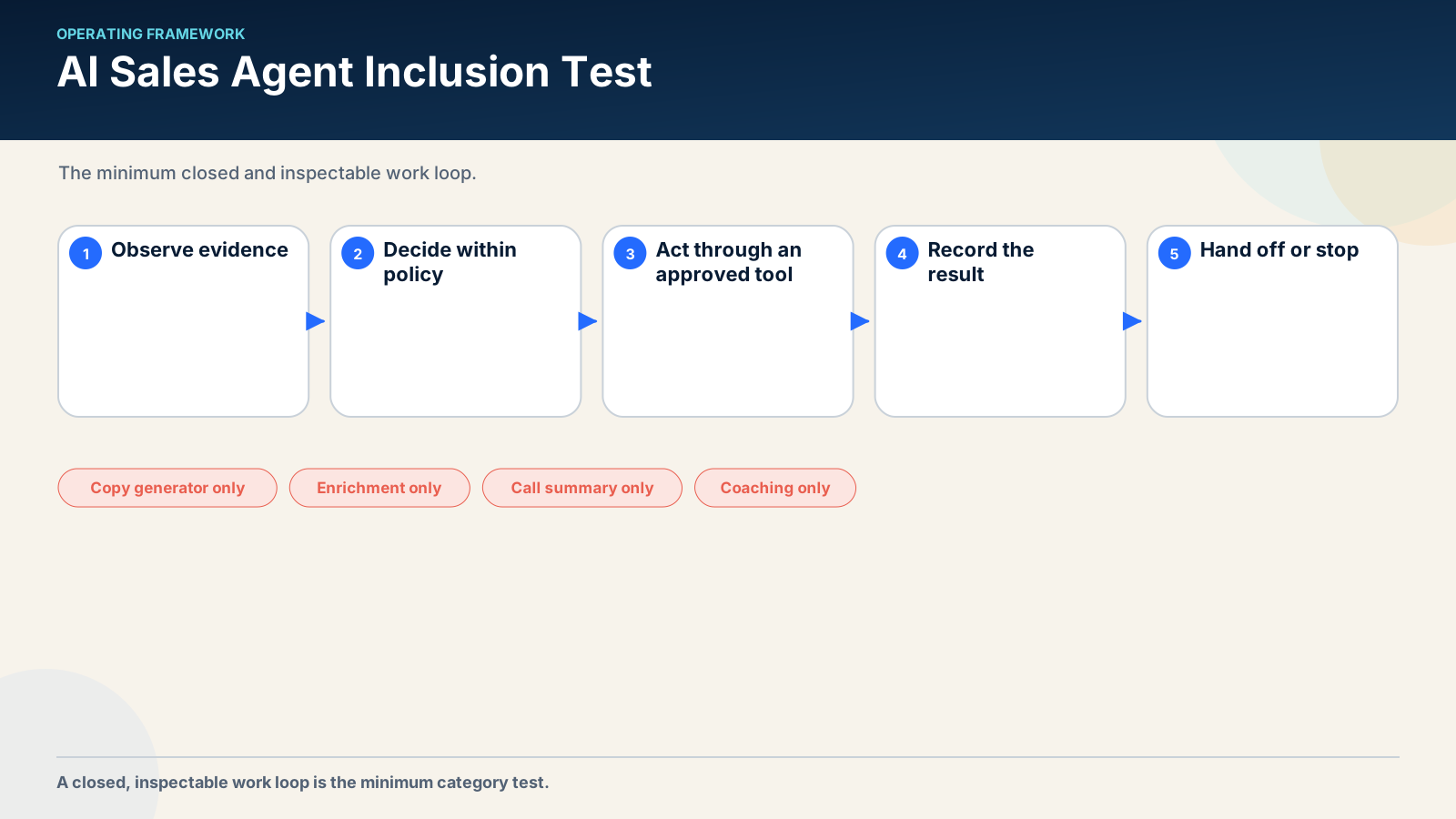
Five-stage inclusion test separating AI sales agents from assistants and single-purpose tools.
A closed, inspectable work loop is the minimum category test.

02 / Start with the sales job, not the

Start with the sales job, not the persona

A buyer should be able to complete this sentence before opening a demo:

For this defined group of eligible records, the agent may use these sources to produce this outcome, take these actions and stop in these conditions. This person owns every exception.

That sentence turns a broad ambition such as “automate SDR work” into a testable job. Common jobs include:
Sales jobSuitable first outcomeHuman decision that remains
Inbound qualificationValidated routing or booked next stepQualification policy, exception and final opportunity acceptance
Warm lead follow-upContacted, dispositioned and routed leadConsent scope, objection handling and handoff
Outbound prospectingApproved contact and compliant sequence actionICP, reason to contact, named accounts and meaningful replies
Voice appointment bookingConfirmed slot with complete contextComplex objection, sensitive topic and failed transfer
CRM follow-upDrafted task or validated field proposalOpportunity Stage, owner, price and irreversible change
Account expansionSourced recommendation to account ownerOffer, price, timing and customer conversation
The narrower the first outcome, the easier it is to build an answer key, detect errors and roll back. “Book an approved demo request into an available calendar slot” is testable. “Move every prospect through the funnel” is not.

03 / How we compared the four products

How we compared the four products

The products were selected because the owner asked for them and because together they expose four different buying decisions. We reviewed each against the same questions:
  1. What bounded sales job does the current first-party documentation support?
  2. Is the product a configured workflow, an application role, an API platform or a developer layer?
  3. Which channels and actions are documented?
  4. Who must provide the data model, prompts, policies, integrations and QA?
  5. Can the system pass context to a person and record the result?
  6. Which important limitation appears in the official documentation?
  7. What is included in the published price, and what remains outside it?
We did not use vendor customer outcomes to score products. We did not infer quality from the number of integrations or languages. We did not treat a compliance badge as legal approval for a use case. We also did not give extra weight to NextLevel.AI because the source workflow is affiliated.

04 / AI sales agents compared at a glance

AI sales agents compared at a glance

ProductBest-fit bounded jobProduct typeDocumented strengthsMain operating burdenNot ideal when
NextLevel.AIConfigured multichannel outbound qualification and bookingService-led sales-agent platformPhone, SMS, WhatsApp and email on shared memory; qualification, calendar and CRM workflowScoping, integrations, SIP, professional services, monitoring and affiliated vendor validationYou need a fully self-serve, vendor-neutral developer substrate
Bland AIProgrammable outbound voice calls and structured call pathwaysAPI-first voice-agent platformOutbound call API, pathway control, webhooks, voicemail and warm transferConversation design, telephony, integrations, legal review and sales operationsWebsite-led inbound selling or low-technical ownership is the primary need
Intercom FinInbound website qualification and routingCustomer Agent with a Sales roleProactive inbound conversation, knowledge, playbooks, qualification, routing and shared customer contextIntercom setup, knowledge quality, role configuration and workspace verificationCold outbound calling or independent programmable telephony is required
VapiCustom inbound or outbound voice agentsDeveloper voice-agent platformAPIs, assistants, phone calls, tools, provider choice and multi-assistant orchestrationEngineering, provider selection, telephony, state, controls, QA and support designYou want a finished sales playbook with minimal build work
The table is a map, not a verdict. The next sections explain the buying boundary behind each row.
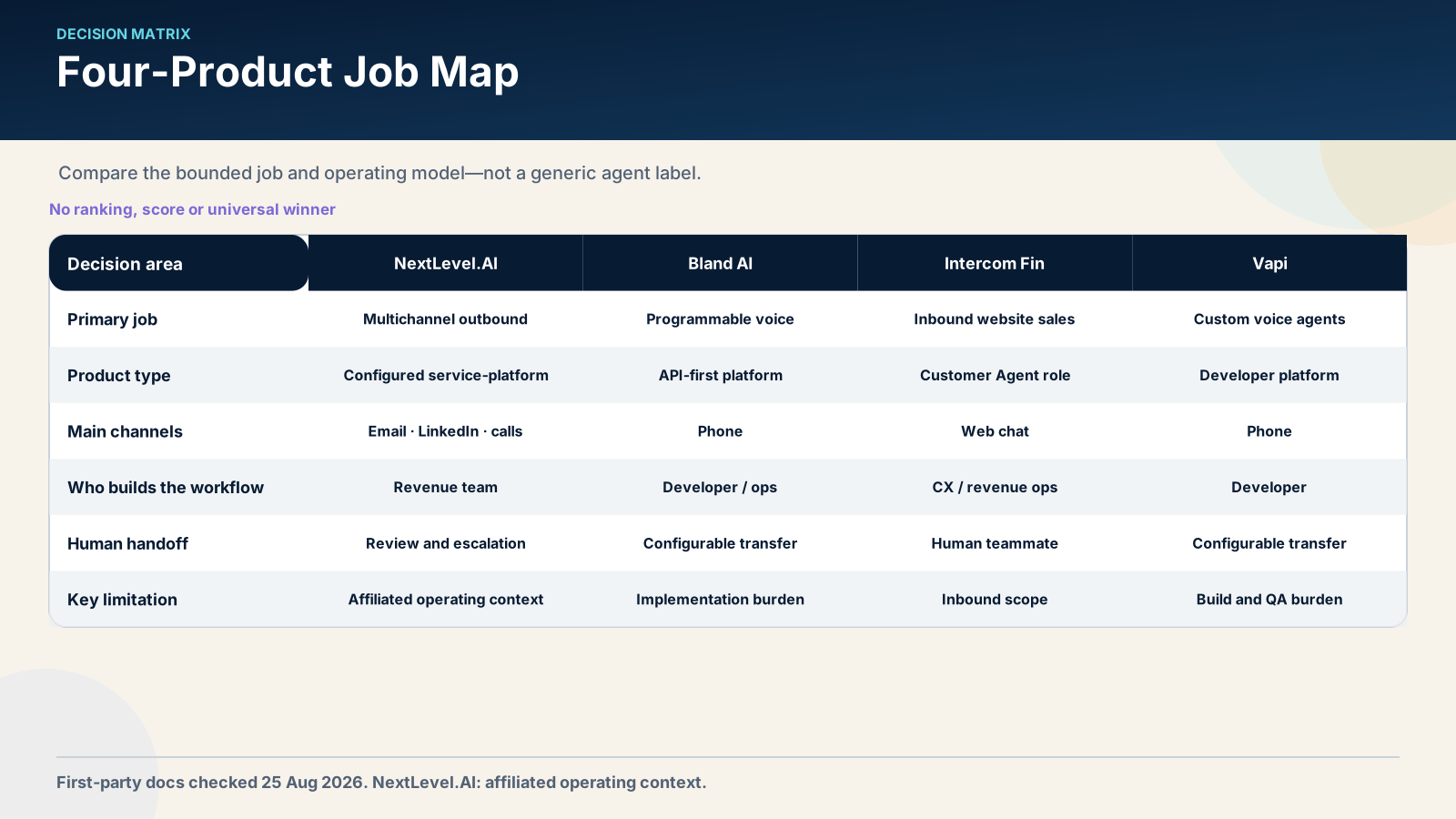
Four-product AI sales-agent map comparing bounded job, product type, implementation owner and limitation.
The four products belong to different buying categories even when their marketing language overlaps.

05 / NextLevel.AI: configured multichannel outbound sales work

NextLevel.AI: configured multichannel outbound sales work

NextLevel.AI is the closest of the four to a configured multichannel sales-agent offering. Its current AI Sales Agent page describes phone, SMS, WhatsApp and email using shared memory. It also documents BANT-style qualification, booking, CRM synchronization and escalation to a person.
That combination suits a team that wants one operator and vendor to scope the workflow rather than assemble every speech, model and orchestration component. The public page says the sales agent can move from outreach to qualification and calendar action. It also makes an important infrastructure boundary explicit: voice deployments require active SIP telephone lines. The listed sales-agent plans start at $500 per month for a defined contact and voice-hour allowance and move to a higher tier at $1,250, with custom terms beyond that. The page says tuning, post-acceptance improvements and integrations may be billed as professional services.
Those details matter more than the headline price. The buyer still needs to price:
  • SIP numbers and carrier usage;
  • CRM and calendar integration work;
  • data and enrichment;
  • approval and exception handling;
  • transcript, retention and monitoring policy;
  • ongoing tuning and change requests;
  • legal review in every calling and messaging market.
The official page contains performance, scale and compliance statements. This comparison does not treat them as independent proof. Ask for the evidence, contract language and relevant reports. Then test the exact channel, language, integration and handoff you intend to use.
NextLevel.AI is also the affiliated operating context in this article. That makes disclosure and a strict evidence boundary essential. The owner-supplied workflow supports the value of a shared state across channels and a deterministic CRM validator. It does not prove that another customer will achieve a particular result.
Best fit: a team that wants a scoped multichannel outbound workflow and vendor implementation support.
Main caution: separate public capability claims from the tested behavior, legal scope and total services cost in your own deployment.

06 / Bland AI: programmable voice workflows with explicit

Bland AI: programmable voice workflows with explicit pathway control

Bland AI is an API-first voice platform. Its Send Call documentation supports outbound calls with an instruction, a conversation pathway, tools, voicemail behavior, variables and webhooks. Its Conversational Pathways give teams node-level control over dialogue and external API calls.
This architecture is useful when the call flow needs visible branches. For example, a lead can verify identity, answer qualification questions, trigger a CRM lookup, route based on the response and end or transfer under defined conditions. A webhook can return data that controls the next node. That is more inspectable than asking one long prompt to manage every state.
Bland also documents a warm transfer that calls and briefs a human agent before merging the conversation. It is an Enterprise feature. That plan boundary should enter the buying decision early if a contextual handoff is mandatory.
Current Bland billing documentation lists a free Start plan with a connected-minute rate, plus paid Build and Scale plans with lower minute rates and higher limits. It also separates transfer time and an outbound attempt minimum. These are vendor fees, not the total call cost. Number provider, implementation, storage, integration, monitoring, QA and human transfer capacity still belong in the budget.
Bland provides a flexible voice execution layer. It does not discover your ICP, consent policy or qualification truth. Your team must define:
  • the eligible call population;
  • the disclosure and suppression rules;
  • the pathway and approved knowledge;
  • the external API permission model;
  • the disposition schema;
  • the warm-transfer destination and no-answer fallback;
  • the review sample and stop conditions.
Best fit: a technical team building structured outbound or inbound voice workflows with explicit branches and tools.
Main caution: the platform surface is not a complete sales operating model, and warm transfer may require Enterprise.

07 / Intercom Fin: inbound website sales inside a

Intercom Fin: inbound website sales inside a Customer Agent

Intercom now documents Fin as one Customer Agent with Service, Sales and Ecommerce roles. The Fin overview describes the Sales role as running inbound conversations: engage a prospect, guide discovery, qualify the lead and book a meeting. Intercom's April 2026 Fin for Sales announcement adds playbooks, product knowledge, enrichment, memory and real-time routing.
This makes Fin relevant to sales teams that already receive website demand and want one conversation layer across pre-sale and post-sale questions. It is not the same job as a cold outbound voice agent. The documented value lies in responding while the visitor is on the site, using approved knowledge and moving a qualified conversation to a human or next step.
There is also an important documentation inconsistency. The general Fin FAQ says informational or support Fin cannot book, schedule or confirm meetings. Newer Sales-role pages say Fin for Sales can book meetings. The likely explanation is product role and configuration, but a buyer should not infer the answer. Ask Intercom to demonstrate the exact Sales role in the intended workspace, plan, region and channel. Put the demonstrated action and limitations in the order form or implementation record.
Fin's broader documentation lists Messenger, email, WhatsApp, SMS and social channels and supports escalation rules. That breadth should not be mistaken for cold outbound authority. The buyer still needs a clear definition of when Fin initiates a conversation, which knowledge it can use, what it may write to CRM and which question forces a person into the thread.
Best fit: inbound website sales where customer-service and sales context should live in one conversation system.
Main caution: verify Sales-role availability and meeting actions in the exact workspace; do not extend inbound documentation to cold outbound calling.

08 / Vapi: a developer platform for custom voice

Vapi: a developer platform for custom voice agents

Vapi describes itself as a developer platform for voice AI agents. Its documentation covers inbound and outbound phone calls, web voice, tools and multi-assistant orchestration. The outbound calling guide supports immediate, scheduled and batch calls using saved or transient assistants.
This makes Vapi attractive when the team wants to choose and combine the speech-to-text, model, voice, tools and telephony layers. A developer can integrate custom APIs, manage assistant versions and design a specialized sales or qualification workflow. That control also moves more responsibility to the buyer.
The system still needs:
  • a sales job and state model;
  • provider and model selection;
  • phone numbers and allowed destinations;
  • tool schemas and server-side validation;
  • persistent context and idempotency;
  • consent, disclosure, suppression and retention controls;
  • evaluation cases and incident response;
  • a human handoff with a tested fallback.
Vapi's current pricing page separates a hosting charge from provider costs. The Build plan lists Vapi call hosting at $0.05 per minute, while speech-to-text, model and voice costs are passed through or use customer keys. Concurrency, retention and security add-ons create additional cost dimensions. This structure is transparent but easy to under-budget if a buyer quotes only the hosting fee.
Best fit: a developer-led team that wants composable voice infrastructure and can own production operations.
Main caution: Vapi is not a prebuilt AI SDR; the sales policy, state, integrations, evaluation and compliance layer are your implementation.

09 / Match the product to the motion

Match the product to the motion

Team situationStrongest initial shortlistReason
Need vendor-led multichannel outbound qualificationNextLevel.AIClosest match to a configured phone, message, booking and CRM workflow
Need programmable call pathways and enterprise warm transferBland AIVoice-first API and pathway controls
Need to qualify inbound website visitors in an existing helpdesk contextIntercom FinSales role inside the Customer Agent model
Need custom voice infrastructure and provider choiceVapiDeveloper control across assistants, tools and telephony
ICP and offer are unstableNone yetAutomate research or drafting; keep the motion human while learning
Only need copy, enrichment or call summariesAn adjacent toolA full agent adds unnecessary scope and risk
Do not choose by the maximum automation a demo can show. Choose by the smallest permission that removes a real bottleneck.

10 / Turn autonomy into a permission matrix

Turn autonomy into a permission matrix

Autonomy is not one switch. It is a set of permissions that should differ by action, segment and state.
ActionSafe starting pointWhy
Read approved CRM fieldsAutonomous within access policyLow-impact if permissions and logging are correct
Recommend next actionAutonomous recommendationHuman can reject before consequence
Draft a messageAutonomous draftEvidence and prohibited claims still need controls
Send to an approved routine cohortApproval mode firstBrand, consent and sender consequences
Place an opted-in callbackApproval mode, then bounded autonomyCall context and market rules must be proven
Book a verified available slotDeterministic execution after validationTimezone and duplicate errors require code checks
Change Opportunity StageHuman approvalForecast and ownership consequence
Create an opportunityHuman approvalPipeline semantics and compensation consequence
Set price or discountHuman onlyCommercial and contractual authority
Negotiate termsHuman onlyContext, commitment and legal consequence
Pause and escalateAlways availableSafe exit must not depend on the model
The owner-supplied NextLevel.AI workflow used a useful pattern: the agent could score context and coordinate voice, WhatsApp and email, but CRM writes passed through deterministic validation. High-impact stage changes and follow-up email required SDR approval. Every action had an audit record and rollback path.
This pattern is portable even if the product is not. The model can propose structured output. Tested code checks required fields, suppression, ownership, timezones and current state. The external action executes only after the preconditions pass.
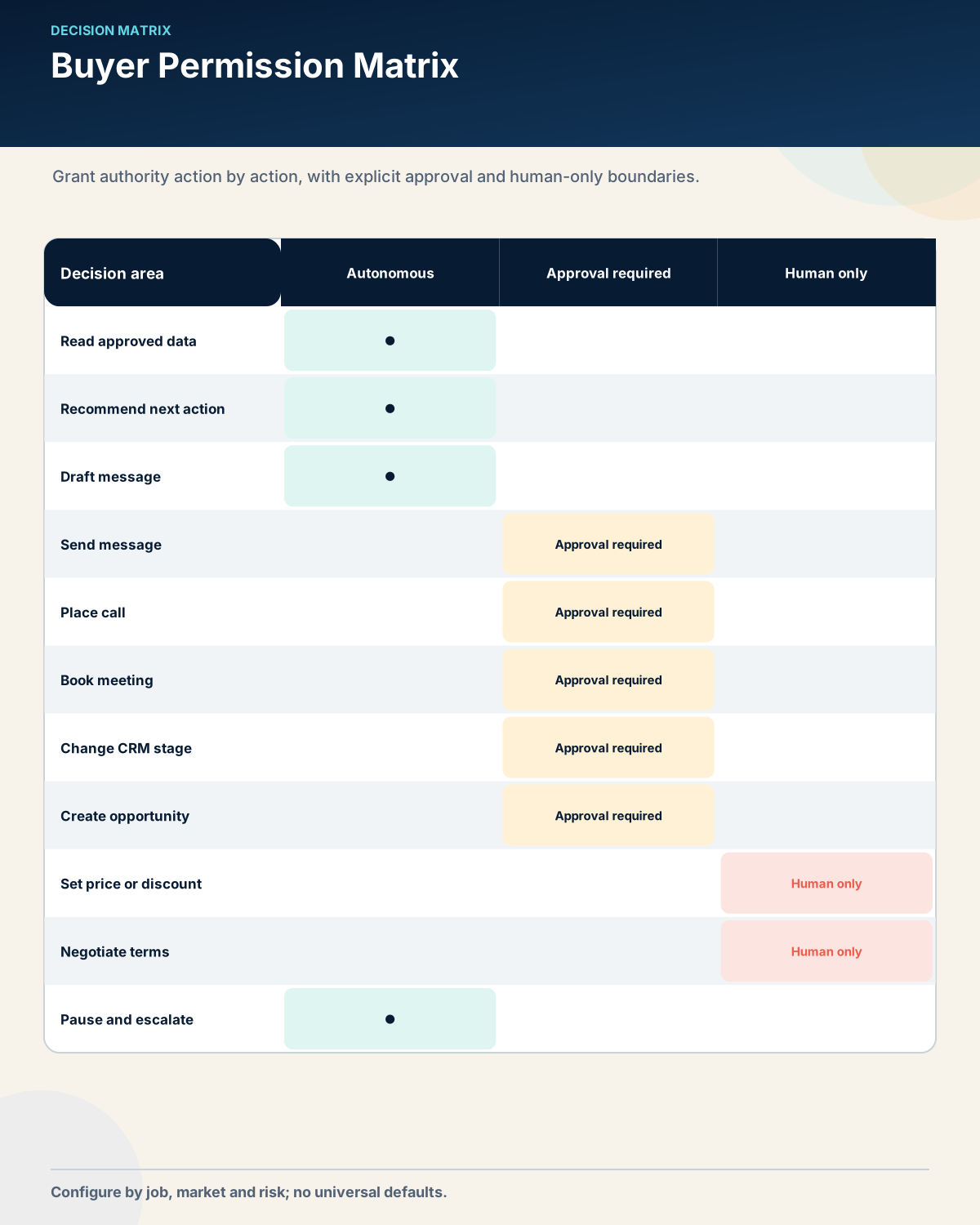
Permission matrix for AI sales-agent actions from reading data to negotiating terms.
Autonomy should be granted action by action, not switched on for a whole persona.

11 / Compare total operating cost

Compare total operating cost

Published pricing answers only one part of the buying question. Use a cost ledger that includes:
Cost lineWhat belongs in it
PlatformPlan, usage, contacts, minutes, messages, concurrency and support
ChannelsTelephony, SIP, numbers, SMS, WhatsApp, email and carrier fees
Models and dataSTT, LLM, TTS, enrichment, verification and storage
IntegrationCRM, calendar, webhooks, queues, identity and data mapping
ImplementationWorkflow design, prompts, test cases, security and legal review
OperationsQA sample, monitoring, exceptions, coaching and change management
Human work retainedApprovals, replies, calls, opportunity review and negotiation
Failure and exitCleanup, duplicate contact, bad writes, porting, export and replacement
Then compare the total with an accepted outcome, not with raw activity. Cost per sales-accepted meeting and cost per created opportunity are more useful than cost per call. They are also different metrics and must not share a denominator.
The useful denominator is not cost per generated message or connected minute. It is cost per accepted outcome: a held meeting that met the agreed qualification rule, a correctly routed inquiry or an opportunity the sales team accepted. An inexpensive sales AI agent that creates duplicate records, low-quality meetings or long review queues can cost more than a higher-priced workflow with fewer errors.
Normalize every vendor quote to the same operating scenario. Specify the number of eligible records, expected channel mix, calling regions, average duration, concurrency, data sources, integrations, retention period, support level and human review rate. Mark every unknown rather than filling it with a favorable assumption. Then model a normal month, a high-volume month and an incident month in which more work falls back to people.

12 / Build an evidence room before the demo

Build an evidence room before the demo

A polished demonstration shows that a path can work. It does not show that the path works with your permissions, data quality, market rules or exception volume. Before comparing demos, create a small evidence room for every shortlisted AI sales agent platform.
The evidence room should contain five records:
RecordMinimum contentWhy it matters
Capability recordFirst-party page, documentation link, plan, region and date checkedSeparates current capability from a sales-deck promise
Permission recordEvery read, recommendation, external action and consequential writeMakes autonomy inspectable instead of rhetorical
Cost recordPlatform, usage, channels, providers, services and human operationsPrevents an incomplete per-minute or per-seat comparison
Test recordInput, expected result, actual trace, failure category and reviewerShows performance on your job rather than a generic script
Change recordProduct version, workflow version, owner and retest decisionKeeps the comparison maintainable after launch
Ask vendors to label each answer as generally available, plan-limited, beta, custom implementation or roadmap. A roadmap item is not a current capability. A feature that exists only through professional services belongs in both the capability and cost records. If a vendor cannot expose a trace, ask what alternative audit evidence is available and whether it can be exported.
For the live demo, provide the same small scenario pack to every finalist. Include a normal case, missing evidence, a duplicate, an opted-out contact, contradictory CRM data, a human request, a tool timeout and an action that the system must refuse. Require the demonstrator to show the input, decision, action request, provider response, stored result and handoff. Do not allow the difficult cases to be replaced with a rehearsed happy path.
Reference calls also need a consistent script. Ask a customer with a similar motion which team owned implementation, which actions remained human-approved, which failure created the most review work, what changed after launch and how easily they could export records or switch providers. Treat the answer as one customer's experience, not a universal benchmark.
This process is especially important when searching for the “best AI sales agents.” The best result is contextual. One team may value a managed, multichannel deployment; another may need programmable calling; a third may already live inside an inbound service workspace; a fourth may want to own the voice stack. The evidence room makes those differences visible without pretending that one ranking fits every buyer.

13 / Use a decision record, not a weighted-feature

Use a decision record, not a weighted-feature illusion

A score can help summarize a review, but it can also hide a disqualifying condition. Record the decision in this order:
  1. Job: the exact population, trigger and accepted outcome.
  2. Hard gates: legal scope, data access, required channel, handoff and audit export.
  3. Observed evidence: which scenarios passed, failed or remained untested.
  4. Operating owner: who maintains data, policy, prompts, integrations and exceptions.
  5. Full cost range: recurring, usage, service and human-review assumptions.
  6. Residual risk: what remains uncertain and how the pilot will resolve it.
  7. Exit path: how data, numbers, prompts and workflow state can be exported or replaced.
Only score products that pass every hard gate. Keep unknown separate from fail; an unverified claim may become evidence later, but it should not receive partial credit now. The final record should explain why the selected approach fits the bounded job and why the alternatives were rejected or deferred. That explanation will be more useful six months later than a feature spreadsheet whose weights no one remembers.

14 / Run a pilot that can reject the

Run a pilot that can reject the product

A credible pilot uses one bounded job and a fixed sample.
  1. Freeze the eligible segment, offer, qualification rule and channels.
  2. Create a human answer key for identity, fit, suppression and allowed next action.
  3. Map every data source and external permission.
  4. Start in shadow or approval mode.
  5. Test normal cases and failures: stale records, duplicates, missing evidence, unsupported questions, human requests, no-answer transfers and tool outages.
  6. Record model/workflow version, evidence, proposal, action, result, reviewer and correction.
  7. Measure accepted outcomes, human review time, total cost and harm signals.
  8. Define warning, stop and rollback rules before live traffic.
  9. Test export, access revocation and suppression survival.
Do not compare products on different jobs or samples. A website agent and outbound call platform should not receive one blended score. Compare each against the baseline for the job it is supposed to improve.
Useful pilot metrics include:
  • eligible-record completion;
  • correct disposition and routing;
  • unsupported or materially incorrect response rate in a reviewed sample;
  • human correction and override;
  • clean handoff rate;
  • meetings held and accepted by sales;
  • opportunities created under the CRM rule;
  • total cost per accepted outcome;
  • suppression breach, complaint and duplicate-action rate.
The detailed formulas belong in the AI Sales Agent KPIs guide. The architecture and staged rollout belong in How to Build an AI Sales Agent.
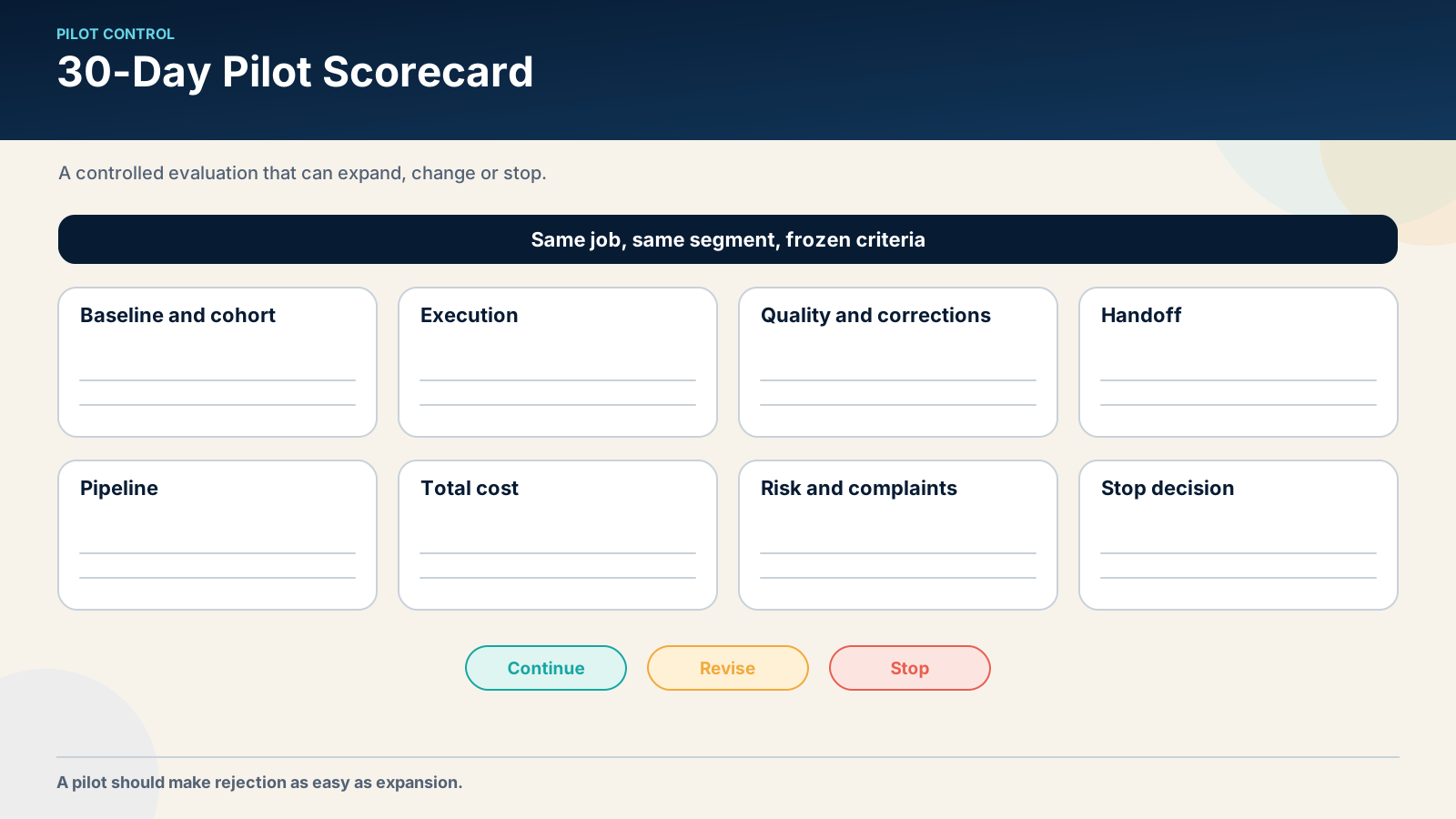
Thirty-day AI sales-agent pilot scorecard with baseline, quality, pipeline, cost and stop decision.
A pilot should make rejection as easy as expansion.

15 / When an AI sales agent is the

When an AI sales agent is the wrong purchase

Wait or choose a smaller tool when:
  • the team cannot define one bounded job;
  • ICP and offer are still being discovered through founder conversations;
  • CRM ownership and stage definitions are inconsistent;
  • there is no global suppression state;
  • the company cannot inspect evidence behind a material claim;
  • no one owns replies and exceptions;
  • the product cannot pause, export or reverse actions;
  • the buyer expects the vendor to make legal decisions for each market;
  • the projected value depends on vendor outcome claims rather than your baseline.
An agent can increase throughput. It can also multiply a weak targeting rule, a stale data source or an unclear handoff. The system becomes safer when it is easier to stop.

16 / Frequently asked questions

Frequently asked questions

What is the difference between an AI sales agent and an AI SDR?

An AI SDR is one type of AI sales agent focused on sales-development work such as research, outreach, qualification, replies or booking. AI sales agents also include inbound website agents, voice agents, CRM agents and post-sale expansion agents. Compare the owned actions rather than the name.

Which AI sales agent is best for a small business?

There is no universal best product. A small business with a proven outbound motion may prefer a configured service-led agent. A technical team building voice workflows may prefer an API platform. A website-led business may prefer an inbound agent. A founder still changing the offer should wait.

Can an AI sales agent replace an SDR?

It can automate bounded SDR tasks. It does not automatically own market strategy, account relationships, ambiguous replies, negotiation or pipeline semantics. Define the retained human work before comparing cost.

How much do AI sales agents cost?

Pricing ranges from usage-based developer fees to bundled platform plans and custom services. The real cost includes channels, providers, data, integration, monitoring, human review and failure recovery. Recheck dated vendor pricing and calculate cost per accepted outcome.

Are AI voice sales agents legal?

Legality depends on jurisdiction, call type, consent, disclosure, suppression, calling window, recording, data handling and sector rules. A platform feature or compliance claim does not answer that question. See the AI Voice Sales Agent guide and obtain market-specific legal review.

Should the agent write directly to CRM?

Low-impact, reversible fields may be suitable after validation. Opportunity Stage, ownership, opportunity creation and other consequential changes should begin with human approval. Every write needs an idempotency key, precondition, confirmation and audit trail.

17 / Buying checklist

Buying checklist

Before signing, require clear answers to these questions:
  • What exact job and eligible population are in scope?
  • Which data sources can the agent read?
  • Which actions can it take without approval?
  • What happens when evidence is missing or contradictory?
  • What stops all channels after a reply or opt-out?
  • What context reaches the human?
  • Which CRM fields can change, and how are they reversed?
  • What does the price exclude?
  • Which claims have independent or customer-verifiable evidence?
  • Can you export records, revoke access and preserve suppression on exit?
The correct purchase is not the agent with the longest feature list. It is the product whose job, evidence, permissions, cost and failure path your team can inspect.

Research note

Methodology

  1. 01The comparison uses a job-first inclusion test and current first-party product documentation checked on 25 August 2026.
  2. 02NextLevel.AI is disclosed as the author's affiliated operating context; vendor claims are attributed and are not treated as independent performance evidence.
  3. 03No common-sample production test or universal winner is claimed; pricing and capabilities require rechecking before purchase.
Read the full methodology

Source ledger

Sources & editorial notes

  1. 01
    NextLevel.AI

    NextLevel.AI · Primary, official or disclosed research source used for the bounded claim cited in this guide; scope and current status require rechecking.

  2. 02
    Bland AI

    Bland AI · Primary, official or disclosed research source used for the bounded claim cited in this guide; scope and current status require rechecking.

  3. 03
    Intercom Fin

    Intercom · Primary, official or disclosed research source used for the bounded claim cited in this guide; scope and current status require rechecking.

  4. 04
    Vapi

    Vapi · Primary, official or disclosed research source used for the bounded claim cited in this guide; scope and current status require rechecking.

  5. 05
    NIST AI Risk Management Framework

    nist.gov · Primary, official or disclosed research source used for the bounded claim cited in this guide; scope and current status require rechecking.

Corrections or primary material: contact the corrections desk.

About the author

Anastasiia Krynytska

Anastasiia Krynytska is a LeadGen Team Lead at Softermii and the lead editor of Luck My Sales. She covers AI-assisted outbound, account research, qualification, messaging, CRM handoffs and revenue workflows from a practitioner’s perspective.View author profile LinkedIn

Continue reading

01 · News analysis

AI sales is moving from assistant to operating layer

The category is expanding from drafting support into research, pipeline decisions, recommended actions and controlled execution.

Read news
02 · Field analysis

In AI sales, the handoff may be the product

Models are becoming accessible; durable value sits in the controlled transition from signal to seller action.

Read analysis
03 · Research framework

Sales AI Workflow Signals 2026

A launch framework for mapping the products, controls and buying questions shaping AI-enabled revenue work.

Read reports

Luck My Sales briefing

Useful context, once a week.

News, explanations and original research from this desk. No noise.
The newsletter is still being built. We will contact you when the first edition is ready.