Weekly industry intelligence · No noiseSubscribe to the Luck My Sales newsletterFree briefing

Independent operator-led media on AI in B2B sales

Menu

Voice-agent operating and platform guide · Implementation guides

AI Voice Sales Agent Guide: Calls, Controls and Handoffs

Evaluate AI voice sales agents by call loop, consent, language, tool permissions, disposition quality, warm handoff, platform fit and pilot controls.
Editorial disclosure

AI may assist research organization and drafting. A human editor reviews every published page, checks material claims against the cited sources and owns the final decision. No company paid for placement in this article.

AI use policy

Agent-ready brief

AI takeaways

Keep the key points here, or take a source-aware text brief into Claude, ChatGPT or another AI workspace.
  1. 01Start with a bounded, lower-risk call job and treat cold autonomous outbound as a separate deployment.
  2. 02Consent, disclosure, suppression, timing, recording and retention belong inside the call design.
  3. 03Measure the full speech-to-action loop, including language changes, tools and disposition quality.
  4. 04A human handoff needs identity, evidence, current state, unresolved issue, owner and fallback.
  5. 05Platform capability does not prove legal fit or production quality in the intended market.
Includes summary, takeaways, sources and a use note.
An AI voice sales agent is useful when it can complete one bounded call job, preserve the evidence behind its answers, record a correct disposition and hand uncertainty to a person. A human-sounding voice is not the production standard. The standard is a lawful, observable call that reaches the right state without inventing claims or losing context.
Start with lower-risk calls: inbound requests, explicitly requested callbacks, reminders or warm follow-up connected to an existing interaction. Treat cold autonomous outbound as a separate, higher-risk deployment. It demands market-specific review of consent, disclosure, suppression, calling times, recording, retention, number use and sector rules.
This guide explains the live call loop, compares conducted voice agents with adjacent tools, maps use cases by risk, reviews three platform approaches and provides a human-handoff contract and pilot plan.
Method, affiliation and legal scope: the guide uses an anonymized owner-supplied MENA/GCC insurance workflow in which quote context moved across email, voice and WhatsApp before a broker handoff. NextLevel.AI was the affiliated operating platform; this is not an independent product test. The reported English-to-Gulf-Arabic pause is an approximate failure observation, not a latency benchmark. Legal sources cover selected US, UAE and Saudi rules only. This is operational information, not legal advice. The deploying company must obtain current local and sector-specific review for the exact call, channel, data and market.

A production voice agent is a call-control system that can listen, decide, act, record and exit safely—not merely a human-sounding demo.

01 / What an AI voice sales agent is—and

What an AI voice sales agent is—and is not

A conducted voice agent listens and responds during a live call. It may retrieve approved context, ask questions, call tools, schedule or transfer under a defined policy.
SystemWhat it doesWhat it does not do by itself
AI voice sales agentConducts or answers a live sales conversationProve consent, qualification quality or legal compliance
IVRRoutes callers through fixed menus and inputsHold an open-ended sales conversation
Power dialerConnects human reps to more callsSpeak or make decisions for the rep
Real-time coachingSuggests language during a human callOwn the caller relationship or disposition
Conversation intelligenceRecords, transcribes and analyzes callsConduct the original call
Voice API/platformSupplies components to build an agentSupply the complete sales policy and operating model
The distinction prevents category errors. A call summary can help coaching. It is not evidence that the system can make a compliant outbound call, handle an interruption or complete a warm transfer.

02 / How one production call turn works

How one production call turn works

A voice agent is a pipeline of systems:
  1. Telephony receives or places the call. The number, carrier, geography and call direction matter.
  2. The workflow checks permission and context. It reads consent source, suppression, calling window, account owner and the reason for the call.
  3. The agent discloses identity where required. It follows the approved introduction and recording policy.
  4. Speech-to-text transcribes the caller. Language, accent, noise and endpointing affect what the system hears.
  5. Context retrieval loads approved information. This may include a quote, CRM status, prior channel thread and a bounded knowledge base.
  6. The policy and model produce a response or tool proposal. The system distinguishes allowed conversation from prohibited claims or actions.
  7. Deterministic code validates tools. Calendar, CRM, transfer and payment actions need schema and permission checks.
  8. Text-to-speech generates audio. Voice, language, interruption and pacing shape the experience.
  9. The workflow records a disposition. It stores the event, evidence, action, result and any uncertainty.
  10. The call closes, continues or hands off. A human request or unsupported topic takes the safe path.
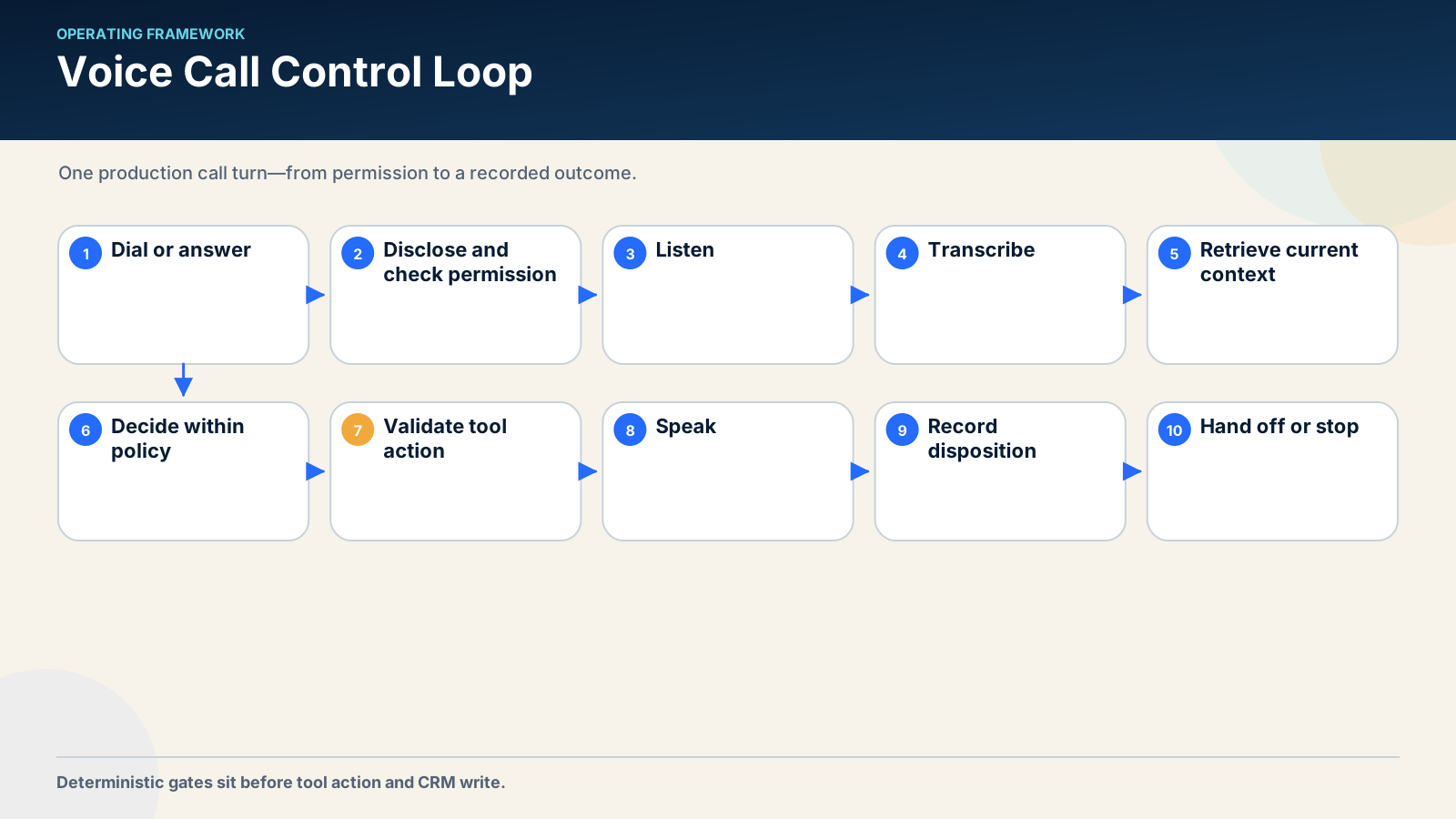
Failures can occur at every stage. Wrong transcription can produce a wrong decision. A correct decision can fail at the calendar API. A successful transfer call can reach nobody. A useful pilot measures the whole loop, not only the voice sample.
End-to-end voice call control loop from dialing and disclosure to disposition and human handoff.
The model is one component inside a larger telephony, policy and action loop.

03 / Define the call disposition before writing the

Define the call disposition before writing the script

A disposition is the controlled final state of the call, not a free-text summary. Define the allowed values before conversation design so that every branch has somewhere truthful to end.
A practical schema can include:
  • completed request;
  • qualified and transferred;
  • qualified and callback required;
  • meeting proposed but not confirmed;
  • not qualified under the named rule;
  • no interest;
  • opt-out or do-not-call;
  • human requested;
  • unsupported topic;
  • identity or permission unresolved;
  • voicemail, no answer or busy;
  • tool or transfer failure;
  • incomplete call or unknown state.
Each value needs required evidence. Meeting confirmed requires the calendar provider's successful postcondition, timezone and event ID. Transferred requires the destination and connection result, not only that the transfer was attempted. Not qualified requires the criterion that failed. Opt-out must update the authoritative suppression system even if the CRM write later fails.
Keep the model's conversational summary separate from the disposition. Deterministic validation should reject incompatible combinations such as meeting_confirmed without an event ID, qualified with missing required answers or transferred after a no-answer result. Route uncertain combinations to review.
The disposition drives reporting, follow-up and retry policy. A busy signal may permit a bounded retry. An opt-out never does. A failed transfer creates a human-owned task with the preserved context. An unsupported question may allow a promised follow-up only if the workflow can assign it to a real owner.
This schema also improves handoffs between a virtual AI agent for sales calls and the rest of the sales stack. The CRM receives a small, validated state plus trace references rather than an optimistic paragraph that another automation must reinterpret.

04 / Choose the call job by risk

Choose the call job by risk

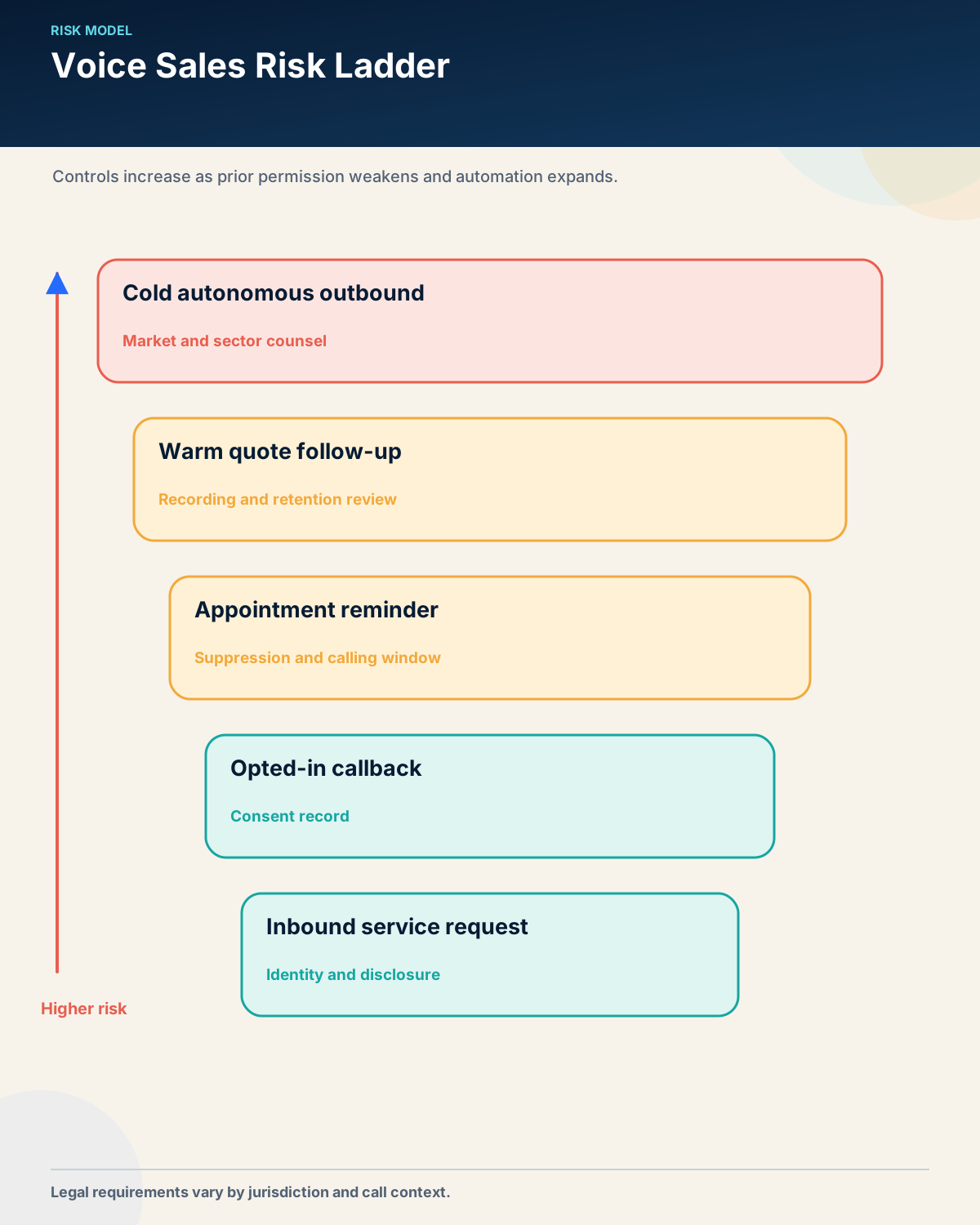
Use a risk ladder rather than a list of exciting demos.

1. Inbound request

The caller initiates contact. The agent can answer approved questions, collect structured context and route to a person. The workflow still needs identity, disclosure, data and recording rules.

2. Explicitly requested callback

The buyer asks to be called. Preserve the consent event, purpose, number and time. Keep the callback inside that scope.

3. Appointment reminder or confirmation

The agent communicates a known event and can confirm, reschedule or route. Avoid expanding a service message into a marketing pitch without an approved basis.

4. Warm quote or lead follow-up

The call follows a quote, inquiry or other recent interaction. It can clarify context and propose the next step. The workflow must still prove the applicable permission and market rules.

5. Cold autonomous outbound

The recipient has not initiated the immediate call context. This is the highest-risk rung. Consent, DNC, disclosure, artificial-voice, number, calling-hour, recording, data and sector rules can all apply. A platform's ability to dial is not permission to use it.
Start lower on the ladder. Promote only after the team can measure identity, consent, disposition, handoff and complaint outcomes.
Five-level risk ladder for inbound, opted-in, reminder, warm follow-up and cold AI voice calls.
Higher automation and weaker prior permission demand stronger controls and review.

05 / Legal and compliance controls are part of

Legal and compliance controls are part of the call design

Do not add a generic compliant badge after the flow is built. Record the legal inputs before the call can enter the queue.

United States artificial-voice baseline

In February 2024, the Federal Communications Commission confirmed that AI-generated voices fall within the TCPA treatment of artificial or prerecorded voice calls. That means relevant consent and robocall requirements can apply. It does not answer every state, recording, disclosure, DNC or sector question.

UAE telemarketing and messaging

The UAE has specific telemarketing regulations under Cabinet Resolution No. 56 of 2024. Applicability and operational duties should be reviewed for the entity, sector, call and later guidance.
For promotional SMS, current TDRA FAQs describe prior explicit consent, permitted sending times and a free unsubscribe mechanism. TDRA also states that third-party voice and video calling services are regulated. These points cannot be stretched into a complete rule for every AI call or WhatsApp message. They show why the telephony provider and channel must be reviewed, not only the model.

Saudi direct marketing and personal data

Saudi Arabia's PDPL Implementing Regulation requires consent and a withdrawal mechanism for direct marketing, clear sender identity and prompt cessation after withdrawal. It also addresses information duties, data minimization, processor selection, impact assessment and records. Telecommunications, sector and cross-border rules may add obligations.

Required deployment record

For every market and call type, record:
  • controller and responsible legal entity;
  • recipient category and source;
  • consent or other approved legal basis and its scope;
  • DNC and suppression source;
  • allowed calling hours and timezone;
  • AI or caller identity disclosure;
  • recording and transcript rule;
  • data fields used and retention period;
  • processors, sub-processors and data locations;
  • number ownership and telephony provider;
  • sector-specific restrictions;
  • opt-out and complaint handling;
  • human escalation and incident owner;
  • approval date and reviewing counsel or owner.
If the system cannot read the current permission state, it should fail closed.

06 / An anonymized bilingual quote-follow-up workflow

An anonymized bilingual quote-follow-up workflow

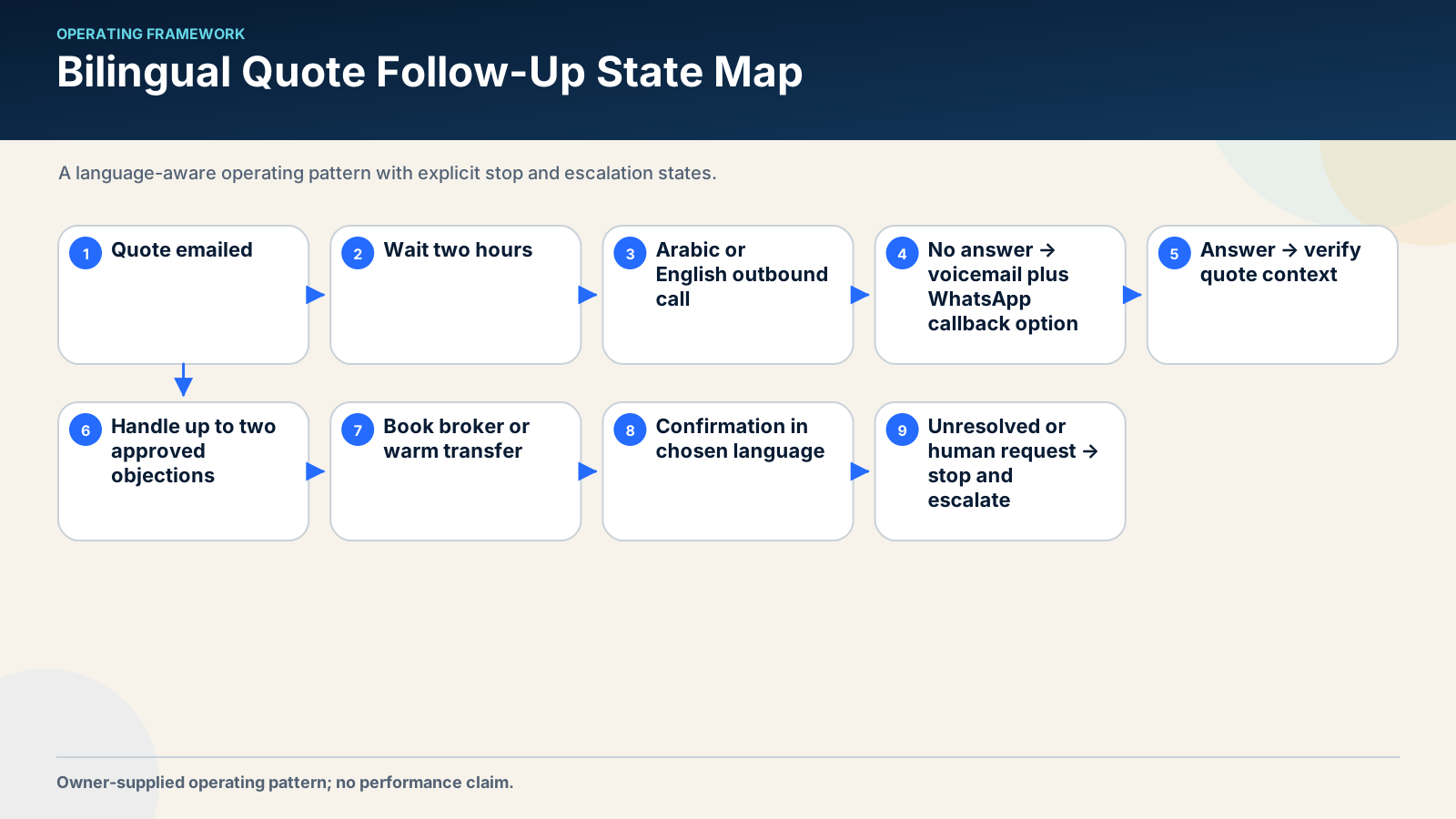
The owner supplied a practical MENA/GCC insurance pattern:
  1. A broker emails a quote.
  2. Two hours later, the workflow attempts an outbound call in Arabic.
  3. If nobody answers, it leaves an approved voicemail and sends a WhatsApp option to request a call immediately.
  4. If the prospect answers, the voice agent loads the quote, preferred language and prior objections from a shared thread.
  5. It handles no more than two approved objections.
  6. It books time with the broker or initiates a human transfer.
  7. The workflow sends confirmation in the selected Arabic or English channel.
  8. An unsupported question or human request stops autonomous selling and creates a broker handoff.
The handoff arrives as a Slack or CRM card containing the conversation context, detected objections, sentiment or urgency, and requested next action. The human should not have to ask the prospect to repeat the quote and objection history.
This workflow is useful as an operating pattern, not as a legal or performance claim. It also exposes two difficult edges: language state and transfer failure.

The language-switch failure

In one observed failure, a switch from English to Gulf Arabic introduced an awkward pause estimated at roughly 1.5 seconds. The team changed the orchestration so the language state persisted from the WhatsApp session and used streaming behavior during the transition.
The number is approximate and cannot compare vendors. The lesson is more durable: test code-switching as a state transition. Include mixed-language sentences, names, product terms, interruptions and a return to the first language. Measure the exact end-of-speech-to-audio boundary by percentile if latency will become a KPI.

The no-broker fallback

A warm transfer is incomplete if the human queue does not answer. Use a deterministic fallback:
  1. tell the caller that the transfer is unavailable;
  2. do not continue into unsupported selling;
  3. offer an approved callback or scheduling option;
  4. preserve the full context card;
  5. create an owned exception task;
  6. confirm the next step in the caller's chosen language;
  7. close the call cleanly.
Do not repeatedly transfer the caller between queues or let the model invent availability.
Bilingual insurance quote follow-up flow from emailed quote to voice call, WhatsApp fallback and broker handoff.
Shared context matters most at language switches, channel changes and human handoffs.

07 / Compare voice-agent platform approaches

Compare voice-agent platform approaches

This guide does not declare one platform best. It uses current first-party documentation to show three buying models.

NextLevel.AI: configured multichannel voice and sales workflow

NextLevel.AI's current AI Sales Agent and AI Insurance Agent pages describe voice plus messaging channels, CRM and calendar integration, qualification, shared context and human escalation. The sales page also says clients need active SIP telephone lines.
This approach fits a team that wants vendor-led scoping and a configured cross-channel workflow. Verify the exact language and dialect, telephony country, number type, consent controls, warm transfer, CRM fields and retention behavior. Treat published outcome, scale and compliance statements as vendor claims unless the vendor supplies applicable evidence and the buyer validates the deployment.
The affiliation disclosed above means this article does not treat owner experience as independent product proof.

Bland AI: pathway-controlled voice calls

Bland's outbound call API documents instructions, pathways, tools, voicemail behavior and webhooks. Conversational Pathways provide node-level dialogue and routing control. Its warm transfer documentation describes briefing a human before merging the calls and labels the feature Enterprise.
This approach fits technical teams that want visible call states and API integration. Test the exact carrier and queue. Inspect fallback behavior. Add legal and sales policy outside the pathway. Published plan and minute charges do not include the full telephony, integration, monitoring and human-transfer cost.

Vapi: composable developer voice infrastructure

Vapi's developer documentation covers inbound and outbound phone agents, web voice, tools and multi-assistant orchestration. Its outbound guide supports immediate, scheduled and batch calls.
This approach fits a team that wants provider choice and code-level control. The team must own state, tools, validation, consent, suppression, evaluation and handoff. Vapi's pricing separates the platform hosting fee from speech, model and voice provider costs, so total cost depends on the chosen stack.

08 / Use a platform evaluation matrix

Use a platform evaluation matrix

Ask every vendor or internal build the same questions:
DimensionEvidence to request
Call direction and geographySupported inbound/outbound countries, number types and restrictions
TelephonyCarrier, number ownership, portability, SIP and failure states
LanguageTarget language, dialect, code-switching and named test set
Turn-takingEndpointing, interruption, barge-in, silence and noise recovery
GroundingApproved sources, update behavior and unsupported-answer path
ToolsSchemas, permissions, validation, idempotency and confirmation
TransferWarm/cold mode, briefing, queue, no-answer and dropped-call fallback
CRMRead/write fields, owner conflicts, audit and rollback
Consent and suppressionSource, global state, calling window and fail-closed behavior
Recording and retentionDefault behavior, configuration, export and deletion
ObservabilityTranscript, trace, latency stages, disposition and corrections
TestingSimulations, batch replay, version pinning and evaluation export
CostPlatform, carrier, STT, model, TTS, numbers, storage and support
ExitData export, number portability, access revocation and suppression survival
A demo should include difficult cases, not only a perfect scripted conversation.

09 / Build an adversarial call test pack

Build an adversarial call test pack

An AI sales call agent should be tested as a stateful system, not judged from a voice sample. Create a versioned test pack before the first live call. Each case needs an initial state, permitted evidence, expected disposition, prohibited actions, required disclosure, handoff behavior and cleanup step.
Cover at least these families:
Test familyExampleRequired result
IdentityCaller supplies a different company or phone numberAsk a bounded verification question or route; do not merge records automatically
PermissionConsent is absent, expired or outside the stated purposeDo not place or continue the marketing call
SuppressionCRM and channel provider disagree on opt-outFail closed and create an owned exception
TimeContact travels to another timezoneUse the approved authoritative timezone or pause
KnowledgeCaller asks about an undocumented featureState the limit and offer a human follow-up
Commercial authorityCaller requests a discount or binding quote changeDo not invent or negotiate; route to the authorized person
Prompt attackCaller says to ignore previous instructionsKeep policy and tool permissions unchanged
Tool ambiguityCRM or calendar times out after a requestReconcile state before retry; never claim success without confirmation
TransferHuman queue does not answerPreserve context, create the fallback task and explain the next step
LanguageCaller switches language, dialect or writing systemConfirm understanding, continue only within the tested policy or route
AudioCrosstalk, silence, noise or interrupted speechRecover without fabricating a response or skipping disclosure
ClosureCaller opts out or requests a humanStop the autonomous path immediately and record the disposition
For a bilingual or multilingual deployment, translate meaning rather than only prompts. The test owner should verify product terms, numbers, dates, names, consent language, uncertainty phrases and handoff wording with a qualified speaker. Test code-switching in both directions. A voice AI sales agent may perform well in two separate monolingual scripts yet fail when a caller changes language mid-turn.
Review the trace stage by stage. Check the audio input, transcript, detected language, retrieved evidence, policy decision, tool arguments, provider response, spoken output and final disposition. A correct final answer does not excuse an unsafe intermediate action. Likewise, a failed provider call should not be scored as a reasoning error if the agent followed the correct fallback.
Use severity as well as frequency. A minor pronunciation issue is not equivalent to a false claim about price, consent or coverage. Define which failures block launch, which require correction before the next cohort and which can enter a monitored improvement queue. Keep the answer key and reviewers stable enough to compare versions.
The broader implementation guide explains event contracts, idempotency and staged permissions. Apply those controls even when the voice layer is purchased as a service.

10 / Design the conversation around safe states

Design the conversation around safe states

Keep the conversation policy smaller than the knowledge base.
Define:
  • exact introduction and disclosure;
  • identity verification appropriate to the call;
  • approved topics and claims;
  • maximum qualification depth;
  • objection topics the agent may handle;
  • sensitive or regulated topics it must not handle;
  • tool actions and approval rules;
  • human-request phrase and immediate behavior;
  • uncertainty language;
  • hostility and complaint handling;
  • voicemail and no-answer behavior;
  • end-call criteria.
The agent should say it does not have the answer rather than improvise price, coverage, legal terms or security details. It should not continue qualification after a clear opt-out or human request.

11 / Build a complete human-handoff contract

Build a complete human-handoff contract

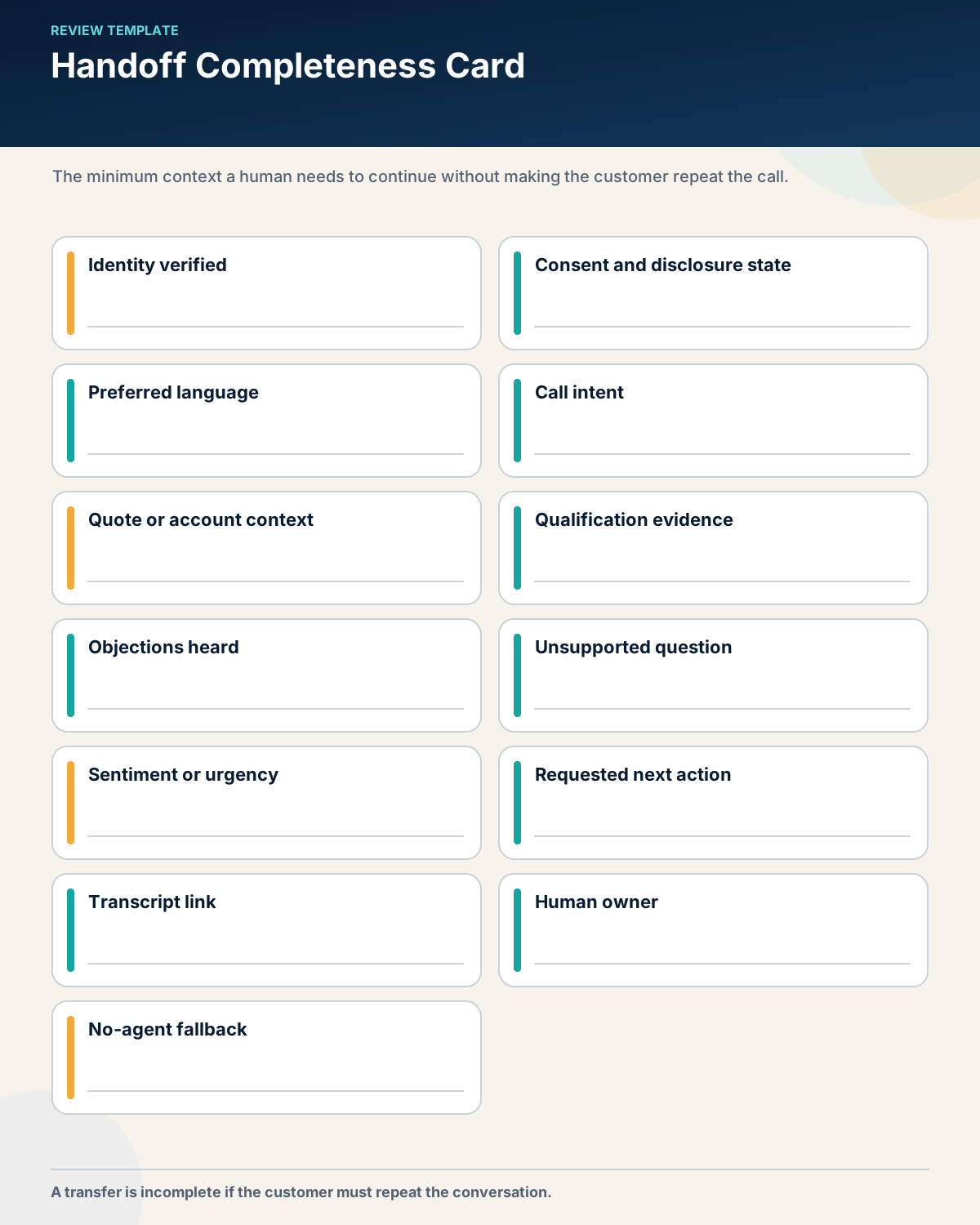
The handoff packet should contain:
  • verified identity and account;
  • consent and disclosure state;
  • preferred language;
  • call purpose;
  • quote, product or account context;
  • qualification evidence;
  • objections and approved answers already used;
  • unsupported or unresolved question;
  • requested next action;
  • transcript or recording link where lawful;
  • attempted tool actions and results;
  • human owner and fallback state.
Measure whether the human accepts the handoff as complete. Transfer success alone can hide missing context.
Voice-agent handoff card containing consent, language, intent, objections, unresolved questions and human owner.
A transfer is incomplete if the customer must repeat the conversation.

12 / Model cost per completed disposition

Model cost per completed disposition

Per-minute pricing is useful for invoice reconciliation, but it is a poor buying denominator. A short, failed call can be cheap and useless. A longer call may correctly identify intent and produce a complete handoff. Model the full cost of one accepted disposition.
Include:
  • platform and concurrency plan;
  • telephone numbers, SIP or carrier charges;
  • connected time and any minimum attempt charge;
  • speech recognition, model and voice-provider usage;
  • recording, transcript, storage and retention;
  • CRM, calendar and workflow infrastructure;
  • implementation, language QA and legal review;
  • human monitoring, exception work and live transfers;
  • failed attempts, duplicate cleanup and incident remediation.
Then separate outcomes. A correct no-interest disposition, a confirmed callback, a held qualified meeting and a clean human transfer are not interchangeable. Calculate cost against the outcome the workflow was designed to produce. Also report review burden and severe failure count beside the financial metric; otherwise a cheaper platform can appear efficient by pushing hidden work or risk onto people.
Run sensitivity ranges rather than one confident forecast. Model normal and high call duration, transfer rate, human-review rate, provider retries and language mix. Mark unknown inputs explicitly. The AI sales agents comparison provides a broader platform cost ledger, while the KPI guide defines accepted-outcome denominators.

13 / Pilot the voice agent

Pilot the voice agent

Use a limited, legally reviewed cohort and a fixed script policy.
  1. Define the call job, population and legal review.
  2. Freeze knowledge, claims, tools and transfer rules.
  3. Create a human answer key for qualification and dispositions.
  4. Test in simulation and internal calls first.
  5. Include normal, missing, contradictory and adversarial cases.
  6. Test target languages and dialects with qualified speakers.
  7. Test interruption, silence, background noise and code-switching.
  8. Test voicemail, no answer, busy, transfer failure and dropped call.
  9. Review every call in the first live sample.
  10. Promote one use case or permission at a time.
Track:
  • eligible-call completion;
  • correct disclosure and suppression behavior;
  • transcription or entity errors affecting outcome;
  • turn latency by defined stage and percentile;
  • interruption recovery;
  • unsupported or materially incorrect response rate;
  • correct disposition;
  • clean-handoff rate;
  • booked, held and sales-accepted meeting rates;
  • complaint and opt-out outcomes;
  • total cost per accepted outcome.
The formulas and denominator rules belong in the AI Sales Agent KPIs guide.

14 / Stop conditions

Stop conditions

Pause or move to Shadow Mode when:
  • the workflow cannot prove permission or suppression;
  • a human request does not stop autonomous handling;
  • the agent makes a severe unsupported claim;
  • a language change repeatedly causes an unacceptable failure;
  • transfer context is incomplete or reaches the wrong owner;
  • call state becomes uncertain after a provider error;
  • recording or retention differs from the approved policy;
  • duplicate or out-of-window calls occur;
  • the audit trail is missing.
Define thresholds from your baseline and severity. Do not copy a vendor's latency or conversion target.

15 / Frequently asked questions

Frequently asked questions

What is an AI voice sales agent?

It is software that conducts or answers a live sales call using telephony, speech recognition, a policy/model layer, approved context, speech generation and tools. It should also record the outcome and hand uncertainty to a person.

Are AI sales calls legal?

It depends on the market, call type, consent, disclosure, DNC, calling hours, recording, data processing and sector. In the US, the FCC treats AI-generated voice as artificial voice under relevant TCPA rules. UAE and Saudi rules create different duties. Obtain current local review.

Can a voice agent switch languages during a call?

Platforms may support multiple languages, but a list is not proof of dialect or code-switching quality. Test the actual language pair, terminology, interruption and state persistence with target speakers.

What is a good voice-agent latency?

There is no universal number without a clock boundary and context. Measure end of user speech to first audible response, tool waits and transfer stages separately. Report a median and tail percentile by language and network.

Should the agent handle objections?

Only approved, bounded objections supported by current knowledge. Price, legal, security, coverage, sensitive or novel questions should route to a person unless a narrower policy is explicitly approved and tested.

What happens when no human answers a transfer?

The agent should stop unsupported selling, preserve context, offer an approved callback or booking option, create an owned exception and confirm the next step. Repeated blind transfers are not a fallback.

16 / Go/no-go checklist

Go/no-go checklist

Do not launch until you can answer yes to all relevant items:
  • The call population and permission source are recorded.
  • Market, sector, disclosure, DNC, time, recording and retention rules were reviewed.
  • The phone number and provider are approved for the geography.
  • The target language and dialect passed a defined test set.
  • Approved claims and prohibited topics are explicit.
  • Tool actions use schemas, validation and idempotency.
  • The agent stops on opt-out, human request and uncertainty.
  • Dispositions have clear definitions.
  • The handoff packet and no-answer fallback are tested.
  • Logs preserve versions, evidence, actions and outcomes.
  • Warning, stop, rollback and re-entry owners are named.
A convincing voice demo proves that a model can speak. A production pilot must prove that the entire call system can listen, decide, act, record and exit safely.

Research note

Methodology

  1. 01The guide combines current official legal and product sources with an anonymized owner-supplied MENA/GCC insurance workflow.
  2. 02NextLevel.AI is disclosed as the affiliated operating platform; the workflow is not presented as an independent product test.
  3. 03Legal discussion is jurisdiction-bounded operational information, not legal advice; exact deployments require current local and sector review.
Read the full methodology

Source ledger

Sources & editorial notes

  1. 01
    FCC's artificial-voice ruling summary

    Federal Communications Commission · Primary, official or disclosed research source used for the bounded claim cited in this guide; scope and current status require rechecking.

  2. 02
    UAE Ministry of Economy legislation listings

    moec.gov.ae · Primary, official or disclosed research source used for the bounded claim cited in this guide; scope and current status require rechecking.

  3. 03
    TDRA FAQs

    UAE Telecommunications and Digital Government Regulatory Authority · Primary, official or disclosed research source used for the bounded claim cited in this guide; scope and current status require rechecking.

  4. 04
    Saudi PDPL Implementing Regulation

    Saudi Data & AI Authority · Primary, official or disclosed research source used for the bounded claim cited in this guide; scope and current status require rechecking.

  5. 05
    NextLevel.AI

    NextLevel.AI · Primary, official or disclosed research source used for the bounded claim cited in this guide; scope and current status require rechecking.

  6. 06
    Bland AI

    Bland AI · Primary, official or disclosed research source used for the bounded claim cited in this guide; scope and current status require rechecking.

  7. 07
    Vapi

    Vapi · Primary, official or disclosed research source used for the bounded claim cited in this guide; scope and current status require rechecking.

Corrections or primary material: contact the corrections desk.

About the author

Anastasiia Krynytska

Anastasiia Krynytska is a LeadGen Team Lead at Softermii and the lead editor of Luck My Sales. She covers AI-assisted outbound, account research, qualification, messaging, CRM handoffs and revenue workflows from a practitioner’s perspective.View author profile LinkedIn

Continue reading

01 · News analysis

AI sales is moving from assistant to operating layer

The category is expanding from drafting support into research, pipeline decisions, recommended actions and controlled execution.

Read news
02 · Field analysis

In AI sales, the handoff may be the product

Models are becoming accessible; durable value sits in the controlled transition from signal to seller action.

Read analysis
03 · Research framework

Sales AI Workflow Signals 2026

A launch framework for mapping the products, controls and buying questions shaping AI-enabled revenue work.

Read reports

Luck My Sales briefing

Useful context, once a week.

News, explanations and original research from this desk. No noise.
The newsletter is still being built. We will contact you when the first edition is ready.