Weekly industry intelligence · No noiseSubscribe to the Luck My Sales newsletterFree briefing

Independent operator-led media on AI in B2B sales

Menu

Measurement and governance guide · RevOps automation

AI Sales Agent KPIs: Cost, Quality, Pipeline and Failure Metrics

Measure AI sales agents with explicit denominators across execution, quality, human control, pipeline, total cost, failures and stop conditions.
Editorial disclosure

AI may assist research organization and drafting. A human editor reviews every published page, checks material claims against the cited sources and owns the final decision. No company paid for placement in this article.

AI use policy

Agent-ready brief

AI takeaways

Keep the key points here, or take a source-aware text brief into Claude, ChatGPT or another AI workspace.
  1. 01Instrument the workflow and define every denominator before choosing dashboard metrics.
  2. 02Pair an accepted business outcome with a quality metric and a harm metric.
  3. 03Separate booked meetings, held meetings, sales acceptance, opportunities, pipeline and revenue.
  4. 04Include human review, correction, infrastructure, data and failure recovery in total operating cost.
  5. 05Use trace-stage failures, warning thresholds, stop rules and named re-entry authority.
Includes summary, takeaways, sources and a use note.
The core AI sales agent KPIs belong in four layers: execution, quality and control, sales outcomes, and economics and risk. Track all four. A dashboard that shows calls, emails or meetings without a denominator, acceptance rule and failure trace can make a faster system look successful while it creates worse pipeline.
Start with the event schema and baseline. Define what counts as an eligible record, completed action, meaningful conversation, qualified lead, held meeting, sales-accepted opportunity and policy breach. Record the cohort and attribution window. Then set warning and stop rules before launch.
A practical scorecard should answer four questions:
Did the system execute the intended work?
Was the decision and output acceptable?
Did the accepted work create a useful sales outcome?
Was the outcome worth the full cost and risk?
These AI sales agent KPIs form one decision system; none should be interpreted in isolation.
Method and evidence boundary: this guide uses owner-supplied metric priorities from an AI sales-agent operation, including speed-to-lead, meeting conversion, CRM field errors, total cost and Shadow Mode stop rules. Those priorities are useful. The supplied before-and-after figures and latency/error thresholds are not published as verified results because the eligible counts, exact denominators, review sample and measurement boundaries were not supplied. The operator's speed target appears only as an internal example. NIST and current agent-evaluation research support the measurement and failure-diagnosis approach, not universal sales benchmarks.

Measure execution, quality and control, sales outcomes, and economics and risk together so faster activity cannot masquerade as better pipeline.

01 / Instrument the workflow before choosing KPIs

Instrument the workflow before choosing KPIs

A metric is trustworthy only when its events are trustworthy. Every agent run needs:
  • a stable run ID;
  • lead, contact and account IDs;
  • trigger and eligible-population rule;
  • workflow, prompt and model version;
  • source records and timestamps;
  • proposed and executed actions;
  • permission and reviewer;
  • provider response and postcondition;
  • final disposition;
  • downstream CRM outcome;
  • correction, rollback and failure category.
Without these fields, a team cannot tell whether a conversion change came from the agent, a different cohort, a changed offer or a manual intervention.

Define the unit of analysis

Do not mix these units:
UnitExample question
Agent runDid one workflow execution reach a valid terminal state?
Unique leadWhat share of eligible people received a correct disposition?
AttemptDid a specific send or call action succeed?
ConversationWas the interaction meaningful and correctly handled?
MeetingWas it booked, held and accepted by sales?
OpportunityDid it meet the CRM admission rule?
AccountDid the workflow improve account-level coverage or expansion?
A lead may have several attempts and one conversation. A meeting may be rescheduled. An account may contain several contacts. Counting all of them in one rate creates denominator drift.
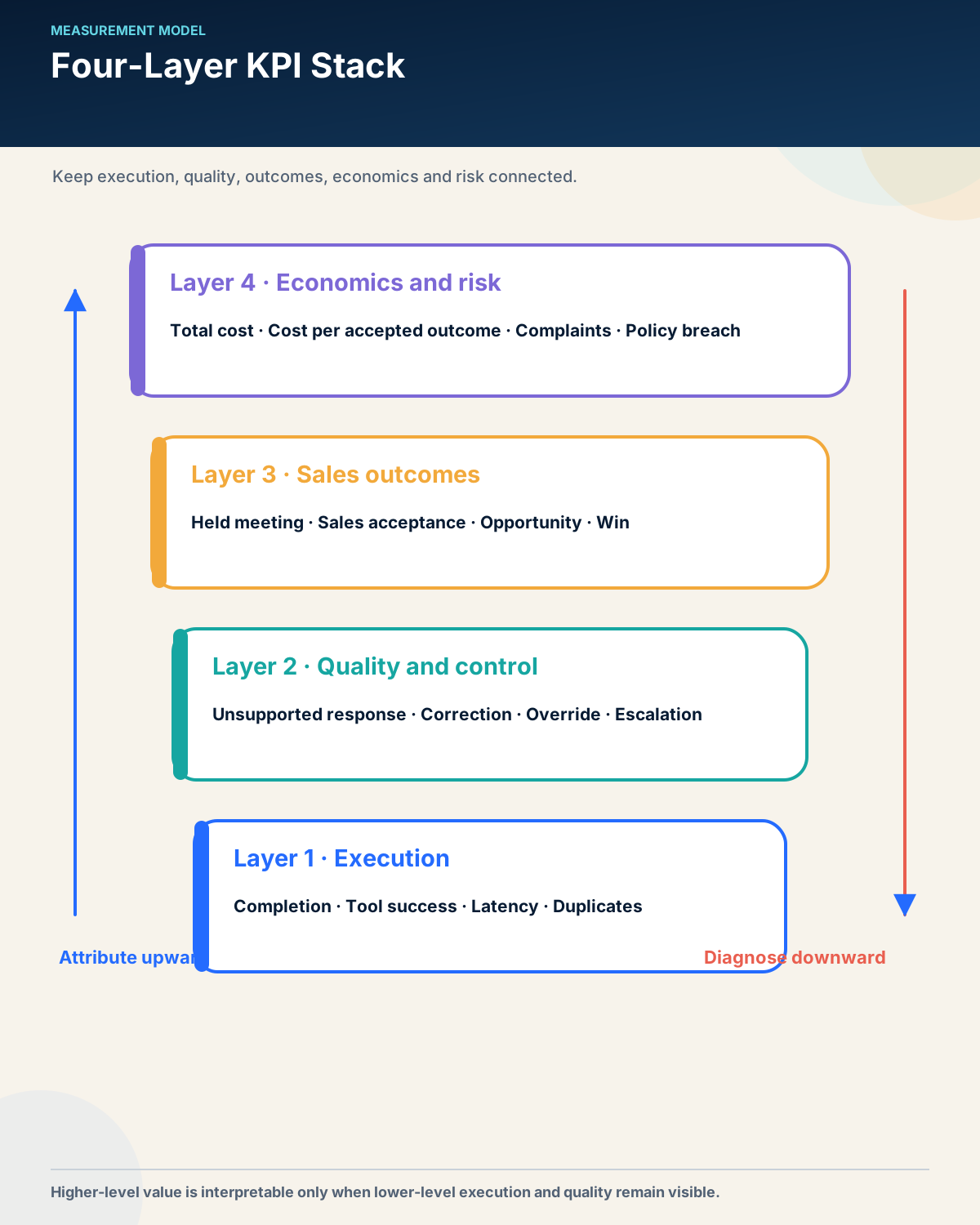
Four-layer AI sales-agent KPI stack from execution to quality, sales outcomes, economics and risk.
Higher-level value is interpretable only when lower-level execution and quality remain visible.

02 / Use a metric dictionary

Use a metric dictionary

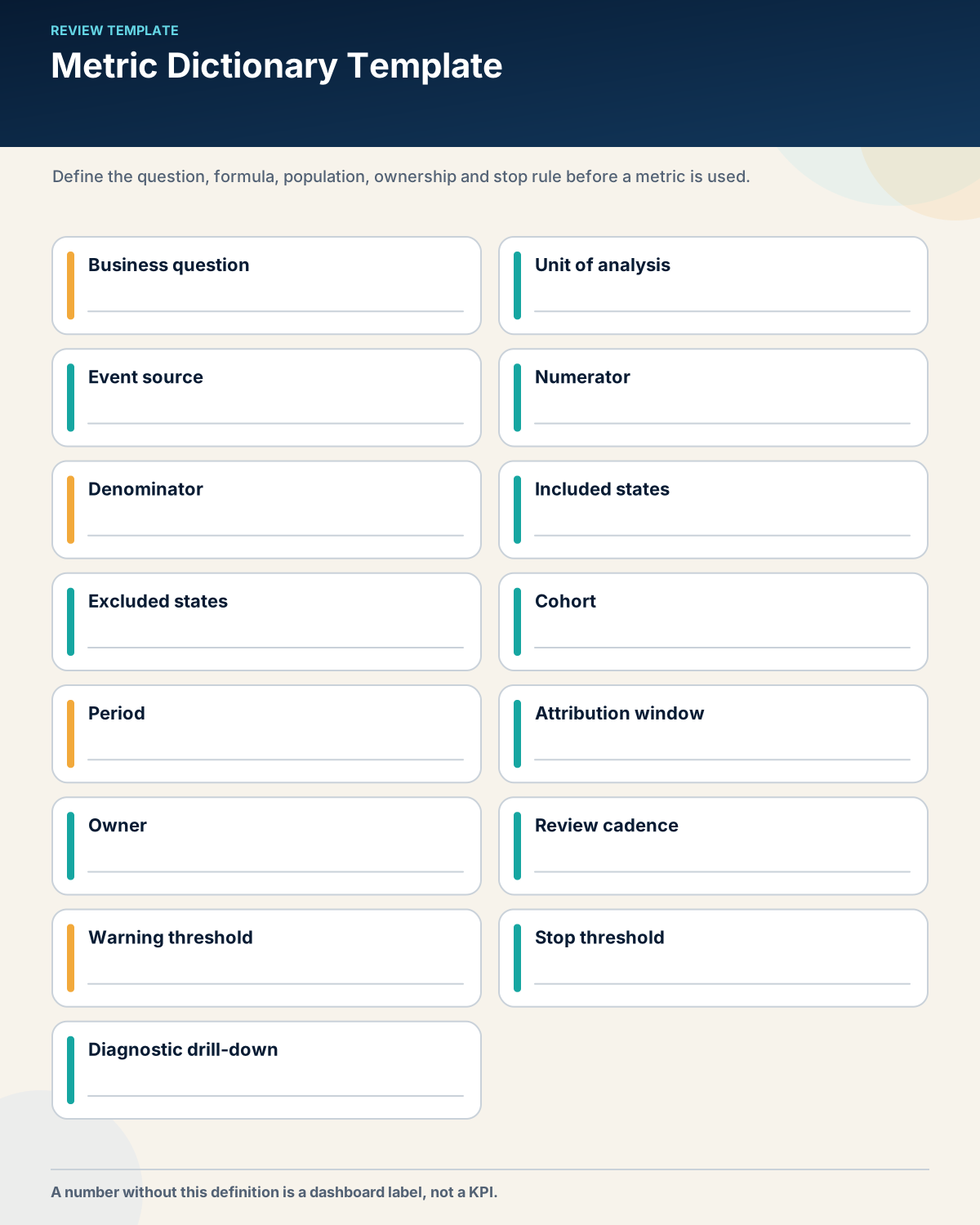
Every KPI should have the same definition fields:
FieldWhat to record
Business questionThe decision this KPI supports
Unit of analysisRun, lead, attempt, conversation, meeting, opportunity or account
Event sourceCRM, agent log, provider, calendar or human review
NumeratorExact included outcomes
DenominatorExact eligible population
Included and excluded statesCancellations, retries, tests, duplicates and missing data
Cohort and segmentSource, market, channel, owner, offer and risk tier
PeriodEvent window and reporting window
Attribution windowWhen downstream outcomes count
Owner and cadenceWho reviews it and how often
Warning and stop thresholdAction taken, not only a color
Diagnostic drill-downWhich failure categories explain movement
Use blank values until the team has a baseline and risk decision. A vendor benchmark cannot supply your denominator.
Metric dictionary template requiring numerator, denominator, cohort, period, attribution and stop rule.
A number without this definition is a dashboard label, not a KPI.

03 / Layer 1: execution and system health

Layer 1: execution and system health

Execution metrics show whether the system performed the intended technical work. They are leading indicators, not revenue outcomes.

Eligible-record processing rate

Eligible records reaching a valid terminal state ÷ all eligible records
A valid terminal state can include completed, correctly suppressed, correctly routed or human-review required. Do not count a silent failure as completion.

Successful-action rate

Confirmed external actions ÷ attempted permitted actions
Confirmation matters. An HTTP 200 is not enough if the CRM field did not change or the calendar slot was never created.

Duplicate-action rate

Duplicate external actions ÷ attempted external actions
Track duplicate emails, calls, bookings, tasks and CRM writes separately. A low overall rate can hide a serious duplicate-booking problem.

Unclassified-outcome rate

Runs without a recognized terminal disposition ÷ completed or timed-out runs
This reveals missing states and parser failures. A large other category makes every downstream rate less trustworthy.

Latency

Define the clock. For inbound speed-to-lead, use something such as:
timestamp of first valid response attempt − timestamp of eligible lead event
Report a median and a tail percentile, not only an average. For voice, distinguish end-of-user-speech to first audible response, full turn latency, tool-call wait and transfer time. Network, provider and language can change the result.
The owner uses a speed-to-lead target below 15 seconds in one operating context. That is an internal target example, not a market benchmark or proof of conversion impact.

Retry and tool-failure metrics

Track:
  • retry attempts per run;
  • exhausted retries;
  • tool timeouts;
  • partial writes;
  • provider errors;
  • validation rejects;
  • recovery time;
  • exceptions older than the service expectation.
A retry that eventually succeeds still consumed cost and may reveal instability.

04 / Layer 2: quality and human control

Layer 2: quality and human control

Quality metrics ask whether the agent's evidence, decision and output were acceptable. They require a human-reviewed sample or a trusted answer key.

Unsupported or materially incorrect response rate

Avoid the vague label hallucination rate. Define:
Reviewed responses containing at least one unsupported or materially incorrect claim ÷ all reviewed responses
The rubric must specify:
  • what counts as supported evidence;
  • whether an irrelevant but true claim is an error;
  • severity levels;
  • whether the error reached a buyer;
  • who adjudicates disagreement;
  • how the sample was selected.
Report minor and severe errors separately. A wrong adjective and an invented price should not have equal weight.

Evidence-grounding rate

Material decisions with an openable, current source record ÷ reviewed material decisions
The source must support the exact claim. A link to a homepage does not ground a statement about current pricing or technology use.

Human correction rate

Agent outputs changed before acceptance ÷ reviewed agent outputs
Tag the reason: identity, evidence, inference, tone, policy, routing, tool arguments or CRM semantics. A falling correction rate is useful only if review quality and cohort stay stable.

Override rate

Executed or recommended decisions reversed by a human ÷ decisions eligible for override
Separate immediate overrides from later reversals after a downstream result. The second group may reveal hidden quality problems.

Escalation precision

Use two metrics:
  • Correct escalations ÷ all escalations
  • Cases that required escalation but did not receive it ÷ reviewed cases requiring escalation
An agent can inflate apparent safety by escalating everything. Precision and miss rate show whether the boundary is useful.

Clean-handoff rate

Human-accepted handoffs containing all required fields ÷ all handoffs
Required fields may include identity, evidence, consent or suppression state, intent, qualification, objections, unresolved question, attempted actions, next action and owner. A transcript alone is not a complete handoff.

CRM field error rate

Incorrect, unauthorized or conflicting field writes ÷ reviewed agent-authored field writes
Break it down by field. Opportunity Stage and account owner deserve stricter treatment than an internal summary.

05 / Layer 3: sales outcomes

Layer 3: sales outcomes

Sales outcomes must follow the real funnel. Do not skip states because the product dashboard does.
Eligible lead → reached → meaningful conversation → qualified → meeting booked → meeting held → sales accepted → opportunity created → closed won
Each arrow has a different denominator.

Meaningful-conversation rate

Human-validated commercial conversations ÷ reached eligible leads
Define what makes a conversation meaningful: a relevant question, qualification exchange, accepted referral or another usable commercial state. A voicemail or generic reply may not qualify.

Qualified-conversation rate

Conversations meeting the approved qualification rule ÷ meaningful conversations
Store the evidence behind qualification. A score without the reason cannot be audited.

Meeting-booked rate

Meetings booked ÷ named eligible population
Always name the denominator: eligible leads, reached leads, meaningful conversations or qualified leads. These rates answer different questions.

Held-meeting rate

Meetings completed ÷ meetings booked
Track cancellations, reschedules and no-shows as separate dispositions. Do not treat a booking as value until the meeting occurs.

Sales-acceptance rate

Meetings accepted by sales as appropriate ÷ meetings held
This is one of the best checks against low-quality calendar volume. Define acceptance before the pilot.

Opportunity-creation rate

Opportunities meeting the CRM admission rule ÷ sales-accepted meetings
Do not let the agent create the opportunity and then use that event as independent proof of quality. Human or deterministic validation should own the rule.

Pipeline and revenue

Report:
  • qualified pipeline created by the defined cohort;
  • agent-sourced versus agent-assisted pipeline;
  • opportunities progressed within the attribution window;
  • closed-won value;
  • time to outcome.
Use assisted when humans or other channels materially contributed. A clean label is better than false causal precision.
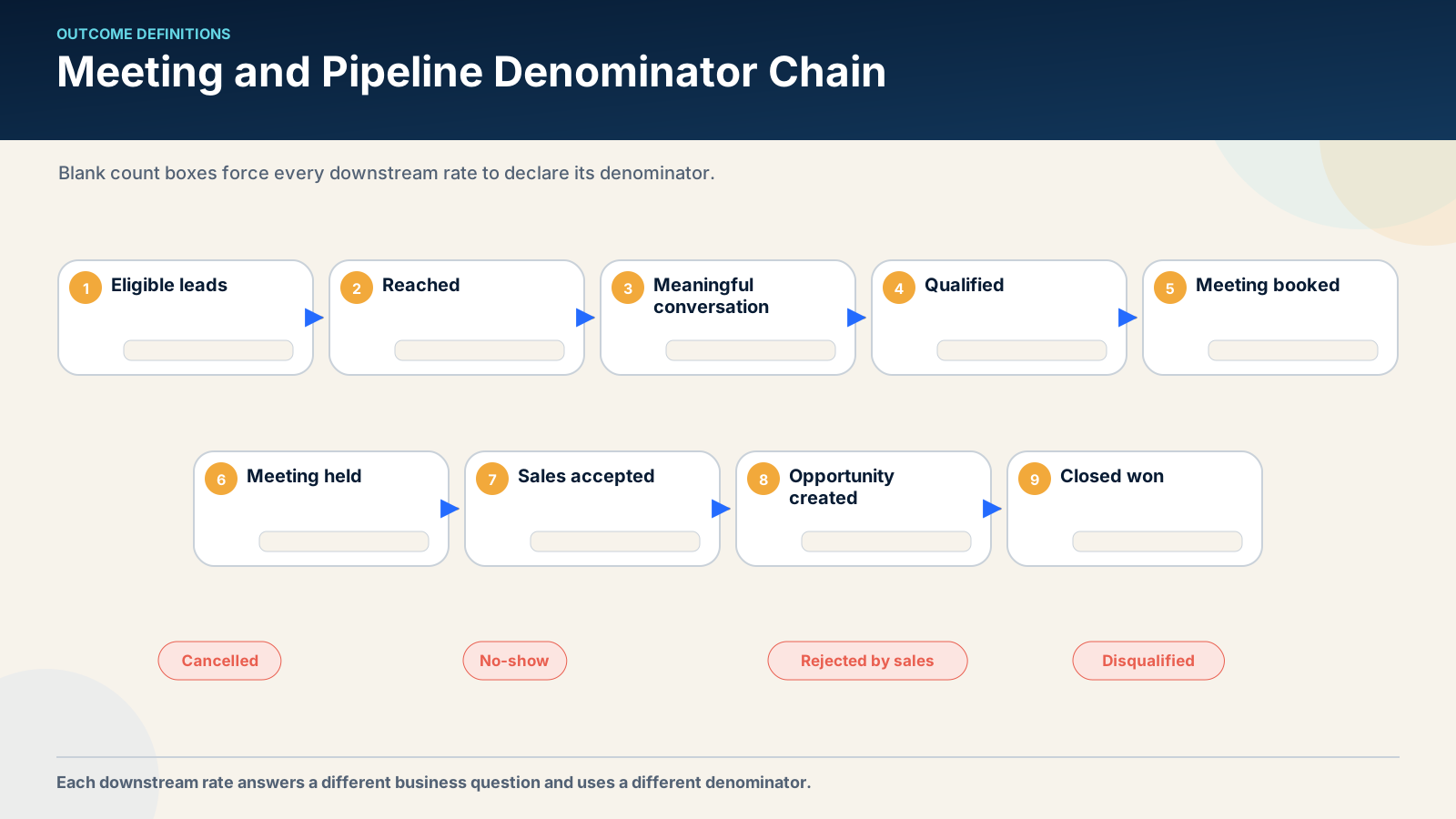
Sales outcome chain separating booked, held, accepted, opportunity and closed-won states.
Each downstream rate answers a different business question and uses a different denominator.

06 / Layer 4: economics and risk

Layer 4: economics and risk

Total operating cost

Include:
  • product subscription and usage;
  • models and providers;
  • data, enrichment and verification;
  • phone, SMS, WhatsApp, email and carrier costs;
  • integration and implementation;
  • monitoring, QA and review time;
  • human reply and exception work;
  • remediation, CRM cleanup and rollback;
  • retained human selling work;
  • exit and replacement cost.

Cost per accepted meeting

Total operating cost for the cohort ÷ sales-accepted meetings
This is not the same as cost per booked meeting.

Cost per created opportunity

Total operating cost for the cohort ÷ opportunities meeting the admission rule

Cost per qualified pipeline dollar

Total operating cost for the cohort ÷ qualified pipeline value created within the attribution rule
Use this only when opportunity values and qualification are consistent. Do not call the ratio cost per qualified pipeline without naming its unit.

Payback and attributed value

Use conservative expected gross contribution, not pipeline face value, if calculating payback. Document the win probability, margin, attribution and time window. If those assumptions are weak, report cost per accepted opportunity and wait for mature revenue data.

Risk and harm metrics

Track at least:
  • suppression breaches;
  • calls or messages outside approved scope;
  • complaints;
  • policy violations;
  • unauthorized CRM changes;
  • sensitive-data exposure;
  • unrecorded human requests;
  • failed handoffs;
  • repeat contact after a stop state;
  • remediation time.
For high-severity events, one occurrence may trigger a stop regardless of the percentage.

07 / Diagnose failures by trace stage

Diagnose failures by trace stage

Outcome metrics tell you that something failed. A failure taxonomy tells you where.
Failure familyExampleLikely owner
InputMissing consent, stale role, wrong account matchData/RevOps
EvidenceSource absent, old or irrelevantResearch/content owner
ReasoningUnsupported inference or wrong qualificationAgent/product owner
PolicyProhibited action proposed or allowedGovernance owner
ToolTimeout, invalid arguments or partial writeEngineering/integration
StateDuplicate, stale retry or cross-channel conflictOrchestration owner
HandoffMissing context, wrong queue or no fallbackSales operations
DownstreamMeeting rejected or opportunity reversedSales manager/RevOps
Pair each KPI alert with a drill-down. If held meetings fall, inspect qualification, segment, no-show, owner and handoff. Do not solve every problem by changing the prompt.
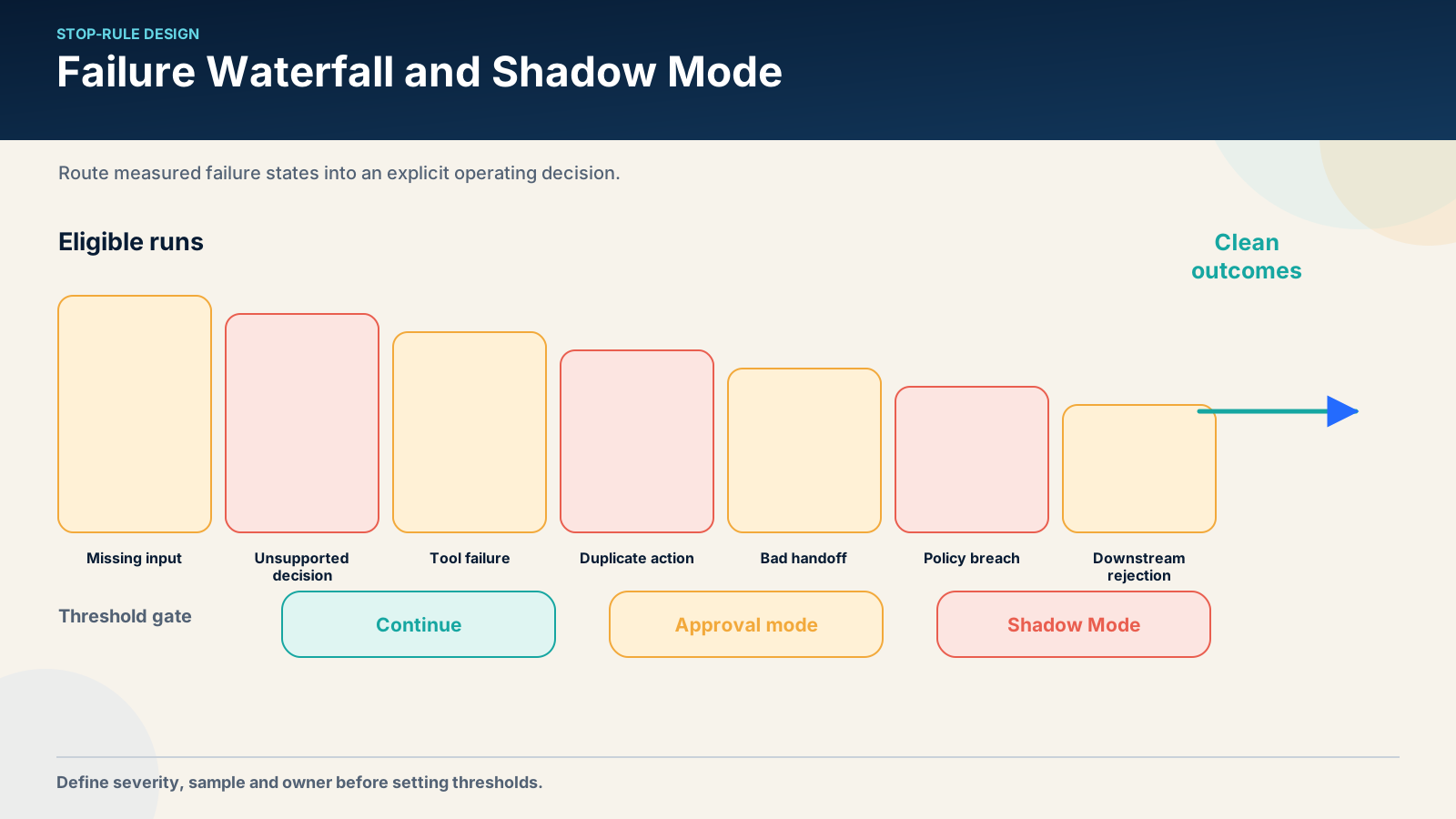
AI sales-agent failure waterfall with routes to continue, approval mode or shadow mode.
A stop rule is credible only when the failure type, sample and recovery state are defined.

08 / Design the baseline and pilot

Design the baseline and pilot

Use a baseline that matches the pilot's job, segment and period.
  1. Freeze eligibility, offer, channels, qualification and CRM rules.
  2. Choose a current sample and record exclusions.
  3. Capture the previous workflow's events with the same definitions.
  4. Run the agent in shadow or approval mode.
  5. Review a defined quality sample.
  6. Measure accepted downstream outcomes inside a fixed window.
  7. Record concurrent changes such as offer, staffing or seasonality.
  8. Promote one permission or segment at a time.
The owner supplied a 60-day before-and-after observation in which response time and demo conversion improved. It remains outside the quantitative article because the eligible counts, segment and confounding changes were not supplied. This is the correct treatment: a promising internal observation should trigger better measurement, not become a public benchmark.

09 / Segment AI sales agent KPIs before comparing

Segment AI sales agent KPIs before comparing them

An overall average can hide the part of the workflow that is failing. Segment the scorecard by factors that can change eligibility, difficulty, risk or cost:
  • lead source and trigger;
  • new versus existing account;
  • inbound, warm follow-up and outbound motion;
  • market, language and timezone;
  • channel and channel sequence;
  • offer, campaign and qualification rule;
  • owner, queue and handoff destination;
  • workflow, prompt, model and provider version;
  • risk tier and permission mode;
  • complete, missing and contradictory evidence.
Choose segments before inspecting outcomes. Post-hoc slicing can always find a favorable view. Preserve the original cohort and exclusion rules, then add diagnostic segments when a result needs explanation.
Report both count and rate. A 100% clean-handoff rate based on one transfer is not comparable to 92% across hundreds. For reviewed quality metrics, include the sample size, sampling method, reviewer and severity distribution. If the sample intentionally oversamples risky cases, do not present its raw rate as the population rate.
Watch for mix shift. Suppose the agent begins receiving more low-intent leads after a campaign change. Booked-meeting rate may fall even if the workflow improved within every source segment. The opposite can happen when the team narrows eligibility during a pilot. Show the cohort mix beside the KPI so stakeholders do not attribute a population change to the system.
Keep human and agent paths comparable. If the agent handles only easy records while people handle exceptions, a direct average comparison is biased. Report the autonomous, approval and human-only cohorts separately, including the routing rule that assigned each record.

10 / Treat attribution as a claim with evidence

Treat attribution as a claim with evidence

Agent-sourced, agent-assisted and human-sourced outcomes should have explicit rules.
An agent-sourced outcome might require that the defined workflow initiated the eligible interaction and that no earlier active human or campaign contact created the opportunity. An agent-assisted outcome might include research, drafting, qualification or scheduling where a person owned the commercial conversation. A human-sourced outcome begins outside the agent workflow even if the agent later performs an administrative task.
Document:
  • the first eligible event;
  • all material touches inside the attribution window;
  • which person or system made the consequential decision;
  • when the CRM outcome was created and accepted;
  • how reopened, merged or transferred opportunities are handled;
  • which concurrent campaigns are excluded or marked assisted.
Do not use last-touch convenience as proof of causality. A calendar booking made by the agent may reflect demand created by marketing, a prior seller relationship or a partner referral. Report the operational contribution precisely: the agent scheduled, qualified or routed the outcome. Reserve causal claims for an evaluation design that supports them.
For a pilot, a matched baseline or randomized holdout can improve inference, but only if the business can maintain comparable treatment and clean event capture. When that is not practical, use cohort comparisons with transparent limitations. Avoid multiplying pipeline by a generic win rate and labeling the result revenue.
This caution does not make financial measurement useless. It makes AI sales agent ROI more credible. Cost per accepted outcome and downstream progression can guide a decision while mature revenue develops.

11 / Run a weekly scorecard review

Run a weekly scorecard review

A dashboard does not govern the workflow by itself. Use a short, repeatable decision meeting with technical, operational and sales ownership.
Review the scorecard in this order:
  1. Safety and customer harm: suppression, complaints, severe unsupported claims, unauthorized actions and failed human requests.
  2. State integrity: missing events, duplicates, uncertain provider responses, retries and rollback.
  3. Quality sample: evidence use, qualification, correction, override and handoff completeness.
  4. Sales acceptance: held meetings, acceptance, opportunity admission and rejection reasons.
  5. Economics: full cost, review burden and cost per accepted outcome.
  6. Version and mix: workflow changes, cohort shift, incidents and external campaign changes.
For every red or amber result, record the owner, diagnosis, action, deadline and re-entry test. Possible actions include fixing data, narrowing the cohort, reverting a version, returning an action to approval mode, changing the answer key or pausing the workflow. “Monitor” is not an action unless it names the next sample and decision date.
Maintain a compact decision log:
FieldExample content
Review periodExact event and outcome windows
CohortEligibility rule and material exclusions
VersionsWorkflow, model, provider and policy
EvidenceScorecard link and reviewed case set
DecisionContinue, narrow, correct, promote or stop
OwnerAccountable person for each change
Re-entry testCases and metrics required before promotion
The log prevents the team from changing thresholds after seeing a result. It also preserves why a permission was expanded or withdrawn. That history is often more useful than a screenshot of the dashboard.
Use the implementation guide to connect these decisions to workflow versions, and the voice-agent guide for call-specific latency, transfer and language tests.

12 / Set warning, stop and re-entry rules

Set warning, stop and re-entry rules

A threshold needs an action and owner.
StateRequired definition
WarningMetric, value, sample, review owner and investigation deadline
Approval modeWhich autonomous actions revert to review
Shadow ModeWhich external actions stop while proposals continue
Full stopWhich triggers disable the workflow or channel
RollbackWhich state and version are restored
Re-entryEvidence required before live actions resume
The operator uses Shadow Mode when quality or voice latency crosses an internal limit. The specific values are not reusable until the review sample and latency boundary are defined. Teams should set their own thresholds from severity, baseline, customer harm and legal exposure.
Examples of deterministic stop events include:
  • any suppression breach;
  • duplicate external action above the allowed zero or near-zero tolerance;
  • severe unsupported price, legal or security claim;
  • unlogged CRM mutation;
  • inability to route a human request;
  • missing audit events;
  • provider incident that makes state uncertain.

13 / Reporting cadence

Reporting cadence

Use different cadences for different signals:
  • Real time: suppression, severe policy breach, duplicate action, tool outage and failed human request.
  • Daily during pilot: execution, exceptions, corrections and handoffs.
  • Weekly: quality sample, qualification, held meetings, sales acceptance, cost and failure distribution.
  • Monthly or cohort-close: opportunity creation, pipeline progression, revenue, payback and strategic review.
Keep the dashboard small. Add diagnostic detail behind each KPI rather than adding dozens of top-level numbers.

14 / Frequently asked questions

Frequently asked questions

What is the most important AI sales agent KPI?

There is no single KPI. Use a paired view: one accepted business outcome, one quality metric and one harm metric. For example, sales-accepted meetings, unsupported-response rate and suppression breaches.

Should we track messages and calls?

Yes, for capacity and diagnostics. Do not treat them as value. Connect activity to meaningful conversations, accepted meetings, opportunities and cost.

How do we measure hallucinations?

Define a reviewed sample and call the metric unsupported or materially incorrect response rate. Specify source requirements, severity, reviewer and whether the error reached a buyer.

How should voice-agent latency be measured?

Name the clock boundary, such as end of user speech to first audible agent response. Report a median and tail percentile by language, network and workflow. Separate tool waits and transfer time.

How do we calculate AI sales agent ROI?

Use total operating cost and conservative attributed contribution. If win and margin data are immature, calculate cost per sales-accepted meeting and created opportunity first.

When should we pause an AI sales agent?

Pause when a severe event occurs or a defined quality, latency, duplicate or handoff threshold is breached. The rule must specify whether the workflow returns to approval mode, Shadow Mode or full stop and who approves re-entry.

15 / Scorecard checklist

Scorecard checklist

Before presenting an AI sales agent KPI, confirm that:
  • the unit and event source are named;
  • numerator and denominator are explicit;
  • tests, retries, duplicates and missing data are handled;
  • the cohort and attribution window are fixed;
  • activity, acceptance and revenue are separate;
  • human corrections and overrides are recorded;
  • total cost includes retained human work;
  • failure categories explain movement;
  • warning and stop rules have owners;
  • quarantined or vendor numbers are not presented as benchmarks.
The goal is not a perfect dashboard. It is a measurement system that prevents activity, automation and pipeline from becoming the same word.

Research note

Methodology

  1. 01The scorecard structure applies NIST lifecycle risk management and current agent-evaluation research to sales operations.
  2. 02Every KPI is defined with a unit, event source, numerator, denominator, cohort and attribution window.
  3. 03No universal conversion, latency, cost or ROI threshold is asserted; teams must derive targets from their own baseline and severity model.
Read the full methodology

Source ledger

Sources & editorial notes

  1. 01
    NIST AI Risk Management Framework

    nist.gov · Primary, official or disclosed research source used for the bounded claim cited in this guide; scope and current status require rechecking.

Corrections or primary material: contact the corrections desk.

About the author

Anastasiia Krynytska

Anastasiia Krynytska is a LeadGen Team Lead at Softermii and the lead editor of Luck My Sales. She covers AI-assisted outbound, account research, qualification, messaging, CRM handoffs and revenue workflows from a practitioner’s perspective.View author profile LinkedIn

Continue reading

01 · News analysis

AI sales is moving from assistant to operating layer

The category is expanding from drafting support into research, pipeline decisions, recommended actions and controlled execution.

Read news
02 · Field analysis

In AI sales, the handoff may be the product

Models are becoming accessible; durable value sits in the controlled transition from signal to seller action.

Read analysis
03 · Research framework

Sales AI Workflow Signals 2026

A launch framework for mapping the products, controls and buying questions shaping AI-enabled revenue work.

Read reports

Luck My Sales briefing

Useful context, once a week.

News, explanations and original research from this desk. No noise.
The newsletter is still being built. We will contact you when the first edition is ready.