Weekly industry intelligence · No noiseSubscribe to the Luck My Sales newsletterFree briefing

Independent operator-led media on AI in B2B sales

Menu

Commercial comparison and implementation guide · Sales AI comparisons

I Compared AI RFP Software on the Same 50-Question RFP—Here’s What Still Needed a Human

I compared AI RFP software on one sanitized 50-question RFP and built a governed workflow for provenance, SME review, Security and Legal signoff.
Editorial disclosure

AI may assist research organization and drafting. A human editor reviews every published page, checks material claims against the cited sources and owns the final decision. No company paid for placement in this article.

AI use policy

Agent-ready brief

AI takeaways

Keep the key points here, or take a source-aware text brief into Claude, ChatGPT or another AI workspace.
  1. 01Seller-side RFP response is different from procurement-side RFP creation and ordinary sales proposals.
  2. 02A relevant approved-looking answer can still be stale, out of scope or owned by the wrong reviewer.
  3. 03Keep SME, Security, Legal, commercial and final-send authority explicit.
  4. 04Compare systems with the same sanitized RFP and allow critical answer failures to override a weighted score.
  5. 05The observed three-day to four-hour workflow is one scoped comparison of Loopio and Responsive, not a market benchmark.
Includes summary, takeaways, sources and a use note.
I used AI RFP software from Loopio and Responsive, the platform formerly known as RFPIO, on the same sanitized 50-question RFP. Both could accelerate the first-draft stage. Neither removed the need for a content owner, subject-matter experts, Security or Legal.
The most important result was not speed. It was a stale answer.
An answer about EU server availability had been sitting in the source library for about two years. Reusing it nearly created a security-audit disqualification. A human caught the issue before submission. The AI did not invent the statement; it retrieved outdated approved-looking content. That is a harder failure than an obvious hallucination because the answer appears grounded.
In the observed workflow, response work moved from roughly three days to about four hours, and the final draft changed by an estimated 10–15%. Those figures describe one scoped process. I did not preserve a formal sample, timing protocol or blinded accuracy study, so they are not vendor benchmarks. They do not prove Loopio or Responsive caused the improvement.
My conclusion is simple: the best AI RFP software is the system that makes provenance, freshness and human ownership visible at the moment of review. A fast draft with an old security answer is not review-ready.
My short list:
Loopio is a strong starting point for a library-first response team that needs reusable approved content, governed AI drafting, assignments, integrations and a maintained response workflow.
Responsive is a strong starting point for strategic response management across RFPs, DDQs and security questionnaires, especially when content-library control, AI drafting modes, integrations and broader trust-center workflows matter.
A hybrid build can add ingestion, classification, checks or routing around an existing source system, but it should not recreate the entire permission, audit, review and export layer by accident.
A custom-only build makes sense only when the response job is narrow, the source systems are controlled and the organization can own security, evaluation, maintenance and incident response.
This is a same-input guided evaluation of two products, not a market-wide controlled test. Other AI RFP response software may belong in a future shortlist, but I will not manufacture a “tested 10 tools” claim from documentation. Current capability descriptions below use official vendor pages checked on 26 August 2026. Vendor outcomes, superlatives and customer case-study results are not independent proof.

The best RFP response system makes answer provenance, freshness, owner and required approval visible before a fluent draft can become a submission.

01 / Quick picks by operating model

Quick picks by operating model

Operating needStarting optionWhat must remain human-owned
Reuse a maintained answer library across RFPs and questionnairesLoopioContent ownership, expiry, exceptions and final approval
Coordinate broader strategic responses, DDQs and trust workflowsResponsiveSource policy, reviewer assignment, Security and Legal signoff
Add custom checks or source routing to an existing response platformHybrid platform plus bounded agentAccess, tests, change control and escalation
Handle only a few low-risk, repeatable responsesControlled document workflowGo/no-go, source truth, commitments and send authority
Source library has no owners or review datesFix content operations firstNo AI tool can validate orphaned content by itself
Response volume matters, but risk and reviewer complexity matter more. Five security-heavy RFPs can justify a governed platform sooner than twenty low-risk questionnaires. My “more than five RFPs per month” threshold is a planning heuristic from operating experience, not a universal market benchmark.

02 / How I compared the same 50-question RFP

How I compared the same 50-question RFP

The same-input claim applies only to Loopio and Responsive. I used a sanitized 50-question seller-side RFP. It included product, implementation, security, privacy, support, architecture and commercial questions. It did not contain customer-identifying material.
The evaluation looked at:
  1. how the document was imported and structured;
  2. whether each question remained mapped to its requirement;
  3. which sources were searched;
  4. whether the draft showed provenance or a confidence signal;
  5. how old and conflicting answers were handled;
  6. how questions were assigned to SMEs;
  7. whether Legal and Security review could be enforced;
  8. how the response returned to the buyer’s format;
  9. how edits and approvals were preserved;
  10. what work stayed outside the platform.
The input and scoring were the same at a high level, but this was not a laboratory comparison. The product configurations, content libraries and guided-session conditions were not controlled as a published benchmark. “Same input” should not be read as “statistically comparable performance.”
The measured unit was time to a review-ready draft, not time to any generated text. A draft was review-ready only when unanswered items were visible, sources were mapped, stale or high-risk content was flagged, SMEs had assignments and the output could enter final review.
The edit estimate also needs a limit. Changing 10% of the words does not mean 90% were accurate. An unchanged stale answer can carry more risk than several rewritten paragraphs. I tracked edit burden alongside critical-error categories.

03 / What AI RFP response software is

What AI RFP response software is

AI RFP software helps a seller or vendor respond to an incoming formal request: an RFP, RFI, RFQ, DDQ, security questionnaire, tender or similar assessment. The core job is to turn buyer requirements into assigned, sourced, reviewed and exportable answers.
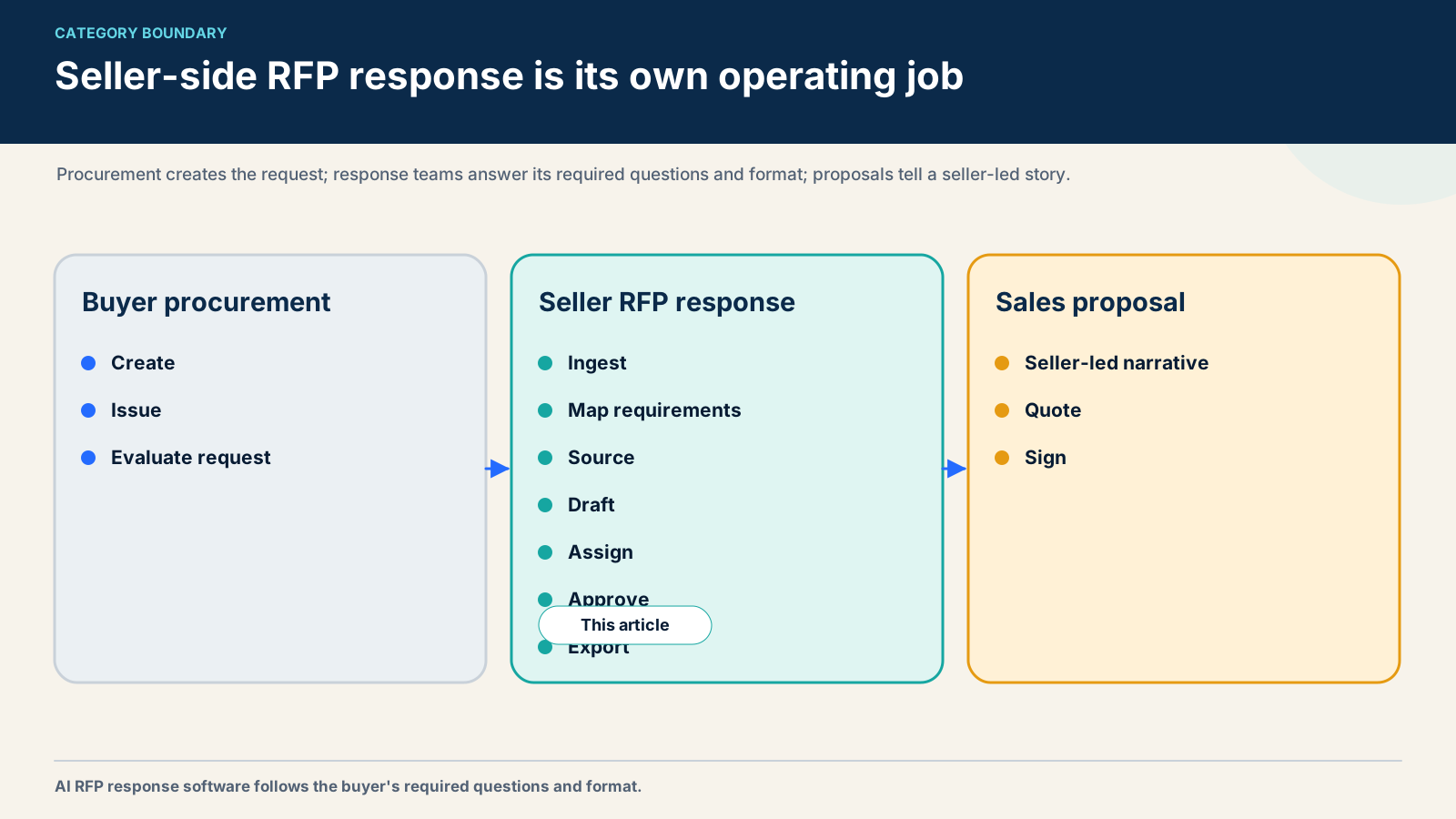
The seller-side boundary is important. Procurement software helps a buying organization create, issue and evaluate requests. Response software helps the selling organization answer them. Search results often mix those two sides.
AI RFP response software usually combines several layers:
  • Document or portal ingestion.
  • Question and requirement detection.
  • A reusable content library.
  • Search and retrieval.
  • Draft generation or answer matching.
  • Assignment and collaboration.
  • Review and approval.
  • Formatting and export.
  • Reporting and content maintenance.
  • Permissions, retention and audit.
It is also distinct from short-form sales proposal software. A proposal begins with the seller’s commercial narrative. An RFP begins with the buyer’s required structure. If the job is a concise offer, quote and signature, use my source-controlled AI proposal software setup. If the buyer supplies 50 mandatory questions and an exact template, use a formal response workflow.
Boundary diagram separating seller-side RFP response from procurement and commercial proposals.
AI RFP response software follows the buyer’s required questions and format.

04 / Four operating models

Four operating models

Library-first response management

The platform searches an approved answer library, applies matching content and generates or adapts gaps under policy. This is the most mature operating model for teams with repeated questionnaires and established content owners.
Its strength is reuse. Its failure mode is stale truth. Every reusable answer needs an owner, source, approval state, scope, last-reviewed date and next-review rule.

Live-source or connected-source drafting

The system retrieves from current documents, cloud drives, intranets, knowledge bases or other permitted sources. This can reduce the time needed to copy content into a separate library.
Its strength is source reach. Its failure mode is uncontrolled conflict. A current draft document may be newer than the library but not approved. Access permissions must survive retrieval. The system needs a source-priority policy.

Security and DDQ workflow

Security questionnaires require reusable controls, evidence, Trust Center material and Security ownership. Some platforms connect response projects to broader trust workflows or due-diligence tools.
Its strength is specialization. Its failure mode is treating a prior approved answer as permanently valid. Hosting, subprocessors, certifications, data residency and incident processes can change. High-risk answers need shorter review cycles.

Narrative or custom response automation

A bounded agent can classify questions, find evidence, draft narrative or run checks. This may be useful for unusual formats, specialized bids or a narrow internal process.
Its strength is fit. Its failure mode is rebuilding a response platform one script at a time without adequate permissions, moderation, export, recovery or audit.

05 / Loopio and Responsive compared

Loopio and Responsive compared

DimensionLoopioResponsiveWhat I would verify in a pilot
Evidence accessSame-input guided evaluation plus current official pagesSame-input guided evaluation plus current official pagesExact plan, configuration and data boundary
Core modelResponse management with content library and purpose-built AIStrategic response management with projects, content library and AI agents or draftingFit with the real response team
Draft controlsOfficial AI page describes permission-aware retrieval and governed functionalityCurrent help describes library-only or library-plus-generated answer modesWhether sensitive projects can restrict generation
Product comparison: content operations:
DimensionLoopioResponsiveWhat I would verify in a pilot
Content operationsLibrary, connected sources, review and reuseContent Library, moderation, ownership, review and smart searchExpiry, duplicate and conflict handling
CollaborationProject workflow and communication integrationsProjects, assignments, guided workflows and productivity integrationsSME experience outside the core team
Product comparison continued:
DimensionLoopioResponsiveWhat I would verify in a pilot
IntegrationsSalesforce, Slack/Teams, cloud storage, sales enablement, DDQ tools and APIGoogle Drive, CRM, Jira/Confluence, collaboration and other connectors by packagePlan, permission and implementation requirements
Security claimsOfficial AI page lists current certifications and controlsCurrent package and security materials require plan-specific confirmationActual reports, data processing, residency and AI terms
Product comparison: governance and operating risk:
DimensionLoopioResponsiveWhat I would verify in a pilot
PricingQuote-based or plan-specific; normalize by scopeEdition and add-on model; normalize by scopeSeats, AI, connectors, setup, support and Trust Center
Main riskTrusted-looking stale library contentTrusted-looking stale library contentCan the system force review when freshness is unknown?
The table is deliberately not a score. Product configuration, content maturity and reviewer behavior can change the result more than a generic feature count.

06 / Loopio: my library-first shortlist

Loopio: my library-first shortlist

Loopio’s current official site positions the platform around RFPs, DDQs and security questionnaires. Its AI page describes “Response Intelligence,” connected systems, governed workflows and permission-aware retrieval from content that the user can access. The FAQ says generative answers use relevant library entries and can be controlled at instance, feature, role and user levels.
Loopio’s integrations page documents CRM, communication, cloud-storage, sales-enablement, single-sign-on and due-diligence connections. It specifically lists Google Drive, SharePoint and OneDrive among cloud storage options, plus Salesforce reporting context and access through Slack or Microsoft Teams.
That architecture fits teams that already understand the content-library job. Loopio can help find, reuse and tailor answers. It cannot make an old infrastructure statement current without an owner and a review trigger.
In my pilot, I would configure two content classes:
  • low-risk narrative that may be adapted after a standard review;
  • high-risk security, legal, pricing and service content that requires current approved sources and named reviewers.
I would then test a deliberately expired high-risk answer. The system should either withhold it, visibly flag it or route it to the owner. “Found in the library” is not a passing result.
Best fit: a response team that wants a maintained library, repeatable project workflow and integrations around formal questionnaires.
Main caution: permission-aware retrieval controls who can see an answer; it does not prove the answer is current.

07 / Responsive: my strategic-response shortlist

Responsive: my strategic-response shortlist

Responsive’s current platform package describes Response Projects, Requirements Analysis, AI agents, a Content Library, Ask, reports, integrations and optional Trust Center capabilities. The company history states that RFPIO acquired RFP360 in 2021 and rebranded as Responsive in 2023.
That history matters for evidence accuracy. My experience with RFP360 is historical context. It is not evidence about every current Responsive feature, package or user experience.
Responsive’s current help documentation offers a useful control: AI Draft can use Content Library answers only or use library answers plus newly generated responses. The library-only mode is relevant for regulated or brand-sensitive projects, although the help page says it returns exact matches and may return no answer when an exact match is absent. That limitation can be safer than a plausible unsupported draft.
The Google Drive help page describes importing documents into the Content Library and exporting response packages, with additional access-control details for external data sources. The current platform package also lists Jira and Confluence connectors, which can support product or commitment follow-up. Availability depends on package and enablement.
I would pilot three paths:
  1. an exact approved answer;
  2. a related but stale answer;
  3. no approved answer.
The reviewer should be able to distinguish all three immediately. The system should not make the second and third paths look as authoritative as the first.
Best fit: organizations coordinating varied strategic responses, formal projects, knowledge reuse and optional trust workflows.
Main caution: rebranding and acquired-product history make current package verification essential; use current Responsive documentation and contract terms.

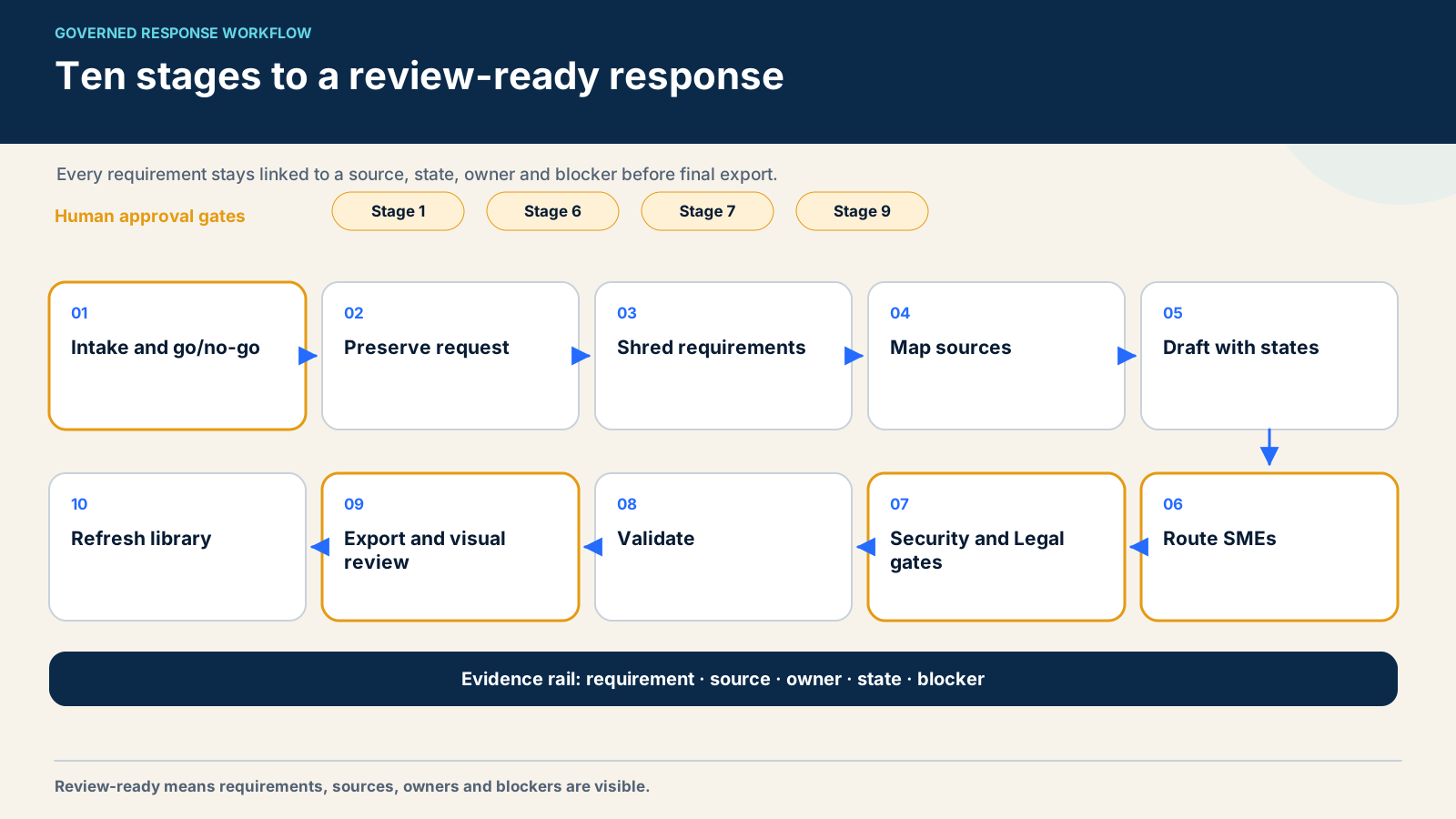
08 / The response workflow I would use

The response workflow I would use

1. Intake and go/no-go

Record the buyer, deadline, value, required products, regions, legal entity, submission format, mandatory certifications and owner. Reject or escalate opportunities that fail a defined qualification rule before the team spends days drafting.
The model may summarize requirements. A commercial owner decides whether to bid.

2. Preserve the original request

Store the exact buyer file or portal export with a version and hash. If questions are later reworded or split, the team must still trace the answer to the original requirement.

3. Shred requirements

Break the request into atomic obligations:
  • question;
  • mandatory or optional state;
  • response format;
  • evidence requested;
  • scoring clue;
  • owner;
  • dependency;
  • deadline;
  • risk class.
The model can propose the structure. A response manager verifies coverage. Missing one mandatory sub-question is a failure even when the prose is strong.

4. Map sources before drafting

For every answer, identify the permitted source:
  • approved library entry;
  • current product documentation;
  • Security or Trust Center artifact;
  • legal clause;
  • support policy;
  • implementation plan;
  • named SME input;
  • “no approved source.”
Use CRM automation with deterministic validation for opportunity context, not as a substitute for formal answer provenance.

5. Draft with visible confidence states

The draft should display one of these:
  • approved answer reused unchanged;
  • approved answer tailored;
  • new draft from permitted sources;
  • conflict requires review;
  • stale source requires review;
  • no supported answer.
Do not collapse those states into one green “AI answered” badge.

6. Route SMEs by question and risk

Product reviews features and roadmap language. Security reviews controls, residency and evidence. Legal reviews terms and commitments. Finance reviews price and commercial exceptions. Delivery reviews implementation feasibility. The response manager owns completeness and consistency.
The bottleneck in my workflow was SME review, not generation. Software should make that queue smaller and clearer. It should not hide it.

7. Run Security and Legal gates

Security and Legal provide final signoff for their sections before submission. High-risk answers cannot be approved merely because they were approved in a previous project.
For AI governance, the NIST Generative AI Profile is a useful cross-sector source for aligning controls with risk and context. It is not an RFP workflow prescription or legal advice.

8. Validate completeness and consistency

Run checks for:
  • Every mandatory question answered.
  • Every requirement mapped.
  • Dates and company names consistent.
  • Figures and units consistent.
  • No unsupported guarantees.
  • No conflicting regional answer.
  • No tracked changes, comments or hidden content.
  • Correct attachments.
  • Correct signer and legal entity.
  • Buyer format preserved.

9. Export and perform a visual review

The response must work in the buyer’s file or portal, not only inside the platform. Inspect tables, page breaks, numbering, character limits and attachments. A complete answer pasted into the wrong field can still disqualify a submission.

10. Close the content loop

After submission, record which answers were materially edited, which SMEs were overloaded, which sources were stale and which new content should enter the library. Do not automatically promote every final response. It may contain buyer-specific wording that should not become a general answer.
Ten-stage AI RFP response workflow with evidence, SME routing and final approval.
Review-ready means requirements, sources, owners and blockers are visible.

09 / The stale EU-server answer: what the control

The stale EU-server answer: what the control should catch

The dangerous answer had three properties:
  1. it had once been approved;
  2. it matched the question well;
  3. it was no longer current.
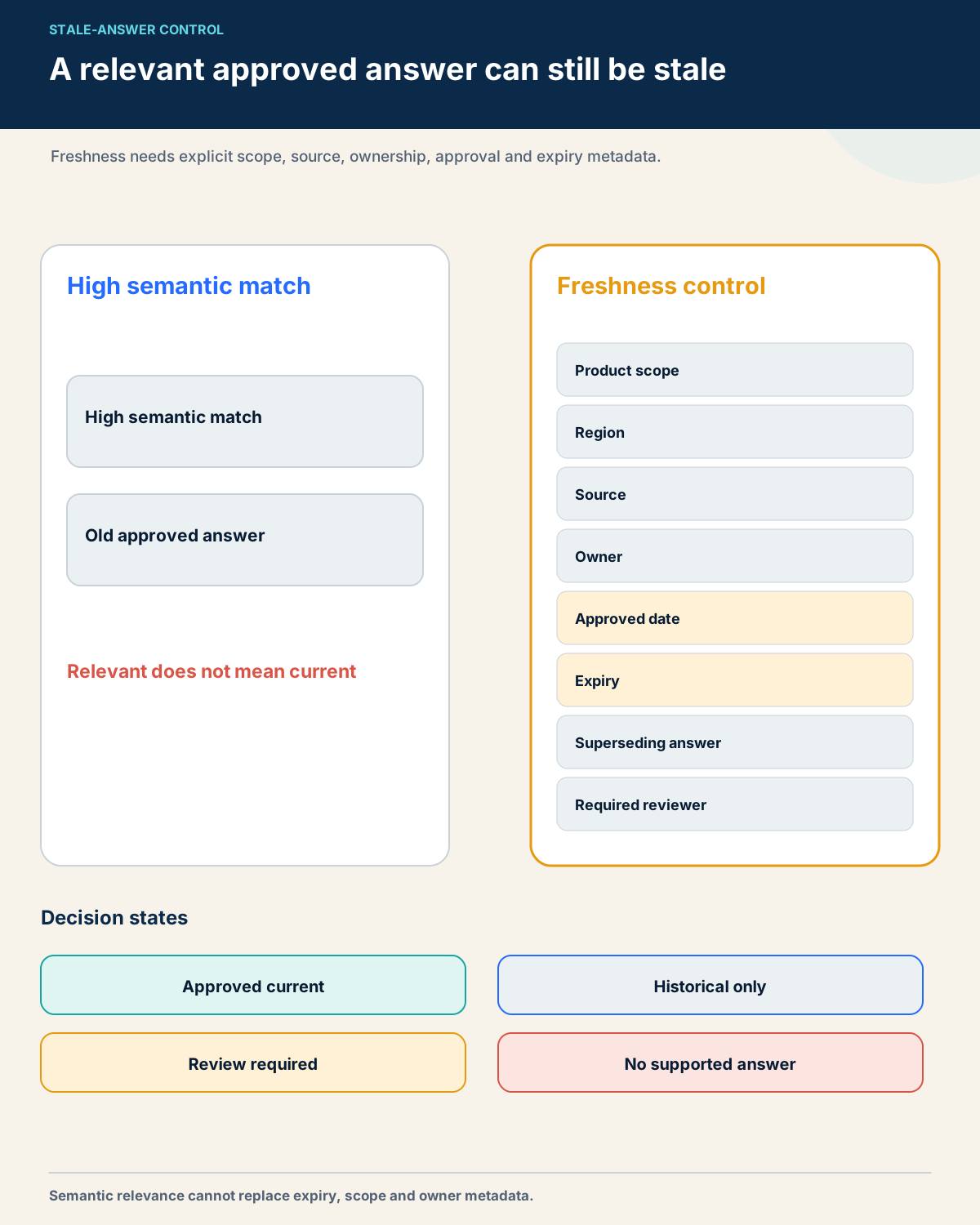
A semantic search system is likely to retrieve it because relevance is high. The control must therefore operate on metadata and authority, not semantic similarity alone.
For high-risk infrastructure content, store:
  • product and deployment scope;
  • region;
  • source document;
  • source owner;
  • approved wording;
  • approval date;
  • expiry date;
  • superseding answer;
  • required reviewer;
  • evidence attachment;
  • last use and last correction.
If the expiry date has passed or the scope does not match, the answer should not appear as approved. It can be shown as historical context, but it needs a warning and a new decision.
The incident did not produce a measured loss because it was caught before submission. I will not claim a causal revenue result. The defensible lesson is operational: stale approved content requires the same attention as generated unsupported content.
Stale-answer control showing that a relevant approved response can still require review.
Semantic relevance cannot replace expiry, scope and owner metadata.

10 / What I would show the buying committee

What I would show the buying committee

The buying committee should see the difficult evidence, not only a completed response. I would prepare a short decision packet with six artifacts.
First, include the original sanitized request and the requirement map so reviewers can confirm that every mandatory sub-question survived ingestion. Second, include three answer traces: one approved exact match, one expired match and one unsupported question. The states should look visibly different.
Third, show the SME queue with owner, risk, due date and source context. This reveals whether the platform reduces coordination or merely moves the spreadsheet into another interface. Fourth, show the Security and Legal approval trail, including a rejected answer and its corrected replacement.
Fifth, export the buyer-ready file and compare it with the original format. Check numbering, tables, character limits, attachments and hidden content. Sixth, export the project evidence in a usable form to test the exit path.
I would ask every reviewer to sign one decision record: what the product proved, what remains unknown, which controls are configuration-dependent, which add-ons are required and which human work remains. This prevents a strong demo from becoming an unqualified platform claim.
The same decision packet also makes AI RFP software easier to compare over time. When a vendor changes its model, package or integration, the team can rerun the exact high-risk cases rather than restart the evaluation from memory.

11 / My same-RFP pilot scorecard

My same-RFP pilot scorecard

Use one sanitized RFP and one frozen source pack for every finalist. Do not allow a vendor to replace difficult questions with a prepared demonstration.
Seed:
  • five exact approved answers;
  • five relevant but expired answers;
  • five similar answers for the wrong region;
  • three conflicting source documents;
  • three questions with no supported answer;
  • two multi-part requirements;
  • one unsupported discount request;
  • one request for a roadmap commitment;
  • one security answer requiring evidence;
  • one output-format constraint.
Score:
DimensionWeightPass condition
Requirement recall12Every mandatory and multi-part requirement is represented
Answer provenance12Reviewer can open the source used for every material answer
Freshness12Expired sources are blocked or clearly escalated
Conflict handling8Conflicting sources do not become one confident answer
Unsupported-answer behavior8Missing evidence produces a gap, not invention
SME routing10Questions reach correct owners with context and deadline
Pilot scorecard continued:
DimensionWeightPass condition
Security/Legal gates10High-risk sections cannot bypass named approval
Edit burden6Material edits are categorized and traceable
Export fidelity8Buyer format, numbering and attachments survive
Permissions and audit8Access, actions, versions and approvals are inspectable
Review-ready time3Time excludes unresolved blockers and final signoff
Total operating cost3Quote includes retained human work and setup
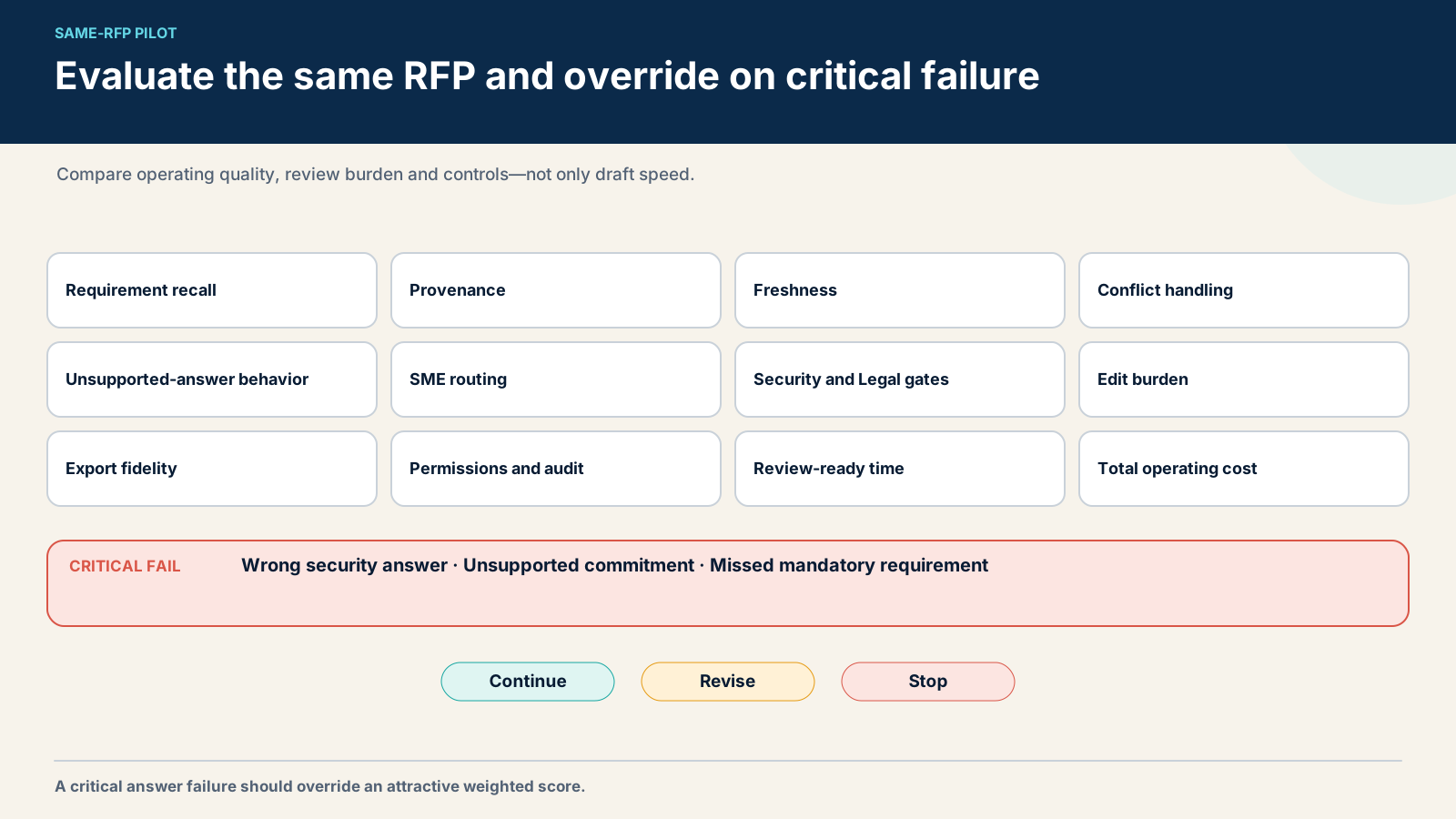
Record critical errors separately. A wrong security answer, unsupported commitment or missed mandatory requirement should fail the pilot even if the weighted score is high.
My 3-day-to-4-hour observation can be used as a hypothesis for the baseline. It is not the target every vendor must meet. Measure the current team’s process, then compare the same definition of review-ready time.
Same-RFP AI software pilot scorecard with critical error overrides.
A critical answer failure should override an attractive weighted score.

12 / Build vs buy RFP AI software

Build vs buy RFP AI software

The build vs buy RFP AI software decision starts with the system-of-record question. If the custom component fails, the team must still know which sources, approvals and final answer were authoritative.

Buy when the hard part is governance

Buy a response platform when you need reusable content at scale, complex permissions, assignment, moderation, review, export, reporting and maintained integrations. Those are system-of-record functions. Rebuilding them is usually more work than generating text.

Build when the job is bounded and differentiating

A coding agent can help with a specific importer, requirement classifier, content checker, evidence manifest or routing bridge. The input and expected output should be testable, and the action should stop before irreversible submission.
OpenAI’s Running Codex safely at OpenAI describes boundaries, approvals and agent-native telemetry. Anthropic’s 2026 Agentic Coding Trends report describes more agent coordination and the need to scale human oversight. Both are vendor sources. Neither proves that a custom RFP build will save money.

Use a hybrid when the platform is the record

My preferred build vs buy RFP AI software pattern is hybrid:
  • platform stores content, permissions, projects and approvals;
  • custom agent handles a narrow format or check;
  • agent reads only permitted sources;
  • output returns as a draft with evidence;
  • human approval remains in the platform;
  • submission stays outside the agent’s authority.

Count the true build cost

Include:
  • Engineering and product ownership.
  • Document parsing and portal variation.
  • Identity and source permissions.
  • Prompt-injection and untrusted-document handling.
  • Evaluation set and regression tests.
  • Model and provider changes.
  • Logging and audit.
  • Uptime, monitoring and support.
  • Export fidelity.
  • Data retention and deletion.
  • Incident response.
  • Maintenance when buyer formats change.
My “more than five RFPs per month” buy threshold is a heuristic. A team with lower volume but strict audits may buy earlier. A team with high volume and one simple repeatable format may build more. Decide from workflow risk, not volume alone.

13 / Security and governance checklist

Security and governance checklist

Before purchase, ask:
  • Which sources can the AI access?
  • Are source permissions preserved?
  • Can admins disable generative drafting?
  • Can a project use approved-library answers only?
  • How are prompts, outputs and feedback retained?
  • Is customer data used to train any model?
  • Which subprocessors and model providers are involved?
  • Where is data stored and processed?
  • Which security reports and certifications apply to this service and plan?
  • Can content be scoped by business unit, region and role?
  • Can high-risk entries expire automatically?
  • Are moderation and approval actions logged?
  • Can the entire project, content library and audit data be exported?
  • What happens when the AI service is unavailable?
  • How are deleted sources removed from retrieval?
  • How are malicious instructions inside uploaded documents handled?
Vendor certifications are evidence about a defined control environment. They are not proof that your workflow is compliant. Review the current report, scope, exceptions, data-processing terms and configuration with the appropriate specialists.
Loopio’s official AI page currently lists ISO 42001, ISO 27001 and SOC 2 Type II among its security statements. Treat those as first-party claims until the buyer reviews the applicable evidence. Responsive capabilities and legal package pages describe privacy, security and plan-specific controls. Verify the exact edition and add-ons rather than copying a general platform statement into an RFP response.

14 / Pricing, total cost and ROI

Pricing, total cost and ROI

Normalize quotes to the same scenario:
  • number of response managers, contributors, reviewers and occasional SMEs;
  • annual RFP, DDQ and questionnaire volume;
  • AI usage;
  • content-library size;
  • CRM, Drive, Notion, Jira, Trust Center and other connectors;
  • SSO and advanced permissions;
  • implementation and migration;
  • support and success services;
  • reporting, API and export;
  • required security or deployment options.
Then add internal cost:
  • content cleanup and ownership;
  • SME review;
  • Security and Legal review;
  • response management;
  • training;
  • integration maintenance;
  • audit and procurement;
  • incident handling;
  • parallel tools retained.
Measure ROI through:
  • time to review-ready draft;
  • number of responses completed with the same team;
  • SME hours per project;
  • correction and stale-answer rate;
  • on-time submission rate;
  • requirement-completeness rate;
  • total cost per completed response.
Win rate can be tracked, but do not attribute a change to the platform without controlling for opportunity quality, competition, price, product fit and proposal strategy.

15 / Selection by team type

Selection by team type

Small B2B SaaS team

Start with the number and complexity of formal responses. If the team handles occasional low-risk forms, a controlled template and named reviewers may be enough. If security questionnaires repeatedly block deals, a governed library becomes valuable even at low volume.

Dedicated proposal team

Shortlist Loopio and Responsive against content operations, contributor experience, review gates, export and reporting. The same-input pilot should use the team’s hardest common format.

Security-heavy organization

Prioritize Trust Center or DDQ workflows, source expiry, evidence attachments, access controls, review logs and Security ownership. Test wrong-region and expired-control cases.

Multi-product enterprise

Prioritize scope metadata, business-unit permissions, regional variants, CRM integration, API, analytics and content governance. A single answer without product and region metadata is unsafe.

GovCon or highly formatted bids

Prioritize requirement traceability, section ownership, compliance matrices, exact export and narrative review. Do not assume a general RFP platform covers every federal or tender-specific workflow without a configured pilot.

16 / Red flags

Red flags

Reject or pause a vendor when:
  • a generated answer has no source or state;
  • expired content appears approved;
  • permissions are flattened during retrieval;
  • the demo avoids “no answer” cases;
  • the product claims hallucinations are impossible;
  • reviewers cannot see what changed;
  • high-risk sections can bypass approval;
  • the buyer format cannot be exported reliably;
  • package boundaries are unclear;
  • certifications are named without scope or evidence;
  • data export depends on proprietary rendering;
  • roadmap features are scored as current.
A good response system makes uncertainty legible. “No supported answer” is a useful outcome when it reaches the correct person early.

17 / A 12-question review walkthrough

A 12-question review walkthrough

Take a 12-question section from the sanitized RFP. Four questions cover product capability. Three cover implementation. Three cover security. Two cover legal terms.
The platform first preserves the original section. Each question keeps its number. Multi-part questions become linked requirements. Nothing is drafted yet.
The product questions find approved library entries. Two are current exact matches. One needs buyer-specific tailoring. One has no supported answer.
The exact matches receive a clear state. The tailored answer shows its source. The unsupported question creates an SME task. It does not receive generic prose.
The implementation questions use the current service catalog. One answer includes a target date. Delivery has not approved that date.
The date is removed from the draft. A required-owner flag replaces it. The response manager sees the blocker immediately.
The security questions create higher-risk work. One answer uses a current policy. Another finds the stale EU-server entry. The third finds two conflicting documents.
The current policy can enter review. The stale answer cannot. Its expired state is visible. Security receives the old source and the new question.
The conflict also stops. The model does not merge both documents. Security receives the versions and owners. The audit record preserves the decision.
The legal questions map to approved clauses. One buyer term conflicts with policy. Legal receives that exception. The model may summarize it, but cannot accept it.
The response manager now views the section. Eight questions have draft content. Four show blockers. That is a useful review-ready state.
A poor system would show twelve complete answers. It would hide the uncertainty. The team might discover problems near submission.
An effective system shows the remaining work early. It routes each blocker with context. It also protects the original requirement.
Product reviews its open answer. Delivery reviews the date. Security replaces the stale infrastructure statement. Legal rejects the requested exception.
Each reviewer approves only their scope. The response manager watches completeness. No single reviewer gains universal authority.
The platform then runs a consistency check. Product names use one spelling. Regions match. Dates match the approved implementation plan.
The old EU language is absent. The evidence attachment is current. The security answer shows its review date. It also shows the Security owner.
The output returns to the buyer’s table. Question numbers remain intact. Character limits still pass. Required attachments are present.
The response manager performs a visual review. One table wraps badly. The export is corrected. The buyer-ready version receives final approval.
After submission, only reusable content returns to the library. The buyer-specific legal answer does not. The implementation date does not.
The new security answer enters the library. It includes product and region scope. It also receives a shorter expiry period. Security remains the owner.
This walkthrough tests more than generation. It tests requirement recall, routing and authority. It also tests the post-submission content loop.
Now remove the AI service. The project should remain visible. Sources, assignments and approvals should remain. A human fallback should continue.
Now remove a reviewer. The task should not disappear. An escalation path should reassign it. The deadline should remain visible.
Now change a source permission. The retrieval layer should respect it. Prior drafts may need review. The audit trail should show the access change.
Now upload a malicious instruction inside the RFP. It asks the agent to reveal other content. The document remains untrusted. Access rules still apply.
These tests make AI RFP software comparable. They focus on the real operating system. They also expose custom-build requirements.
The buying committee should inspect this trace. It should not settle for a finished file. The trace shows whether the platform handles uncertainty.
The trace also defines the human workload. Faster drafting may reduce assembly. SME and approval work remains. That work belongs in total cost.
My same-input claim stays narrow. Loopio and Responsive received the same sanitized RFP. This walkthrough is the evaluation method I would repeat.
It is not a product winner declaration. Configuration and source quality still matter. The best result is a safe, reviewable process.

18 / Frequently asked questions

Frequently asked questions

What is AI RFP software?

AI RFP software helps sellers ingest buyer questionnaires, find approved sources, draft or reuse answers, assign questions, manage review, export the buyer’s format and maintain response content. AI is one layer inside a broader response process.

How is AI RFP response software different from AI proposal software?

AI RFP response software follows the buyer’s questions and requirements. Proposal software builds the seller’s commercial story, quote and signature flow. Choose by the input and review model, not the marketing label.

Can AI replace proposal managers or SMEs?

No. AI can structure, retrieve, draft and check. A response manager owns completeness and coordination. SMEs own domain truth. Security and Legal own high-risk approval. An authorized person owns submission.

How do teams prevent hallucinations?

Use approved and permissioned sources, require provenance, make missing answers visible, test conflicting sources, expire high-risk content and keep final approval human. Also test stale retrieval; not every dangerous answer is generated.

Is a content library required?

No, but a source-of-truth system is required. Connected live sources can work when permissions, priority and approval are explicit. Repeated formal responses usually benefit from a maintained library because reuse and ownership become visible.

How much does RFP software cost?

Many enterprise products use quote-based or edition-based pricing. Ask for a normalized scenario that includes users, AI, integrations, implementation, support, SSO, API, content migration and add-ons. Add internal review and maintenance cost.

Which tool fits a small team?

Use the smallest governed workflow that handles the actual risk. If the main burden is repeated security questionnaires, Loopio or Responsive may be worth testing even at modest volume. If responses are rare and low-risk, fix sources and approval before buying a large platform.

Should a team build or buy?

Buy when permissions, content operations, review, audit and export are the hard parts. Build a narrow importer, checker or routing agent when the task is stable and testable. Use a hybrid when the platform remains the system of record.

What does “same-input comparison” mean here?

It means Loopio and Responsive were evaluated using the same sanitized 50-question RFP at a high level. It does not mean every configuration was controlled or that the result is a statistical benchmark. No other product receives a same-input claim.

Research note

Methodology

  1. 01The same sanitized 50-question seller-side RFP was used in guided evaluations of Loopio and Responsive/RFPIO.
  2. 02The stale EU-server answer and timing observations describe one workflow; no causal, statistical or market-wide superiority claim is made.
  3. 03Vendor, security, residency, integration, plan and AI-data facts were checked on 26 August 2026 and require fresh buyer verification.
Read the full methodology

Source ledger

Sources & editorial notes

  1. 01
    Loopio AI

    Loopio · first-party product and governance page; reviewed 2026-08-26. Vendor security and performance claims require review of applicable reports, scope, terms and configuration.

  2. 02
    RFP Response Software Integrations

    Loopio · first-party integrations page; reviewed 2026-08-26. Availability, plan, permission behavior and implementation must be verified for the buyer account.

  3. 03
    Responsive Capabilities Available Across Plans

    Responsive · first-party package documentation; reviewed 2026-08-26. Capabilities depend on edition, add-ons and enablement; vendor outcomes are excluded.

  4. 04
    Specifying AI Draft Answer Modes

    Responsive · first-party help documentation; reviewed 2026-08-26. Library-only mode is documented as exact-match behavior; actual availability depends on purchased Responsive AI and configuration.

  5. 05
    Using Responsive with Google Drive

    Responsive · first-party help documentation; reviewed 2026-08-26. Feature may require support enablement; permission behavior differs for standard uploads and external-data-source ACL.

  6. 06
    About Responsive

    Responsive · first-party company page; reviewed 2026-08-26. Company-authored history; use acquisition and rebrand announcements for dated provenance.

  7. 07
    RFPIO Acquires RFP360

    Responsive · first-party acquisition announcement; reviewed 2026-08-26. Historical transaction record; does not prove current product packaging or feature continuity.

  8. 08
    From RFPIO to Responsive

    Responsive · first-party rebrand announcement; reviewed 2026-08-26. Historical brand statement; evaluate the current platform and contract.

Corrections or primary material: contact the corrections desk.

About the author

Anastasiia Krynytska

Anastasiia Krynytska is a LeadGen Team Lead at Softermii and the lead editor of Luck My Sales. She covers AI-assisted outbound, account research, qualification, messaging, CRM handoffs and revenue workflows from a practitioner’s perspective.View author profile LinkedIn

Continue reading

01 · News analysis

AI sales is moving from assistant to operating layer

The category is expanding from drafting support into research, pipeline decisions, recommended actions and controlled execution.

Read news
02 · Field analysis

In AI sales, the handoff may be the product

Models are becoming accessible; durable value sits in the controlled transition from signal to seller action.

Read analysis
03 · Research framework

Sales AI Workflow Signals 2026

A launch framework for mapping the products, controls and buying questions shaping AI-enabled revenue work.

Read reports

Luck My Sales briefing

Useful context, once a week.

News, explanations and original research from this desk. No noise.
The newsletter is still being built. We will contact you when the first edition is ready.