Implementation guide · AI CRM
How AI Lead Scoring Works Across Gmail and CRM—and How to Track Its Influence
AI may assist research organization and drafting. A human editor reviews every published page, checks material claims against the cited sources and owns the final decision. No company paid for placement in this article.
AI use policyAgent-ready brief
AI takeaways
Keep the key points here, or take a source-aware text brief into Claude, ChatGPT or another AI workspace.- 01Treat Gmail as an evidence source and keep the CRM as the approved system of record.
- 02Resolve contact, company, opportunity and conversation identity before interpreting reply intent.
- 03Keep stable fit, reply evidence, confidence, AI recommendation and human decision in separate fields.
- 04Use AI-influenced only when a seller accepted advice that created or changed a documented action.
- 05Run in shadow mode first and preserve timestamps, model versions, overrides and later outcomes.
The email is evidence. AI recommends. A seller decides what it means commercially.
01 / Evidence boundary
Treat Gmail as evidence, not as the CRM
| Record | What it answers | Example |
|---|---|---|
| Mailbox event | What arrived, where, and when? | Reply in thread T-104, received at 10:42 UTC |
| Identity match | Which CRM objects does it belong to? | Contact C-81, account A-12, no active opportunity |
| Evidence state | What did the person explicitly say? | Asked for details; timing not established |
| AI recommendation | What does the model suggest? | Classify as details_requested; propose seller review |
| Human decision | What did the accountable seller approve? | Accept class; create next action |
| CRM action | What changed operationally? | Lead status changed to follow-up; owner assigned |
| Outcome | What happened later? | Call held, nurture, closed, or no response |
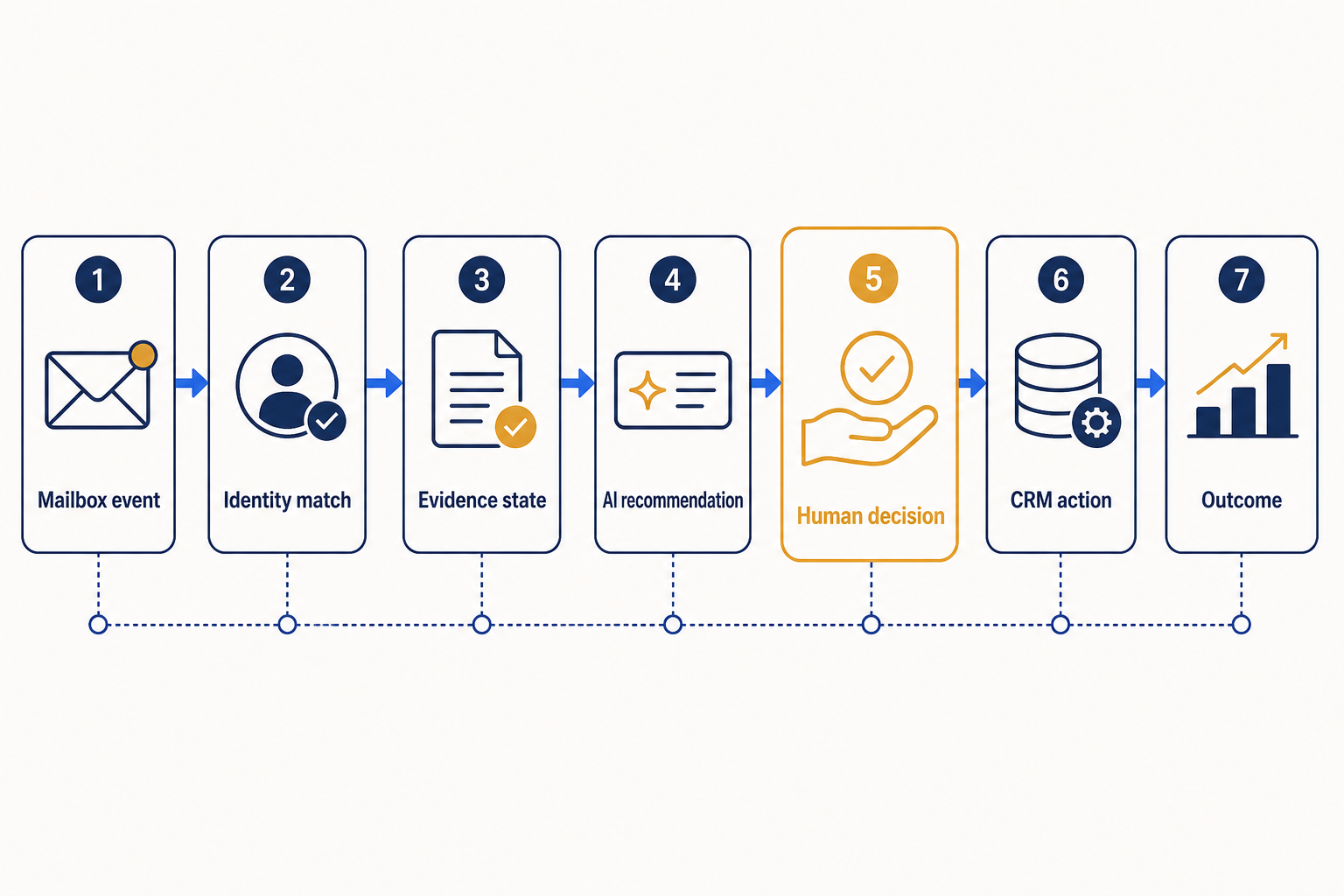
AI score hides the facts a seller needs to challenge the system. It also weakens reporting. The analyst cannot tell whether the model found new evidence. Nor can they tell whether a person agreed or the score merely existed before the outcome.A reply, an AI label, and a qualified opportunity are different states
02 / Signal permissions
Decide what an email is allowed to change
Keep ICP fit stable unless the message supplies fit evidence
- “I left that company last year.”
- “We only serve enterprise software vendors, not local service businesses.”
- “Please speak with our operations director instead.”
- “That brand is no longer active.”
Update message evidence by dimension
| Observed evidence | Dimension that may change | What the system may log | What still needs judgment |
|---|---|---|---|
| A reply arrived | Engagement and recency | Reply timestamp and channel | Whether it deserves a commercial response |
| Direct meeting request | Buying evidence and next-action recommendation | meeting_requested | Meeting owner, agenda, time, and opportunity status |
| Price or implementation question | Buying evidence | commercial_details_requested | Whether need, authority, and timing are sufficient |
| Referral to another person | Contact path | referred_contact and supplied details | Whether the new person is current and relevant |
| “Not now” with a date | Timing | Follow-up date candidate | Nurture route and approved wording |
| Existing solution mentioned | Blocker or incumbent | incumbent_present | Whether the incumbent covers the same workflow |
| Wrong person or changed role | Identity/contact fit | identity_review_required | Correct account/contact association |
| Clear opt-out | Contact policy | Immediate no-send hold | Authorized suppression processing under policy |
| Positive or negative tone alone | Nothing decisive | Optional tone note | It must not create intent or disqualification |
Define the action before the delta
If a verified contact asks for commercial details, recommend seller review within one business day. Do not change opportunity stage until the seller accepts the request as relevant to the offer.
03 / Identity resolution
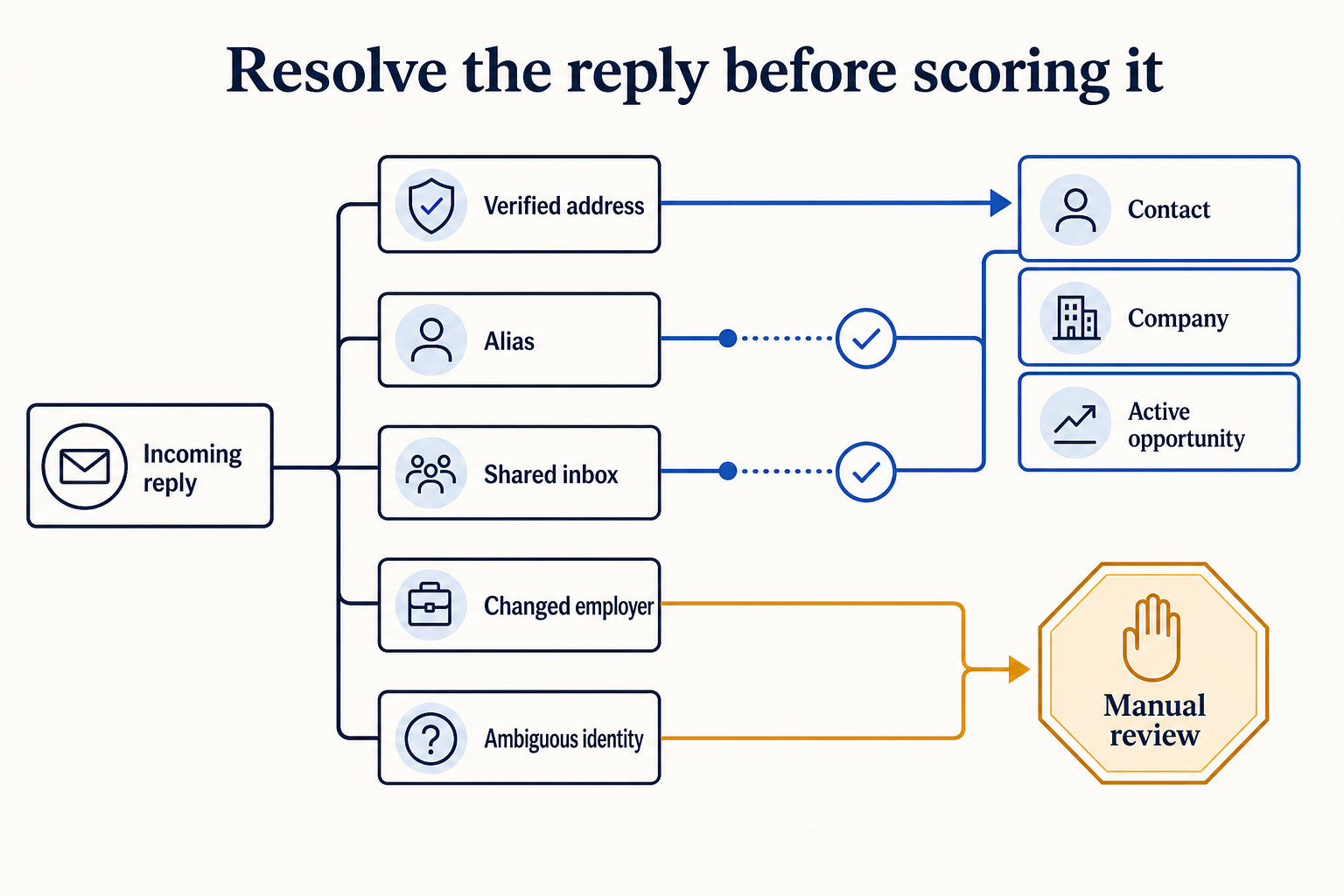
Build the Gmail-to-CRM identity chain
Preserve source identifiers first
| Source field | Purpose |
|---|---|
| Mailbox or authorized account ID | Identifies the approved source |
| Provider message ID and thread ID | Supports lookup, replay, and deduplication |
| Sender and recipient addresses | Supports contact matching |
| Sent, received, and ingestion times | Preserves event order |
| Reply-to and forwarding flags | Warns that the visible sender may not own all text |
| Connector or parser version | Identifies the ingestion logic |
| Idempotency key | Prevents a repeated event from creating a second action |
Resolve contact, company, and opportunity separately
| Object | Strong match candidates | Stop condition |
|---|---|---|
| Contact | Verified sender address, CRM contact ID carried by the outreach tool, confirmed alias | Two active contacts share the address or alias remains unverified |
| Company | Contact-company association, verified current domain, approved account ID | Contact has several current businesses or employer evidence conflicts |
| Opportunity | Existing open deal associated with the contact/account and offer | Several active opportunities could own the thread |
| Conversation | Provider thread ID plus participants | Forwarded or merged content crosses unrelated conversations |
info@ or sales@ can represent several people. A founder may run several businesses. A forwarded message may include text from another person.identity_review_required. Stop the sales transition. Do not create a duplicate lead merely to keep the automation moving.What a real wrong-person reply exposed
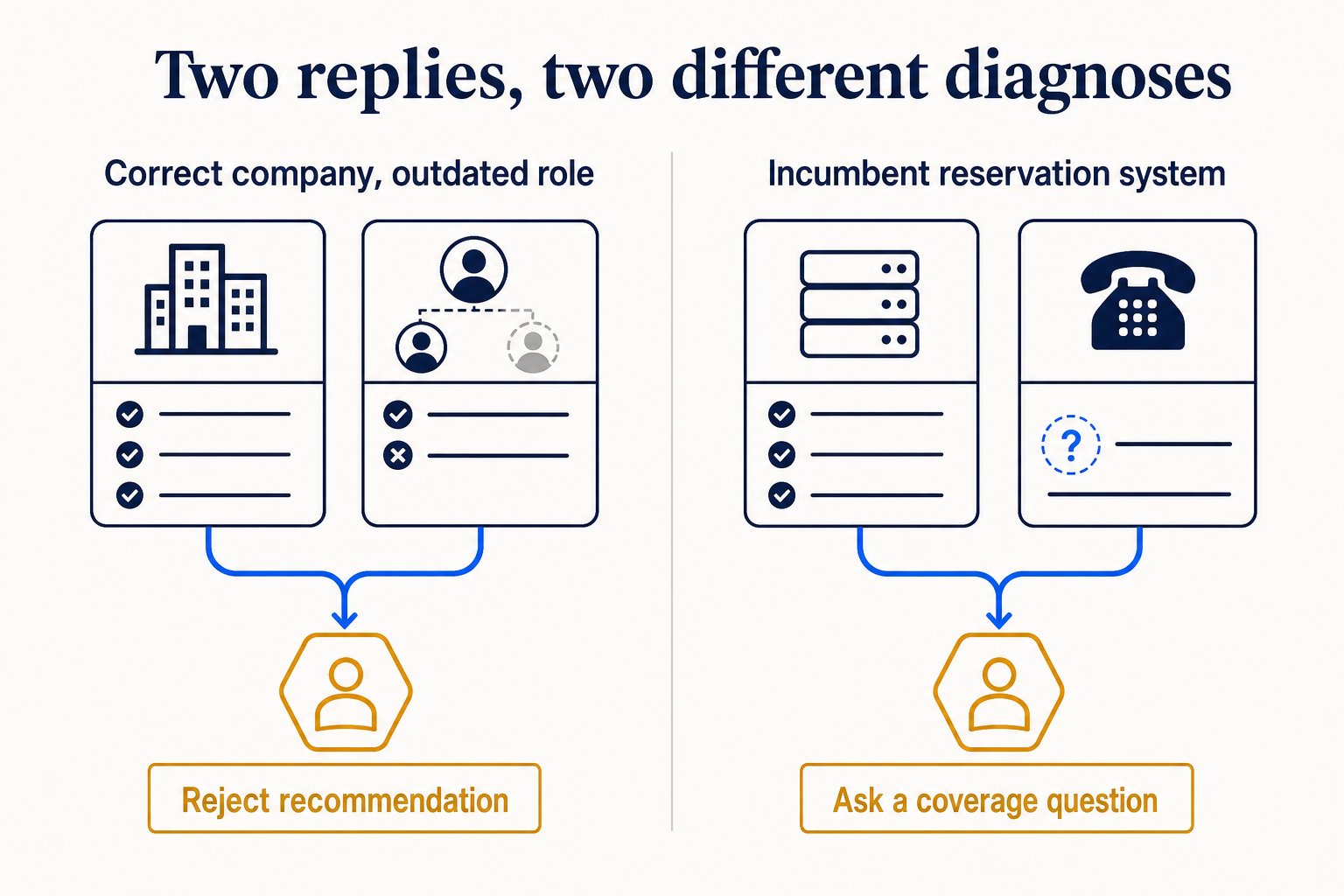
negative reply. It was a contact-fit correction with an evidence note:| Review field | Recorded value |
|---|---|
| Company record | Valid |
| Historical association | Valid |
| Current commercial role | Conflicts with the target-partner role |
| Action | Seller rejection or competitor review |
| Correction reason | current_business_identity_mismatch |
not interested, it cannot fix the contact rule.04 / Reply evidence
Extract structured evidence from the thread
Use a fixed reply taxonomy
| Reply class | Minimum direct evidence | Default recommendation |
|---|---|---|
wrong_person | Sender explicitly denies responsibility or refers another person | Verify role and referral; do not auto-reject the account |
not_interested | Clear refusal without an opt-out ambiguity | Seller closes or records reason |
timing | Busy now, follow up later, or a stated future date | Propose a follow-up date |
incumbent_solution | Existing vendor, tool, internal build, or partner mentioned | Identify coverage before deciding fit |
details_requested | Request for pricing, examples, implementation, or more information | Seller reviews and answers |
negative_contact_request | Unsubscribe, stop, or do-not-contact language | Place immediate no-send hold and process under policy |
unclear | Message lacks enough evidence or contains conflicting meanings | Human review; no stage change |
Separate statement, inference, unknown, and contradiction
| Evidence state | Meaning |
|---|---|
| Direct statement | The claim made by the sender |
| Inference | The model’s limited reading of that claim |
| Unknown | A fact the message does not establish |
| Contradiction | New evidence conflicts with the CRM or an earlier message |
| Field | Value |
|---|---|
| Direct statement | Existing reservation platform mentioned |
| Inference | Some booking workflow may already be covered |
| Unknown | Whether the platform answers missed or after-hours phone calls |
| Contradiction | None |
| Recommended class | incumbent_solution |
| Confidence | High for the incumbent; low for coverage equivalence |
Store a source pointer, not an unsupported paraphrase
| Event field | Example controlled value |
|---|---|
source_event_id | Provider message identifier |
contact_id, account_id | Existing CRM object identifiers |
identity_match_status | verified |
reply_class | incumbent_solution |
direct_statement | Existing booking system mentioned |
inference | Coverage overlap possible |
unknown | Phone and after-hours coverage |
confidence | medium |
recommended_action | seller_review |
model_version | Versioned classifier identifier |
05 / Versioned scoring
Recalculate without hiding the decision
Keep fit and reply evidence separate
fitScore moved into HubSpot. People changed stages, statuses, notes, and next actions as evidence arrived. The improved design keeps those records apart:| Field family | Example values | Update trigger |
|---|---|---|
| Fit snapshot | Account 8/10, contact 7/10 | Verified account or role evidence changes |
| Engagement state | Replied, no response, clicked | Observable dated event |
| Reply evidence | Details request, incumbent, timing | Reviewed message evidence |
| Confidence | High, medium, low | Source completeness or conflict changes |
| AI recommendation | Review, follow up, hold, reject | Versioned model/rule output |
| Human decision | Accepted, edited, rejected | Named reviewer action |
| CRM state | Lead, SQL, follow-up, intro call, nurture | Approved operational action |
| Outcome | Call held, contract, closed, no response | Later verified event |
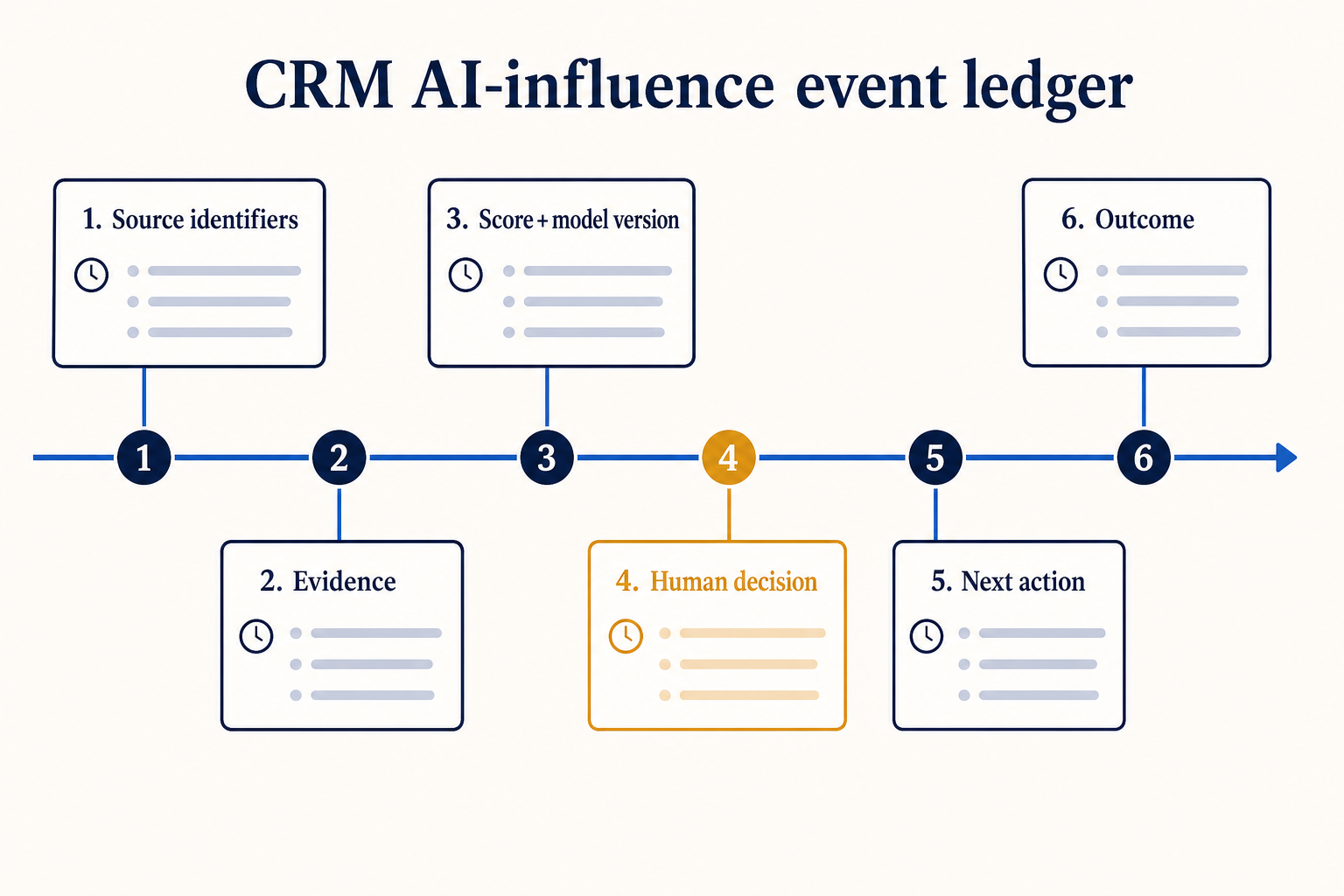
Version every recommendation and preserve the previous state
- previous and proposed value;
- affected dimension;
- reason code;
- evidence event ID;
- confidence;
- rule and model version;
- recommendation timestamp;
- reviewer and decision;
- final applied value and timestamp.
Do not make confidence a hidden score penalty
06 / Human approval
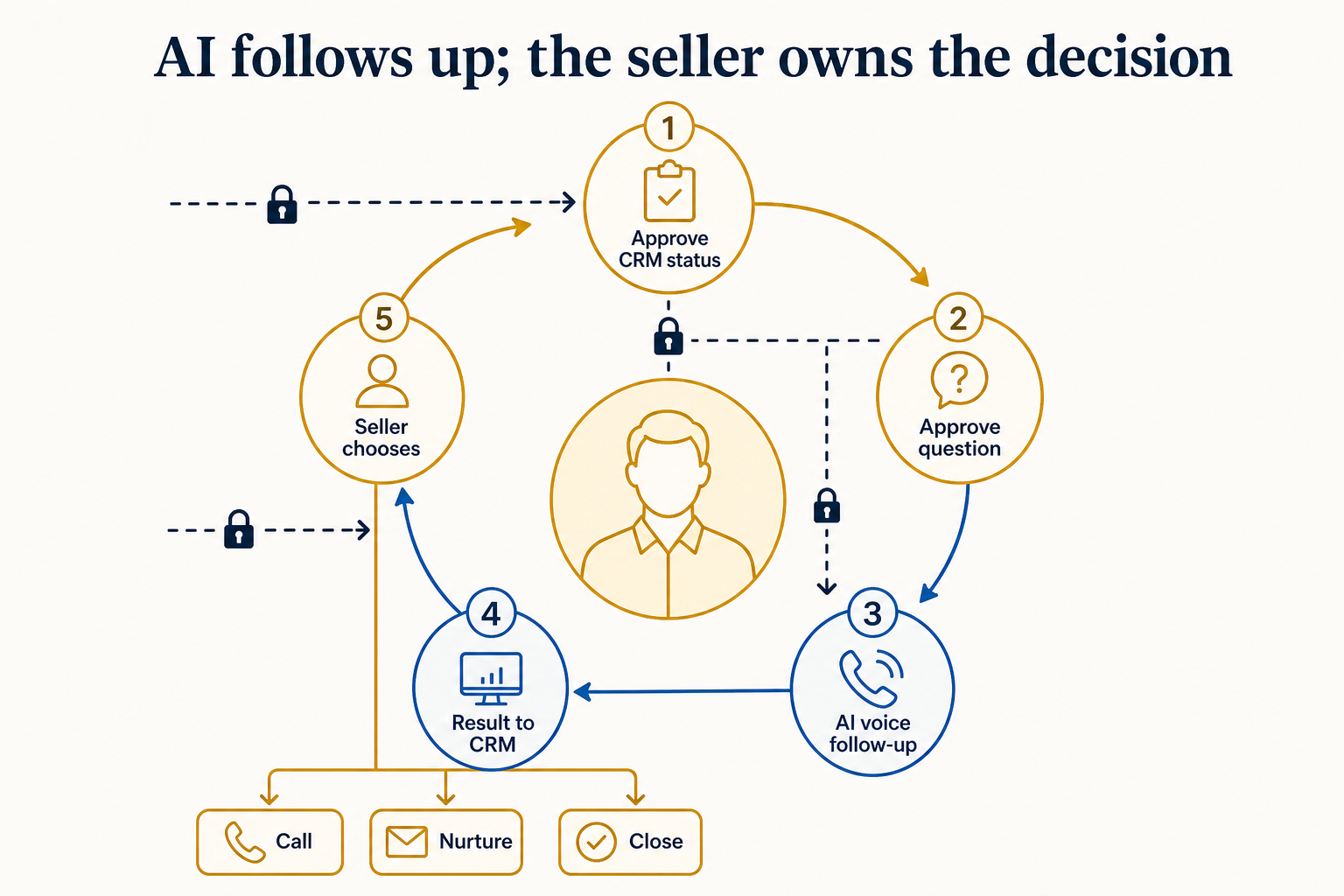
Route every consequential change through a human gate
- approving the reply;
- changing lead status or lifecycle stage;
- setting up a call;
- moving the record into nurture;
- closing the record or opportunity.
Divide machine work from accountable work
| The system may prepare | The seller or authorized owner approves |
|---|---|
| Ingest and deduplicate a message event | Identity resolution when evidence conflicts |
| Extract a direct statement | Commercial meaning of an ambiguous reply |
| Recommend a reply class | Final reply/disposition class |
| Draft a response | External send |
| Suggest lifecycle stage or lead status | Applied stage or status change |
| Suggest follow-up time and question | Call setup, nurture route, and question |
| Prepare an AI voice follow-up task | Activation of the voice follow-up |
| Summarize later outcome evidence | Closure, contract state, and outcome reason |
Let AI voice follow-up begin after approval
| Control | Required value |
|---|---|
| Contact and channel | The approved person and contact path |
| Objective | The allowed question or task |
| Claims | What the agent may not claim |
| Attempts | Time window and attempt limit |
| Escalation | When a person must take over |
| Ownership | Named human owner |
| Result | Fields returned to the CRM |
07 / Influence measurement
Track leads influenced by AI scoring without claiming causation
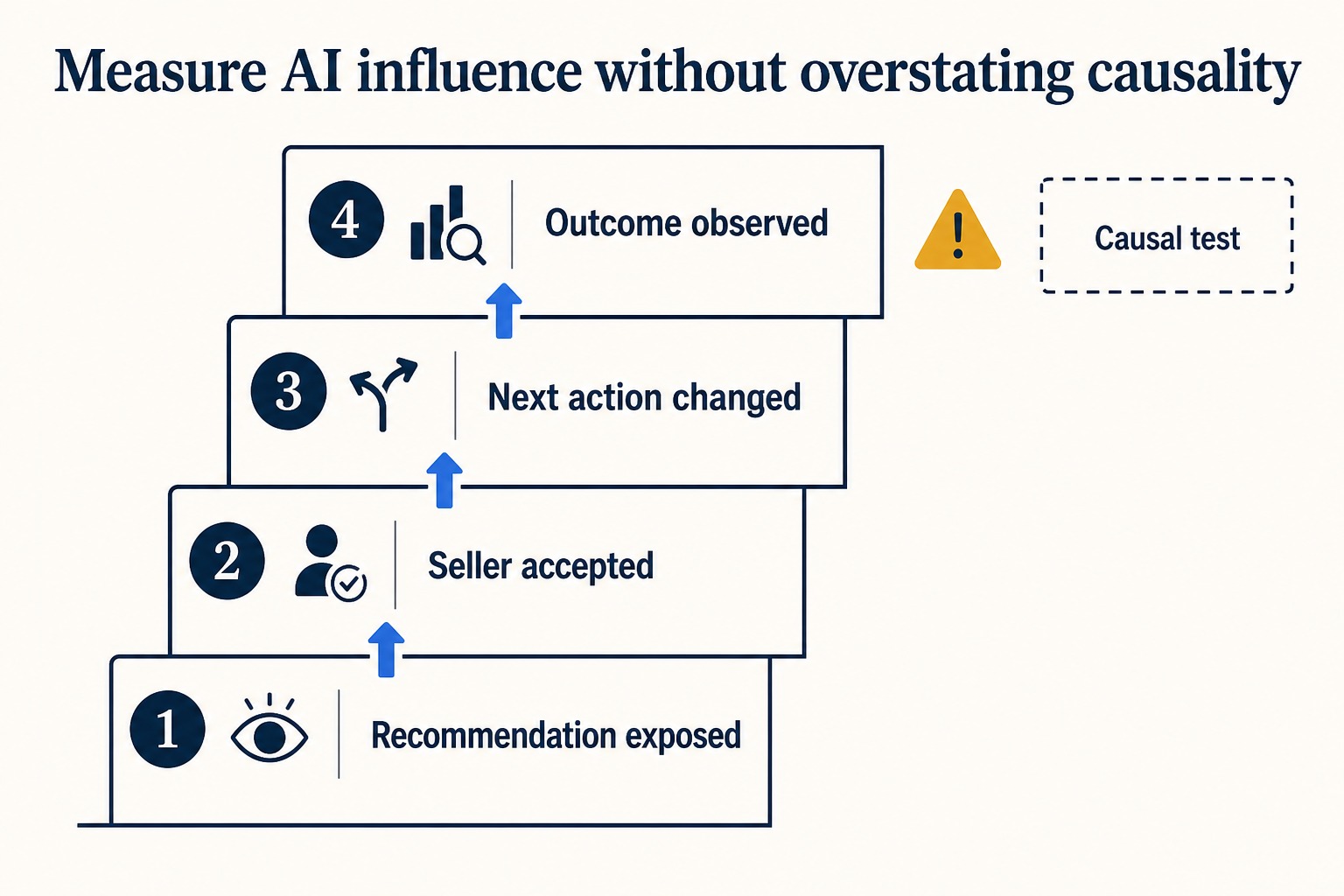
| Reporting level | Required proof | Honest label |
|---|---|---|
| Recommendation exposed | AI advice was shown before the seller decision | AI-assisted |
| Recommendation accepted | A named seller accepted the advice | AI-accepted |
| Next action changed or created | Accepted advice produced a documented route, status, call, or nurture action | AI-influenced |
| Downstream outcome observed | Later reply, held call, opportunity, or contract linked to the action | AI-associated outcome |
Use an AI-influence event, not a permanent checkbox
AI influenced = yes loses timing, reason, model version, and human decision. Store a repeatable event instead.| Group | Fields |
|---|---|
| Identity | event_id, contact_id, account_id, opportunity_id |
| Source | channel, source_system, message_id, thread_id, event_at, ingested_at |
| Match | identity_match_status, identity_match_reason, matched_by |
| Evidence | evidence_type, direct_statement, source_pointer, confidence |
| Recommendation | previous_state, recommended_state, reason_code, rule_version, model_version |
| Exposure | recommendation_shown_at, shown_to_user_id |
| Human decision | accepted, edited, or rejected; reviewer_id, decision_at, correction_reason |
| Applied action | final_lifecycle_stage, final_lead_status, next_action, action_at, owner_id |
| Follow-up | ai_followup_approved, followup_objective, followup_at, escalation_result |
| Outcome | outcome_type, outcome_at, opportunity_stage, contract_status |
Map the event to ordinary CRM fields
| CRM purpose | Tool-neutral field | Example |
|---|---|---|
| Stable fit | fit_score, fit_rule_version, fit_scored_at | 8, icp-v3, timestamp |
| Evidence state | latest_reply_class, reply_confidence | timing, high |
| Lifecycle | lifecycle_stage | lead, sales_qualified_lead |
| Work queue | lead_status | follow_up, intro_call, nurture |
| Ownership | contact_owner, next_action_owner | Internal user IDs |
| Action | next_action, next_action_at | confirm_call, timestamp |
| Source | original_source, source_message_id, source_thread_id | email, provider IDs |
| AI recommendation | ai_recommendation, ai_reason, ai_version | seller_review, reason code, version |
| Human judgment | reviewer_decision, override_reason, reviewed_at | edited, incumbent_scope_unknown, timestamp |
| Outcome | call_status, opportunity_stage, contract_status | Controlled values |
Distinguish influence, attribution, and causal lift
- Was AI present? A recommendation existed.
- Did a person use it? The recommendation was accepted.
- Did it change work? A route or next action was created or changed.
- What happened afterward? A downstream outcome appeared.
- Did AI cause improvement? A controlled test must isolate the effect.
Roll contact events up to the account carefully
AI-influenced. Require proof that it changed an account action, open deal, or owner decision. Keep the source contact and time.08 / Data governance
Protect mailbox and CRM data
Minimize the content sent to the model
- the latest reply only;
- the last approved exchange;
- structured CRM context;
- a redacted excerpt;
- the full thread.
Define access, retention, and deletion
| Control | Decision to record |
|---|---|
| Authorization | Who can approve mailbox access? |
| Scope | Which mailboxes, labels, threads, and OAuth scopes are allowed? |
| Storage | Where do raw content and derived evidence live? |
| Retention | How long are raw content and event records kept? |
| Deletion | How are content and access removed? |
| Correction | How can a user fix identity or classification? |
| Audit | Which logs remain after source content is deleted? |
| Recovery | Who can pause and roll back the integration? |
09 / Shadow-mode pilot
Run a shadow-mode pilot before changing sales stages
Pilot sequence
- Ingest without action. Capture message and thread identifiers, but do not change the CRM.
- Audit identity. A person checks each proposed contact, account, and opportunity match.
- Audit extraction. Check the direct statement, reply class, unknowns, and contradictions.
- Show recommendations. Let sellers accept, edit, or reject without automatic sends.
- Record disagreement reasons. Use one code for each error type: identity, evidence, class, route, or policy.
- Apply low-risk actions. Allow approved internal tasks or queue changes first.
- Add controlled follow-up. Approve the route, content, limits, and owner first. Then activate external messages or voice follow-up.
- Compare outcomes. Use the nearest operational outcome without calling it causal lift.
What to review each week
| Metric | What it diagnoses |
|---|---|
| Identity-match acceptance | Whether replies attach to the correct records |
| Reply-class acceptance and edits | Whether the taxonomy and prompts match seller judgment |
| Stage/status overrides | Whether recommendations fit the sales process |
| Time to reviewed next action | Whether the workflow reduces delay |
| Suppression and policy errors | Whether contact controls are safe |
| Duplicate or replayed actions | Whether ingestion is idempotent |
| Outcomes by accepted recommendation | Whether the route deserves further testing |
| Outcomes by rule/model version | Whether a change improved the observed decision |
10 / Checklist
Gmail-to-CRM AI lead-scoring checklist
| Area | Check before activation |
|---|---|
| Source | [ ] Store the provider message ID and thread ID. |
| Source | [ ] Keep source time and ingestion time. |
| Identity | [ ] Match contacts with verified IDs, not display names. |
| Identity | [ ] Resolve the company and open deal as separate objects. |
| Identity | [ ] Stop when records conflict or several objects match. |
| Ingestion | [ ] Use an idempotency key to prevent duplicate work. |
| Evidence | [ ] Keep original ICP fit apart from reply evidence. |
| Evidence | [ ] Preserve direct claims, model inference, unknowns, and conflicts. |
| Evidence | [ ] Use a bounded reply taxonomy and source pointer. |
| Scoring | [ ] Keep the prior state and proposed state. |
| Scoring | [ ] Version the rule, model, and extraction schema. |
| Scoring | [ ] Keep confidence apart from lead quality. |
| Human control | [ ] Name the seller who reviews each recommendation. |
| Human control | [ ] Record whether the seller accepted, edited, or rejected it. |
| Human control | [ ] Require approval for replies, stages, calls, nurture, and closure. |
| Contact policy | [ ] Stop automated contact after a clear opt-out. |
| Feedback | [ ] Log each override with a controlled reason code. |
| Influence | [ ] Time-stamp exposure, acceptance, action, and outcome. |
| Influence | [ ] Use an event record instead of one permanent checkbox. |
| Influence | [ ] Keep assisted, accepted, influenced, and associated outcome apart. |
| Reporting | [ ] Preserve contact events under account rollups. |
| Reporting | [ ] Do not claim causal lift without a valid comparison. |
| Security | [ ] Use the minimum mailbox scope and model context. |
| Security | [ ] Define access, retention, deletion, and correction. |
| Recovery | [ ] Test connector replay and full sync. |
| Recovery | [ ] Give a named owner pause and rollback control. |
11 / FAQ
AI lead scoring in Gmail and CRM FAQ
How does AI lead scoring work with Gmail and a CRM?
Can Gmail score sales leads by itself?
Which email signals should change a lead score?
Should an email open increase a lead score?
How do you track a lead influenced by AI scoring?
AI-influenced only when accepted advice created or changed work. A later outcome is linked evidence, not proof of cause.What fields should an AI scoring workflow write to CRM?
Can AI automatically classify sales replies?
How do you prevent duplicate leads when syncing Gmail and CRM?
12 / Final rule
The operating principle to keep
13 / Methods
Stats and sources
- Google: Gmail API reference
- Google: Synchronize clients with Gmail
- Google: Use the Salesforce for Gemini integration in Gmail
- Google Workspace Admin Help: Control which apps access Google Workspace data
- Apollo: How to Track Which Leads Were Influenced by AI Lead Scoring
- Anastasiia Krynytska’s anonymized July 2026 workflow records and CRM screenshots, reviewed on 12 August 2026.
Research note
Methodology
- 01Use official Google documentation only for current Gmail and Workspace capabilities.
- 02Treat Apollo as a commercial comparison source, not proof that AI caused a sales outcome.
- 03Attribute the July 2026 workflow, reply cases and 1,627-to-4 funnel to Anastasiia Krynytska's anonymized operating records.
- 04Present the event ledger, identity stops and tool-neutral CRM dictionary as the improved architecture Anastasiia would implement now, not as a claim that every field existed in July.
- 05Remove names, companies, email addresses, profile links, raw messages and identifying CRM details.
- 06Report exposure, seller acceptance, changed action and associated outcome separately; require a controlled comparison before claiming causal lift.
Source ledger
Sources & editorial notes
- 01Gmail API reference
Google for Developers · Official capability documentation for messages, threads, labels and mailbox history.
- 02Synchronize clients with Gmail
Google for Developers · Official sync guidance used for partial history, replay and full-resync requirements.
- 03Use the Salesforce for Gemini integration in Gmail
Google Workspace Help · Official capability example for surfacing related CRM records inside Gmail; it does not define a scoring policy.
- 04Control which apps access Google Workspace data
Google Workspace Admin Help · Official administration guidance used for third-party access and scope governance.
- 05How to Track Which Leads Were Influenced by AI Lead Scoring
Apollo · Commercial comparison source for influence tracking; it is not evidence of causal lift.
- 06How Does AI Assist in Lead Qualification? A Human-Gated B2B Workflow
Luck My Sales · Supporting guide for the boundary between scoring and seller qualification.
- 07How to Implement Lead Scoring Criteria in Your CRM Without Hiding the Sales Decision
Luck My Sales · Supporting guide for eligibility, fit, engagement, evidence confidence and criteria governance.
- 08AI Lead Generation: How to Build a B2B Workflow That Produces Qualified Opportunities
Luck My Sales · Parent guide for sourcing, enrichment, outreach and CRM learning.