
Workflow guide · AI prospecting
How Does AI Assist in Lead Qualification? A Human-Gated B2B Workflow
AI may assist research organization and drafting. A human editor reviews every published page, checks material claims against the cited sources and owns the final decision. No company paid for placement in this article.
AI use policyAgent-ready brief
AI takeaways
Keep the key points here, or take a source-aware text brief into Claude, ChatGPT or another AI workspace.- 01Define the commercial event that counts as qualified before using AI to recommend a status.
- 02Keep deterministic eligibility checks, contextual AI interpretation and human decisions as separate layers.
- 03Expose the evidence, uncertainty and dimension scores behind every recommendation instead of relying on one hidden score.
- 04Measure model-human disagreement and downstream calls or contracts—not only throughput or reply sentiment.
- 05Turn reviewed mistakes and override reasons into reusable rules before increasing automation.
When evidence is insufficient, lower confidence—not standards. AI recommends; a seller qualifies.
01 / Definitions
What AI-assisted lead qualification means
| State | Operational meaning in this guide | What it does not prove |
|---|---|---|
| Candidate record | A company or contact selected for research | Accurate identity, fit or permission to contact |
| Fit-qualified record | The record passes the campaign’s account, contact and exclusion criteria | Current buying intent or willingness to speak |
| Replied | The person responded to outreach | Positive sentiment or commercial interest |
| Interested after pitch | The person responded positively after seeing the core offer | That a call happened or an opportunity was accepted |
| Call | A commercial conversation was held or confirmed | A contract or closed revenue |
| Contract | The parties reached the campaign’s recorded contract stage | Delivery success, retention or lifetime value |
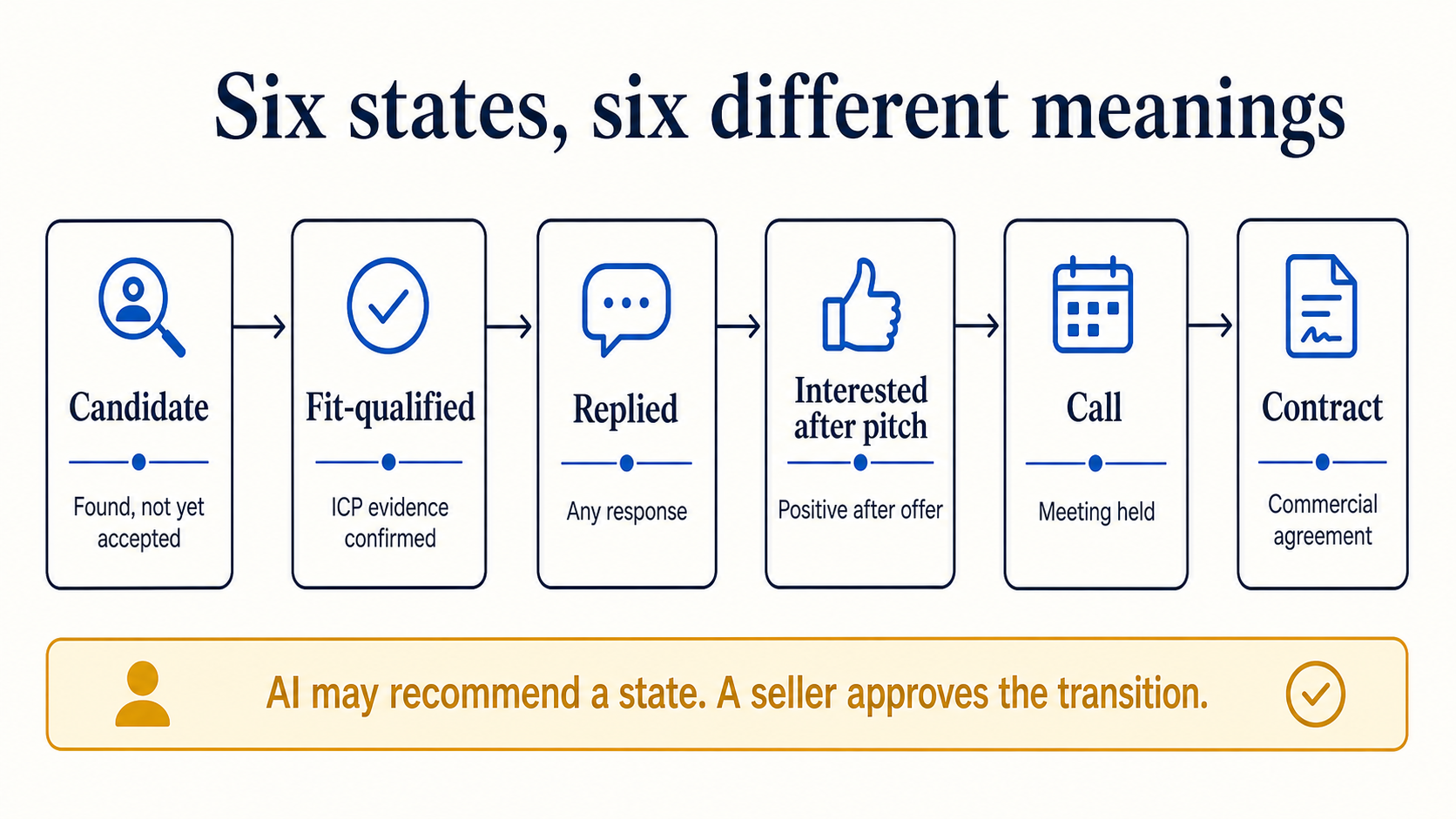
fit-qualified meant suitable for outreach. It did not mean the buyer had expressed interest. The score estimated ICP fit and affected channel routing. Scores of 8–10 went to LinkedIn. Scores of 7 or below went to email. This was a campaign rule, not advice for every market.AI lead scoring is not the same as AI lead qualification
02 / Task ownership
How AI assists in lead qualification
| Qualification task | Useful AI contribution | Required evidence | Decision that remains human-owned |
|---|---|---|---|
| Identity verification | Normalize names, domains, titles and company records; flag conflicts | Current company site, verified profile or licensed source | Whether the identity is sufficiently verified to proceed |
| Enrichment | Retrieve decision-relevant firmographic and contact fields | Source and retrieval date for each material field | Whether a missing or conflicting field requires rejection or review |
| Client and workflow research | Summarize services, customer examples, case studies and operating workflows | Reopenable public pages and first-party records | Whether those facts support the campaign’s commercial hypothesis |
| ICP comparison | Compare evidence with must-have, exclusion and segment rules | Approved ICP version and rule owner | Whether the model’s recommendation deserves approval or override |
| Context extraction | Identify potential use cases, objections and incumbent solutions in text | Original reply, form submission, transcript or page context | Whether the context is sufficient to change the qualification state |
| Reply classification | Suggest sentiment, objection type and next action | Exact reply plus account and offer context | Final disposition and external response |
| Routing | Recommend a seller, queue, channel or nurture action | Territory, role, capacity and stage rules | Whether to execute the route or escalate an exception |
| CRM write-back | Structure the recommendation, evidence and summary | Original source fields and human decision | Final status, override reason and accountable owner |
- Deterministic checks verify hard constraints and preserve unknown values.
- AI review reads the context and suggests a decision.
- Human judgment approves exceptions, status changes and outbound actions.
03 / Decision design
Define “qualified” before adding AI
Could this agency credibly resell a white-label voice solution? Would enough existing clients have a relevant use case and buy it?
Build an evidence hierarchy
- the company website and service pages;
- industries served;
- customer work;
- case studies;
- proof of the workflow.
Write universal exclusions sparingly
04 / Qualification model
Use six qualification dimensions instead of one hidden score
| Dimension | Question | Typical evidence | Valid unknown condition |
|---|---|---|---|
| Identity and validity | Is this the real company and the correct person? | Verified domain, current profile and person-company match | Profile or company relationship cannot be confirmed |
| Client portfolio | Who does the company actually serve? | Service pages, case studies, testimonials and customer examples | Client type is not publicly documented |
| Workflow relevance | Do those clients have the sales, support, booking, dispatch or call-handling workflow connected to the offer? | Public workflow descriptions and use cases | Industry appears relevant, but the workflow is not shown |
| Commercial potential | Could the company credibly resell or apply the offer across its current client base? | Existing relationships, service model and plausible activation path | A use case exists, but scale across the portfolio is unclear |
| Contact and current-role fit | Does this person currently own or influence the decision, and are they eligible rather than a competitor? | Current headline, active roles and responsibility | The person holds multiple roles or the current commercial identity is unclear |
| Evidence confidence | How current, attributable and complete is the evidence? | Source type, retrieval date and consistency across records | Sources conflict, are stale or do not cover a required criterion |
05 / Workflow
A human-gated AI lead-qualification workflow
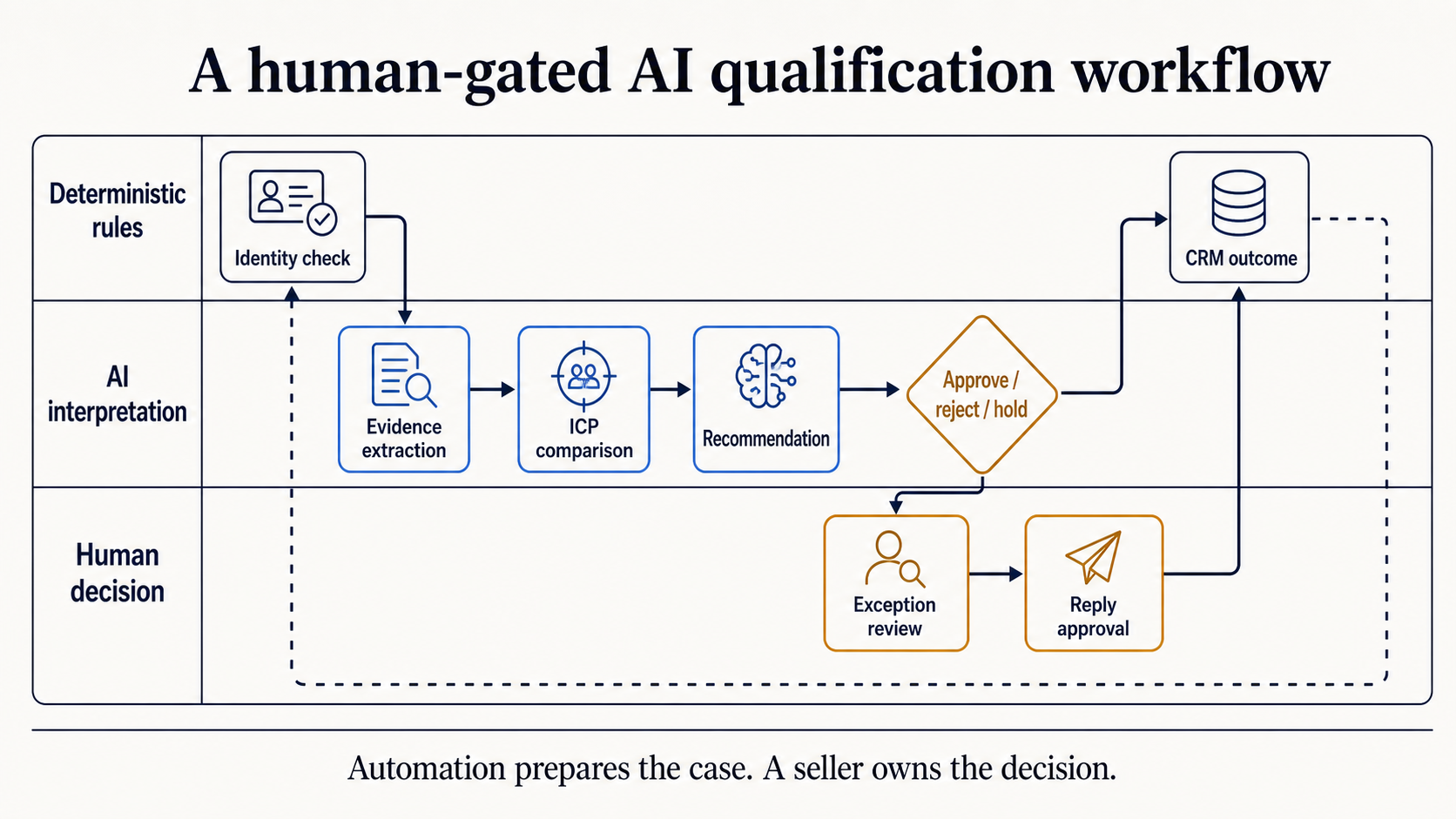
1. Capture the record and preserve its source
2. Run deterministic eligibility checks
- real, verified domain;
- verified link between the person and company;
- suppression and exclusion lists;
- confirmed competitor status;
- required market or legal constraints;
- duplicate checks.
unknown and route valuable cases to review.3. Enrich only decision-relevant fields
4. Ask AI to interpret contextual evidence
- Who are the company’s typical clients?
- Which workflows do those clients operate?
- What evidence supports the use case?
- What evidence contradicts it?
- What remains unknown?
5. Generate a reasoned recommendation
- typical client profile;
- evidence found;
- potential use cases;
- estimated commercial potential;
- confidence level;
- final score;
- concise reasoning.
6. Review exceptions and high-consequence records
- Is the person still active in the role used for targeting?
- Does the evidence support the commercial hypothesis?
- Did the model confuse a category with a workflow?
- Is an incumbent solution present?
- Does the message make a product claim we can verify?
- Should an uncertain record be rejected, researched or tested through a lower-risk channel?
7. Route with the reason attached
8. Feed replies and downstream outcomes back into the rule
06 / Operating cases
Four qualification errors that changed our rules
| Case | What the initial evidence suggested | What human review or the reply revealed | Rule change |
|---|---|---|---|
| Category shortcut | A business-development agency looked like a plausible sales-automation reseller | Its clients were mainly B2B technology vendors using email, LinkedIn, SDRs and meeting setting; there was no evidence of high-volume customer phone workflows | Do not qualify appointment-setting or SDR agencies by category. Cap the score unless their client portfolio shows the relevant workflow |
| Legacy-role mismatch | The company and CEO identity were technically correct | The company used for personalization was a legacy role; the person’s current business centered on AI automation, making them closer to a competitor or peer | Verify the current headline and active commercial identity, not only the historical company relationship |
| Correct fit, incumbent present | A small agency serving phone-heavy local businesses fit the client-portfolio hypothesis | The contact already referred clients to virtual receptionists | Keep the fit decision separate from the reply outcome; record incumbent coverage and close or test one approved differentiation question |
| Incumbent scope unclear | A restaurant-marketing agency fit a missed-reservations hypothesis | The contact said existing reservation platforms already handled the problem | Do not assume the objection is wrong or fully conclusive. Ask whether the incumbent covers online booking, phone handling or both—then update the record |
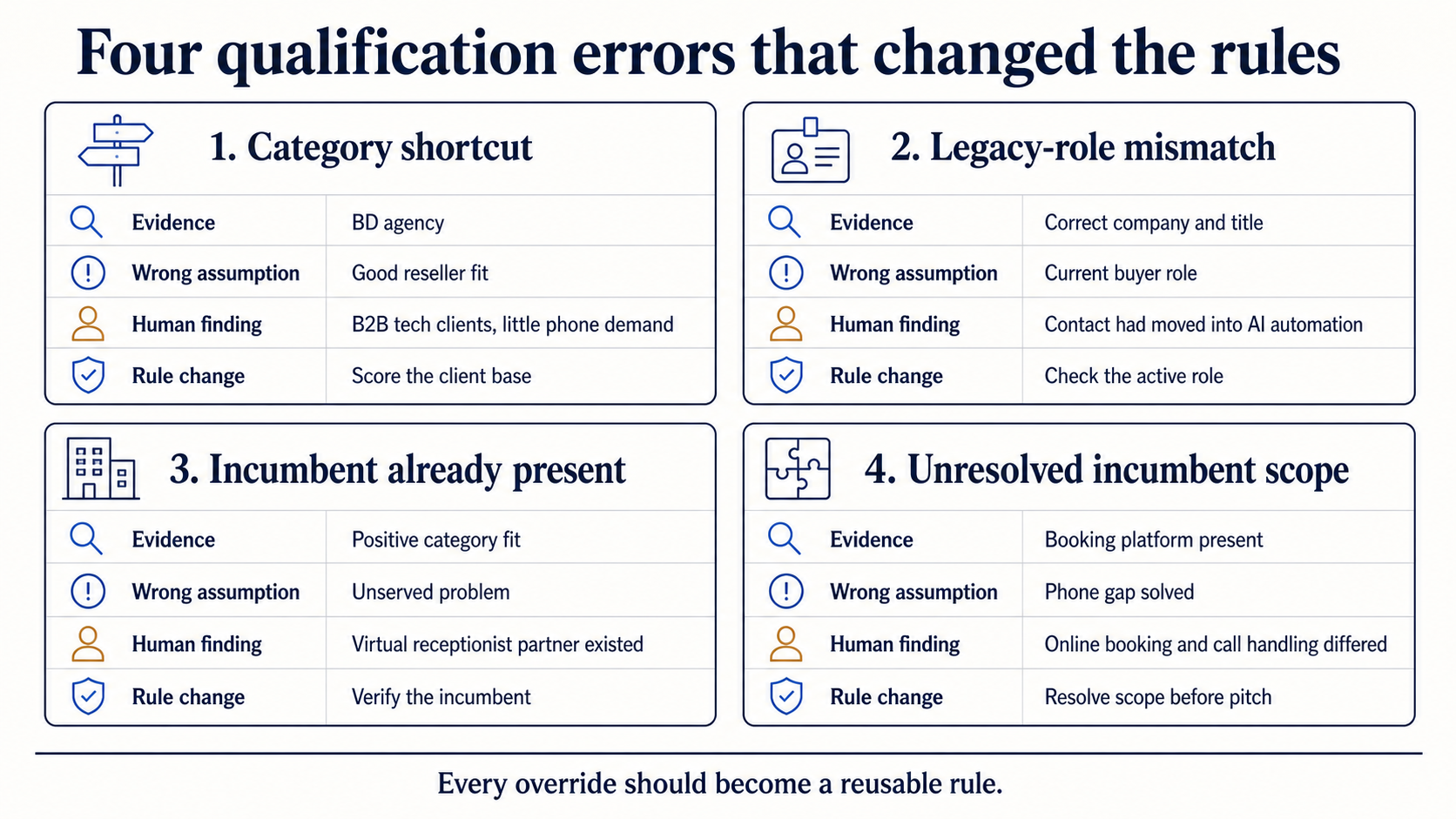
Error 1: the agency category looked right, but its clients did not
Error 2: all the identity fields were correct, and the lead was still wrong
Error 3: a correctly qualified account can still reject the offer
fit, incumbent, reply disposition and next action.Error 4: “we already have this” can still contain an unanswered question
07 / Reply handling
Classify replies by next action, not only sentiment
| Reply state | What it means | Human-controlled next action |
|---|---|---|
| Wrong person | The contact does not own the decision, or the original role context may be wrong | Recheck account and current-role fit before asking for an introduction |
| Not interested | The person clearly declines without an unresolved factual question | Record the reason; send at most one approved low-pressure response |
| No time / follow up later | Timing blocks the conversation | Store the date requested by the lead rather than a generic nurture label |
| Existing solution | The need category exists but may be covered | Identify incumbent scope; ask one factual question or close the record |
| Send information | Interest is incomplete and asynchronous | Send the requested material and set a dated follow-up |
| Meeting proposed | The person is willing to continue | Confirm time, owner and agenda; do not count a meeting until accepted |
| Technical or measurement question | Progress depends on a concrete capability | Route to a qualified human and verify the claim before answering |
| Unclear | The commercial meaning cannot be determined safely | Preserve the exact reply and escalate rather than forcing a label |
08 / Human control
What AI should not decide by itself
Do not let missing evidence become rejection by default
no evidence found separate from evidence of no fit.Do not infer intent from one weak signal
Do not resolve incumbent objections with unsupported claims
Do not reject high-value exceptions without review
Do not change the qualification policy from replies alone
09 / CRM evidence
What to record in the CRM
| Field group | Minimum fields | Why they matter |
|---|---|---|
| Source | Source URL/system, retrieval date, original text or record ID | Lets a reviewer reopen the evidence and check freshness |
| Identity | Company, domain, contact, current role and verified relationship | Separates account fit from contact fit |
| Qualification | ICP version, dimension scores, confidence, unknowns and exclusion checks | Shows how the recommendation was produced |
| AI output | Recommendation, reasoning and proposed next action | Preserves the model’s original contribution |
| Human review | Reviewer, final disposition, override reason and approval time | Makes responsibility and disagreement visible |
| Reply | Exact reply, objection class, requested action and follow-up date | Prevents sentiment compression and missed commitments |
| Outcome | Meeting proposed, meeting held, opportunity, contract, loss reason and date | Connects qualification with downstream commercial reality |
10 / Measurement
How to measure AI-assisted lead qualification
Start with model-human disagreement
- human approval rate;
- human override rate;
- reasons for overrides;
- a reviewed sample of rejected records;
- downstream outcomes by recommendation and segment;
- time required per reviewed record.
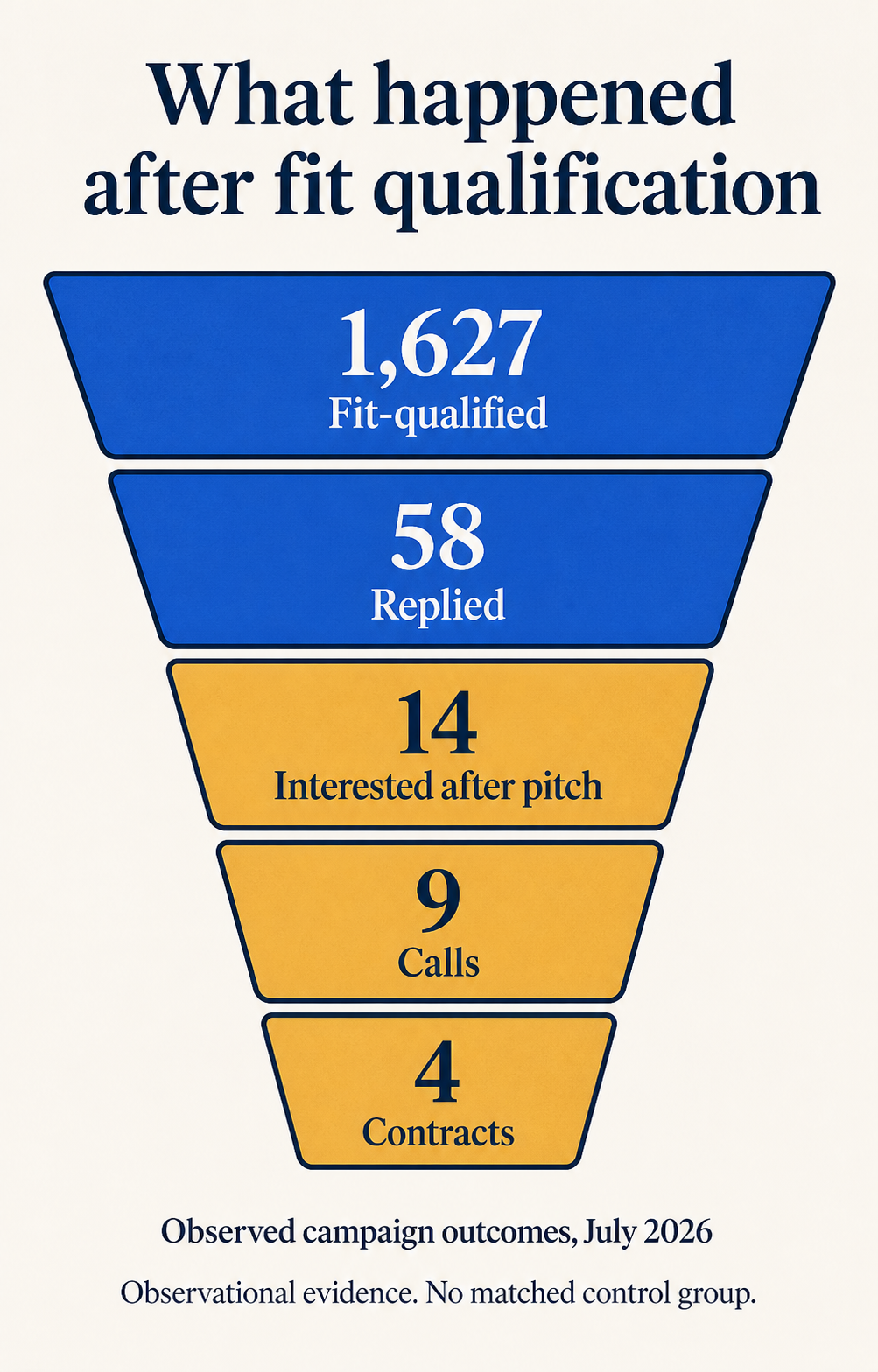
Preserve the funnel stages and denominators
| Stage | Count | Rate from prior stage | What the number means |
|---|---|---|---|
| Fit-qualified for campaign | 1,627 | — | Records approved to enter outreach |
| Replies | 58 | 3.6% of fit-qualified records | Any recorded response, not necessarily positive |
| Interested after pitch | 14 | 24.1% of replies | Positive interest after the offer was presented |
| Calls | 9 | 64.3% of interested leads | Leads that progressed to the recorded call stage |
| Contracts | 4 | 44.4% of calls | Leads that reached the recorded contract stage |
Treat zero replies carefully
Recommendation → Human decision → External action → Reply state → Commercial outcome → Rule revision
11 / Failure modes
Common failure modes and stop conditions
| Failure mode | Observable symptom | Correction | Stop condition |
|---|---|---|---|
| Category replaces evidence | Every company with the same agency or industry label receives a similar score | Inspect client portfolio and workflow one level deeper | Pause the segment if reviewers repeatedly find no relevant workflow |
| Correct identity, stale role | Names and domains are valid, but recipients say they are not the right person | Verify current headline, active company and responsibility | Stop sends from unresolved multi-role records |
| Missing data becomes certainty | The explanation contains confident claims absent from sources | Require unknowns and source-linked evidence | Reject outputs containing unsupported facts |
| One score hides conflict | High fit masks low confidence or wrong contact | Display dimension scores and evidence separately | Do not auto-route when required dimensions conflict |
| Reply sentiment replaces qualification | Polite or curious replies become opportunities | Preserve exact reply, offer context and next action | Reopen any opportunity without the qualifying event |
| Incumbent is mishandled | AI argues with “we already have this” | Classify incumbent scope and ask at most one approved question | Close when the lead confirms full coverage or declines further discussion |
| Channel rule goes stale | High-scoring records underperform in one channel or region | Compare channel outcomes within relevant segments | Pause the rule when the sample shows repeated mismatch |
| Activity grows without outcomes | More records and messages produce no calls or opportunities | Review qualification and offer before adding volume | Do not scale on throughput alone |
12 / Pilot
A practical pilot for a B2B sales team
1. Choose one decision
- which accounts enter seller research;
- which inbound requests reach sales;
- which replies need a human response;
- which records enter nurture rather than outreach.
2. Write the policy before the prompt
- must-have evidence;
- hard exclusions;
- context-dependent signals;
- valid unknown states;
- human escalation conditions;
- CRM disposition and next action.
3. Build a sample a human can inspect
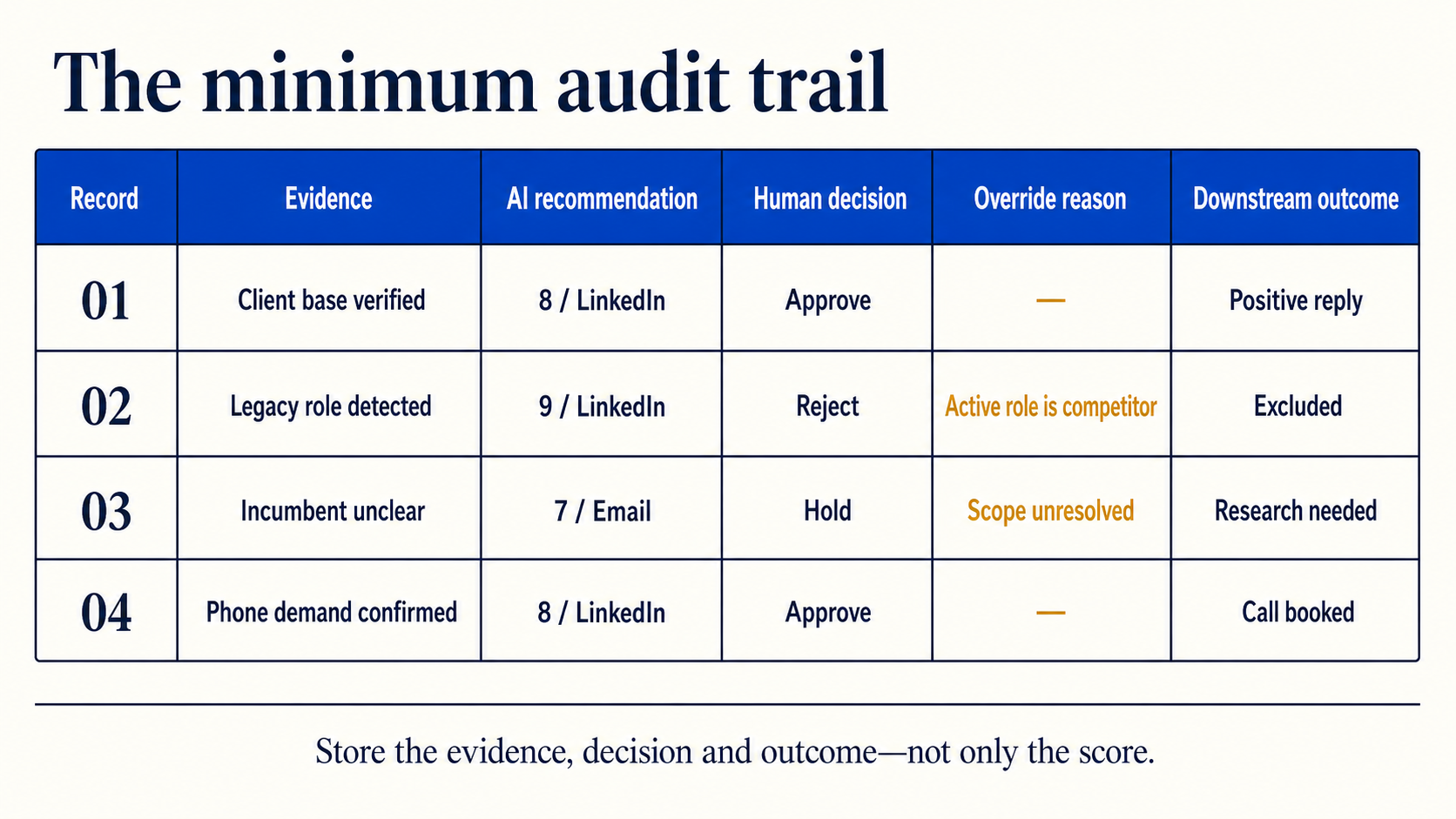
4. Store the disagreement
| Record | Evidence | AI recommendation | Human decision | Override reason | Downstream outcome |
|---|---|---|---|---|---|
| A | Verified sources | Approve | Reject | Current role is a competitor | No outreach |
| B | Partial sources | Reject | Research | Client workflow unclear | Pending |
| C | Verified sources | Approve | Approve | — | Existing-solution reply |
5. Review outcomes before increasing autonomy
- Which error repeated?
- Which source was usually stale?
- Which unknowns deserved research?
- Which high scores failed because of the contact, channel or offer?
- Which low scores produced useful conversations?
- Did the CRM preserve enough context to explain the result?
13 / Checklist
AI lead-qualification checklist
- [ ] Define the exact event that changes the lead’s status.
- [ ] Separate account fit, contact fit, workflow proof and confidence.
- [ ] Identify hard rules that do not need AI.
- [ ] Define
unknowninstead of treating missing values as rejection. - [ ] Require source URLs or record IDs for material claims.
- [ ] Name the reviewer and the decisions they own.
- [ ] Keep the AI recommendation before an override.
- [ ] Store reply meaning and requested next action separately.
- [ ] Choose downstream measures beyond reply volume.
- [ ] Set a stop condition before scaling.
- [ ] Review every rejected or corrected record.
- [ ] Inspect current roles and rival status.
- [ ] Sample low-scoring or rejected records for false negatives.
- [ ] Compare channels across similar segments.
- [ ] Check incumbent replies for scope, not a sales angle.
- [ ] Confirm that calls and contracts trace back to their qualification evidence.
- [ ] Update the policy, prompt and CRM schema together.
14 / FAQ
Frequently asked questions
How does AI assist in lead qualification?
Can lead qualification be fully automated with AI?
What data does AI need to qualify a B2B lead?
What is the difference between AI lead scoring and AI lead qualification?
How accurate is AI lead qualification?
When should a salesperson review an AI-qualified lead?
How should inbound and outbound qualification differ?
What should an AI qualification system write to the CRM?
15 / Methods
Methodology and disclosure
Research note
Methodology
- 01Use official Microsoft documentation for examples of recorded lead-state transitions and official NIST resources for general human-oversight principles.
- 02Attribute the anonymized July 2026 workflow, scoring rules, reply cases and downstream funnel to Anastasiia Krynytska’s first-hand campaign review.
- 03Keep fit-qualified, replied, interested after pitch, call and contract as separate commercial states.
- 04Treat the 1,627 → 58 → 14 → 9 → 4 funnel as observational evidence because there was no matched manual control group.
- 05Remove names, companies, URLs, emails and identifying message details from the operating cases.
Source ledger
Sources & editorial notes
- 01Qualify or convert leads to opportunities
Microsoft Learn, Dynamics 365 Sales · Official product documentation used to illustrate qualification as a recorded business-state transition with an audit trail.
- 02Qualify the best leads
Microsoft Learn, Dynamics 365 Customer Insights · Official product documentation used for the relationship between scoring criteria, review, assignment and next actions.
- 03AI Risk Management Framework Core
US National Institute of Standards and Technology · Primary governance framework used for human-AI role clarity, documentation, oversight and performance measurement principles.
- 04Appendix C: Human-AI Interaction
US National Institute of Standards and Technology · Primary NIST resource used for context on human oversight; it is not a sales-qualification standard.
- 05AI Lead Generation: How to Build a B2B Workflow That Produces Qualified Opportunities
Luck My Sales · Parent pillar containing the broader sourcing, enrichment, outreach, campaign and CRM evidence context.
- 06Luck My Sales methodology
Luck My Sales · Evidence states, first-hand-source treatment, freshness requirements and correction protocol.
- 07Luck My Sales AI use policy
Luck My Sales · Permitted AI assistance and required human editorial review.