
Operational email guide · Cold email AI
AI Email Sales Outreach: Research, Personalization, Sending and Follow-Up
AI may assist research organization and drafting. A human editor reviews every published page, checks material claims against the cited sources and owns the final decision. No company paid for placement in this article.
AI use policyAgent-ready brief
AI takeaways
Keep the key points here, or take a source-aware text brief into Claude, ChatGPT or another AI workspace.- 01Start from an eligible contact, approved offer and source-linked reason to write.
- 02Give every follow-up a distinct commercial job instead of paraphrasing the first email.
- 03Separate official sender requirements from operator practices and delivery guarantees.
- 04Every reply, unsubscribe or hard bounce must stop the sequence.
- 05Keep untouched cold records outside CRM until a response is validated.
Treat the sequence as a controlled relationship workflow, not a prompt plus a timer.
01 / Definitions
Define the email workflow boundary before automating it
- Eligible contact: Is this the current person in an approved role and account?
- Approved offer: What problem and outcome may the message discuss?
- Reason to contact: Which current professional fact connects the offer to this recipient?
- Sender identity: Which authenticated domain, mailbox and person or business is sending?
- Suppression state: Is the person or account blocked, unsubscribed, bounced, owned or already in an active conversation?
- Accountable owner: Who takes control after a reply or exception?
02 / Authority
Write an AI email sales outreach sequence contract
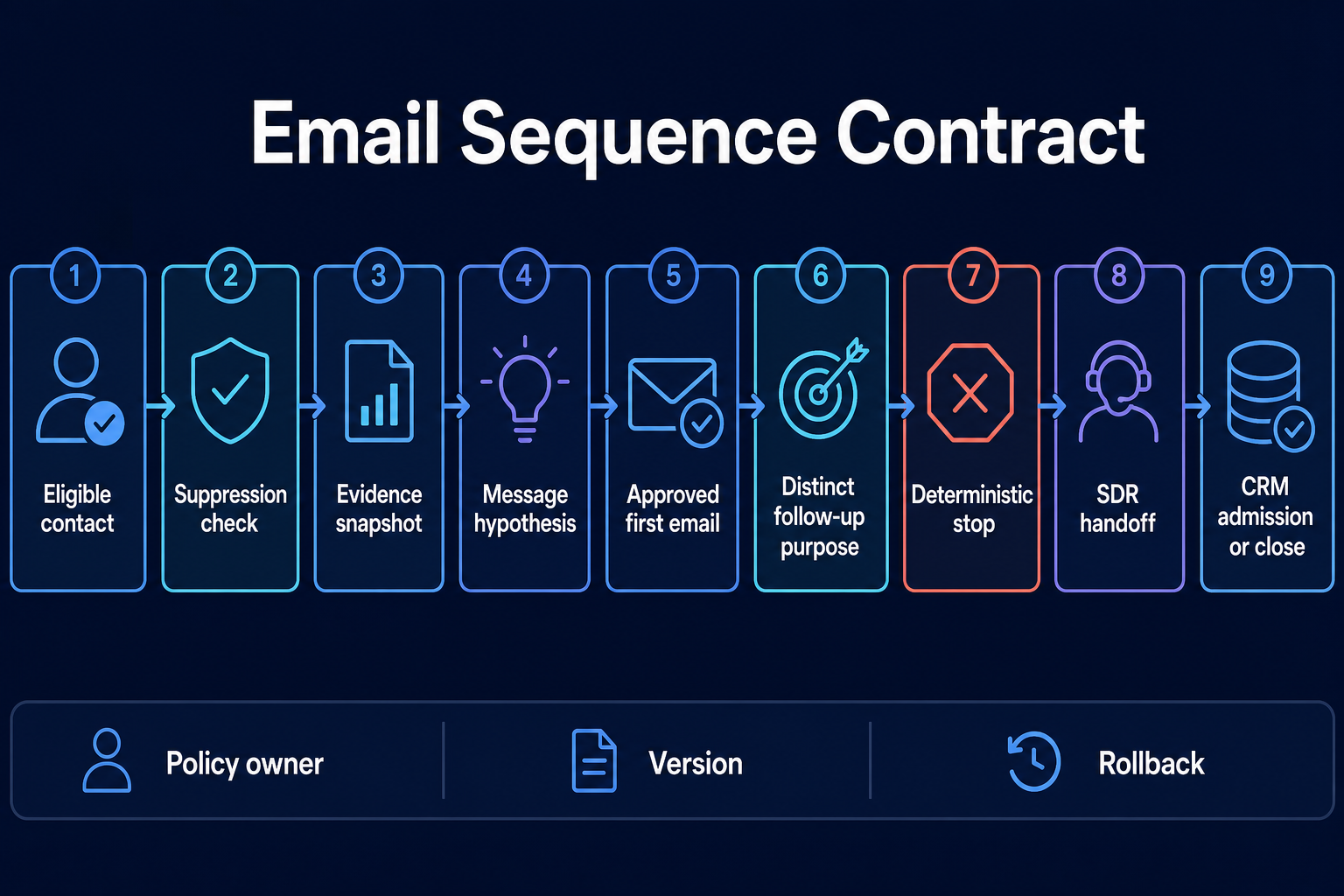
| Contract field | Decision to record | Why it matters |
|---|---|---|
| Eligible contact | Role, company, segment and exclusion checks | Prevents copy quality from hiding wrong targeting |
| Suppression check | Contact, account, customer, opportunity and prior-reply state | Prevents duplicate or prohibited outreach |
| Evidence snapshot | Source, capture date, observation and allowed claim | Makes personalization inspectable |
| Message hypothesis | Problem, offer, value angle and CTA | Keeps strategy outside the model's improvisation |
| First-email purpose | The one job of the opening touch | Prevents feature dumping |
| Follow-up purpose | A distinct reason for every later touch | Prevents repeated paraphrases |
| Human authority | Campaign-level, record-level or exception review | Makes approval proportional to risk |
| Deterministic stop | Reply, unsubscribe, hard bounce, owner conflict or manual pause | Stops timers from overruling state |
| Handoff and record | SDR disposition, CRM admission, nurture, close or correction | Gives the buyer and data a next owner |
Current contacts in the approved segment may enter after identity, suppression and owner checks. AI may summarize approved sources and draft from one message hypothesis. Routine cohort emails may send after campaign-level review; named accounts require record-level review. Every follow-up must add a new commercial reason. Any reply, unsubscribe or hard bounce stops the email path. An SDR validates replies. Pre-reply records stay in the outreach workspace; positive or neutral validated replies enter CRM with an owner and next action.
03 / Evidence
Build a source-linked email brief
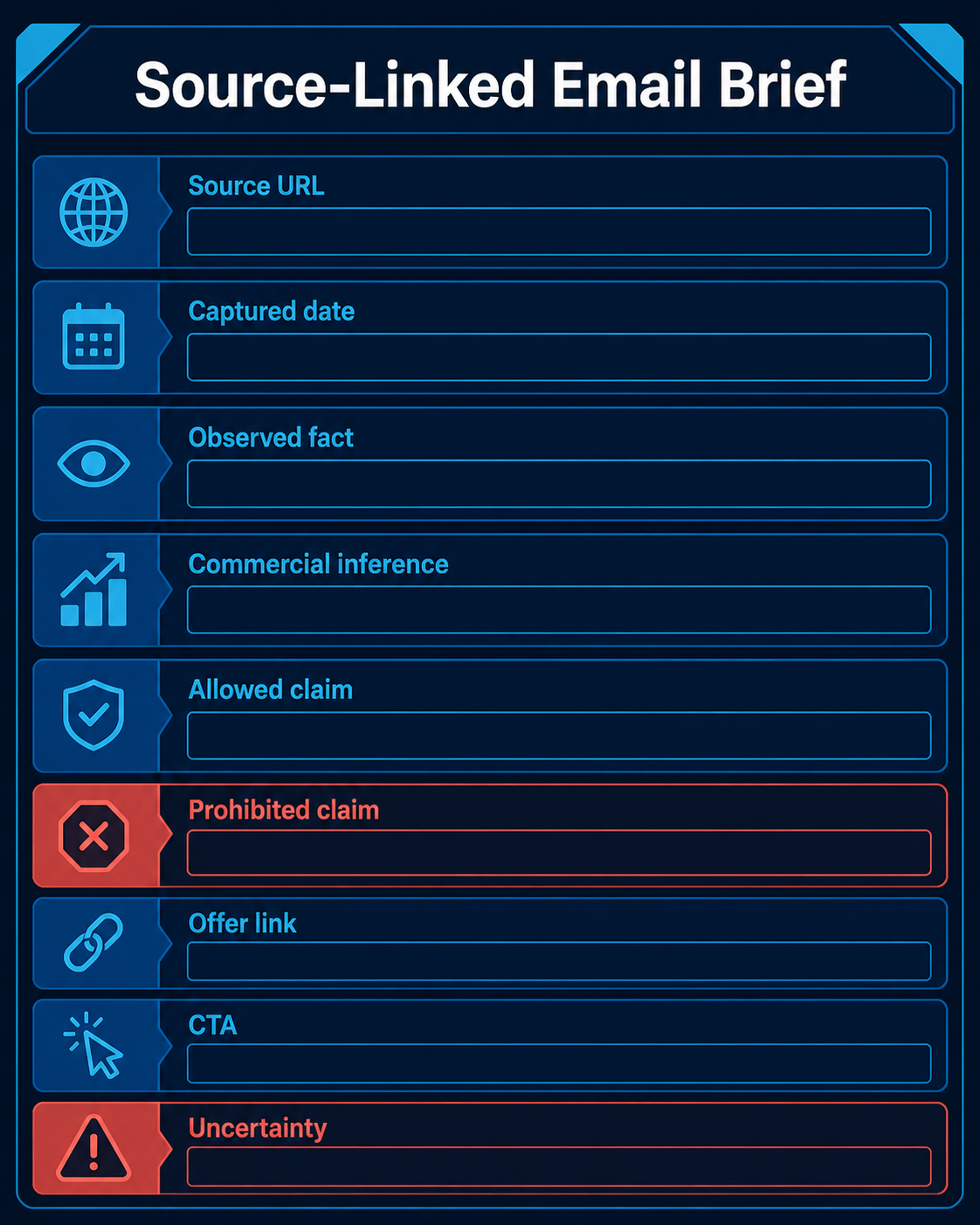
| Field | Example |
|---|---|
| Source URL | Official company careers page |
| Captured date | Named current date |
| Observed fact | Company lists three open support roles |
| Commercial inference | The team may be preparing for more support demand |
| Allowed claim | “I saw the open support roles” |
| Prohibited claim | “Your support team is overloaded” |
| Recipient relevance | Operations leader responsible for service delivery |
| Offer connection | Reduce after-hours response gaps |
| CTA | Ask whether the issue is worth comparing |
| Uncertainty | Hiring may be replacement, not growth |
04 / Draft the first
Draft the first email from the brief
- Reason: the current, sourced reason this person is receiving the email.
- Problem: the commercial problem that may follow, stated as a possibility rather than hidden knowledge.
- Offer: the specific help or artifact being proposed.
- CTA: one low-friction question that lets the recipient decide whether to continue.
- claims the recipient has a problem that the evidence does not establish;
- sounds as if the sender knows the person personally;
- opens with praise that has no commercial purpose;
- combines several unrelated facts;
- hides the offer behind generic AI language;
- asks for multiple actions;
- uses a feature list instead of a reason to respond.
05 / Sequence
Use a researched distinct-purpose sequence
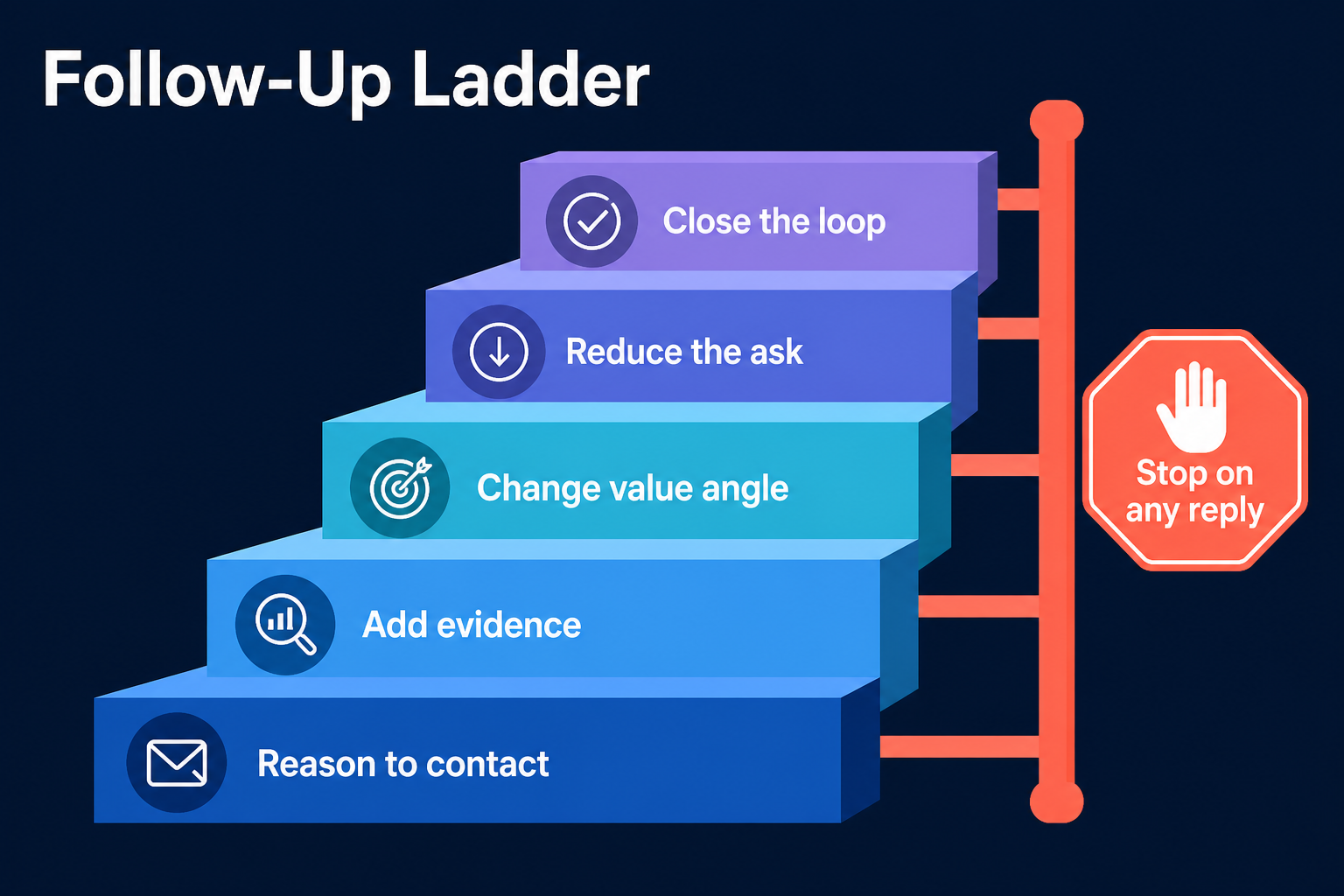
| Touch | Commercial job | New information | Stop condition |
|---|---|---|---|
| 1. Reason to contact | Connect one current source to one plausible problem | Source and offer | Any reply, unsubscribe, bounce or owner conflict |
| 2. Add evidence | Give the recipient a concrete artifact, example or comparison | New evidence, not “checking in” | Same |
| 3. Change the value angle | Address another approved consequence of the same problem | New role-relevant angle | Same |
| 4. Reduce the ask | Offer a smaller next step or direct answer | Lower-friction CTA | Same |
| 5. Close the loop | End the active sequence and leave a clear re-entry path | Explicit close | Same |
Touch 1: state the reason
Touch 2: add proof or an artifact
Touch 3: change the value angle
Touch 4: reduce the ask
Touch 5: close the loop
06 / Run a pre-send
Run a pre-send human gate
Eligibility and ownership
- Is the person still in the current role and company?
- Does an existing customer, opportunity, partner or named-account owner take precedence?
- Has the person or account replied, unsubscribed or been suppressed elsewhere?
Evidence and relevance
- Can the reviewer open the source?
- Is the capture date current enough for this signal?
- Does the message distinguish observation from inference?
- Does the recipient plausibly own the problem?
- Is the claim allowed by the campaign policy?
Message and offer
- Does the email have one job?
- Is the offer specific?
- Does the CTA ask one question?
- Does the follow-up add something new?
- Are all customer, performance, price and product claims verified?
Sender and compliance
- Are sender identity and routing information accurate?
- Are the sending domain and mailbox authenticated under the provider's requirements?
- Is the physical address and opt-out mechanism present where required?
- Can suppression update across every list and tool?
- Is the person accountable for the send identifiable?
Authority
- Is this a routine approved cohort or a named account?
- Who can pause the campaign?
- Who owns the thread after reply?
- Which ruleset and message version created this action?
07 / Sender controls
Separate official sender requirements from operator practice
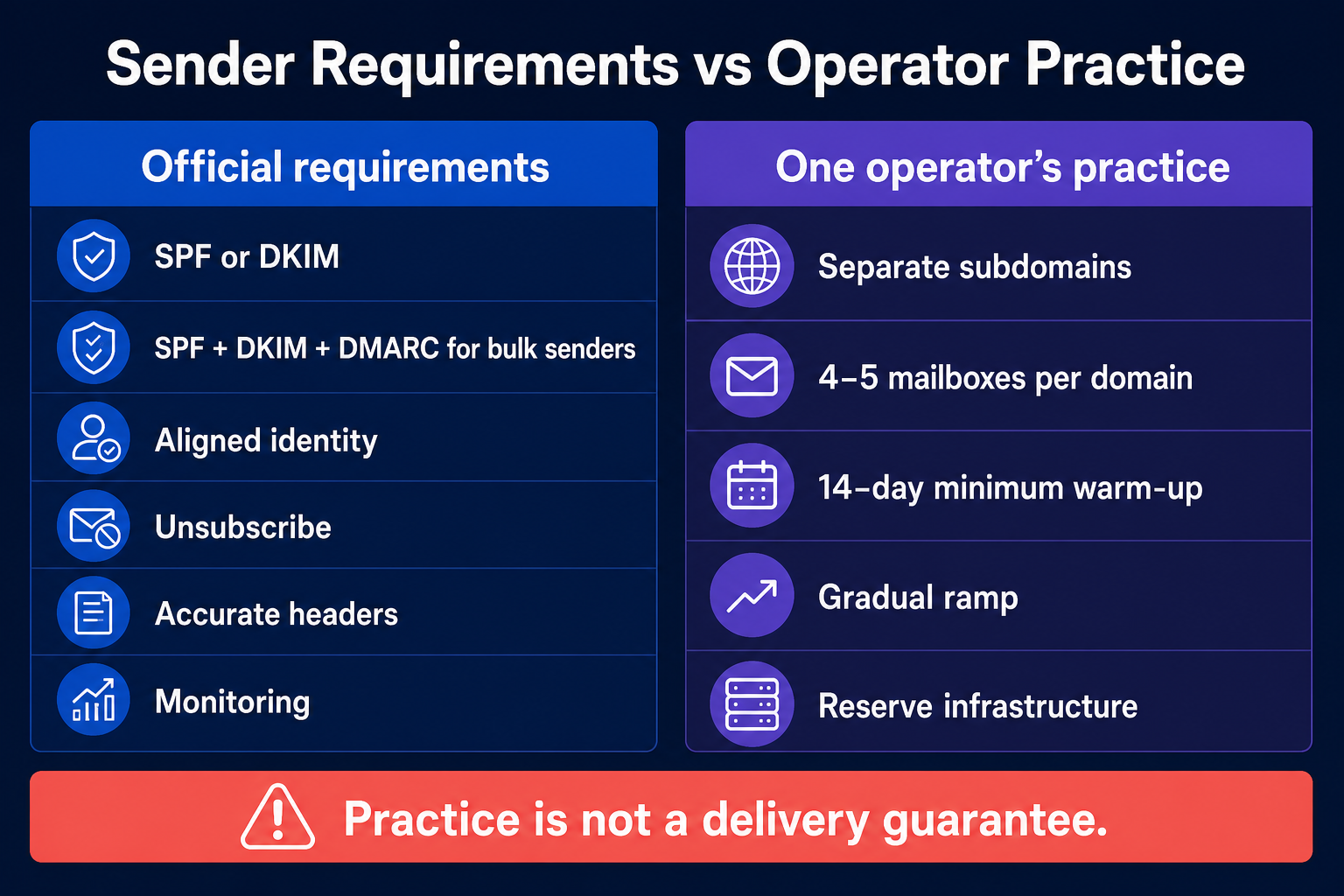
Current official requirements
Anastasiia's documented operating practice
- four subdomains, never the main domain;
- four to five mailboxes per domain;
- at least 14 days of warm-up;
- an initial five emails per day, increasing to 15 over three weeks;
- a stated ceiling of 30 emails per healthy mailbox or domain setup;
- ZeroBounce for mass verification, with Clay also used as a data source;
- Lemlist duplicate suppression;
- two or three reserve subdomains or mailboxes warming.
Sender preflight
- SPF, DKIM and DMARC status for the actual sending domain.
- Alignment of the visible From identity under the provider's rules.
- Valid forward and reverse DNS where applicable.
- TLS and provider-specific sender requirements.
- Accurate sender identity, subject and postal information.
- Working opt-out and global suppression.
- Current verified address and duplicate state.
- Gradual, monitored volume rather than a burst.
- Separate monitoring for normal business mail.
- A pause rule for provider errors, spam complaints and reputation change.
08 / Workflow
Model sequence state instead of relying on timers
| State | Meaning | Required action |
|---|---|---|
| Scheduled | A future attempt is permitted under the current contract | Recheck state before send |
| Attempted | The platform tried to send | Await provider result |
| Delivered | Provider accepted the message for delivery | Do not call it read or successful |
| Bounced | Address or provider rejected the message | Stop the address and investigate |
| Out of office | Automated reply created new timing or delegation context | Pause and review |
| Buyer replied | Recipient supplied relationship context | Stop all touches and hand off |
| Unsubscribed | Recipient opted out or requested no contact | Suppress across tools |
| Manually paused | Human owner stopped the sequence | Record reason and owner |
| Completed | Sequence ended without another permitted touch | Do not silently restart |
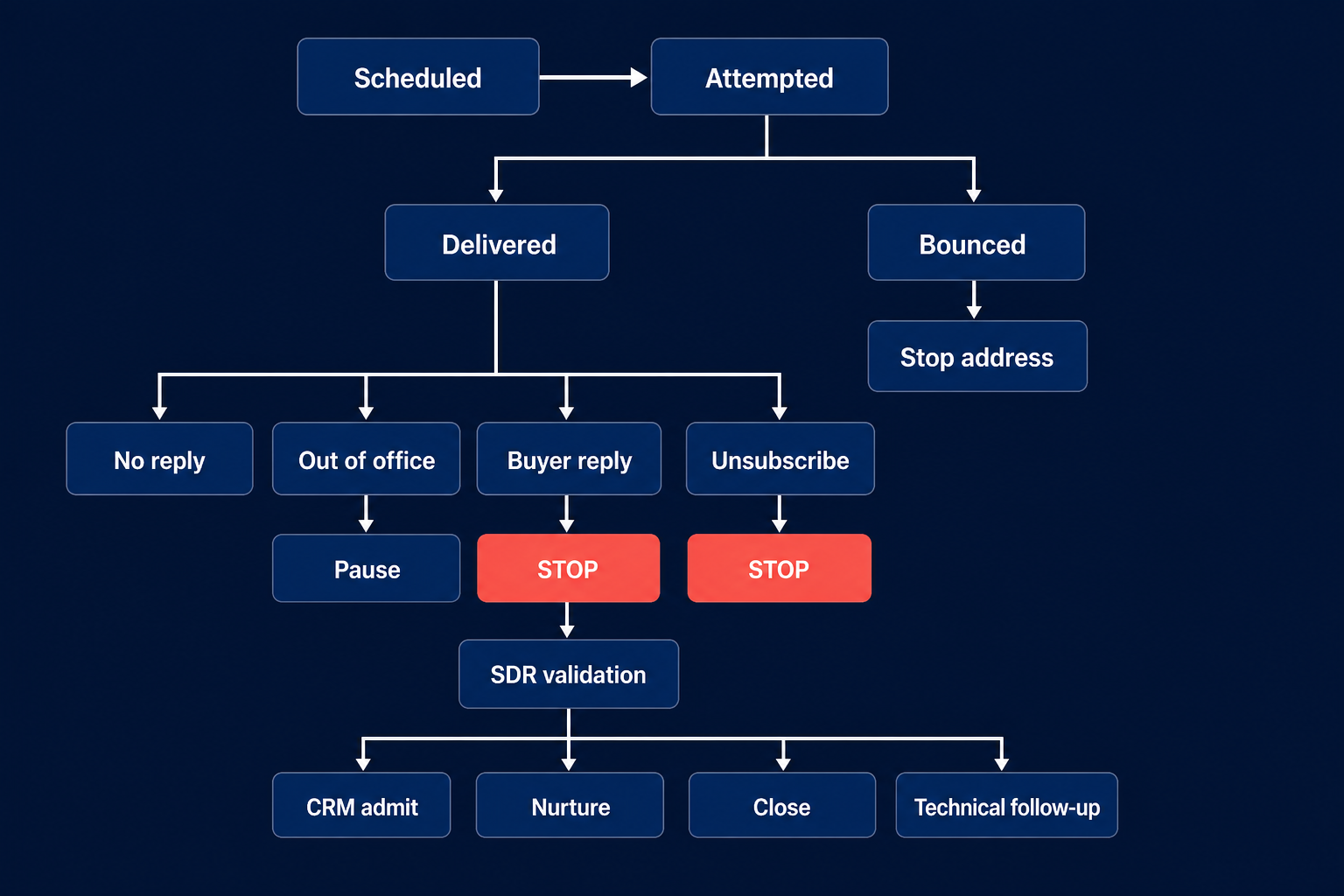
09 / Reply control
Transfer every reply to an SDR
| Reply | SDR decision |
|---|---|
| Positive interest | Validate need, account, owner and next action |
| Neutral question | Answer, route for detail or qualify the context |
| Objection | Respond, close or set a justified revisit condition |
| Referral | Validate the referred person before new outreach |
| Wrong person | Correct identity; do not automatically enroll another contact |
| Not now | Record reason and human-approved re-entry condition |
| Unsubscribe | Suppress; do not continue |
| Out of office | Check return date, delegate and whether resumption is appropriate |
| Ambiguous | Keep paused until a person resolves meaning |
| Technical question | Bring the technical team into the thread with context |
- evidence source and capture date;
- all sent messages and timestamps;
- the complete reply;
- suggested disposition and confidence;
- account and owner conflicts;
- suppression state;
- next-action options.
10 / CRM state
Keep untouched cold records out of qualified pipeline
- a positive or neutral reply;
- human validation of identity and context;
- assignment of an owner;
- a usable next action.
11 / Workflow
Pilot the AI email sales outreach workflow on a fixed sample
- Freeze the segment, offer, evidence rules and message hypothesis.
- Select one fixed sample.
- Create a human answer key for eligibility, evidence, permitted claim and suppression.
- Review every first email and follow-up purpose.
- Test reply, unsubscribe, bounce and out-of-office stops.
- Launch only the approved cohort.
- Review every reply and exception.
- Change one variable at a time.
- Keep the previous approved ruleset available for rollback.
| Metric | Definition |
|---|---|
| Eligible-record rate | Records passing identity, segment and suppression checks ÷ records reviewed |
| Evidence acceptance | Evidence briefs accepted ÷ briefs reviewed |
| Message approval | Drafts approved ÷ drafts reviewed |
| Delivery rate | Delivered messages ÷ attempted messages |
| Bounce rate | Bounced messages ÷ attempted messages |
| Meaningful reply rate | Human-validated meaningful replies ÷ delivered messages |
| Held-meeting rate | Held meetings ÷ validated positive or neutral replies |
| Accepted-opportunity rate | Opportunities accepted under the CRM rule ÷ held meetings or validated replies |
| Review time | Human minutes ÷ reviewed records |
| Total cost | Data, infrastructure, software and human time for the measured period |
12 / Failure modes
Diagnose the failure before changing the copy
Low delivery or rising bounces
Delivery is stable but replies are weak
Replies arrive but meetings do not
Follow-ups produce complaints
CRM fills while pipeline stays flat
One wrong-person reply appears
A reply is followed by another automated touch
13 / Checklist
AI email sales outreach checklist
Before drafting
- Confirm eligible contact, account and owner.
- Capture current evidence and date.
- Separate observation from inference.
- Define one message hypothesis.
- Check suppression across tools.
Before sending
- Verify SPF, DKIM and DMARC for the actual sending domain.
- Confirm current Google, Microsoft and other provider requirements.
- Confirm sender identity, postal information and opt-out behavior.
- Review message claim, offer and CTA.
- Confirm follow-up purposes and stop states.
- Keep named accounts under record-level review.
After sending
- Store attempted, delivered, bounced, OOO, reply and unsubscribe as separate events.
- Stop on every reply.
- Hand the full thread to an SDR.
- Admit only validated positive or neutral replies to CRM under this operating policy.
- Measure meaningful replies, held meetings and accepted opportunities with denominators.
- Roll back when stop, suppression or ownership controls fail.
14 / FAQ
Frequently asked questions
What is AI email sales outreach?
Can AI write and send the first email automatically?
How many follow-ups should an AI email sequence contain?
What should stop an automated email sequence?
Does a separate subdomain guarantee deliverability?
Should all cold contacts be added to CRM?
Is CAN-SPAM enough for global outreach?
15 / Decision rules
Final operating rule
16 / Method
Sources and methodology
- Gmail email sender guidelines — current Google authentication, alignment, monitoring and volume guidance for messages to personal Gmail accounts.
- Gmail sender guidelines FAQ — current Google bulk-sender definition, primary-domain counting and covered unsubscribe requirements.
- Microsoft outbound spam protection — current Microsoft 365 bulk-mail, primary-domain and custom-subdomain guidance.
- FTC CAN-SPAM compliance guide for business — US federal commercial-email overview, including B2B; not legal advice.
- Owner-supplied sources K02 and K03 — five-pillar email model, real Lemlist context, sender practice, reply-stop and CRM-admission rules reviewed on 18 August 2026.
Research note
Methodology
- 01The guide uses Anastasiia Krynytska's real Lemlist workflow and documented sender practices.
- 02The exact email-only touch order is editorial synthesis, not a sequence the author claims to have run unchanged.
- 03Provider and FTC sources support only the official requirements they state.
Source ledger
Sources & editorial notes
- 01Gmail email sender guidelines
support.google.com · Official product, platform, policy or regulatory source cited in this guide.
- 02Gmail sender guidelines FAQ
support.google.com · Official product, platform, policy or regulatory source cited in this guide.
- 03Microsoft outbound spam protection
learn.microsoft.com · Official product, platform, policy or regulatory source cited in this guide.
- 04FTC CAN-SPAM compliance guide for business
US Federal Trade Commission · Official product, platform, policy or regulatory source cited in this guide.