Weekly industry intelligence · No noiseSubscribe to the Luck My Sales newsletterFree briefing

Independent intelligence on AI in sales

Menu

Implementation guide · RevOps automation

How to Implement Lead Scoring Criteria in Your CRM Without Hiding the Sales Decision

A field-tested CRM guide to hard stops, fit and engagement criteria, evidence confidence, human review, score thresholds and outcome-led calibration.
Editorial disclosure

AI may assist research organization and drafting. A human editor reviews every published page, checks material claims against the cited sources and owns the final decision. No company paid for placement in this article.

AI use policy

Agent-ready brief

AI takeaways

Keep the key points here, or take a source-aware text brief into Claude, ChatGPT or another AI workspace.
  1. 01Name the business action and outcome that a score is intended to influence before assigning points or bands.
  2. 02Keep eligibility, account and contact fit, workflow relevance, engagement and evidence confidence separately visible.
  3. 03Use hard stops and score caps for missing proof; strong known fields must not repair invalid identity or hidden uncertainty.
  4. 04Store source lineage, rule version, model rationale, human decision, override reason and downstream outcome in the CRM.
  5. 05Calibrate from structured disagreements and outcome reasons, then backtest and approve each new rule before wider automation.
Includes summary, takeaways, sources and a use note.
A reliable lead scoring engine criteria implementation begins by defining the business decision that the engine will influence. Separate mandatory eligibility from account fit, behavioral engagement and confidence in the available evidence. Preserve the accountable human decision beside the model recommendation, then connect both to downstream commercial outcomes. Revise criteria from those observed outcomes rather than optimizing for an attractive score distribution.
The resulting score is a routing hypothesis, not the sales decision itself. It helps a seller prioritize a record, select an appropriate channel or choose a follow-up path without replacing professional judgment.
This guide draws on an anonymized B2B scoring workflow I reviewed in July 2026. Public company pages and verified contact records informed a 1–10 fit estimate with documented reasoning, while a human reviewer approved each outreach batch. The audit uncovered category shortcuts, outdated employment roles and important workflow mismatches.
The campaign was not a controlled experiment, and the team did not calculate formal false-positive or override rates. This case demonstrates how to make a scoring decision inspectable, reproducible and open to correction. It neither establishes universal thresholds nor proves that scoring caused later sales outcomes.
Disclosure: I have no commercial relationship with any vendor named here. I am not their affiliate, client, employee or sponsor. Products appear only to explain documented capabilities or tools used in the workflow.

When evidence is thin, lower confidence—not standards. AI recommends; a seller qualifies.

01 / Decision architecture

Implement a decision system, not a decorative score

The useful output is not merely “82 points,” but a recommendation that a responsible seller can review. That recommendation needs attributable supporting evidence, a defined next action, and an accountable human owner.
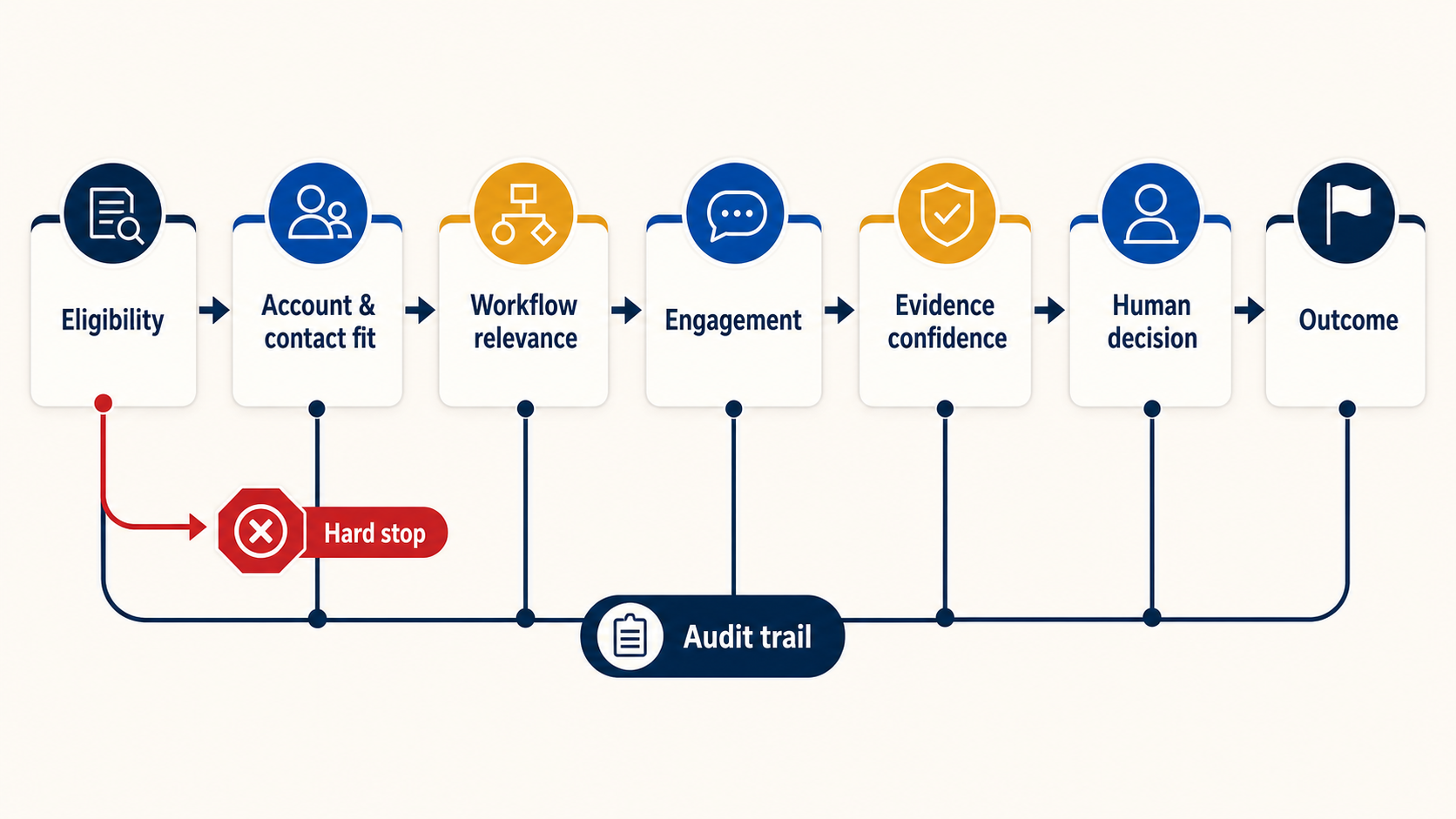
A complete setup keeps these states apart:
StateQuestion it answersExample CRM valueOwner
EligibilityMay this record enter the scoring workflow?eligible, blocked, reviewRevOps or policy owner
ICP fitHow closely does the account and contact match the approved target?8/10 with component fieldsSales/RevOps
Workflow relevanceDoes the buyer or its clients operate the problem the offer solves?inbound calls, outbound database, not evidencedSeller or segment owner
EngagementWhat observable interaction occurred, and how recent was it?accepted invite, pricing-page visit, no responseMarketing/sales operations
Evidence confidenceHow complete, current and attributable is the proof?high, medium, lowReviewer
Human decisionWhat did the accountable person approve?route to email, hold, rejectNamed seller or reviewer
OutcomeWhat happened after the action?wrong person, interested, call held, contractSeller/CRM owner
Lead scoring architecture from eligibility and fit through human decision and outcome.
Keep the evidence, recommendation, decision and outcome as separate CRM facts.
This separation prevents three common analytical errors. A high-fit account may show no current engagement, while an active person may still be a poor commercial fit. A record may also appear suitable when the evidence supporting that conclusion remains incomplete, stale, or contradictory.
Some CRM products already support part of this architecture. HubSpot describes separate fit, engagement, and combined scores, alongside inclusion and exclusion criteria. Those capabilities can preserve distinct scoring dimensions and make them visible to an operator. They cannot determine which criteria reliably represent your own sales process or qualification standard. See HubSpot’s current lead score setup and scoring overview.

What a lead score should control

A scoring engine converts mixed account and contact evidence into a limited recommendation. It should not manufacture certainty or declare an opportunity. Nor should it execute a consequential customer action in silence. The suggested action must reflect both evidence quality and the cost of a false route.
A score can rank records or recommend a controlled action:
RecommendationResulting action
RejectRecord the failed hard rule
HoldGather more evidence
ReviewSend the record to a seller
RoutePlace it in a channel-specific queue
NurtureEnter the approved follow-up path
CallTrigger the approved immediate-call process
ResearchRequest a manual account brief
Do not ask one aggregate score to predict every event between database entry and closed revenue. A score designed to allocate research effort may be unsuitable for creating a sales opportunity. Each decision has a different target outcome, time horizon, review burden, and cost of error.

Lead scoring and lead qualification are different states

Lead scoring ranks. Lead qualification changes the next action.
This distinction matters because a model can rank records without confirming intent or authority. It may also miss commercial timing. Qualification adds a judgment about the next sales action under the team’s current rule. A ranking can support that judgment, but never replace it.
In the reviewed workflow, the score estimated ICP fit and recommended an outreach channel. Scores from 8–10 entered a LinkedIn route, while scores of 7 or less entered an email route. A mandatory disqualifier could block either route regardless of the numerical total. Human approval still controlled the first records, the initial messages, and consequential outbound actions.
This campaign rule is not a universal standard. Another team may use scores for research allocation, SDR review, or nurture. A scoring rule is valid only when it specifies the resulting action.
Our AI-assisted lead qualification guide shows where scoring ends and seller qualification begins.
Our Gmail-to-CRM lead-scoring guide shows how a reply becomes versioned evidence, a human-approved action and an auditable influence event.

02 / Commercial decision

Start with the commercial decision and its outcome

Before choosing criteria, write this statement:

For this record, the score suggests an action. A later outcome tests the rule.

Replace every vague word.
For example:

For a verified B2B contact, the fit score suggests LinkedIn or email. Record interest, held calls, and contracts as separate later outcomes.

This statement defines a test. “The score finds the best leads” does not.

Define the object being scored

An account, contact, deal and buying group are not interchangeable.
Each CRM object has different fields, owners, and valid outcome labels. One opaque formula creates false precision. Strong account traits can hide a weak contact match. Diagnosis also fails when the team cannot tell which object produced the error.
  • Account fit covers the business model, clients, geography and scale.
  • Contact fit covers the current role, authority, and verified company link.
  • Engagement records a dated action by a person or account.
  • Deal score covers an active sales process, its stage, and supporting proof.
Do not copy every account field into each contact score. One strong account can contain several kinds of people. One may own the decision. Another may have no role in it. A former leader may still appear in old data. A total score hides which layer passed.

Define an action, not a hot/warm label

Terms such as hot, warm, MQL, and SQL can hide different actions. Replace each vague label with a clear operation.
Weak labelBetter operational definition
Hot leadSeller must inspect within four business hours; no automatic send
MQLMeets approved account and contact criteria and has a named engagement event
SQLSeller has accepted the record under the current opportunity rule
Low scoreKeep in research or nurture; do not interpret as permanent rejection
The definition needs an owner, required proof, and response time. Without them, the team cannot audit the threshold.

Choose the outcome that will correct the rule

The right outcome depends on the decision.
Outcome selection is a measurement problem, not a reporting preference. The label must occur near the scoring decision. Otherwise, the team cannot interpret the connection. It must also occur often enough for comparison across bands, routes, or rule versions.
If the score selects research, track how often sellers accept the account. For channel choices, compare replies and positive interest across each route. For call recommendations, record held calls instead of bookings alone. Create opportunities only under the sales team’s approved rule.
Do not judge every scoring choice against closed-won revenue. A long cycle may leave too few recent examples. Message quality, timing, sender, price, and sales execution also shape the result.
Use the nearest outcome that the decision can influence. Keep later stages for context.

A worked implementation from source to outcome

Consider one record entering the scoring workflow. Operations first confirms the domain and current employer. A fixed rule blocks the record if either check fails. Industry and company size cannot repair that failure.
If identity passes, the model reviews service pages and customer stories. It identifies the client type, workflow, and likely commercial problem. The output separates confirmed facts, limited inferences, and unknown information. Every key fact keeps its source URL and retrieval date.
The CRM then calculates each part and applies approved caps. Missing workflow evidence, for example, limits the total to 7. The LinkedIn route remains blocked until a person verifies that evidence. The seller can choose email, request research, or reject the record with a reason.
That decision becomes the baseline for later measurement. The team records replies, positive interest, held calls, and contracts as separate events. It also records wrong-person replies, incumbent tools, timing issues, and offer objections. These details show whether to change the fit rule, contact rule, route, or message.
Repeated errors create a proposed rule version. Historical scores stay tied to the old version. New records use the revised logic. Old records can receive a separate rescore without losing the original advice. This preserves an audit trail instead of rewriting the past.

03 / Criteria model

Build separate criteria for eligibility, fit, workflow, engagement and confidence

The criteria should reveal why a record moved. They should not merely produce a total.

Eligibility and hard disqualifiers

Eligibility comes first because some failures cannot be repaired with more points.
In the approved workflow, these conditions override a high score:
Hard-stop areaBlocking condition
DomainInvalid or invented domain
IdentityUnresolved person-to-company match
CompetitionCompany appears on the approved exclusion list
RoleWrong or outdated current role
WorkflowNo proof of the required client workflow
LinkedIn routeNo verified LinkedIn profile
PolicyLegal, suppression or contactability block
Store each rule as its own Boolean or status field. Never turn a hard stop into a minus-20 adjustment. Company size and industry points cannot repair a failed identity check.

ICP and account fit

Account fit should describe the commercial model, not just firmographics.
Company traits are useful filters. Yet they rarely show whether an account experiences the problem behind the offer. A useful fit model combines stable facts with evidence about customers, services, and workflows. This creates a commercial profile instead of a simple demographic resemblance.
Useful fields may include:
Field groupWhat to capture
Commercial modelCustomer type and business model
MarketIndustries served and allowed regions
CapacityCompany size and operating capacity
Offer fitCurrent services and adoption or resale capacity
Problem evidenceProof that the relevant problem exists
PortfolioThe client accounts that shape the use case
Industry and size are weak when used alone. In the July case, “marketing agency” did not settle fit. We inspected the agency’s clients and their workflows.
An agency serving appointment-led local firms had one use case. An agency booking software sales meetings had another. Both used a broad sales or marketing label. The clients’ work determined the relevant offer.

Contact fit must use the current role

Contact scoring should answer two questions:
  1. Does this person still work with the target company?
  2. Can the current role own or influence this decision?
This test needs current proof. One contact still had a link to the chosen company. Yet the person now worked through another automation business. The company and identity were real. The sales choice was still wrong because the role was stale.
That failure changed the rule. Check the current headline, active roles and competing interests. A name-to-company match is not enough.

Workflow relevance determines product fit
Workflow relevance asks whether the target operates the problem that the offer solves.
This criterion matters when one broad audience supports several product paths. An agency may match the partner profile but serve clients with another workflow. Calling that low account fit would hide the true diagnosis. The company fits, but the proposed use case does not.
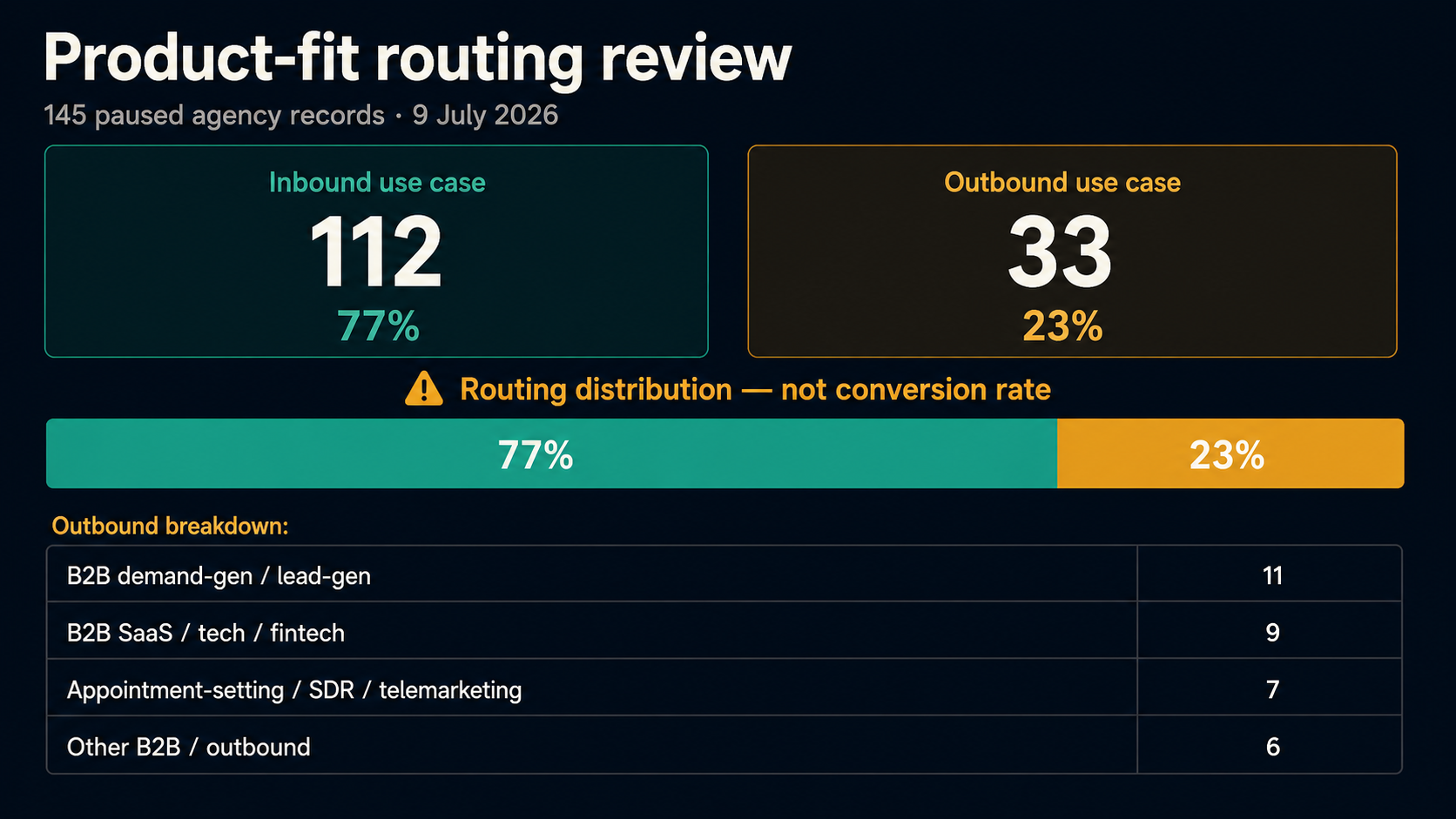
This dimension changed a review of 145 paused agency records. The team first examined each agency’s clients. It then chose the relevant product path. Reviewers assigned 112 records, or 77%, to an inbound use case. The other 33 records, or 23%, stayed on an outbound path. Those agencies mainly served B2B or outbound-led clients.
Routing review of 145 records: 112 inbound use case and 33 outbound use case.
The 77%/23% split records a reviewed routing decision, not a conversion result.
Those percentages are not conversion rates. They describe one reviewed routing decision from July 9, 2026. The result shows why product fit needs its own field. A company can match the reseller ICP yet need another offer.

Engagement, intent and recency

Engagement means an action we can observe. It does not prove intent by itself.
Store the event and timestamp rather than a permanent bonus:
Event classExample
SocialInvitation accepted
EmailReply received
WebsiteOffer page viewed
FormForm submitted
QuestionPricing or setup question
CallBooked or held
SequenceNo response after the defined steps
Use recency and decay when old behavior loses meaning. A visit from yesterday may matter more than one from nine months ago. The decay period must match the sales cycle. Do not copy a universal 30-day rule.

Unknown evidence must lower confidence

Confidence rates the proof behind the advice. It is not a softer fit score.
Confidence should reflect completeness, freshness, source quality, and consistency. It should not reward persuasive language or model certainty. One stale source deserves a different route from several current, attributable sources. This remains true even when both recommendations claim high fit.
Use at least four states:
  • confirmed: a current source supports the criterion;
  • inferred: several facts support a narrow conclusion;
  • unknown: the required evidence was not found;
  • conflicting: sources disagree or look stale.
Missing or conflicting proof sends the record to human review. It also caps the score at 7. The LinkedIn route remains blocked until a reviewer confirms the required facts.
The cap is an approved rule for this workflow. It is not a global standard. Its purpose is simple. Good known fields cannot turn missing proof into high confidence.

04 / CRM implementation

Translate the criteria into CRM fields and deterministic rules

The CRM must keep the input, rule, advice, decision, and outcome. Overwriting one layer removes part of the diagnosis.
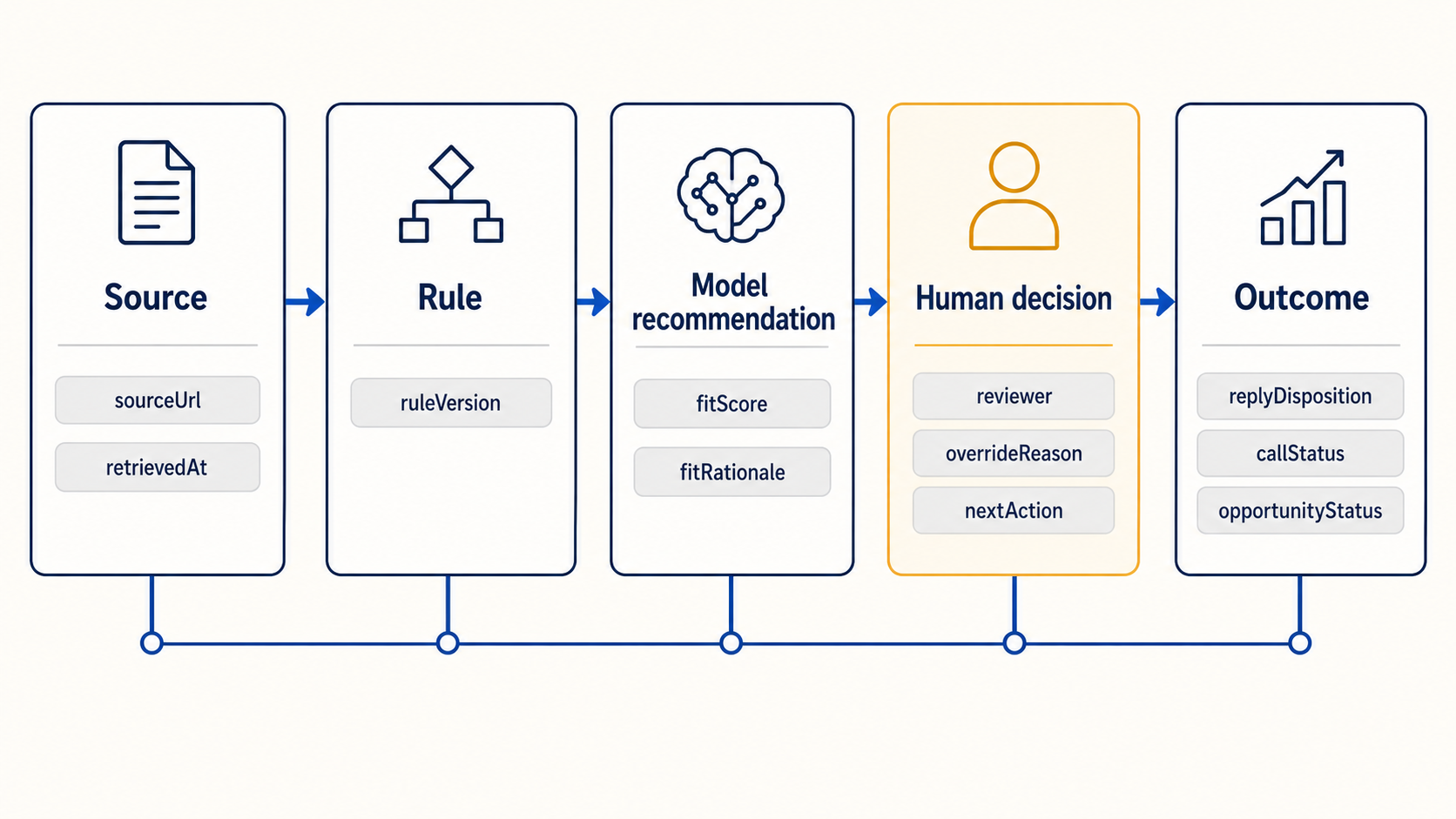
An auditable schema should preserve data lineage throughout the decision process. Every recommendation must identify the source fields, transformation rule, scoring version, reviewer decision, and resulting disposition. This separation allows revenue operations to reproduce a historical decision and determine precisely where a later error originated.

Store source, score, decision and outcome fields

LayerMinimum fieldsWhy they matter
SourcesourceSystem, sourceUrl, retrievedAtReopen the evidence and assess freshness
IdentitycompanyDomainVerified, contactCompanyVerified, currentRoleVerifiedEnforce hard stops before scoring
FitaccountFit, contactFit, workflowFitExpose which part of fit passed or failed
EngagementengagementEvent, engagementAt, engagementScoreKeep behavior and recency separate from static fit
ConfidenceevidenceStatus, evidenceConfidence, conflictNotePreserve unknown and conflicting evidence
ModelfitScore, fitRationale, ruleVersion, scoredAtExplain and reproduce the recommendation
Human decisionreviewStatus, reviewer, reviewedAt, overrideReason, nextActionEstablish accountability
OutcomereplyDisposition, callStatus, opportunityStatus, outcomeAtRecalibrate from what happened later
CRM data lineage from source evidence to rule, recommendation, human decision and outcome.
An audit trail should preserve what the system knew, what it recommended and what the seller decided.
The live workflow stored the company name, website, and LinkedIn page. It also kept industry, size, location, description, and segment. The model added a fit score and written reasons. Each contact had a name, title, and LinkedIn URL. The improved schema adds proof state, rule version, human override, and outcome history.
That distinction matters. The first system lacked some controls now recommended.

Store fitRationale beside fitScore

The live CRM showed both fitScore: 8 and a written fitRationale. That is better than a bare total. The rationale still needs a fixed structure.
A useful rationale should state:
  1. the evidence that passed;
  2. the evidence that failed;
  3. what remains unknown;
  4. the rule or cap applied;
  5. the recommended action.
For example:

Account matches the approved agency segment and serves the target client type. Current contact role is verified. Client workflow is inferred from two current case studies. No hard disqualifier found. Confidence: medium. Fit score capped at 7 pending direct workflow evidence. Recommended action: email route or manual research.

This format is easier to inspect than a loose model paragraph.

Version rules without rewriting history

Record a ruleVersion and scoredAt timestamp. When an error repeats, create a new rule version. Do not change the prompt in silence.
Version control is essential because scoring criteria evolve as the team discovers exclusions, stale fields, and missing workflows. Without an explicit version, historical outcomes can appear to validate rules that did not exist when the original decision occurred. A separate timestamp also distinguishes changing evidence from changing logic.
Historical records should keep their original score and rule. A later rescore belongs in new fields. Otherwise, old outcomes may seem to validate logic that did not yet exist.

Prevent double counting

Correlated signals can inflate a total.
Suppose four signals add points: industry = dental, clinic service page, clinic case study and Google Ads. They may reflect one fact. The agency serves appointment-led health clients. Use the signals to support one dimension, not four separate fit claims.
Use a cap for each dimension or an ordered rule. More proof can raise confidence without adding endless fit points.

Do not mix deliverability with lead fit

Deliverability asks if email can reach the inbox. Sender reputation rates the sending system. Enrichment confidence rates a data field. Lead fit asks whether the offer suits the record. Keep these scores separate.
A weak sender can harm a campaign aimed at strong prospects. That does not make those prospects poor fit. Store system health apart from lead fit. Stop the campaign when its sending system fails the required threshold.

05 / Threshold design

Set initial points and thresholds without copying arbitrary templates

No global rule says company size deserves 15 points. Nor must an MQL begin at 70. A neat 100-point model can still encode guesswork.
Initial weights are hypotheses about the relative importance of each criterion. They should reflect commercial judgment, observed history, and the operational consequence attached to a score band. A weight becomes defensible only after reviewers can explain it and outcome data can challenge it.
The July workflow used ordered rules and a final 1–10 estimate:
OrderRule
1Verify identity and route fields
2Apply hard exclusions
3Inspect account, client, and workflow evidence
4Cap unknown or conflicting evidence at 7
5Estimate final ICP fit
6Attach a written rationale
7Ask a person to approve early records and exceptions
This order works well when must-have conditions exist. Points can still compare records inside a valid group. They should never cancel a hard failure.

Backtest the decision, not just the distribution

Start with reviewed history when it exists. Use only the proof available at scoring time. Compare the model advice with the later seller decision. Then add the relevant outcome.
This point-in-time constraint prevents hindsight leakage. A company page updated after outreach cannot justify the earlier recommendation, and a later job title cannot repair stale contact evidence. Backtesting should reconstruct what the system and reviewer could genuinely know when the route was selected.
Useful checks include:
CheckComparison
Seller acceptanceBy score band
Human overridesCount and reason
Evidence holdsMissing or conflicting source
Positive replies after pitchBy route
Held callsBy score band
ContractsBy score band
Review timeBy score band
Do not choose a threshold to create a neat count of “hot” leads. Choose it when review effort and error cost suit the action.

Use a fit × engagement × confidence matrix before one total

One total is often less useful than a small matrix.
FitEngagementConfidenceRecommended action
HighHighHighPrioritized seller review
HighLowHighApproved outbound or account-based nurture
HighAnyLowResearch hold; do not auto-route
LowHighHighReview intent and identity; do not promote on engagement alone
LowLowHighSuppress or deprioritize under the current ICP
AnyAnyConflictingHuman review and source reconciliation
This matrix stops one webinar click from creating a false SQL. It also protects a strong account that has not engaged yet.

Route by action, not adjective

Document what each threshold does.
Band in this workflowMeaningRoute
BlockedHard disqualifier or contactability restrictionNo activation; record reason
1–6Low fit under current evidenceReject, deprioritize or research only if strategically valuable
7Plausible fit with a material unknown or weaker evidenceEmail route or manual review
8–10Strong fit supported by required evidenceLinkedIn route after approval
The boundaries are not a market standard. They record one campaign decision. A new audience, sender, offer, or channel needs a fresh test.

06 / AI and human roles

Add AI only where fixed rules stop being sufficient

AI is useful when the proof is unstructured. Fixed checks should own facts they can verify.
This division of labor reduces unnecessary model discretion. Deterministic logic handles conditions with a single verifiable answer, while a language model interprets nuanced text under a bounded rubric. The human reviewer remains responsible for consequential actions, conflicts, and exceptions that exceed the approved automation scope.

Deterministic rules should own hard constraints

Use fixed logic for:
ControlDeterministic check
IdentityVerified domains and required URLs
Data hygieneDuplicates and suppression
RoutingRequired fields for each route
CompetitionApproved competitor lists
ScoreCaps and allowed ranges
PolicyConsent and contactability states
TimeDate arithmetic and score decay
CRMAllowed status transitions
These rules should be readable without prompting a model.

An LLM should interpret sourced context

An LLM can help answer focused questions from current sources:
  • Who does this company serve?
  • Which workflow appears in its case studies?
  • Does the contact’s current role conflict with the selected account?
  • Is the company a buyer, reseller, or competitor?
  • Which facts support the fit recommendation?
  • Which proof is missing or in conflict?
Require three outputs: evidence, inference, and unknowns. A plausible answer without a source remains unconfirmed.

Predictive scoring requires a stable outcome label

Predictive scoring estimates an outcome from past data. LLM scoring reads text against a fixed rubric. They solve different problems.
Microsoft Dynamics describes scores from 0 to 100. It also shows reasons, grades, and score trends. These features put an explanation beside the number. They do not prove that its model matches your opportunity rule. See Microsoft’s predictive scoring guide.
Use predictive scoring only when the target label is stable. The history must also reflect the current process. If the ICP or qualification rule changed, the model may learn old behavior. Poor CRM hygiene creates the same risk.

The seller must approve consequential decisions

Human review is required at these points:
Review pointWhy a person decides
First batch under a new ruleExpose repeated errors before scale
Exceptions or source conflictsResolve facts the rule cannot settle
Hard-stop or threshold changesControl a system-wide change
High-value or high-risk recordsMatch oversight to the cost of error
External messages and pilot routesApprove actions outside the CRM
Replies that change the next stepInterpret new buyer context
Rules drawn from small samplesPrevent weak evidence from becoming policy
NIST’s AI Risk Management Framework is not a sales manual. Its governance approach still helps here. Teams should define human and AI roles, then watch results after launch. The framework covers human oversight and ongoing checks.

07 / Pilot and calibration

Pilot the scoring engine before automatic routing

The first goal of a pilot is not scale. It is to find repeated errors while they remain cheap to fix.

A large source pool is not a qualified-lead list

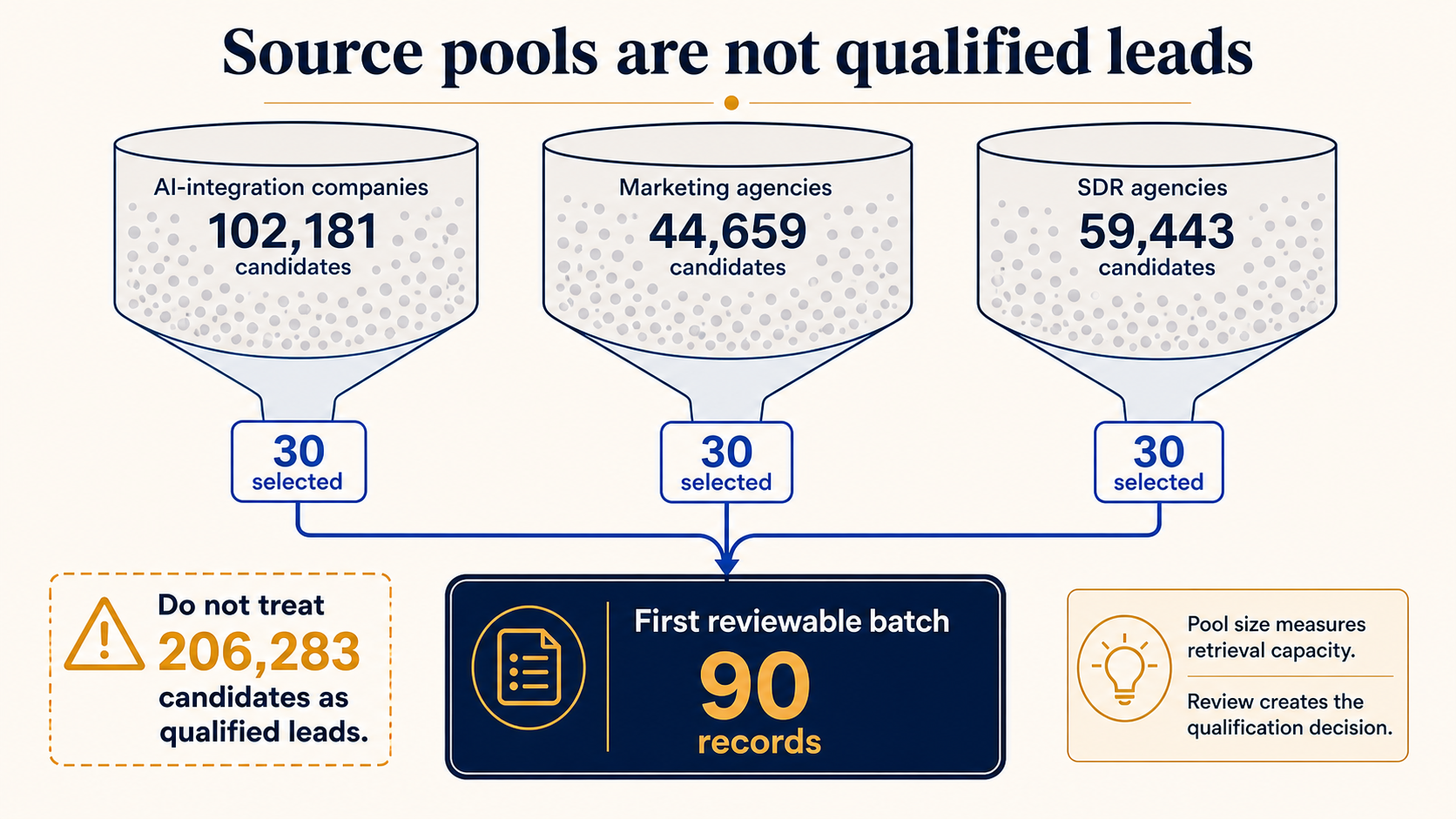
In one documented pilot, sourcing produced three candidate pools:
Source segmentCandidates in source poolRecords selected for first review
AI-integration companies102,18130
Marketing agencies44,65930
SDR agencies59,44330
Three large candidate pools narrowed to a first reviewed batch of 90 records.
A large source pool says nothing about lead quality until an acceptance rule is applied and audited.
These were source pools, not 206,283 qualified leads. The team selected 30 records from each segment. The first reviewable batch held 90 records. Each one needed a LinkedIn URL, company data, an ICP score, and qualification text.
That distinction matters. A large pool shows retrieval capacity, not lead quality. Quality appears only after the team applies and audits its acceptance rule.

Log every disagreement and rule change

For every reviewed record, capture:
FieldExample values
AI recommendationapprove, reject, hold, route A, route B
Human decisionaccepted, edited, rejected, more evidence required
Disagreement typeidentity, role, workflow, competitor, evidence, route
Rule affectedIDENTITY-02, WORKFLOW-04, ROUTE-01
Corrective actionadd hard stop, lower cap, request source, rewrite criterion
Later outcomeno reply, wrong person, incumbent, interested, call, contract
The 90-record pilot did not preserve a publishable decision count. We cannot report accepted, edited, rejected, or held totals. The pilot therefore documents controls, not model accuracy.

Repeated errors should change a rule or field

The most useful corrections came from specific mistakes:
Observed mistakeDiagnosis
Broad company category passedIts clients lacked the required workflow
Person and company matchedThe current role was stale
Prospect raised an objectionAn incumbent existed; account fit was still valid
Existing tool covered online activityThe phone workflow remained open
Each error should change a field, rule, or review question. Lowering the score alone teaches the team little.

Stop routing when the evidence chain breaks

Pause automatic routing under these conditions:
Stop signalWhat it may reveal
Required source links disappearBroken evidence lineage
Identity conflicts riseWeak matching or stale data
Reviewers cannot explain the adviceOpaque or incomplete reasoning
One error repeats across a segmentMissing criterion or hard stop
Scores shift after a source changeData drift
Seller overrides exceed toleranceModel and seller judgment diverge
Outcomes fall while volume risesThreshold or campaign quality problem
Policy rules become unclearLegal or contactability risk
Set numerical limits for your own team. No single override rate fits every risk, capacity, or action.

Calibrate the workflow with real disagreements

Begin calibration with records from every active score band and route. This selection reveals errors that a conversion-only sample would miss. Free-text notes can add context but should not replace structured dispositions. A single surprising record should create a question, not a new rule.
Test each proposed rule against records outside the original error group. Document which records change route under the proposed scoring logic. Estimate the review workload created by each proposed threshold change. The acceptable balance depends on the action and cost of error.
Track review time because a precise model can still be impractical. A route requiring twenty minutes per record may not support campaign volume. Measure time by score band, segment, and disagreement type when possible. Some fields should be removed if they create work without changing decisions.
A high unknown rate can reveal weak sourcing or an unrealistic ICP definition. It can also show that the target workflow is not publicly observable. In that case, design a research step or ask the seller directly. Do not let fluent model prose conceal the absence of required proof.
Every decisive statement should link to a source or remain an inference. Averages can hide whether one source is current and another obsolete. Keep a sample of source pages for later audit and reproduction. Anonymize names, emails, profile links, and distinctive message details in reports.
The review cadence depends on campaign volume, data change, and commercial risk. Weekly calibration suits a new high-volume program with changing rules. A stable lower-volume program may use a monthly review and spot checks. Do not wait for quarterly reporting when the underlying decision has changed.
Compare later outcomes without treating them as proof of scoring causation. The score controls one decision within a longer commercial system. Messages, timing, pricing, and seller execution still influence what happens next. Keep later revenue stages as context rather than a direct performance label.
The owner can pause a route while preserving records for investigation. After correction, restart with a small reviewed batch before restoring volume. This staged recovery prevents the same failure from repeating at scale. It also protects the audit trail needed to explain the correction.
The operating guide should explain routes, caps, stops, and common override reasons. It should state which decisions require human review and why. Sellers should know why a record scored highly and what action follows. They should also know how to challenge the recommendation with better evidence.
The system improves when human judgment becomes structured feedback, not silence. That feedback must preserve reasons, ownership, timing, and downstream outcome. One assigned owner documents each decision and prepares any revised rule. The team then tests that rule on a separate historical sample.

Document governance before expanding automation
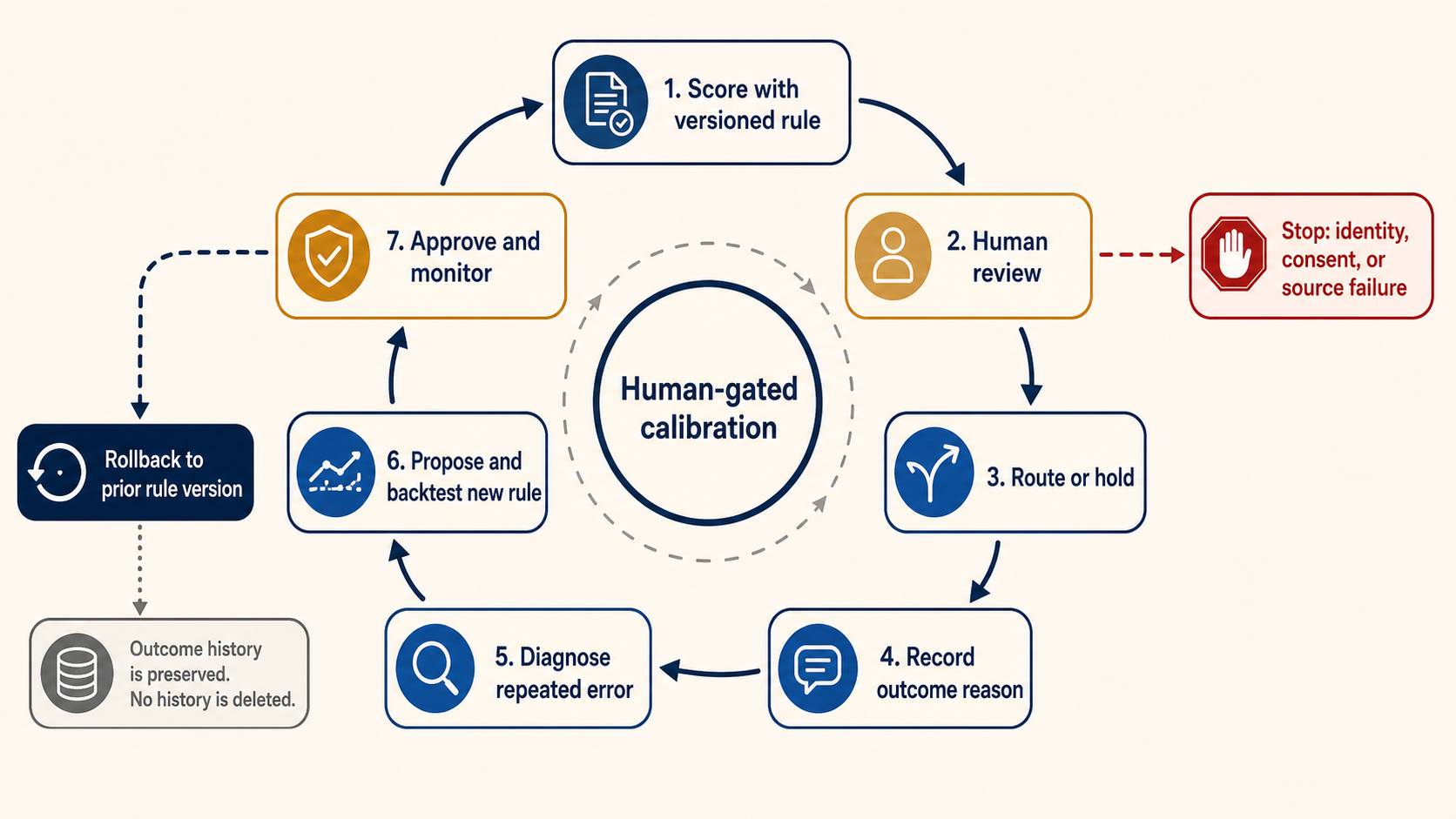
Lead scoring governance should identify the rule owner, approval authority, and escalation path. The documentation should define purpose, scope, eligible CRM objects, data sources, exclusions, and expected refresh intervals. It should also describe every automated transition and every checkpoint that still requires human authorization.
Maintain a structured change log for criteria, weights, caps, and routing thresholds. Each entry should include the business reason, supporting evidence, effective date, approver, and expected operational effect. Link the change to affected segments and CRM objects so later analysis can compare equivalent cohorts.
Define rollback instructions before a new rule enters production. A rollback should restore the previous route without deleting decisions made under the failed version. Preserve both versions and their timestamps, allowing analysts to reconstruct the sequence without hindsight leakage.
Automation should expand according to decision consequence. Begin with low-risk internal recommendations such as research queues. Add seller-facing prioritization after evidence fields become consistent and reviewable. Keep external communication behind approval until the team has reliable stop conditions, monitoring, and recovery steps.
Consistency does not mean reviewers must agree with every model recommendation. It means they apply the same documented rule to comparable evidence. Useful disagreement exposes ambiguity in the criterion, source, or operating definition and becomes material for the next calibration review.
Production monitoring should alert a named owner whenever a stop condition appears. The alert needs affected records, current routes, rule versions, and evidence sources. The owner should be able to pause activation while preserving every record required for diagnosis.
Governance also includes data minimization and access control. Store only information necessary for the defined scoring and review purpose. Limit sensitive contact evidence to authorized operators, follow applicable retention requirements, and remove identifying details from material shared outside the operating team.
These controls do not make the model infallible. They make its errors visible, attributable, and recoverable. That is the practical foundation for responsible automation in a revenue process where recommendations can influence real customer contact.
Lead scoring calibration loop connecting human review, outcome reasons, rule changes and rollback.
Repeated disagreements should change a versioned rule, not silently rewrite historical scores.

08 / Outcome learning

Use downstream outcomes to revise the criteria

The scoring engine should learn from clear outcome reasons, not one conversion field.
Outcome taxonomy determines the quality of that learning loop. A generic negative label collapses several different diagnoses into one field and invites the wrong correction. Structured dispositions let the team distinguish a scoring failure from weak timing, channel mismatch, incumbent software, or ineffective positioning.
In the wider campaign, 1,627 records entered the fit-qualified stage. The team recorded 58 replies and 14 interested prospects after the core pitch. Nine calls and four contracts followed. These counts are observational. No matched control group existed, and reviewers changed the workflow as errors appeared.
The funnel does not prove that scoring created four contracts. It shows why fit-qualified does not mean opportunity.

Keep bad fit separate from timing, channel and offer

Use distinct labels for distinct causes:
DiagnosisExample CRM dispositions
Contactwrong person
Existing systemincumbent solution
Timingbad timing, follow up later
Offerbad offer, unclear value
Routebad channel
Fitbad fit
Early interestrequested information, positive after pitch
Sales progresscall booked, call held, contract
A negative reply from a correct account may reveal timing or an incumbent. A positive reply from a low-scoring segment may expose a missing use case. Without the reason, both events can lead to the wrong scoring change.

Change the rule when the same error repeats

Suppose high-scoring agencies serve software vendors with little inbound call volume. Subtracting five points from every agency is too broad. Change the workflow rule:

Do not approve a sales agency from its category alone. If it serves B2B technology vendors, require current proof of customer phone activity.

This keeps agencies serving clinics, trades, property firms, and other call-led clients. It repairs the rule without punishing an entire category.

Review thresholds against precision, coverage and capacity

Raise, lower, or split a threshold using several signals:
SignalWhat it tests
Seller acceptance and overridesFit with seller judgment
Missing-evidence rateResearch quality
Positive replies after the pitchEarly commercial response
Held callsProgress beyond booking
ContractsLater commercial outcome
Review timeOperational cost
Repeated errorsMissing or weak criteria
Do not optimize only for the highest conversion band. A narrow threshold may improve precision but starve the team of coverage. A loose threshold may create activity but bury sellers in reviews.
The right threshold balances quality, capacity, and the cost of error.

09 / Checklist

Lead scoring implementation checklist

Use this checklist before activating a scoring rule:
AreaCheck before activation
Decision[ ] Name the account, contact, deal or buying group being scored.
Decision[ ] Define the action that the score recommends.
Ownership[ ] Name the person who approves records and exceptions.
Measurement[ ] Name the nearest outcome you can measure.
Criteria[ ] Keep eligibility, account fit and contact fit apart.
Criteria[ ] Keep workflow fit, engagement and confidence apart.
Evidence[ ] Record hard stops as rules, not negative points.
Evidence[ ] Preserve unknown and conflicting states.
Evidence[ ] Add source URLs and dates to key facts.
Evidence[ ] Prevent related signals from earning duplicate credit.
CRM[ ] Store component values beside the total.
CRM[ ] Save a structured rationale.
CRM[ ] Version the rule and timestamp every score.
CRM[ ] Record the reviewer, decision and override reason.
CRM[ ] Keep each historical score tied to its rule version.
Pilot[ ] Review the first batch one record at a time.
Pilot[ ] Maintain a disagreement log.
Monitoring[ ] Define stop rules before automatic routing.
Monitoring[ ] Compare outcomes by score band and route.
Diagnosis[ ] Keep person, incumbent, timing, offer, channel and fit apart.
Learning[ ] Update the rule when an error repeats.

10 / FAQ

Lead scoring implementation FAQ

What criteria should a B2B lead scoring engine include?

Start with hard eligibility rules, then assess account and current-role fit. Add workflow relevance, engagement, recency, and confidence in the evidence. Preserve the seller decision and downstream outcome as separate fields, even when the CRM calculates one total.

What is the difference between fit score and engagement score?

Fit score estimates whether the account and contact match the target profile. Engagement score records observable actions such as replies, page visits, forms, or calls. Strong engagement cannot repair poor fit, while strong fit does not prove current interest.

Should a CRM use one total lead score?

A combined score can help rank work. The seller should still see each component and source. A fit, engagement, and confidence matrix exposes failure in any single dimension.

How do you choose an MQL or sales-routing threshold?

Choose the threshold according to the action, review capacity, and cost of false routing. Test it on a reviewed cohort, then compare seller acceptance and overrides across score bands. Add the nearest downstream outcome. Do not copy point ranges from a generic template.

Can AI automate lead scoring?

AI can interpret unstructured evidence, apply a bounded rubric, and draft a rationale. It can also recommend a route. Deterministic rules should own hard constraints. A seller or RevOps owner should approve early batches, exceptions, and material status changes.

How often should lead-scoring criteria be updated?

Review the criteria when the ICP, offer, channel or source data changes. Do the same when the opportunity rule changes. A score shift, repeated error or weaker outcome can also trigger review. Keep each version so past decisions still make sense.

How do you measure whether a lead-scoring model works?

Measure the decision that the score controls. Track seller acceptance and documented override reasons, for example. Add positive replies, held calls, or accepted opportunities when relevant. Preserve later outcomes for context, but do not claim causation without a controlled comparison.

11 / Final rule

The implementation rule to keep

A lead score is valuable when it makes the next commercial decision easier to inspect. It becomes dangerous when an aggregate total replaces the underlying evidence.
Start with hard eligibility. Keep fit, engagement and confidence apart. Give unknown evidence a real state. Attach the advice to a human owner and an outcome. When the team disagrees with the model, update the rule—not only the number.
This approach turns lead scoring into an auditable sales system that the team can challenge and improve over time.

12 / Methods

Sources and methodology

This guide combines official product documentation with my first-hand review of anonymized July 2026 campaign records. Official HubSpot documentation supports only the described scoring capabilities. Microsoft documentation supports only the cited predictive-scoring capabilities. NIST supplies general governance and oversight principles, not a sales-scoring standard.
The first-hand records cover source pools, the first reviewed batch, CRM rationale, product routing, scoring rules and later funnel stages. They describe one campaign. We removed names, companies, emails, profile URLs and identifying message details. We also excluded unsupported product results, customer claims, prices and volume claims.
The 90-record pilot did not preserve publishable accepted, edited, rejected or held totals. No matched control group existed. We therefore report neither model accuracy nor causation. The separate-dimension CRM schema in this guide is the improved architecture I would implement now; it is not a claim that every field existed in the July system.

Research note

Methodology

  1. 01Use official vendor documentation only for current product capabilities and NIST only for general governance principles.
  2. 02Attribute the 90-record first review, 145-record product-routing review, scoring rules and later funnel to Anastasiia Krynytska’s anonymized July 2026 operating records.
  3. 03Label the proposed separate-dimension CRM schema as the improved architecture Anastasiia would implement now, not the exact July schema.
  4. 04Keep source pools, reviewed records, fit-qualified records, replies, interest, calls and contracts as distinct states.
  5. 05Treat all campaign results as observational because there was no matched control group and no publishable false-positive, false-negative or override rate.
  6. 06Remove names, companies, emails, profile URLs and identifying message details; exclude unsupported performance, pricing, customer and throughput claims.
Read the full methodology

Source ledger

Sources & editorial notes

  1. 01
    Build lead scores to qualify contacts, companies and deals

    HubSpot Knowledge Base · Official capability documentation used for fit, engagement and combined scores plus inclusion and exclusion criteria.

  2. 02
    Understand the lead scoring tool

    HubSpot Knowledge Base · Official capability overview; it does not validate the author’s thresholds or commercial outcomes.

  3. 03
    Predictive lead scoring

    Microsoft Learn, Dynamics 365 Sales · Official product documentation used for score ranges, grades, reasons and trends.

  4. 04
    AI Risk Management Framework Core

    US National Institute of Standards and Technology · Primary governance framework used for general human-oversight and ongoing-monitoring principles; it is not a sales-scoring standard.

  5. 05
    How Does AI Assist in Lead Qualification? A Human-Gated B2B Workflow

    Luck My Sales · Supporting guide used for the boundary between scoring and qualification.

  6. 06
    Luck My Sales methodology

    Luck My Sales · Evidence states, first-hand-source treatment, freshness requirements and correction protocol.

  7. 07
    Luck My Sales AI use policy

    Luck My Sales · Permitted AI assistance and required human editorial review.

Corrections or primary material: contact the corrections desk.

About the author

Anastasiia Krynytska

Anastasiia Krynytska is a LeadGen Team Lead at Softermii and the lead editor of Luck My Sales. She covers AI-assisted outbound, account research, qualification, messaging, CRM handoffs and revenue workflows from a practitioner’s perspective.View author profile LinkedIn

Continue reading

01 · News analysis

AI sales is moving from assistant to operating layer

The category is expanding from drafting support into research, pipeline decisions, recommended actions and controlled execution.

Read news
02 · Field analysis

In AI sales, the handoff may be the product

Models are becoming accessible; durable value sits in the controlled transition from signal to seller action.

Read analysis
03 · Research framework

Sales AI Workflow Signals 2026

A launch framework for mapping the products, controls and buying questions shaping AI-enabled revenue work.

Read reports

Luck My Sales briefing

Useful context, once a week.

News, explanations and original research from this desk. No noise.
The newsletter is still being built. We will contact you when the first edition is ready.