Weekly industry intelligence · No noiseSubscribe to the Luck My Sales newsletterFree briefing

Independent operator-led media on AI in B2B sales

Menu

Technical and operational implementation guide · Implementation guides

How to Build an AI Sales Agent: Architecture and Controls

Build a production AI sales agent around one bounded job, a source-linked event contract, action-level permissions, deterministic validation, tests and rollback.
Editorial disclosure

AI may assist research organization and drafting. A human editor reviews every published page, checks material claims against the cited sources and owns the final decision. No company paid for placement in this article.

AI use policy

Agent-ready brief

AI takeaways

Keep the key points here, or take a source-aware text brief into Claude, ChatGPT or another AI workspace.
  1. 01Start with one job contract that names eligible records, completion, exclusions, owner and stop states.
  2. 02Separate facts, interpretations and hypotheses before the model proposes an action.
  3. 03Keep permissions action- and field-specific, with consequential CRM changes human-approved.
  4. 04Use validation, idempotency, postconditions, retry ceilings and exception ownership around every tool call.
  5. 05Promote from shadow mode only after the real test pack, failure trace and rollback path pass.
Includes summary, takeaways, sources and a use note.
This is the practical answer to how to build an AI sales agent for production: start with one bounded sales job—not a persona and not a long prompt. Define the eligible records, evidence, allowed outcome, prohibited actions, human owner and stop states. Then put the model inside a deterministic control loop that validates external actions, records every result and can roll back without asking the model for permission.
A useful first agent might qualify an opted-in demo request and propose an available meeting. It should not “manage the pipeline.” The smaller job gives you a fixed answer key, visible failures and a safe promotion path from shadow mode to limited autonomy.
This guide builds that system in nine stages:
choose one job and define done;
write the evidence and event contract;
separate model reasoning from deterministic rules;
map permissions by action and field;
assemble the architecture;
design handoff, retries and rollback;
create a prelaunch test pack;
roll out in controlled modes;
decide whether to build or buy.
Method and disclosure: this article uses owner-supplied architecture and failure evidence from a NextLevel.AI Core SDR workflow. NextLevel.AI is an affiliated operating context, not an independent product recommendation. The workflow is described in neutral voice because named first-person attribution is still unresolved. It included webhook middleware, structured outputs, human approval for consequential CRM and email actions, an action audit and rollback. Customer data, endpoints and secrets are excluded. NIST and technical research support the risk and evaluation concepts in their stated scope; they do not certify this architecture or prove sales outcomes.

Build one bounded sales job inside a deterministic control loop with typed evidence, action-level permissions, observable outcomes and model-independent rollback.

01 / How to build an AI sales agent

1. How to build an AI sales agent around one useful job

Begin with a business bottleneck that is repetitive, observable and reversible.
Good first jobs include:
  • classify and route an opted-in inbound lead;
  • research one approved account list and produce a sourced brief;
  • propose a reply disposition for human review;
  • book a meeting after explicit interest and validated availability;
  • create a follow-up task from a completed call;
  • flag an account-expansion signal for its human owner.
Poor first jobs include:
  • find our best market;
  • replace the SDR team;
  • run outbound end to end;
  • manage all CRM records;
  • negotiate pricing;
  • decide which legal rules apply.
The difference is not ambition. It is whether a reviewer can identify a correct outcome for every record.

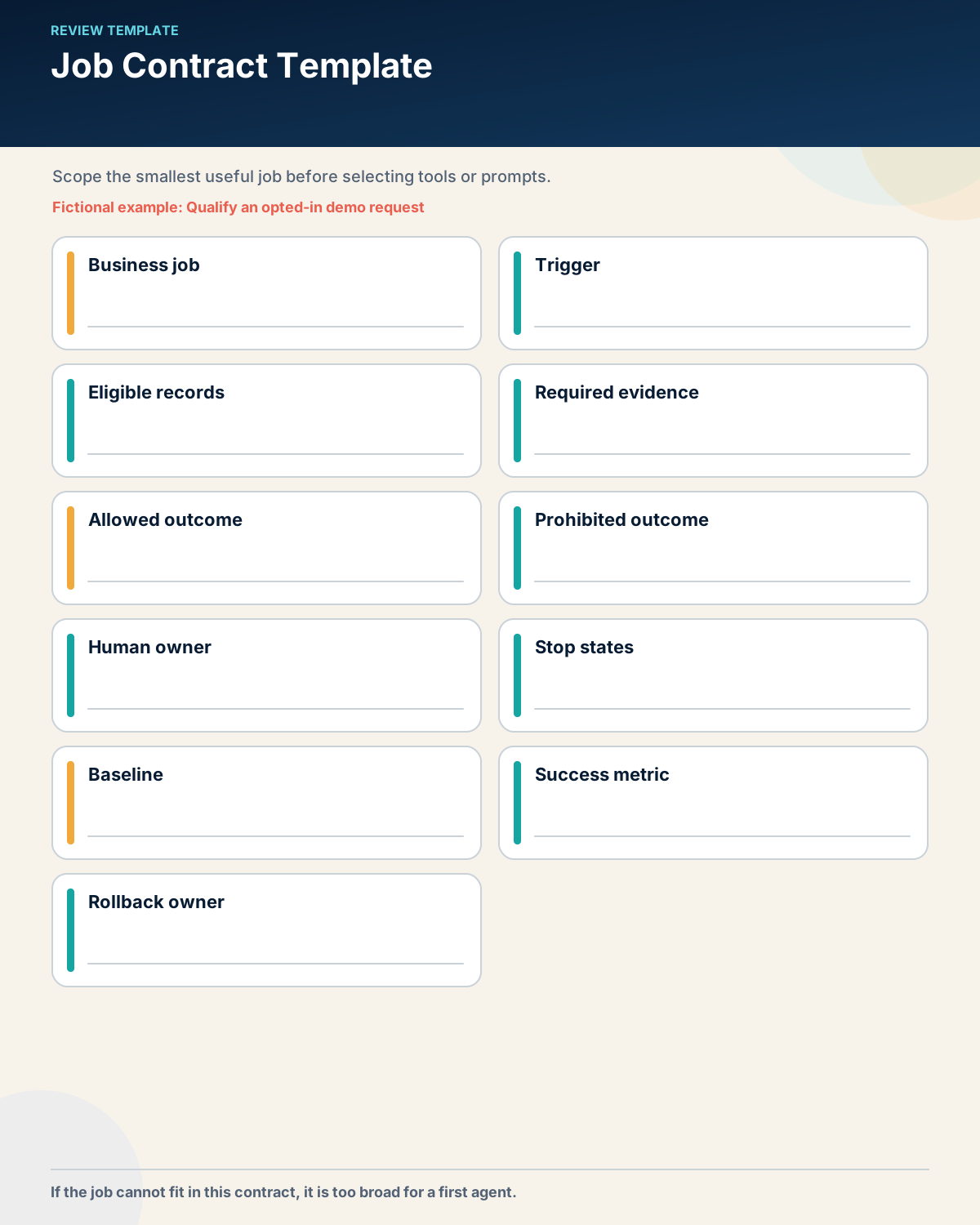
Write a job contract

Use one page with these fields:
FieldExample for a first agent
Business jobQualify an opted-in demo request
TriggerValid website-form event with consent state
Eligible recordsNew business contacts not suppressed, duplicated or owned
Required evidenceForm, approved firmographics, product interest, territory and calendar
Allowed outcomeRoute, request one missing fact, propose a meeting or close as ineligible
Prohibited outcomeSet price, promise features, create an opportunity or change owner
Human ownerAssigned SDR or exception queue
Stop statesHuman request, contradiction, tool failure, sensitive topic or missing permission
BaselineCurrent response, accepted-meeting and error definitions
Rollback ownerNamed RevOps or engineering operator
If the job cannot fit into this contract, split it. A first agent should have one primary outcome and a small number of explicit exits.
AI sales-agent job contract defining trigger, evidence, allowed outcome, owner, stop states and rollback.
If the job cannot fit in this contract, it is too broad for a first agent.

02 / Write the evidence contract

2. Write the evidence contract

The model should not receive a pile of fields and decide which are true. Give every input an authority, date and missing-data behavior.
At minimum, the evidence contract should record:
  • stable lead, contact, account and agent-run IDs;
  • source system or URL;
  • captured or updated timestamp;
  • field authority when sources disagree;
  • freshness rule;
  • allowed use;
  • confidence or verification state;
  • missing and contradictory state;
  • sensitive-data exclusion;
  • suppression and prior-contact state.
For example, the CRM may own account assignment, while the current company website supports product facts and the calendar API owns availability. A model summary owns none of those truths. It may combine approved evidence into a proposal, but the source record remains visible.

Separate facts from interpretations

Use four evidence states:
StateMeaningAllowed use
Verified factCurrent source supports the exact statementMay support a bounded decision or claim
Bounded inferenceEvidence suggests, but does not establish, a meaningMay guide a question, not a confident claim
Sales hypothesisCommercial idea the seller wants to testRequires human approval and buyer confirmation
Missing or conflictingRequired evidence is absent or disagreesPause, ask or route; do not improvise
This structure prevents a job listing from becoming “your team is overloaded” or a pricing-page visit from becoming “you have budget.”

03 / Define the event contract

3. Define the event contract

An agent needs a state model, not only a prompt. Each run should produce a versioned event that a human or service can replay.
A minimal event can contain:
json { "run_id": "stable-id", "record_id": "lead-or-account-id", "workflow_version": "v1.3", "trigger": "demo_request_received", "evidence_refs": ["crm:contact:...", "form:event:..."], "proposed_action": "book_meeting", "arguments": { "timezone": "IANA timezone", "start": "ISO-8601 timestamp", "owner_id": "approved-owner-id" }, "permission": "approval_required", "status": "proposed", "reviewer": null, "result": null }
The example is intentionally plain. The important properties are identity, version, evidence, typed arguments, permission and lifecycle state.
Define the states explicitly:
received → normalized → evaluated → proposed → validated → approved → attempted → confirmed.
Add terminal or exception states such as rejected, suppressed, duplicate, failed, uncertain, human_requested and rolled_back. Timers and retries must read the current state before acting.

04 / Build the control loop

4. Build the control loop

A reliable agent loop separates interpretation from execution:
  1. Observe: load the trigger and approved evidence.
  2. Normalize: resolve identity, schema and time formats.
  3. Apply deterministic rules: suppression, ownership, required fields and hard prohibitions.
  4. Ask the model for a proposal: use a typed output schema.
  5. Validate the proposal: schema, business preconditions, permission and current state.
  6. Request approval if required.
  7. Execute the tool action: use tested code and an idempotency key.
  8. Check the postcondition: confirm that the expected state exists.
  9. Record the event: include result, latency, error and version.
  10. Hand off, wait or close.
The model does not bypass steps three, five or seven. It cannot declare that suppression does not apply, invent a required ID or mark an API call successful.

The calendar failure that explains the boundary

In the owner-supplied workflow, direct model control of the calendar caused timezone collisions. The failure was not solved by a more emphatic prompt. The architecture changed.
The revised pattern was:
  1. the model interpreted the conversation;
  2. it returned a typed JSON proposal;
  3. deterministic code checked timezone, availability and required fields;
  4. the calendar API executed only after validation;
  5. the workflow recorded confirmation or created an exception.
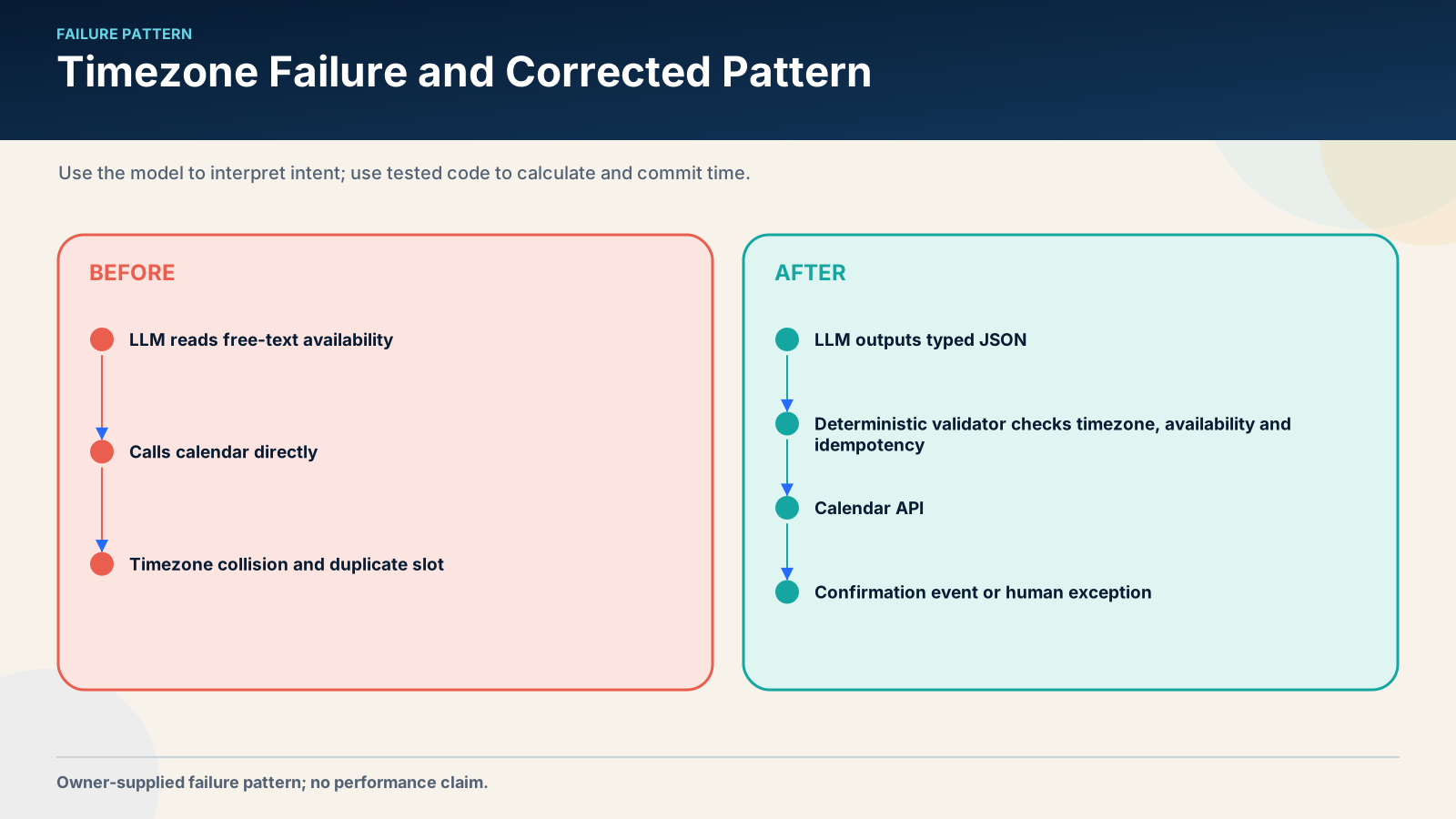
This is a general engineering rule: use the model for ambiguous language and contextual judgment; use tested code for arithmetic, identity, availability, permissions and irreversible writes.
Direct model calendar control compared with validated typed output and deterministic calendar execution.
Use the model to interpret intent; use tested code to calculate and commit time.

05 / Map permissions by action

5. Map permissions by action

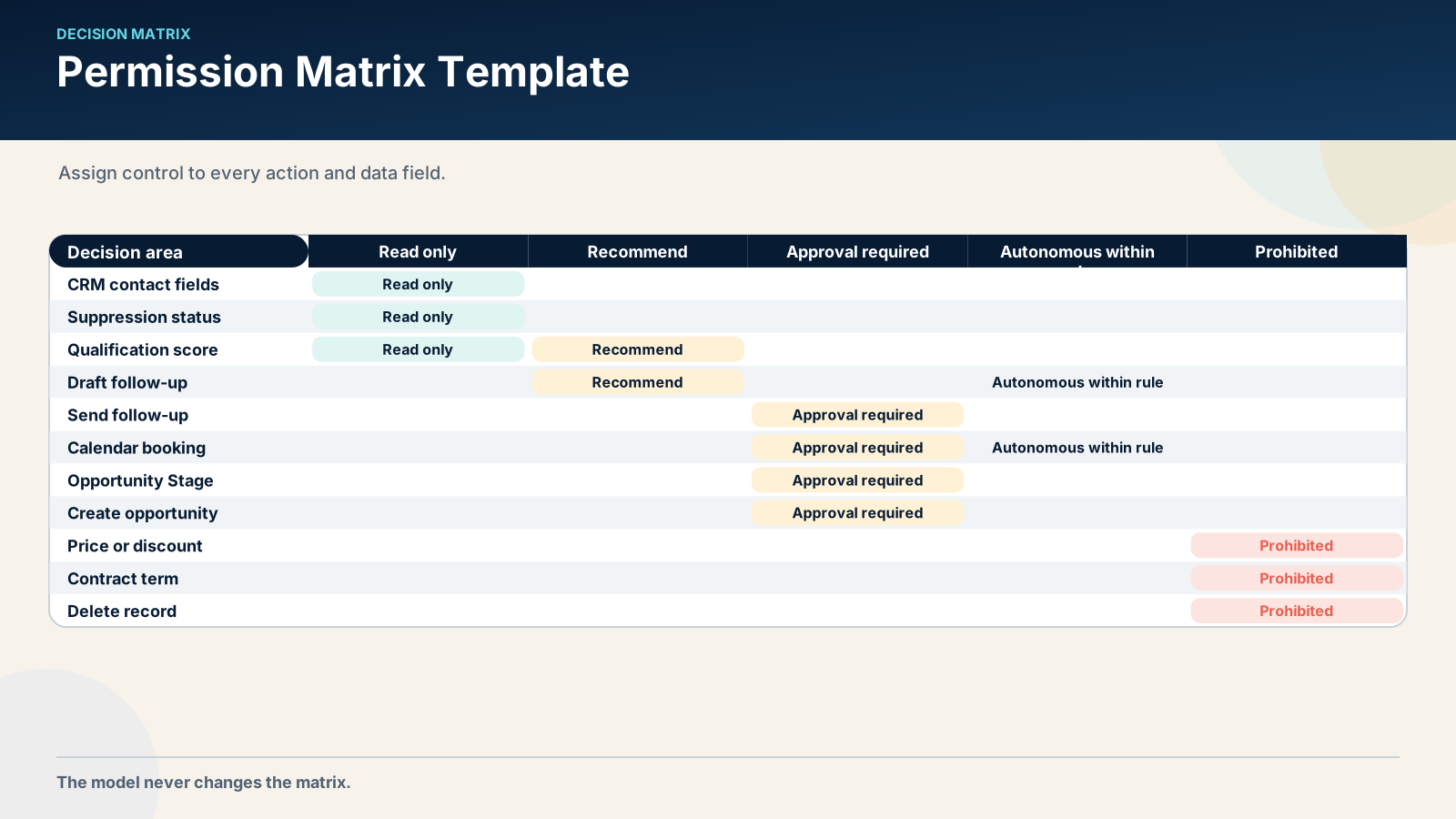
Do not grant autonomy to an AI SDR as one block. Grant it to specific actions under specific conditions.
ActionStarting permissionRequired control
Read approved lead fieldsAutonomousLeast-privilege access and logging
Read suppression stateAutonomous, mandatoryAuthoritative source and fail-closed behavior
Summarize evidenceAutonomous proposalSource references and uncertainty labels
Recommend qualificationAutonomous proposalRubric, reason and human correction
Draft follow-upAutonomous draftAllowed claims and campaign-level review
Send follow-upApproval requiredCurrent state, suppression and sender checks
Book a meetingBounded automation after validationTimezone, availability, idempotency and confirmation
Change Opportunity StageHuman approvalCurrent value, owner and audit
Create opportunityHuman approvalQualification and CRM admission rule
Set price or discountHuman onlyCommercial authority
Negotiate contract termsHuman onlyLegal and executive authority
Pause and escalateAlways availableDeterministic safe-stop path
The owner-supplied implementation required SDR approval before changing Opportunity Stage or sending the follow-up email. That is a reasonable starting position because both actions alter the commercial record or external relationship.
The permission service should sit outside the model. It reads the actor, record, action, policy version and current state. Its decision—allow, require approval or deny—belongs in the audit log.
Permission matrix assigning read, recommendation, approval, bounded autonomy or prohibited status to sales actions.
Permissions belong to actions and data fields, not to an agent persona.

06 / Assemble the production architecture

6. Assemble the production architecture

Tool choice comes after the contracts. A production agent commonly needs these components:
ComponentResponsibility
Trigger and queueReceive events, control concurrency and retry safely
Identity and normalizationMatch lead, contact and account; standardize fields and time
Evidence retrievalLoad only approved, current sources
Deterministic policyApply suppression, ownership, limits and prohibited states
Model layerInterpret language and return a typed proposal
ValidatorCheck schema, evidence, permissions and business preconditions
Tool adapterCall CRM, calendar, email, voice or enrichment APIs
State storePreserve run and contact state across steps and channels
Approval queueGive a human the evidence, proposal and consequence
Audit and observabilityRecord versions, traces, errors, corrections and outcomes
Secrets and accessKeep keys outside prompts and apply least privilege
Kill switch and rollbackStop new actions and reverse supported changes
You can buy several of these layers in one platform or compose them. A packaged platform reduces build work but may hide internal decisions. A developer platform increases control but transfers more responsibility to your team. The AI Sales Agents comparison maps that tradeoff.

Keep CRM writes reversible

Before any write:
  • read the current record and version;
  • verify the expected owner and state;
  • check suppression and duplicate action;
  • store the proposed before-and-after values;
  • use an idempotency key;
  • require approval when policy says so.
After the write:
  • confirm the actual stored value;
  • record API response and timestamp;
  • link the evidence and reviewer;
  • create an inverse action or restoration record when possible.
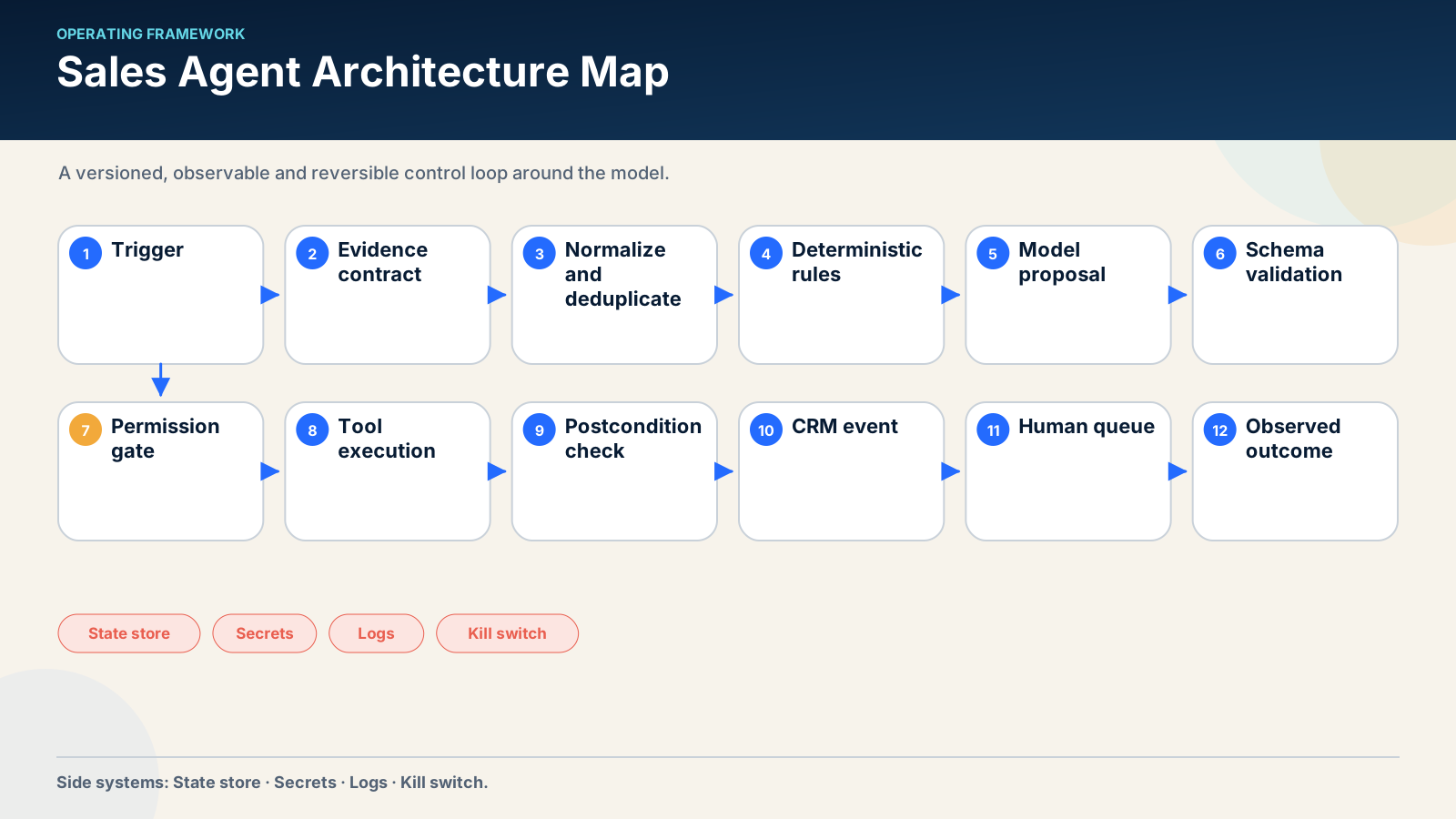
One-click rollback is useful only when it is tested. Some actions—an email sent, a call placed or a promise made—cannot be undone. For them, rollback means stop, suppress, correct the record and route remediation to a person.
Production AI sales-agent architecture from trigger and evidence through validation, tool action, audit and human queue.
The model proposes inside a versioned and reversible operating loop.

07 / Protect customer data, secrets and tool boundaries

Protect customer data, secrets and tool boundaries

Teams asking how to build an AI sales agent often begin with model prompts. Production security begins earlier: with the data-flow map and the authority of every service identity.
Draw the path for each sensitive field from source to model, tool, log, approval screen and export. Record why the field is needed, which region stores it, how long it remains, who can read it and how deletion propagates. If the agent does not need a full transcript, payment field, personal note or sensitive attribute to complete its bounded job, exclude it before retrieval.
Apply these controls at the system boundary:
  • give each connector a separate service identity;
  • grant read and write scopes by object and action, not broad administrator access;
  • keep API keys and tokens in a secrets manager, never in a prompt, trace or source repository;
  • send the model the minimum evidence needed for the current step;
  • redact sensitive values from logs while preserving stable references for investigation;
  • validate every tool argument on the server;
  • allow destinations, domains, phone regions and tool operations explicitly;
  • rotate credentials and test revocation;
  • preserve suppression and deletion state when data is copied;
  • review provider retention and model-training settings for the actual plan.
Treat retrieved text as untrusted. A website, CRM note, email or uploaded document can contain instructions that attempt to change the agent's behavior. The retrieval layer should label content as evidence, not policy. The model may summarize it, but only the deterministic permission service can authorize an external action.
Tool adapters should expose narrow operations. Prefer propose_meeting(slot_id, contact_id) over a general calendar command and create_followup_task(record_id, reason) over arbitrary CRM mutation. Validate identifiers against the current tenant and record. Reject fields that are not part of the schema. Apply rate and spend limits outside the model.
Separate environments. Development and test should use synthetic or approved redacted records and non-production destinations. A test email must not be able to reach a real prospect. A simulated phone tool must not place an external call. Production access should require an explicit deployment identity, auditable change and fast revocation.
Incident preparation is part of the architecture. Define who can disable new triggers, revoke a connector, suppress a segment, freeze a workflow version and export affected runs. Preserve enough evidence to reconstruct the event without exposing more customer data than the investigation needs. The AI policy should state these boundaries in language operators can follow.

08 / Make observability answer operational questions

Make observability answer operational questions

Logs are useful only if they can answer what happened to a specific record and whether the failure is systemic. Give each event a stable run_id, record_id, workflow version, model version and policy version. Correlate those identifiers across queues, model calls, tools, approvals and CRM results.
Capture at least:
Trace fieldOperational question it answers
Trigger and eligibility resultWhy did this record enter the workflow?
Evidence references and timestampsWhat did the agent know, and how fresh was it?
Deterministic rule resultsWhich suppression, owner or permission rule applied?
Typed model proposalWhat did the model recommend without executing?
Validation resultWhich schema or business precondition passed or failed?
Approval eventWho accepted, changed or rejected the consequence?
Tool request and provider responseWhat was attempted, and did the provider confirm it?
PostconditionDoes the target system now contain the expected state?
Handoff or terminal stateWho owns the next step?
Correction and rollbackHow was the record repaired?
Do not store only prompt and response text. That omits the business state around the model. Do not store raw sensitive payloads merely because debugging might be easier. Use structured fields, references, access controls and retention periods.
Build operational views around decisions. RevOps needs eligible volume, dispositions, corrections, human review time and downstream acceptance. Engineering needs queue age, provider errors, retry state, latency by stage and version regressions. Risk owners need unsupported claims, prohibited actions, suppression failures, complaints and unresolved incidents. The metric definitions belong in the AI Sales Agent KPIs guide, not in an ad hoc dashboard query.
Alerts must point to an owner and response. “Error rate high” is incomplete. State which workflow and version changed, which segment is affected, whether external actions continue, who will investigate and what stop or rollback rule applies. A dashboard without an operating response is decoration.

09 / Version the workflow as one release unit

Version the workflow as one release unit

An agent's behavior can change when the prompt, model, tool schema, knowledge source, deterministic rule or provider changes. Record those dependencies as one release unit even if they live in different systems.
For each release:
  1. describe the intended change and affected actions;
  2. identify the test cases and risks that must be rerun;
  3. compare the candidate with the current version on the same answer key;
  4. require approval from the technical and operational owners;
  5. deploy to a limited cohort;
  6. monitor corrections, failures and downstream outcomes;
  7. preserve a tested rollback or disable path.
Do not change several uncertain components at once. If model, prompt and qualification policy all move together, a result shift becomes difficult to diagnose. Keep a change log that connects each production run to the exact release. Re-test after provider updates even when your own code did not change.
This discipline is what makes an AI sales agent workflow maintainable. The goal is not to freeze learning. It is to make learning attributable, reversible and safe.

10 / Assign operating ownership before launch

Assign operating ownership before launch

An AI sales agent architecture crosses sales, RevOps, engineering, security, legal and customer-facing operations. If ownership ends with “the AI team,” exceptions will accumulate between functions.
Name at least these roles:
RoleAccountable decision
Business ownerJob, eligible cohort, expected outcome and budget
Sales or service ownerQualification, handoff, customer promise and exception handling
RevOps ownerCRM semantics, ownership, suppression and reporting
Technical ownerIntegrations, state, deployment, reliability and rollback
Risk ownerData use, market rules, prohibited actions and incident escalation
Content or knowledge ownerApproved claims, source updates and expiry
QA ownerAnswer key, review sample, severity and promotion evidence
One person may hold several roles in a small company, but the decisions should remain explicit. Every queue and alert needs a named destination and response time. Every rule and knowledge source needs an update owner. Every external action needs someone authorized to pause it.
Define support boundaries with vendors as well. Record who investigates a carrier failure, model regression, webhook error, missing CRM event or disputed invoice. Confirm which logs and exports the vendor supplies and how urgent incidents are escalated. A service contract does not remove the buyer's responsibility for the sales policy and customer consequence.
Review ownership after each rollout stage. Shadow Mode creates QA work; approval mode creates reviewer work; limited autonomy shifts effort toward monitoring and exceptions. Capacity must move with the permission model. Otherwise slow queues and silent fallbacks can erase the benefit the agent was meant to create.

11 / Design retries and exception ownership

7. Design retries and exception ownership

Retries are actions. They need limits and state checks.
Use exponential backoff for transient system errors, but never retry a consequential action without an idempotency key. Do not retry a message after an ambiguous provider response until the system knows whether it sent. Do not retry a calendar booking against stale availability.
Every exception needs:
  • error category;
  • record and run ID;
  • last safe state;
  • evidence and proposed action;
  • attempts and provider responses;
  • human owner;
  • deadline or service expectation;
  • allowed resolution;
  • correction and re-entry rule.
Send exhausted or contradictory cases to an exception queue. Do not convert them into a generic “agent failed” metric. The failure category tells engineering and RevOps what to change.

12 / Create a prelaunch test pack

8. Create a prelaunch test pack

Build the test set before live traffic. Start with at least one case in every expected and dangerous category, then expand it from observed failures.
Test familyExample
NormalEligible lead with complete evidence and valid slot
MissingNo timezone, owner or required qualification answer
ContradictoryCRM and form disagree on company or country
DuplicateSame person, account or action arrives twice
SuppressedContact or account has an opt-out or active owner
StaleOld role, archived domain or expired availability
AdversarialPrompt injection or request to ignore policy
UnsupportedProspect asks about an unapproved product or legal topic
Tool failureTimeout, partial write, provider 500 or invalid response
HandoffHuman requested, no agent available or queue fails
PermissionModel proposes a stage, price or owner change it may not make
RollbackWrite succeeds, then reviewer reverses it
Each test case should name:
  • initial state;
  • approved evidence;
  • expected proposal;
  • allowed and prohibited actions;
  • expected event trail;
  • human owner;
  • pass rule;
  • cleanup or rollback.
Do not score only the final answer. General agent-evaluation research warns that a plausible outcome can hide a broken intermediate trace. Review identity resolution, evidence selection, policy decision, tool call and postcondition separately.

13 / Roll out in stages

9. Roll out in stages

Use four operational modes:

Shadow mode

The agent reads real inputs and proposes actions but cannot execute them. Compare its outputs with a human answer key. Measure missing evidence, unsupported decisions, corrections and failure categories.

Approval mode

The agent can prepare external actions, but a person approves each one. This reveals review burden and dangerous edge cases. It also tests whether the approval screen contains enough evidence.

Limited autonomy

Grant autonomy to low-risk actions with stable pass rates. Keep named accounts, consequential CRM changes, sensitive topics and uncertain evidence in approval mode.

Monitored expansion

Add volume, segment or actions one at a time. Keep a rollback rule and compare downstream accepted outcomes, not activity alone.
Promotion is a human decision. A model cannot approve its own performance. Set warning and stop conditions from your risk tolerance and reviewed sample. The AI Sales Agent KPIs guide provides the metric dictionary.

14 / Build versus buy

Build versus buy

Buy more of the workflow when:
  • the job matches a product's documented pattern;
  • your team lacks the engineering capacity for telephony, orchestration or monitoring;
  • the vendor can expose sufficient logs, permissions and exports;
  • implementation support is worth the service cost;
  • the contract preserves data, access and exit rights.
Build more of the workflow when:
  • proprietary evidence or decision logic creates the value;
  • field-level CRM permissions are unusual;
  • you need provider choice or custom latency/cost tradeoffs;
  • the product cannot implement the required handoff or rollback;
  • you have engineers and an operational owner for production.
Wait when the business process is not stable. Building a flexible agent around an unproved sales motion creates an expensive way to change prompts while customers expose the real strategy problem.

15 / Common failure modes

Common failure modes

The agent owns too many decisions

Split the job. Move price, negotiation, ownership and opportunity semantics back to humans.

The prompt contains policy

Move hard rules into deterministic code or a permission service. Prompts help behavior; they do not enforce authorization.

The system cannot explain a field

Store source, date, authority and transformation. If the evidence cannot be opened, the claim cannot support an external action.

Retries create duplicates

Add idempotency, current-state checks and provider reconciliation before retry.

The handoff is a transcript dump

Provide identity, intent, evidence, qualification, unresolved issue, requested next action and owner. A transcript is supporting detail, not the handoff summary.

The pilot shows more meetings but no better pipeline

Separate booked, held, sales-accepted and opportunity-created states. Review qualification and denominator drift.

16 / Frequently asked questions

Frequently asked questions

Do I need to code an AI sales agent?

Not always. Configured platforms can supply orchestration, channels and integrations. You still need to design the job, evidence, permissions, tests, human ownership and measurement. No-code removes code from some steps, not operational responsibility.

Which model should I use?

Choose after defining the job and test set. Compare models on the actual proposal schema, evidence use, unsupported responses, latency and cost. Keep model choice replaceable where practical.

Should the AI write directly to CRM?

Only for fields and states that pass explicit permission, validation and rollback rules. Start with proposed writes or low-impact reversible fields. Keep Opportunity Stage, opportunity creation, ownership and commercial commitments human-approved.

How do I prevent hallucinations?

Do not rely on a prompt to eliminate them. Restrict evidence, require source references, use typed outputs, validate material claims, route uncertainty and review a defined sample. Measure unsupported or materially incorrect responses by severity.

What belongs in the human handoff?

Identity, evidence, current state, prospect intent, qualification, objections, unresolved question, attempted actions, consent or suppression state, recommended next action and accountable owner.

17 / Production checklist

Production checklist

Before live autonomy, confirm that:
  • the job contract has one primary outcome;
  • evidence fields have authority and freshness rules;
  • every external action has an idempotency key;
  • permissions are action- and field-specific;
  • high-impact writes require approval;
  • suppression fails closed;
  • time and arithmetic use tested code;
  • tool calls have postcondition checks;
  • retries have ceilings and owners;
  • logs contain evidence, versions, action and outcome;
  • handoff and no-agent fallback are tested;
  • rollback does not depend on the model;
  • the team can pause, export and revoke the system;
  • warning and stop rules are defined before launch.
An AI sales agent becomes production-ready when the team can inspect what it saw, why it proposed an action, what actually happened and how to stop or correct it. The prompt is the easy part.

Research note

Methodology

  1. 01The architecture applies NIST risk-management principles to an operational sales workflow rather than presenting a vendor blueprint.
  2. 02Calendar and CRM examples come from anonymized owner-supplied operating evidence in an affiliated NextLevel.AI context.
  3. 03The guide makes no universal model, accuracy, ROI or conversion claim; those outcomes require the reader's own fixed test set and baseline.
Read the full methodology

Source ledger

Sources & editorial notes

  1. 01
    NIST AI Risk Management Framework

    nist.gov · Primary, official or disclosed research source used for the bounded claim cited in this guide; scope and current status require rechecking.

  2. 02
    Generative AI Profile

    National Institute of Standards and Technology · Primary, official or disclosed research source used for the bounded claim cited in this guide; scope and current status require rechecking.

Corrections or primary material: contact the corrections desk.

About the author

Anastasiia Krynytska

Anastasiia Krynytska is a LeadGen Team Lead at Softermii and the lead editor of Luck My Sales. She covers AI-assisted outbound, account research, qualification, messaging, CRM handoffs and revenue workflows from a practitioner’s perspective.View author profile LinkedIn

Continue reading

01 · News analysis

AI sales is moving from assistant to operating layer

The category is expanding from drafting support into research, pipeline decisions, recommended actions and controlled execution.

Read news
02 · Field analysis

In AI sales, the handoff may be the product

Models are becoming accessible; durable value sits in the controlled transition from signal to seller action.

Read analysis
03 · Research framework

Sales AI Workflow Signals 2026

A launch framework for mapping the products, controls and buying questions shaping AI-enabled revenue work.

Read reports

Luck My Sales briefing

Useful context, once a week.

News, explanations and original research from this desk. No noise.
The newsletter is still being built. We will contact you when the first edition is ready.