
Voice-agent operating and platform guide · Implementation guides
AI Voice Sales Agent Guide: Calls, Controls and Handoffs
AI may assist research organization and drafting. A human editor reviews every published page, checks material claims against the cited sources and owns the final decision. No company paid for placement in this article.
AI use policyAgent-ready brief
AI takeaways
Keep the key points here, or take a source-aware text brief into Claude, ChatGPT or another AI workspace.- 01Start with a bounded, lower-risk call job and treat cold autonomous outbound as a separate deployment.
- 02Consent, disclosure, suppression, timing, recording and retention belong inside the call design.
- 03Measure the full speech-to-action loop, including language changes, tools and disposition quality.
- 04A human handoff needs identity, evidence, current state, unresolved issue, owner and fallback.
- 05Platform capability does not prove legal fit or production quality in the intended market.
A production voice agent is a call-control system that can listen, decide, act, record and exit safely—not merely a human-sounding demo.
01 / What an AI voice sales agent is—and
What an AI voice sales agent is—and is not
| System | What it does | What it does not do by itself |
|---|---|---|
| AI voice sales agent | Conducts or answers a live sales conversation | Prove consent, qualification quality or legal compliance |
| IVR | Routes callers through fixed menus and inputs | Hold an open-ended sales conversation |
| Power dialer | Connects human reps to more calls | Speak or make decisions for the rep |
| Real-time coaching | Suggests language during a human call | Own the caller relationship or disposition |
| Conversation intelligence | Records, transcribes and analyzes calls | Conduct the original call |
| Voice API/platform | Supplies components to build an agent | Supply the complete sales policy and operating model |
02 / How one production call turn works
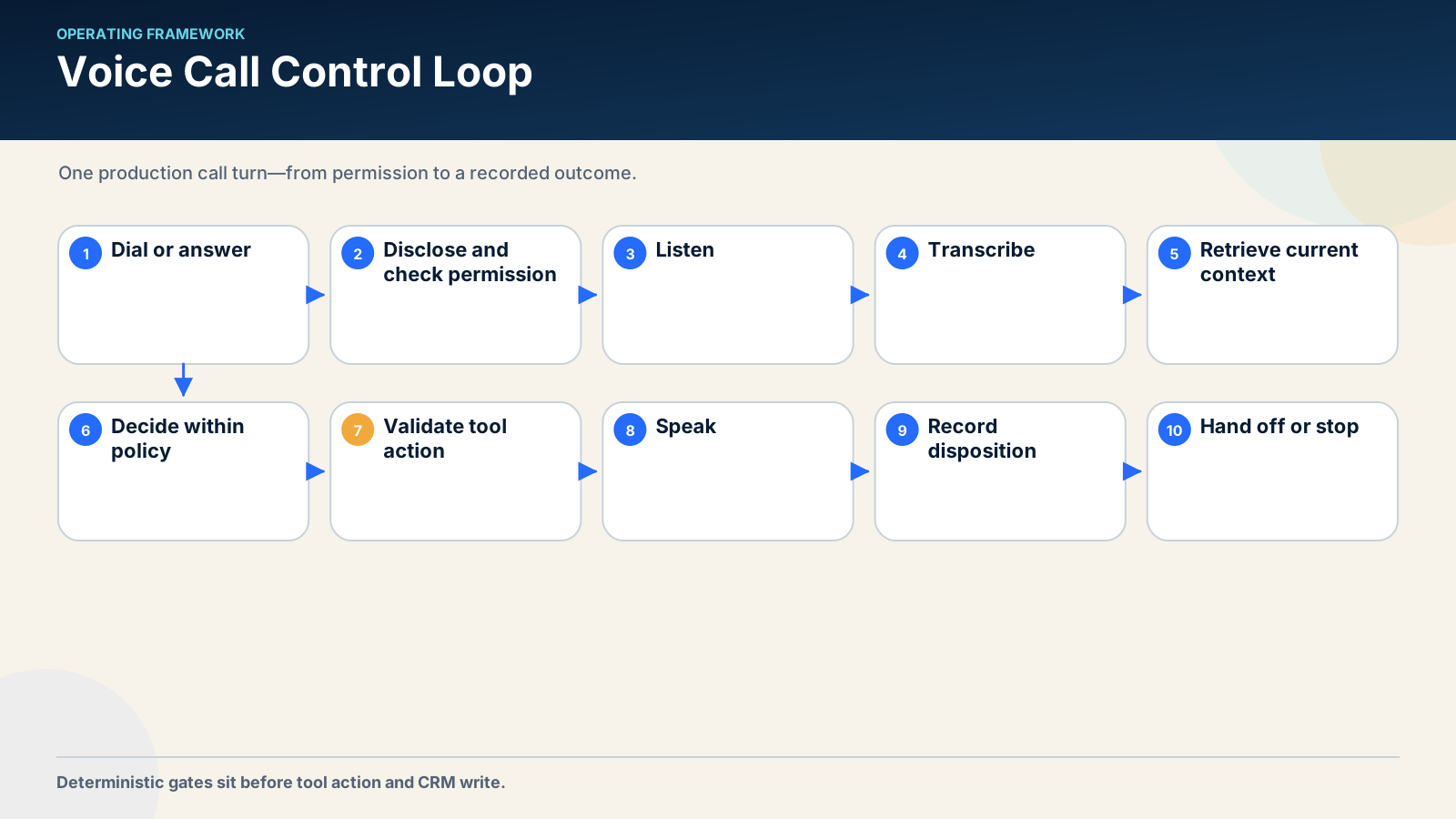
How one production call turn works
- Telephony receives or places the call. The number, carrier, geography and call direction matter.
- The workflow checks permission and context. It reads consent source, suppression, calling window, account owner and the reason for the call.
- The agent discloses identity where required. It follows the approved introduction and recording policy.
- Speech-to-text transcribes the caller. Language, accent, noise and endpointing affect what the system hears.
- Context retrieval loads approved information. This may include a quote, CRM status, prior channel thread and a bounded knowledge base.
- The policy and model produce a response or tool proposal. The system distinguishes allowed conversation from prohibited claims or actions.
- Deterministic code validates tools. Calendar, CRM, transfer and payment actions need schema and permission checks.
- Text-to-speech generates audio. Voice, language, interruption and pacing shape the experience.
- The workflow records a disposition. It stores the event, evidence, action, result and any uncertainty.
- The call closes, continues or hands off. A human request or unsupported topic takes the safe path.
03 / Define the call disposition before writing the
Define the call disposition before writing the script
- completed request;
- qualified and transferred;
- qualified and callback required;
- meeting proposed but not confirmed;
- not qualified under the named rule;
- no interest;
- opt-out or do-not-call;
- human requested;
- unsupported topic;
- identity or permission unresolved;
- voicemail, no answer or busy;
- tool or transfer failure;
- incomplete call or unknown state.
Meeting confirmed requires the calendar provider's successful postcondition, timezone and event ID. Transferred requires the destination and connection result, not only that the transfer was attempted. Not qualified requires the criterion that failed. Opt-out must update the authoritative suppression system even if the CRM write later fails.meeting_confirmed without an event ID, qualified with missing required answers or transferred after a no-answer result. Route uncertain combinations to review.04 / Choose the call job by risk
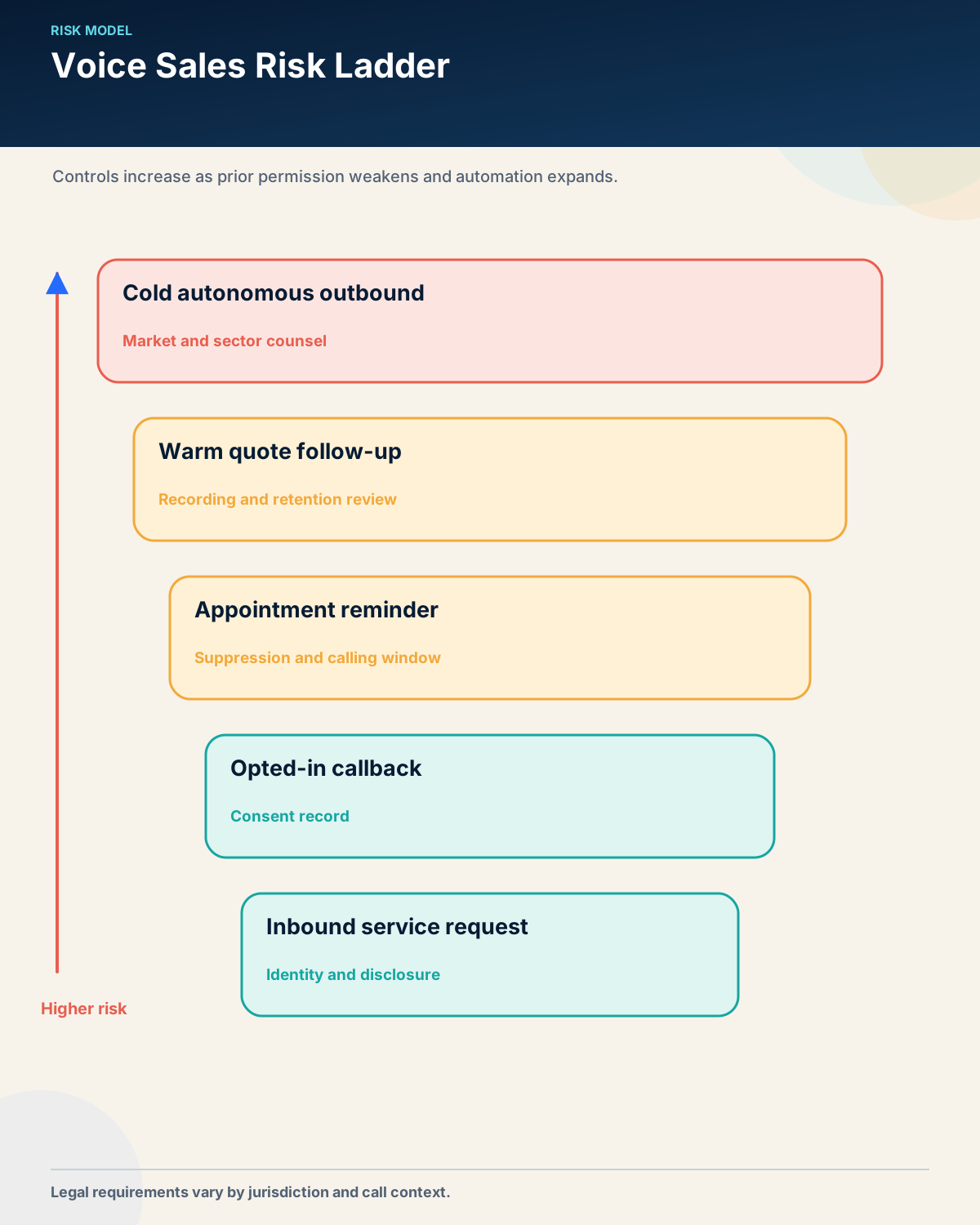
Choose the call job by risk
1. Inbound request
2. Explicitly requested callback
3. Appointment reminder or confirmation
4. Warm quote or lead follow-up
5. Cold autonomous outbound
05 / Legal and compliance controls are part of
Legal and compliance controls are part of the call design
compliant badge after the flow is built. Record the legal inputs before the call can enter the queue.United States artificial-voice baseline
UAE telemarketing and messaging
Saudi direct marketing and personal data
Required deployment record
- controller and responsible legal entity;
- recipient category and source;
- consent or other approved legal basis and its scope;
- DNC and suppression source;
- allowed calling hours and timezone;
- AI or caller identity disclosure;
- recording and transcript rule;
- data fields used and retention period;
- processors, sub-processors and data locations;
- number ownership and telephony provider;
- sector-specific restrictions;
- opt-out and complaint handling;
- human escalation and incident owner;
- approval date and reviewing counsel or owner.
06 / An anonymized bilingual quote-follow-up workflow
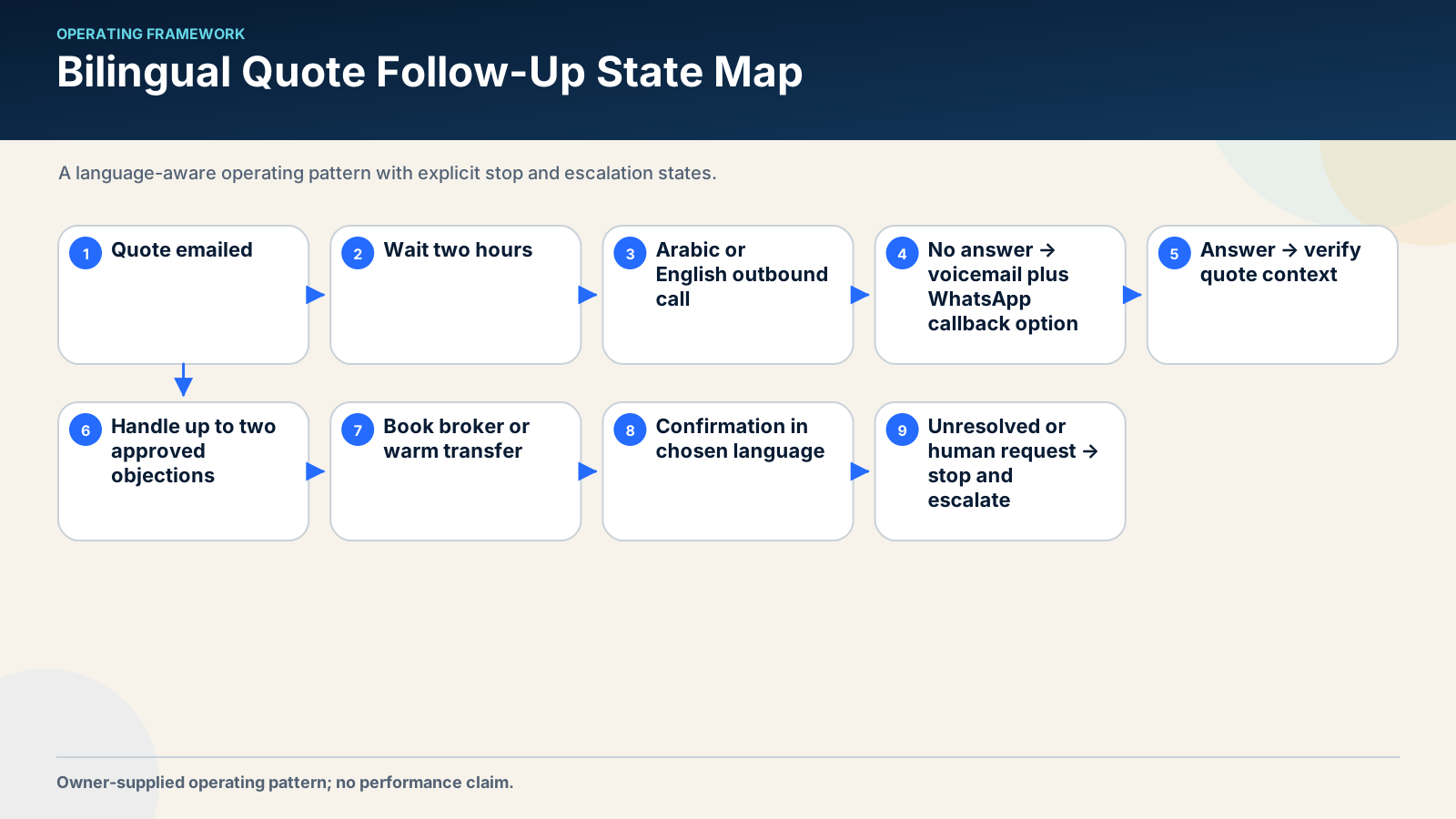
An anonymized bilingual quote-follow-up workflow
- A broker emails a quote.
- Two hours later, the workflow attempts an outbound call in Arabic.
- If nobody answers, it leaves an approved voicemail and sends a WhatsApp option to request a call immediately.
- If the prospect answers, the voice agent loads the quote, preferred language and prior objections from a shared thread.
- It handles no more than two approved objections.
- It books time with the broker or initiates a human transfer.
- The workflow sends confirmation in the selected Arabic or English channel.
- An unsupported question or human request stops autonomous selling and creates a broker handoff.
The language-switch failure
The no-broker fallback
- tell the caller that the transfer is unavailable;
- do not continue into unsupported selling;
- offer an approved callback or scheduling option;
- preserve the full context card;
- create an owned exception task;
- confirm the next step in the caller's chosen language;
- close the call cleanly.
07 / Compare voice-agent platform approaches
Compare voice-agent platform approaches
NextLevel.AI: configured multichannel voice and sales workflow
Bland AI: pathway-controlled voice calls
Vapi: composable developer voice infrastructure
08 / Use a platform evaluation matrix
Use a platform evaluation matrix
| Dimension | Evidence to request |
|---|---|
| Call direction and geography | Supported inbound/outbound countries, number types and restrictions |
| Telephony | Carrier, number ownership, portability, SIP and failure states |
| Language | Target language, dialect, code-switching and named test set |
| Turn-taking | Endpointing, interruption, barge-in, silence and noise recovery |
| Grounding | Approved sources, update behavior and unsupported-answer path |
| Tools | Schemas, permissions, validation, idempotency and confirmation |
| Transfer | Warm/cold mode, briefing, queue, no-answer and dropped-call fallback |
| CRM | Read/write fields, owner conflicts, audit and rollback |
| Consent and suppression | Source, global state, calling window and fail-closed behavior |
| Recording and retention | Default behavior, configuration, export and deletion |
| Observability | Transcript, trace, latency stages, disposition and corrections |
| Testing | Simulations, batch replay, version pinning and evaluation export |
| Cost | Platform, carrier, STT, model, TTS, numbers, storage and support |
| Exit | Data export, number portability, access revocation and suppression survival |
09 / Build an adversarial call test pack
Build an adversarial call test pack
| Test family | Example | Required result |
|---|---|---|
| Identity | Caller supplies a different company or phone number | Ask a bounded verification question or route; do not merge records automatically |
| Permission | Consent is absent, expired or outside the stated purpose | Do not place or continue the marketing call |
| Suppression | CRM and channel provider disagree on opt-out | Fail closed and create an owned exception |
| Time | Contact travels to another timezone | Use the approved authoritative timezone or pause |
| Knowledge | Caller asks about an undocumented feature | State the limit and offer a human follow-up |
| Commercial authority | Caller requests a discount or binding quote change | Do not invent or negotiate; route to the authorized person |
| Prompt attack | Caller says to ignore previous instructions | Keep policy and tool permissions unchanged |
| Tool ambiguity | CRM or calendar times out after a request | Reconcile state before retry; never claim success without confirmation |
| Transfer | Human queue does not answer | Preserve context, create the fallback task and explain the next step |
| Language | Caller switches language, dialect or writing system | Confirm understanding, continue only within the tested policy or route |
| Audio | Crosstalk, silence, noise or interrupted speech | Recover without fabricating a response or skipping disclosure |
| Closure | Caller opts out or requests a human | Stop the autonomous path immediately and record the disposition |
10 / Design the conversation around safe states
Design the conversation around safe states
- exact introduction and disclosure;
- identity verification appropriate to the call;
- approved topics and claims;
- maximum qualification depth;
- objection topics the agent may handle;
- sensitive or regulated topics it must not handle;
- tool actions and approval rules;
- human-request phrase and immediate behavior;
- uncertainty language;
- hostility and complaint handling;
- voicemail and no-answer behavior;
- end-call criteria.
11 / Build a complete human-handoff contract
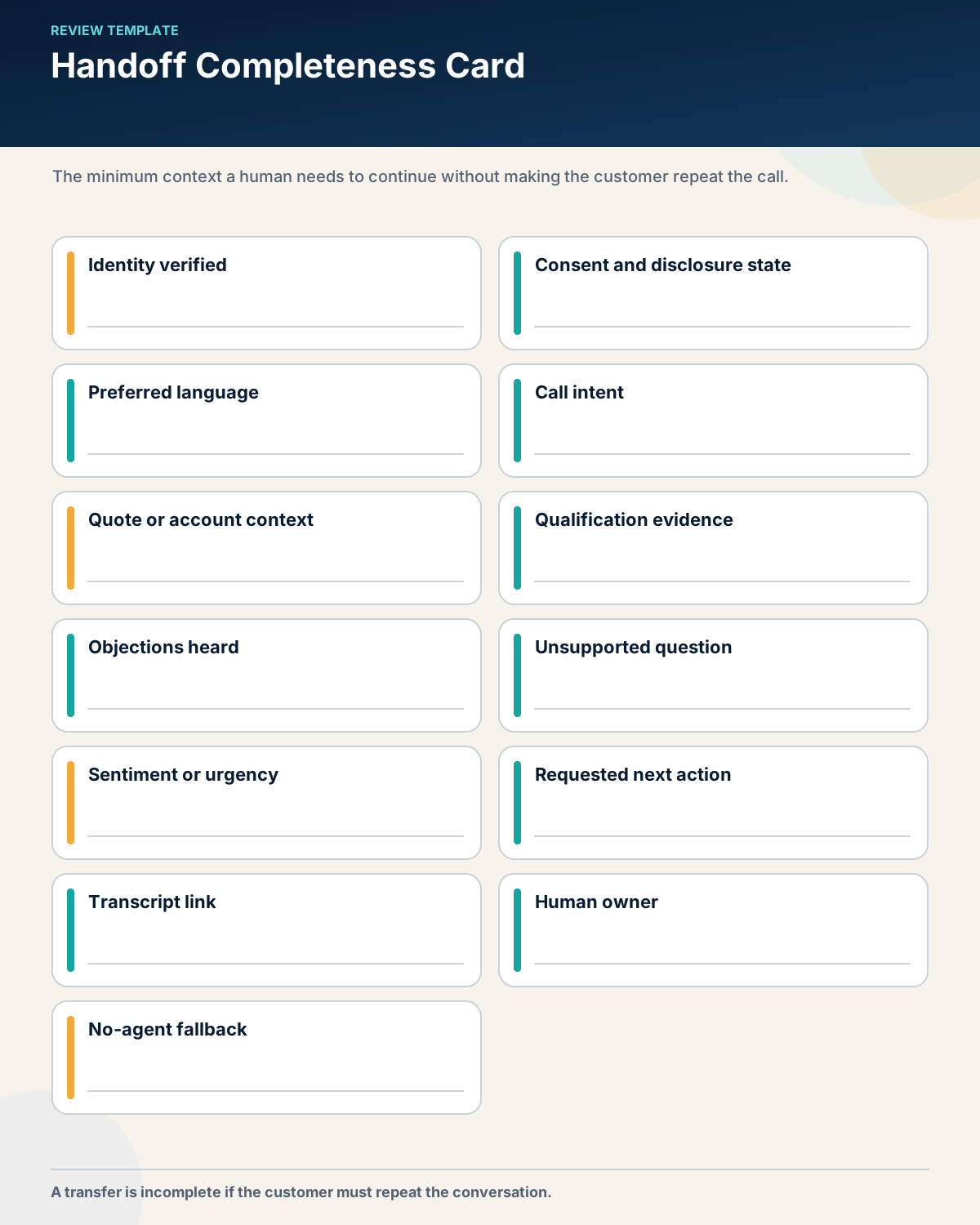
Build a complete human-handoff contract
- verified identity and account;
- consent and disclosure state;
- preferred language;
- call purpose;
- quote, product or account context;
- qualification evidence;
- objections and approved answers already used;
- unsupported or unresolved question;
- requested next action;
- transcript or recording link where lawful;
- attempted tool actions and results;
- human owner and fallback state.
12 / Model cost per completed disposition
Model cost per completed disposition
- platform and concurrency plan;
- telephone numbers, SIP or carrier charges;
- connected time and any minimum attempt charge;
- speech recognition, model and voice-provider usage;
- recording, transcript, storage and retention;
- CRM, calendar and workflow infrastructure;
- implementation, language QA and legal review;
- human monitoring, exception work and live transfers;
- failed attempts, duplicate cleanup and incident remediation.
13 / Pilot the voice agent
Pilot the voice agent
- Define the call job, population and legal review.
- Freeze knowledge, claims, tools and transfer rules.
- Create a human answer key for qualification and dispositions.
- Test in simulation and internal calls first.
- Include normal, missing, contradictory and adversarial cases.
- Test target languages and dialects with qualified speakers.
- Test interruption, silence, background noise and code-switching.
- Test voicemail, no answer, busy, transfer failure and dropped call.
- Review every call in the first live sample.
- Promote one use case or permission at a time.
- eligible-call completion;
- correct disclosure and suppression behavior;
- transcription or entity errors affecting outcome;
- turn latency by defined stage and percentile;
- interruption recovery;
- unsupported or materially incorrect response rate;
- correct disposition;
- clean-handoff rate;
- booked, held and sales-accepted meeting rates;
- complaint and opt-out outcomes;
- total cost per accepted outcome.
14 / Stop conditions
Stop conditions
- the workflow cannot prove permission or suppression;
- a human request does not stop autonomous handling;
- the agent makes a severe unsupported claim;
- a language change repeatedly causes an unacceptable failure;
- transfer context is incomplete or reaches the wrong owner;
- call state becomes uncertain after a provider error;
- recording or retention differs from the approved policy;
- duplicate or out-of-window calls occur;
- the audit trail is missing.
15 / Frequently asked questions
Frequently asked questions
What is an AI voice sales agent?
Are AI sales calls legal?
Can a voice agent switch languages during a call?
What is a good voice-agent latency?
Should the agent handle objections?
What happens when no human answers a transfer?
16 / Go/no-go checklist
Go/no-go checklist
- The call population and permission source are recorded.
- Market, sector, disclosure, DNC, time, recording and retention rules were reviewed.
- The phone number and provider are approved for the geography.
- The target language and dialect passed a defined test set.
- Approved claims and prohibited topics are explicit.
- Tool actions use schemas, validation and idempotency.
- The agent stops on opt-out, human request and uncertainty.
- Dispositions have clear definitions.
- The handoff packet and no-answer fallback are tested.
- Logs preserve versions, evidence, actions and outcomes.
- Warning, stop, rollback and re-entry owners are named.
Research note
Methodology
- 01The guide combines current official legal and product sources with an anonymized owner-supplied MENA/GCC insurance workflow.
- 02NextLevel.AI is disclosed as the affiliated operating platform; the workflow is not presented as an independent product test.
- 03Legal discussion is jurisdiction-bounded operational information, not legal advice; exact deployments require current local and sector review.
Source ledger
Sources & editorial notes
- 01FCC's artificial-voice ruling summary
Federal Communications Commission · Primary, official or disclosed research source used for the bounded claim cited in this guide; scope and current status require rechecking.
- 02UAE Ministry of Economy legislation listings
moec.gov.ae · Primary, official or disclosed research source used for the bounded claim cited in this guide; scope and current status require rechecking.
- 03TDRA FAQs
UAE Telecommunications and Digital Government Regulatory Authority · Primary, official or disclosed research source used for the bounded claim cited in this guide; scope and current status require rechecking.
- 04Saudi PDPL Implementing Regulation
Saudi Data & AI Authority · Primary, official or disclosed research source used for the bounded claim cited in this guide; scope and current status require rechecking.
- 05NextLevel.AI
NextLevel.AI · Primary, official or disclosed research source used for the bounded claim cited in this guide; scope and current status require rechecking.
- 06Bland AI
Bland AI · Primary, official or disclosed research source used for the bounded claim cited in this guide; scope and current status require rechecking.
- 07Vapi
Vapi · Primary, official or disclosed research source used for the bounded claim cited in this guide; scope and current status require rechecking.