
Pillar guide · AI prospecting
AI Lead Generation: How to Build a B2B Workflow That Produces Qualified Opportunities
AI may assist research organization and drafting. A human editor reviews every published page, checks material claims against the cited sources and owns the final decision. No company paid for placement in this article.
AI use policyAgent-ready brief
AI takeaways
Keep the key points here, or take a source-aware text brief into Claude, ChatGPT or another AI workspace.- 01Define the commercial event that counts as qualified before adding AI to the workflow.
- 02Keep source evidence, AI suggestion, human approval, external action and CRM outcome separate and traceable.
- 03Review the first records, messages, sends, replies and qualification decisions before increasing automation.
- 04Measure qualified outcomes first; use connection, reply and efficiency metrics to diagnose the workflow.
- 05Treat tools as replaceable workflow components and stop when evidence, permission or control is insufficient.
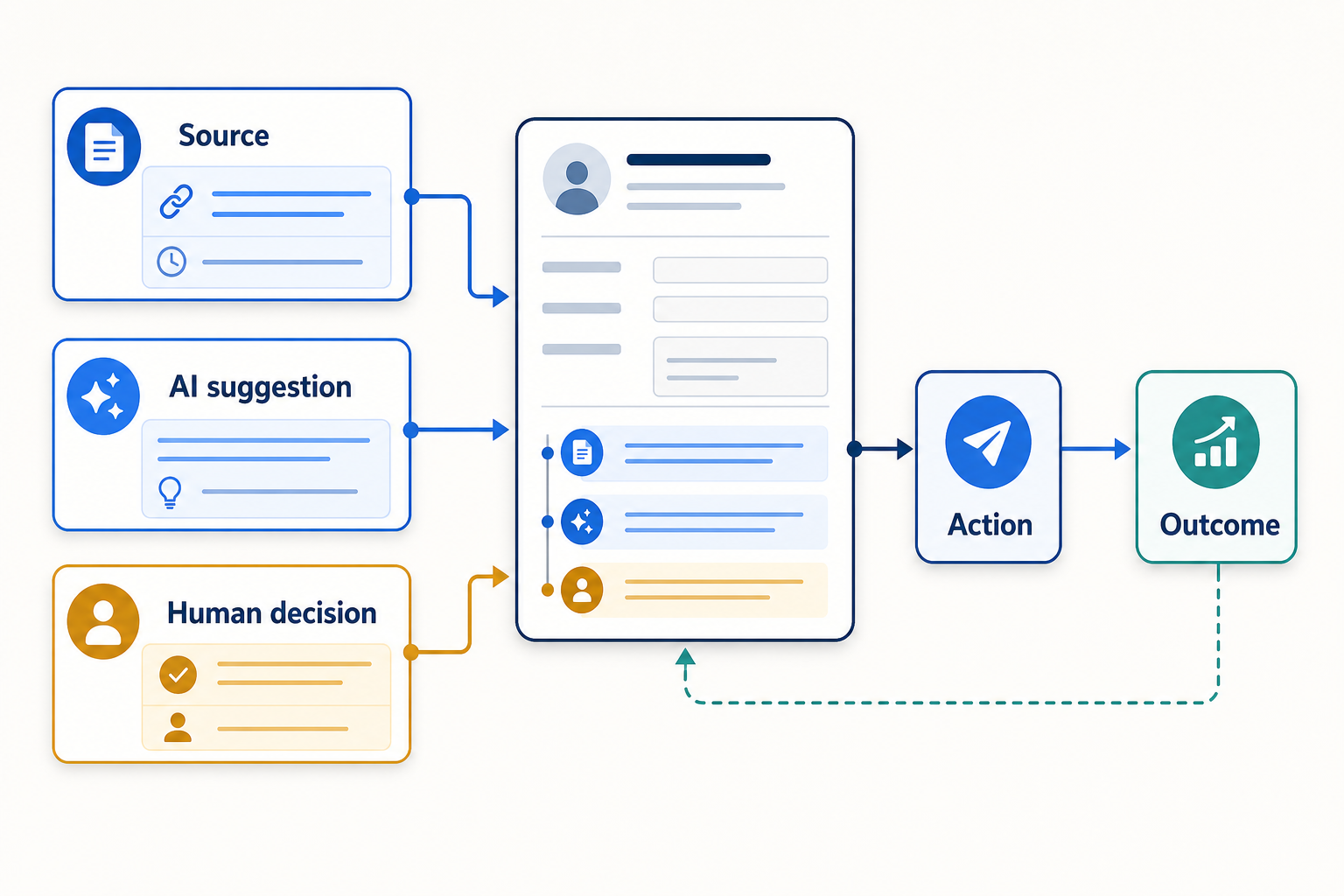
Source → AI suggestion → Human gate → Action → CRM record → Revenue outcome
01 / Definitions
What AI lead generation is—and what it is not
| Term | Operational meaning in this guide | What it does not prove |
|---|---|---|
| Contact | A person or account record that may enter research | Fit, interest or permission to contact |
| Fit-qualified record | A record that passes documented account and contact criteria | Current buying intent |
| Positive reply | A response that moves the conversation forward | That the buyer has seen the full offer and price |
| Interested after pitch | A response showing interest after the value proposition was presented | A qualified opportunity under a stricter commercial rule |
| Qualified outbound opportunity | The first positive response after the core offer and price have been presented | A closed deal or revenue |
| Qualified inbound lead | A submission from an offer-aware page or CTA whose context already implies intent | That every form submission deserves sales time |
02 / Revenue Trace
The Revenue Trace: where AI fits in a B2B lead-generation workflow
| Stage | Input | AI contribution | Human decision | CRM evidence | Useful outcome |
|---|---|---|---|---|---|
| Define | Market, offer and sales process | Organize criteria and edge cases | Approve ICP and qualification rule | Rule version and owner | Consistent acceptance decision |
| Source | Permitted account and contact sources | Find or normalize candidates | Approve source and target set | Source URL/system and retrieval date | Reviewable account sample |
| Enrich | Thin account/contact records | Add or refresh decision-relevant fields | Accept, reject or leave unknown | Field source and freshness | More complete records without hidden assumptions |
| Score | Fit, timing and evidence fields | Rank and explain | Override or approve recommendation | Component scores and reviewer | Better prioritization, not automatic qualification |
| Brief | Verified public and company-owned evidence | Summarize facts and label inferences | Confirm the reason to contact | Evidence links and unresolved gaps | Defensible account context |
| Draft | Approved brief and real offer | Draft channel-appropriate variants | Edit and approve final wording | Message version and hypothesis | Relevant external action |
| Qualify | Reply, form context or call result | Classify and suggest route | Confirm disposition and next step | Human decision and reason | Qualified conversation or nurture path |
| Learn | Outcomes and exceptions | Surface patterns | Update, limit or retire the rule | Change log and outcome | Better next decision |
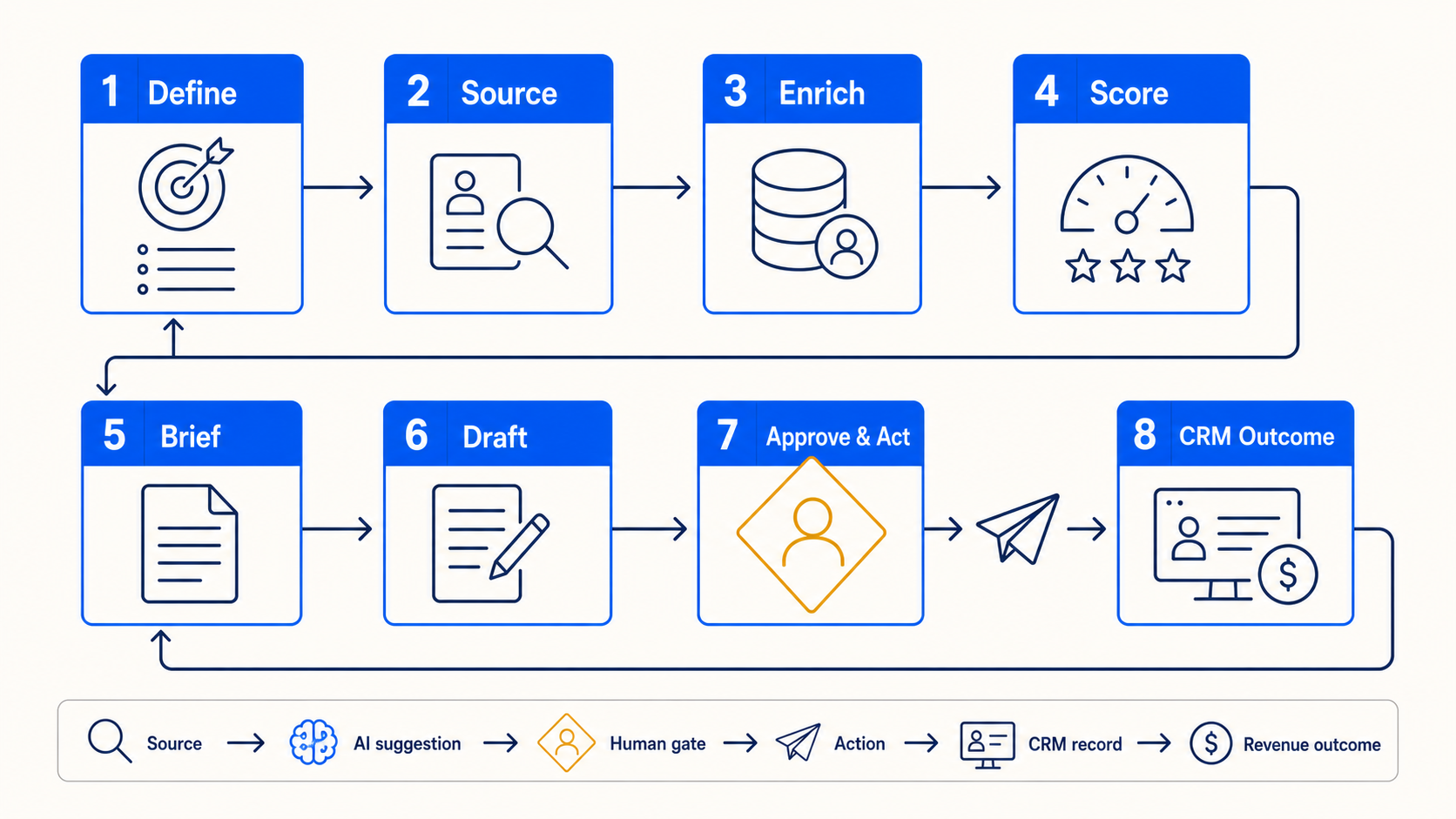
1. Define the ICP, buying situation and qualification rule
2. Find accounts and contacts from permitted sources
3. Enrich and verify the account record
Unknown is a valid state. A blank phone number is less damaging than a wrong number treated as verified. A previous job title should not become a reason to contact someone at a company they left.4. Score fit, timing and evidence separately
- Fit score: how closely the account and contact match the approved profile.
- Timing score: whether a current, observable situation makes the conversation relevant now.
- Evidence confidence: whether the source is current, attributable and strong enough to support an action.
qualified across every funnel stage.5. Build a source-linked account brief
6. Draft outreach from one verified reason to contact
no chat widget detected during review. We did not use the absolute claim you have no chatbot. If the check was uncertain, the message lost that line.7. Qualify, route and nurture with visible human gates
| Observable event | Appropriate state | Human question |
|---|---|---|
| Accepted connection | Connected | Is there a reason to start a conversation? |
| Generic reply | Replied | Did the response move the offer forward? |
| Interest after the pitch | Interested after pitch | Has the buyer also seen the price and accepted a next step? |
| Positive response after offer and price | Qualified outbound opportunity | Who owns the next commercial action? |
| Submission from an offer-aware page | Qualified inbound lead under the page rule | Does the submission meet routing and exclusion criteria? |
| “Not now” with a defined timing signal | Nurture | What event and date should trigger review? |
8. Write decisions and outcomes back to CRM
03 / Build the workflow
How to build a human-gated AI lead-generation workflow
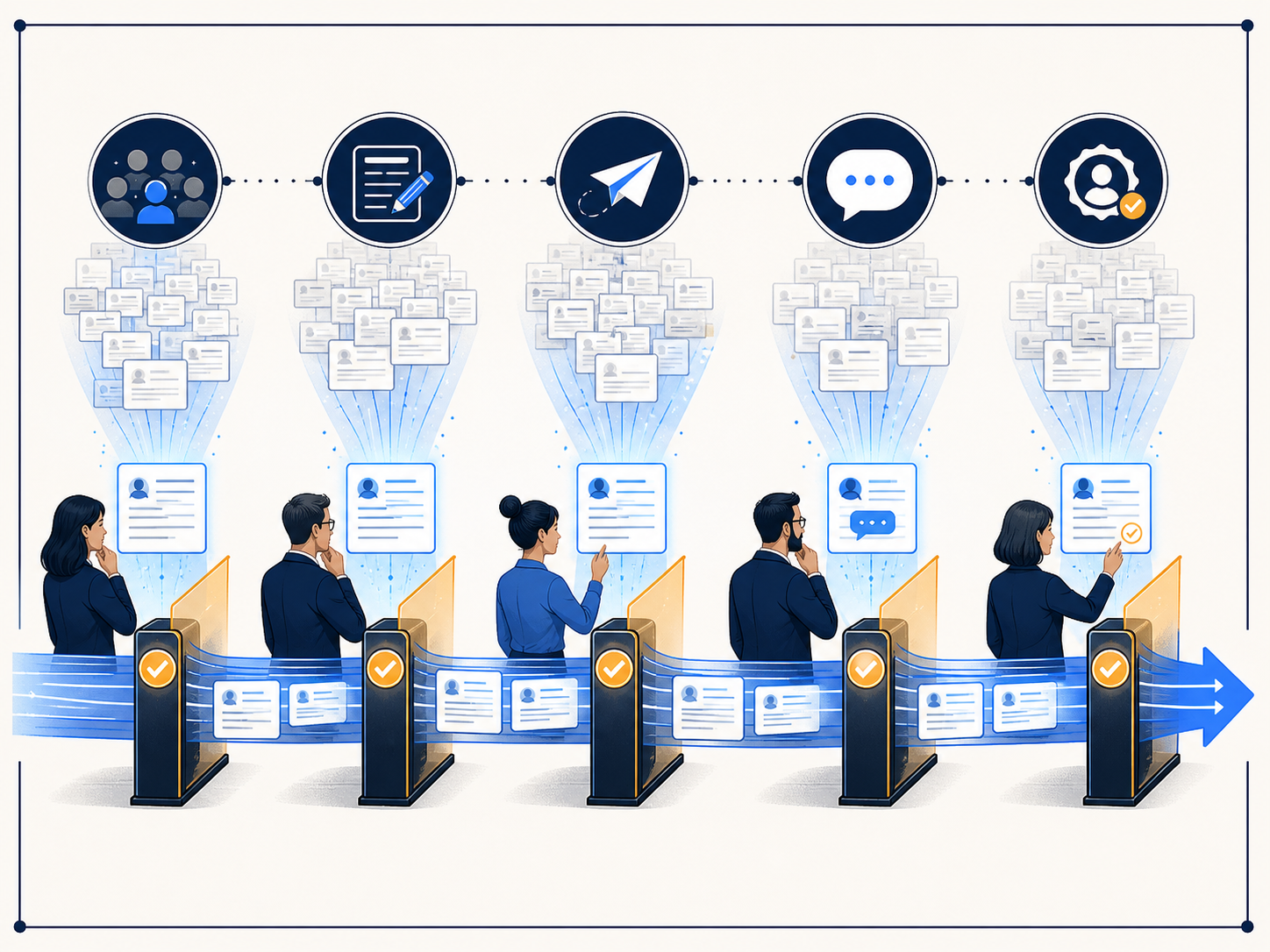
Choose one operating decision and establish a baseline
Write source, freshness and evidence rules before selecting a tool
Generate or enrich a controlled account sample
What I checked in a 23-record pilot before allowing scale
| Check | Control used in the pilot | Stop or correction rule |
|---|---|---|
| Company identity | Use only a real, verified company domain | Do not invent a domain or import an unresolved company |
| Contact identity | Match the enriched name and company to a current LinkedIn profile | No verified profile or a company mismatch stops the contact |
| Competitive fit | Compare the company offer with the campaign's exclusion list | Exclude companies already selling a directly competing voice AI product |
| Vertical and offer fit | Read the company's services, customer examples and project descriptions when available | Keep missing context unknown; do not manufacture a use case |
| Website chat state | Run a script-level check and inspect the visible site | Mention only that no widget was detected during review; remove the claim if uncertain |
| Message constraints | Draft each step from the verified record and run a 290-character internal ceiling for LinkedIn invitations | Shorten, correct or reject before the sequence is approved |
Rank recommendations without hiding the reason
| Field | Example value |
|---|---|
| Fit | 8/10: approved industry, region and company size |
| Timing | 6/10: relevant hiring event, but no confirmed project |
| Evidence | 9/10: current first-party company source |
| AI suggestion | Review for outbound |
| Human decision | Approve, reject or research |
| Reason | Required free-text or coded disposition |
Require seller review before any external action
Execute through an approved channel
Record dispositions, exceptions and outcomes
Update or retire the rule based on evidence
04 / Tool selection
AI lead-generation tools by workflow stage
| Workflow stage | Tool job | Questions to ask | Example categories |
|---|---|---|---|
| Data and enrichment | Find, verify or refresh fields | What is the source, freshness and conflict rule? | Prospecting databases, enrichment waterfalls, validation services |
| Lead intelligence and intent | Surface relevant changes or signals | Can a seller reopen the evidence? | Company intelligence, first-party behavior, licensed intent data |
| Scoring and qualification | Rank and route records | Are components visible and overrideable? | CRM scoring, predictive models, rule engines |
| Research and personalization | Create a source-linked brief or draft | Which facts are allowed, and who approves? | AI workspaces, coding agents, sales copilots |
| Outreach and nurturing | Execute approved channel actions | Are previews, limits, suppressions and stop rules visible? | Sequencing tools, task systems, marketing automation |
| CRM and measurement | Preserve decisions and outcomes | Does write-back separate suggestion, approval and result? | CRM, warehouse and revenue analytics |
Data and enrichment systems
Lead-intelligence and intent systems
Scoring and qualification systems
Research and personalization systems
Outreach and nurturing systems
CRM, routing and measurement systems
05 / Human review
What a seller or RevOps owner must still review
Account fit and current buying situation
Source accuracy, freshness and unsupported inference
Message claims, tone and proportionality
Qualification, routing and next action
06 / CRM evidence
What belongs in the CRM
Source, timestamp and reason-to-contact fields
Model suggestion, reason, reviewer and approval state
Message hypothesis, channel and external action
Outcome, disqualification reason and next-review trigger
| CRM field | Example | Owner | Why it matters |
|---|---|---|---|
| Source record | Company announcement URL | Research workflow | Lets a reviewer reopen the evidence |
| Retrieved at | 2026-08-11 | Research workflow | Supports freshness checks |
| Fit / timing / evidence | 8 / 6 / 9 | Scoring workflow | Preserves score components |
| AI suggestion | Review for outbound | AI workflow | Records what the system recommended |
| Human decision | Approved with edit | Seller | Keeps accountability visible |
| Decision reason | Role verified; timing claim softened | Seller | Creates usable feedback |
| Message version | OUT-ICP2-V3 | Outreach owner | Connects result to the tested hypothesis |
| External action | Email sent | Execution system | Distinguishes draft from action |
| Disposition | Interested after pitch | Seller | Preserves the observed stage |
| Qualified opportunity | No / not yet assessed | Sales owner | Prevents premature pipeline inflation |
| Next review | After pricing response | Sales owner | Makes the next decision explicit |
07 / Measurement
How to measure whether AI lead generation works
Primary outcomes: qualified conversations, accepted leads and opportunities
Diagnostic metrics: validity, approval, rejection, response and meeting rates
| Metric | Formula | What it diagnoses | What it cannot prove |
|---|---|---|---|
| Record validity rate | Valid records ÷ records reviewed | Data quality | Buyer interest |
| Seller approval rate | Records approved ÷ records reviewed | Fit and evidence quality | Message effectiveness |
| Rejection rate | Records rejected ÷ records reviewed | Rule or source problems | That every rejected record was bad |
| Connection acceptance rate | Accepted invitations ÷ invitations actually sent | Channel/list relevance | Qualified opportunity creation |
| Reply rate | Unique contacts replying ÷ delivered or sent contacts, defined in advance | Message/list response | Positive commercial intent |
| Interested-after-pitch rate | Interested responses ÷ contacted records | Offer engagement | Price acceptance or opportunity |
| Qualified-opportunity rate | Qualified opportunities ÷ contacted records | Commercial result | Closed revenue |
| Meeting-held rate | Held qualified meetings ÷ contacted records | Conversation progression | Opportunity quality or revenue |
An anonymized first-hand campaign funnel
| Stage shown | Count | Share shown | Correct interpretation |
|---|---|---|---|
| Records analyzed | 7,520 | 100.0% | Starting records evaluated by the fit process |
| Records rejected | 5,899 | 78.4% | Records removed before campaign activation |
| Records retained as fit-qualified | 1,627 | 21.6% | Records that passed pre-campaign scoring, not qualified opportunities |
| Opened | 605 | 37.2% | Recorded opens; a diagnostic activity signal |
| Interaction | 284 | 17.5% | Campaign-defined engagement state |
| Replied | 58 | 3.6% | Replies under the campaign record |
| Interested after pitch | 14 | 0.9% | Interest after the offer pitch; price exposure is not confirmed |
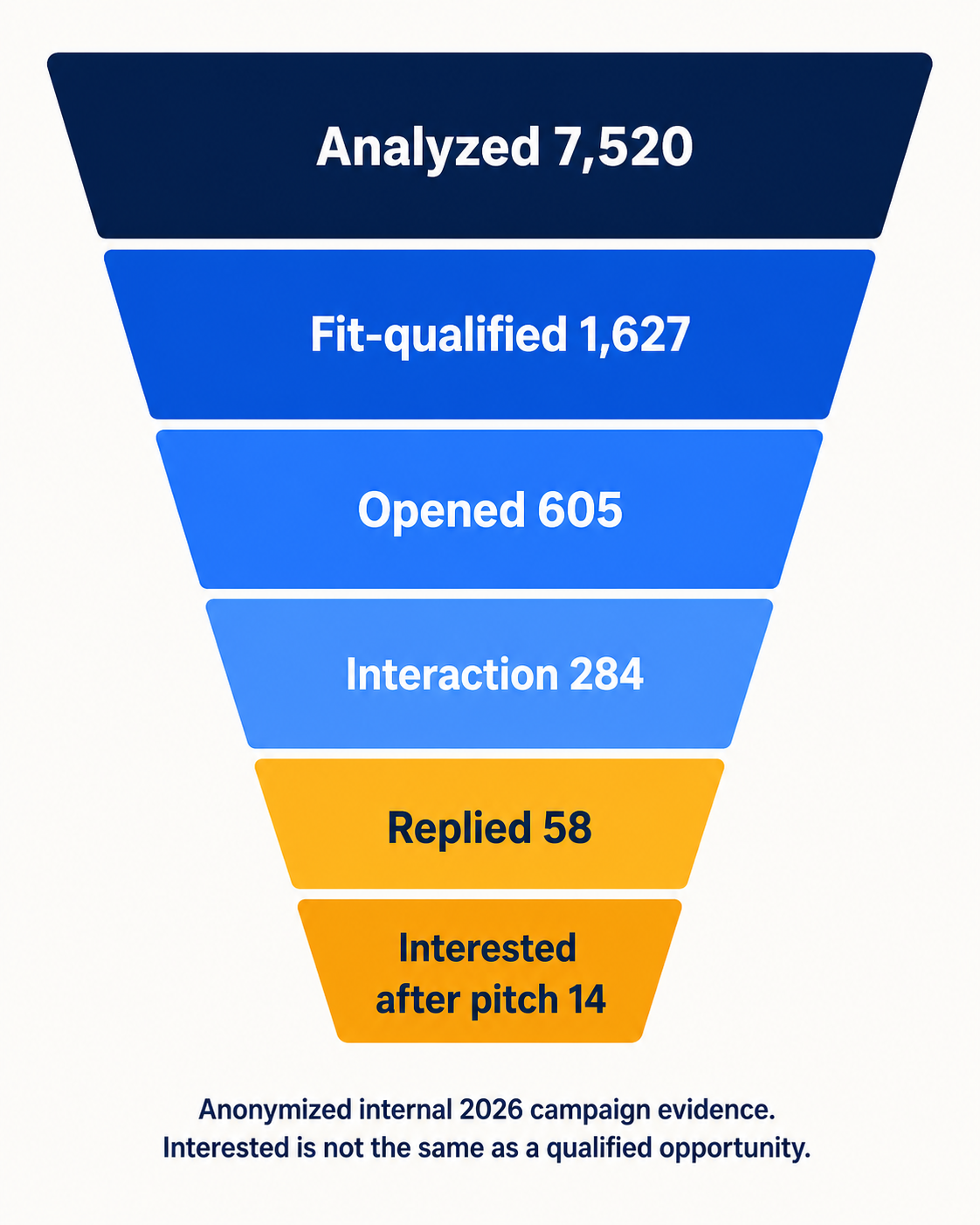
What the comparison suggests—and what it cannot establish
Efficiency metrics: time and cost per reviewed account
Baseline, sample, period and attribution limits
08 / Risk controls
Failure modes, compliance and operating risk
| Failure mode | Observable signal | Human control | Stop rule |
|---|---|---|---|
| Weak or stale data | Wrong role, duplicate or missing source | Reopen source and sample records | Pause when repeated errors exceed the team’s accepted threshold |
| False personalization | Claim cannot be traced | Seller removes or rewrites it | No source, no personalized claim |
| Biased or opaque scoring | Segment rejected for unexplained reasons | Audit components and overrides | No automatic exclusion without a reviewable reason |
| Unauthorized platform action | Tool automates restricted behavior | Check current official terms | Disable the action until permitted use is confirmed |
| Commercial-email noncompliance | Missing sender identity or opt-out process | Compliance and operations review | Do not launch until required controls work |
| Activity without pipeline | Sends rise while qualified outcomes do not | Compare segment outcomes | Do not scale based on activity metrics alone |
Weak or disconnected source data
False personalization and fabricated buying signals
Biased scoring and invisible exclusions
Unauthorized scraping or automated engagement
Commercial-email, deliverability and consent risk
Activity growth without pipeline improvement
09 / Pilot plan
A practical pilot plan for a B2B revenue team
Scope one ICP, one signal, one owner and one channel
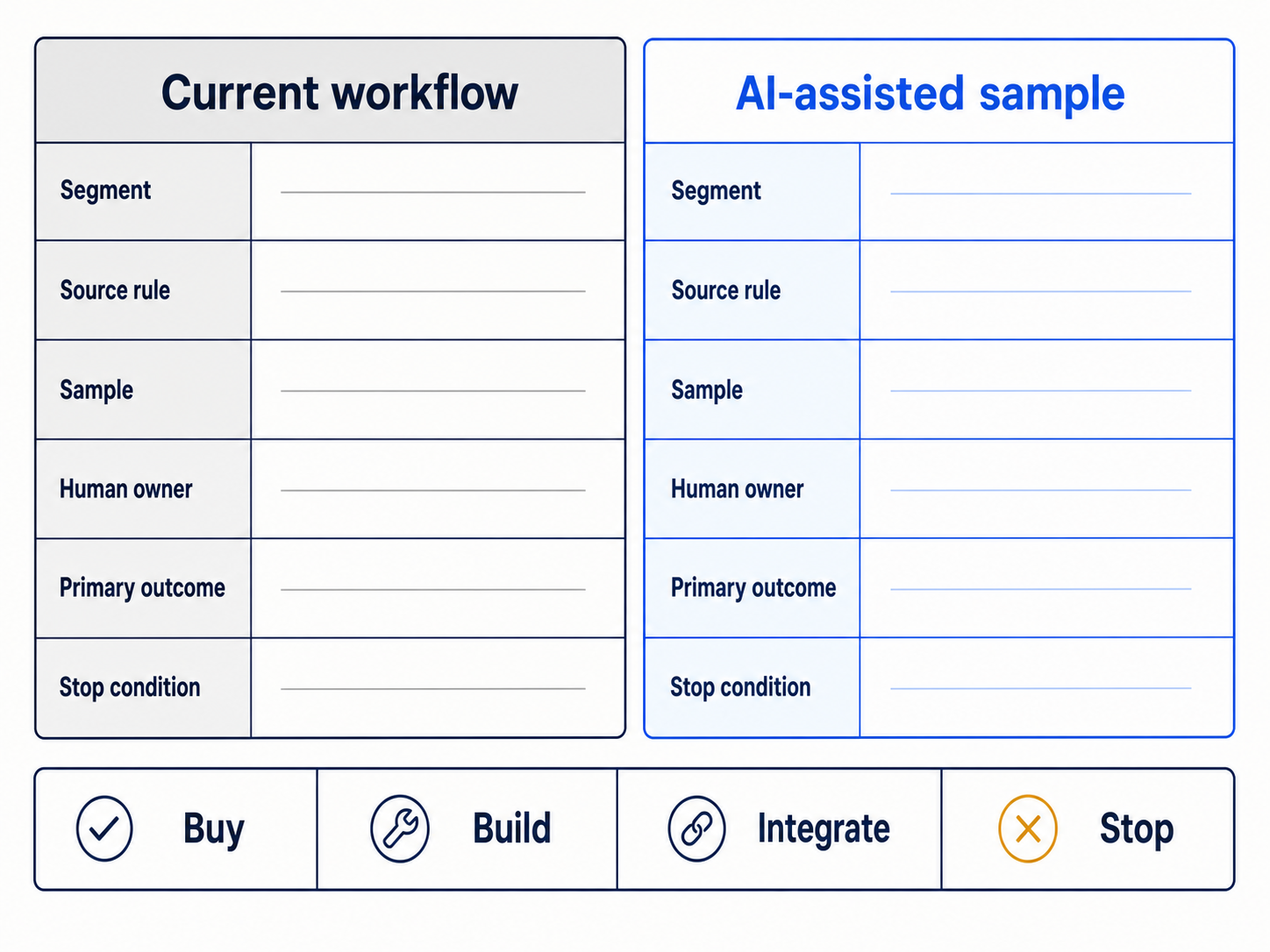
Compare a controlled AI-assisted sample with the current workflow
| Pilot field | Current workflow | AI-assisted sample |
|---|---|---|
| Segment | Same documented segment | Same documented segment |
| Source rule | Current permitted sources | Same sources unless source is the tested variable |
| Sample | Defined unique accounts/contacts | Comparable unique accounts/contacts |
| Human owner | Named reviewer | Same reviewer or controlled assignment |
| Message/offer | Current approved offer | Same offer; documented drafting change |
| Primary outcome | One defined qualified event | The same qualified event |
| Diagnostic metrics | Validity, approval, reply | Same formulas and denominators |
| Stop condition | Existing risk limit | Predefined error, policy or quality limit |
Review exceptions before increasing automation
Decide whether to buy, build, integrate or stop
- Buy when a product covers the required workflow, evidence and controls with less operating cost than a custom system.
- Build when the decision logic or data boundary is proprietary and the team can own maintenance, security and evaluation.
- Integrate when existing systems cover the stages but need a controlled handoff and CRM write-back.
- Stop when the baseline is undefined, the source is not permitted, evidence quality is too weak or the workflow does not improve a revenue-relevant decision.
10 / Checklist
AI lead-generation checklist
Before launch
- Define the ICP and at least one observable buying situation.
- Define
contact,fit-qualified,reply,interestedandqualified opportunityfor this workflow. - Choose one primary outcome closer to revenue than activity volume.
- Record permitted sources, freshness rules and prohibited inferences.
- Decide which fields enrichment may add or overwrite.
- Separate fit, timing and evidence confidence.
- Require a source link for every material reason to contact.
- Name the human owner for the first lead batch, first message, first send, first reply and first qualification decision.
- Map the AI suggestion, human decision, action and outcome to separate CRM fields.
- Define numerators, denominators, sample and observation period.
- Configure suppressions, opt-outs, duplicate handling and channel limits.
- Set stop conditions before seeing the results.
After the first run
- Review rejected records and categorize repeated failure reasons.
- Check whether sellers can reopen the evidence behind approved messages.
- Compare outcomes by segment, source, signal and message hypothesis.
- Separate all replies from positive replies and qualified outcomes.
- Measure verification and review time, not generation time alone.
- Confirm that CRM write-back preserved both the model suggestion and human override.
- Check that no missing downstream state was silently converted into success.
- Recheck current platform and legal requirements before expanding channels.
- Update, narrow or retire rules that create noise.
11 / FAQ
Frequently asked questions
What is AI lead generation?
How do you use AI for lead generation in B2B?
Can AI generate qualified leads automatically?
What is the difference between AI lead generation and marketing automation?
What is the difference between an AI lead generator and an AI SDR?
Which parts of lead generation should not be fully automated?
What data does an AI lead-generation system need?
What should an AI lead-generation tool write to the CRM?
How should a team measure AI lead generation?
Are AI-generated leads accurate?
12 / Evidence limits
First-hand evidence and limitations
interested; call, contract and customer outcomes were blank. The owner-reported comparison with the earlier workflow lacks raw matched before-and-after rates, so it is presented as a directional observation rather than a benchmark or causal result.Research note
Methodology
- 01Define contact, fit-qualified, interested and qualified-opportunity states before interpreting activity.
- 02Use official documentation for vendor capabilities, platform rules and US commercial-email requirements.
- 03Attribute the workflow and anonymized internal 2026 campaign evidence to Anastasiia Krynytska.
- 04Keep the 500-plus discovery pool, 23-record reviewed pilot and historical campaign funnel separate.
- 05Treat the reported connection and reply comparison as directional because matched raw baselines were unavailable.
- 06Keep missing calls, contracts, customers, time and cost outcomes blank rather than inferring success.
Source ledger
Sources & editorial notes
- 01State of Sales, 7th edition
Salesforce, 2026 · Vendor-published survey of 4,050 sales professionals; used for current data-quality and system context, not independent proof of product outcomes.
- 022026 Work Trend Index
Microsoft · Survey of 20,000 AI-using knowledge workers across 10 markets plus Microsoft telemetry; operating-model context, not sales-specific conversion evidence.
- 03CAN-SPAM Act: A Compliance Guide for Business
US Federal Trade Commission · US regulator guidance for commercial email, including B2B email; requirements should be rechecked near use.
- 04LinkedIn User Agreement
LinkedIn · Official platform agreement and responsibility for AI-generated content.
- 05Prohibited software and extensions
LinkedIn Help · Official restrictions on scraping and unauthorized automation on LinkedIn.
- 06Waterfalls
Clay documentation · Official capability documentation for sequential enrichment providers.
- 07Enrichment Overview
Apollo documentation · Official documentation for saved-record, CRM, form, scheduled and API enrichment.
- 08Claude Code documentation
Anthropic · Official product documentation; the workflow description is based on author use, not a vendor performance claim.
- 09Create a lemlist campaign
lemlist documentation · Official documentation for importing leads, reviewing a campaign and launching supported steps.
- 10Luck My Sales methodology
Luck My Sales · Evidence states, source treatment, freshness and correction protocol.
- 11Luck My Sales AI use policy
Luck My Sales · Permitted AI assistance and required human review.